

logo elektroda
logo elektroda
X
logo elektroda

Interior of three-level touch dimmer for bedside lamp - TT6061

p.kaczmarek2 882 5

TL;DR

  • A TT6061-based three-level touch dimmer module for a bedside lamp switches between low, medium, high, and off by sensing touches on the metal housing.
  • Inside, a mostly SMD double-sided board uses a TT6061 controller and a tiny 97A6 W401 triac to chop the 230 V mains line.
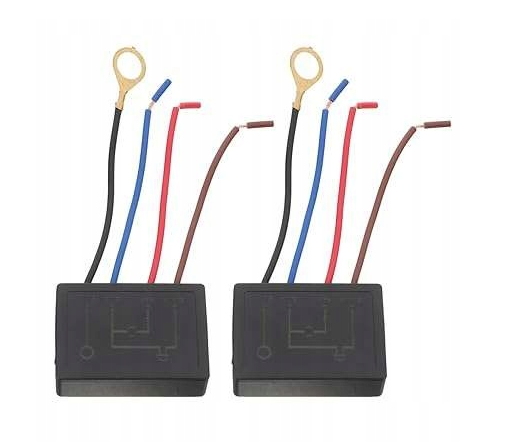
  • The module cost £25 for two units in a Polish online shop, plus shipping.
  • The circuit uses phase-angle control: the triac fires immediately for full brightness or after a delay for dimmed levels, then turns off at the zero crossing.
  • The design works with incandescent bulbs and dimmable LEDs, but LED lamps with capacitive input can eventually damage the triac.
Generated by the language model.
ADVERTISEMENT
This content has been translated flag-pl » flag-en View the original version here
📢 Listen (AI):
  • Interior of three-level touch dimmer for bedside lamp - TT6061
    Today, another curiosity from online shops - a touch dimmer controller module for a bedside lamp. The whole thing works with classic incandescent bulbs and with LEDs designed for dimmers. The principle of operation is simple - one of the wires is connected to the metal housing of the lamp and it fulfils the role of a touch button, whose separate presses switch successive brightness levels - low, medium, high, and the lamp's off state.

    I have shown a similar gadget before:
    Touch bedside lamp with three brightness levels - interior, module, DIY

    Let's start with the price. I was able to buy two of these modules from a Polish online shop for £25, but you still had to add shipping.
    Interior of three-level touch dimmer for bedside lamp - TT6061
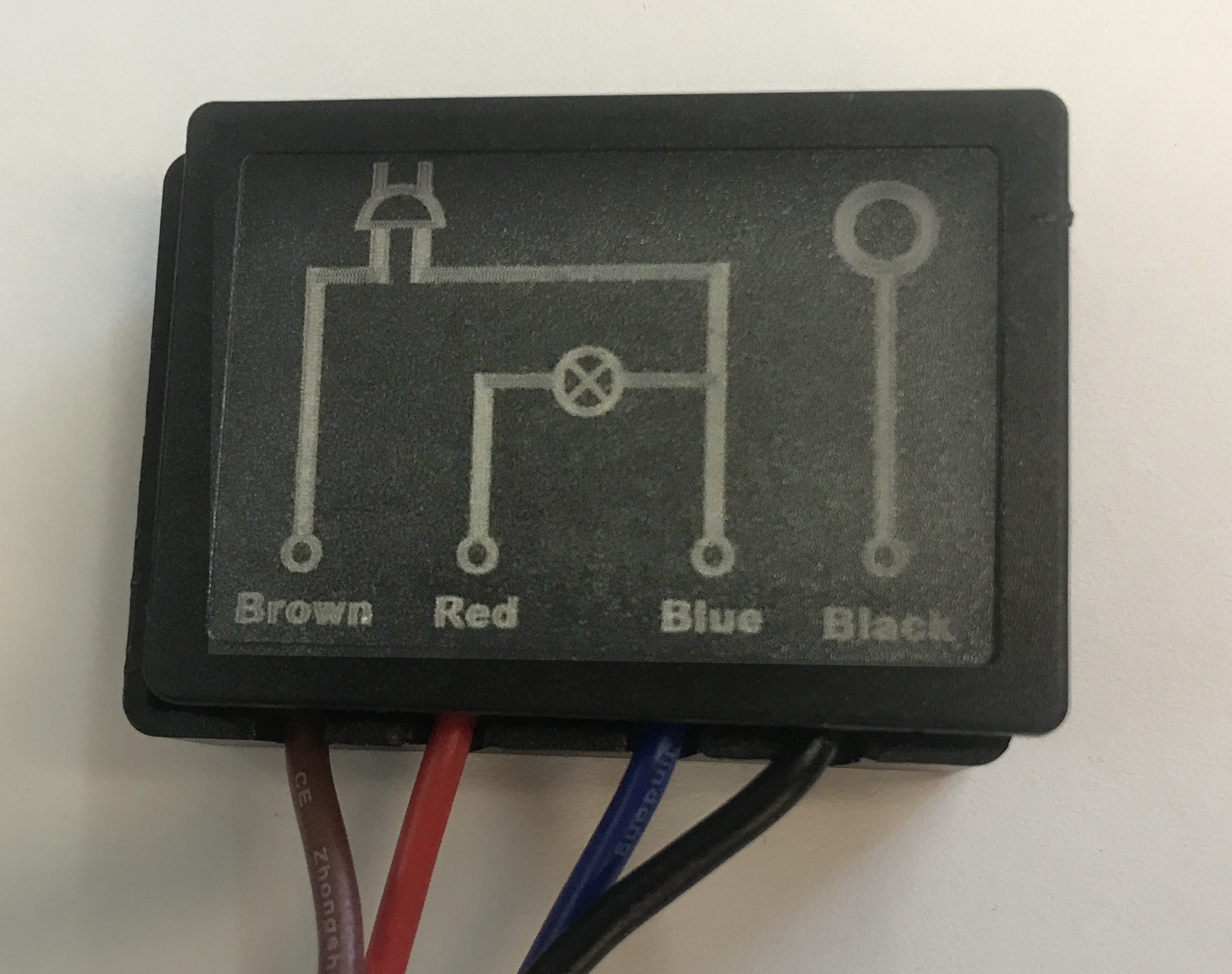
    Assembly of the unit is very simple. It is illustrated by the diagram on the housing.
    Interior of three-level touch dimmer for bedside lamp - TT6061
    The black cable connects to the lamp housing, which is the touch button. However, it is time to look inside:
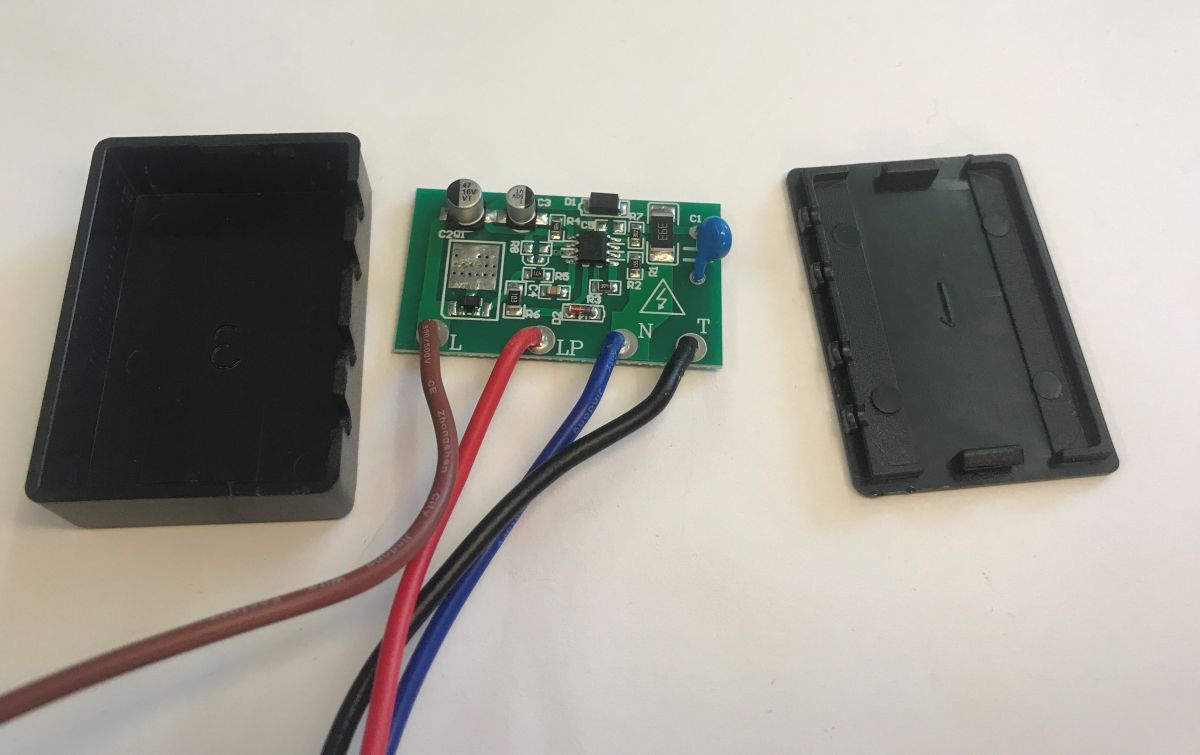
    Interior of three-level touch dimmer for bedside lamp - TT6061
    Inside is a single double-sided board, almost entirely based on surface mount - only the CY capacitor is mounted in a through-hole manner.
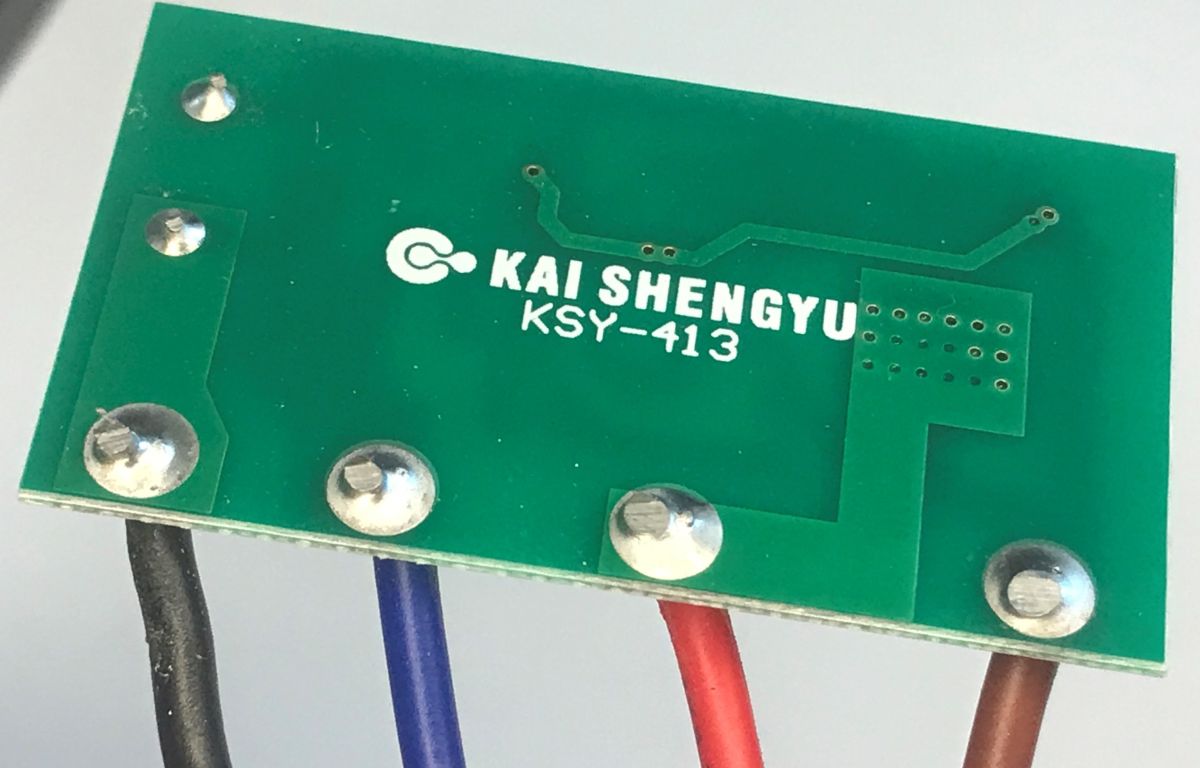
    Interior of three-level touch dimmer for bedside lamp - TT6061
    The module is based on the TT6061 chip:
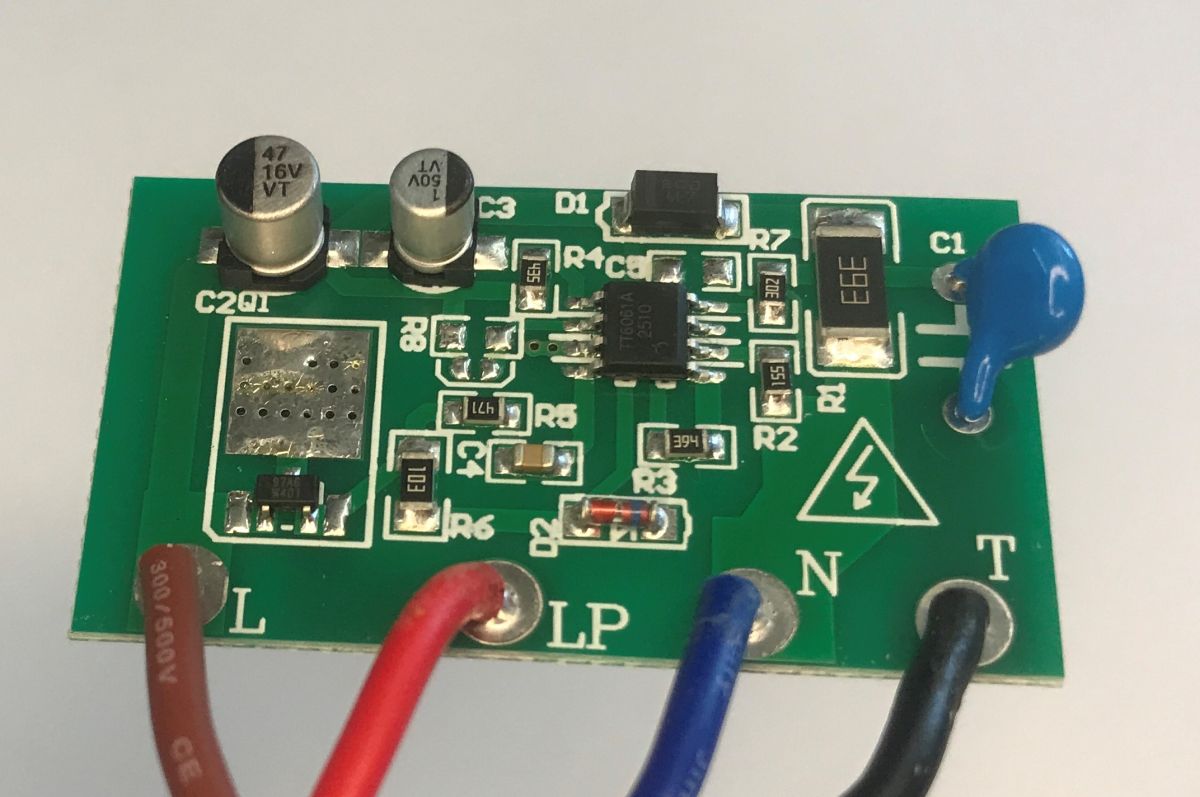
    Interior of three-level touch dimmer for bedside lamp - TT6061
    A 97A6 W401 triac, here very tiny and surface mounted, is used to cut the 230 V line. The board was also designed with a larger triac in mind, as you can see the manufacturer is optimising costs:
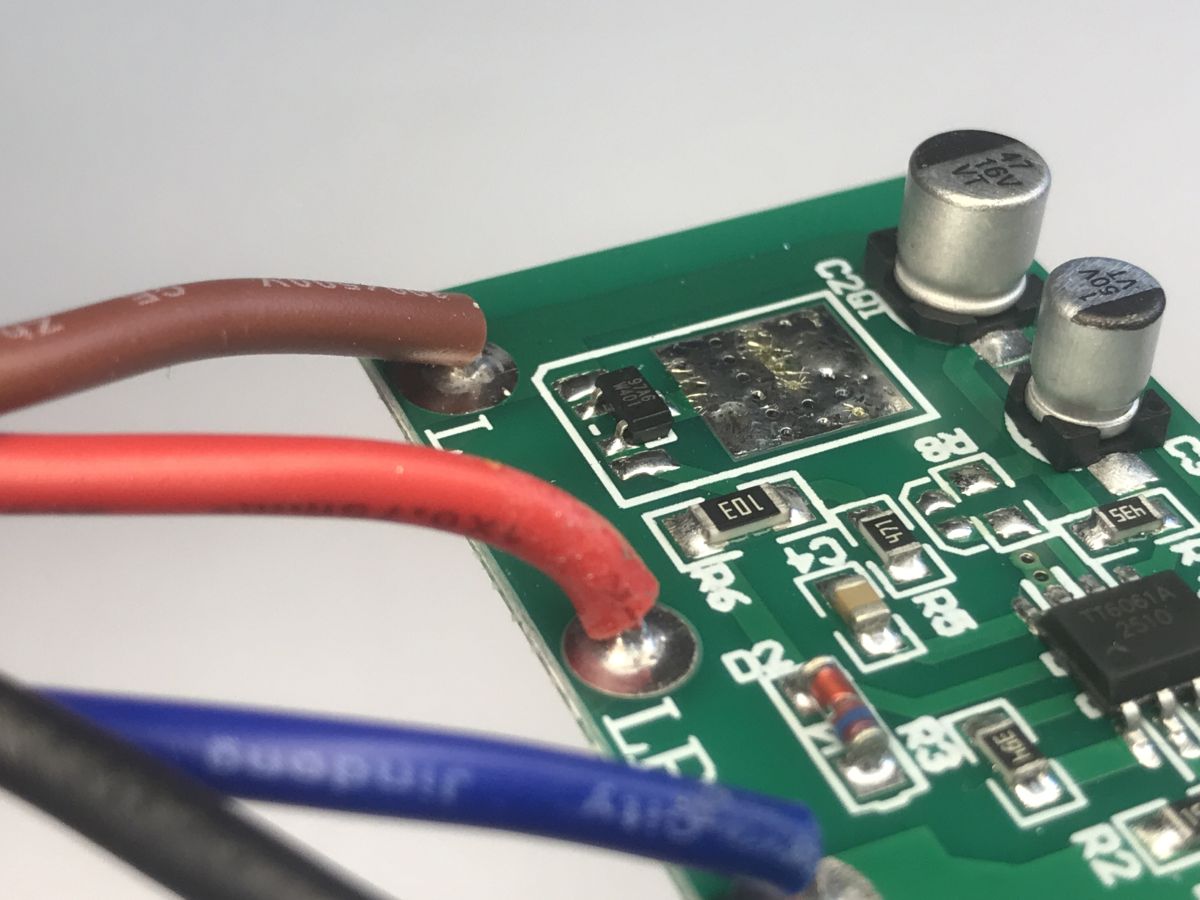
    Interior of three-level touch dimmer for bedside lamp - TT6061
    Could it be a MAC97A6 or similar? 600 mA, 400 V.
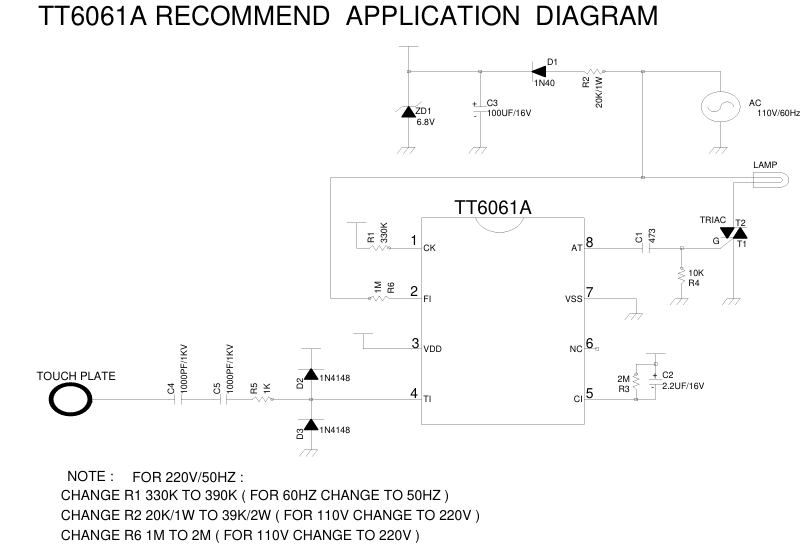
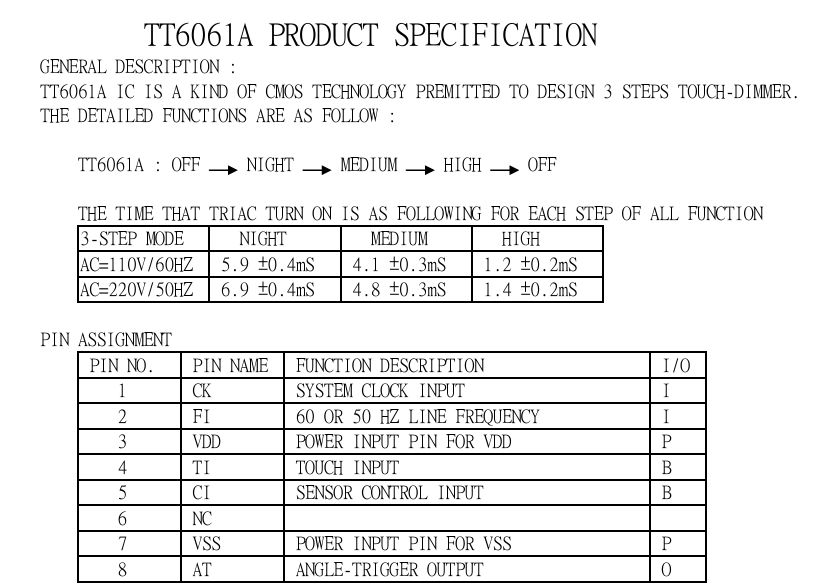
    Finally, most importantly, the TT6061 documentation and application note:
    Interior of three-level touch dimmer for bedside lamp - TT6061
    Interior of three-level touch dimmer for bedside lamp - TT6061
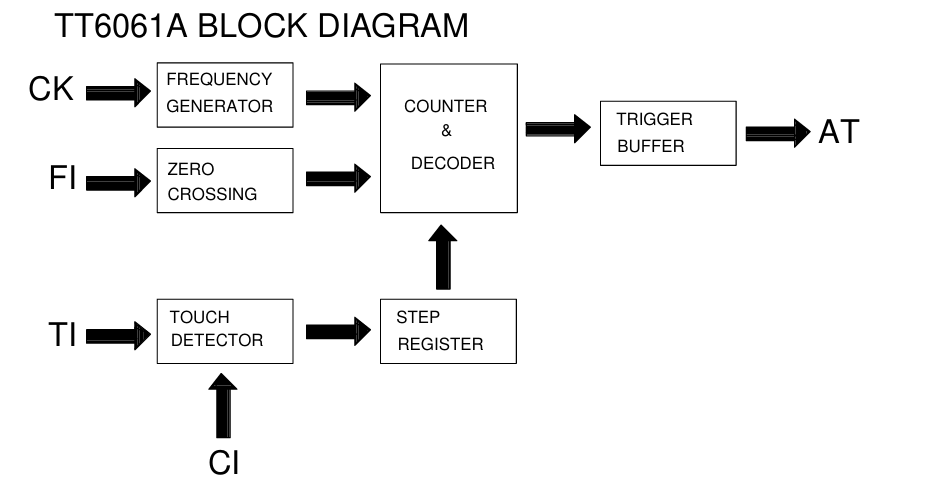
    The circuit in this version dates from 2009. It requires a small number of components to work. It can operate on 110 and 220 V, although each voltage needs separate resistor values R1, R2 and R6. Switching is realised with an external triac; the manufacturer was not tempted to integrate the triac in the housing together with the controller. Block diagram:
    Interior of three-level touch dimmer for bedside lamp - TT6061
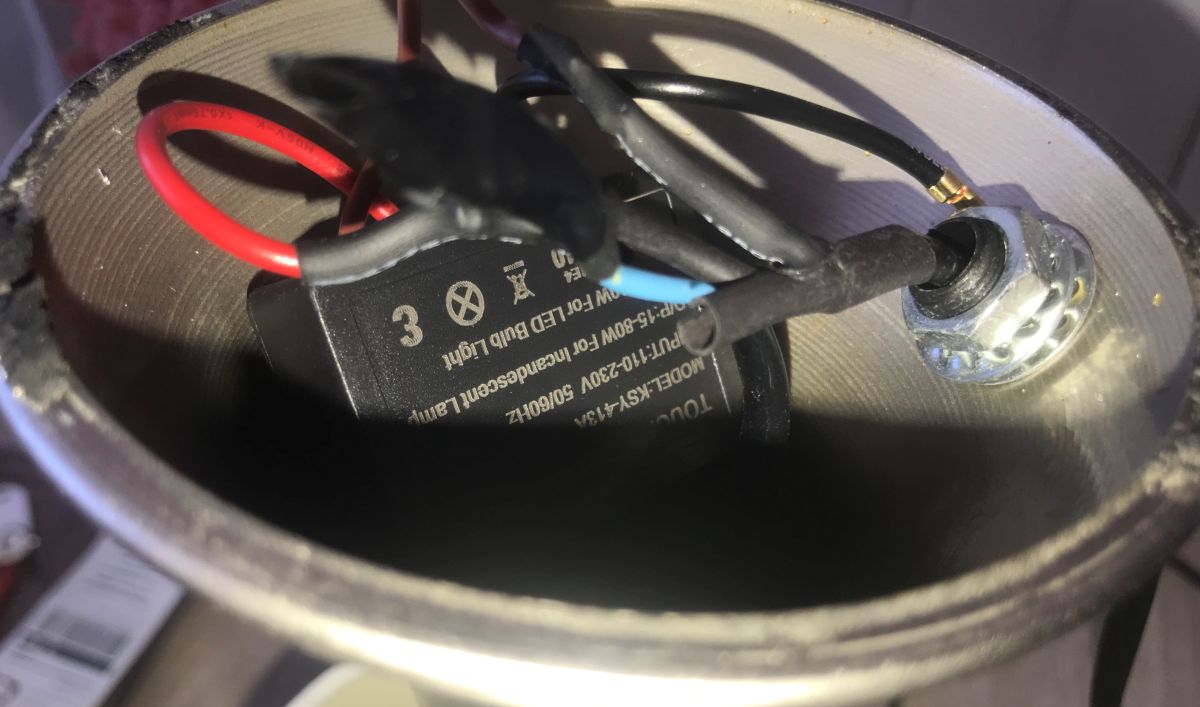
    The module is already mounted in the lamp and fits well there.
    Interior of three-level touch dimmer for bedside lamp - TT6061
    In summary , here we have a simple controller that detects the touch of the lamp housing and controls the triac in such a way that several brightness levels are achieved. The black wire connected to the metal lamp housing acts as a sensor electrode - a touch causes a change in capacitance, which the TT6061 circuit interprets as a control pulse and switches the next mode of operation.
    The brightness is controlled by controlling the moment the triac is switched on in each half-period of the mains voltage. For the highest brightness, the triac is switched on from the beginning of the half-period, for medium and low brightness it is switched on with an appropriate delay, so that a smaller part of the sine wave reaches the bulb. In the off state, the circuit simply does not apply pulses to the gate of the triac.
    Once switched on, the triac conducts until the current falls below the holding current, which in an AC network occurs naturally when the voltage passes zero. In the next half period, the circuit again decides whether and when to give an ignition pulse - depending on the selected brightness level.
    The whole thing is therefore a classic phase dimmer with a simple touch sensor and four operating states: off, low, medium and high brightness levels.
    The device is simple, although also susceptible to damage, which I have already experienced with a neighbour's lamp - if someone screws an LED lamp in there, one with a capacitor at the input, the current pulse drawn by the capacitor at a lower brightness level will sooner or later damage the triac, and the module will have to be repaired or replaced.
    Another issue is the question of the safety of such a gadget - we are protected here by a capacitor (there are two in the diagram) of the appropriate (I hope) class, similar to those connecting the primary to the secondary in a switching power supply.
    Does such a control make sense? I leave the decision to you. Do you use such lights? How do you rate this type of solution?

    Cool? Ranking DIY
    Helpful post? Buy me a coffee.
    About Author
    p.kaczmarek2
    Moderator Smart Home
    Offline 
    p.kaczmarek2 wrote 14604 posts with rating 12620, helped 654 times. Been with us since 2014 year.
  • ADVERTISEMENT
  • #2 21909687
    krzbor
    Level 29  
    Posts: 1755
    Help: 41
    Rate: 1063
    All operator safety is based on capacitor C1. The application note clearly indicates that there should be 2 capacitors in series. Here they have saved money and given 1. I would rather not rely on such protection.
  • ADVERTISEMENT
  • #3 21909866
    MiG25
    Level 23  
    Posts: 538
    Help: 35
    Rate: 97
    Something will happen/change as well as the protective conductor screws into the housing ?
  • ADVERTISEMENT
  • #4 21909891
    Mateusz_konstruktor
    Level 37  
    Posts: 4208
    Help: 269
    Rate: 1104
    p.kaczmarek2 wrote:
    A 97A6 W401 triac, here very tiny, surface mounted, is used to cut the 230 V line. The board was also designed with a larger triac in mind, as you can see the manufacturer is optimising costs

    I see a different situation here: this is a universal board and allows at least two different power triacs to be mounted and in two different resulting housings.
  • ADVERTISEMENT
  • #5 21909958
    krzbor
    Level 29  
    Posts: 1755
    Help: 41
    Rate: 1063
    MiG25 wrote:
    Will something happen/change as well as the protective wire gets screwed into the housing ?

    It will not work. Man is for this device a parallel connected resistance and reactance connected to earth (as in a neon tester). If you ground this it's like adding a 0R resistor in parallel. The circuit will not detect a human.
  • #6 21912306
    bolek
    Level 35  
    Posts: 4099
    Help: 86
    Rate: 299
    Phase control and zero filters, one would expect none of these lights to meet the standards :)
📢 Listen (AI):

FAQ

TL;DR: This FAQ explains a 4-state TT6061 bedside-lamp touch dimmer for people repairing or wiring 230 V lamps. In short, "It will not work" if the housing is earthed, and a 600 mA / 400 V triac can also fail with some LED bulbs at low levels. [#21909585]

Why it matters: This thread shows how a cheap mains touch dimmer works, where it fails, and why its touch sensing and user isolation both deserve scrutiny.

Option Touch sensing Dimming result Main risk or limit
Incandescent bulb Works from metal housing Low / medium / high / off Mains-referenced design
LED bulb designed for dimmers Can work Phase dimming if compatible Compatibility still matters
LED bulb with input capacitor May misbehave Low levels stress the switch Triac damage over time
Housing tied to protective earth Does not work properly No reliable touch detection Sensor is effectively shunted

Key insight: This is a classic phase-angle dimmer plus a capacitive touch input, not an isolated low-voltage control. The same metal housing that senses touch also becomes the system's biggest functional and safety constraint.

Quick Facts

  • The module cycles through 4 states: off, low, medium, and high brightness, using the lamp's metal body as the touch electrode. [#21909585]
  • The switching element is a tiny SMD triac marked 97A6 W401, likely similar to MAC97A6, with about 600 mA and 400 V capability. [#21909585]
  • The TT6061 application shown in the thread supports 110 V and 220 V mains, but R1, R2, and R6 must change between those voltage versions. [#21909585]
  • The posted application circuit dates to 2009, and the author bought 2 modules for £25 plus shipping from a Polish online shop. [#21909585]
  • One reply warns that the application note shows 2 capacitors in series for user protection, while the examined module appears to use 1, reducing confidence in isolation. [#21909687]

How does the TT6061 touch dimmer module switch between off, low, medium, and high brightness levels in a bedside lamp?

It steps through four states with each separate touch: off, low, medium, then high. The TT6061 senses a touch on the metal housing, treats it as a control pulse, and advances to the next mode. It gets different brightness levels by changing when the triac turns on during each AC half-cycle. Earlier turn-on gives more lamp power; later turn-on gives less. [#21909585]

What is the TT6061 chip, and how does it detect touch on a metal lamp housing?

The TT6061 is a touch-dimmer controller IC that detects changes on a metal lamp housing and converts them into dimming commands. The black wire connects that housing to the sensing input. A finger touch changes capacitance at the housing, and the chip interprets that change as a pulse to switch mode. In this module, the sensed electrode is the lamp body itself, not a separate button. [#21909585]

Why can a TT6061-based touch dimmer get damaged when an LED bulb with an input capacitor is used at lower brightness levels?

It can fail because some LED bulbs draw sharp capacitor-charging current pulses when phase-dimmed at low levels. The thread author reports that an LED lamp with an input capacitor can sooner or later damage the triac in this kind of module. That failure is most likely when the dimmer delays conduction and the bulb input capacitor charges abruptly each half-cycle. The result is a module that needs repair or replacement. [#21909585]

How do you wire a three-level touch dimmer module like the TT6061 into a bedside lamp, including the black sensor wire?

You wire it by putting the module in series with the lamp supply and attaching the black lead to the metal housing. 1. Follow the diagram printed on the module housing for the mains and lamp connections. 2. Connect the black wire to the lamp's metal body so it becomes the touch electrode. 3. Mount the module inside the lamp and test the four states: off, low, medium, and high. [#21909585]

What is a triac such as the 97A6 W401 or MAC97A6, and what role does it play in a 230 V touch dimmer?

"Triac" is a bidirectional AC power semiconductor that switches mains current, stays on after a gate pulse, and turns off when current falls below its holding value. In this module, the 97A6 W401 triac, likely similar to a MAC97A6, switches the 230 V line to control lamp power. The thread identifies it as a small SMD part around 600 mA and 400 V. [#21909585]

Why does connecting the protective earth conductor to the lamp housing stop this type of touch dimmer from working?

It stops working because the housing can no longer float enough for the circuit to sense a human touch. One reply explains that a person looks like a resistance and reactance path to earth. If the housing is directly grounded, that path is effectively replaced by a 0 Ω parallel path, so the circuit cannot distinguish a touch. As one poster put it, "It will not work." [#21909958]

What safety concerns are raised by using only one capacitor for user isolation in a mains-powered touch dimmer, instead of two capacitors in series as shown in the application note?

The concern is reduced fault tolerance between the mains-referenced circuit and the touchable housing. One reply says the application note clearly shows two capacitors in series, but the examined module appears to use only one. That means operator safety may depend on a single capacitor, which the commenter considered unsafe enough to say, "I would rather not rely on such protection." [#21909687]

How does phase-angle dimming work in a classic triac lamp dimmer, and why does the triac turn off at the AC zero crossing?

Phase-angle dimming works by delaying the triac trigger within each mains half-cycle. For high brightness, the triac fires near the start of the half-period. For medium or low brightness, it fires later, so less of the sine wave reaches the bulb. The triac then turns off naturally when the AC current falls below its holding current at the zero crossing, and the controller decides again in the next half-cycle. [#21909585]

What resistor values need to change in the TT6061 application circuit when adapting it for 110 V versus 220 V mains?

R1, R2, and R6 must change between the 110 V and 220 V versions. The thread does not list their numeric values, but it explicitly states that each mains voltage requires separate resistor values for those three positions. That means you cannot safely assume one resistor set suits both 110 V and 220 V operation. [#21909585]

Why might a manufacturer use a universal PCB that supports different triac packages in a touch dimmer module?

A universal PCB lets the maker fit at least two different power triacs without redesigning the board. One reply argues that the larger and smaller triac footprints do not necessarily prove cost cutting. Instead, they may show a board intended for multiple assemblies or housing variants. That approach reduces redesign effort while keeping one PCB usable across several module versions. [#21909891]

What is a CY capacitor, and why is it used in a mains touch-sensing circuit like this one?

"CY capacitor" is a safety capacitor that couples small AC signals across an isolation barrier, with controlled leakage and construction intended for mains-related use. In this module, the author points to capacitors that protect the user while still letting the circuit sense touch on the metal housing. Their role is functional and safety-related, because the housing is part of a mains-referenced sensing scheme. [#21909585]

TT6061 touch dimmer versus a touch bedside lamp with a built-in module: which solution is better for repairability and safety?

A separate TT6061 module is better for repairability, while safety still depends on the same mains-referenced design details. The thread shows the module as a single, double-sided board that can be removed, inspected, and replaced inside a lamp. A built-in lamp module may be less accessible. Safety does not automatically improve, because the same concerns remain about touch coupling through capacitors and about compatibility with LED loads. [#21909585]

What kinds of LED bulbs are actually compatible with triac-based touch dimmers, and how can you tell whether a bulb is designed for dimmers?

The thread says this module works with classic incandescent bulbs and with LEDs designed for dimmers. It also warns that an LED bulb with an input capacitor can damage the triac at lower brightness levels. In practice, the safe choice in this thread is a bulb explicitly sold as dimmer-compatible, not a generic LED lamp. If the bulb is not marked for dimming, this module gives no evidence that it will behave well. [#21909585]

How can you troubleshoot a bedside lamp touch dimmer that no longer changes brightness or only works on one level after a bulb swap?

Start by suspecting the bulb change damaged or stressed the triac. 1. Refit a classic incandescent bulb or a known dimmer-rated LED and retest all 4 states. 2. Check whether the black sensor wire is still firmly connected to the metal housing. 3. Inspect the triac stage, because the thread reports that some LED bulbs with input capacitors can damage the triac, leaving the module stuck or faulty. [#21909585]

What are safer alternatives to mains-referenced touch dimmer modules for controlling a bedside lamp with multiple brightness levels?

The thread does not name a specific replacement design, but it clearly points toward avoiding direct mains-referenced touch sensing on the housing. A safer direction is any solution that does not rely on one capacitor between the user and a mains-connected sensor path. That conclusion follows from two facts in the discussion: the housing touch method depends on capacitive coupling, and one reply criticizes the use of only one protection capacitor instead of two in series. [#21909687]
Generated by the language model.
ADVERTISEMENT