
logo elektroda
logo elektroda
X
logo elektroda
Dostępna jest polska wersja

Czy wolisz polską wersję strony elektroda?

Nie, dziękuję Przekieruj mnie tam

A tour of the Odra computers – computers designed and built in Poland

TechEkspert 2082 47

TL;DR

  • The tour traces the Polish Odra computer series built by Elwro in Wrocław, from valve-and-transistor prototypes to TTL-based third-generation machines.
  • Odra 1002 used 36-bit words, drum storage with 4,096 words, valve modules, and transistor modules connected by shielded coaxial cables.
  • Later transistor models improved steadily: Odra 1003 reached 500 additions per second, Odra 1103 5,000, and Odra 1204 60,000.
  • Odra 1304 became software-compatible with the British ICL1904, while Odra 1305 and 1325 adopted TTL integrated circuits and raised production above 1,000 machines.
  • The piece notes missing circuit diagrams, asks for corrections, and laments that Poland later lost continuity in large-scale computer production.
Generated by the language model.
ADVERTISEMENT
Treść została przetłumaczona polish » english Zobacz oryginalną wersję tematu
  • A tour of the Odra computers – computers designed and built in Poland
    Odra is the name of a series of Polish computers manufactured at the Wrocław electronics plant Elwro . Subsequent generations of computers moved from valve-and-transistor solutions to digital TTL circuits. These must have been fascinating challenges: designing and establishing standards for computing machines. In theory, I would now know how to build a digital device using transistors, but I would prefer to use integrated circuits, gates, flip-flops, registers, memory or simply microcontrollers. The designers of the Odra computers had no choice but to use the components available to them.

    I haven’t managed to find any circuit diagrams for the Odra series of computers; if you have any further information or spot an error in this exploration of Polish computers, please do get in touch in this thread. Better documentation is available for the Polish MERA 400 computers; I have been following the YouTube channel MERA400 , where the author demonstrates experiments with a preserved example of this computer. Another unit was located at Gdańsk University of Technology ProjektM400 .

    Returning to the Odra computers, on the website aresluna we can find information on the design of subsequent Odra models and the number of units produced. For example, the Odra 1001 and 1002 were prototype models, each of which was produced as a single unit. The Odra 1002 is a valve-basedand transistor-based computing machine from 1962, operating on 36-bit words and performing 800 additions per second. The Wikipedia page on the 1002 contains a photograph showing the cabinets with the equipment installed and the control panel. This is exactly how the writers of early sci-fi films imagined computers – cabinets with lots of flashing indicators.
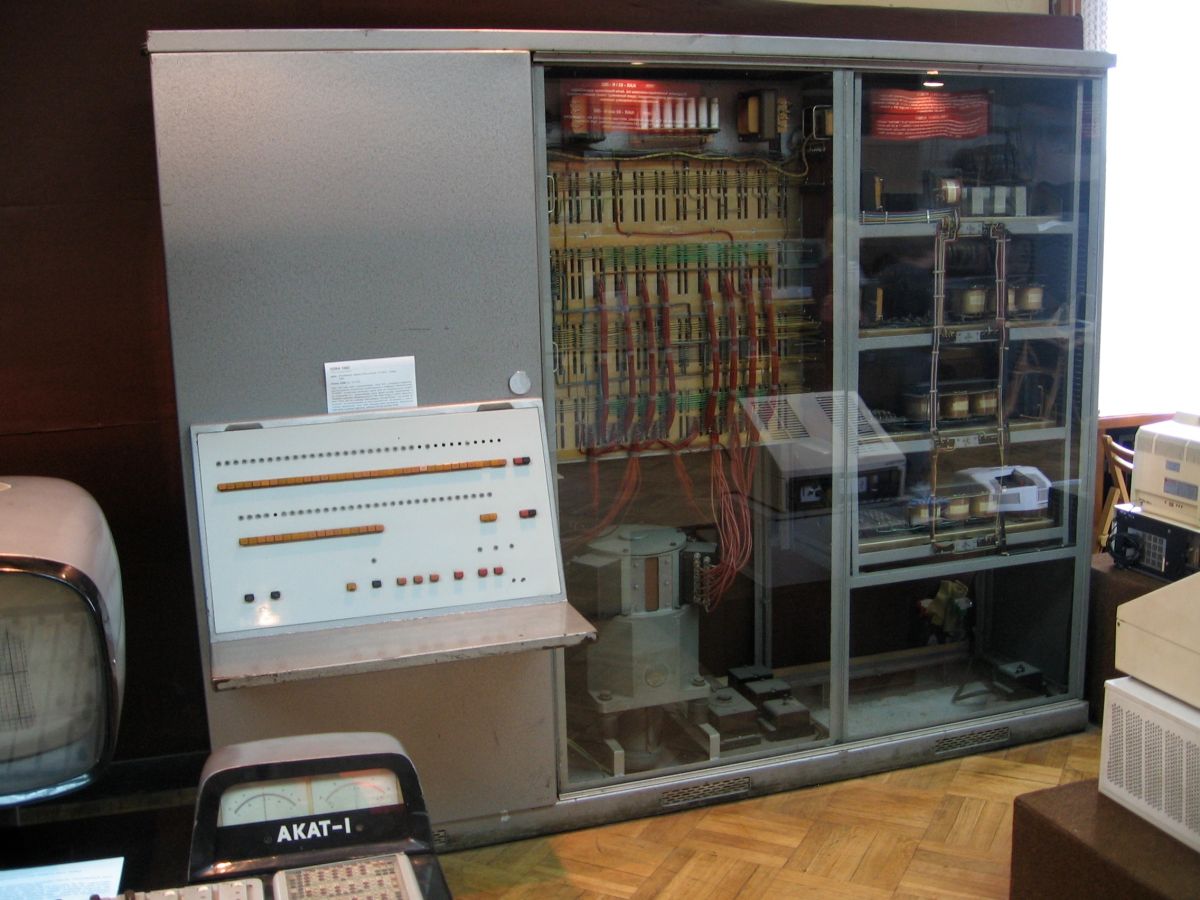
    A tour of the Odra computers – computers designed and built in Poland

    The Polish Odra 1002 computer at the National Museum of Technology in Warsaw, source: Wikipedia, Author: Marcin Wichary, Licence CC 2.0


    The computer’s design features numerous modules installed in cabinets. The modules containing vacuum tubes are connected to the drum storage heads. Perhaps the need for compact component layout, small signal amplitudes, low noise levels and specific signal frequencies meant that vacuum tubes were the better solution? Signals from the heads are routed via shielded cables; in the photograph, these are visible as bundles of red wires.
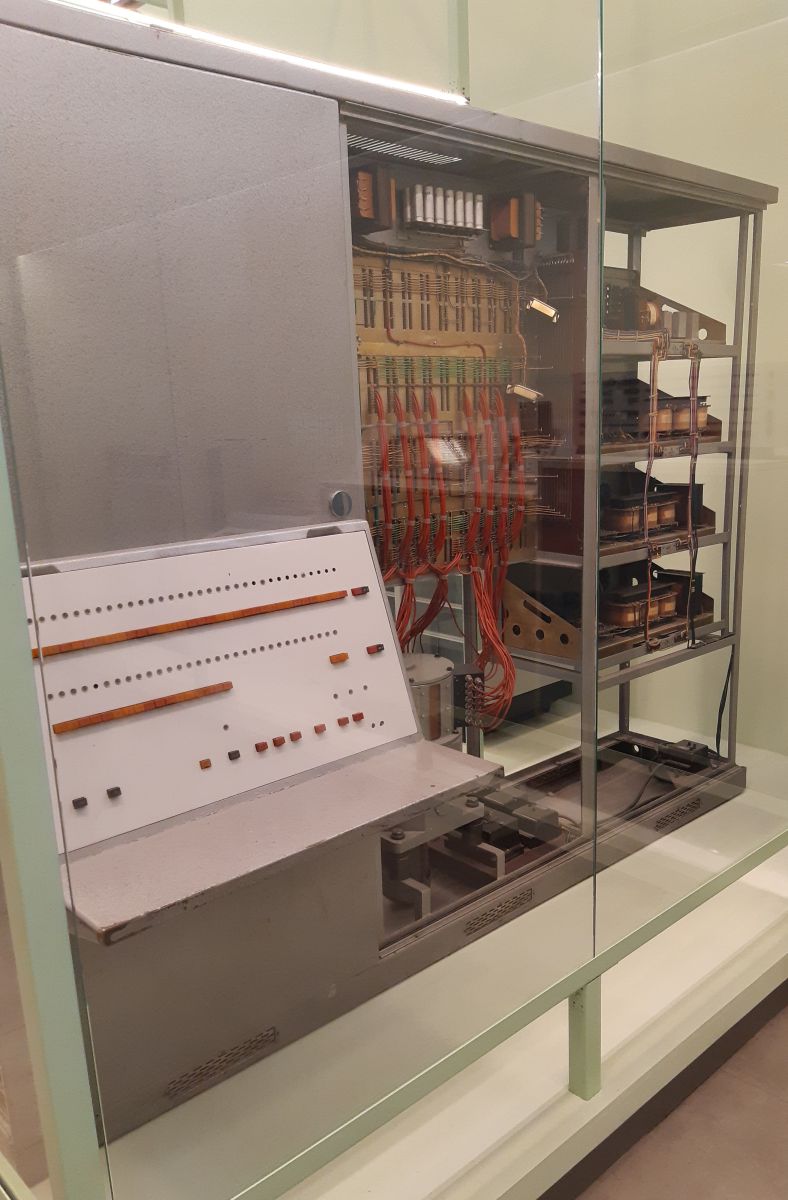
    A tour of the Odra computers – computers designed and built in Poland

    The Odra 1002: the control panel, drum memory and transformer power supplies are visible.


    The valve modules are located in the centre. The transistor modules are on the right. The analogue voltmeters are used to monitor the supply voltages.
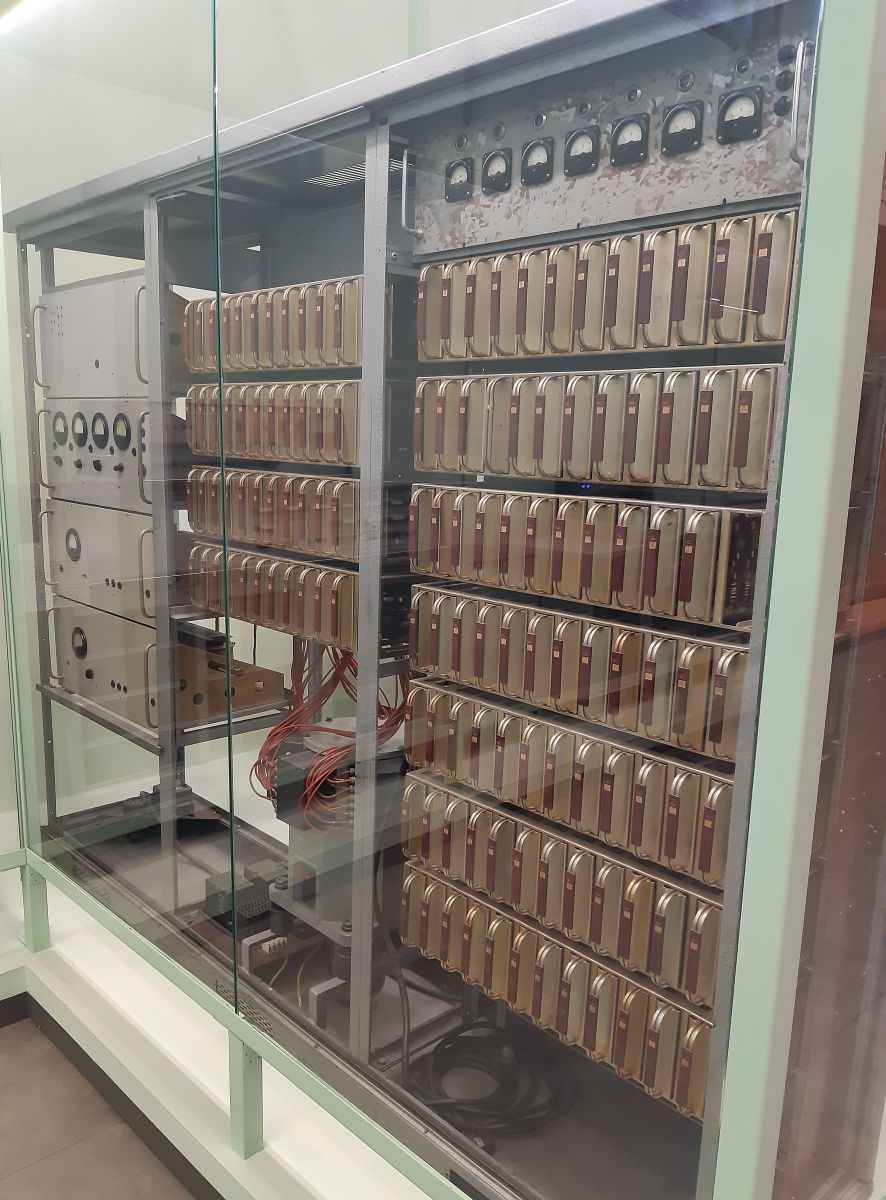
    A tour of the Odra computers – computers designed and built in Poland

    Odra 1002, from the left: power supplies, tube modules compatible with drum memory heads, modules containing transistors and germanium diodes.


    Transformer-based power supplies provide multiple voltages; electrolytic capacitor assemblies are also visible.
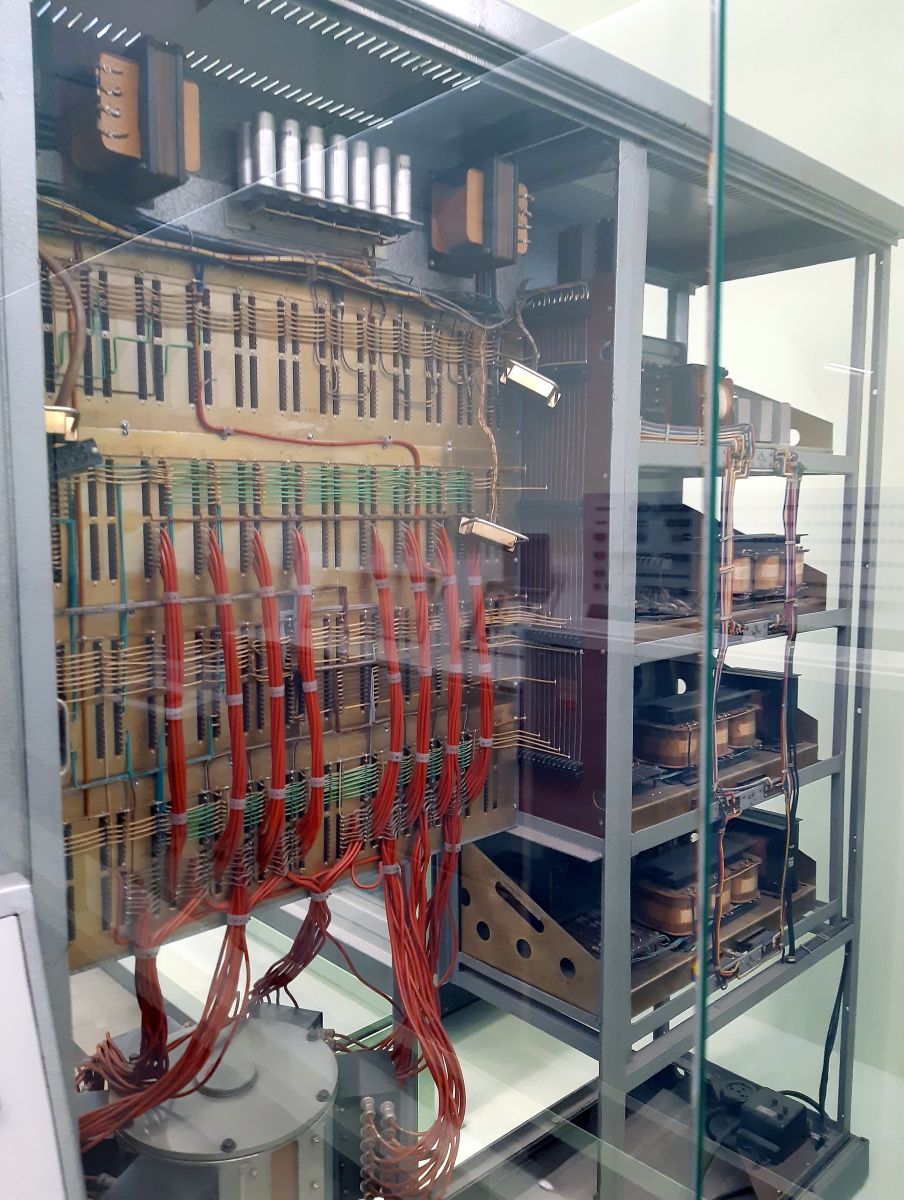
    A tour of the Odra computers – computers designed and built in Poland

    Odra 1002, power supplies and visible bundles of coaxial cables connecting the drum memory heads to the valve modules.


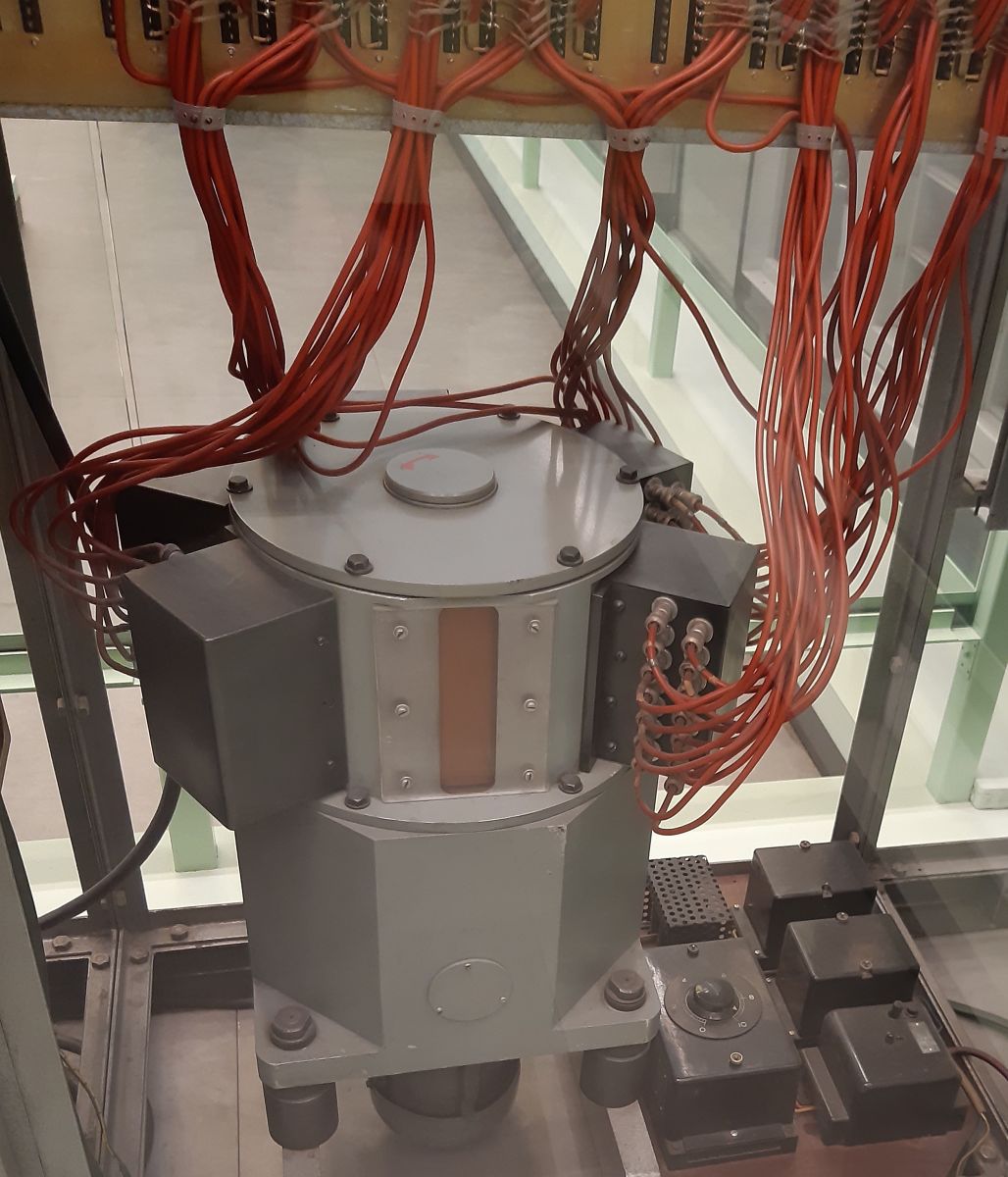
    The drum memory stored 4096 words. The drive motor is visible at the bottom, as is a regulator – possibly an autotransformer. What might it have been used for? Perhaps for starting the motor or regulating its speed, although a synchronous motor should reach 3,000 rpm with only slight variations depending on the current mains frequency. There are a great many heads; I suspect that, in addition to the data heads, there may have been, for example, heads for synchronisation tracks to determine the drum’s position?
    A tour of the Odra computers – computers designed and built in Poland

    Odra 1002, drum memory, bundles of red coaxial cables carrying signals from the heads.


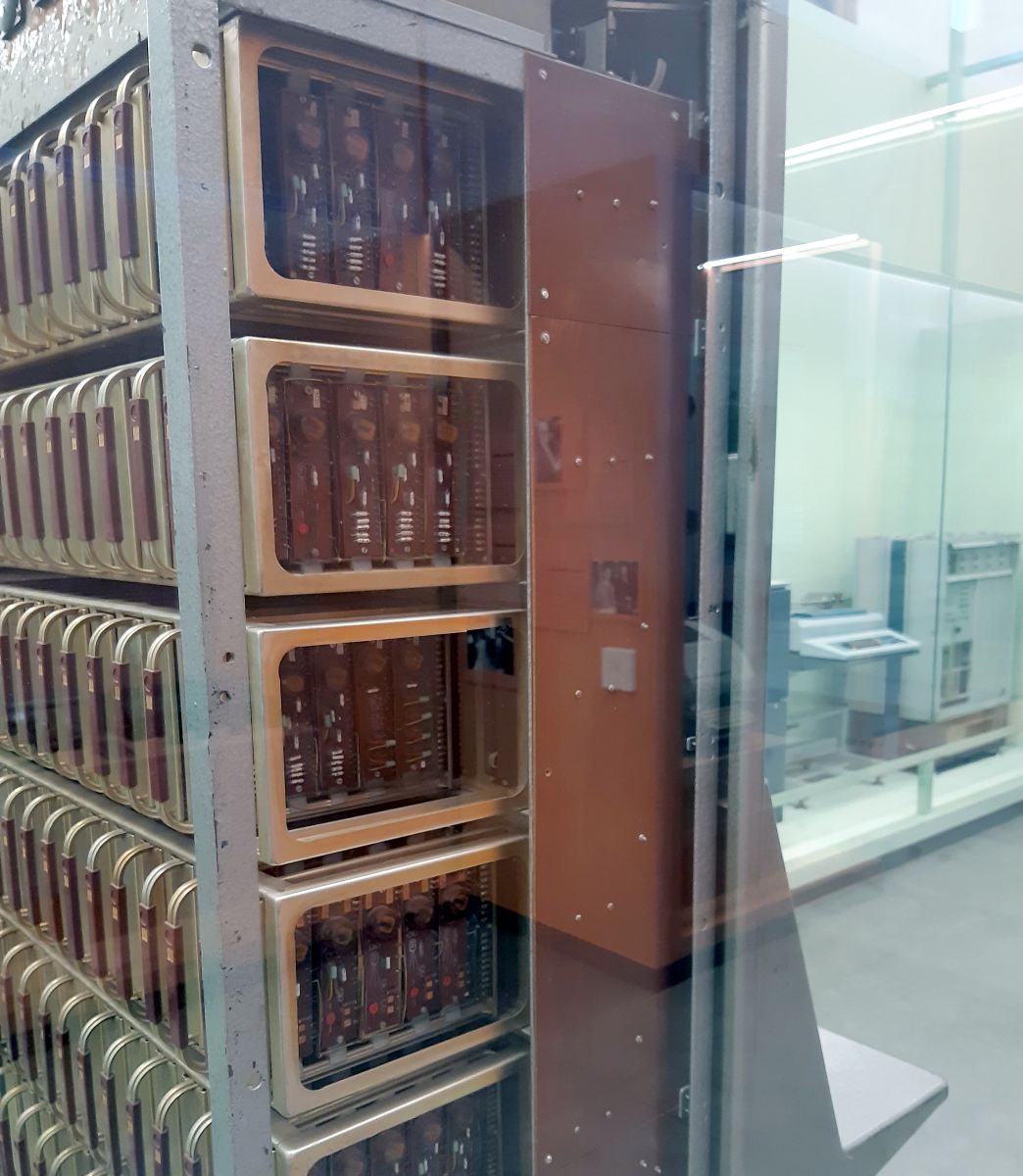
    For the time being, the prototype’s design appears to be an electro-mechanical device fitted with valve modules. However, the Odra 1002 contains a large number of modules fitted with germanium transistors and diodes. Each module contains five circuit boards with semiconductors.
    A tour of the Odra computers – computers designed and built in Poland

    Odra 1002, transistor modules.


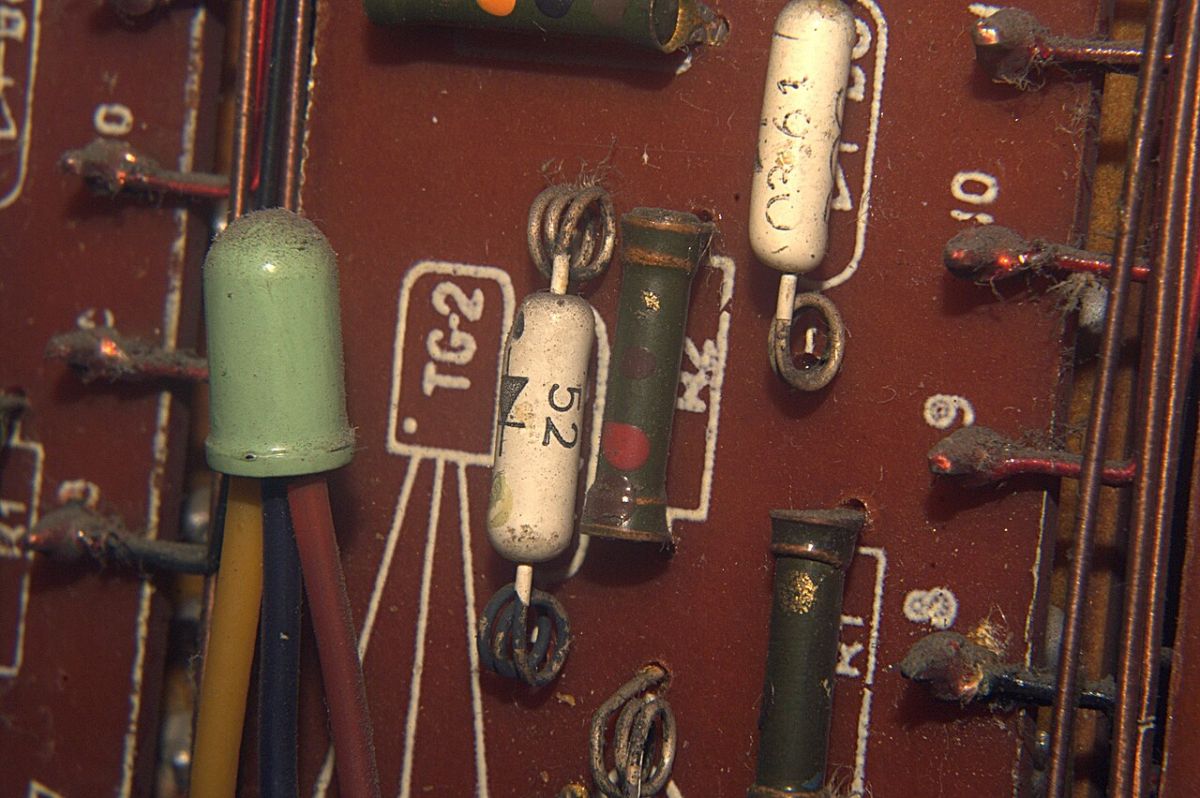
    On Wikipedia, you can find a photograph of a single circuit board featuring the distinctive green TG2 germanium transistor and DOG-52 diodes.
    A tour of the Odra computers – computers designed and built in Poland

    Source: Wikipedia, Author: Topory, Licence CC 3.0


    A single transistor and eight diodes are visible on the board. What could this have been? Perhaps a multi-port gate? At the top there is an inductive component, either a transformer or a choke, although given the greater number of terminals, a transformer seems more likely.
    A tour of the Odra computers – computers designed and built in Poland

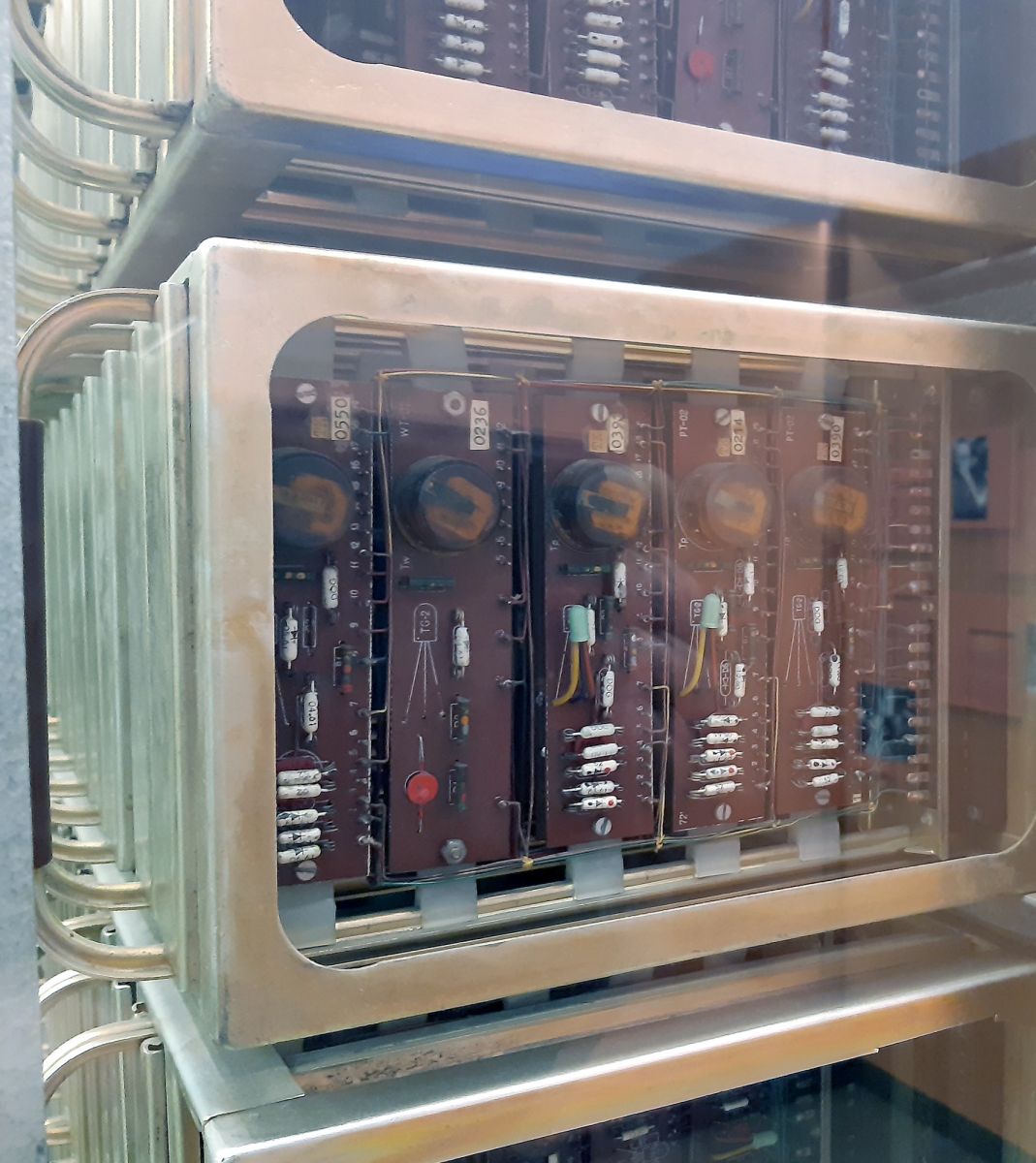
    Odra 1002 transistor modules.


    The input/output devices for this computing machine were a teletype, a punch card machine and a punch card reader.
    I admire the knowledge, perseverance and efficiency of the pioneers of computer science, the designers of computing machines. I wouldn’t want to build a transistor-based computer today, but the designers of the Odra 1002 had no other choice.

    Surprisingly computationally efficient designs were created using transistors, e.g. KAR-65 from 1968 performed 100,000 floating-point operations per second! No wonder that the KAR-65 was used for research at CERN. The KAR-65 was designed by Jacek Karpiński , who later Between 1970 and 1973, he was involved in the construction of a 16-bit computer K-202 . The KAR-65 utilised TG-40 transistors and DOG-61 diodes; 65,000 components were housed in a modular casing typical of that period.
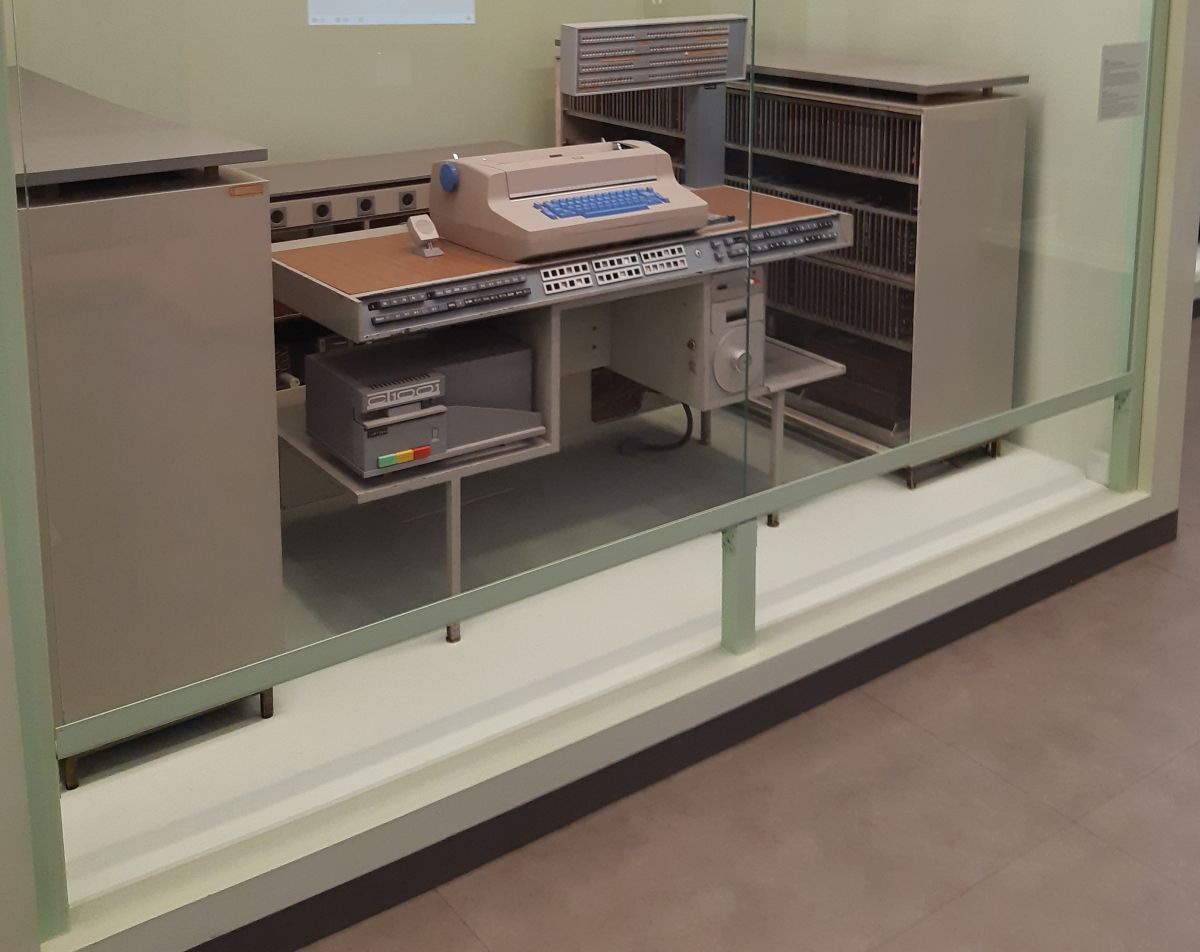
    A tour of the Odra computers – computers designed and built in Poland

    The KAR-65 transistor computer at the National Museum of Technology in Warsaw.


    Digital computing machines in the pioneering days of computing must have posed a major challenge for designers; it is no wonder that experiments were carried out with analogue computers. In such analogue machines, for example Differential Equation Analyser the input and output signals corresponded to the value a, and the calculations were performed by analogue circuits. The analogue transistor computer AKAT-1 , for example, had a very interesting and futuristic appearance. A digital computer solves a problem through a sequence of operations on numbers stored, for example, in binary form, whilst an analogue computer constructs an electrical model of an equation: voltages and currents represent variables, whilst operational amplifiers, integrators, summing amplifiers and potentiometers perform mathematical operations.
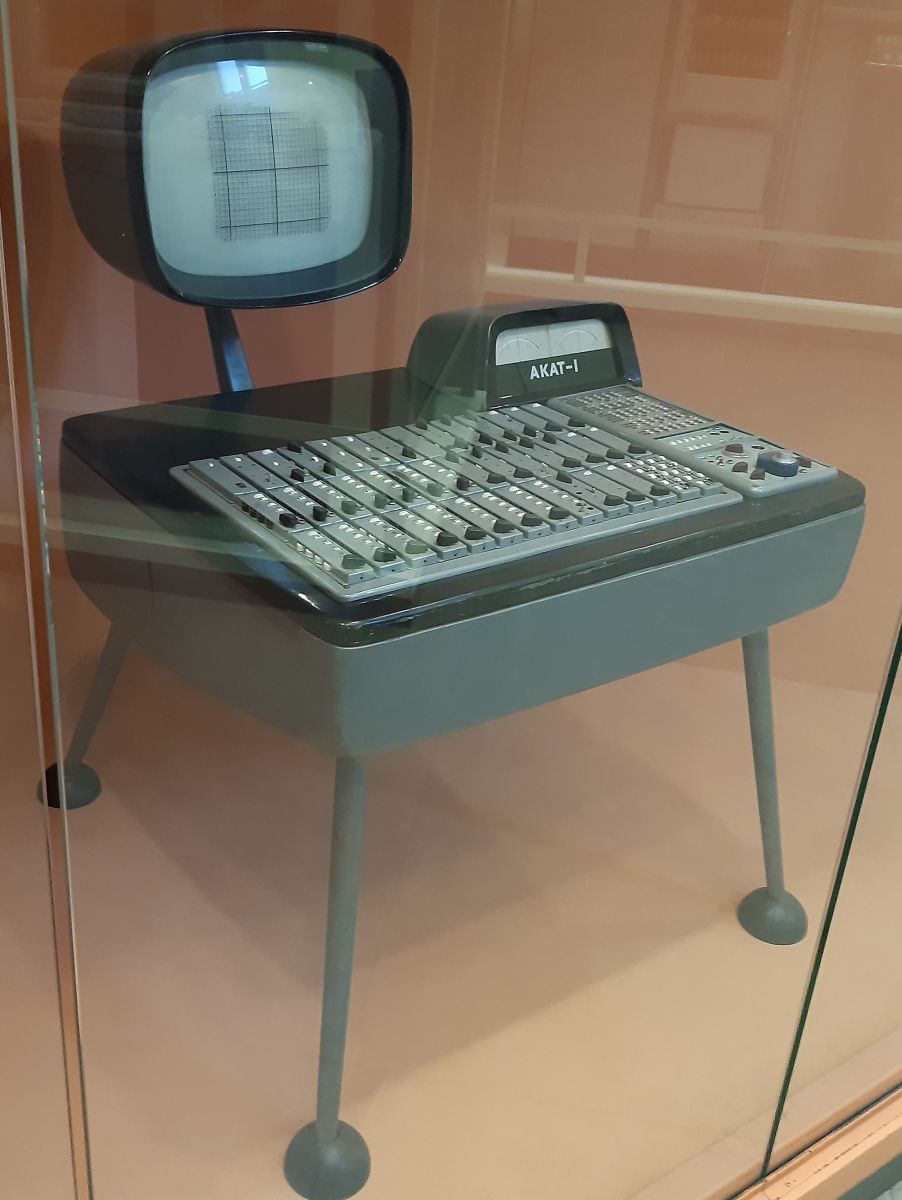
    A tour of the Odra computers – computers designed and built in Poland

    The AKAT-1 analogue computer at the National Museum of Technology in Warsaw.


    We return to the eponymous series of Polish Odra computers. Following the prototypes, the Odra 1003 from 1963. It was a transistor-based machine capable of performing 500 additions per second, of which 42 units were produced. The capacity of the drum memory was increased to 8,192 words. The casing became more compact.
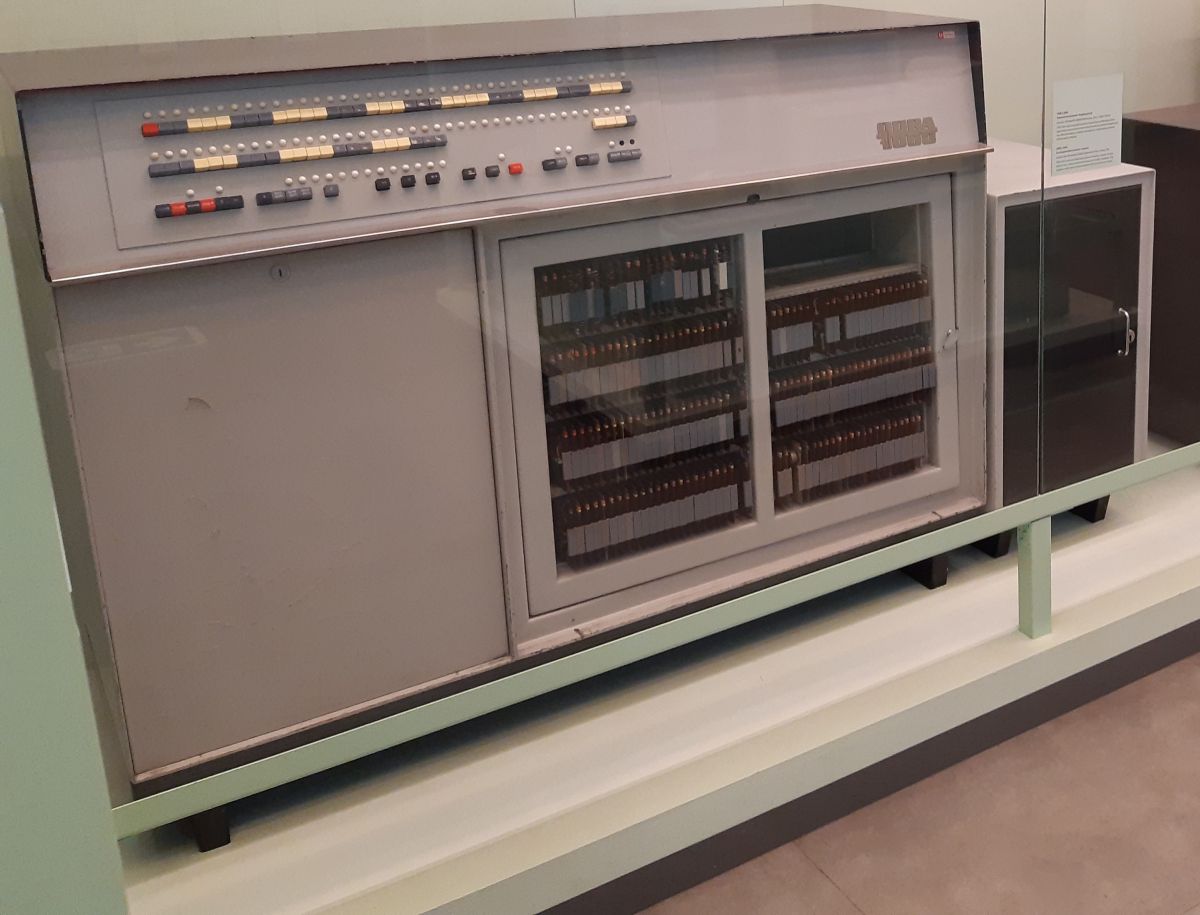
    A tour of the Odra computers – computers designed and built in Poland

    The Odra 1003 transistor computer at the National Museum of Technology in Warsaw.


    The circuit board layout within the module has been expanded; circuits containing 3 transistors, 6 diodes and an inductor, repeated three times, are visible.
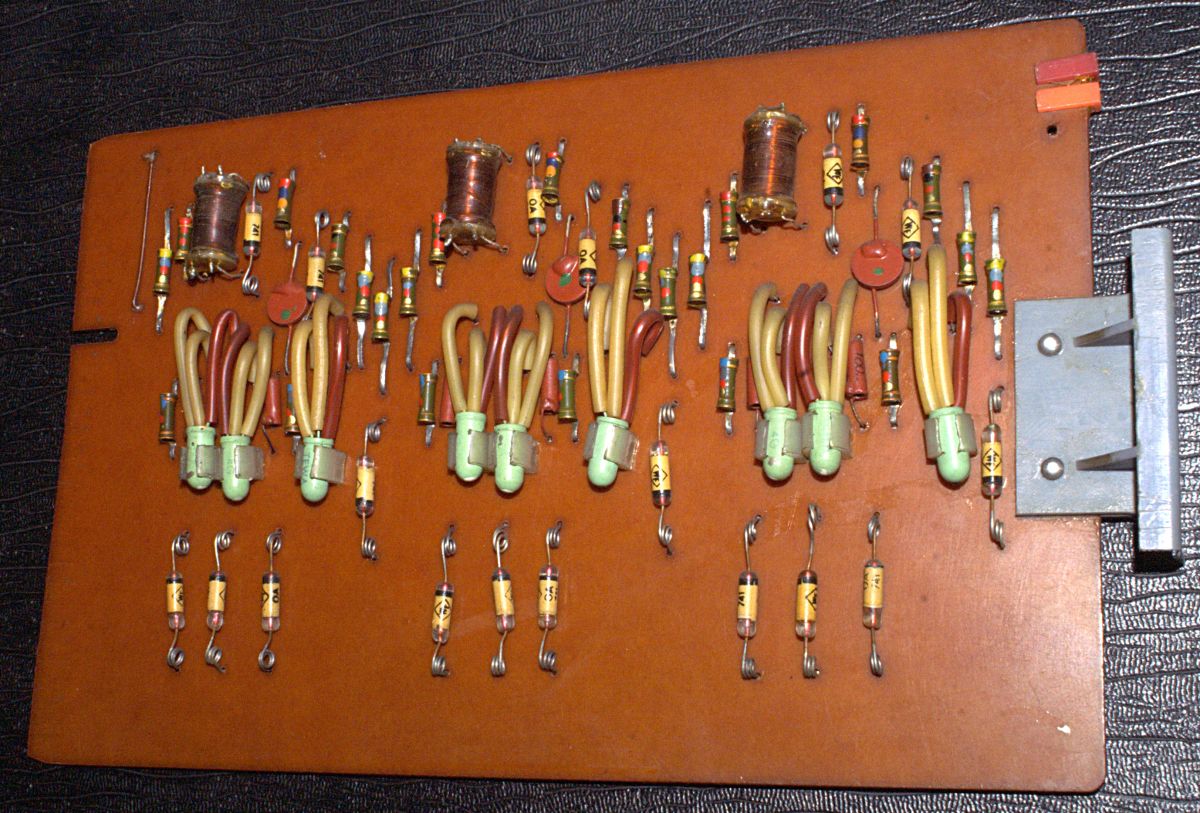
    A tour of the Odra computers – computers designed and built in Poland

    Odra 1003 package, source: Wikipedia, Author: Marcin Wichary, Licence CC 4.0


    Subsequent generations of transistor-based Odra computers became faster Odra 1013 it could add at a rate of 1,000 per second and 84 units were sold. From the 1013 model onwards, 256-word main memory was introduced, the capacity of which increased in subsequent versions. Unlike the drum, the ferrite core memory had no moving mechanical parts; access to memory cells was random (equivalent to RAM); reading a bit was destructive (the state had to be rewritten); however, unlike RAM, the memory was non-volatile.
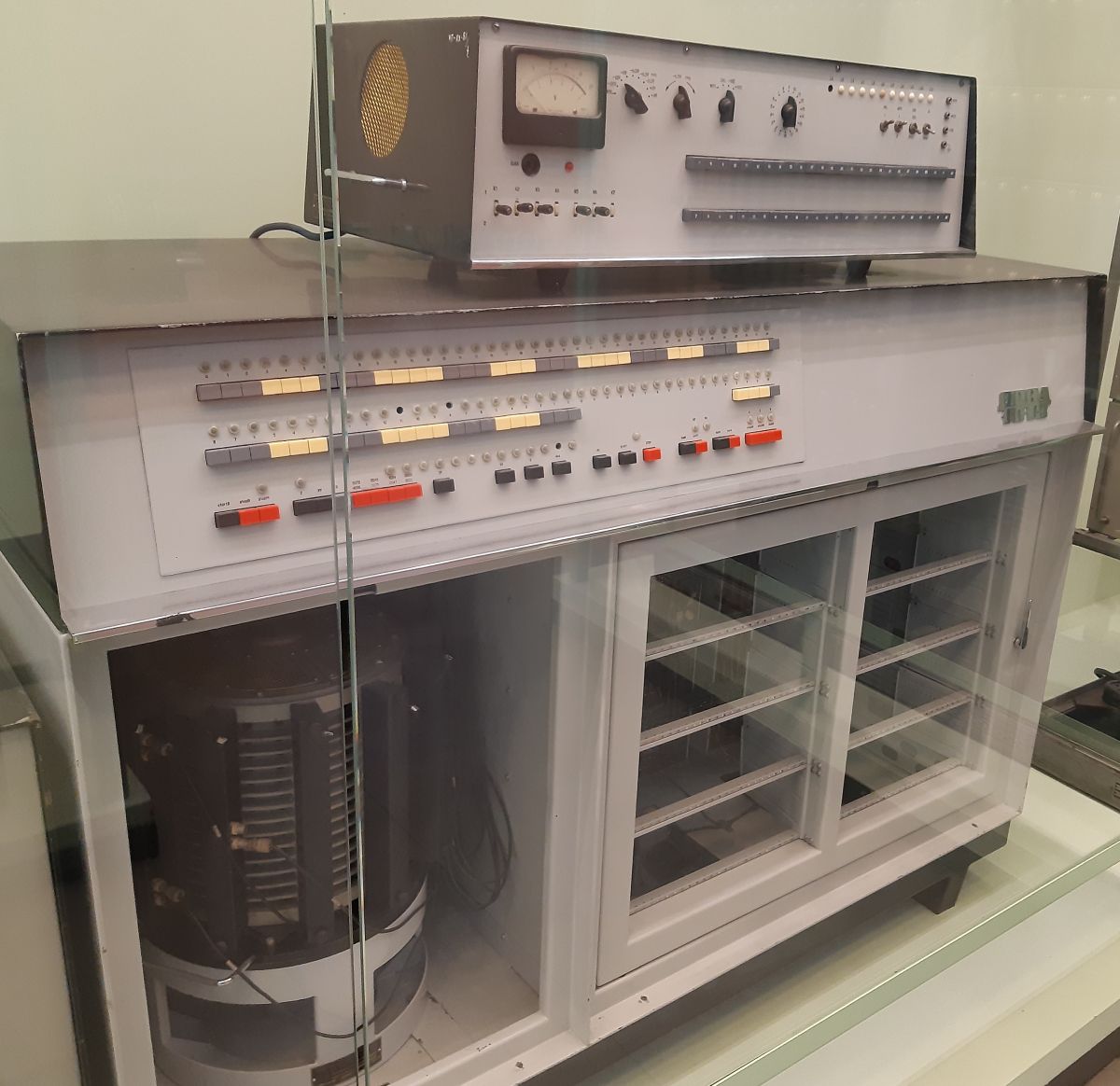
    A tour of the Odra computers – computers designed and built in Poland

    The Odra 1013 transistor computer with drum storage and 256-word main memory, National Museum of Technology in Warsaw.


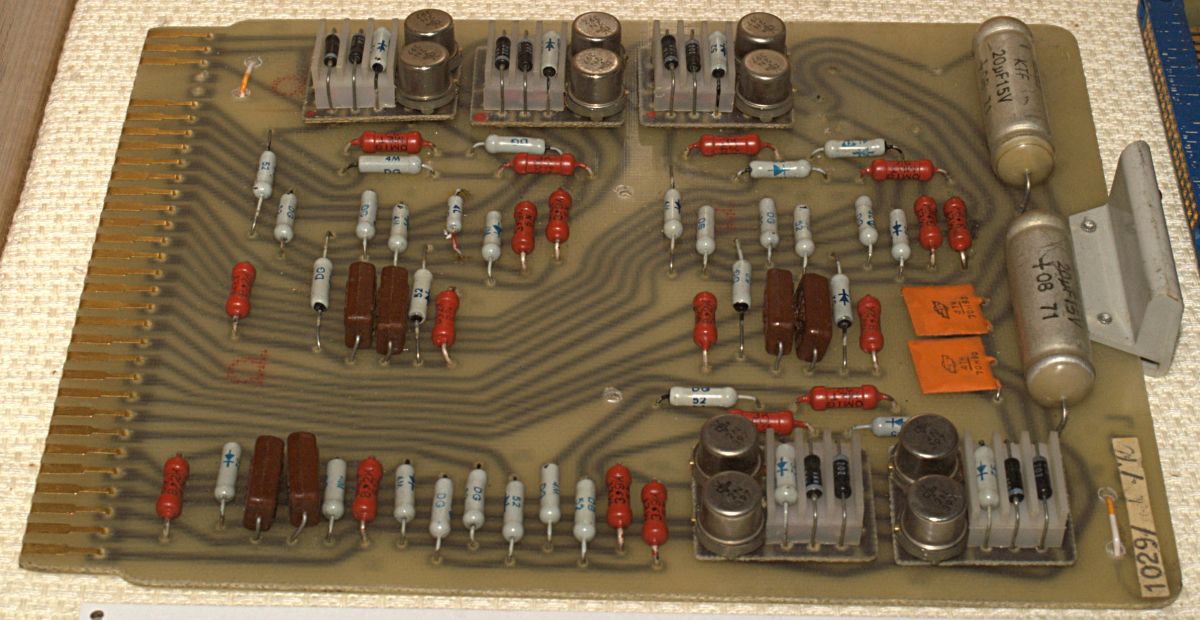
    Odra 1103 reached a speed of 5,000 additions per second and 64 units were sold. Odra 1204 that’s 60,000 additions per second and 179 units sold. Odra 1304 achieved 50,000 additions per second and 90 units were sold. The 1968 Odra 1304 was software-compatible with the British ICL1904 whilst being a faster, smaller machine that consumed less power. Designing it to be compatible with the ICL1904 instruction set allowed for port some of the software from the ICL . Elwro built a machine tailored to the existing software ecosystem, whilst improving the performance of the computer that had originally run these programmes.
    A tour of the Odra computers – computers designed and built in Poland

    Image of the Odra 1304, source: Wikipedia, Author: Topory, Licence CC 3.0


    Transistors occur in pairs; what do you think – are these flip-flops or gates?

    A very good tabular summary of information about the Odra series can be found on the aforementioned website https://aresluna.org/attached/computerhistory/articles/odra

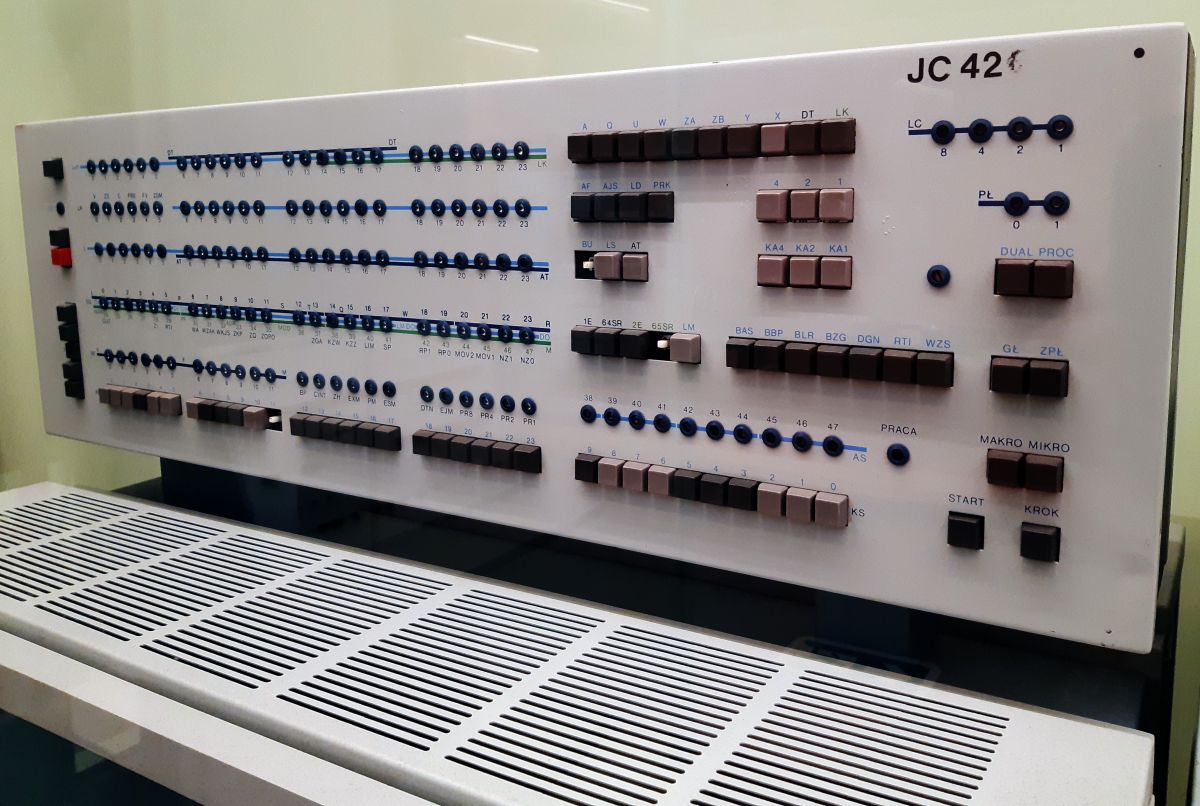
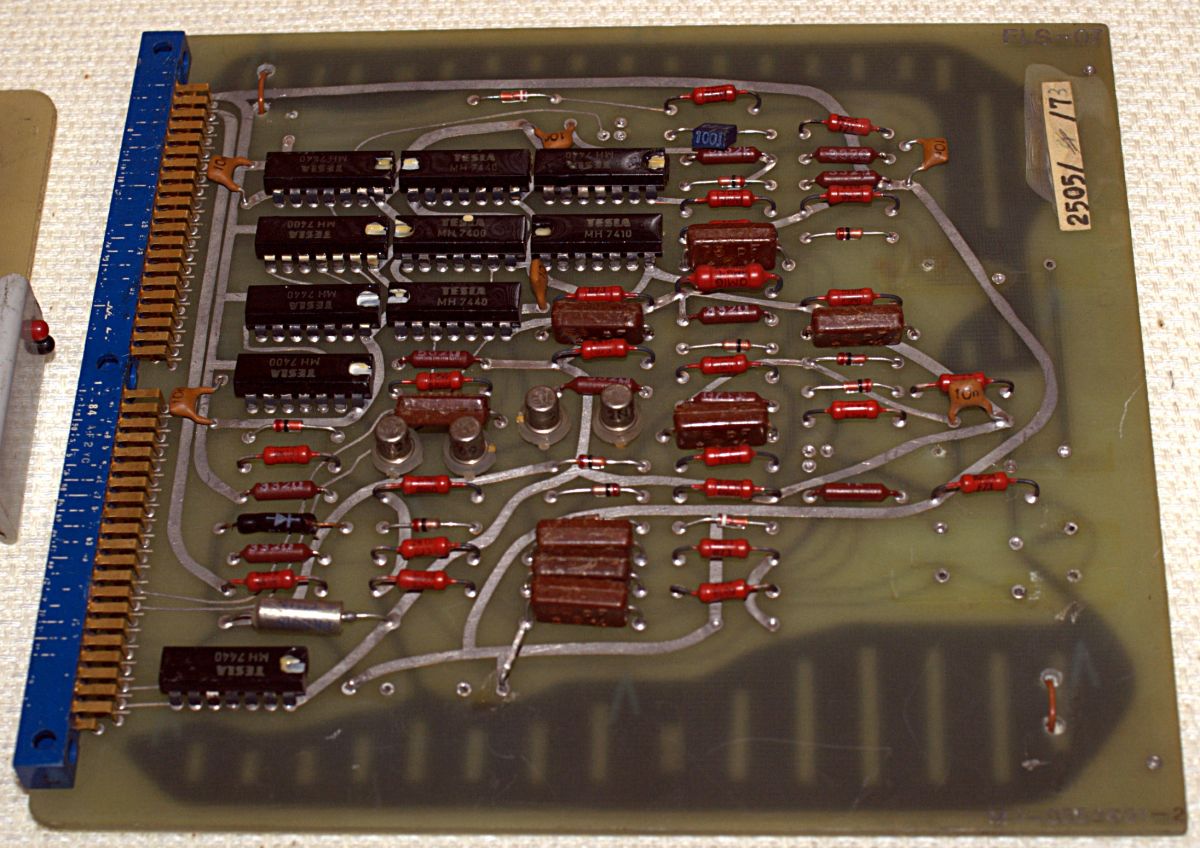
    The new third generation of machines based on integrated circuits was launched by the Odra 1305 manufactured since 1973, the front panel of which is visible on the cover photo of this article. Odra 1305 it achieved 370,000 additions per second and 346 units were sold. It was also based on TTL integrated circuits Odra 1325 achieved 280,000 additions per second and sold 151 units. In total, over 1,000 Odra computers were produced.

    From model 1305 onwards, Odra computers incorporated TTL digital circuits, which enabled a significant increase in component density compared to transistor-based designs.
    A tour of the Odra computers – computers designed and built in Poland

    Source: Wikipedia, Author: Topory, Licence CC 3.0


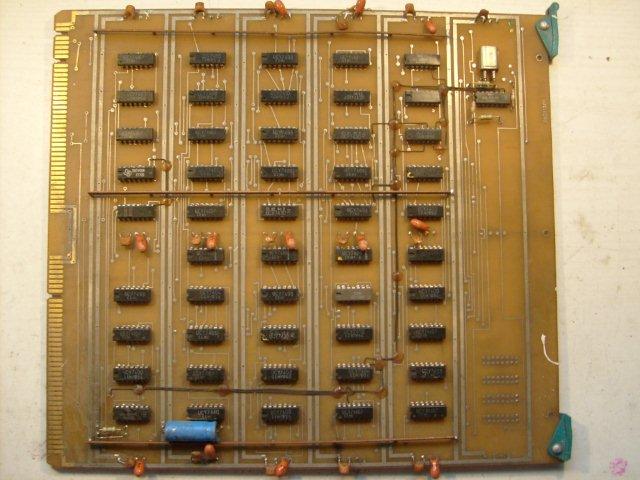
    On elektroda.pl, in a thread started by @dj_volt, you can find photos of Odra packages containing larger quantities of TTL integrated circuits, posted by @Gizmoń.
    A tour of the Odra computers – computers designed and built in Poland


    This brings our tour of the Odra series to an end; please do let us know what you think,
    perhaps we can add to it, correct any errors in the description or answer some of your questions.

    Those were fascinating times, the pioneering days of digital machines and computing. Old computers Second-generation (transistor-based) and third-generation (TTL integrated circuits) Odra computers look rather unusual today, a bit like the control panel of some sort of industrial automation device. Odra computers often required a three-phase power supply! It’s quite impressive to see a single transistor inside a computer. I am full of admiration for the skill and perseverance of the Polish computer designers. I suspect that the process of designing the first digital computing machines must have been difficult but also fascinating. Overcoming limitations and setting new standards must have been rewarding.

    Unfortunately, we brought the design and production of computers to a close with machines based on integrated circuits. Microprocessors later emerged, and Poland was unable to maintain continuity in the design and mass production of its own large ‘Odra’-class computer systems. Looking at these pioneering designs, one can also see the enormous progress that took place in a relatively short space of time.

    Cool? Ranking DIY
    About Author
    TechEkspert
    Editor
    Offline 
    TechEkspert wrote 7188 posts with rating 5568, helped 16 times. Been with us since 2014 year.
  • ADVERTISEMENT
  • Why Poland lost continuity in computer production

    #3 21927412
    gulson
    System Administrator
    Posts: 29398
    Help: 148
    Rate: 6069
    TechEkspert wrote:
    Unfortunately, we ceased the design and production of computers based on integrated circuits. Later, microprocessors appeared, and Poland was unable to maintain the continuity of design and mass production of its own large Odra-class computer systems.

    One might ask the obvious question: what has happened to us? Why were we manufacturing computers back then, but not now? For example, South Korea and Japan are currently leading the semiconductor race (mainly in memory), and their markets are at all-time highs. Here, however, concrete and banks reign supreme. Back then it was profitable and feasible, but now it isn’t? What did South Korea do differently?
  • Odra computers were outdated copied designs

    #4 21927432
    tzok
    VIP Meritorious for electroda.pl
    Posts: 38744
    Help: 3169
    Rate: 6491
    No, that was during the communist era, and it didn’t have to be profitable. The Party gave the order, and the people produced. I don’t think South Korea is a good example here, because I don’t believe any European would want to live and work there. There’s a certain phenomenon with computers: in reality, one company has a monopoly and decides who can produce them and where. I like such historical artefacts, but knowing the realities of the time, I’m far from glorifying them. These were copies, often unlicensed and usually of already outdated designs. So what if the Odra 1304 was faster than its British counterpart, the ICL1904, back in 1968? By then, the British already had much faster computers.
  • Post-communist industrial decline in Polish electronics

    #5 21927435
    doopagogle
    Level 2  
    Posts: 2
    Rate: 10
    I think the point here is that we’re supposed to be a backwater, a source of cheap labour

    Added after 4 [minutes]:

    One more point… Communism was one thing in Soviet Russia, but here it wasn’t quite the same… Still, it didn’t hold us back that much. We even produced our own integrated circuits, including licensed ones… And now?? EVERYTHING has been shut down!!!!!!!! A nation of pallet stackers, lorry drivers and supermarket shoppers!!!!!
  • Question about diode lead coils and software archiving

    #6 21927439
    gregor124
    Level 29  
    Posts: 1578
    Help: 99
    Rate: 842
    Back then, we were manufacturing computers because we had the capability and were ahead of the curve.
    Unfortunately, the crisis of the 1980s halted our progress and we were unable to catch up.

    Although, despite the crisis of the 1980s and 1990s, microcomputers were still being produced in Poland, albeit certainly not enough to meet demand.

    It’s great that someone is saving these machines; all in all, it was really the last chance to do so.
    And I’m just wondering – since the machines still exist, what’s the situation with archiving the software?
    Have they been preserved at all, and if so, will they be – or perhaps are they already – available?

    And going back to RAM, today’s dynamic memory also loses its contents over time – but only during read operations – except that it now contains circuits responsible for refreshing its contents during reading. In any case, the problem still exists and the memory still needs to be refreshed periodically.


    Are those coiled lead wires for the diodes there to prevent them from being damaged by high temperatures during soldering?
    Helpful post? Buy me a coffee.
  • Polish computers lagged Western designs by years

    #7 21927443
    tzok
    VIP Meritorious for electroda.pl
    Posts: 38744
    Help: 3169
    Rate: 6491
    Back then, computers were very simple; they might have been large and looked complicated, but today a talented student at an electronics technical college could design something like that. Some had strange limitations, such as that drum memory… It wasn’t a hard drive; it wasn’t even main memory – at least in some computers, to reduce the number of vacuum tubes and thus the costs, the drum memory served as the processor’s registers. Many computers operated asynchronously or semi-synchronously, such as our own K-202/Mera-400. Unfortunately, in those days, computing power doubled every year, whilst ‘our’ designs imitated Western solutions from 2–3 years earlier and could be produced without major changes for the next 5 years.

    It is true that there was no communism in Poland in the literal sense of the word; instead, we had overzealous leaders in power who wanted to be more communist than their Russian superiors. To a large extent, they were the ones who restricted us, claiming that the Russians wouldn’t allow it, but often it was merely their own perception that the Russians might not approve (a situation all too familiar to us today)…

    As for the economic situation – from my perspective, we currently live in such prosperity and comfort that we don’t need to keep up with the Joneses. We have everything we need, and we can afford to enjoy life. Perhaps I have a distorted view of reality, as I live in a ‘city of millionaires’… but the very fact that such a city exists in Poland (and not just one) means something. How long can you keep racing? There has to be a goal somewhere, some sort of finish line. You can’t run aimlessly and endlessly. Many have decided that the goal has been achieved and there’s no point in carrying on. It’s time to step back and enjoy what has been achieved.

    Computers are now also being assembled in Poland (and cars – quite a lot of them, in fact). The only difference is the foreign (global) brand, but in practice the difference is negligible. Back then, products were either copied for internal use only, or manufactured under licence, for which one had to pay by producing under a foreign brand.

    Incidentally, it’s usually the one who brings a product to market who has the advantage and gains a monopoly. If someone enters the market 5–10 years later, they’re at a disadvantage. Therefore, in my view, there is no point in us entering the race in semiconductor technologies or the automotive sector; it is (far) too late for that – these niches are not only already taken, but also exhausted.

    gregor124 wrote:
    Returning to RAM, today’s dynamic memory also loses its contents over time, but only during read operations; however, it already contains circuits responsible for refreshing its contents during such operations. In any case, the problem still exists and memory must still be refreshed periodically.
    The first electronic memories were static memories, i.e. those requiring no refreshing whatsoever. Ferrite memory modules also contained circuits that refreshed the contents after each read operation (to mimic static memory). Unlike dynamic random-access memory (DRAM), the contents of ferrite memory (when switched off) can last for decades. To this day, memory is organised into rows and columns, modelled on ferrite memory.

    gregor124 wrote:
    Are those coiled diode leads there to prevent them from being damaged by high temperatures during soldering?
    These were point-contact diodes; the aim was more to minimise stress and dampen vibrations.
  • FRAM as modern equivalent of ferrite memory

    #8 21927448
    gregor124
    Level 29  
    Posts: 1578
    Help: 99
    Rate: 842
    tzok wrote:
    It’s true, there was no communism in Poland in the literal sense of the word; instead, we had overzealous people in power who wanted to be more communist than their Russian superiors. To a large extent, they were the ones who restricted us, claiming that the Russians wouldn’t allow it, but often it was merely their own perception that the Russians might not approve (a situation we are all too familiar with today)…


    Let’s not exaggerate: in the Comecon countries, the standard was the RIAD system, derived from IBM. So these restrictions were based more on economic than political grounds. It was simply easier to sell the dominant system than a niche one in the Comecon countries.

    Quite simply, RIAD had a larger market in which we could have taken the technological lead. The fact that other systems developed despite this rather testifies to Poland’s uniqueness compared to other Eastern Bloc countries.

    And let’s not forget that we were in a bloc regarded by the West as hostile, which had the effect of restricting access to the latest technologies.

    As for those ferrite memories, their modern-day equivalent is FRAM.
    Quite recently, Siemens announced that its FRAM memory can retain data for 200 years without a power supply. Unfortunately, their capacity is very small – just 8 kb.
    Helpful post? Buy me a coffee.
  • Soviet standards and AVR assembly book link

    #9 21927470
    _ACeK_
    Level 15  
    Posts: 166
    Help: 6
    Rate: 195
    :smile: This film on YouTube ⬇️


    :idea: The Soviets copied things, and sometimes made them themselves; they even had their own standards, such as the pin spacing in circuits 2.5 Hmm, where in the world 2.54 . But the world doesn’t revolve around the fact that you can produce something, but rather on having someone to sell it to. In the West, the first major orders for electronics were for the military; this strengthened companies and led to research and the development of new technologies. The costs ran into millions. We were too poor to manufacture or to buy :sad:

    Here :arrow: Link to a book on programming microcontrollers in assembly language AVR in Russian :roll: everything in English, even using the Latin alphabet instead of Cyrillic :cunning:
  • ADVERTISEMENT
  • Microprocessors made Polish computers obsolete

    #10 21927515
    waltersalata
    Level 25  
    Posts: 715
    Help: 65
    Rate: 286
    gulson wrote:

    One might ask the obvious question: what has happened to us? Why were we manufacturing computers back then, but not now?


    Polish industry did not survive the influx of products from other countries. Why, in the 1990s, did everyone prefer a 15-year-old VW to a new Polonez?
    Similarly, computer products were technologically obsolete and there was no way of turning them into competitive products. At the time Karpiński was building the K-202, microprocessors were already available worldwide, representing a technological leap forward.
  • ADVERTISEMENT
  • #11 21927556
    gulson
    System Administrator
    Posts: 29398
    Help: 148
    Rate: 6069
    @ElektrodaBot So what’s different about South Korea compared to Poland that it’s become a semiconductor hub?
    It’s certainly not knowledge or people – we’re leading the way in those areas.
  • Export-driven industrial system enabled Korea’s semiconductor rise

    #12 21927560
    ElektrodaBot
    AI OpenAI ChatGPT4
    Posts: 8835
    Help: 359
    Rate: 945
    gulson wrote:
    @ElektrodaBot, what’s different about South Korea compared to Poland that makes it a semiconductor hub?
    It’s certainly not knowledge or people – we’re leading the way in those areas.

    Previous user posts...
    Direct reply

    In my opinion, the difference lay not in the ‘wisdom of a single engineer’, but in the industrial system . Poland had very good designers, computer scientists, electronics engineers and academic support. South Korea, on the other hand, built something that we lacked: a continuous chain, funded over decades: state → banks → chaebols → exports → reinvestment → successive generations of technology .

    In the semiconductor industry, it is not enough to know how a MOS transistor works or how to design a computer. You also need:

    - capital amounting to hundreds of millions, then billions, of dollars,
    - access to lithography machines, chemicals, masks, gases and measuring equipment,
    - a market for millions and billions of units,
    - a repeatable manufacturing process and high production yield,
    - global customers who demand quality,
    - sustained investment over 20–40 years.

    Korea either had these factors or systematically built them up. Poland had talented people, but lacked the appropriate capital, geopolitical and market environment.

    A detailed analysis of the problem

    1. South Korea focused on exports, not on the ‘domestic market’

    This is the fundamental difference. Since the 1960s, South Korea has built its economy around exports. The OECD notes that the state supported exports through exchange rates, export credits, export-linked import concessions and institutional support from KOTRA; since the 1980s, South Korea’s exports have exceeded imports as a share of GDP. This mechanism has consistently forced companies to compete with the best, rather than merely satisfying the domestic market or a political bloc. ( oecd.org )

    In the People’s Republic of Poland, the situation was the reverse. The Comecon market often accepted a product simply because it was available, rather than because it was the best in the world. This stifled pressure on cost, quality, miniaturisation and production yield. In electronics, such pressure is crucial, as technology becomes obsolete within a few years.

    2. Korea chose the right niche: memory

    Samsung and Hyundai Electronics/SK hynix did not start by building a completely proprietary computer ecosystem. They entered the DRAM memory market, followed by NAND and, today, HBM. It was a brilliant industrial choice:

    - a standardised product,
    - mass-produced,
    - scalable,
    - essential for every computer manufacturer,
    - less dependent on proprietary CPU architecture and software.

    Samsung highlights the development of 64Kb DRAM, the launch of the Giheung campus and its subsequent rise to a leading position in DRAM as further milestones in its history. ( semiconductor.samsung.com ) SK hynix states that Hyundai Electronics was founded in 1983, in 1985 it began mass production of 64K DRAM and 256K DRAM, and in 1986 it developed 4M DRAM in collaboration with the government. ( skhynix.com )

    Poland, on the other hand, often attempted to build the ‘entire system’: the computer, the architecture, the peripherals, the software, and sometimes even its own chips. This was ambitious from an engineering perspective, but very costly from an industrial standpoint. South Korea started with a product that could be sold in huge volumes.

    3. The South Korean state did not merely ‘assist’, but actively steered priorities

    South Korea was not a pure free market. It was a directed form of capitalism. The state identified strategic sectors, banks financed large conglomerates, and chaebols such as Samsung, Hyundai, LG and, later, SK were large enough to survive years of losses.

    The OECD reports that in the South Korean semiconductor sector, the major conglomerates received significant resources for R&D programmes, whilst the government played a “pivotal role” in the industry’s development: it funded research, supported cooperation and competition between firms, and helped establish a mass production system in the 1980s. ( oecd.org )

    In Poland, the state also directed industry, but without the same export discipline and without effective feedback mechanisms. A factory might have met its production target, but that did not mean the product was competitive on the global market. Korean chaebols received support, but had to sell for dollars.

    4. Geopolitics: Korea was on the ‘right’ side of the technology chain

    This is no trivial matter. Poland was a country of the Eastern Bloc, subject to restrictions on the transfer of dual-use technology. CoCom controlled the sale of modern technologies to Comecon countries; in the case of the People’s Republic of Poland, this specifically concerned strategic goods with both civilian and military applications. ( rcin.org.pl )

    For semiconductors, this posed a practical problem, not an ideological one. It is not enough to have a circuit diagram. One must have:

    - a stepper or lithographic scanner,
    - photoresists,
    - ion implantation equipment,
    - diffusion furnaces,
    - plasma etching,
    - metrology,
    - testers,
    - pure gases,
    - a stable service chain.

    South Korea was able to legally purchase equipment, obtain licences, employ people with international experience and learn through manufacturing for the global market. Poland often had to make up for lost ground through reverse engineering, substitution and improvisation.

    5. The critical moment came in the 1980s.

    For Poland, the 1980s were a time of economic crisis, debt, foreign exchange shortages, martial law, underinvestment and the technological obsolescence of its plants. For South Korea, it was a time of entering the DRAM market and building process capabilities.

    This is important: in semiconductors, falling one generation behind is painful, but falling two or three generations behind can be economically fatal. If a competitor has a smaller process node, a larger wafer, better yield and higher volume, their chip can be newer, cheaper and more reliable all at the same time.

    The Polish CEMI did not fail because there were no people in Poland with expertise in electronics. It failed because it lacked scale, foreign currency, a steady supply of machinery and a market that would finance successive generations of the process.

    6. The transformation disrupted production continuity

    After 1989, Poland entered the global market with an industry that was, in many areas, technically backward and financially depleted. From a short-term economic perspective, importing ready-made circuits, computers and components was a sensible move. From the point of view of national strategy, however, this meant a loss of continuity.

    The history of the Łukasiewicz-IMiF Institute states that in 1994, following the closure of the TEWA Semiconductor Factory, the land previously occupied by CEMI was sold to private investors, the buildings and technical installations were demolished, and some of the equipment was sold off. This marks the symbolic end of Poland’s production continuity in silicon microelectronics. ( imif.lukasiewicz.gov.pl )

    At the same time, South Korea did not dismantle its factories. Instead, it modernised, merged and restructured them, and poured vast amounts of capital into successive generations of DRAM.

    7. ‘Knowledge and people’ — yes, but this needs clarifying

    I agree that Poland had, and still has, very talented people. But in the semiconductor industry, there are two different types of expertise:

    Type of expertise Poland South Korea
    Talented electronics engineers, IT specialists and designers Yes Yes
    Technical universities Yes Yes
    Large-scale fab process culture Weak or interrupted Has been under continuous development since the 1980s.
    Suppliers of materials, parts, servicing and metrology Restrictions Expanded around Samsung/SK
    Global clients demanding quality Constraints A key element of the model
    Capital for future generations of technology Lack of continuity Very high continuity


    The latter is the most important. Being able to design a circuit is one thing. Being able to manufacture it for months on end with good yield across thousands of wafers is quite another. And being able to do this for 40 years, whilst keeping pace with successive generations of technology, is the third factor.

    8. To this day, South Korea continues to follow the same logic of scale

    As of 25 June 2026, South Korea continues to develop precisely this model: memory, HBM, advanced packaging, and massive clusters. In 2025, South Korean ICT exports reached US$264.3 billion, whilst exports of semiconductors and computers/peripherals set a record, according to a statement from MOTIR and MSIT. ( english.motir.go.kr )

    The plan for a semiconductor mega-cluster in Korea envisages investments of around 622 bln won by 2047, 16 additional fabs, and the concentration of memory production, foundry, R&D and suppliers of materials, components and equipment in the southern part of Gyeonggi Province. ( en.yna.co.kr ) SK hynix, for its part, reports that it commenced mass production of 12-layer HBM3E in 2024, and by 2025 had completed the development of HBM4 and was preparing for mass production. ( skhynix.com )

    This illustrates the scale of the difference. Korea does not have ‘just one factory’. It has the entire nervous system of the semiconductor industry.

    9. What about Poland today?

    Poland is not without prospects, but it should not start with the slogan ‘let’s build a competitor to Samsung in DRAM from scratch’. That would be very risky economically. Niche markets are more realistic:

    - advanced packaging and testing,
    - photonics, IR detectors, specialised sensors,
    - SiC/GaN power devices,
    - electronics for the military, space, railways and the energy sector,
    - IP design, FPGAs/ASICs for industrial applications,
    - materials, chemicals and auxiliary equipment,
    - metrology, automation and maintenance for fabs,
    - software tools, EDA, firmware and validation.

    PAIH points out that Poland has significant potential in terms of technical personnel — including one of the largest numbers of people with technical qualifications in Europe — but at the same time highlights the following weaknesses: a lack of programmes specifically designed to prepare students for semiconductor manufacturing, limited financial resources among companies, a small number of employees ready to work in fabs, the absence of a developed supplier ecosystem, and the low participation of Polish companies in the global semiconductor supply chain. ( paih.gov.pl )

    It is also worth noting that even Intel’s announced investment near Wrocław was not a classic front-end fab, but rather an integration and testing facility; in 2025, Intel withdrew from projects in Poland and Germany, leaving primarily R&D activities in Poland. ( wroclaw.pl )

    Conclusion

    In a nutshell: Korea succeeded not because it had better individual engineers, but because, over decades, it consistently transformed engineering into mass export production .

    Poland had people and ideas. Korea had people, ideas, capital, exports, chaebols, continuity of investment, access to technology and brutal market discipline. In semiconductors, it is this second combination that determines victory.
    You can call me in any topic by writing @ElektrodaBot. Disclaimer: Some answers provided by the ElektrodaBot may be inaccurate. Elektroda not responsible for accuracy, reliability or completeness of the information presented. All ElektrodaBot responses should be verified by the user. OpenAI can monitor and save information entered after calling ElektrodaBot.
  • Odra 1002 transistor packages used in Mrówka controller

    #13 21927566
    TechEkspert
    Editor
    Posts: 7188
    Help: 16
    Rate: 5568
    I seem to recall that CEMI was experimenting with microstructures for 8-bit microcontrollers – the MCY7880, perhaps?

    You’ve raised some interesting points; I was particularly struck by the fact that, if we were to go back in time, most participants in this thread would have been able to work on repairing or building an Odra-type computer. Except that, in our case, it would involve adapting well-known, more efficient solutions to the limited capabilities available during Elwro’s heyday. I see a certain difference here, as Elwro’s engineers didn’t have the knowledge we have today; instead, they built solutions from scratch, in a sense discovering sensible approaches.

    I’ve found a film showing the production of components for the Odra 1002 (transistor packages), which, as it turned out, were used in the ‘Mrówka’ controller – a device that could not be called a computer, as the department producing the Mrówki did not have a licence to manufacture computers.


  • Economic reasons behind Poland’s lost computer industry

    #14 21927570
    bsw
    Level 22  
    Posts: 697
    Help: 5
    Rate: 731
    gulson wrote:
    One might ask the obvious question: what has happened to us? Why were we manufacturing computers back then, but not now?
    [..]
    It was profitable and feasible back then, but not now?

    It was profitable back then for two reasons:
    1. A centrally planned socialist economy – in which profit was calculated quite differently. The fundamental problem and challenge was not spending but acquiring foreign currency (the zloty was not directly convertible. Therefore, efforts were made to manufacture everything without buying components ‘from the West’, but by prudently purchasing licences in such a way as to be able to sell products in the West (and acquire foreign exchange).
    2. The 1970s were a period when the Far Eastern Tigers (Taiwan, South Korea, etc.) were not yet operating on a large scale. Polish products were cheaper at that time than those manufactured in the West. We sold a great many products there, including advanced electronic goods (radio receivers and hi-fi systems).
    Everything collapsed in the 1980s due to cheaper competition from the Far East and economic sanctions. Whilst in the 1970s we were technologically behind by a maximum of 10 years, by the 1980s, due to a lack of development, this gap had widened to 20 years and was impossible to bridge.

    waltersalata wrote:

    Polish industry could not survive the influx of products from other countries. Why did everyone in the 1990s prefer a 15-year-old VW to a new Polonez?

    Exactly. As well as large machines, in the 1970s we were building 8-bit microcomputers (based on Soviet or CEMI processors) for banks and businesses, which were used, amongst other things, as terminals (e.g. the PSPD 90, MK 45). They were more or less the equivalents of Western devices, but much cheaper. In the 1980s, we tried in vain to catch up with the 16-bit world (Mazovia, Krak86). But by then it was pointless, as it was cheaper to import an IBM PC clone from Taiwan...
    Helpful post? Buy me a coffee.
  • IBM and Intel’s 1981 decision doomed Polish computer production

    #15 21927574
    gregor124
    Level 29  
    Posts: 1578
    Help: 99
    Rate: 842
    As a result of a decision taken in 1981 by the two monopolists, Intel and IBM, computer production in Poland – and indeed in the West – was doomed, and the Polish authorities had no say in the matter.
    Admittedly, they tried to salvage the industry in some way by producing the MCY7880 CPU, but as it turned out in 1981, choosing this processor was a mistake.
    What happened? Until 1977, the 8080 processors had dominated so-called ‘professional’ computers, whilst in the meantime an improved version, the Z80, had appeared.
    But in 1977, the superbly designed Apple II suddenly appeared; the following year, it was fitted with a cheap and fast disk drive and, thanks to the company’s excellent strategy, quickly gained recognition amongst buyers.

    In response to the Apple II, IBM and Intel decided to build a conceptually similar computer.
    The result of their work, launched in 1980, was a complete flop: the PC 5150, an expensive computer, which, in its basic version, had 16 kB of RAM expandable to 64 kB on the motherboard and up to a maximum of 256 kB via an expansion card; furthermore, it lacked HDD support, and with its 8-bit 8088 CPU clocked at 4.7 MHz, it proved slower than the 1977 Apple II. Its price, of course, was in keeping with that of a product from companies accustomed to state contracts and completely out of touch with the realities of the free market;)
    In any case, they were charging $6,500 in cash for such a configuration with 256 kB.

    At around the same time, Apple launched the LISA computer with an HDD, 1–2 M RAM and a graphical OS, priced at under $10,000, which was the equivalent not of the PC 5150, but of IBM mainframe computers costing tens of thousands of dollars.

    At that time, Apple’s only competitor was a flood of cheap knock-offs of its Apple II computer manufactured in Asia.
    These clones had practically taken over the Asian market and Australia, and were even appearing in Western Europe.

    IBM quickly realised that, in a fair fight, their technological marvel didn’t stand a chance; they decided to salvage whatever they could and allowed the Chinese to copy their microcomputer and, most importantly, – to import it legally into the US market in order to destroy Apple.
    The result was that even IBM’s public sector contracts were of no help, and its decline began, lasting for many years until, ultimately, its microcomputer business was taken over by the Chinese.

    Intel protected itself in such a way that it effectively became the sole manufacturer of components for PCs produced in Asia.

    And what does this have to do with Poland? Well, by the time we were able to manufacture the 8080, it had turned out to be completely obsolete, and we weren’t the only ones who stood no chance against the Chinese.
    Besides, because we were living in a hostile camp due to the embargo – the infamous COCOM – we didn’t even have access to Intel’s components.
    So it was the greed and short-sightedness of the two monopolists, Intel and IBM, that built China’s power.

    All in all, the same thing is happening today, except that the battle has shifted from computers to AI.
    Helpful post? Buy me a coffee.
  • Odra 1300 documentation and surviving systems

    #16 21927579
    stachu_l
    Level 38  
    Posts: 2970
    Help: 477
    Rate: 1115
    TechEkspert wrote:
    I haven’t managed to get hold of the schematics for the Odra series computers,

    As for the older versions, if there’s no documentation at the Museum of Technology or somewhere in the Elwro archives, it’ll certainly be difficult.
    The 1300 series probably has some documentation, mainly for the 1305 and 1324 models.
    The railway-used Odra 1305s ended up in Jaworzyna Śląska (https://archiwum.jaworzyna.net/index.php?option=18&action=articles_show&art_id=20&menu_id=37&page=2), where I believe some attempts were made to get the system up and running. I read somewhere that some of the documentation for these computers ended up there, but you’d have to ask exactly how much and what sort.
    Some software also ended up there (I’m not sure whether it was on tapes or a simulation of them)

    The second place is the MHK (Museum of the History of Computers and Information Technology), but I’m told it has closed and the exhibits have been moved to Kraków – https://pl.wikipedia.org/wiki/Muzeum_Historii_Komputer%C3%B3w_i_Informatyki.
    There are videos of the Odra being booted up at the MHK and running a programme – the Moon landing and, I think, calculating the value of pi.
    I’m not sure if the George 3 system was actually run, as in that game it was more likely to be launched via some sort of monitor/executor rather than the full George OS.

    Towards the end of the 1980s, foreign currency investments from compatriots in the so-called ‘second currency zone’ (Western countries) were channelled into the country in the form of Polish diaspora companies. There, certain replacements for the Odra 1300 were developed – RAM instead of ferrite cores, simulators for controllers and tape rewinders based on a PC plus some hardware, with tape records stored on that PC’s hard disk drive. Punch card readers were simulated in a similar way.
    Thanks to these modifications, some Odra machines were still in operation during the first decade of the 21st century:
    https://www.computerworld.pl/article/2502613/wylaczono-ostatni-komputer-odra-w-polsce.html
  • ADVERTISEMENT
  • #17 21927688
    CHOPIN66
    Level 15  
    Posts: 650
    Help: 3
    Rate: 245
    I think that if we could get hold of the Odra schematics, we could build an emulator on a Raspberry Pi – just as was done with the PDP-11. One of the engineers responsible for the development of the PDP-11 created, based on the RaspberryPi, a powerful PDP-11 emulator that is compatible with the original I/O devices and with 99 per cent of the software ever released for the PDP-11.
  • #18 21927696
    gregor124
    Level 29  
    Posts: 1578
    Help: 99
    Rate: 842
    >>21927688
    I actually fancied creating an ODRA emulator myself at one point and adding it to my STM32-based computer emulation system.
    Unfortunately, at least for the time being, I’ve held off because the software is practically unavailable.
    So, in the case of Polish computers, such an emulator would be nothing more than art for art’s sake.
    Helpful post? Buy me a coffee.
  • US funding helped South Korea become a semiconductor hub

    #19 21927709
    tzok
    VIP Meritorious for electroda.pl
    Posts: 38744
    Help: 3169
    Rate: 6491
    TechEkspert wrote:
    I found a film showing the production of Odra 1002 components (transistor packages), which, as it turned out, were used in the ‘Mrówka’ controller – a device that could not be called a computer, as the department producing the Mrówki did not have a licence to manufacture computers.
    This wasn’t actually specific to Poland; I believe the PDP wasn’t called a computer either, but a “programmable data processor” for a very similar reason.

    gulson wrote:
    What was different in South Korea compared to Poland, that it has become a semiconductor hub?
    What was different? The funding from the US was different ;)
  • Foreign brands control production scale and profits

    #20 21927781
    kris8888
    Level 41  
    Posts: 6972
    Help: 532
    Rate: 1900
    tzok wrote:
    Computers (and cars – quite a lot of them, in fact) are now also being assembled in Poland. The only difference is the foreign (global) brand, but in practice the difference is negligible

    Contrary to appearances, the difference is very significant, and as long as this mindset – that it doesn’t matter – persists, we will never become a second Korea, a second Japan, or even a country on a par with Western Europe.
    Quite simply, a foreign brand will always control the scale and profile of production in our country, whilst transferring the majority of the profits to its parent company.
  • US funds diverted to shut down CEMI

    #21 21927805
    CHOPIN66
    Level 15  
    Posts: 650
    Help: 3
    Rate: 245
    tzok wrote:


    gulson wrote:
    What was different in South Korea compared to Poland that has made it a semiconductor hub?
    What went differently? The funds from the US went differently ;)

    Money from the US did flow in, but into the pockets of Polish politicians to shut down CEMI (to get rid of domestic competition), rather than entering into cooperation with, for example, Taiwan or Japan for the purpose of modernisation.
    I recently submitted an individual petition to the Sejm regarding the reactivation of CEMI – if anyone would like to know the details, please send me a private message so as not to discuss political matters in public – I’m just mentioning it here in passing.
  • Elwro sale, not IBM or Intel, ended production

    #22 21927820
    NegativeFeedback
    Level 15  
    Posts: 320
    Help: 3
    Rate: 109
    >>21927688
    gregor124 wrote:
    So, in the case of Polish computers, such an emulator would be nothing more than art for art’s sake.

    The emulator does exist; as far as I can recall, it was created by former ICL employees or something like that.


    Added after 3 [minutes]:

    gregor124 wrote:
    Due to a decision taken in 1981 by the two monopolists, Intel and IBM, computer production in Poland – and indeed in the West – was doomed, and the Polish authorities had no say in the matter.

    Wrong – just have a quick look at who bought Elwro and what happened to it. It wasn’t IBM or Intel… type in the keywords ‘Elwro’ and ‘sale’, and everything is well documented.

    Moderated By ArturAVS:

    Political content has been removed.
    3.1.14. Posting content that is not relevant to the topic of a particular forum section or discussion thread.

  • ODRA software compared unfavorably with IBM MVS

    #23 21927828
    NegativeFeedback
    Level 15  
    Posts: 320
    Help: 3
    Rate: 109
    gregor124 wrote:
    due to the software being practically unavailable.

    There is something produced on ICL, but the domestic version seems to be worthless, even as a historical artefact. The same goes for the one on RIAD.
    On IBM MVS, for example, the vintage SPICE circuit simulator works nicely; in fact, I’ve run a few examples through this SPICE programme in FORTRAN, copying it from Micro-Cap, and, essentially without any modifications, it runs and produces identical results to Micro-Cap.
    In old scripts for students from 50–60 years ago, you can find traces of Polish programming work for ODRA or MVS; that software was pitiful. Industrial applications… not worth mentioning.

    Added after 16 [minutes]:

    NegativeFeedback wrote:
    Moderated by ArturAVS:

    Hot? A glass of cold water will cool you down. The ODRA is history, and that history is deeply intertwined with politics.
    So why single out the government that was in power at the time? Explain yourself, or give yourself a chance not to interfere.

    That government consisted of the PSL and the SLD; the names are widely known: Pawlak, Blida, Kołodko, Kaczmarek, Cimoszewicz, ....
    And forget about the US – just type a name into the AI along with ‘bribe’, and the AI will provide a summary of press articles from that period.
    Similarly, type “Elwro” + “sale” or “scandal” or “bribe”. The AI will display a summary.
  • Poland could not compete with cheap imported PC parts

    #24 21927862
    gregor124
    Level 29  
    Posts: 1578
    Help: 99
    Rate: 842
    >>21927820
    What does the granting of licences for IBM computers to Asian manufacturers in 1981 have to do with the sale of ELWRO in 1989?

    And from 1981 onwards, IBM saw a spectacular decline in turnover, inversely proportional to the rise in the popularity of PCs worldwide ;)

    In 1989, anyone could set up a company, buy a ticket to, say, Singapore, where a man would be waiting for them right at the airport – a man who could even speak Polish – solely to offer the ‘tourist from Poland’ everything they needed to build their own PC at prices ten times lower than those available in Poland.
    What’s more, they were so clever that at the time they even provided manuals in both English and Polish.
    And from the mid-1980s, computer markets had been operating regularly in Poland, where one could easily source PC components.

    Under such circumstances, could anyone really have seriously considered manufacturing PC components and computers in Poland?

    Most Western companies at that time were winding down their PC production rather than thinking about starting it up.
    Occasionally, they still produced more specialised computers that required more advanced technology, such as laptops.
    Helpful post? Buy me a coffee.
  • #25 21927914
    TechEkspert
    Editor
    Posts: 7188
    Help: 16
    Rate: 5568
    Elwro also experimented with AT motherboards. Below is a more detailed look at Polish computers from the 1970s and 1980s.


  • IBM licence openness contrasted with Odra’s closed design

    #26 21927915
    NegativeFeedback
    Level 15  
    Posts: 320
    Help: 3
    Rate: 109
    gregor124 wrote:
    What does the granting of licences for IBM computers to Asian manufacturers in 1981 have to do with the sale of ELWRO in 1989?


    The IBM licence was available to everyone; it was essentially open-hardware mainframe and open-source for many OS variants and a wealth of software that was important at the time. That’s why the Russians ‘appropriated’ it. If IBM hadn’t released it, the Soviets would probably still be doing their calculations on calculators...
    ODRA wasn’t open hardware or software, which is why Elwro’s pursuit of that project made no sense – it was doomed to failure – and theories that ‘if it weren’t for the Soviets...’ are simply idiotic; instead of moving forward, they kept churning out those R-32s, which were slower than PCs costing next to nothing.

    The PC was also open hardware in terms of its physical components, which is why anyone could build as many as they liked without paying licence fees.
    Elwro also assembled these PCs, but that wasn’t all. Making PCs wasn’t a recipe for success.
    Our distinguished ‘geniuses’ of the economy seemed to have only one solution to any problem – to sell.
  • #27 21927923
    PRL
    Level 41  
    Posts: 6908
    Help: 953
    Rate: 893
    gulson wrote:
    Over here, concrete and banks reign supreme.


    The answer is simple: communism, the Russians and a bunch of old fools in positions of power – in short, the Polish People’s Republic.
    Helpful post? Buy me a coffee.
  • Lack of IT education hindered Polish computerization

    #28 21927986
    gregor124
    Level 29  
    Posts: 1578
    Help: 99
    Rate: 842
    I wouldn’t be so harsh on the Polish People’s Republic when it comes to computers.
    Generally speaking, the People’s Republic of Poland was in a very poor state after the Second World War; indeed, this was true of the whole of Europe, which had first lost its leading position as a result of the war and was then intellectually exploited by the USA in the post-war period.
    It was not without reason that Europeans were designing microprocessors in the US, such as the z80 and 4004, the first 16-bit CP1600, and so on, and it even reached the point where the first European microprocessor was manufactured in the US and gave rise to, for example, the PIC processor line, which is still in production today.

    The Americans were bleeding Western Europe dry, whilst the Russians were doing the same to Eastern Europe.

    It was only the EU – and initially the EEC – that put a stop to this, creating the conditions for development in Europe.


    Quite simply, Europe was paying the price for its ‘affair’ with nationalism, which had destroyed it in the war they had brought about.

    Japan, for example, found itself in a much more privileged position; it had access to the largest market, namely the US.

    Poland faced significant barriers to accessing the Western European and US markets, not least because it was subject to regulations imposed by Moscow.

    Despite this, it managed to build computers, but unfortunately it missed the boat when microcomputers emerged and failed to educate the public using them; in fact, the IT curriculum was never actually implemented.

    I found an interesting documentary film about the Japanese computer market in 1982.
    At one point, it states that in 1982, 55 per cent of machines in Japanese companies were using computers.
    What was the situation like in Poland? Those who were around at the time will remember ;)
    Quite simply, the lack of IT education caused problems with the country’s computerisation.


    An educational film from 1982. And in which year could a similar film have been made in Poland?


    Helpful post? Buy me a coffee.
  • LDB-3 gold-plated connector used in Odra computers

    #29 21928308
    pavyan
    Level 20  
    Posts: 321
    Help: 33
    Rate: 138
    Here’s an interesting fact: in the third-to-last photo from the first post, you can see a primitive edge connector; its male part consists of a row of gold-plated contacts soldered onto the circuit board.
    This is the male half of the LDB-3 connector, well known amongst ‘gold salvagers’, which was used in ODRA computers. There were LDB-1, -2 and -3 variants, differing in the number of contacts, and they were coated with a relatively thick layer of gold – no expense was spared.
    I remember that when ODRA computers were being phased out and sent for scrap in the 1980s, for many years the back page of the monthly magazine *Radioelektronik* would feature several advertisements with similar content, namely: “Wanted: LDB-1, 2, 3 connectors, any quantity; I’ll pay between $3 and $7 per piece.” And back then – I remember – in 1979, fresh out of school, I was earning about $16 at the black market exchange rate :-)
  • IBM and Intel used high prices to protect their market share

    #30 21928593
    gregor124
    Level 29  
    Posts: 1578
    Help: 99
    Rate: 842
    NegativeFeedback wrote:
    The IBM licence was available to everyone; it was a sort of open-hardware mainframe and open source for many OS variants and a whole host of software that was important at the time. That’s why the Russians ‘appropriated’ it. If IBM hadn’t released it, the Soviets would probably still be doing their calculations on calculators...


    So IBM was a charitable organisation and all it wanted was to give people a cheap computer ;)
    In that case, why did it sell its computers at such high prices, much higher than other American manufacturers?

    IBM’s prices for their 1981 microcomputer:
    "Model 5150, 16 KB RAM, no floppy drives, no monitor = $1,565 USD.
    Model 5150, 16 KB RAM, single 5.25" floppy drive, monochrome monitor = $2,880 USD.
    Model 5150, 64 KB RAM, single 5.25" floppy drive, monochrome monitor = $3,005 USD.
    Model 5150, 16 KB RAM, single 5.25" floppy drive, colour CGA monitor = ? USD.
    Model 5150, 64 KB RAM, single 5.25" floppy drive, colour CGA monitor = $4,500 USD.

    With the maximum amount of 256 KB RAM and colour graphics, the total cost would reach $6,000 USD.
    A Model 5150 with a single floppy drive and a monochrome monitor retailed in the UK at £1,736 GBP"

    These prices were probably set out of a desire to look after the customer and provide them with an affordable computer ;)

    But seriously, INTEL/IBM/Motorola divided up the market and practically monopolised it.
    Initially (and this was the general thinking in Poland too), they ignored the new home computer market.
    At that time, Apple appeared on the market, as did Commodore and others, and a home computer boom began.

    Faced with this situation, the monopolists decided to take action; first, they set extremely high prices for 16-bit processors – the prices were astronomical and completely out of proportion to the processors’ capabilities.

    Motorola was the first to seek a market for its processors in this new sector, but due to a collusion with Intel, it did not offer Apple – which was seeking a faster processor for the successor to the Apple II – its 16-bit 68k processor (developed in 1976), but instead the new 8-bit 6809 (developed in 1978), which had been specially designed for the home computer market.
    It was then that Jobs, who was, amongst other things, a brilliant negotiator, presented the CEO of Motorola with the famous Japanese sushi, on which was the equivalent of the 6809 processor, albeit from the Japanese firm Hitachi, along with a proposal that either Motorola would sell him the processor he wanted – namely the 16-bit 68000 – for $15 rather than $175, or Apple would buy the processors for its new computer from Hitachi.
    The threat of losing market share prompted Motorola to reduce the price of the 68000 from $175 to $14.75 ;)

    Both Atari and Commodore later benefited from this, but they too soon went bankrupt, unable to compete with the increasingly cheap PC clones from Asia.

    And what happened to IBM? The first legal clone was produced in 1982; as late as 1985, IBM still employed 450,000 staff and was consistently making losses, by 1992, IBM’s workforce had shrunk to around 100,000, and even massive reforms and restructuring failed to help; finally, in 2004, it sold what remained of its PC business to the Chinese.
    Helpful post? Buy me a coffee.
ADVERTISEMENT