I would like to share an interesting observation after PCB assembly.
I was testing a device today whose PCB assembly of components I had commissioned 8 months ago. Lead assembly. The device failed the test due to unusual malfunctions. My initial thought was a faulty PCB, probably a micro short circuit. One or more. A former PCB supplier had incidentally made this type of error, despite a commissioned electrical test. I tried to find shorted tracks starting with the input circuits. To no avail. I started looking at the board under a microscope and eventually found the cause to be tin whiskers. The whiskers had grown on the input leads of the semiconductor actuators. You can read more about the subject of tin whiskers in Monika Jaworowska's article
What is the danger of tin whiskers and how to avoid them?
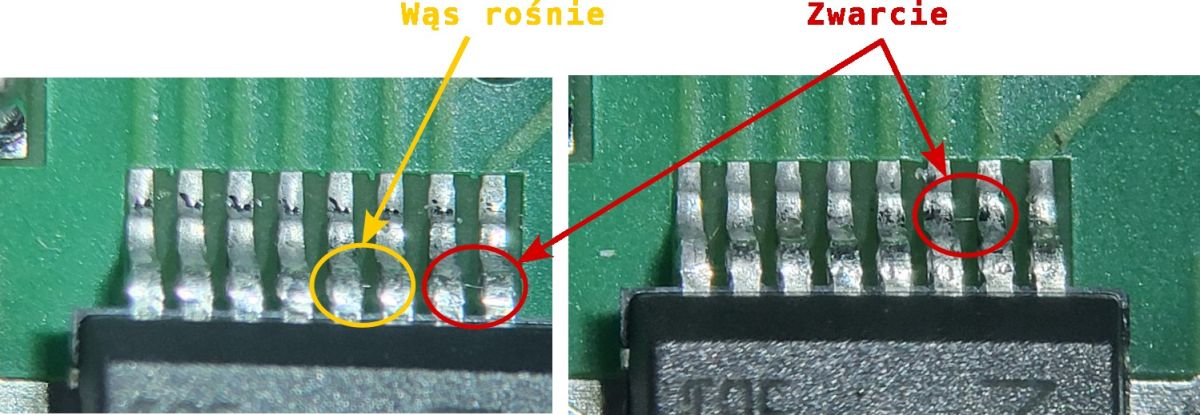
The problem involved two ICs in housings with 0.5mm raster. The distance between the leads is therefore 0.2mm by catalogue. I am posting the pictures. Forgive the quality, but I only have a standard stereo optical microscope and had to take the photo through an eyepiece.
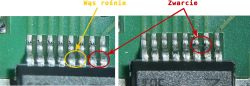
On the first element you can see a whisker that was already making a short circuit and another growing. The second element also had a whisker causing a short circuit. I estimate the width of the whisker (based on the photo) to be around 30-40µm.
After re-soldering the leads, the problem disappeared and the device works properly. Interestingly, on the first component, where 1.5 whiskers can be seen, they grew on the top of the leads, the whisker on the second component grew close to the PCB.
This is the first time I have encountered this type of fault in my devices. I recalled seeing a piece of clean tin. It contained a lot of strange hair-like structures on the outside.
I should point out in advance that I am approaching the subject from the practical side. What puzzles me is the cause of this type of structure and how to deal with it. My guess:
1. Excess solder paste applied to the PCB.
2. The paste was not mixed well enough before being applied to the PCB (?).
3. Residue of unleaded paste in the wrong ratio was left on the paste printer. Remnants of assembly of other boards (?).
4. Mechanical stress (?).
Points 2-4 I cannot verify, so they remain in the realm of conjecture. On the other hand, point 1 is insufficient for the problems described above.
I would like to flag up the problem and encourage Colleagues to discuss.







Comments
Hello, "Washes" are simply metal crystals, the fact that they occur in a particular group of metals is due to their crystallographic arrangement, or more simply: what type of crystals they form. These... [Read more]
Thank you colleague viayner for your substantive response. This is basically an isolated case, so it is difficult to establish any regularity here. To simplify, out of a thousand copies I have never... [Read more]
Hello, the growth of this type of crystal is a difficult process and many conditions must be met simultaneously, which is not often the case. Coming back to the problem, I think that heating the PCB... [Read more]
I had completely forgotten about this phenomenon 😱 somehow it gets overlooked. Thanks for sharing a practical occurrence! Maybe something more @ElektrodaBot will write. What are the dangers of tin whiskers... [Read more]
Short answer Tin whiskers (tin whiskers) are spontaneously growing, conductive, homogeneous tin crystals, growing mainly from pure tin coatings. They threaten bridges and short-circuits - also intermittent... [Read more]
With lead-free alloys this is one problem The other is their hardness and therefore faster cracking away from copper, etc. Apparently, however, manufacturers were supposed to use alloys with a small... [Read more]
Tin whiskers are a profound topic. NASA has a whole page dedicated to this very phenomenon: https://nepp.nasa.gov/whisker/ As you can easily guess, in space missions, where equipment is expected to operate... [Read more]
Entire gallery Link [Read more]
As the name suggests, tin whiskers are made of tin; pure tin, not alloyed with other additives (except silver). From what I have read in a magazine, it is the addition of lead that prevents the formation... [Read more]
It is particularly easy to short-circuit commonly used SMD components. The components are densely spaced, the chip leads densely spaced. So short circuits are not hard to come by. [Read more]
well, maybe not Because it also appears in binders where there is tin and, for example, copper, and if there is Pb this effect is reduced. [Read more]
Tin is a strange metal. Under "normal" conditions it grows hairs, at 230 it melts, but with admixtures it melts much earlier, and at -20, -30 it very quickly changes its allotropic form and becomes a powder... [Read more]
Hello, perhaps, instead of the physical properties of lead, one must look for the chemical properties? In the case of a mixture of the two metals: Sn+Pb, let's look at lead as a surfactant in relation... [Read more]
The growth of tin whiskers has also been observed inside hermetically sealed transistor enclosures, see https://nepp.nasa.gov/whisker/anecdote/af114-transistor/index.html so the influence of atmospheric... [Read more]
I wrote: Hermetically the enclosure was closed, but inside there was nevertheless air and its components trapped. Air is one of the conditions for tin whiskers to grow, but not the only one. Tin whiskers... [Read more]
Another explanation is that the varnish is simply a mechanical barrier through which the whiskers do not grow. Besides, moustaches also grow in a vacuum, according to information from the NASA website: ... [Read more]
Here, the behaviour of the crystal lattices of eutectic alloys would have to be explored further. [Read more]
This is precisely not true. There are HEPA filters but for catching physical contaminants. No filtered air has a chemical composition control. [Read more]
Well, that, and also no one has chemically studied the behaviour of lead particles with tin particles. As I wrote earlier, to me it looks like a surfactant - the heavier lead molecules don't allow the... [Read more]