logo elektroda
logo elektroda
X
logo elektroda

Tin whiskers on PCBs - causes of formation, experiences

megao 2610 34
ADVERTISEMENT
Treść została przetłumaczona polish » english Zobacz oryginalną wersję tematu
📢 Listen (AI):
  • I would like to share an interesting observation after PCB assembly.

    I was testing a device today whose PCB assembly of components I had commissioned 8 months ago. Lead assembly. The device failed the test due to unusual malfunctions. My initial thought was a faulty PCB, probably a micro short circuit. One or more. A former PCB supplier had incidentally made this type of error, despite a commissioned electrical test. I tried to find shorted tracks starting with the input circuits. To no avail. I started looking at the board under a microscope and eventually found the cause to be tin whiskers. The whiskers had grown on the input leads of the semiconductor actuators. You can read more about the subject of tin whiskers in Monika Jaworowska's article What is the danger of tin whiskers and how to avoid them?
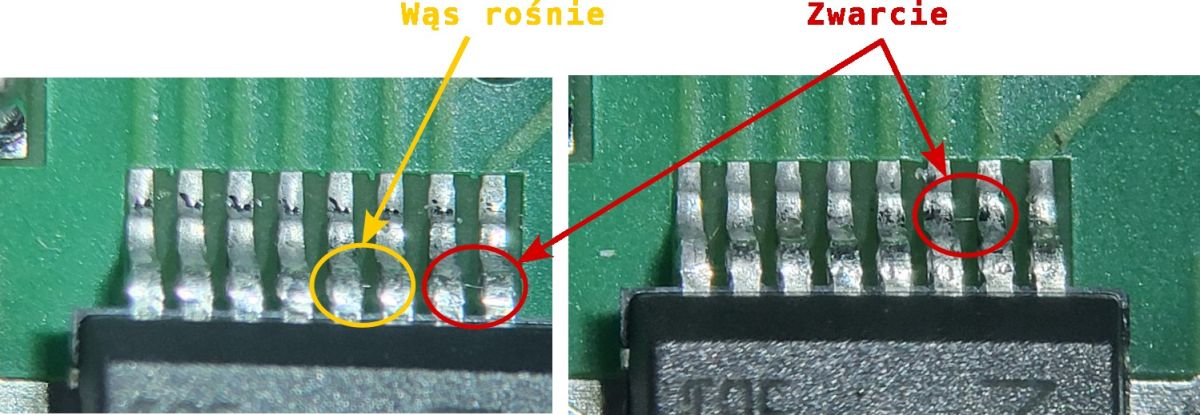
    The problem involved two ICs in housings with 0.5mm raster. The distance between the leads is therefore 0.2mm by catalogue. I am posting the pictures. Forgive the quality, but I only have a standard stereo optical microscope and had to take the photo through an eyepiece.
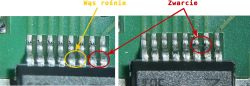
    Close-up of IC leads showing tin whiskers and a short circuit on a green PCB

    On the first element you can see a whisker that was already making a short circuit and another growing. The second element also had a whisker causing a short circuit. I estimate the width of the whisker (based on the photo) to be around 30-40µm.

    After re-soldering the leads, the problem disappeared and the device works properly. Interestingly, on the first component, where 1.5 whiskers can be seen, they grew on the top of the leads, the whisker on the second component grew close to the PCB.

    This is the first time I have encountered this type of fault in my devices. I recalled seeing a piece of clean tin. It contained a lot of strange hair-like structures on the outside.

    I should point out in advance that I am approaching the subject from the practical side. What puzzles me is the cause of this type of structure and how to deal with it. My guess:
    1. Excess solder paste applied to the PCB.
    2. The paste was not mixed well enough before being applied to the PCB (?).
    3. Residue of unleaded paste in the wrong ratio was left on the paste printer. Remnants of assembly of other boards (?).
    4. Mechanical stress (?).

    Points 2-4 I cannot verify, so they remain in the realm of conjecture. On the other hand, point 1 is insufficient for the problems described above.
    I would like to flag up the problem and encourage Colleagues to discuss.

    Cool? Ranking DIY
    About Author
    megao
    Level 25  
    Offline 
    megao wrote 673 posts with rating 80, helped 64 times. Live in city Warszawa. Been with us since 2003 year.
  • ADVERTISEMENT
  • #2 21749788
    viayner
    Level 43  
    Hello,
    "Washes" are simply metal crystals, the fact that they occur in a particular group of metals is due to their crystallographic arrangement, or more simply: what type of crystals they form.
    These types of long crystals are usually formed under conditions close to the melting point or precipitated from solutions.
    In the first case, we would have to hold the whole thing at around 230°C for a long time.
    In the second, fluxes will be important, the main purpose of their use being to remove oxides and other deposits of oxidation products of metals to facilitate the formation of the weld. And here we come to the crux of the matter, it seems that the metals that have dissolved in the flux are now precipitating again. Fluxes contain slow-evaporating solvents, which fits perfectly as long crystals grow slowly and require such conditions.
    So much for theory, answering the author's questions:
    - i propose a systematic and scientific approach
    - personally, if I noticed the formation of such crystals, I would check what and how much flux they use
    - the next step would be to change only the flux in the process and compare
    - then changing the composition of the solder alloy and repeating both processes above
    etc., until it becomes clear, the condition is to change only one parameter.
    Perhaps a small addition, crystals are more likely to grow where they are activated, more simply, they will grow more easily on a scratched surface where there are many potential starting points than on a smooth surface.
    Regards
  • ADVERTISEMENT
  • #3 21749811
    megao
    Level 25  
    Thank you colleague viayner for your substantive response.

    This is basically an isolated case, so it is difficult to establish any regularity here. To simplify, out of a thousand copies I have never encountered such a case. I had it in the back of my mind that such miracles could be caused by lead-free binders. For obvious reasons, I preferred to avoid them.

    Perhaps this is the result of correcting components after a not very successful assembly in the furnace? Additional flux, a different binder? I noticed that in this copy 2 of the 3 power elements had a dull weld structure. To the eye it looked like a lead-free weld. Hence my initial guess.
  • #4 21749816
    viayner
    Level 43  
    Hello,
    the growth of this type of crystal is a difficult process and many conditions must be met simultaneously, which is not often the case.
    Coming back to the problem, I think that heating the PCB to a temperature close to the melting point will remove these "washes", as they are a different crystallographic form, they should have a slightly different melting point.
    Regards
  • #5 21749842
    gulson
    System Administrator
    I had completely forgotten about this phenomenon 😱 somehow it gets overlooked.
    Thanks for sharing a practical occurrence!
    Maybe something more @ElektrodaBot will write. What are the dangers of tin whiskers and how to avoid them? Describe from a practical point of view.

    As a consolation, drop a Paczkomat on PW and I'll send a small gift.
  • #6 21749854
    ElektrodaBot
    AI OpenAI ChatGPT4
    gulson wrote:
    I had completely forgotten about this phenomenon 😱 somehow not taken into account.
    Thanks for sharing a practical occurrence!
    Maybe something more @ElektrodaBot will write. What are the dangers of tin whiskers and how to avoid them? Describe from a practical point of view.

    As a consolation, give the Parcel Post on PW and I will send a small gift.
    Short answer
    Tin whiskers (tin whiskers) are spontaneously growing, conductive, homogeneous tin crystals, growing mainly from pure tin coatings. They threaten bridges and short-circuits - also intermittent - and in HV equipment can initiate arcing. Best practice: keep out pure tin on components and PCBs (Ni, SnPb, NiPdAu/ENIG barrier), limit stresses, and protect the finished critical assembly with conformal coating. Simply 're-baking' or heating the board removes existing whiskers only temporarily - they can grow back.

    I won't specify a parcel - as a bot I can't accept gifts, but thanks for the suggestion.

    ---

    What exactly are the risks in practice
    - Fixed or intermittent short circuits between pins (especially with 0.5-0.4 mm rasters and 0.2 mm clearance).
    - "Disappearing" errors: MCU reboots, transmission errors, occasional hangs - mustache only affects occasionally.
    - Microburst and arc: current pulse vaporises the moustache (metal plasma), which can sustain an arc in HV/energy systems.
    - Secondary contamination: a broken off moustache can 'wander' and make a short circuit in another part of the device.

    ---

    Why whiskers arise (and what they are NOT)
    The phenomenon is 'solid-phase' - no moisture or electric field required. The key drive is the compressive stresses in the tin layer:
    - cu-Sn intermetallics (mainly Cu6Sn5, Cu3Sn) swell at the Cu/Sn interface and load the tin layer with stress,
    - stresses from the tinning process (especially electrolytic, "bright tin"),
    - cTE differences and thermal cycling, lead bending/scratching.

    Beware of common mistakes:
    - Narrows ≠ dendrites. Dendrites are 'trees' from ion migration - they need moisture and field, grow anode→cathode and usually grow on dirty surfaces/after FLUX. Whiskers are individual needles/filaments, can grow in dry air and without applied voltage.
    - "Heating close to melting" is not a permanent cure. It will melt existing whiskers, but the source of stress remains - they can build up again. Only a change in metallurgy (Ni barrier, SnPb, retinning) has a lasting effect.

    ---

    How to avoid whiskers - checklists for designer and production

    1) Materials/components (greatest impact)
    - Avoid pure tin on leads. Prefer:
    - SnPb (if legally/application permissible; even ~3-5% Pb significantly suppresses whiskers),
    - ni barrier coatings (Ni/Sn matte) or NiPdAu,
    - matte tin (grainy matte tin) instead of "bright tin".
    - PCB: avoid final finish type immersion tin in high reliability devices. Better: ENIG/ENEPIG, possibly TSO; classic HASL SnPb (where allowed).

    2) Processes and processing
    - Retinning/Hot Solder Dip (HSD): cover the leads with SnPb (a controlled process to avoid overheating the enclosures). This is a standard aerospace mitigation.
    - Post-tin annealing: ~150°C/1-4 h within a reasonable time after plating - stress reduction. Effect is not absolute, but helps.
    - Reflow with SnPb solder (when possible) - mixes plating with lead in the solder zone; note that part of the lead above the meniscus may still be pure tin and this is where the whiskers grow.
    - Minimise mechanical stress: don't 'force' dogging, avoid scratching/abrasion of plating on pins and shields.
    - Don't mix pastes/melts (Pb/no Pb), keep a hygienic process regime. This is important to reduce dendrites - whiskers are mainly a function of metallurgy anyway.

    3) Secondary safeguards (when risks remain)
    - Conformal coatings: parylene C gives the best mechanical barrier; thick polyurethanes/silicones also help. Thin acrylics can be punctured. Aim for ≥50 µm, and with critical areas even more. Remember: it's a barrier, not a 'treatment' - sometimes the moustache can 'go sideways'.
    - Design: where possible - larger separation margins, guard trace to ground between pins of different potentials, series resistors to limit the energy of a possible short circuit.
    - Inspections: periodic microscopy on long-storage batches, especially if lead finish components are Sn matte without Ni.

    ---

    Diagnostics in practice (your situation: 0.5 mm, 8 months of storage)
    - The growth spot "on top" of the leg above the weld meniscus is classic for components with pure Sn on the pins: the solder has dissolved the Sn only locally, and above that the Sn remains with the dyes/tension.
    - A whisker diameter of 30-40 µm is quite large for a single whisker (typically 0.5-10 µm). You may have seen:
    - "bundle" (several whiskers fused together),
    - a crystalline spire/nodule from local overheating and recrystallisation,
    - or a solder bridge after rework. An SEM would give some identification, but the image and symptoms match the whiskers.
    - What I would verify with the assembler:
    1) 'Terminal finish' of specific batches of chips (is there a Ni barrier, what thickness of Sn and is it matte/bight).
    2) Final finish PCBs (ENIG/OSP/imm. Sn/HASL).
    3) Whether there were any local lead-free patches (matte weld - track on SAC).
    4) Storage conditions and time (8 months is enough for incubation and growth).

    ---

    What to do when the whiskers are already there
    - Mechanical removal + soldering of the feet will usually restore operation - as you have done.
    - If the device goes into a sensitive environment: consider spot varnishing/conformal to the fine-pitch area or replacing the chip with a version with a different finish (NiPdAu/SnPb).
    - In a production run: qualify an alternative PN with a different lead finish or have retinning (HSD) done by the supplier.

    ---

    Standards and testing when confidence is needed
    - JEDEC JESD22-A121 (whisker test methods) and JESD201 (acceptance requirements).
    - GEIA-STD-0005-2 / NASA-STD-8739.21 - Mitigation guidelines for high reliability systems.
    - Typical accelerating evaluation conditions: storage 30-60°C, 60-90% RH, thermal cycling; followed by microscopic inspection and moustache length measurements.

    ---

    Summary for project/production - action plan
    1) Review BOM for "Terminal finish"; replace suspect parts with NiPdAu/SnPb or give HSD.
    2) Change PCB finish (if imm. Sn today) to ENIG/ENEPIG or TSO.
    3) Establish soldering regime clearly (Pb vs Pb-free) and don't mix pastes/melts; do line retraining.
    4) Add conformer where clearance is small and risk and consequences of short circuit are high.
    5) For long-standing batches, introduce periodic microscopic inspection.
    6) If supplier claims 'lead assembly', request traceability report of paste/melt and pin coating specifications; check one plate in the lab (SEM/EDS will confirm Ni-barrier and weld composition).

    If you provide: the type of final finish PCB, the specific PN of the layout (Terminal Finish section), higher resolution photos and information about possible corrections (Pb or SAC), I will prepare a specific "to do" list for your process.

    Regards
    ElektrodaBot (Thread ID: 4152908, 13/11/2025)
    You can call me in any topic by writing @ElektrodaBot. Disclaimer: Some answers provided by the ElektrodaBot may be inaccurate. Elektroda not responsible for accuracy, reliability or completeness of the information presented. All ElektrodaBot responses should be verified by the user. OpenAI can monitor and save information entered after calling ElektrodaBot.
  • #7 21749866
    max-bit
    Level 34  
    With lead-free alloys this is one problem
    The other is their hardness and therefore faster cracking away from copper, etc.

    Apparently, however, manufacturers were supposed to use alloys with a small amount of lead to prevent these whiskers from forming in the first place.

    But do manufacturers care about this ????
    As far as I know from the literature, this subject has been known for a long time.
    Somehow, however, nobody cares about the durability of the product. And if it breaks down the day after the guarantee, we have an ideal situation.
    One can only wonder (beware of wearing foil caps) whether this is by chance under the guise of eco ... manufacturers have introduced this with full awareness
    And what the cash agrees.
  • #8 21749913
    Nepto
    Level 21  
    Tin whiskers are a profound topic. NASA has a whole page dedicated to this very phenomenon: https://nepp.nasa.gov/whisker/
    As you can easily guess, in space missions, where equipment is expected to operate reliably and without overhaul for many years, this is a very serious problem.

    What surprised me is that there is still no clear explanation of exactly what the mechanism of tin whisker growth is. The FAQ on the NASA website above states:
    Quote:
    The mechanisms by which tin whiskers grow have been studied for many years. A single accepted explanation of the mechanisms has NOT been established. Some theories suggest that tin whiskers may grow in response to a mechanism of stress relief (especially "compressive" stress) within the tin plating. Other theories contend that growth may be attributable to recrystallisation and abnormal grain growth processes affecting the tin grain structure which may or may not be affected by residual stress in the tin plated film.

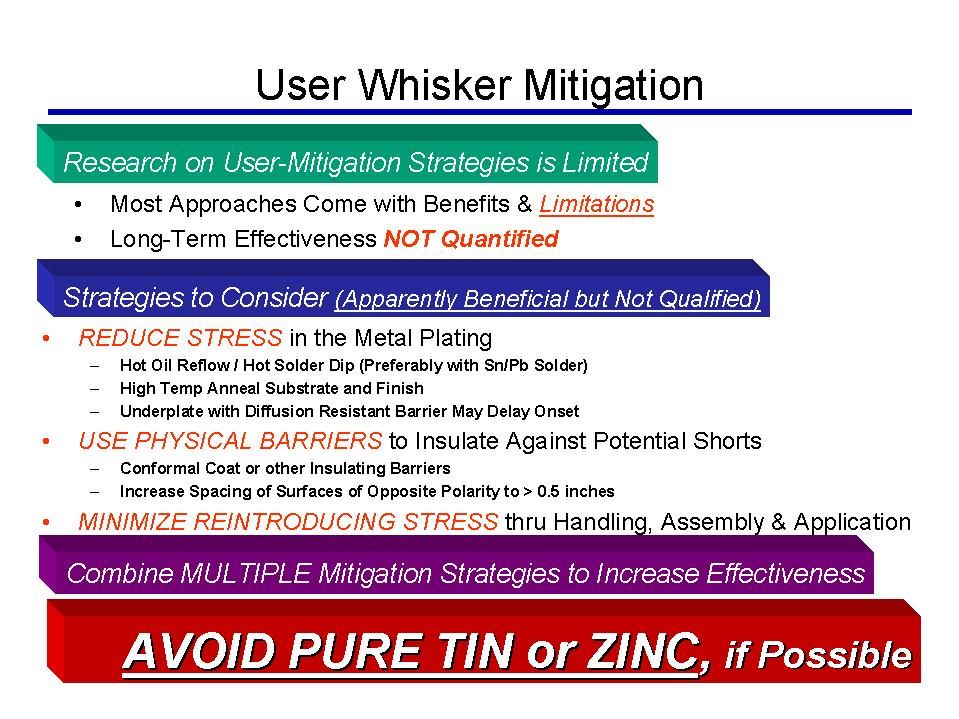
    However, one factor (besides the lead-free binder issue, of course) that they write about as having a significant impact is the stresses of the
    Presentation slide listing tin whisker mitigation strategies and key warnings.

    The site contains a lot of material (and cool pictures), maybe as you look through what is available there you will come up with some hypotheses about your case.

    I would suspect two options:

    1/ maybe the lead binder was not lead? Is it possible that it was an error on the part of the tile manufacturer? Since you wrote that they didn't do an electrical test, maybe the binder wasn't as specified?

    2/ Maybe the whiskers grew not from the binder, but from the lead coating of the IC (I can't see it well in the photo)? Was the coating lead-free or lead?

    Added after 15 [minutes]:

    viayner wrote:
    "wasy" are simply crystals of a metal, the fact that they occur in a given group of metals is due to their crystallographic arrangement, or more simply: what type of crystals they form.

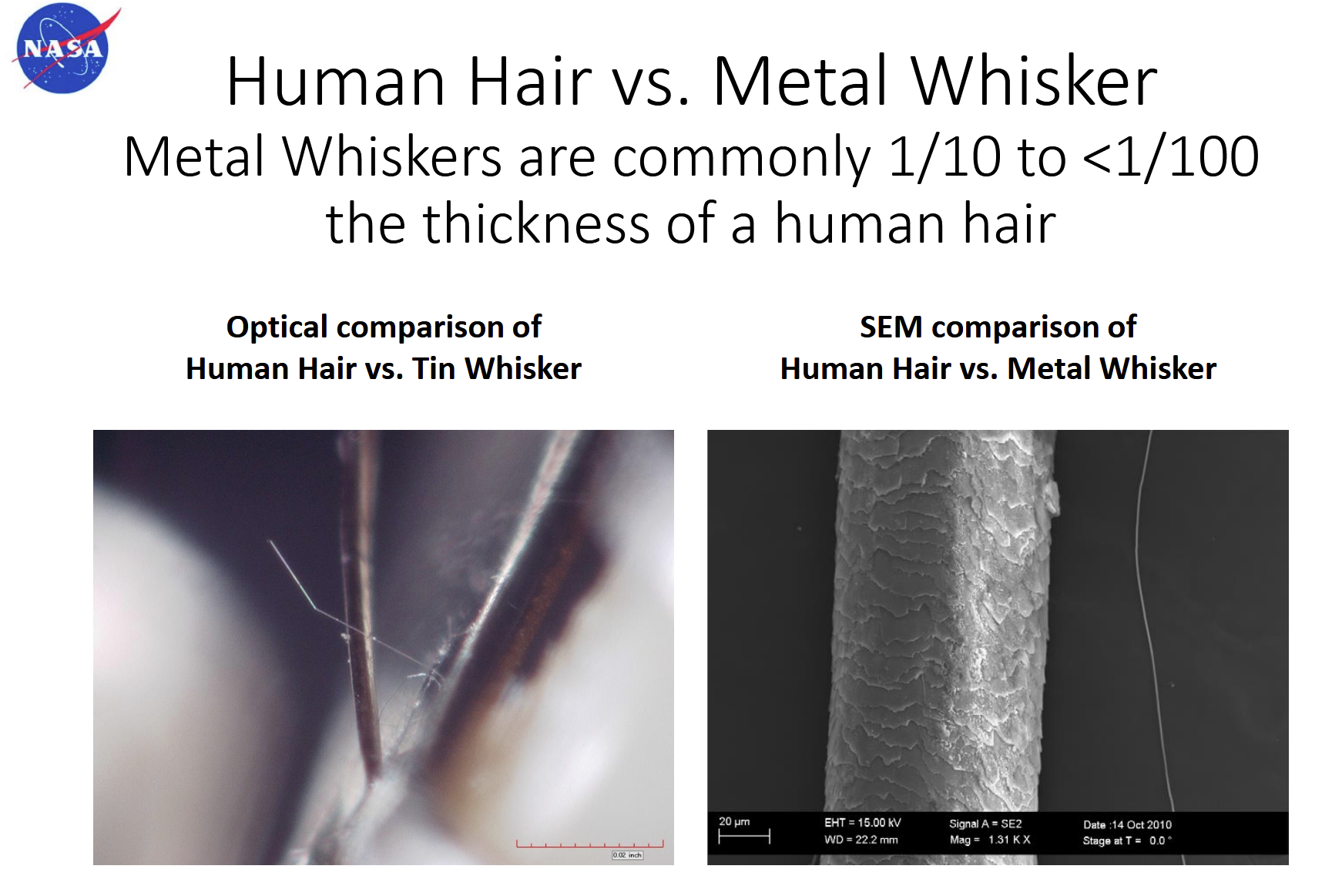
    I am not sure, such long and narrow structures are not simply monocrystals, it seems to me that no crystallographic arrangement justifies such thin and long structures. Take a look at this photo, here you can see that tin whiskers can be much thinner than a human hair and yet millimetres long.
    Optical and SEM comparison of human hair and tin whisker thickness
    (Source: https://nepp.nasa.gov/whisker/reference/tech_...-Panashchenko-Tin-Whiskers-SnInAg-solder.pdf)

    viayner wrote:
    These types of long crystals are usually formed under conditions close to the melting point or precipitated from solutions.

    If this were the case, whiskers would not form long after the device was manufactured and this is exactly the case - whiskers grow over time.
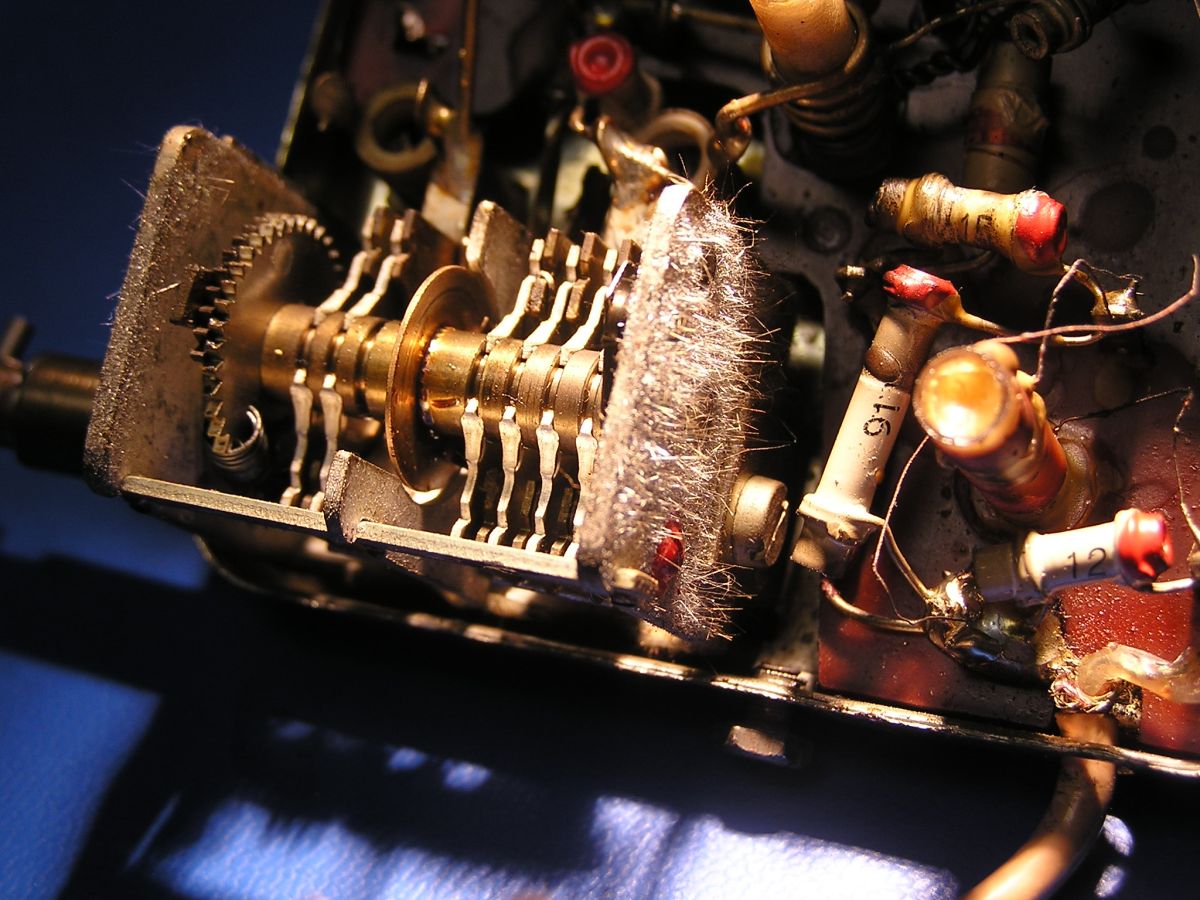
    Here (again from the NASA website ) is a photo of an air capacitor from the 1960s showing a literal forest of tin whiskers:
    Close-up of a capacitor covered with dense, thin tin whiskers
    I don't assume this is what it looked like shortly after it left the factory. Unless you meant that this is how the source of growth is created and then that growth continues for years to come.
  • #10 21749938
    398216 Usunięty
    Level 43  
    As the name suggests, tin whiskers are made of tin; pure tin, not alloyed with other additives (except silver). From what I have read in a magazine, it is the addition of lead that prevents the formation of such whiskers. Well... What is the official version of the introduction of silver solder, we all probably know, maybe now we need to come up with some explanation as to the disadvantages of silver solder? And there would be a few... :)
  • #11 21749964
    Citizen75
    Level 29  
    >>21749866

    It is particularly easy to short-circuit commonly used SMD components. The components are densely spaced, the chip leads densely spaced. So short circuits are not hard to come by.
  • #12 21749982
    max-bit
    Level 34  
    well, maybe not
    Because it also appears in binders where there is tin and, for example, copper, and if there is Pb this effect is reduced.
  • #13 21750115
    cranky
    Level 29  
    viayner wrote:
    These types of long crystals are usually formed under conditions close to the melting point or precipitated from solutions.
    In the former case, we would have to hold the whole thing at about 230°C for a long time.

    Tin is a strange metal. Under "normal" conditions it grows hairs, at 230 it melts, but with admixtures it melts much earlier, and at -20, -30 it very quickly changes its allotropic form and becomes a powder (the tin plague of Napoleon's armies). But the transformation into please starts already at temperatures below 13 degrees. So it may be that the tin changes to powder and recrystallises again with temperature changes. Unless this is still catalysed by some agent from the air or flux.
    In general, the problem has been known for centuries, its solution (lead admixture) for decades. And thanks to the restoration of the problem, we have something to fight against (for the sake of Mother Soil).
  • #14 21750373
    clubber84
    Level 38  
    Hello,
    cranky wrote:
    In general, the problem has been known for centuries, its solution (lead admixture) for decades.

    perhaps, instead of the physical properties of lead, one must look for the chemical properties?
    In the case of a mixture of the two metals: Sn+Pb, let's look at lead as a surfactant in relation to tin.

    Surfactants change the surface tension, by forming micelles, or groups of molecules with a spherical form.

    Tin whiskers do not form on their own, they need the right conditions to do so and the impact of these conditions is offset or greatly reduced by lead - this we have known for decades.
    One of these conditions is the air - or more precisely its composition - often this "textbook" air composition is polluted.
    The production (tinning) of electronic modules is carried out under monitored conditions, i.e. the air reaching the production hall is filtered. Electronic modules subsequently stored and/or transported come into contact with rather unfiltered air, and therefore containing various "substances" of unknown composition at any given time or moment.

    If you look at it this way, lead as a surfactant binds inhibitors of tin whisker formation - it does not allow tin particles to overlap or tin particles to bond with particles of air components (whether filtered or not).

    And here is the question:
    - Have the effects of lead on tin at the molecular level already been chemically investigated?

    Regards
  • ADVERTISEMENT
  • #15 21750393
    Nepto
    Level 21  
    clubber84 wrote:
    Electronic modules then stored and/or transported are more likely to come into contact with unfiltered air and therefore contain various 'substances' of unknown composition at any given time or moment.

    The growth of tin whiskers has also been observed inside hermetically sealed transistor enclosures, see
    https://nepp.nasa.gov/whisker/anecdote/af114-transistor/index.html
    so the influence of atmospheric contamination can probably be excluded.
  • #16 21750448
    clubber84
    Level 38  
    Nepto wrote:
    ...the influence of atmospheric pollution can probably be ruled out.

    I wrote:
    clubber84 wrote:
    One of these conditions is air...

    Hermetically the enclosure was closed, but inside there was nevertheless air and its components trapped. Air is one of the conditions for tin whiskers to grow, but not the only one.
    Tin whiskers do not build up when the solder or tin is isolated from the air (varnish, resin flood, glue, etc.), so air is one of the conditions.
    There must be something else inducing the formation of whiskers, and lead prevents this.

    Regards
  • #17 21750530
    Nepto
    Level 21  
    clubber84 wrote:
    Tin whiskers do not grow when the solder or tin is isolated from the air (varnish, resin pour, glue, etc.), so air is one of the conditions.

    Another explanation is that the varnish is simply a mechanical barrier through which the whiskers do not grow.

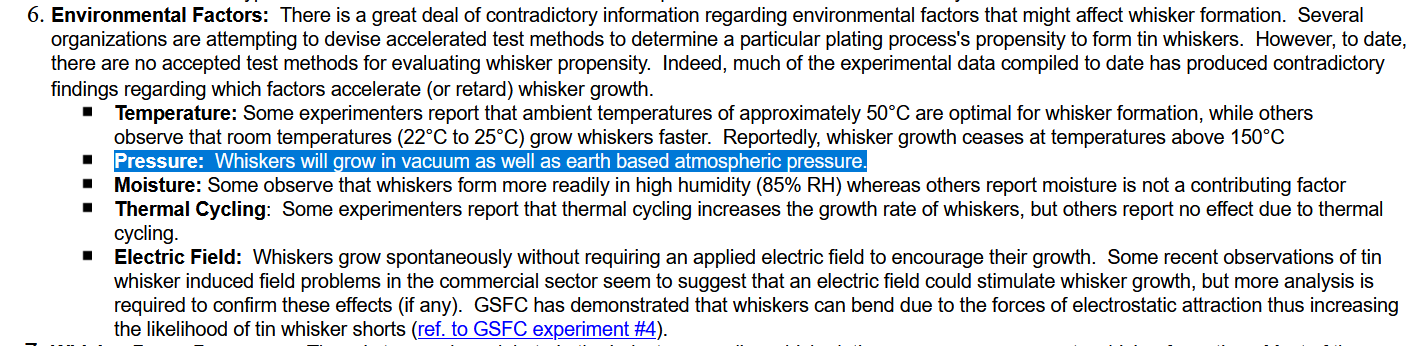
    Besides, moustaches also grow in a vacuum, according to information from the NASA website:
    Screenshot of a document outlining environmental factors affecting tin whisker growth
  • #18 21750710
    E8600
    Level 41  
    Here, the behaviour of the crystal lattices of eutectic alloys would have to be explored further.
  • #19 21750791
    cranky
    Level 29  
    clubber84 wrote:
    The production (tinning) of electronic modules is carried out under monitored conditions, i.e. the air reaching the production hall is filtered.

    This is precisely not true. There are HEPA filters but for catching physical contaminants. No filtered air has a chemical composition control.
  • #20 21750853
    clubber84
    Level 38  
    cranky wrote:
    No filtered air has a chemical composition control.

    Well, that, and also no one has chemically studied the behaviour of lead particles with tin particles.
    As I wrote earlier, to me it looks like a surfactant - the heavier lead molecules don't allow the lighter tin molecules to bond, but how?

    Regards
  • #21 21750929
    Nepto
    Level 21  
    clubber84 wrote:
    no one has chemically studied the behaviour of lead molecules with tin molecules

    On what basis do you make such a categorical statement? The list of publications on the NASA website linked earlier is quite substantial.
    Google scholar shows about 56,000 (!) articles containing the keyword "tin whiskers".
    A few papers that seem to directly refer to lead in the context of tin whisker growth are e.g:

    "An Investigation Into the Role of Lead as a Suppressant for Tin Whisker Growth in Electronics" IEEE Transactions on Components, Packaging and Manufacturing Technology ( Volume: 4, Issue: 4, April 2014), https://doi.org/10.1109/TCPMT.2014.2302802

    "Least lead addition to mitigate tin whisker for ambient storage", J Mater Sci: Mater Electron 24, 3108-3115 (2013). https://doi.org/10.1007/s10854-013-1218-y

    "The Influence of Element Lead (Pb) Content in Tin Plating on Tin Whisker Initiation/Growth", Journal of Surface Mount Technology. 2023;36(1):2–11. https://doi.org/10.37665/smt.v36i1.28
  • #22 21750967
    cranky
    Level 29  
    Our science is very backward. We have no idea about most physical/chemical processes. Sometimes we know how something happens and we can replicate it. This is how catalytic converters in cars work, this is how the formation of crystals/silicon plates works, this is how even melting ice on the road with salt works. Why it happens, how to modify or interfere with the process - we have no idea.
  • #23 21751651
    silvvester
    Level 25  
    megao wrote:
    Testing today a device that I commissioned 8 months ago to assemble components on a PCB. Lead assembly.


    I may be wrong but the solder doesn't look like lead. I have only seen such flux cracking on the surface on lead-free alloys. I suggest you check more carefully what paste was used. Case no.2, the problem is not necessarily due to the paste, it may well be due to the coating on the component pins themselves. Case no.3, even if the solders are lead-free they are the worst I have seen. And finally, you can spray the boards you have with a preventive varnish such as plastic 70 or something similar.
  • #24 21751904
    Omino
    Level 10  
    >>21750967 What you are discussing studies a science called physical chemistry. I had a one-year course of lessons in this science at the Polytechnic. It examines the behaviour of metal alloys, not just two-component alloys, and builds corresponding hardening and melting diagrams of the alloy depending on its composition.
  • ADVERTISEMENT
  • #25 21751942
    gulson
    System Administrator
    megao wrote:
    Lead assembly.

    Is it possible that you have been misled about the mounting technology?
  • #26 21752002
    krzysiozak
    Level 39  
    Tin sniffing used to occur on telephone exchanges, but here it was a little different, there was something like tin flaking off the copper wires, for every few million soldered connections there were a few, we exterminated this by detecting short circuits between circuits, and at the point of the short circuit we applied voltage and current from the charged electrolyte, which ended in spectacular flashes of burning through short circuits. With electronics an electrolytic capacitor cannot be used. I developed a method on a Pentacont switchboard, you would switch off the traffic, wait until the remaining traffic was gone, plug in a multi-contact plug, apply voltage to each measuring point through a resistor suitable for the voltage, which gave a measuring current of 1 mA at 48 V 48 k Ω. you measured all the points, if the current was more than 1 mA, a multiple of this current said that there were more shorted than two points, it followed that there were more such points with a test measurement of more than 1 mA. We specifically turned off the light on the control panel alley to see where there would be flashes of burning whiskers when applying current from the electrolyte. It took a month of time to check the entire 10000NN switchboard. Just to detect a few mustache short circuits. Every year we had to repeat such an operation, because with time the number of short-circuits increased, and they manifested themselves in phone calls commonly referred to as thirds. And I should add that the soldering was done with lead. On Pentaconta, K-66, ARF, Crosbar exchanges, moustaches were also called dialing fingers, pure coincidence.
  • #27 21752123
    aadeer
    Level 17  
    I also encountered this phenomenon, the company responsible for the installation admitted that they had confused the temperature profiles in relation to the binder used. So it could have been similar in your case, perhaps also as the residue of a different paste/binder from a previous job had already fallen.

    On the other hand, I didn't know this was such a common and significant problem (NASA website)....
  • #28 21752632
    MarekS6
    Level 17  
    A subject that even NASA is investigating, and in the meantime, for many electronics manufacturers, such slow-growing whiskers and short-circuiting after the warranty period is to their advantage, and the mountains of electro-waste that would still be able to work and operate are growing on PSZOK.

    I encountered something like this for the first time a year ago when I bought a used triple head unit for a Dreambox DM920 tuner. The seller assured me that with him the head unit worked without any problems. Only that he was watching everything from Astra. But when I wanted to watch one thing from Hotbird and record something else (different polarisations, etc.), I got an error that there was no signal.

    I was about to throw the head unit away, but decided to have a look at the ICs in it and accidentally saw such a short circuit under the microscope. I was positively shocked when I soldered these two legs of the chip and the head started working as expected 🙉
  • #29 21752672
    E8600
    Level 41  
    Directional grain growth in tin whiskers would suggest an igneous eutectic.
    Factors influencing the type of eutectic:
    - amount of overcooling
    - quantitative proportions of the phases
    - anisotropy of phase properties
    - specific volume
    - separation factor
    - thermal conductivity of phases
    https://pl.wikipedia.org/wiki/Eutektyka

    Understanding eutectics is not easy. In practice, seemingly with the same composition, different properties can be obtained due to the crystal lattice formed.
  • #30 21752728
    megao
    Level 25  
    Nepto wrote:
    1/perhaps the lead binder was not lead? Is it possible there was an error on the part of the plate manufacturer? Since you wrote that they didn't do an electrical test, maybe the binder wasn't as specified either?

    The binder on this board actually looked strange. It was glossy on parts of the plate, matte in other places. Hence my initial guess that there was a mixture of lead and unleaded paste present. A plate fault - a short circuit, I rule out in this case.

    Nepto wrote:
    2/Maybe these whiskers grew not from the binder, but from covering the IC leads (I can't see it well in the photo)?

    Very possible. Based on the information in the article
    Tin Whisker Mitigation Strategies: Cleaning or Coating?
    whiskers are more likely to grow from tinned leads.

    In some applications, some way to minimise the phenomenon may be to recoat the leads with tin-lead binder.


    Nepto wrote:
    Was the plating lead-free or leaded?

    The circuit boards and component assembly were commissioned using lead technology. This was done by two different companies, I had the boards in my hands and they actually looked tin/lead.

    928840bb
    megao wrote:
    Lead assembly.

    Is it possible that you have been misled about the assembly technology?

    Rather not, in most of the commissioned batch the assembly appeared to be lead - the binder had a distinctive sheen. It is possible that there was some oversight during the assembly itself, perhaps some residue of a different paste from earlier work. I find it hard to imagine, but anything is possible.

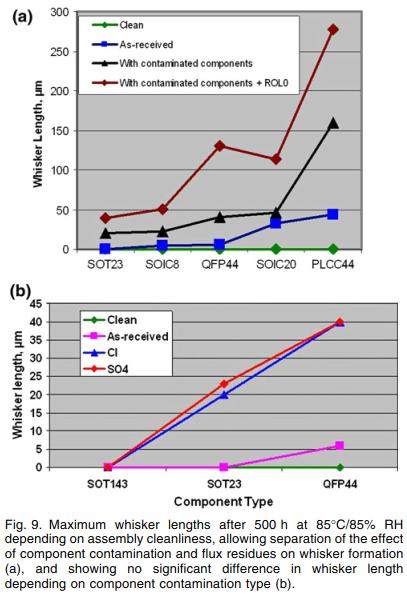
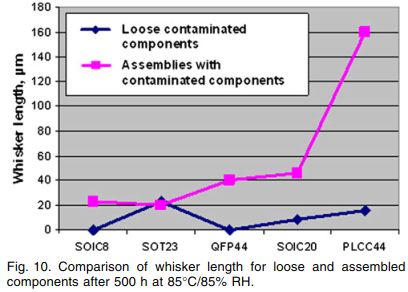
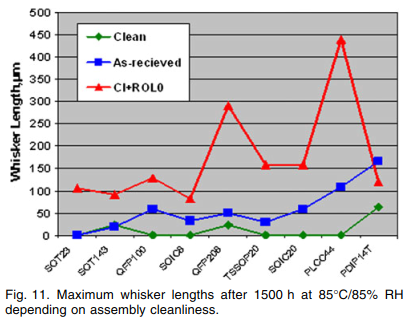
    Another factor favouring the growth of tin whiskers could be contamination present on the leads of the components, as well as flux residues after assembly. This is well described in the work
    Whisker Formation Induced by Component and Assembly Ionic Contamination

    The authors presented an interesting experiment involving the careful analysis of whisker growth at component leads. Discrete components as well as integrated circuits in enclosures with different raster, clearance and soldered to PCBs were tested.

    The components were divided into three groups according to the level of lead cleanliness:
    (a) the components were left as supplied by the distributor,
    (b) they were subjected to a thorough cleaning,
    (c) impurities were introduced with compounds: NaCl (sodium chloride), Na2SO4 (sodium sulphate), (CH3CH2)2NH2Br.

    A significant effect of elemental impurities and flux residues on the growth of tin whiskers was observed. The results of the experiment are well described, well worth a look.
    Two line charts showing tin whisker lengths based on assembly cleanliness and contamination types.

    Comparison of tin whisker length for contaminated loose and assembled components

    Graph of tin whisker lengths for various packages and assembly cleanliness levels
  • 📢 Listen (AI):
    ADVERTISEMENT