logo elektroda
logo elektroda
X
logo elektroda

The most shot-put components - a few words about noise filters and RIFA capacitors

filipcichowskidev  41 2124 Cool? (+6)
📢 Listen (AI):

TL;DR

  • Polish measurement equipment often uses Silesia mains filters and notorious RIFA paper capacitors that fail after decades.
  • The filter topology uses an input choke for common-mode noise, two Y capacitors to earth, and an X capacitor across L and N for differential noise.
  • In HP digital oscilloscopes from the 1990s, these capacitors were built into filters integrated into the socket and switch.
  • Cracked resin lets moisture in, the capacitors leak, and the filter can explode, swell, or spray tar inside the unit.
  • Repairs usually mean replacing them with film or polypropylene capacitors such as WIMA or Wurth Electronics, or removing the filter entirely.
Generated by the language model.
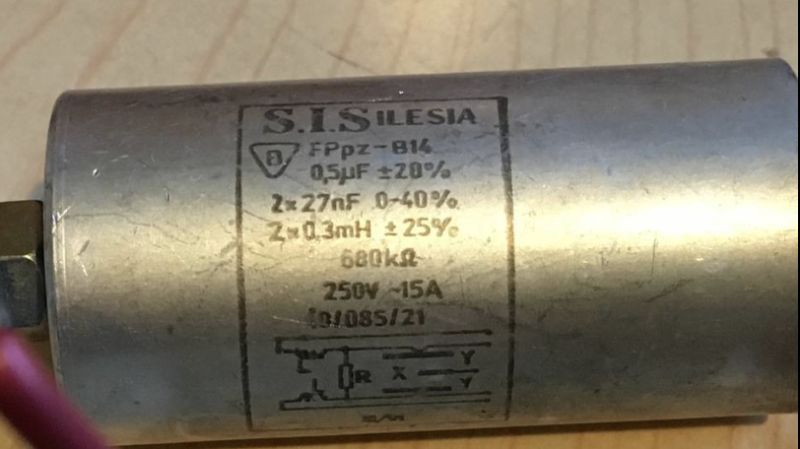
Metal enclosure of S.I.S Silesia EMI filter with printed electrical specifications

In Polish measurement equipment it is common to find filters manufactured by Silesia . The diagram on the chassis allows discussion of each part of this filter - the purpose of the choke at the input is to suppress common mode interference ( common-mode interference ), that is, interference that occurs simultaneously on the L and N wires relative to PE. Two capacitors of type Y form a low impedance path to earth for high frequency currents. The capacitor type X is intended to suppress differential interference ( differential-mode ), i.e. that which occurs between the L and N conductors. It acts as a shunt for high-frequency currents, allowing them to flow past the receiver (the rest of the device).

What are the problems with them?

These filters were built using paper capacitors. The filter housing was filled with tar and the whole thing was sealed with epoxy resin. After years, this resin often cracks and moisture gets inside. The capacitors get leakage, so several things can happen. It usually ended up that when plugged in, the filter explodes with a big bang or slowly expands, pelting the inside of the unit with tar. The repair is to remove the filter, which can be replaced with a modern factory design made with film capacitors, or it can simply be cut out, reckoning with a higher level of interference. The tar can be easily removed with either extraction petrol or WD-40.

The story is very similar with RIFA capacitors.
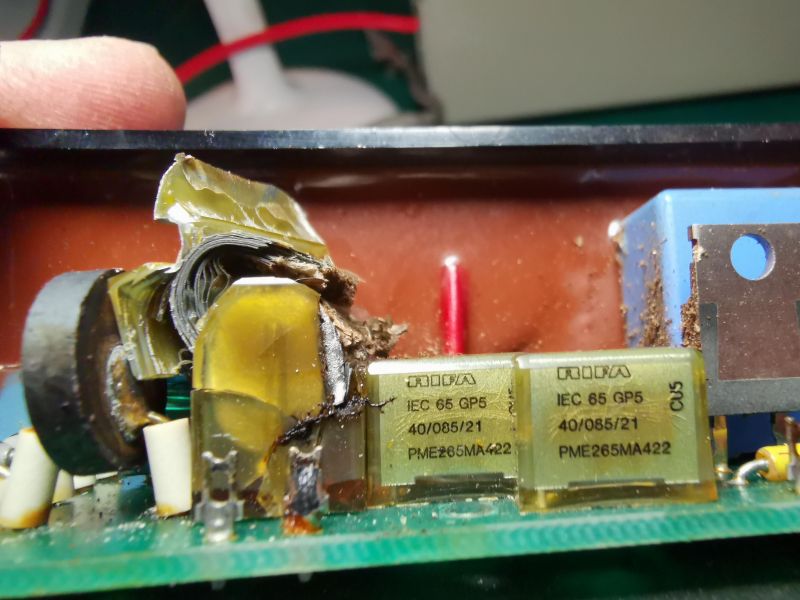
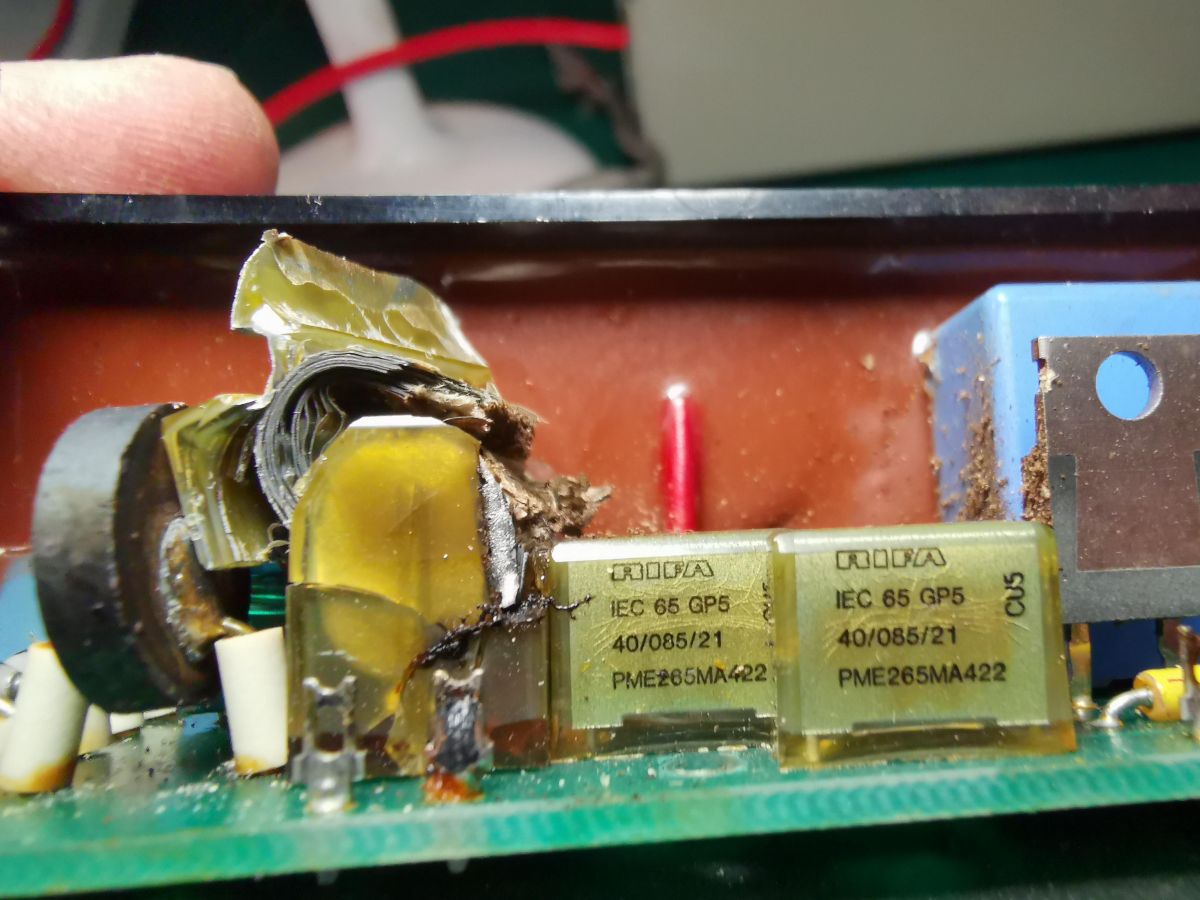
Damaged RIFA paper capacitor on a PCB, partially blown open with foil exposed


Some say that Surstromming is the worst thing the Swedes have given the world, but my poll winner is these paper capacitors. The EEV Blog forum community often jokes that an extension of the name RIFA is " replace if found, always! " The capacitor housing is simply a layer of resin that cracks after years and leakage occurs. I have repaired quite a lot of Tektronix brand measuring equipment by simply replacing the RIFs with good quality polypropylene capacitors WIMA or Wurth Electronics .

The problem is not Tektronix's domain - in HP digital oscilloscopes from the 1990s, such capacitors sat in filters integrated into the socket and switch. Worst case - it's hard to get such a filter for anything.


About Author
filipcichowskidev wrote 53 posts with rating 86 , helped 3 times. Been with us since 2025 year.

Comments

ArturAVS 09 Dec 2025 10:11

What do you see as the problem? These were the elements then, and these were used. Every filter from the factory has a data sheet with the most important parameters to help you choose a replacement. [Read more]

filipcichowskidev 09 Dec 2025 11:32

The problem I see is that someone could be electrocuted by such a faulty filter. Such components were used then, but today we have 2025 and better capacitors. Let me give you an example from work: we... [Read more]

ArturAVS 09 Dec 2025 11:41

And what did you expect from such a vintage piece of equipment? That each component would hold its parameters for 50 years? So before measurements, they had to be upgraded to modern components. They... [Read more]

filipcichowskidev 09 Dec 2025 11:49

This was a 2013 power supply.... I would expect it to be working normally like this after 12 years when someone has shelled out 20k to buy professional equipment. Surely normal capacitors could have been... [Read more]

ArturAVS 09 Dec 2025 11:57

And it doesn't have to meet current legal/technical requirements. What matters is that it met them at the time it entered the market. The same applies to electrical installations, for example. Does a... [Read more]

filipcichowskidev 09 Dec 2025 12:36

I see that this has not resonated. No standard that I know of allows 10 mA to flow between PE and L. This is already a noticeable current flow. A healthy person should be fine if such a current flows... [Read more]

ArturAVS 09 Dec 2025 13:38

The current standards are a different matter, the plant standards are "standards internal " and are not of general application in the legal sense of them (the standards). A device that complied with... [Read more]

filipcichowskidev 11 Dec 2025 11:58

Regulations and standards aside, let's both agree that if we have a leakage of 10 mA, that's a problem that needs to be fixed? [Read more]

ArturAVS 11 Dec 2025 12:18

Of course! I don't remember the exact value anymore, but it was a few uA. [Read more]

filipcichowskidev 11 Dec 2025 18:06

Slightly more, as according to EN 50699 0.75 mA under normal conditions. [Read more]

398216 Usunięty 11 Dec 2025 23:20

As for the topic itself - it was posted in the wrong section in my opinion. There are much more appropriate places on the forum for this type of topics treating typically occurring defects in electronic... [Read more]

tos18 11 Dec 2025 23:59

Not just the Rifa. Wima MP3 X2 - it blazed like New Year's Eve and smoked up the whole room.It made a mess of the power supply by throwing black stuff all around. Just a malfunction. [Read more]

koko0 13 Dec 2025 18:33

Rifles commonly used in Revox equipment. Some do not replace them to this day, and write that the device after service..... [Read more]

DJ MHz 13 Dec 2025 18:50

I recently replaced the Rify in the softstart with new Rify. Good to know :D next time I will give something better [Read more]

gregor124 13 Dec 2025 19:57

A little strange when you consider that RIFA AB ended capacitor production in 1988. And new buyer Finvest Oy rebranded RIFA as Evox Rifa AB in the same year. And finally Evox RIFA in 2007 was acquired... [Read more]

DJ MHz 14 Dec 2025 00:07

Yes, tme sells as Kemet, but parts come branded Rifa [Read more]

Ktoś_tam 14 Dec 2025 15:26

Why did the current electrocute Zdzisio if, as you write, there is PE? Was the installation also faulty? Well yes, old installation and nails instead of fuses. Perhaps to add to the drama there was phase-to-phase... [Read more]

Wawrzyniec 14 Dec 2025 16:53

Some people have quite a fantasy or a lack of foundation in the subject they assume. [Read more]

filipcichowskidev 14 Dec 2025 17:41

The story is, of course, exaggerated and coloured, inserted for humorous reasons - with a working installation, the differential should work. However, in many older houses I have seen some hmmm odd... [Read more]

FAQ

TL;DR: Old Silesia/RIFA-style EMI filters use 2 Y capacitors to earth and are known to crack; “replace if found, always!” applies. [Elektroda, filipcichowskidev, post #21775596]

Why it matters: This FAQ helps bench technicians and restorers spot failing mains filters and choose safe, modern replacements, reducing shock risk and downtime.

Quick Facts

What exactly fails in old Silesia/RIFA mains filters?

Paper-dielectric X and Y capacitors absorb moisture after the resin case cracks. Leakage rises, leading to smoke, bangs, or tar ejection. The common‑mode choke usually survives. The EEVBlog rule of thumb quoted is “replace if found, always!” because these parts age poorly. [Elektroda, filipcichowskidev, post #21775596]

How much leakage current is acceptable during safety testing?

Use 0.75 mA under normal conditions per EN 50699 as a practical acceptance figure in PAT workflows. If you read values near or above this, investigate immediately. “Safety limits exist for a reason.” Replace suspect X/Y caps before returning the device to service. [Elektroda, filipcichowskidev, post #21778064]

I measured 10 mA from L to PE. What should I do first?

Isolate mains, discharge capacitors, and inspect X/Y caps for cracks or discoloration. Replace degraded paper capacitors with modern polypropylene film parts, then retest insulation/leakage. A real case showed 10 mA L–PE; replacing cracked RIFAs with Würth restored compliance the same day. [Elektroda, filipcichowskidev, post #21775678]

What are X and Y capacitors in EMI filters?

X capacitors connect across L–N to suppress differential‑mode noise. Y capacitors connect from L and N to PE to shunt common‑mode noise. Old paper types drift and leak; modern polypropylene X2/Y2 parts are safer and more reliable. [Elektroda, filipcichowskidev, post #21775596]

Why do these filters fail after years of service?

They operate hot and across the mains from power‑on to power‑off. Aging, voltage spikes, and poor historical materials accelerate dielectric breakdown. As one expert notes, components can fail “by themselves” after decades; this is a known lifecycle outcome. [Elektroda, 398216 Usunięty, post #21778433]

Are WIMA MP3 X2 or other brands immune to this problem?

No brand is immune to misuse or aging. Users reported a WIMA MP3 X2 that blazed and contaminated the supply. Select suitable class‑rated film parts, observe temperature and surge ratings, and locate them away from heat sources. [Elektroda, tos18, post #21778451]

Can modern equipment still show RIFA branding?

Yes. RIFA AB ended capacitor production in 1988; the brand moved through Evox Rifa and later KEMET (2007). You may still see RIFA‑marked stock or labeling even when supplied under KEMET. [Elektroda, gregor124, post #21779893]

Does older gear have to meet today’s safety standards?

Legally, equipment must meet the standards that applied at market entry. Current requirements do not retroactively bind earlier devices. Your workplace can impose stricter internal policies for continued use, though. [Elektroda, ArturAVS, post #21775715]

What’s the difference between common‑mode and differential‑mode noise?

Common‑mode noise appears on L and N simultaneously relative to PE; the choke and Y caps shunt it to earth. Differential‑mode noise exists between L and N; the X cap suppresses it across the line. [Elektroda, filipcichowskidev, post #21775596]

How do I retrofit a failed Silesia can filter with discrete parts?

  1. Remove the potted can and clean tar residue with extraction petrol or WD‑40. 2. Recreate the topology: common‑mode choke, two Y caps to PE, one X across L–N, all class‑rated film types. 3. Verify wiring, then run insulation and leakage tests before power‑up. [Elektroda, filipcichowskidev, post #21775596]

Are RCDs appropriate in TN‑C installations for these issues?

No. In TN‑C, protective earth and neutral are combined; RCDs are not applied. Use RCDs in TN‑S. A poster clarified their earlier mistake, noting RCDs fit TN‑S, not TN‑C. [Elektroda, filipcichowskidev, post #21781367]

I can’t source a 1990s IEC inlet filter from HP—what now?

Those combined switch‑socket filters can be hard to obtain. Consider bypassing the failed module and recreating the filter with discrete class‑rated film X/Y caps and a choke, observing creepage and wiring discipline. [Elektroda, filipcichowskidev, post #21775596]

Were RIFA capacitors common in Revox equipment?

Yes. Users report RIFA parts widely used in Revox gear, with some still not replacing them during service. Proactive replacement reduces future failures. [Elektroda, koko0, post #21779811]

What pre‑power checks should I perform on vintage mains gear?

Use an insulation tester before any live work, wear insulating gloves and goggles, and inspect transformer leads and sleeving. Replace degraded mains parts first, then power through an isolation transformer or variac. “A little paranoia never hurts.” [Elektroda, filipcichowskidev, post #21781219]

How do I clean up after a capacitor ‘tar bomb’ inside equipment?

Mechanically remove chunks, then dissolve residue using extraction petrol or WD‑40. Protect coils and delicate parts from solvents, and re‑varnish if needed. Finish by replacing the failed capacitors with polypropylene film types. [Elektroda, filipcichowskidev, post #21775596]
Generated by the language model.
%}