In recent years, designs, mainly acoustic amplifiers, based on germanium transistors have become increasingly popular among audiophiles. They are increasingly competing with tube amplifiers, even though germanium transistors are now increasingly difficult to find on the market. What is the basis of their popularity? Do germanium transistors really have their advantages and do designs based on these elements sound better than those using silicon transistors? We will try to clarify this in this article.
Germanium was the first semiconductor material used on a large scale to manufacture transistors, diodes and other electronic components. Germanium transistors, whose production began in the 1950s, revolutionised electronics and ushered in the decline of the vacuum tube era, at least in some areas. Unlike tubes, transistors do not require heating of the cathode or the use of a high anode voltage. They are also much smaller, which has enabled the development of truly portable devices.
However, germanium transistors also have their disadvantages, especially when compared to the silicon transistors that soon followed. Firstly, they are expensive because germanium is a relatively rare and difficult element to mine. It is estimated that the germanium content of the Earth's crust is around 0.0007%, while silicon is around 20%. The latter is found almost everywhere, literally even under our feet.
Even leaving aside the high price, we have to contend with a number of limitations when it comes to germanium semiconductor components:
High temperature sensitivity. Germanium is characterised by a much smaller energy gap compared to silicon. This makes germanium components thermally unstable and easily damaged at higher temperatures, and their performance changes drastically with increasing temperature. Even when soldering germanium elements, they had to be protected from crystal heating - the temperature should not exceed 75-85°C.
High reverse current. Germanium transistors and diodes have a high reverse current, which increases with increasing temperature.
Low frequency of operation. Low frequency of operation
Small transistor gain factor.
Germanium is also very sensitive to external influences. Therefore, germanium components require a hermetic enclosure.
Despite this, germanium elements are once again attracting interest among audio enthusiasts, mainly because of their supposedly specific sound. In reality, the sound itself does not depend directly on the material of the semiconductor elements. Rather, the character of the sound is due to specific distortions, a result of the way electronic circuits were designed in the old days.
As with tubes, we are dealing here with a subjective assessment of sound quality. The aim is not to reproduce the sound 100% from the source, as in Hi-Fi equipment, but to add a certain note of nostalgia - so that the sound evokes associations with childhood or youth.
Retro audio enthusiasts highly appreciate the sound of amplifiers made according to classic schemes, with transformers in the final (coupling and output) stages. These are the ones that to a large extent introduce a certain timbre to the sound.
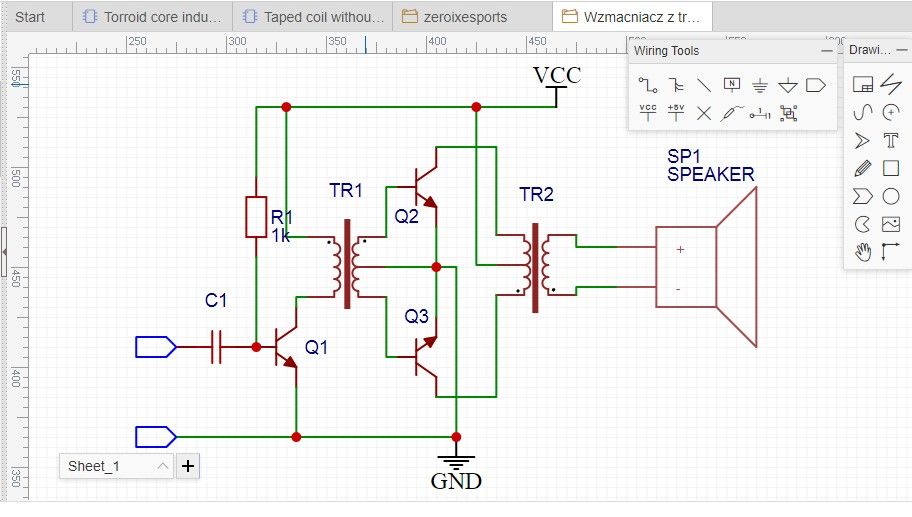
Of course, there are also amplifiers based on germanium transistors without transformers. However, due to their lower amplification factor, they are usually equipped with an additional stage that imparts the desired timbre to the sound through the introduced distortion.
A typical schematic of a transformerless amplifier looks as follows:
Amplifier without transformers. source:
https://cxem.net/sound/amps/amp259.php
As you can see, there is a complementary pair in front of the terminal transistors. A few days ago there was a question on the forum why amplifiers on germanium transistors are so often made with a transformer. I already explain.
In the early days of solid-state electronics, transistors were relatively expensive and their performance was very unstable. This was due to the fact that germanium is a rather capricious material and the technology for its production was not yet well developed. In order to achieve the required parameters, pairs of transistors with similar characteristics, including complementary pairs, had to be handpicked from several copies.
In schemes with transformers, this time-consuming operation could be avoided. It is true that transformers narrow the frequency response, but - as I mentioned earlier - germanium transistors did not offer better performance in this respect than transformers alone.
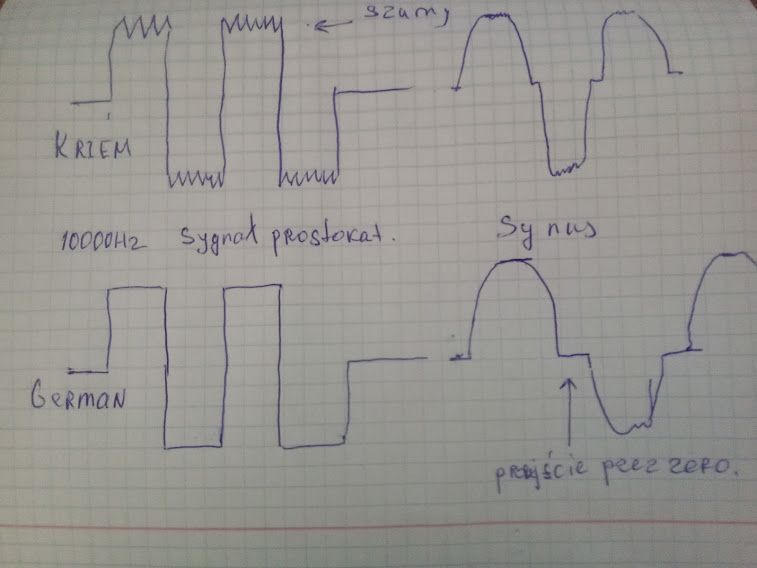
On the other hand, the very wide frequency bandwidth of silicon transistors, especially in transformerless circuits, favours the amplification of parasitic signals and high-frequency noise.
For this reason, one proponent of 'germanium sound' tried to convince me that germanium elements - due to their low cut-off frequency - do not generate harmonics, presenting an oscillogram similar to the one shown in the figure.
However, as can be seen, the harmonics and noise have frequencies above 10 kHz and are therefore not audible to most listeners. On the other hand, germanium transistors have a higher noise floor. Although there are special grades of germanium transistors (e.g. Soviet: ГТ107, ГТ108, ГТ308, П27, П28, МП39Б), they did not survive the era of silicon transistors and are now very difficult to find.
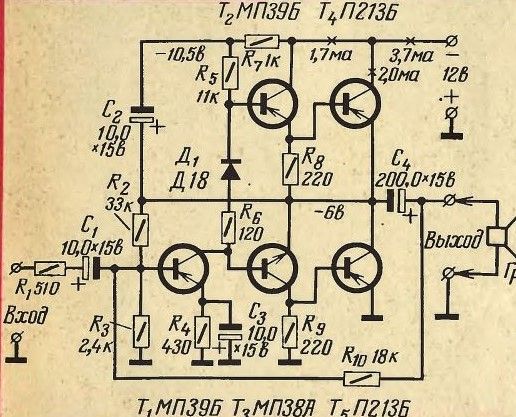
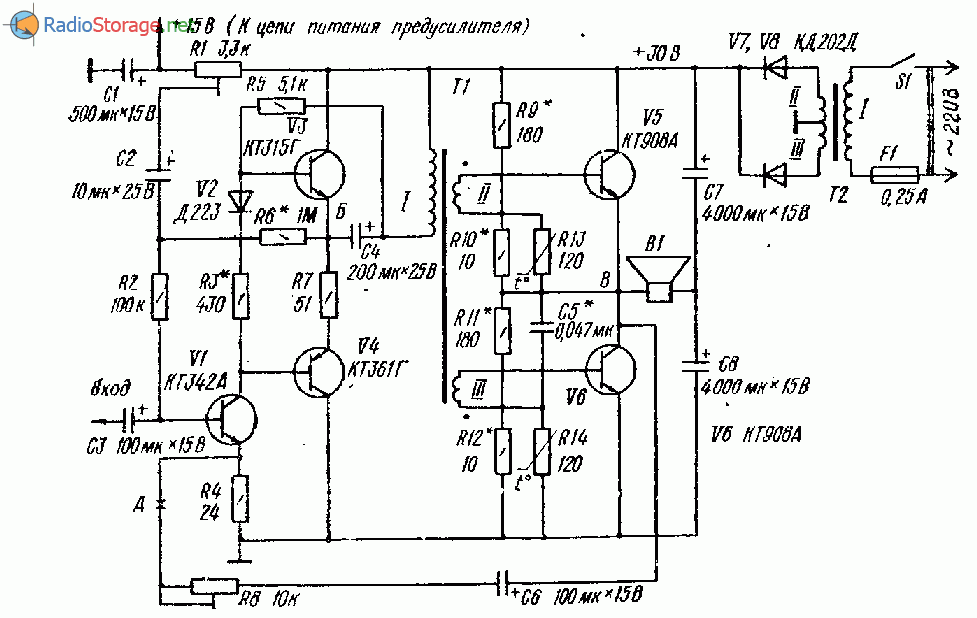
To summarise: in acoustic circuits, germanium transistors are no better than silicon transistors - they just sound different. Distortion occurring in amplifiers using germanium transistors is often perceived as more pleasing to listeners, even if its level is higher than in silicon designs, because it lies mainly in the low frequency band. However, the effect of the so-called 'germanium sound' can also be achieved on silicon transistors using appropriate design solutions, for example transformer circuits as shown in the image below.
Silicon transistor amplifier with transformer. source magazine "Радио" №1/1981
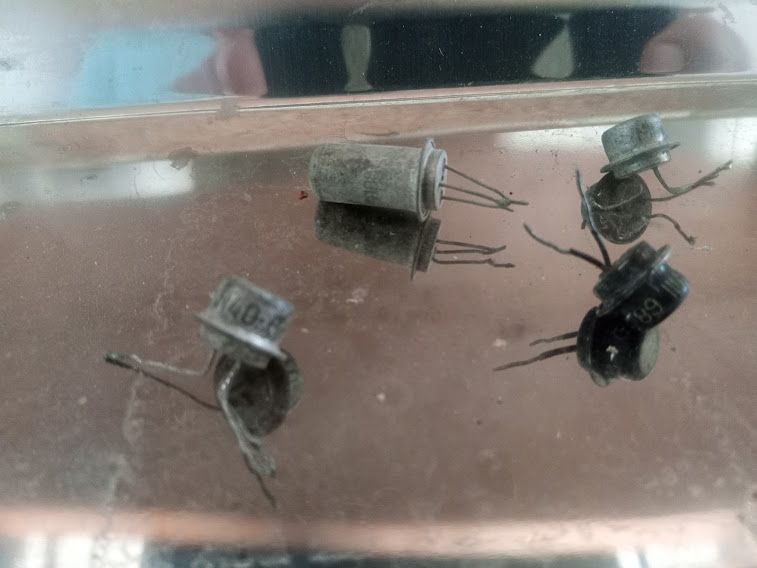
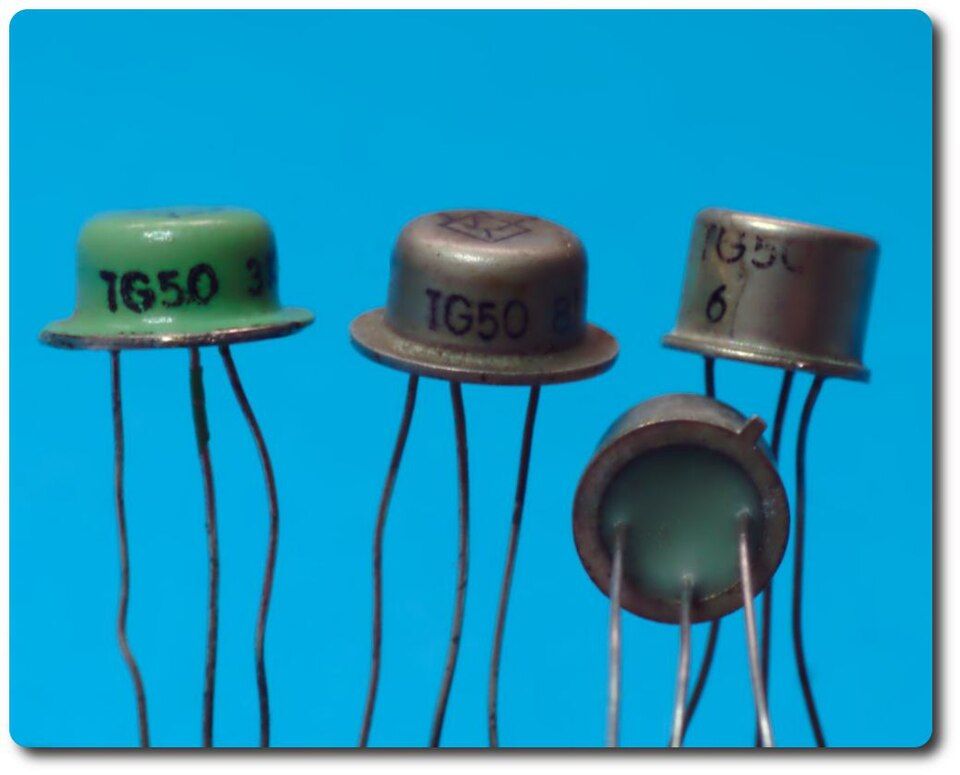
In Poland, germanium transistors of the TG5, TG50 and TG70 series were popular. The TG50 models came in a distinctive green casing - you may remember them or their later version in a metal casing, no longer painted with paint.
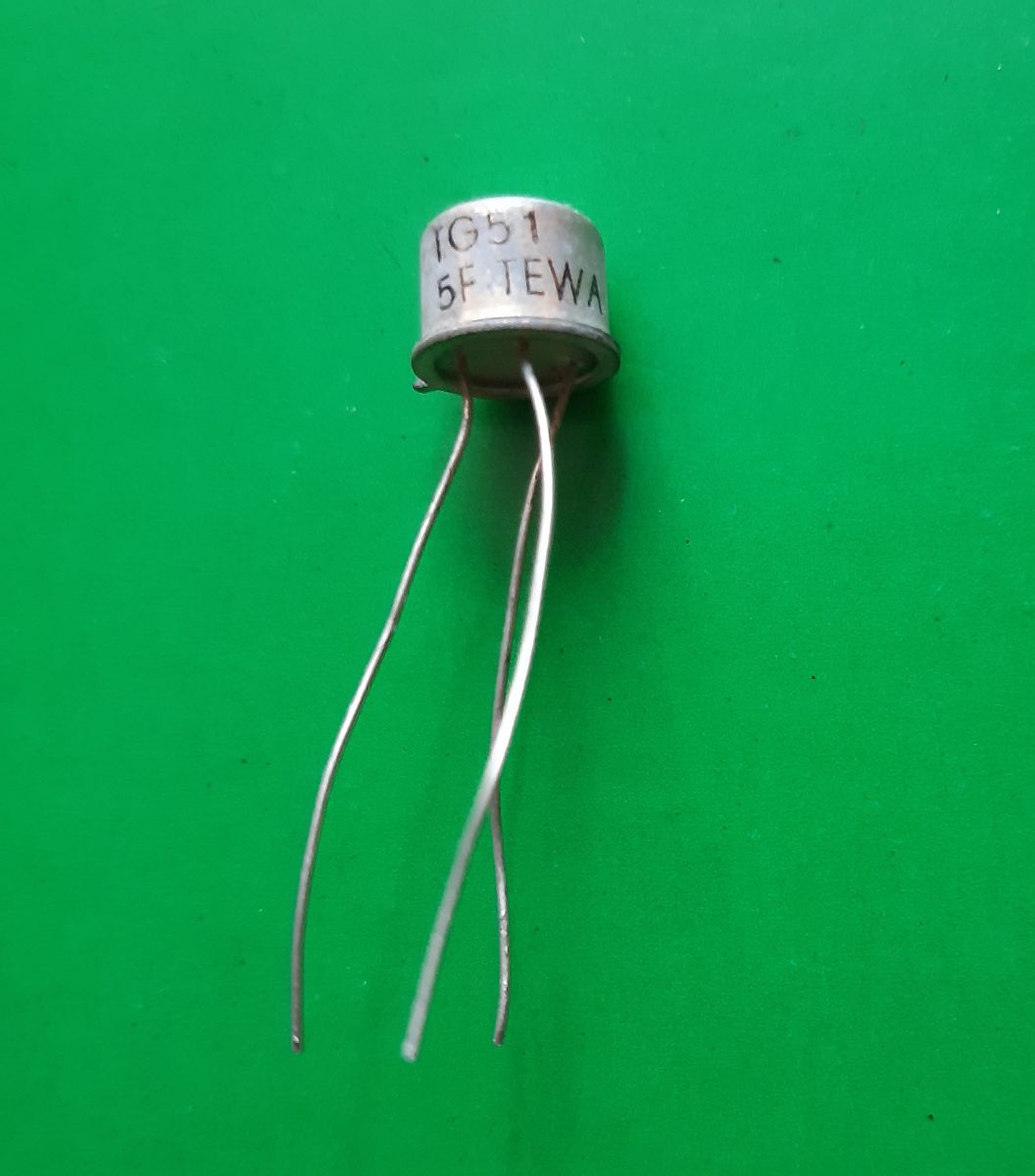
Below the less common TG51 made by TEWA, which is believed to have been used in inverters.
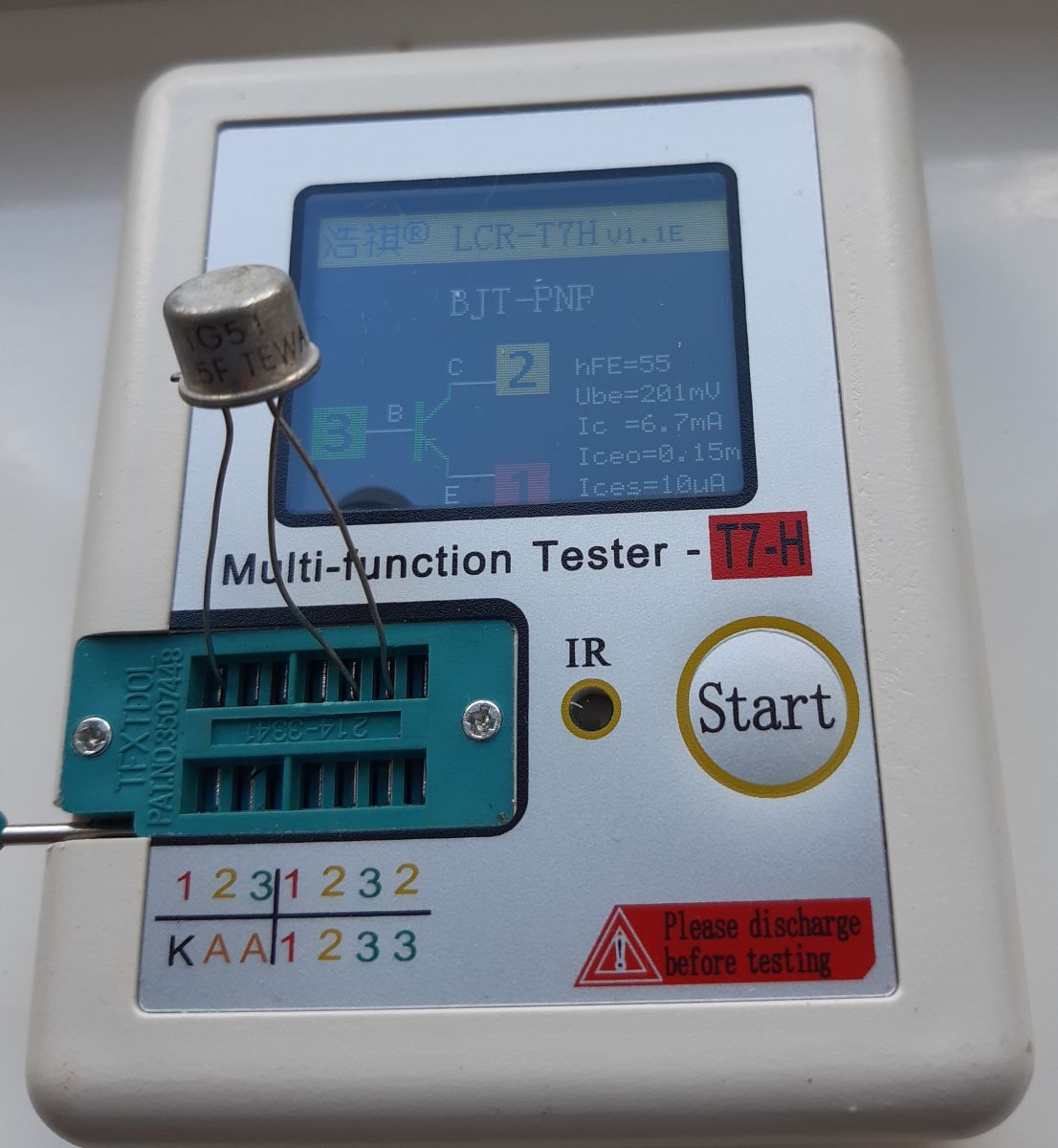
Despite the passage of years, the tester still shows the efficiency of this transistor.
On the page AlekZ you will find scans of the schematics of the amplifiers that the germanium transistor manufacturer proposed:
TEWA 500mW acoustic transistor amplifier on TG50
Transistor acoustic amplifier 6W TEWA on TG71
The presence of transformers in the signal section was probably a hindrance to novice electronics engineers.
The 1963 TEWA catalogue contains surprising application diagrams for germanium transistors, e.g. transformer to power a fluorescent lamp or transformer to power a flash lamp .
TEWA application circuits
Applications of TEWA semiconductor components
A list of types of semiconductor elements, including silicon, produced by Polish manufacturers is available at the following link:
https://publikacje.r-kobus.eu/TEWA/Elementy%20polprzewodnikowe_wstep_wykaz%20typow.pdf







Comments
Well, germanium ones have lower noise than silicon ones. I have a Hummingbird 2 and everything works. My brother had a big Nordmende radio and the power amp was on germaniums just. Interesting articl... [Read more]
The way I see it. The tube era gave us simple receivers where there were several tubes and it worked great (optimised designs). The germanium transistor era inherited a lot from the tube era, so the receivers... [Read more]
Hi, Germanium transistors have tragically high levels of pink noise and popcorn noise, low gain, low bandwidth, large performance spread, huge temperature-dependent leakage and, to top it all off, low... [Read more]
I'm afraid that the aforementioned growing popularity of germanium in audiophile circles has not occurred despite the rising price of these transistors and because of price increases . Same as for... [Read more]
I myself a long, long time ago made my brother a FUZZ guitar pickup for foot-press pedal, on a transistor probably that AF428. The musicians were delighted. [Read more]
Audiophilism has much in common with the luxury goods market. The most important common denominator is unavailability. The unavailability can be due to a financial barrier (a watch for 300,000, a car for... [Read more]
I would put it briefly, where physics and logic end is where audiophilism begins. [Read more]
And wasn't it generally the case that a germanium diode starts conducting already from 0.2V, i.e. the voltage drop at the germanium junction is of the order of 0.2-0.3V, and at the silicon junction 0.6-0.7V,... [Read more]
This is true, right. However, there are other factors of germanium technology that increase significantly. No. I wanted to show that due to the higher transition capacitance on the germanium... [Read more]
Although I have digital hearing (I detect when they are playing or not), the sound of tube amps is indeed distinctive, from hard data a tube has a different overdrive characteristic to a transistor. On... [Read more]
the reel-to-reel ones are already making a comeback and cost a fortune. https://obrazki.elektroda.pl/1312789300_1779119579_bigthumb.jpg The Tr-1000 from Analog Audio Design costs US$26,000... [Read more]
Only from where to record the audio signal on such a reel-to-reel player ?, from spotfi, YT premium, or from an FM tuner, the times of IV PR and scout radio are over [Read more]
Probably by microphone, straight from the speaker :) Germanium diodes are still used in special applications, the main detectors, precisely because of their mild characteristics at zero. Besides,... [Read more]
Admit it, where did you get that from? I'm curious. Because the WSJP indicates all possibilities, it doesn't indicate which is wrong and which is right. All the studies I've seen talk about high frequency... [Read more]
This moment of transition of the sine wave through zero and prolonged lack of conduction seems to occur in Class B transistor amplifiers and much less in the pre-polarised transistors of Class AB amplifiers,... [Read more]
Indeed, I have come across germanium diodes in AM receivers, both the green DOG series and later the AAP152. Reading the comments, I suspect it would be useful to have equally well done material on... [Read more]
I once knew an elderly audiophile gentleman who listened to mainly classical and baroque music on his old Maranz, he said that he could hear the double bass player in the orchestra breathing and fidgeting... [Read more]
Breathing and moving a chair is rather fanciful ;) but picking up sound differences between amplifiers or audio sets is quite plausible. [Read more]
Well yes, it's hard to discuss what anyone hears if I don't hear it. But I don't believe it. Being at a classical music concert the only grunt, crackle I hear comes from the listener next to me. The very... [Read more]