





A tour of the Odra computers – computers designed and built in Poland
TL;DR 
- Poland’s Elwro Odra series traces an unusually tangible evolution from cabinet-sized valve-and-transistor computers to TTL integrated-circuit machines.
- Odra 1002 combined vacuum-tube modules for drum-memory heads with germanium-transistor and diode modules, while later models adopted ferrite core memory and ICL1904 software compatibility.
- The 1962 Odra 1002 used 36-bit words, stored 4,096 words on a drum, and performed 800 additions per second.
- The TTL-based Odra 1305 reached 370,000 additions per second and sold 346 units; total Odra production exceeded 1,000 computers.
- Circuit diagrams for the Odra series remain unavailable, leaving functions of several transistor modules and drum-memory details unresolved.
AI summary based on the discussion. May contain errors.
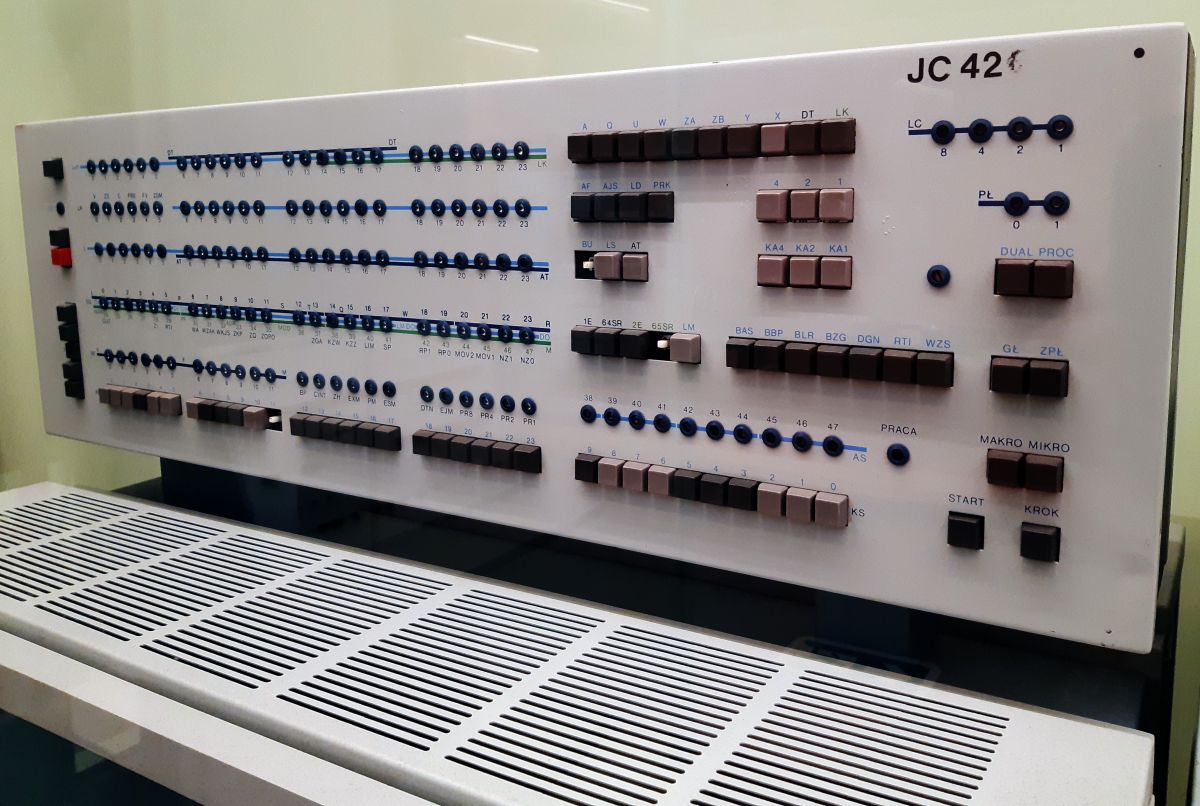
I haven’t managed to find any circuit diagrams for the Odra series of computers; if you have any further information or spot an error in this exploration of Polish computers, please do get in touch in this thread. Better documentation is available for the Polish MERA 400 computers; I have been following the YouTube channel MERA400 , where the author demonstrates experiments with a preserved example of this computer. Another unit was located at Gdańsk University of Technology ProjektM400 .
Returning to the Odra computers, on the website aresluna we can find information on the design of subsequent Odra models and the number of units produced. For example, the Odra 1001 and 1002 were prototype models, each of which was produced as a single unit. The Odra 1002 is a vacuum-tubeand transistor-based computing machine from 1962, operating on 36-bit words and performing 800 additions per second. The Wikipedia page on the 1002 contains a photograph showing the cabinets with the equipment installed and the control panel. This is exactly how the writers of early sci-fi films imagined computers – cabinets with lots of flashing indicators.
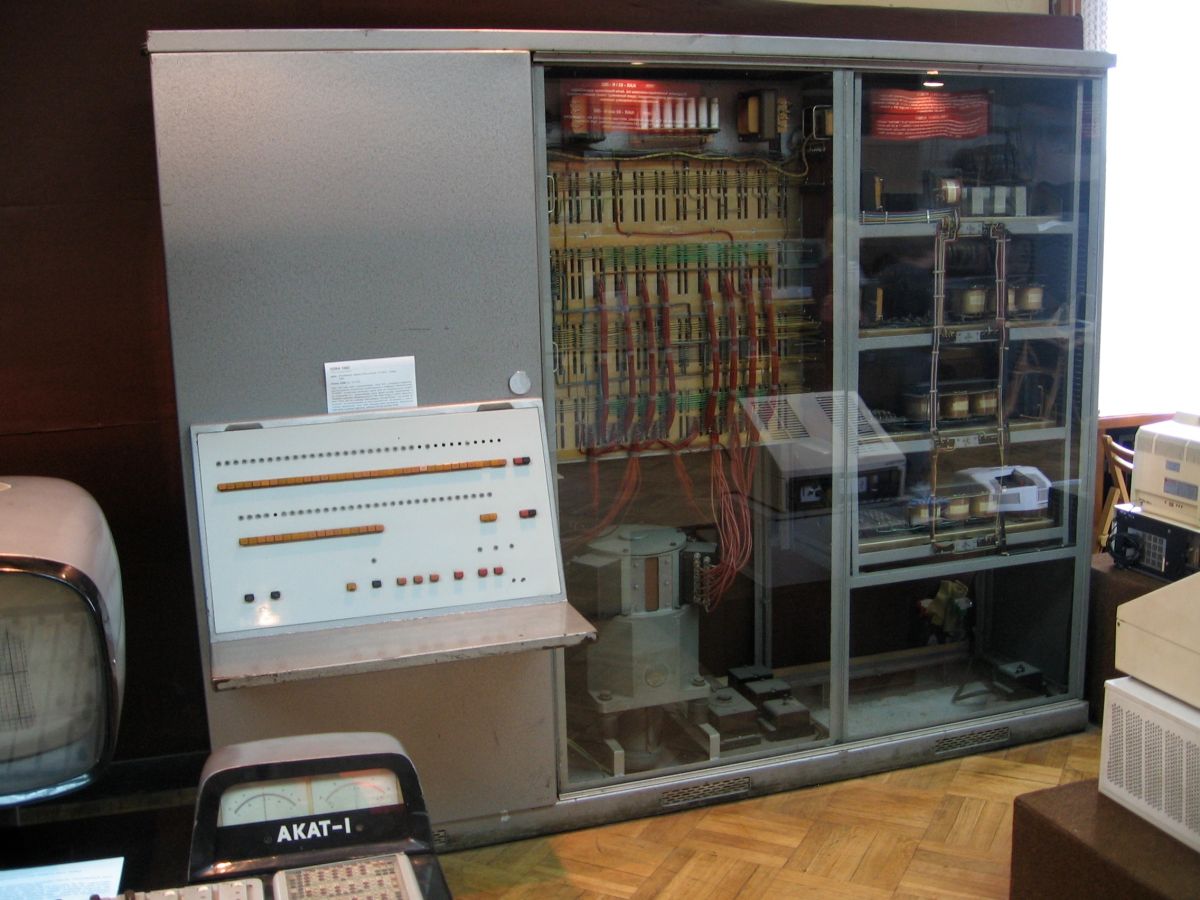
The Polish Odra 1002 computer at the National Museum of Technology in Warsaw, source: Wikipedia, Author: Marcin Wichary, Licence CC 2.0
The computer’s design features numerous modules installed in cabinets. The modules containing vacuum tubes are connected to the drum storage heads. Perhaps the need for compact component layout, small signal amplitudes, low noise levels and specific signal frequencies meant that vacuum tubes were the better solution? Signals from the heads are routed via shielded cables; in the photograph, these are visible as bundles of red wires.
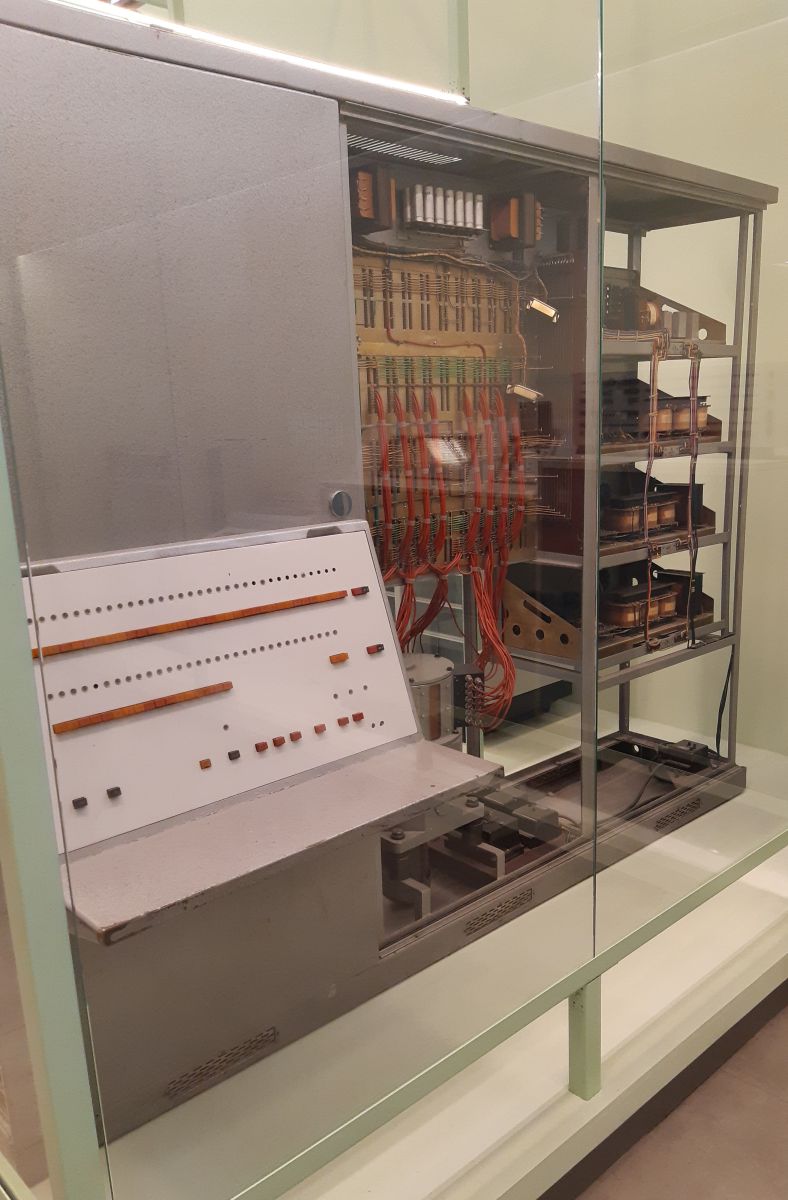
The Odra 1002: the control panel, drum memory and transformer power supplies are visible.
The valve modules are located in the centre. The transistor modules are on the right. The analogue voltmeters are used to monitor the supply voltages.
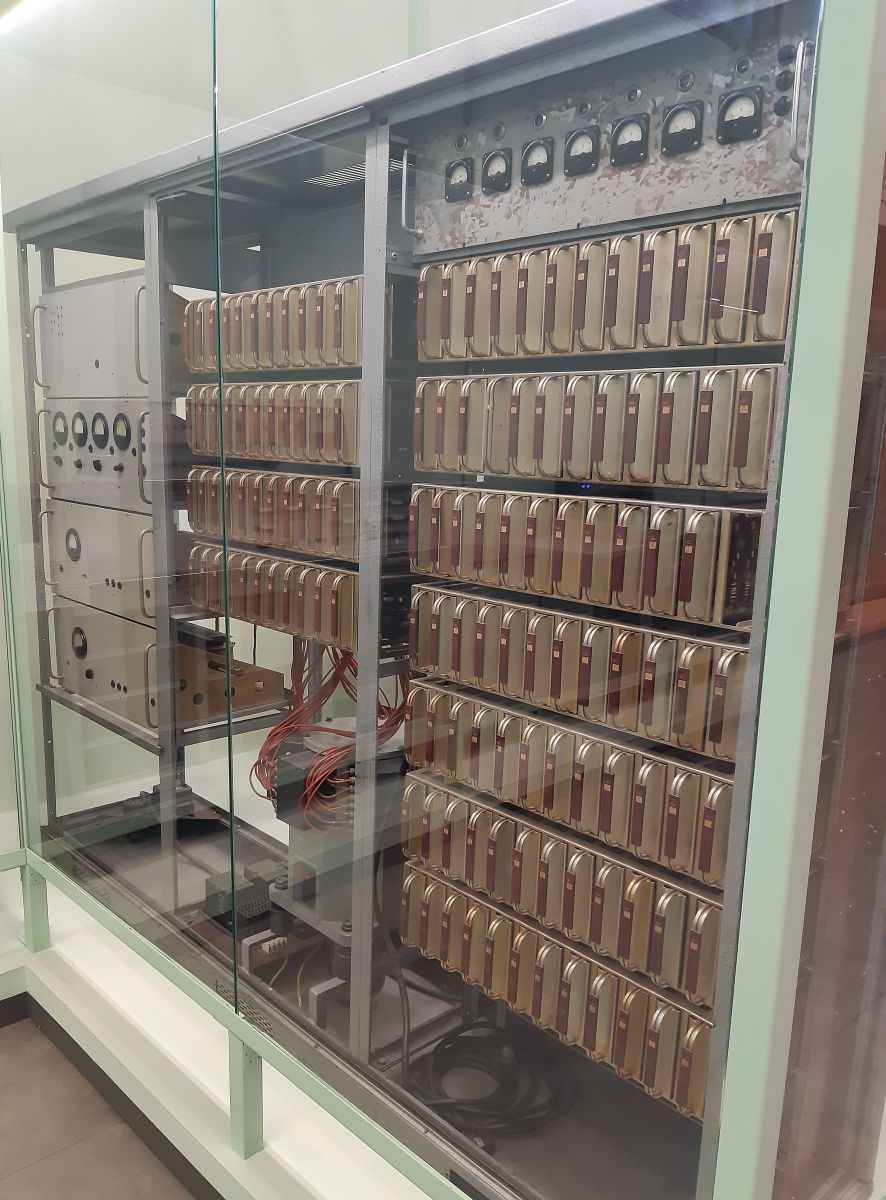
Odra 1002, from the left: power supplies, tube modules working in conjunction with drum memory heads, modules containing transistors and germanium diodes.
Transformer-based power supplies provide multiple voltages; electrolytic capacitor assemblies are also visible.
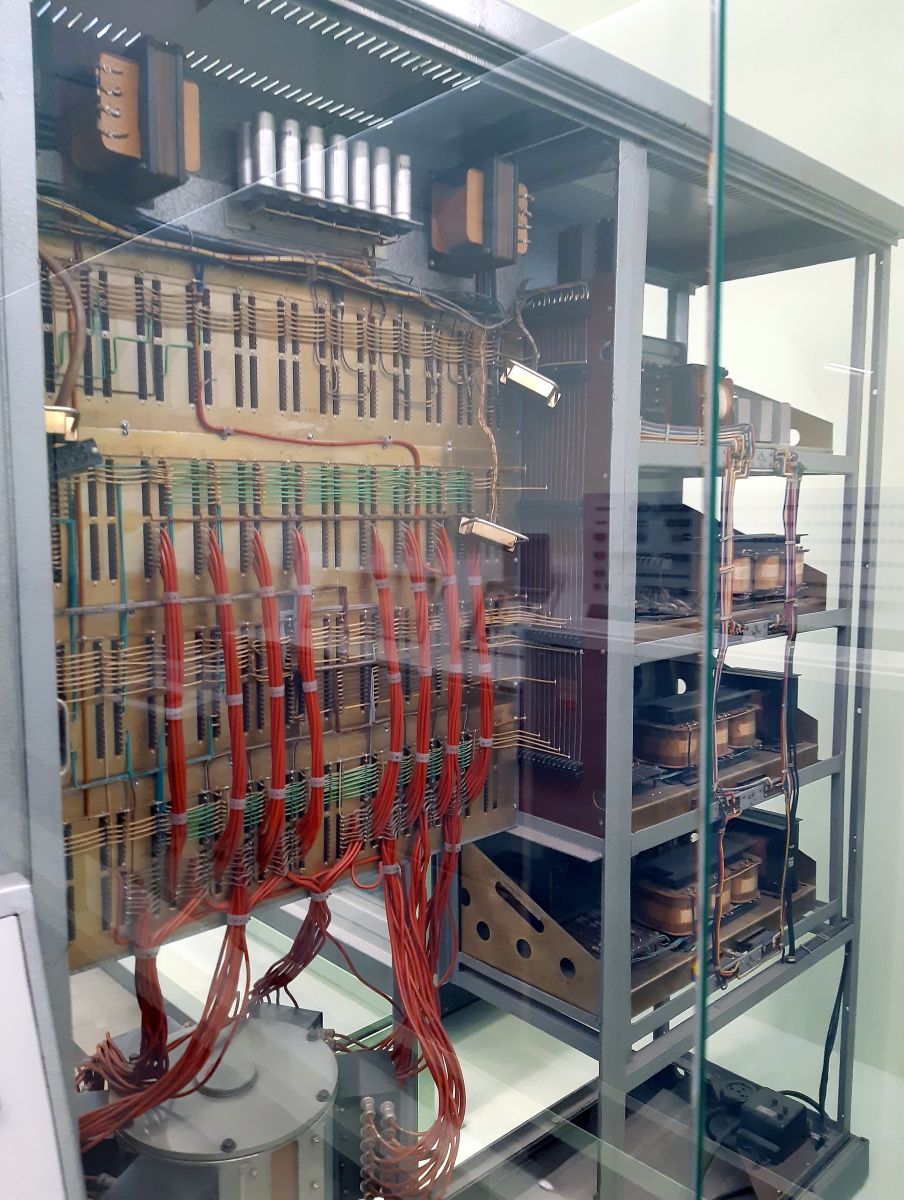
Odra 1002, power supplies and visible bundles of coaxial cables connecting the drum memory heads to the valve modules.
The drum memory stored 4,096 words. The drive motor is visible at the bottom, as is a regulator – possibly an autotransformer. What might it have been used for? Perhaps for starting the motor or regulating its speed, although a synchronous motor should reach 3,000 rpm with only slight variations depending on the current mains frequency. There are a great many heads; I suspect that, in addition to the data heads, there may have been, for example, heads for synchronisation tracks to determine the drum’s position?
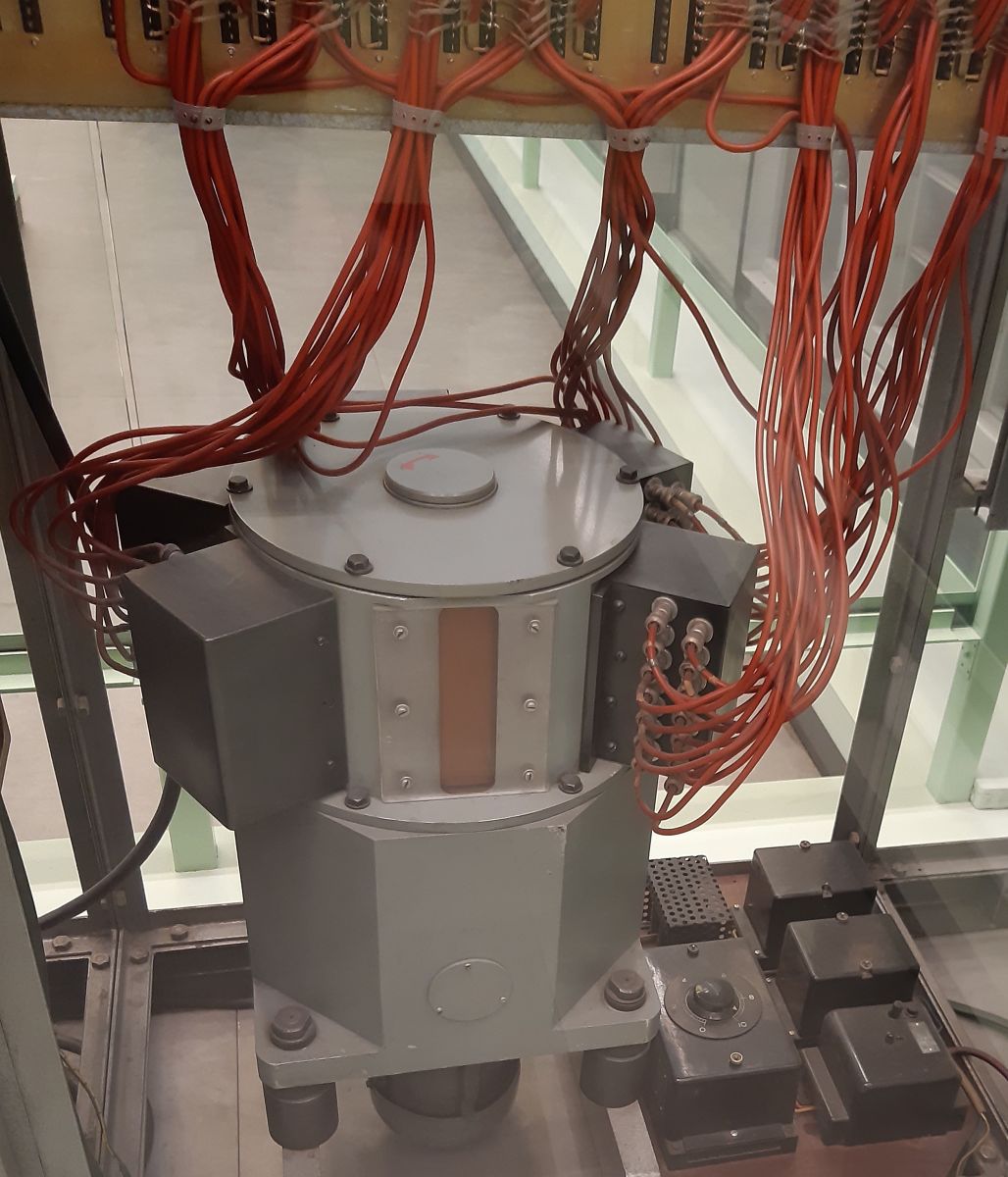
Odra 1002, drum memory, bundles of red coaxial cables carrying signals from the heads.
For the time being, the prototype’s design appears to be an electro-mechanical device fitted with valve modules. However, the Odra 1002 contains a large number of modules fitted with germanium transistors and diodes. Each module contains five circuit boards with semiconductors.
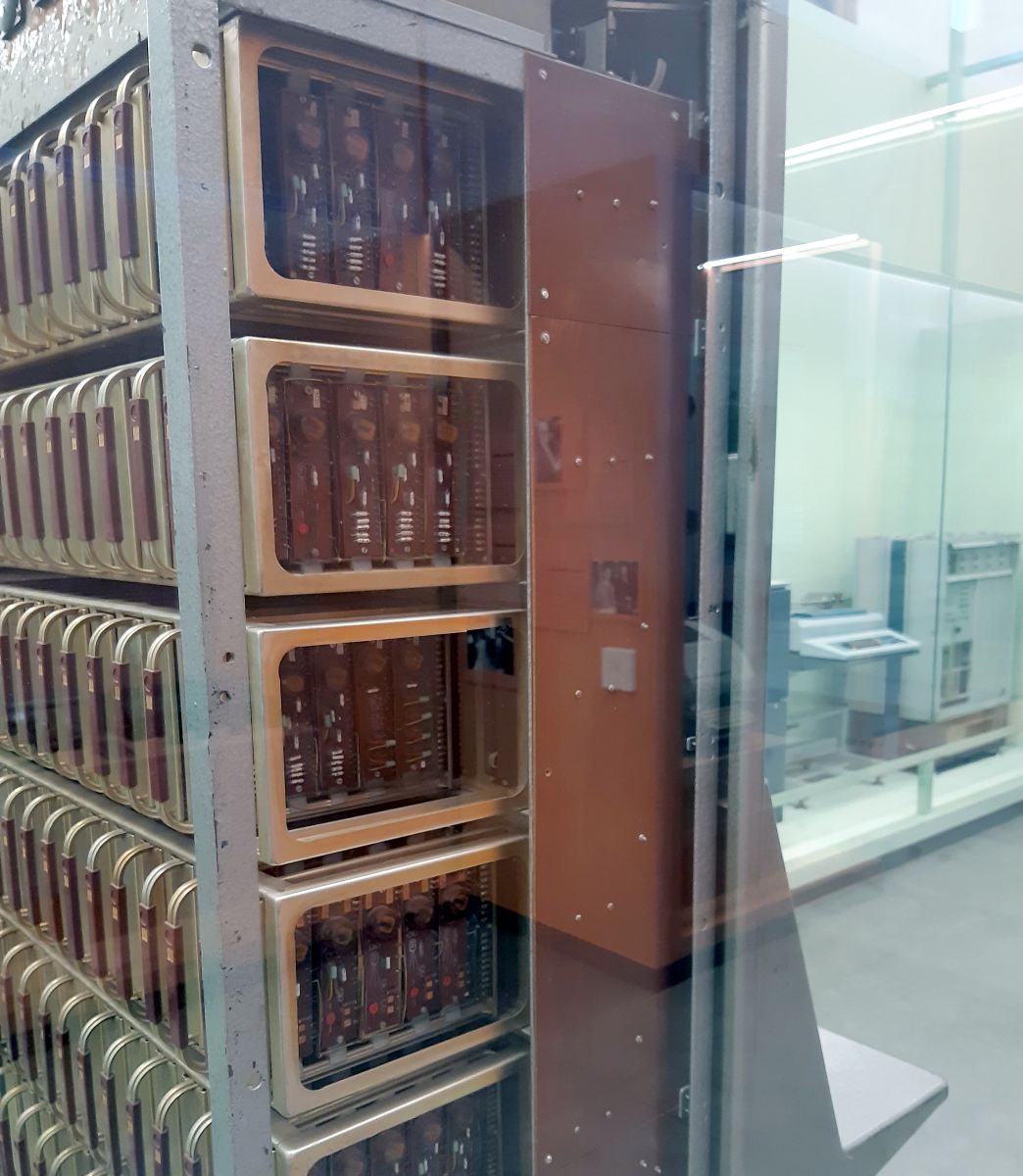
Odra 1002, transistor modules.
On Wikipedia, you can find a photograph of a single circuit board featuring the distinctive green TG2 germanium transistor and DOG-52 diodes.
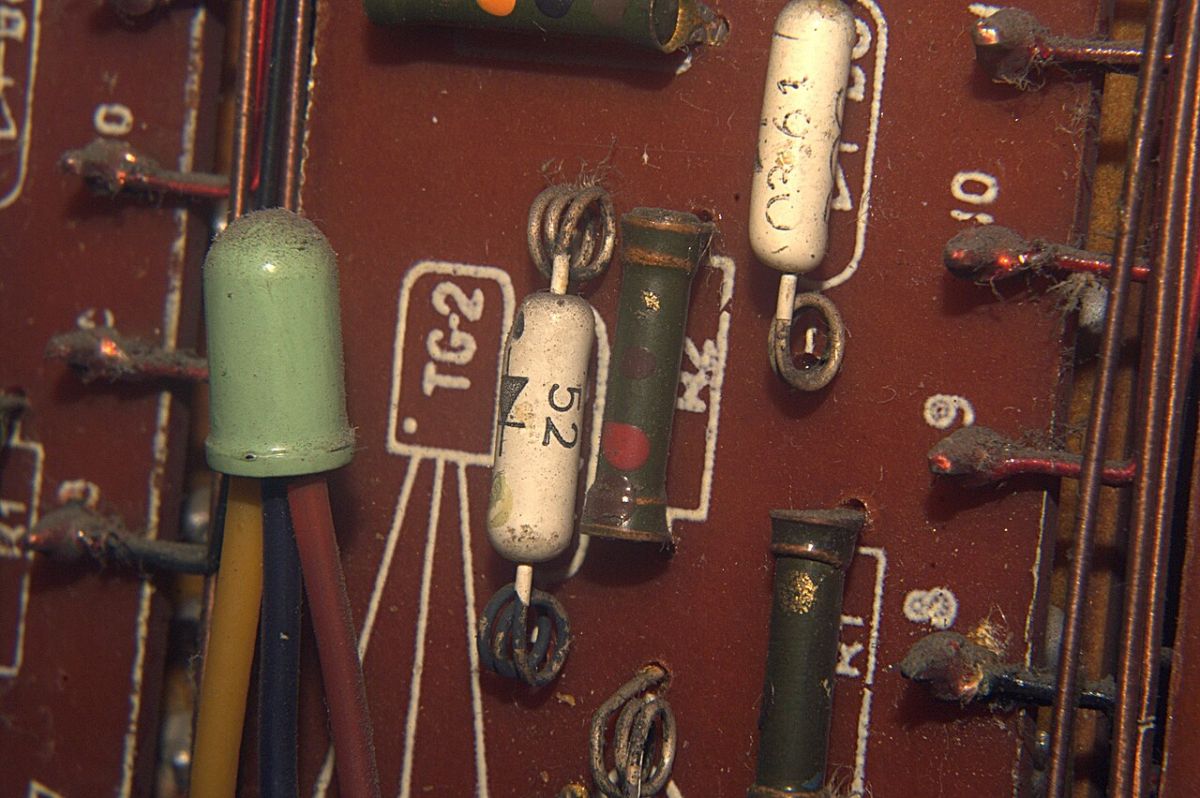
Source: Wikipedia, Author: Topory, Licence CC 3.0
A single transistor and eight diodes are visible on the board. What could this have been? Perhaps a multi-port gate? At the top there is an inductive component, either a transformer or a choke, although given the greater number of terminals, a transformer seems more likely.
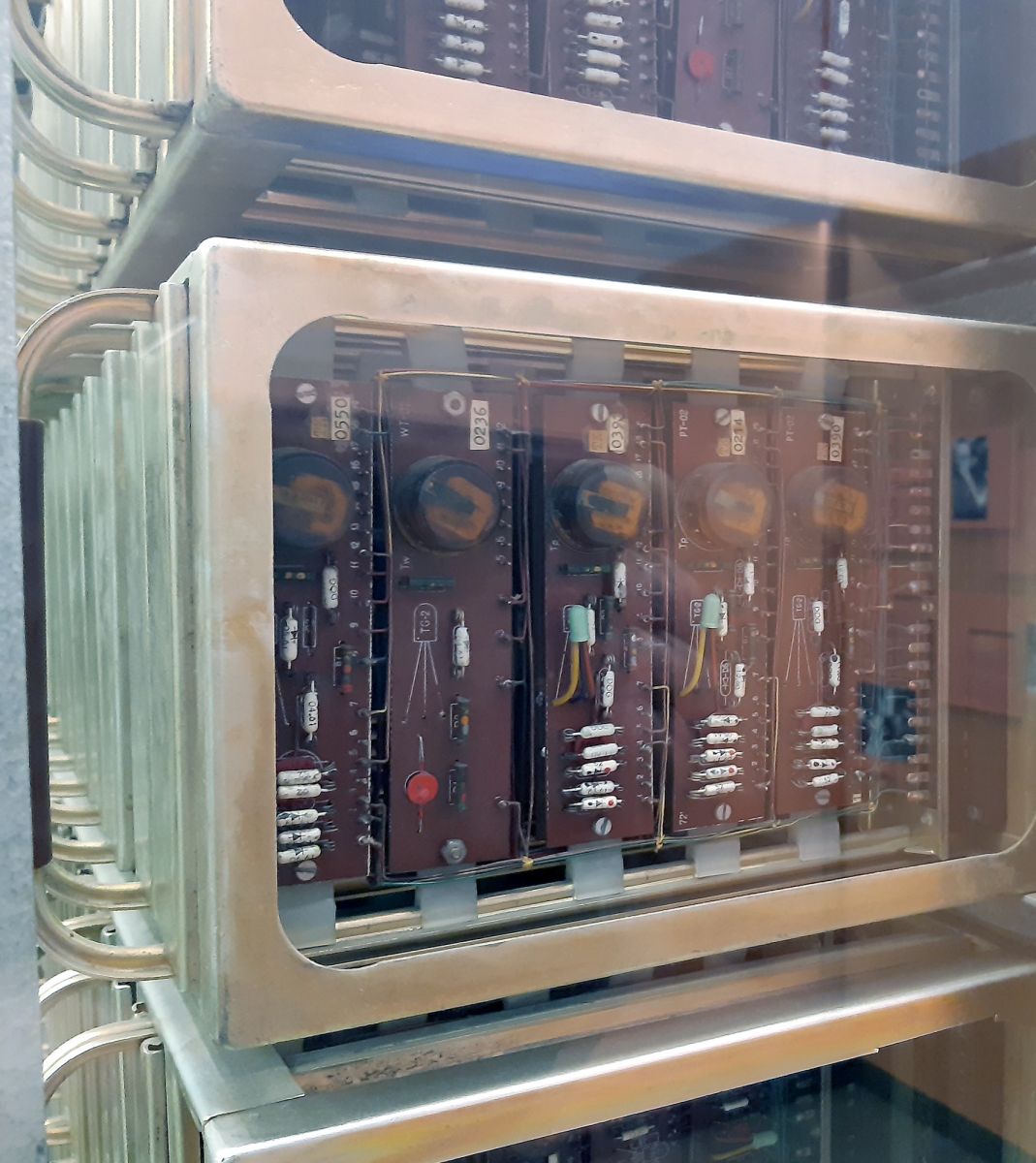
Odra 1002 transistor modules.
The input/output devices for this computing machine were a teletype, a punch card machine and a punch card reader.
I admire the knowledge, perseverance and efficiency of the pioneers of computer science, the designers of computing machines. I wouldn’t want to build a transistor-based computer today, but the designers of the Odra 1002 had no other choice.
Surprisingly computationally efficient designs were created using transistors, e.g. KAR-65 from 1968 performed 100,000 floating-point operations per second! No wonder that the KAR-65 was used for research at CERN. The KAR-65 was designed by Jacek Karpiński , who later Between 1970 and 1973, he was involved in the construction of a 16-bit computer K-202 . The KAR-65 utilised TG-40 transistors and DOG-61 diodes; 65,000 components were housed in a modular casing typical of that period.
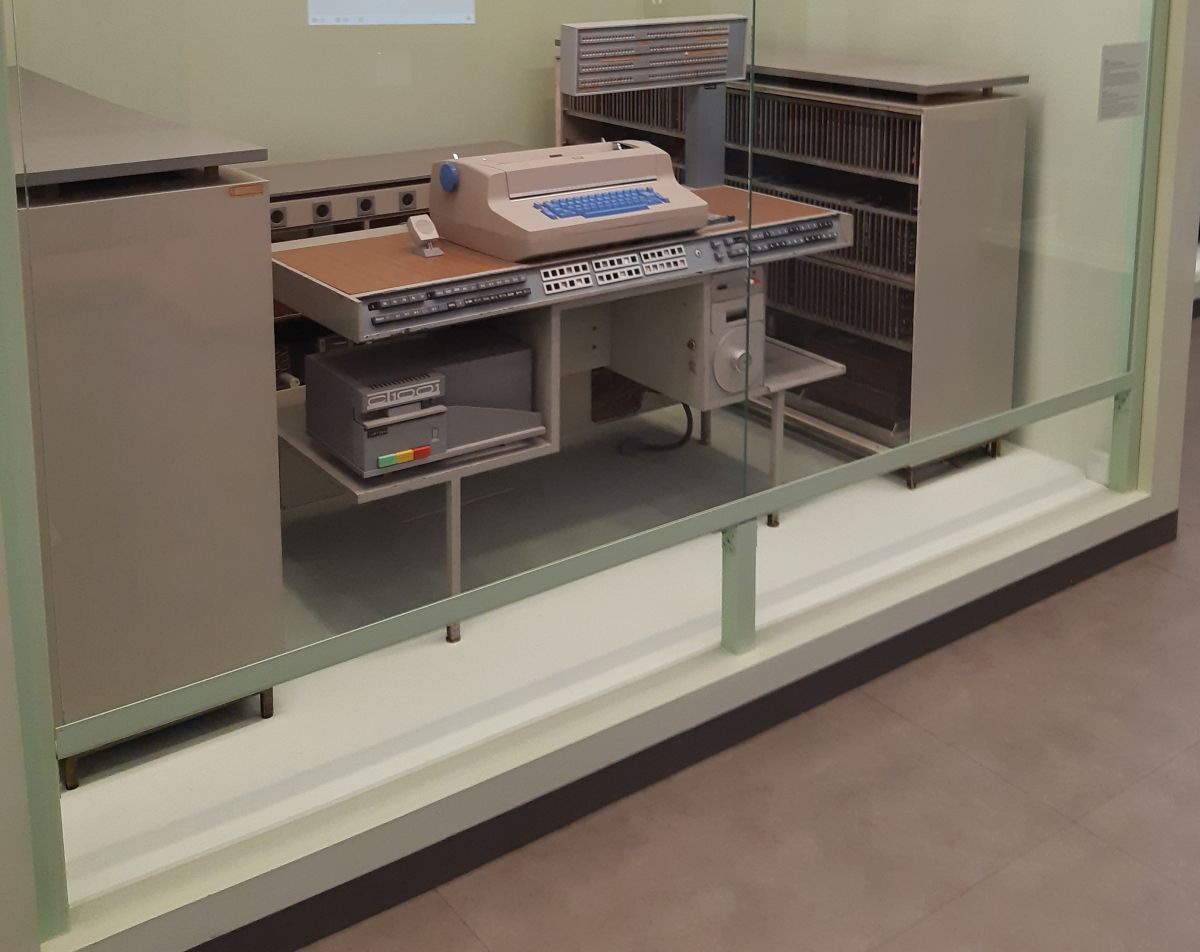
The KAR-65 transistor computer at the National Museum of Technology in Warsaw.
Digital computing machines in the pioneering days of computing must have posed a major challenge for designers; it is no wonder that experiments were carried out with analogue computers. In such analogue machines, for example Differential Equation Analyser the input and output signals corresponded to the value a, and the calculations were performed by analogue circuits. The analogue transistor computer AKAT-1 , for example, had a very interesting and futuristic appearance. A digital computer solves a problem through a sequence of operations on numbers stored, for example, in binary form, whilst an analogue computer constructs an electrical model of the equation: voltages and currents represent variables, whilst operational amplifiers, integrators, summing amplifiers and potentiometers perform mathematical operations.
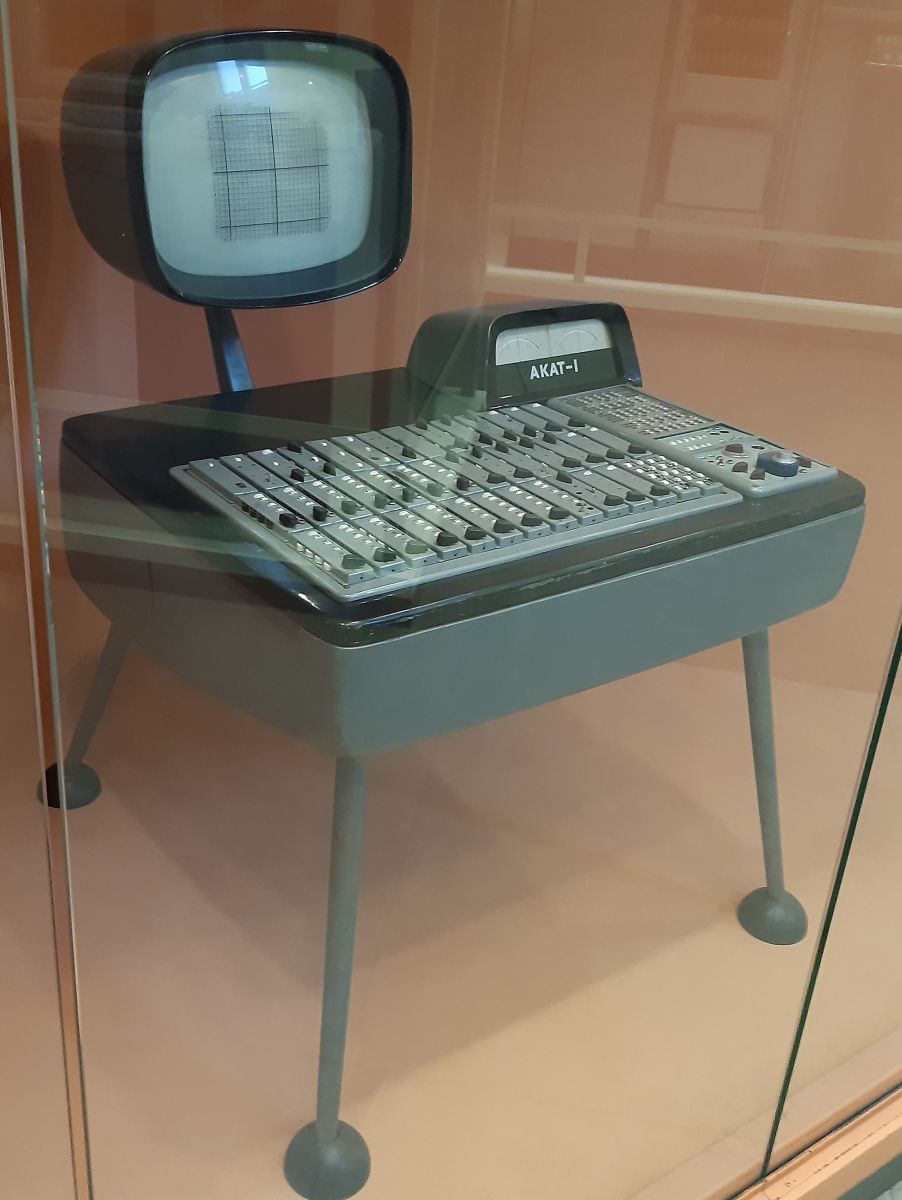
The AKAT-1 analogue computer at the National Museum of Technology in Warsaw.
We return to the eponymous series of Polish Odra computers. Following the prototypes, the Odra 1003 from 1963. It was a transistor-based machine capable of performing 500 additions per second, of which 42 units were produced. The capacity of the drum memory was increased to 8,192 words. The casing became more compact.
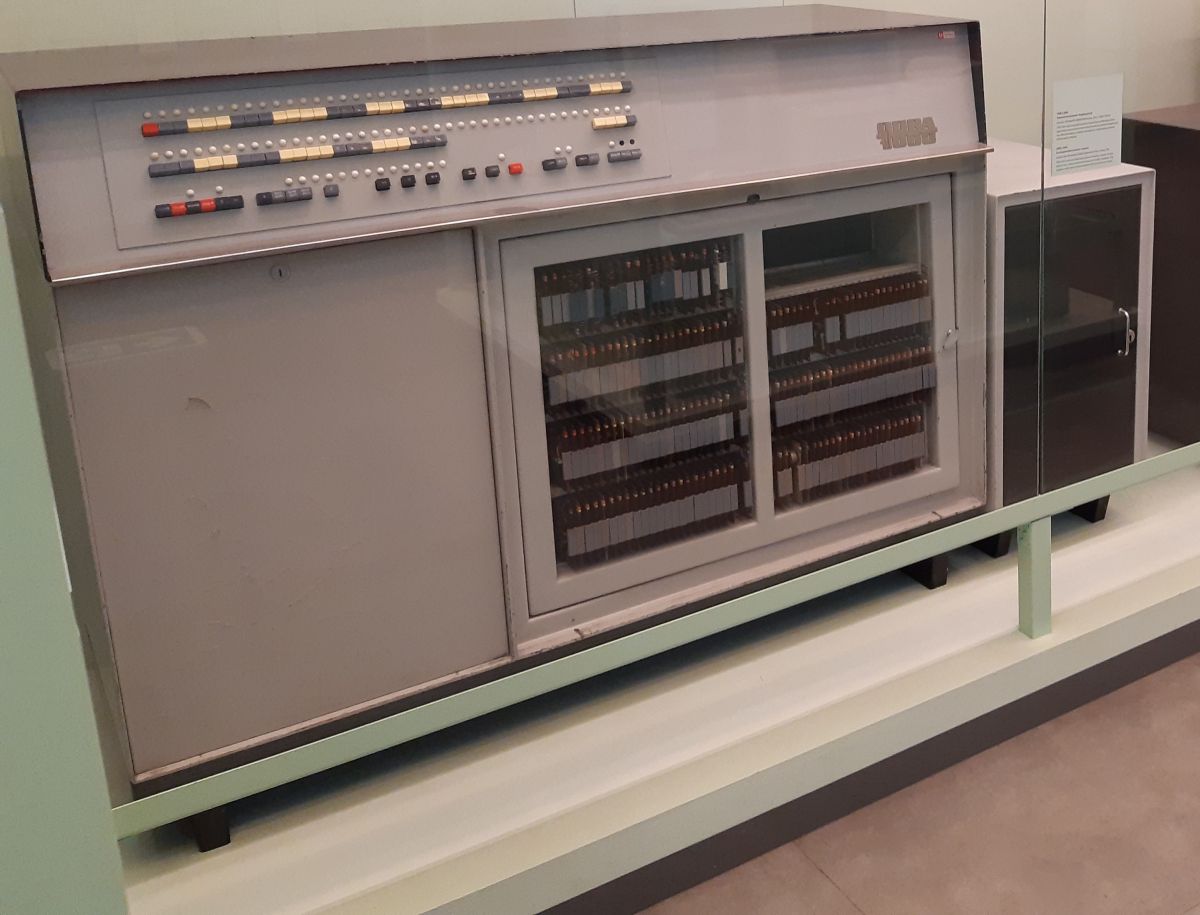
The Odra 1003 transistor computer at the National Museum of Technology in Warsaw.
The circuit board layout within the module has been expanded; circuits containing 3 transistors, 6 diodes and an inductor, repeated three times, are visible.
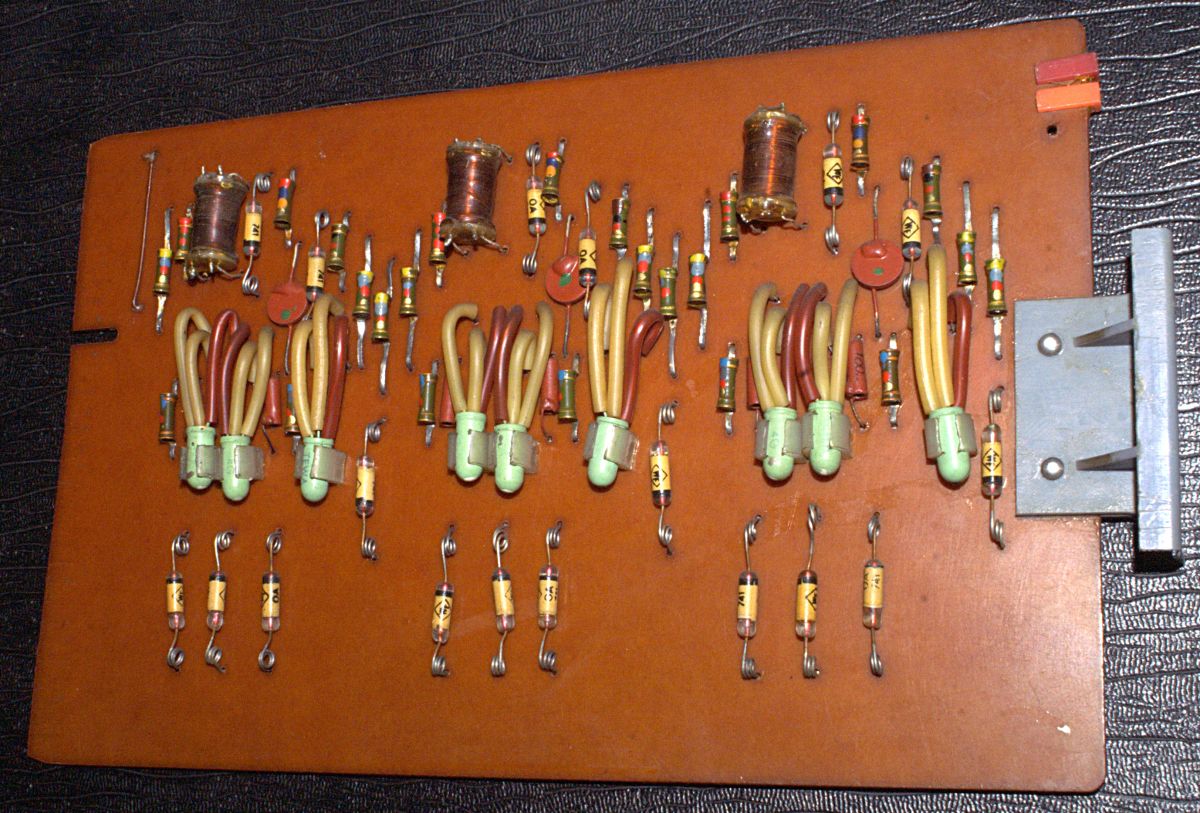
Odra 1003 package, source: Wikipedia, Author: Marcin Wichary, Licence CC 4.0
Subsequent generations of transistor-based Odra computers saw an increase in speed Odra 1013 added at a rate of 1,000 per second and sold 84 units. From the 1013 model onwards, 256-word main memory was introduced, the capacity of which increased in subsequent versions. Unlike the drum, the ferrite random-access memory had no moving mechanical parts; access to memory cells was unrestricted (equivalent to RAM); reading a bit was destructive (the state had to be rewritten); however, unlike RAM, the memory was non-volatile.
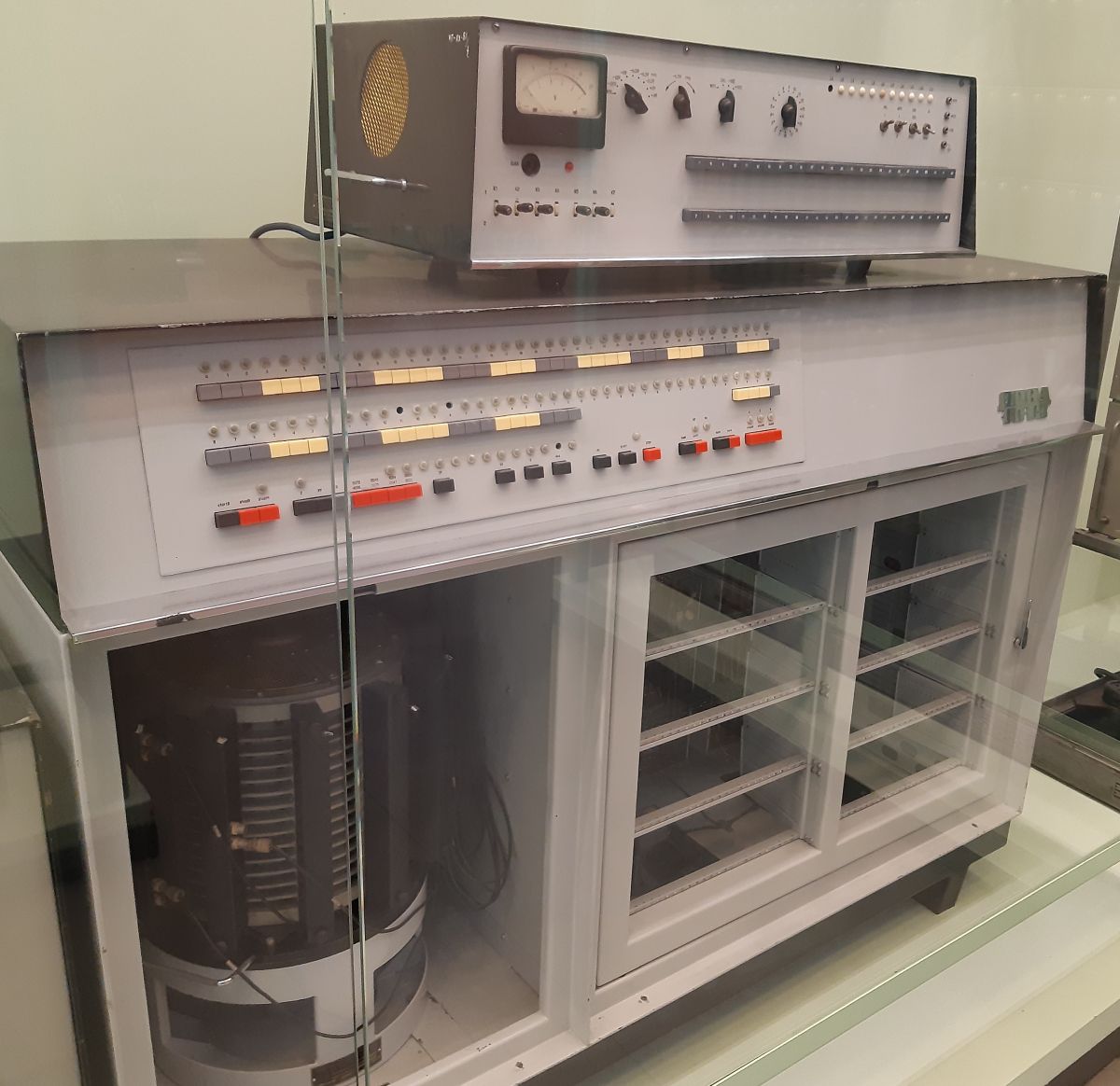
The Odra 1013 transistor computer with drum storage and 256-word main memory, National Museum of Technology in Warsaw.
Odra 1103 reached a speed of 5,000 additions per second and 64 units were sold. Odra 1204 that’s 60,000 additions per second and 179 units sold. Odra 1304 achieved 50,000 additions per second and 90 units were sold. The 1968 Odra 1304 was software-compatible with the British ICL1904 whilst being a faster, smaller machine that consumed less power. Designing it to be compatible with the ICL1904 instruction set allowed for port some of the software from ICL . Elwro built a machine tailored to the existing software ecosystem, whilst simultaneously improving the performance of the computer that had originally run these programmes.
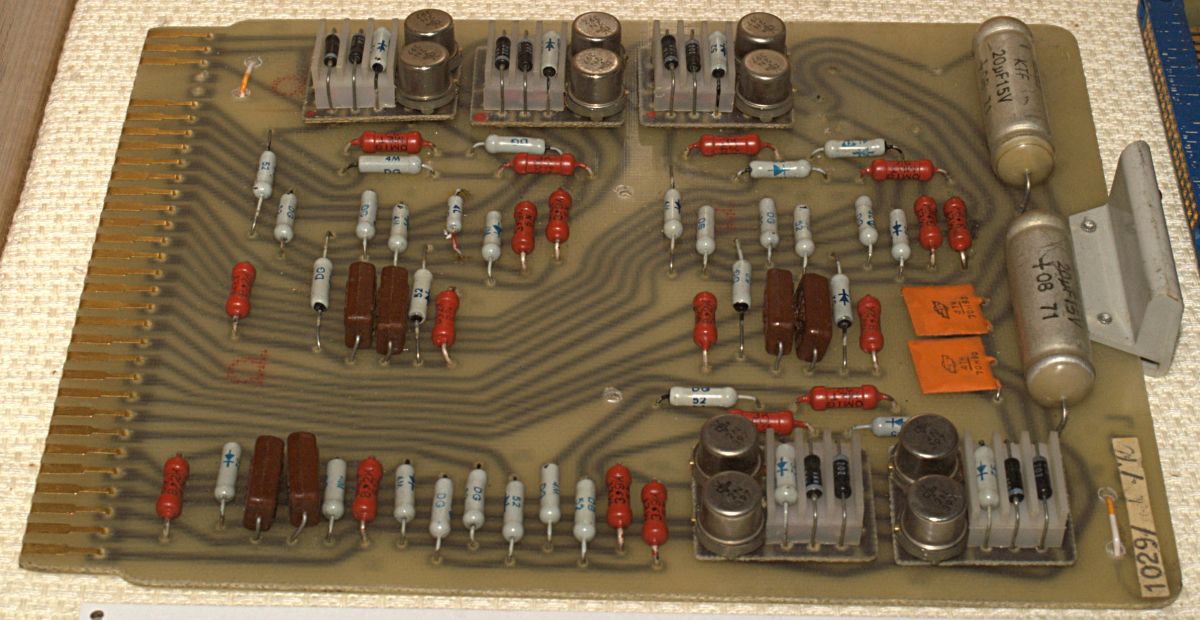
Odra 1304 package – source: Wikipedia, Author: Topory, Licence CC 3.0
Transistors occur in pairs; what do you think – are these flip-flops or gates?
A very good tabular summary of information about the Odra series can be found on the aforementioned website https://aresluna.org/attached/computerhistory/articles/odra
A new third generation of machines based on integrated circuits was launched Odra 1305 which has been in production since 1973, and whose control panel is visible in the cover photograph of this article. Odra 1305 achieved 370,000 additions per second and 346 units were sold. It was also based on TTL integrated circuits Odra 1325 achieved 280,000 additions per second and sold 151 units. In total, over 1,000 Odra computers were produced.
From model 1305 onwards, Odra computers incorporated TTL digital circuits, which enabled a significant increase in circuit density compared to transistor-based designs.
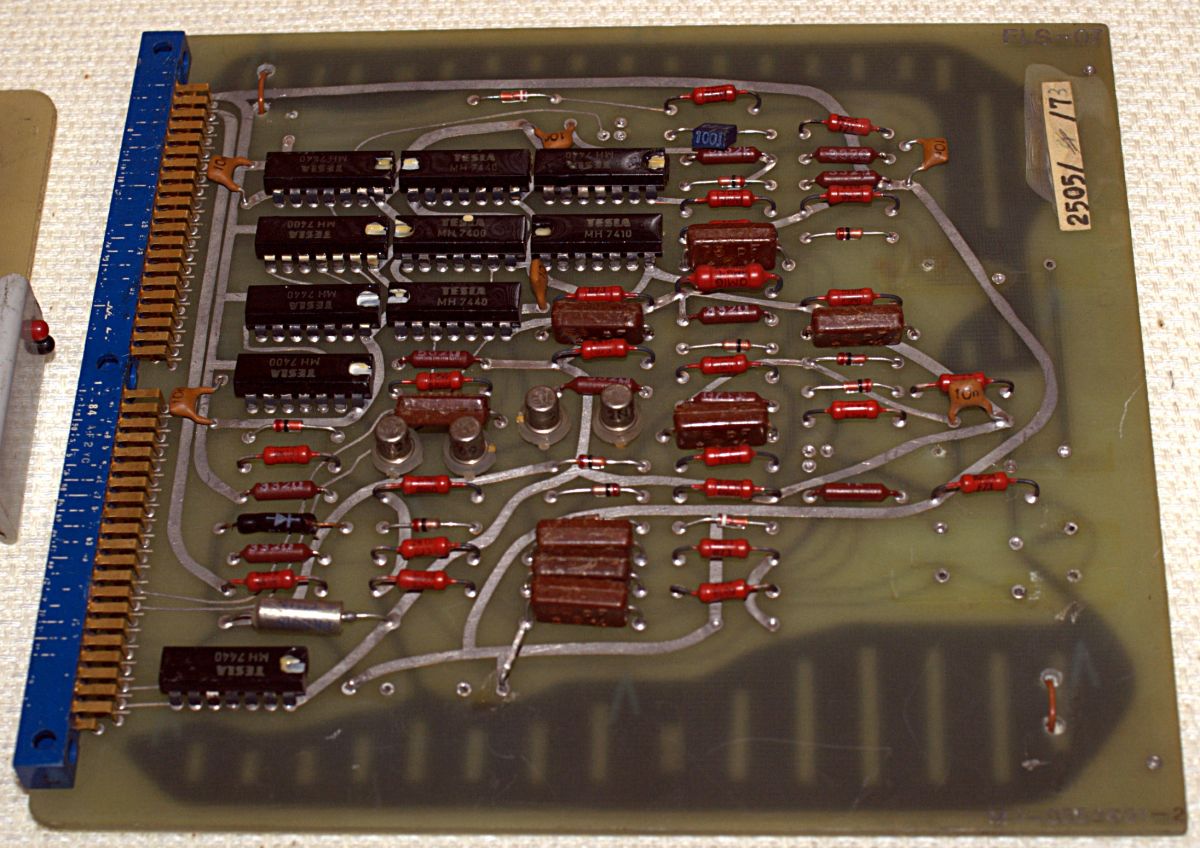
Source: Wikipedia, Author: Topory, Licence CC 3.0
On elektroda.pl, in a thread started by @djvolt1, you can find photos of Odra packages containing larger quantities of TTL integrated circuits, posted by @gizmon.

This brings our tour of the Odra series to an end; please do let us know what you think,
perhaps we can add to it, correct any errors in the description or answer some of your questions.
Those were fascinating times, the pioneering days of digital machines and computing. Old computers Second-generation (transistor-based) and third-generation (TTL integrated circuits) Odra computers look rather unusual today, a bit like the control panel of some sort of industrial automation device. Odra computers often required a three-phase power supply! It’s impressive to see a single transistor inside a computer. I am full of admiration for the skill and perseverance of the designers of Polish computers. I suspect that the process of designing the first digital computing machines must have been difficult but also fascinating. Overcoming limitations and setting new standards must have been rewarding.
Unfortunately, we brought the design and production of computers to a close with machines based on integrated circuits. Microprocessors later emerged, and Poland was unable to maintain continuity in the design and mass production of its own large ‘Odra’-class computer systems. Looking at these pioneering designs, one can also see the enormous progress that took place in a relatively short time.
The topic of tape storage also came up in the thread PT-3 .

TechEkspert wrote 7352 posts with
rating 5719 , helped 17 times.
Been with us since 2014 year.
Comments
Yesterday I visited the Museum of Technology in Warsaw, where there is currently an exhibition of these computers. https://nmt.waw.pl/wystawy/historia-komputerow-liczy-sie/ [Read more]
One might ask the obvious question: what has happened to us? Why were we manufacturing computers back then, but not now? For example, South Korea and Japan are currently leading the semiconductor race... [Read more]
No, that was during the communist era, and it didn’t have to be profitable. The Party gave the order, and the people produced. I don’t think South Korea is a good example here, because I don’t believe... [Read more]
I think the point here is that we’re supposed to be a backwater, a source of cheap labour Added after 4 [minutes]: One more point… Communism was one thing in Soviet Russia, but here it wasn’t quite... [Read more]
Back then, we were manufacturing computers because we had the capability and were ahead of the curve. Unfortunately, the crisis of the 1980s halted our progress and we were unable to catch up. Although,... [Read more]
Back then, computers were very simple; they might have been large and looked complicated, but today a talented student at an electronics technical college could design something like that. Some had strange... [Read more]
Let’s not exaggerate: in the Comecon countries, the standard was the RIAD system, derived from IBM. So these restrictions were based more on economic than political grounds. It was simply easier to sell... [Read more]
:smile: This film on YouTube ⬇️ :idea: The Soviets copied things, and sometimes made them themselves; they even had their own standards, such as the pin spacing in circuits 2.5 Hmm, where... [Read more]
Polish industry did not survive the influx of products from other countries. Why, in the 1990s, did everyone prefer a 15-year-old VW to a new Polonez? Similarly, computer products were technologically... [Read more]
@ElektrodaBot So what’s different about South Korea compared to Poland that it’s become a semiconductor hub? It’s certainly not knowledge or people – we’re leading the way in those areas. [Read more]
Direct reply In my opinion, the difference lay not in the ‘wisdom of a single engineer’, but in the industrial system . Poland had very good designers, computer scientists, electronics engineers... [Read more]
I seem to recall that CEMI was experimenting with microstructures for 8-bit microcontrollers – the MCY7880, perhaps? You’ve raised some interesting points; I was particularly struck by the fact that,... [Read more]
It was profitable back then for two reasons: 1. A centrally planned socialist economy – in which profit was calculated quite differently. The fundamental problem and challenge was not spending but acquiring... [Read more]
As a result of a decision taken in 1981 by the two monopolists, Intel and IBM, computer production in Poland – and indeed in the West – was doomed, and the Polish authorities had no say in the matter. Admittedly,... [Read more]
As for the older versions, if there’s no documentation at the Museum of Technology or somewhere in the Elwro archives, it’ll certainly be difficult. The 1300 series probably has some documentation, mainly... [Read more]
I think that if we could get hold of the Odra schematics, we could build an emulator on a Raspberry Pi – just as was done with the PDP-11. One of the engineers responsible for the development of the PDP-11... [Read more]
I actually fancied creating an ODRA emulator myself at one point and adding it to my STM32-based computer emulation system. Unfortunately, at least for the time being, I’ve held off because the software... [Read more]
This wasn’t actually specific to Poland; I believe the PDP wasn’t called a computer either, but a “programmable data processor” for a very similar reason. What was different? The funding from the... [Read more]
Contrary to appearances, the difference is very significant, and as long as this mindset – that it doesn’t matter – persists, we will never become a second Korea, a second Japan, or even a country on a... [Read more]