


logo elektroda
logo elektroda
X
logo elektroda

FDM 3D printer BiBONE by U-Design / not RepRap

codec 10944 15
ADVERTISEMENT
Treść została przetłumaczona polish » english Zobacz oryginalną wersję tematu
📢 Listen (AI):
  • I would like to present a printer of my construction, which I called BiBONE [Bigger is Better ;) ] At first glance, similar in construction to the RepRap Prusa Mendel, but this is only appearances. Unlike Prusa's flaccid design (M8 rods) BiBONE has a frame made of M12 and M10 rods. to which linear guides fi12. I designed all the plastic parts from scratch. Z-axis motors placed at the bottom of the frame (Nema17), XY-axis motors more powerful, in a Nema23 housing. I am successively posting the files on Thingiverse, where they will be available for download for use "for your own purposes, no sale", licence: Non-Commercial - No Derivatives.
    Instructions for assembling the printer as of today based on photos taken of the finished machine:
    http://www.mojreprap.pl/board/viewtopic.php?f=23&t=288
    Files on Thingiverse:
    http://www.thingiverse.com/thing:21178
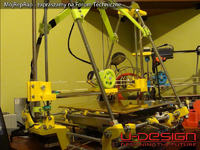
    FDM 3D printer BiBONE by U-Design / not RepRap
    If you have any questions, feel free to chat in this topic

    Video footage of the printer in operation and comparison to the Prusa Mendel RepRap
    http://www.youtube.com/watch?v=IO-CvadXPWw&feature=plcp
    http://www.youtube.com/watch?v=FpjraS-AW_0&feature=plcp

    I was inspired by the Prusa Mendel model, but unfortunately it has its rather serious flaws. When designing the BiBONE, I improved everything that I found uncool in the Prusa: the rigidity of the frame, the possibility of fitting more powerful motors, moving the Z motors downwards, a different way of running the toothed belts, a different way of fixing the Z axis linear rods

    The printer was designed to work with a 300x270x300 work area, but nothing prevents you from assembling a smaller but even more rigid version. I am currently assembling a miniBiBONE version with a work area of 240x200x200
    http://www.mojreprap.pl/board/viewtopic.php?f=16&t=289

    Cool? Ranking DIY
    About Author
    codec
    Level 12  
    Offline 
    codec wrote 79 posts with rating 20, helped 1 times. Live in city Darłowo. Been with us since 2003 year.
  • ADVERTISEMENT
  • #2 11133036
    Propaganja12
    Level 9  
    Printing your own parts is something.
    Plastic parts created in another reprap?
    What are the costs of the overall design?
  • #3 11133116
    djoy
    Level 15  
    Extra :D and what plastics can your printer print with ?
  • #4 11133189
    codec
    Level 12  
    Yes, I printed the plastics on my smaller Prusa. Printing standard ABS/PLA (that's what I tested on). The head can be heated up to 260 degrees.
    The cost of the overall design depends on many factors:
    - ready-made or in-house electronics
    - linear guides new or second-hand from disassembly
    - new motors or dismantled from machines
    - type of heater for the table
    - head ready-made or manufactured in-house

    In general, you can fit between 1400 and 2200 zł
  • ADVERTISEMENT
  • #5 11133225
    Propaganja12
    Level 9  
    In what program can you design the solids?
    You can buy a set of plastics for the reprap for 300£.Printing is that expensive or is it some kind of their markup?
  • #6 11133256
    codec
    Level 12  
    Printing is cheap, the cost of ABS is £35-60/kg. The weight of the Mendel Prusa Reprap components is about 450 grams. The main thing you pay for is the time taken to print, which, depending on your printer, can range from a dozen to several dozen hours of printing. The solids can be designed in many programmes. Of the free ones, Google Sketchup and Blender. Commercial CADs are many ;)
  • ADVERTISEMENT
  • #7 11133278
    Zigus
    Level 14  
    Can the author explain how the head of this printer works? I think some sort of pinion takes the plastic, drags it on, where it is heated by the wire windings? and pushed out through the nozzles? That's more or less how it works? Nice machine like this, and I'm thinking of building one, but on the cheap....
  • #8 11133372
    codec
    Level 12  
    The whole extruder (as it is referred to) is a simple device. The motor, via a gearbox, drives the main screw that pushes the ABS plastic (in the wire). The screw is knurled so that there is no slippage. The wire is pushed into the head. It is heated up to the melting temperature (abs - 230 degrees, PLA 190 degrees) and the hot liquid flows out through the nozzle end hole (0.4-0.5mm in my heads). Heating of the head is accomplished by 1-2 wire resistors mounted in the heating block. The temperature is controlled by the electronics of the printer together with the soft
  • #9 11133419
    Propaganja12
    Level 9  
    How is the solid converted to layers?
    I see some uC in there.Is the code publicly available in hex form or better still, in a higher level language or maybe only to be bought from the on-board computer?
  • #10 11133483
    codec
    Level 12  
    The code is generated by a cutting program called a slicer. The most popular are Slic3r and Skeingorge. They convert a solid file in STL format into gcode.
    Firmware for the atmega is available on the web. The most popular is Marlin
    https://github.com/ErikZalm/Marlin/
    It is loaded via the Arduino software
  • ADVERTISEMENT
  • #11 11134113
    Zigus
    Level 14  
    Another question about the head. Does the gearbox have to be the same as the original or is it all set via soft start? Now a purely theoretical question, can the plastic parts holding the threaded rods be made from plywood and precisely milled out with CNC, then it is possible to print this out of plastic and replace it with :D .
  • #12 11134324
    codec
    Level 12  
    The gear ratio can be anything you want. In the firmware you set the number of steps per mm according to a given formula (you specify the gear ratio). The plywood parts will be stronger than the printed ones, so by all means
  • #13 11171983
    kolokiler
    Level 11  
    Hello

    I am thinking of buying such a printer.

    I won't build one myself as far as mechanics I have no problems with, I can't cope with electrics and electronics.

    I found something like this in the states:

    http://store.solidoodle.com/index.php?route=product/product&product_id=56

    price 600 dollars max option with covers only that a small table

    what do you think ?


    codec
    i see you are dealing with this professionally.
    you wrote about the cost of 1400-2200 zł
    can you elaborate a bit or write how much it would cost to assemble such a version, but only to screw it together and put it together, nothing soldered, not programmed, etc?


    Luke
  • #14 11172140
    codec
    Level 12  
    Looking at these photos, the construction leaves a lot to be desired - supposedly a sealed box, but all welded from thin, bent sheet metal, I would be wary of buying such a printer.

    Soldering is the least in the kit, because the electronics is already all assembled - just connect the components ;) Programming is also a moment. The most time is taken up by twisting and pinning ;)

    As for minimum costs:
    - rods, bolts, nuts - DIY/ironmonger's market - about £50
    - bearings and linear rods, CNC shops - approx. 200 zł
    - motors from disassembly from machines - you can get quite good 30-70 PLN for a set
    - electronics, the cheapest, sanguinololu - 380 zł with drivers
    - plastics - 250 zł (reprap)
    - power supply - at best 2x ATX from old computers or 1 decent one. Preferably one from a server - 60 zł
    - belts - 25 zł
    - heated table - 60-200 zł (some aluminium and power resistors 25W)
    - head - 230 zł - this is probably the only element which is not worth saving on
  • #15 11173839
    kolokiler
    Level 11  
    Thanks for your reply

    Well after the calculation it doesn't come out so bad anymore.

    I'll have to ask a colleague if he can help me with the electronic/electrical side.

    But all in all, I can slowly move the subject along by first putting the mechanics together slowly and then collecting the money for the rest.

    Are there any size restrictions ?

    Is there a tutorial on how to assemble ?

    Where to start ?

    Luke
  • #16 11174090
    codec
    Level 12  
    I've made a topic like this "First Steps" on my forum - lots of linked content there, so let me paste a direct link - I think it will help many people familiarise themselves with the topic
    http://www.mojreprap.pl/board/viewtopic.php?f=12&t=192

    A very cool assembly manual can be found here (reprap prusa mendel)
    http://garyhodgson.com/reprap/prusa-mendel-visual-instructions/

    the instructions are for the construction of a plain/printed bearing printer, but the general concept is the same for linearisers

    If you have access to steel/aluminium cutting, you can do such a construction - it is more rigid, although I would still change a lot in this current version - but why not to start with
    http://www.thingiverse.com/thing:14204

    I'm attaching a photo of a small double planetarium I printed out today (a bit bigger than an SD card). Link to the project
    http://www.thingiverse.com/thing:23030

    A video I took while printing an earlier planetarium with one section - printed on this very printer from the topic
    http://www.youtube.com/watch?v=6kspYjYA_ng&feature=plcp

    A video of the printing and operation of the planetarium powered by the screwdriver :)
    http://www.youtube.com/watch?v=hMQNO2vjUPA&feature=plcp
📢 Listen (AI):
ADVERTISEMENT