logo elektroda
logo elektroda
X
logo elektroda
Dostępna jest polska wersja

Czy wolisz polską wersję strony elektroda?

Nie, dziękuję Przekieruj mnie tam

TL;DR

  • A homemade mini hauler uses a 3 hp internal combustion engine from a NAC scythe.
  • A 60:1 worm gearbox drives a mower-tractor differential, with 18-8.00x8 wheels mounted on it.
  • The powertrain combines the 3 hp engine and 60:1 reduction to move the hauler.
  • The kipper is manual, and steering changes by turning the front axle 180 degrees.
Generated by the language model.
ADVERTISEMENT
Treść została przetłumaczona polish » english Zobacz oryginalną wersję tematu
📢 Listen (AI):
  • Good morning.
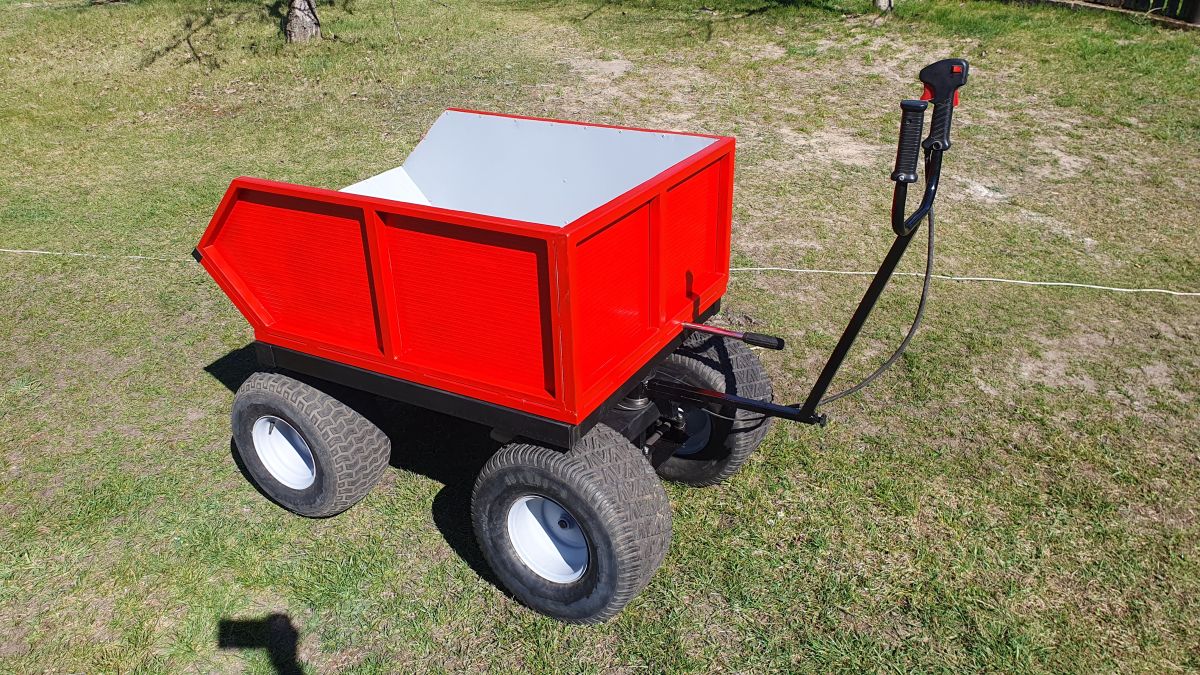
    I would like to show you my mini hauler, which is powered by an engine from a petrol scythe.
    Red mini dumper with four thick tires and a black control handle

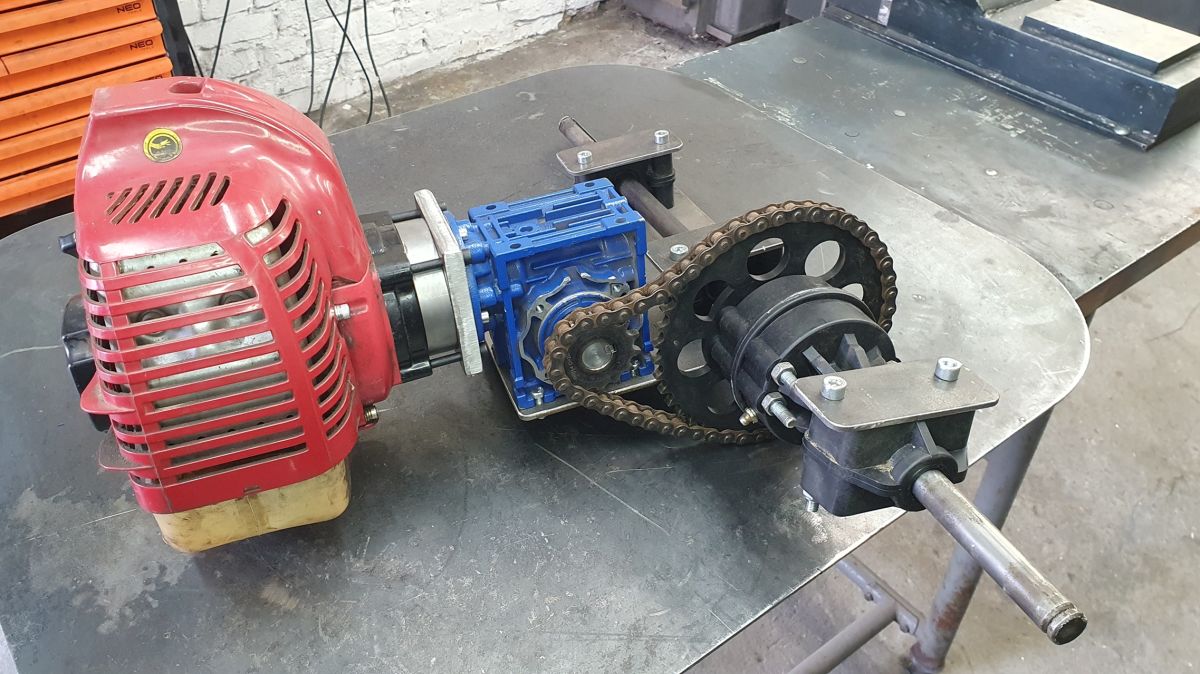
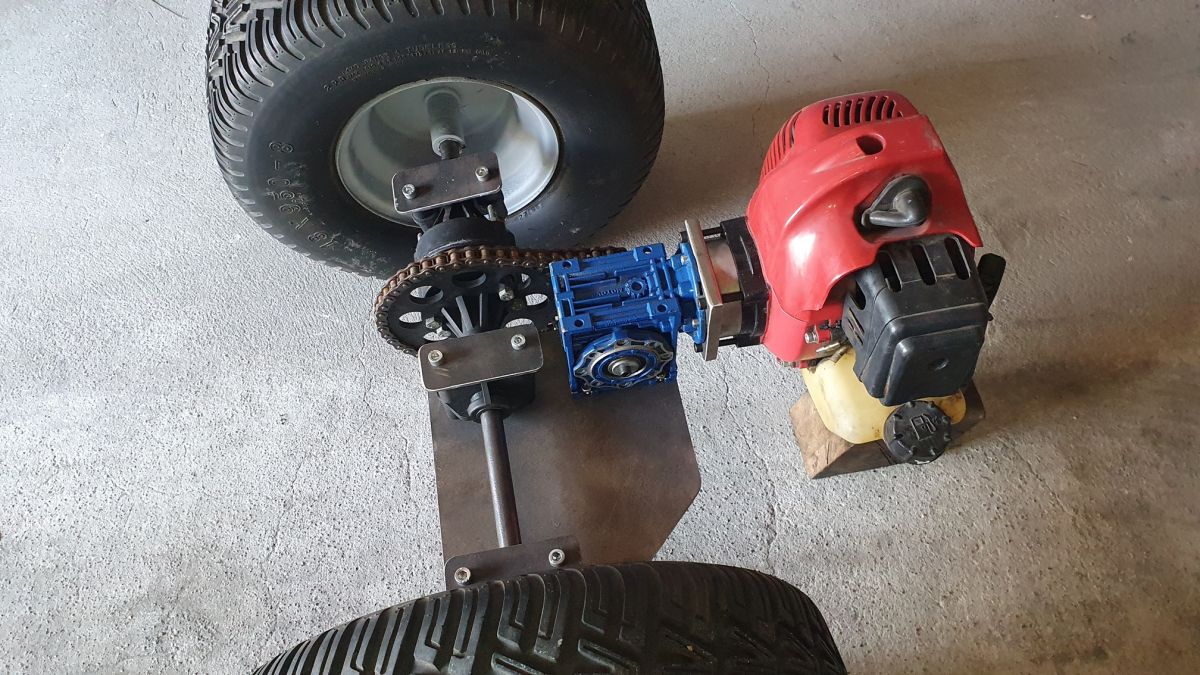
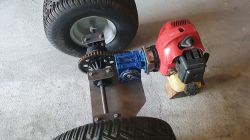
    The 3hp internal combustion engine comes from a NAC scythe and is connected to a 60:1 worm gearbox.
    The gearbox drives the differential from the mower tractor, on which the 18-8.00x8 wheels are mounted.
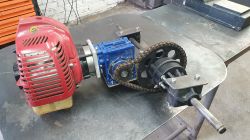
    Brushcutter engine connected to a blue gearbox and chain drive mechanism
    Brushcutter engine connected to gear reducer and axle with large off-road wheels

    The kipper is manual and the change of direction is achieved by turning the front axle 180 degrees.
    The entire construction stage and a demonstration video of the principle of operation.


    Cool? Ranking DIY
    About Author
    Sqerty
    Level 18  
    Offline 
    Sqerty wrote 436 posts with rating 592, helped 5 times. Live in city Ostrowy nad Okszą. Been with us since 2009 year.
  • ADVERTISEMENT
  • #2 21788386
    LEDówki
    Level 43  
    The engine is from a lawnmower. The scythe was used by scythers. Silly names from other languages are not necessary for us. A diesel-powered trolley is fine. Turning the front axle is not too cumbersome? Do you have a workshop equipped like the one in the video? What is the capacity of the loading box? What is the load capacity of the frame? Was something calculated or was everything done by feel?
  • #3 21788390
    m2606
    Level 33  
    Has the Yato tool trolley lost its wheels yet? :-)
    Will you take a photo with the axle reversed?
  • #4 21788569
    CMS
    VIP Meritorious for electroda.pl
    The design is cool and practical. However, I have a question from a different angle. What model of shoes do you have?
  • ADVERTISEMENT
  • #5 21788749
    kombo
    Level 14  
    The name "self-propelled storage tray" fits. :)
  • #6 21788916
    kjoxa
    Level 23  
    Cool, although with that kind of talent and capability I'd give an electric drive.
    Although... here the advantage is that you don't have to worry about keeping an eye on the power supply though, maybe this is a better option after all. It depends where and when it will be used most often.
  • #7 21789001
    zgierzman
    Level 31  
    LEDówki wrote:
    The engine is from a mower. The scythe was used by scythers.


    Scythes were used by reapers - to cut grain at harvest time, or grass during haying. Kosynierzy is the story of how scythes were re-positioned 'for the stiff' for lack of a better weapon to fight with.

    There are petrol mowers and petrol scythes. The mowers ride on wheels, while the scythes are taken in hand, often suspended by braces, and swung in the same way as an old steel scythe - wide sweeps from right to left and back "idling". The smallest models, those without harnesses, for trimming around various small obstacles, are called trimmers.
  • #8 21789005
    LEDówki
    Level 43  
    No, the rules of vocabulary are clear the ending ark you add to the stem if you are forming the name of a machine. You have milling machine, drill, dryer, sharpener, loader, trimmer. The rest of the oddities are inventions of people who don't know these rules and gleefully or thoughtlessly calibrate the names.
    Scythes weren't re-sharpened, they were re-shifted. After combat action, they could continue to be used by mowers to cut grass or grain.
  • #9 21789025
    zgierzman
    Level 31  
    LEDówki wrote:
    The scythes were not re-built, but rearranged. After combat action they could continue to be used by mowers to cut grass or grain


    You've probably never seen a real scythe - it can't be done as you say.

    Three types of war scythe blades and a schematic of the shaft with handwritten Polish labels

    Per Wikipedia :

    Typical treatments resulting in the adaptation of a utility scythe to function as a fighting weapon:

    forging the blade of the economy scythe by a 90-degree angle (upright) - so that the ribs form a single line with the long spar on which they are mounted;
    strengthening the handle that attaches the ribs to the spar (e.g. additional bushing, additional rivets);
    reinforcement of the spar of the scythe, especially in the area of the attachment of the ribs to the spar (in order to protect it from cuts by incisive weapons);
  • #10 21789027
    LEDówki
    Level 43  
    Do you take me for a dimwit? I didn't see a scythe put on a stiletto. No one chased the neighbours in the village, the boneheads died out long ago. I have seen a scythe, my grandfather showed me how to mow the grass with it. As you can see, it's hard to equip a piece of sheet metal on a stick with a combustion engine.
  • #11 21789035
    kkknc
    Level 43  
    Oh lord, it smokes like a two-stroke. And when changing direction I can see the exhaust going straight into my face.
  • #12 21789126
    krzbor
    Level 29  
    I always thought a battery-powered mower was a no-go - after all, smaller petrol mowers stuck in taller grass. However, I have found that the power of the higher voltage electric mowers (36 volts) can cope even with a drive, although they cut a narrower strip. I thought an impact hammer was only for electricity. The assemblers when they were hanging PCs had a hammer on a battery and with an integrated hoover. These days it really pays to build battery-powered things. This hauler would also be much more convenient if it ran on electricity. Exhaust fumes aside - just changing direction is extremely easy.
  • #13 21789132
    LEDówki
    Level 43  
    If the author is a good mechanic, he doesn't have to be a good electronics or electrician. He could make a very nice trolley powered by an internal combustion engine and OK. As for propulsion - power is always what matters. The more power, the more the trolley will carry in less time.
    A combustion engine will give you full power until the fuel runs out. An electric motor will lose power as the resistance of the battery bank powering it increases.
  • #15 21789556
    E8600
    Level 41  
    Sqerty wrote:
    with a worm gear ratio of 60:1.

    Then there is the gear ratio on the chain at an eye-watering 4:1 i.e. a total of about 240:1, and with this ratio a small electric motor would work well (the main problem is 2T motor noise and exhaust). The tapered roller bearings are unlikely to be secured with a seger? The frame gives the impression of being solid, but the plating is thin (a full load of stone would be unlikely to hold it).

    If the gear is going to be usable, I would change the muffler for more soundproofing and this taper roller bearing protection.
  • #16 21789639
    m2606
    Level 33  
    For continuous use, an electric motor is not justifiable from a practical point of view. For occasional use even more so.
  • ADVERTISEMENT
  • #17 21789666
    Staszek_Staszek
    Level 34  
    m2606 wrote:
    For continuous operation, an electric motor is not justifiable from a practical point of view. For occasional use even more so.

    I use DC motors and they meet my requirements.
    The ones I have are quiet, which is critically important to me.
  • #18 21789792
    m2606
    Level 33  
    Staszek_Staszek wrote:
    for me it is critically important.

    This is not a priority for everyone. I use electric ones too, but they are not better for everything.
  • #19 21789900
    E8600
    Level 41  
    Let's not kid ourselves, YT-built equipment is mainly about views, while performance is secondary. An electric drive would be boring and less spectacular (clickable) than an internal combustion engine. It's not very modern, the operator should have a platform so that he doesn't have to walk behind the machine, and this engine could probably still pull a trailer with such a gear ratio.
  • #20 21789904
    m2606
    Level 33  
    The peasant built himself a cart out of rubbish. I don't understand what the whining is about.
  • #21 21790121
    auto_joker
    Level 12  
    Nice trolley, aesthetically made.
  • #22 21790320
    E8600
    Level 41  
    One will pick up on our comments that we are picking on another will see what is worth improving/changing when building something similar.
  • #23 21790426
    m2606
    Level 33  
    E8600 wrote:
    another will see what is worth improving/changing by building something similar.

    That is, he won't build a combustion engine anymore because there will be too many views on YT. It must have a platform because then it is practical.
    Practical it won't be at all then. After all, it's not supposed to be for driving, but for transporting. A platform generates extra size, because it requires a handlebar, so it has to be big. It is also impossible to stand on it when riding off-road, because the first bump in the road will make this impossible. The platform will not allow you to drive it on the road or even on the pavement (registration, homologation, approval, generator, lighting, etc.), because then it will gain the rank of a vehicle.
  • #24 21790450
    E8600
    Level 41  
    A colleague has understood in his own way and is defending his own beliefs by force. I suggested a platform because I know such would get more views. Instead of discussing design flaws, such as the aforementioned seger on the tapered roller bearing, we will be arguing about whether the vehicle was built to earn impressions or utility needs.
    Another error was suggested by another user, which could be a problem if the engine fails.
    acctr wrote:
    What if there is a need to manually push the truck? The worm gear does not get in the way?
  • #25 21790484
    m2606
    Level 33  
    But I am not at all saying that potential problems or oversights in the design should not be pointed out. On the contrary - they are worth discussing.
    I can't find that bearing without the protection - where do you see it?
  • ADVERTISEMENT
  • #26 21790539
    Staszek_Staszek
    Level 34  
    I didn't know about this seger at the bearing and have now found out.
    I will select a different type of bearing - thank you for the information.

    Yellow smiling face emoji with open eyes
  • #27 21790693
    satanistik
    Level 27  
    The electric motor has a disadvantage - or even two disadvantages - the first one is the need for batteries, and here either some gel batteries which are heavy or lithium-ion batteries which unfortunately require electronics And now if you drive it into a puddle, the electronics will probably die, In addition, from vibration and sand it can also die, those expensive cells discharged by leakage current of soggy bms or chargers will probably after a season of non-use have zero volts and will go to waste. The second disadvantage is, as I mentioned earlier, the motor itself and some kind of speed controller is also something that doesn't like water, unfortunately, as the example of many scooters and similar inventions shows, even manufacturers don't quite manage to master waterproofing.

    And then there is power, 1 kW is a small combustion engine, but at 12 volts it is almost 100 amps of current and at higher voltages there is a greater risk of something breaking due to water, but 5 kW is an average combustion engine and almost unrealistic electric project for an amateur.
  • #28 21791443
    szeryf3
    Level 30  
    You had a lot of welding, but the trolley came out great.
  • #29 21792981
    partyzancik
    Level 25  
    m2606 wrote:
    For continuous operation, an electric motor is not justifiable from a practical point of view. For occasional use even more so.

    And then there are the batteries . None of these work in winter in the same way as they do in an electric car
  • #30 21794816
    Erbit
    Level 39  
    the
    Sqerty wrote:
    direction of travel is done by turning the front axle 180 degrees.

    Super mechanism - especially when you can see in the video how you figured it out. Don't listen to the malcontents - they just envy your ingenuity.

    On another note - what was the need behind the construction of this "hauler" ?

    [edit]
    You finished this "dumper" very carefully, as if you were going to drive it to the FSO exhibition, and yet it is probably a working tool.
📢 Listen (AI):

FAQ

TL;DR: DIY mini hauler uses a 3 hp engine and 60:1 worm gearbox; “The 3hp internal combustion engine…is connected to a 60:1 worm gearbox.” [Elektroda, Sqerty, post #21788361]

Why it matters: Builders searching “how to build a small powered hauler” get specs, trade-offs, and fix-it tips distilled from the thread. This FAQ is for hobby fabricators comparing combustion vs. electric drives and looking to avoid common pitfalls.

Quick Facts

What exactly powers this mini hauler and how is torque multiplied?

It’s driven by a 3 hp petrol engine from a NAC brushcutter, feeding a 60:1 worm gearbox, then a mower-tractor differential. This setup provides high torque at low speed for hauling. Wheels are 18×8.00-8, which suits low-speed traction on uneven ground. [Elektroda, Sqerty, post #21788361]

How do you change driving direction on this build?

There is no reversing gearbox. The operator rotates the entire front axle by 180 degrees, and the hauler drives the other way. This keeps the drivetrain simple and robust for a garage build without complex linkages. [Elektroda, Sqerty, post #21788361]

Is there a reversing walk-through?

Yes—three steps:
  1. Stop the engine and stabilize the hauler.
  2. Unlock and rotate the front axle 180°.
  3. Restart and proceed in the new direction. This is shown in the linked demo video by the author. [Elektroda, Sqerty, post #21788361]

What’s the total gear reduction and why does it matter?

A user identified a secondary chain reduction around 4:1. Combined with the 60:1 worm stage, total reduction is roughly 240:1. This large ratio trades speed for strong tractive effort, ideal for starts on soft ground and heavy loads. [Elektroda, E8600, post #21789556]

Can you push the hauler by hand if the engine stops?

Manual pushing can be difficult because worm gears resist back-driving. A commenter flagged this as a practical failure case when the engine is off or stalled. Plan for a clutch, freewheel, or tow-point if manual movement is required. [Elektroda, acctr, post #21789141]

How loud is the drivetrain and how to reduce noise?

Commenters noted two-stroke exhaust noise and smoke. A practical fix is upgrading to a better muffler for sound attenuation and directing gases away from the operator. “I would change the muffler for more soundproofing.” [Elektroda, E8600, post #21789556]

Does the exhaust blow toward the operator when reversing?

Yes, one user observed that reversing directs exhaust toward the operator’s face. Consider rerouting the muffler outlet or adding a deflector to protect the operator during reverse movements. [Elektroda, kkknc, post #21789035]

What is a worm gearbox and why use it here?

A worm gearbox uses a screw-like worm driving a gear for large single-stage reduction and inherent back-drive resistance. It simplifies the layout and delivers high torque for a compact hauler, at the cost of manual back-drive. [Elektroda, Sqerty, post #21788361]

What is the load-box capacity and frame load rating?

The author did not state volume or payload. Users asked about load-box capacity and frame load rating, implying interest in quantified specs. You’ll need measurements and material data to calculate safe limits. [Elektroda, LEDówki, post #21788386]

Is electric drive better than the petrol setup here?

Opinions were split. Some favored electric for quiet operation and easy reversing; others preferred petrol for sustained power without battery concerns. Battery performance in winter and waterproofing electronics were raised as drawbacks. [Elektroda, 21789126/21789666/21790693/21792981]

How does battery performance change in cold weather?

A participant cautioned that batteries don’t perform the same in winter, highlighting reduced effectiveness compared with warm conditions. This impacts runtime and peak power for electric conversions. [Elektroda, partyzancik, post #21792981]

Are there waterproofing concerns for an electric conversion?

Yes. A user warned that controllers, BMS, and chargers can fail from water, vibration, and contamination. Improper storage may also deep-discharge lithium cells via leakage. Protect and seal electronics if you go electric. [Elektroda, satanistik, post #21790693]

Any bearing or retention issues to fix on this build?

One commenter flagged taper roller bearings seemingly secured only by a seger. The recommendation was to improve retention and protection to handle axial loads and shocks. [Elektroda, E8600, post #21789556]

Does the builder have a full workshop like in the video?

A user asked about the workshop seen in the video, but the author did not respond with details. The visible fabrication quality suggests solid tooling and welding capability. [Elektroda, LEDówki, post #21788386]

What is the tire size 18×8.00-8 and why choose it?

It indicates an 18-inch diameter, 8-inch width, for an 8-inch rim. This footprint suits low-speed traction and load distribution on grass, dirt, and yard surfaces. [Elektroda, Sqerty, post #21788361]

Is the finish overkill for a work tool?

One user praised the careful, exhibition-like finish while acknowledging it’s a working dumper. Good finishing improves durability and user pride without reducing utility. [Elektroda, Erbit, post #21794816]
Generated by the language model.
ADVERTISEMENT