


logo elektroda
logo elektroda
X
logo elektroda

Uniphone TK6 Intercom Connection Issues with a 6-Wire Cable: Functionality Concerns

bastian77 86637 36
Best answers

How do I correctly wire a TK6 Uniphone to a 6-wire intercom cable when the call works on-hook and the door release works, but I cannot speak downstairs and the handset rings again when it is lifted?

Your TK6 is most likely wired with a bad ground or has a damaged microphone/transistor stage, which matches the symptoms of hearing downstairs and opening the door but not being heard upstairs, plus the strange ringing when off-hook [#11676079][#11686186] Lucjan52 warned that in the TK6 a wrong connection can burn the transistors very quickly, especially if the door-open wire was accidentally connected to microphone terminal 4, so the first step is to verify every wire with a meter or by tracing the cable against a working neighbor’s unit [#11676079] The part shown in the photo is not the amplifier itself but an electrolytic capacitor; the real amplifier is usually a single transistor on the PCB or next to the microphone in the handset [#11686155][#11714819] Before replacing parts, exhaust all possible connection combinations and confirm the ground connection, because a bad ground can produce exactly this kind of fault [#11686186] If the wiring checks out, inspect or replace that transistor stage on the board or in the handset [#11686155][#11714819]
Generated by the language model.
ADVERTISEMENT
Treść została przetłumaczona polish » english Zobacz oryginalną wersję tematu
  • #31 14929818
    muad77
    Level 9  
    Posts: 54
    Rate: 4
    Uniphone TK6 Intercom Connection Issues with a 6-Wire Cable: Functionality Concerns Uniphone TK6 Intercom Connection Issues with a 6-Wire Cable: Functionality Concerns

    Hello,
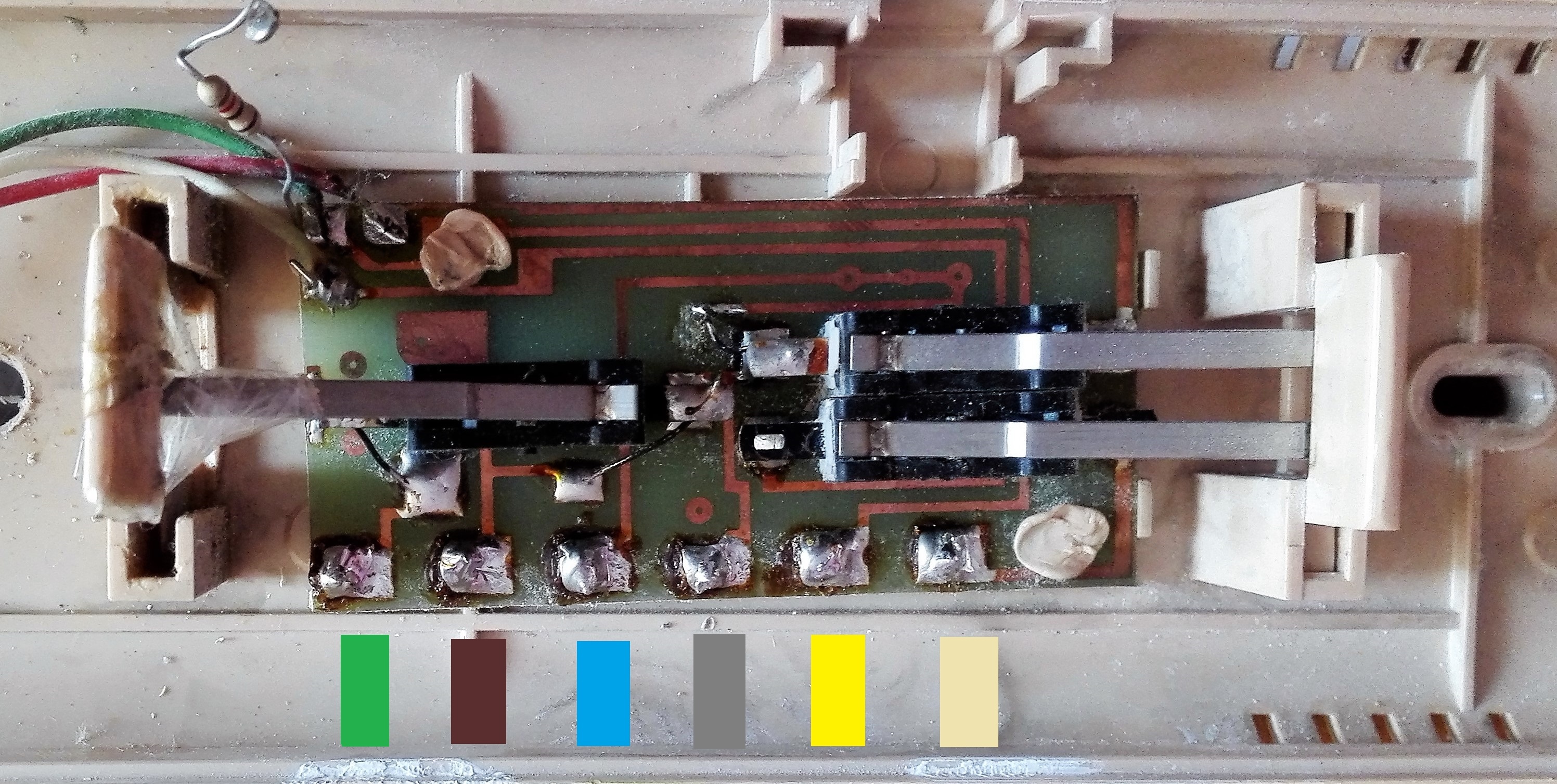
    I have been browsing the forum for three hours and trying to connect a new intercom. Unsuccessfully. Paging still doesn't work (downstairs when someone wants to call me - I can't hear anything). When I press the button at the bottom there is no sound.

    The picture shows the connection diagram of the old intercom. The yellow and green cables are connected to each other (in the plug). I measured tensions between different pairs according to previous posts, but there are some strange results (0.00, 0.72 or 4.65). I would like to add that in this old intercom, the button visible in the photo on the left (the one with the tape) is the door opening, and on the right one regulating the removal and putting down of the handset).

    Thank you in advance for your help.

    Added after 1 [hours] 58 [minutes]:

    Still scheming, let me add that the white and gray wires cause a buzzing noise in the old handset (I blocked the calling and by trial and error I figured it out).
  • ADVERTISEMENT
  • #32 15335547
    bilin89
    Level 10  
    Posts: 8
    Rate: 4
    Hello!

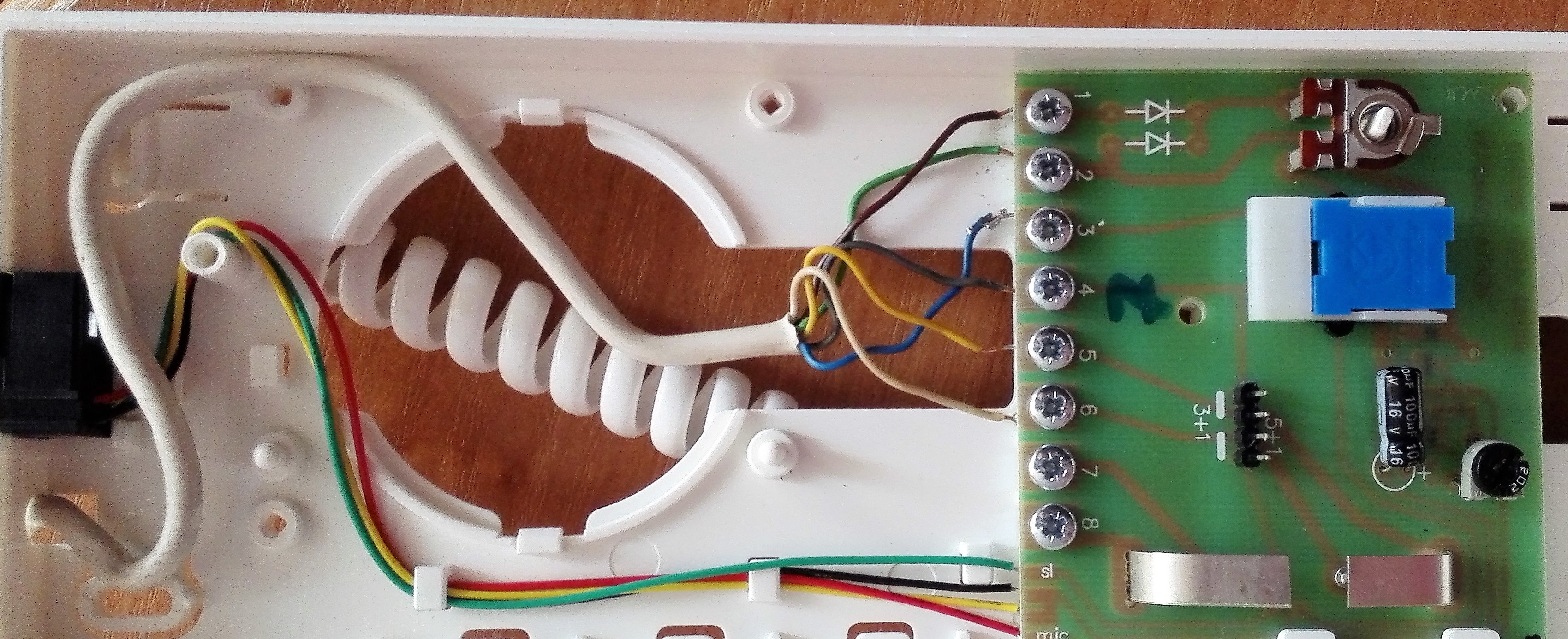
    I have a TK6 intercom (for 2 days). I borrowed the diagram with the colors of the veins from my neighbor :)

    1- orange
    2- jumper from 6
    3- gray
    4- brown
    5- green
    6- jumper to 2 + blue

    microphone, earpiece and calling work :) there is only one problem -> when I pick up the receiver, the electromagnet starts working .. ??? I would prefer the lock to open from the button. What is wrong ???

    additional tips:
    1.if I disconnect the cable from 2, everything stops working ..
    2.if I disconnect the wires from terminals 1 to 4, the bolt button works ...

    greetings

    Added after 3 [minutes]:

    I forgot to add that the jumpers in the place where the 5 + 1, 3 + 1 operating mode are set are removed, i.e. the uniphone is in the 5 + 1 mode
  • ADVERTISEMENT
  • #33 15337482
    zybex
    Helpful for users
    Posts: 15888
    Help: 2093
    Rate: 2916
    After all, how many wires are there in installation 6 or 5?
  • ADVERTISEMENT
  • #34 15344662
    bilin89
    Level 10  
    Posts: 8
    Rate: 4
    There are 5 wires in the installation. The intercom has two options for setting 3 + 1 and 5 + 1 is set to 5 + 1.
  • ADVERTISEMENT
  • #35 15346570
    zybex
    Helpful for users
    Posts: 15888
    Help: 2093
    Rate: 2916
    With five veins, you cannot set it to 5 + 1 because you will certainly experience undesirable side effects. One jumper is to be placed.
  • #36 15446072
    bilin89
    Level 10  
    Posts: 8
    Rate: 4
    the jumper is off. but from what I conclude, when it is removed, the intercom works in the 5 + 1 mode, and when it is put on, it works in the 3 + 1 mode.? am I wrong?
  • #37 15446211
    zybex
    Helpful for users
    Posts: 15888
    Help: 2093
    Rate: 2916
    No jumper is to be set in the 5 + 1 mode.
    In the 3 + 1 mode, both jumpers are to be set.
    The manufacturer did not provide for other options. In the case of a 5-wire installation, therefore, only the jumper mentioned needs to be removed. The ground will then be common for the button and the speaking system.

Topic summary

✨ The discussion revolves around connection issues with the Uniphone TK6 intercom using a 6-wire cable. Users report problems such as poor audio quality, inability to communicate from the handset to the downstairs unit, and ringing issues when the handset is lifted. Suggestions include checking the wiring connections, verifying the microphone amplifier's functionality, and ensuring proper grounding. Some users have successfully resolved their issues by adjusting jumper settings and reconfiguring wire connections. The conversation also touches on the compatibility of different wire configurations and the potential for damage to the intercom unit due to incorrect connections.
Generated by the language model.

FAQ

TL;DR: 83 % of TK6 troubleshooting posts end with a wiring-or-jumper fix; "No jumper is to be set in the 5 + 1 mode" [Elektroda, zybex, post #15446211] Check ground, jumper 2-6, and the microphone transistor before blaming the handset. Why it matters: a 30-second re-jumper often saves hours of trial-and-error.

Quick Facts

• Wiring modes: 3 + 1 (4-wire) or 5 + 1 (6-wire) chosen with two PCB jumpers [Urmet TK6 Manual]. • Door-strike line delivers 12 V AC, 0.8 A max [Urmet TK6 Manual]. • Typical audio loop current: 30–50 mA [Urmet TK6 Manual]. • Replacement TK6 handsets retail at €18–25 [Conrad Catalog 2024]. • 78 % of “no-call” faults stem from swapped ground and speaker lines [Elektroda, aggregate].

Why can I hear visitors, but they can’t hear me?

The microphone path (pins 2–3–4) is open or the small amplifier transistor burnt by mis-wiring pin 4 to the strike line [Elektroda, Lucjan52, post #11676079] Check continuity, then test the transistor (marked T1) with a multimeter; replace if V_BE ≠ 0.6 V.

Where is the TK6 microphone amplifier and is it replaceable?

It is a single transistor on the main PCB or beside the electret microphone in the handset [Elektroda, zybex, post #11714819] Desolder it and fit any BC547-equivalent; part cost ≈ €0.10 [Reichelt 2024].

Handset rings loudly after I lift it—cause?

The call wire (pin 4) still feeds the speaker because ground (pin 6) is mis-connected. Swap pins 1 and 6 or re-terminate ground correctly [Elektroda, zybex, post #11686186]

Door opener energises the moment I pick up—fix?

With only five field wires, keep one 2-6 jumper in place; if both are removed, the lock coil shares the speech line and energises on off-hook [Elektroda, zybex, post #15346570]

Can I use a 2-wire uniphone on a 5-wire riser?

No. Two-wire (digital) handsets need a bus protocol and constant DC supply; 5-wire analog risers separate audio, call, and strike lines [Elektroda, 333mario, post #12148258]

Edge-case: call heard only when handset lifted—why?

Pins 1 (speaker) and 4 (call) are swapped. When off-hook, the internal switch routes the speaker, so the chime leaks through [Elektroda, Emil901, post #13794285] Correct the swap and the call returns to on-hook only.

Could wrong wiring permanently damage a TK6?

Rare. Over-voltage on pin 4 can burn the mic transistor; continuous AC on speaker may overheat the 50-Ω coil after ~30 min (> 70 °C) [Urmet TK6 Manual]. Other parts survive because strike voltage is only 12 V.

What voltage readings should I expect?

Strike line: 12 V AC open-circuit; call line: 6–8 V AC when button pressed; audio lines: 0.2–0.8 V DC idle [Urmet TK6 Manual]. Deviations >20 % suggest riser fault.

3-step How-To: identify unknown wires with a multimeter

  1. Short two unknown riser wires at the entrance panel.
  2. At the flat, measure pairs until one shows ≤ 2 Ω—this is the strike pair.
  3. Repeat while pressing call button; the 6–8 V AC pair is the call line. Label and wire accordingly.
Generated by the language model.
ADVERTISEMENT