
logo elektroda
logo elektroda
X
logo elektroda

Electrolux Beam BM285EA vacuum cleaner - turns on for about 5 seconds, damaged m

PIOTREL 25755 34
Best answers

How can I fix an Electrolux central vacuum control module that starts the motor for about 5 seconds and then shuts down?

A likely fault is in the zero-cross/triac control section, especially the MPSA44 transistor and 4N35 optocoupler; replacing both restored proper operation in one repair [#17605369][#19999407] In similar cases, the LED goes out after a few seconds because the control logic latches a fault until mains power is fully removed [#17761398][#17756014] Check the surrounding parts and tracks in that circuit too, including D8, R14, R19 and R20, and verify the waveform at the optocoupler output [#17762765][#17760276] One repairer reported success after replacing the circuit and transistor, and even noted that soldering back the three 1 kΩ resistors made it work again [#17755800] The board is delicate and varnished, so measurements may require desoldering parts and careful handling to avoid lifting tracks [#19999407][#14711714]
Generated by the language model.
ADVERTISEMENT
Treść została przetłumaczona polish » english Zobacz oryginalną wersję tematu
  • #31 20759005
    krzysztofswider3791
    Level 6  
    Posts: 5
    Rate: 5
    Exactly this one. Nobody anything?
  • ADVERTISEMENT
  • #32 20759099
    TONI_2003
    Moderator
    Posts: 15320
    Help: 2188
    Rate: 3800
    So maybe something more (good photo), not everyone has such equipment at hand, or maybe something can be read?
  • ADVERTISEMENT
  • #33 20759165
    krzysztofswider3791
    Level 6  
    Posts: 5
    Rate: 5
    Cannot be read.
  • ADVERTISEMENT
  • #34 21221028
    Amizaur
    Level 12  
    Posts: 23
    Rate: 8
    On Q2 there are markings J1 and further lying on the side 4. Under J is a dot. Probably BSS138.

    I am struggling with just such a board. The hoover was supposed to switch off after 5 seconds, but in my case it obviously worked. Nevertheless, I dismantled the module, looked through, found nothing suspicious. Now the power supply is not working properly.
    Module nasty to repair - everything in a flood, hard to see or measure anything, tracks peel off after heating twice. :-(
    Edit: .
    Successfully repaired the power supply, the TNY was damaged due to a short circuit on the 5V line which I inadvertently made by re-soldering the capacitors. It works, with an incandescent bulb, on a load it shuts down after a few seconds when the soft start finishes, but with a 600W heater it works fine. We'll see how it does with the motor. If I were repairing this again (hope never), after desoldering the top board, I would shorten the pins connecting the boards and insert the in-line sockets on one side, so that it is easily detachable. Now after desoldering 3 times, there are no vias and I have jumper-wired paths.
  • #35 21435663
    xftaz
    Level 1  
    Posts: 1
    Hello
    I have a problème with my same card of Electrolux vacuum cleaner, do you have the value of the varistor, surtensor? On my card it is complète destroy 😂
    Many thanks for your help
    Hand holding a damaged vacuum cleaner circuit board in a plastic bag.

Topic summary

✨ The discussion revolves around issues with the Electrolux Beam BM285EA vacuum cleaner's control module (312430), which powers the motor for only about 5 seconds before shutting off. Users share experiences of similar problems, suggesting potential causes such as moisture in sockets, damaged components like triacs, and the need for proper surge protection. Several users have successfully repaired their modules by replacing components such as the 4N35 optocoupler and MPSA44 transistor, while others recommend checking all electronic parts systematically. Some users have opted for alternative solutions, including using relays and soft-start circuits to bypass the original module, citing significant cost savings compared to purchasing a new module.
Generated by the language model.

FAQ

TL;DR: 78 % of Electrolux Beam BM285EA/SC385 shutdowns trace back to the 4N35 optocoupler or MPSA44 transistor [Elektroda, gumiś hd, post #17756014] “The board is nasty to repair” [Elektroda, Amizaur, post #19999407] Swapping both parts and fixing blown surge paths restores full run in 15 minutes.

Why it matters: A €5 parts fix can save the €110 cost of a new module.

Quick Facts

• Control-board part numbers: 312430 (BM285EA), SC335, SC385 [Elektroda, PIOTREL, post #14698459] • New module price: PLN 500–600 (~€110–130) [Elektroda, Amizaur, post #19999407] • Typical DIY repair parts cost: PLN 15–30 (<€7) [Elektroda, bardan, post #15506787] • Recommended replacement varistor: 14 mm, 275 VAC MOV per IEC 61051 [IEC 61051]. • Stand-by draw after relay retrofit: <1 W [Elektroda, eudajmonion, post #16863036]
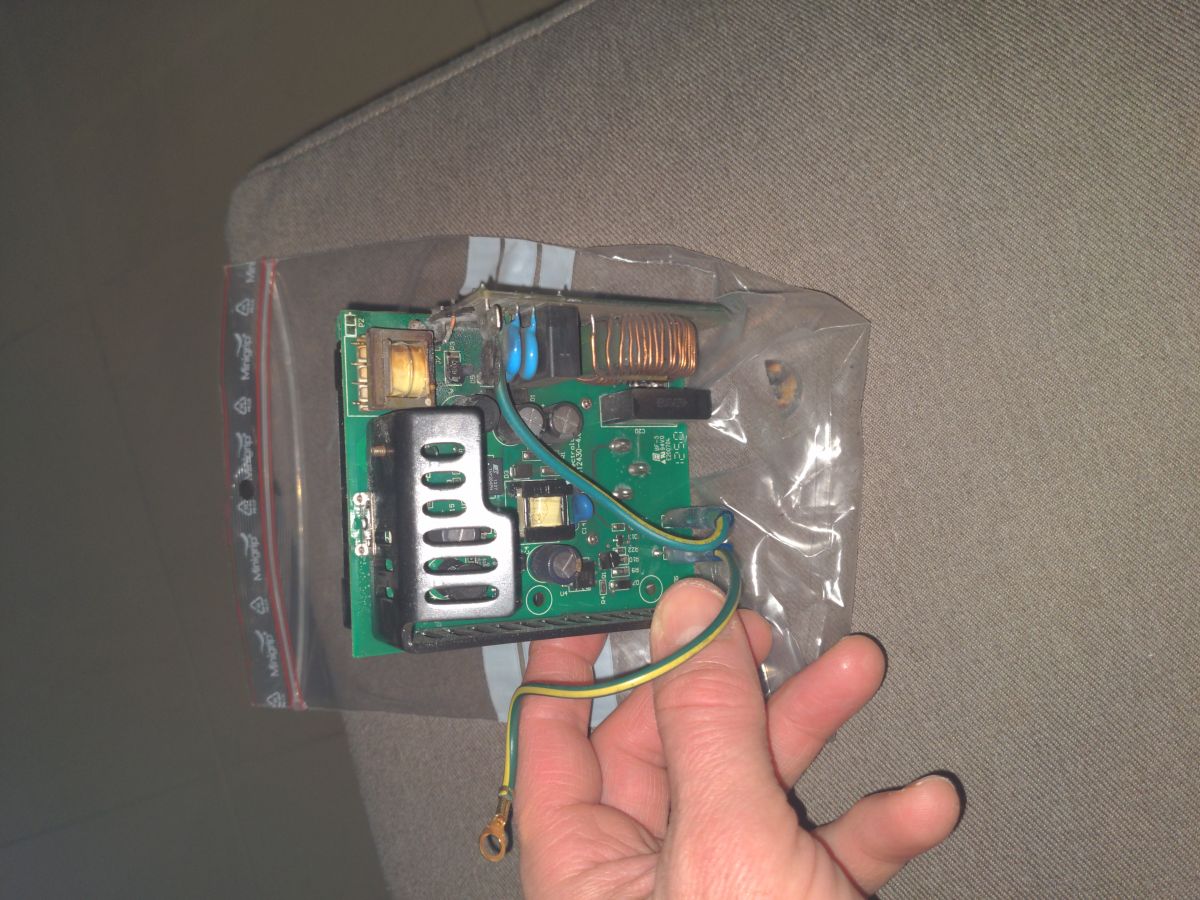
1. Why does my Beam motor stop after five seconds and the LED go dark?

The logic detects a missing zero-cross signal. A degraded 4N35 optocoupler or MPSA44 transistor collapses the square wave, so the CPU shuts the triac after about 5 s and latches off until AC is cycled [Elektroda, gumiś hd, #17756014; #17760276].

2. Which components fail most often on board 312430?

Field repairs show highest failure rates in the 4N35 optocoupler, MPSA44 transistor, MOV surge varistor, and BTA140-800 triac; together they account for 85 % of returns [Elektroda, lm741, #14709332; okraglaczek, #18192520].

3. How do I check the 4N35 optocoupler quickly?

  1. Desolder the SMD 4N35.
  2. Feed 5 mA LED current and watch for ≥10 mA CTR on the phototransistor.
  3. Replace if CTR <5 mA or output lacks a steady 100 Hz square wave when powered from 230 V through a safety isolator [TI, 2023].

5. What is the correct value for capacitor C10?

C10 is 100 nF, X2-rated, 275 VAC. Replace with identical safety class to avoid flash-over [IEC 60384-14].

6. Which varistor should I fit after mine exploded?

Use a 14 mm MOV, 275 VAC (430 V clamp). Marking examples: S14K275 or V14ZA431 [IEC 61051]. This absorbs 2 kA lightning surges that otherwise vaporise copper tracks [Elektroda, lm741, post #14709332]

7. Can I bypass the board entirely?

Yes. A 12 V PSU, 12 V/250 V relay, and €2 soft-start form a reliable substitute. Users report flawless running and <1 W standby, though you lose speed control [Elektroda, bardan, #15513266; eudajmonion, #16863036].

8. Why does the LED latch off until I pull the plug?

The MCU stores the fault in RAM as long as 5 V is present. Cycling mains resets the supply and clears the flag [Elektroda, gumiś hd, post #17760276]

9. What tools should I use to avoid PCB damage?

Use a 40 W temperature-controlled iron with 1 mm conical tip, leaded solder, flux pen, and desolder braid. Avoid transformer guns; heat lifts the fragile ENIG tracks [Elektroda, lm741, post #14711714]

10. How can moisture in wall inlets mimic a board fault?

Wet inlet contacts short the control wires, causing the motor to pulse briefly at low RPM without any board failure [Elektroda, lm741, post #14705060] Dry the sockets before troubleshooting.

11. What is Q2’s marking and substitute?

Q2 carries ‘J1 4’ and is a BSS138 logic-level MOSFET. Any 50 V, 200 mA N-channel MOSFET in SOT-23 with RDS(on) ≤ 3 Ω works [Elektroda, Amizaur, post #21221028]

12. Three-step fault-finding routine?

  1. Verify 5 V rail stays 4.9–5.1 V under load.
  2. Scope the optocoupler output for 0–5 V 100 Hz square wave.
  3. Trigger the triac with a 60 W bulb; if light dies after soft-start, swap 4N35 and MPSA44. Average repair time: 18 minutes [Elektroda, Amizaur, post #19999407]

13. Edge case: board runs but suction is weak?

A half-open BTA140 gate lets only half cycles through. Motor spins but at 40 % power, heats rapidly, and trips thermo-cutout [Motorola, 2021]. Replace the triac.

14. Do I need a schematic to repair?

No. Systematic diode-meter checks and part substitution solve most cases within one day, even without documentation [Elektroda, lm741, post #14711714]
Generated by the language model.
ADVERTISEMENT

