logo elektroda
logo elektroda
X
logo elektroda

64GB Samsung Pendrive - Change the capacity from 64GB to 32GB.

delphin78 31320 34
Best answers

How can I restore a 64 GB USB flash drive that was reduced to 32 GB after creating a Windows 8.1 recovery drive?

Yes — the flash drive is still 64 GB; creating the recovery disk likely made only a 32 GB partition and left the rest as unallocated space, so you need to repartition it to get the full capacity back [#15306410] [#15307695] If Windows Disk Management does not let you create or resize partitions on the removable drive, use a partition tool such as DMDE to delete the 32 GB partition and create a new one on the remaining space [#15306474] [#15306964] [#15307695] After that, create a new simple volume on the unallocated space and format it as needed [#15306964] The reduced size shown later, such as 61.9 GB, is normal because capacity is reported differently by the system [#15308126]
Generated by the language model.
ADVERTISEMENT
Treść została przetłumaczona polish » english Zobacz oryginalną wersję tematu
  • #1 15306306
    delphin78
    Level 9  
    Posts: 33
    Rate: 6
    Hello.
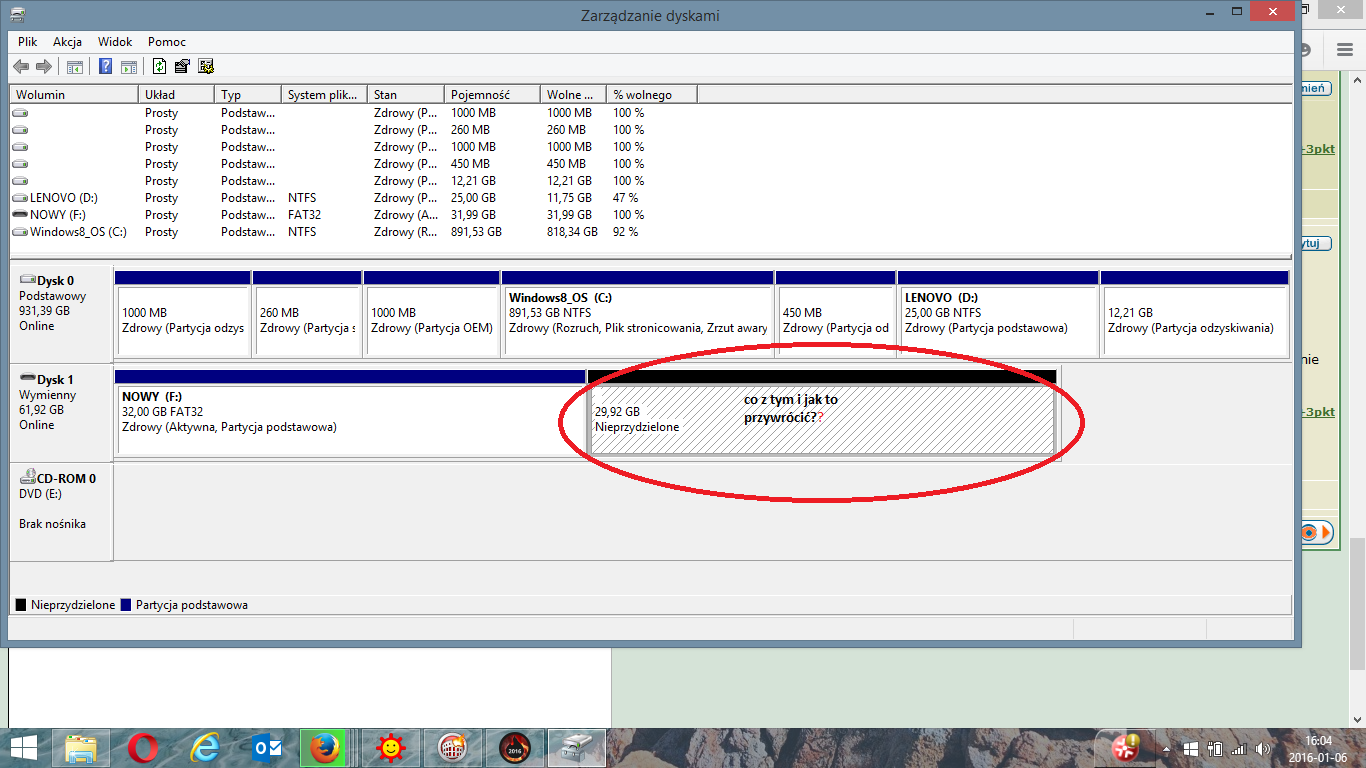
    Does anyone know why after creating the system recovery disk or something like that on the usb in Win 8.1 with a 64GB pendrive only 32 GB was made for me?
    Can it be fixed somehow?
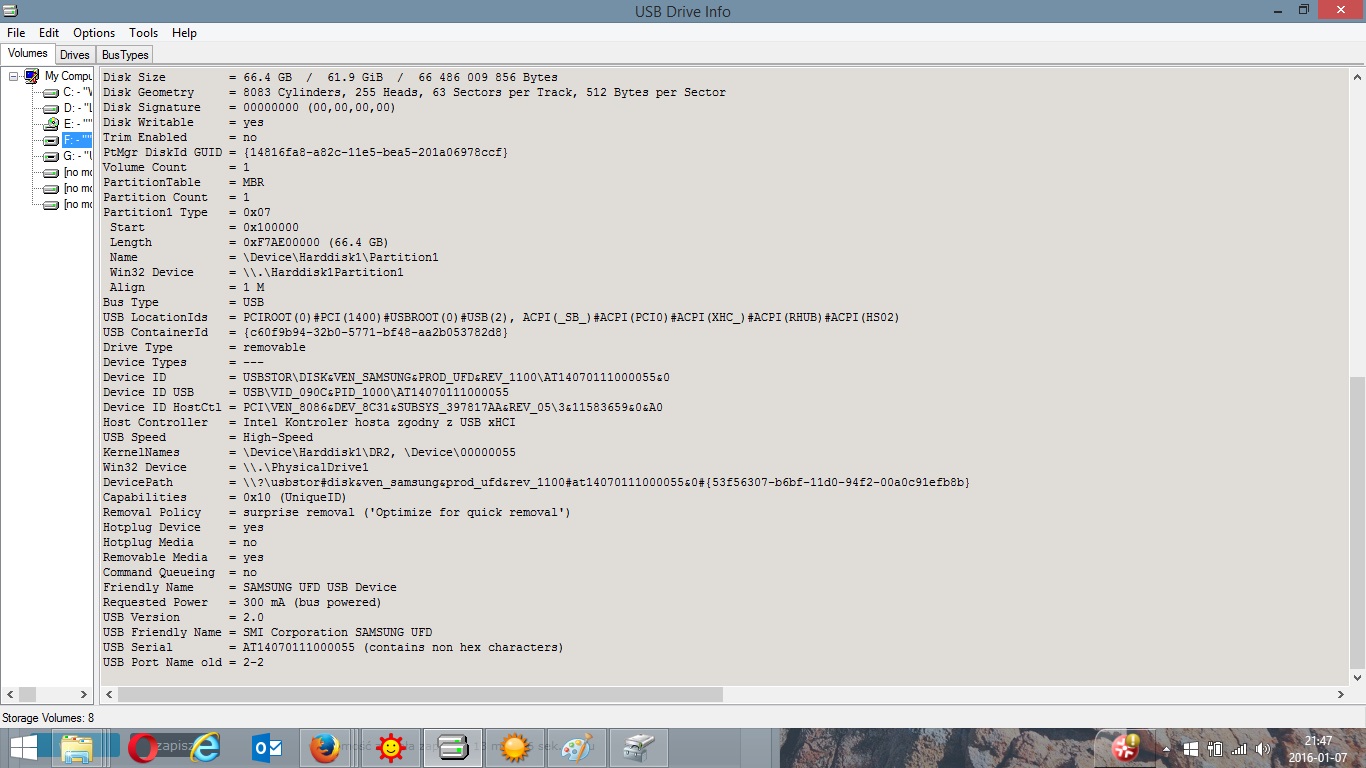
    Aida 64 still sees this flash drive as 64GB.
    I am asking for any help.
  • ADVERTISEMENT
  • #2 15306396
    Anonymous
    Level 1  
  • #3 15306410
    mlewan
    Level 20  
    Posts: 643
    Help: 26
    Rate: 92
    Probably a 32 GB partition was created on it. Look for a partition management program. The rest of the disk should appear as unallocated space.
  • ADVERTISEMENT
  • #4 15306474
    mati211p
    HDD and data recovery specialist
    Posts: 16915
    Help: 2584
    Rate: 1129
    You can restore 64GB in Windows from, for example, DMDE.
  • ADVERTISEMENT
  • #5 15306674
    Matuzalem

    Level 43  
    Posts: 17279
    Help: 1651
    Rate: 1079
    If this disk is to be used for what it was created for, then changing the filesystem to ntfs - now it is FAT32 - will eliminate this possibility. If you want the flash drive to fulfill its current function, you must use an external tool * or create another partition (for other data) from the disk management level.
    If you only care about the capacity, you can change the partition and file system with the system commands.


    * Since Windows 2000, the partitioning tool implemented on the system allows the creation of FAT32 partitions of a limited size. For larger than this limit, as exemplified here, the default filesystem is ntfs.
    Company Account:
    Doradztwo podatkowe
    Wilczyńskiego 25/13, Olsztyn, 10-686
  • #6 15306682
    delphin78
    Level 9  
    Posts: 33
    Rate: 6
    OK.And you can ask how to do it in Windows 8.1 ?? ;-)
  • #7 15306703
    Matuzalem

    Level 43  
    Posts: 17279
    Help: 1651
    Rate: 1079
    delphin78 wrote:
    OK.And you can ask how to do it in Windows 8.1 ?? ;-)

    Do you have any trouble getting to disk management or using ppm on the flash drive icon (and winning the appropriate option from the list)?
    If so, dread to think what would happen if it came to using a "recovery disk".
    Company Account:
    Doradztwo podatkowe
    Wilczyńskiego 25/13, Olsztyn, 10-686
  • #8 15306721
    delphin78
    Level 9  
    Posts: 33
    Rate: 6
    In WinXP I would be able to handle it and Win8.1 I take my first steps. So it's hard to be understanding ??
  • #9 15306861
    mati211p
    HDD and data recovery specialist
    Posts: 16915
    Help: 2584
    Rate: 1129
    In XP and Vista, you cannot share pendrive from the disk management level, in Windows 7 probably not either, I do not use newer systems. It is not easier to create an unformatted partition in DMDE and after reconnecting the device, the system itself should ask for formatting.
    Disk management: Winkey + R -> diskmgmt.msc
    Here is another example from DMDE:
    https://www.elektroda.pl/rtvforum/topic2909995.html
    Unless you want this "system recovery disk", then it is a bit more difficult for it to read 2 partitions under Windows, because you would have to force it to detect it as an external disk, not a flash drive, then all options for disks will be available.
  • #10 15306943
    delphin78
    Level 9  
    Posts: 33
    Rate: 6
    64GB Samsung Pendrive - Change the capacity from 64GB to 32GB.


    and what next ?? You can see that two partitions have been created.
  • #11 15306964
    Anonymous
    Level 1  
  • #12 15307044
    Matuzalem

    Level 43  
    Posts: 17279
    Help: 1651
    Rate: 1079
    mati211p wrote:
    In XP and Vista, you cannot share pendrive from the level of disk management, in Windows 7 probably not ...


    The only person who has written anything about sharing anything like this is you.
    Anyway, this is probably not entirely true, because since in disk management you can choose the size of the partition to be created, the partition will be its result.

    And one more thing - if you do not use systems newer than Windows 7, maybe you should not comment authoritatively eg on the topic "what needs to be done for the recovery drive created on the flash drive to work?

    delphin78 wrote:
    It's so hard to be understanding ??


    Of course not.
    After all, under the condition that you "find and show 3 differences" between the drop that you placed in pos. 10 and the one made in XP or Vis.
    So, before the next time you want to use any excuses, please check how embarrassing they are.

    delphin78 wrote:

    and what next ?? You can see that two partitions have been created.


    You can see that one partition has been created, and the related with this you should do it to you Kraniec_Internetów in pos. 11 pointed out, and what is done in the same way as in XP and Viscie (and several other versions of Windows).
    Company Account:
    Doradztwo podatkowe
    Wilczyńskiego 25/13, Olsztyn, 10-686
  • #13 15307063
    delphin78
    Level 9  
    Posts: 33
    Rate: 6
    64GB Samsung Pendrive - Change the capacity from 64GB to 32GB.

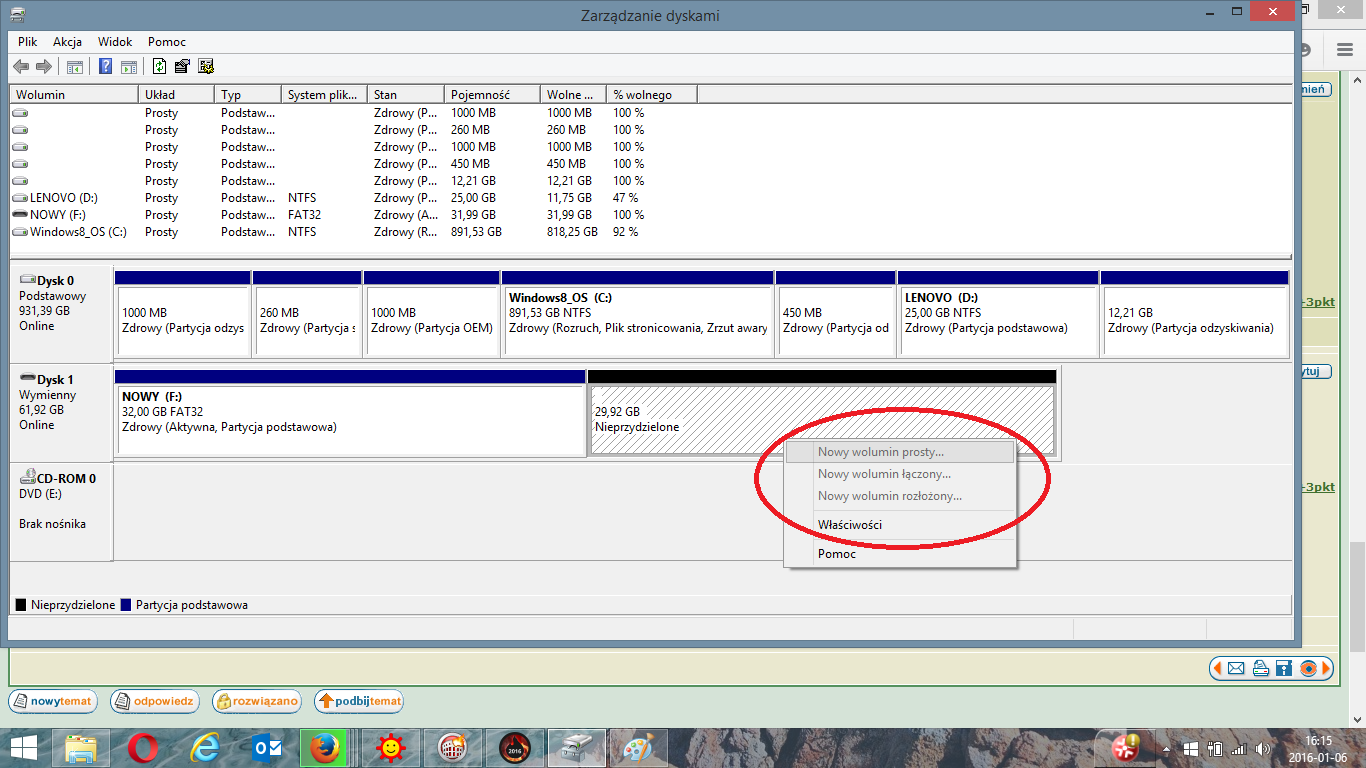
    Unfortunately, these options do not light up.

    Added after 3 [minutes]:

    From what I associate, it was similar even in WinXP with this disk management.
    Better to ask and disgrace yourself than to act as daring and screw up. Whoever asks does not go astray as the old proverb says.
  • #14 15307234
    mati211p
    HDD and data recovery specialist
    Posts: 16915
    Help: 2584
    Rate: 1129
    delphin78 wrote:
    64GB Samsung Pendrive - Change the capacity from 64GB to 32GB.

    Unfortunately, these options do not light up.

    Added after 3 [minutes]:

    From what I associate, it was similar even in WinXP with this disk management.
    Better to ask and disgrace yourself than to act as daring and screw up. Whoever asks does not go astray as the old proverb says.

    After all, I wrote that it is impossible, because it treats it as a removable disk, not a local one, so the options will also be unavailable. For pendrives, the options to create partitions and select the size are not available, I have already done this. I have more than one pendrive divided into partitions. On any PC other than my Windows PC, it sees only the first partition, while for me it is all written in the registry, so that it can read the system this specific device (it does not treat it like any other pendrive).
    This 32GB partition is to remain? Do you want one 64GB?
  • #15 15307629
    delphin78
    Level 9  
    Posts: 33
    Rate: 6
    I would like to restore it to 64GB. Can this be done from Win8.1 ??
  • ADVERTISEMENT
  • #18 15308072
    delphin78
    Level 9  
    Posts: 33
    Rate: 6
    OK. Somehow I managed to restore it, although it shows 61.9 GB, but it's probably some distortions. Thanks for your help and understanding. Best in the new year.
    Regards.
  • #19 15308126
    mati211p
    HDD and data recovery specialist
    Posts: 16915
    Help: 2584
    Rate: 1129
    It shows well. This is due to the capacity being calculated differently. I have a 32GB flash drive with 28.8GB, while 16GB has 14.4GB. 61.9GB is quite a large available capacity anyway. For the same reason, your 1TB drive is 931.39GB.
  • #20 15308184
    pidar
    Mass storage specialist
    Posts: 11332
    Help: 1568
    Rate: 3554
    delphin78 wrote:
    OK. Somehow I managed to restore it, although it shows 61.9 GB, but it's probably some distortions.

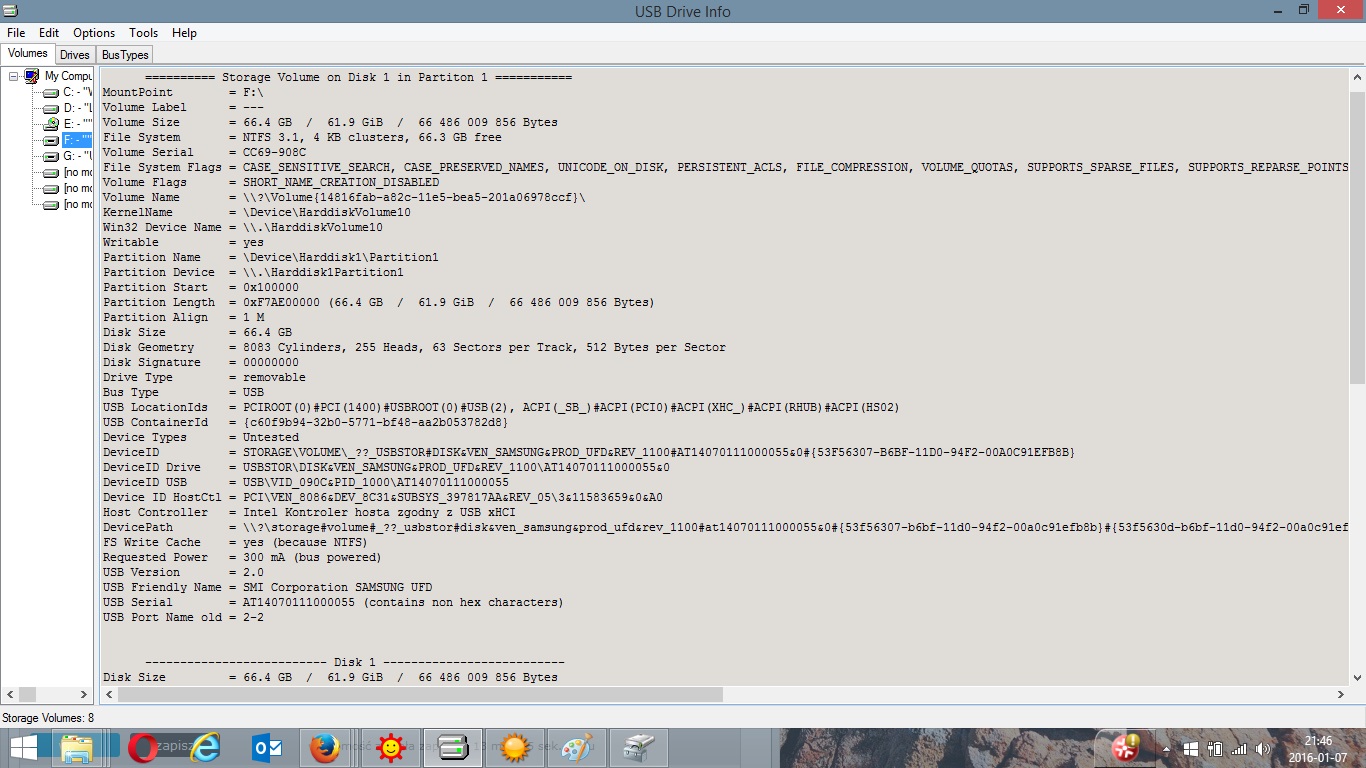
    In the program, what I previously recommended, you have everything "on hand" given:
    pidar wrote:
  • #21 15308350
    delphin78
    Level 9  
    Posts: 33
    Rate: 6
    OK, I understand, so she's all right now and as it should be ;-) It only shows that 91.6 MB is in use, but that's probably normal too ;-) .
  • #22 15308363
    mati211p
    HDD and data recovery specialist
    Posts: 16915
    Help: 2584
    Rate: 1129
    Probably because you have probably created an NTFS partition.
  • #23 15308603
    delphin78
    Level 9  
    Posts: 33
    Rate: 6
    And yes, I created an NTFS partition ;-) .And FAT32 was better to do ??
  • #24 15308626
    mati211p
    HDD and data recovery specialist
    Posts: 16915
    Help: 2584
    Rate: 1129
    NTFS in some cases, FAT32 in others. For example, for example, PS2 does not read pendrive with a partition in NTFS format, and you will not put a file larger than 4GB on FAT32. This is because you have NTFS and the 90MB is also used.
  • #25 15308678
    pidar
    Mass storage specialist
    Posts: 11332
    Help: 1568
    Rate: 3554
    From the examples on the forum -> NTFS and memory, eg TLC, results in higher failure rate.
  • #26 15308893
    delphin78
    Level 9  
    Posts: 33
    Rate: 6
    OK. Thank you for all your help and understanding. I have one more question. I wanted to go back to FAT32 from NTFS but all I can do is some exFAT. Can I do something about it or not?
  • #27 15311651
    delphin78
    Level 9  
    Posts: 33
    Rate: 6
    Hello. The pendrive theoretically works and it returned to its original capacity. I noticed that the ones I have are smaller because 8GB and 16GB are FAT32 and the repaired / restored 64GB somehow is either NTFS or exFAT. In the exFAT file system, unfortunately the car radio does not see the pendrive. Is it possible to restore it to the FAT32 file system ???
  • #29 15311796
    delphin78
    Level 9  
    Posts: 33
    Rate: 6
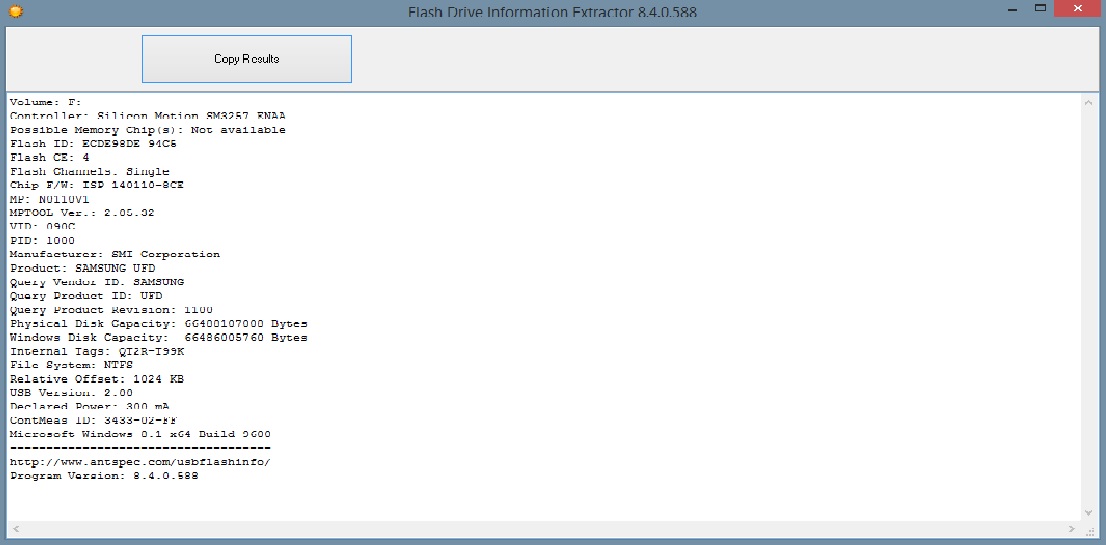
    Where can I find this ChipEasy program?

    64GB Samsung Pendrive - Change the capacity from 64GB to 32GB.

    64GB Samsung Pendrive - Change the capacity from 64GB to 32GB. 64GB Samsung Pendrive - Change the capacity from 64GB to 32GB.

    Added after 7 [minutes]:

    It is possible to do cramps on FAT32 or not and how simple, fast and in points. I am not a professional, as most of them are specialists here, so I ask.

Topic summary

✨ The discussion revolves around a user experiencing an issue with a 64GB Samsung pendrive that only shows 32GB available after creating a system recovery disk in Windows 8.1. Various responses suggest that a 32GB partition was created, leaving the rest of the space unallocated. Solutions include using disk management tools to create a new volume from the unallocated space, restoring the full capacity using software like DMDE, and changing the file system from NTFS to FAT32 for compatibility with other devices. The user successfully restored the pendrive's capacity but faced challenges in formatting it back to FAT32, as Windows 8.1 only offered NTFS or exFAT options. Recommendations for formatting tools and methods were provided throughout the discussion.
Generated by the language model.

FAQ

TL;DR: Windows Disk Management caps FAT32 volumes at 32 GB, so a 64 GB flash drive shrinks when you create a recovery disk; "use a third-party formatter to reclaim space" [Microsoft, 2023; Elektroda, mlewan, #15306410]. Why it matters: regaining the lost 50 % keeps the stick usable in radios, consoles and PCs.

Quick Facts

• Windows’ GUI limits FAT32 volumes to 32 GB [Microsoft, 2023] • Advertised 64 GB (decimal) ≈ 59.6 GiB displayed [Seagate, 2022] • FAT32 single-file ceiling: 4 GB – 1 byte [Microsoft, 2023] • exFAT volume size ceiling: 512 TB [Microsoft, 2023] • DMDE freeware edition handles one device at no cost [DMDE, 2023]

Why did my 64 GB USB stick show only 32 GB after making a Windows 8.1 recovery drive?

The recovery-tool created a 32 GB FAT32 partition because Windows’ GUI refuses to format larger FAT32 volumes; the rest stayed unallocated, so Explorer hid it [Elektroda, Matuzalem, #15306674; Microsoft, 2023].

How can I restore the missing space with built-in Windows tools?

Open Disk Management (Win + R → diskmgmt.msc). Delete the 32 GB partition, then create a new 64 GB volume and format it as exFAT or NTFS. This works only if “Delete Volume” is clickable; many sticks show it greyed out [Elektroda, delphin78, post #15307063]

Disk Management greys out “New Simple Volume” — what now?

Windows classifies most USB sticks as removable. Removable media block multi-partition commands. Use DMDE, Rufus or USB Disk Storage Format Tool, which bypass that limitation [Elektroda, mati211p, post #15307234]

What is DMDE and how do I merge partitions with it?

DMDE is a disk editor. 1. Select the flash drive. 2. Delete existing partitions. 3. Create one unformatted 64 GB entry, apply, reconnect, then format in Windows [Elektroda, mati211p, post #15307695]

Can I safely delete the recovery partition?

Yes; removing it only erases the recovery files on the stick, not the PC’s internal recovery. Keep another recovery medium before deleting if you lack installation media [Microsoft, 2023].

Why does Windows report 61.9 GB instead of 64 GB?

Manufacturers use decimal gigabytes. Windows shows binary gibibytes. 64 GB ÷ 1.073 ≈ 59.6 GiB; 61.9 GB appears when formatted due to file-system overhead [Elektroda, mati211p, post #15308126]

Should I format the drive as FAT32, NTFS, or exFAT?

Choose FAT32 for maximum compatibility, NTFS for files >4 GB with Windows devices, exFAT for large files on modern TVs, Macs and cars built after 2014 [Microsoft, 2023].

Windows only offers exFAT/NTFS — how do I force FAT32 on 64 GB?

Run USB Disk Storage Format Tool, tick “FAT32”, full-format the stick. The utility bypasses the 32 GB FAT32 limit [Elektroda, pidar, post #15311925]

Does NTFS shorten flash-drive life?

“NTFS and TLC memory raise failure rate” [Elektroda, pidar, post #15308678] NTFS writes extra metadata, so wear increases. Lifespan drop is small on SLC/MLC sticks but noticeable on cheap TLC models [Kingston, 2022].

What file-size limits apply to each file system?

FAT32: 4 GB − 1 byte, exFAT: 16 EB, NTFS: 16 TB (practical) [Microsoft, 2023].

How do I reformat a 64 GB stick to FAT32 in three steps?

  1. Launch USB Disk Storage Format Tool. 2. Select device → choose “FAT32” → full format. 3. Wait until “Format complete” appears, then safely eject. Average 64 GB full format over USB 2.0 takes 35–45 min at 25 MB/s [Tom’sHardware, 2023].

Edge case: drive still shows 32 GB after formatting — why?

The stick may be a fake that reports 64 GB but contains 32 GB of real NAND. Run H2testw; if write errors appear beyond 32 GB, demand a refund [Elektroda, pidar, post #15311988]

Will my car radio or PS2 read the 64 GB drive?

Many radios and the PS2 recognise only FAT32. Format accordingly and keep partition below 32 GB if firmware is old [Sony, 2019].

Can I create multiple partitions on a USB stick?

Yes, but Windows will show only the first partition on removable media unless you alter the registry or use drive-type flipping utilities [Microsoft, 2023; Elektroda, mati211p, #15307234].

How long does a full FAT32 format of 64 GB take?

On USB 3.0 at 100 MB/s it finishes in about 11 min; on USB 2.0 at 25 MB/s expect ~45 min [Tom’sHardware, 2023].
Generated by the language model.
ADVERTISEMENT