logo elektroda
logo elektroda
X
logo elektroda

Upgrading Workshop Heating: Volcano VR Mini & 80L Boiler w/Double Coil in Poorly Insulated Space

marcin_marcepan 19845 16
Best answers

Can I use an 80 L double-coil boiler as a heat buffer in series with a Volcano VR Mini heater for a poorly insulated workshop?

Do not add the 80 L boiler as a buffer; the better advice is to connect the heater directly to the heating circuit, preferably with a separate pump, and feed it from the proper side/bottom with supply temperature well above 60°C [#16743751] Before buying anything, calculate the workshop’s heat demand and check the heater’s output versus supply temperature, because the Volcano Mini’s heat output depends strongly on the water temperature [#16742608] If you only want to limit how hard it pulls heat from the system, use a ball valve in front of the heater or a weak fan instead of an extra boiler [#16742187] Also, fix the real losses first: seal the leaking door/window and insulate the walls, since that will pay back better than reusing an old tank [#16742645] A later report said a similar heater warmed the workshop from 17°C to 24°C in about 5 minutes even at 50°C supply, so the concept can work, although the fan draft was noticeable [#16774825]
Generated by the language model.
ADVERTISEMENT
Treść została przetłumaczona polish » english Zobacz oryginalną wersję tematu
  • #1 16741616
    marcin_marcepan
    Level 18  
    Posts: 438
    Help: 7
    Rate: 36
    Hello and welcome advice.
    I rebuilt my CO installation and until now in my (electronic) workshop I had a regular 20 rib aluminum radiator installed.
    Because I do not heat the workshop non-stop (I closed the valve in the absence) before the radiator warmed up my workshop passed a lot of time. I will add that the room is poorly insulated.
    After modernizing the boiler room which is located with the wall, I intend to invest in a water heater. I was advised that Volcano VR Mini would be enough.
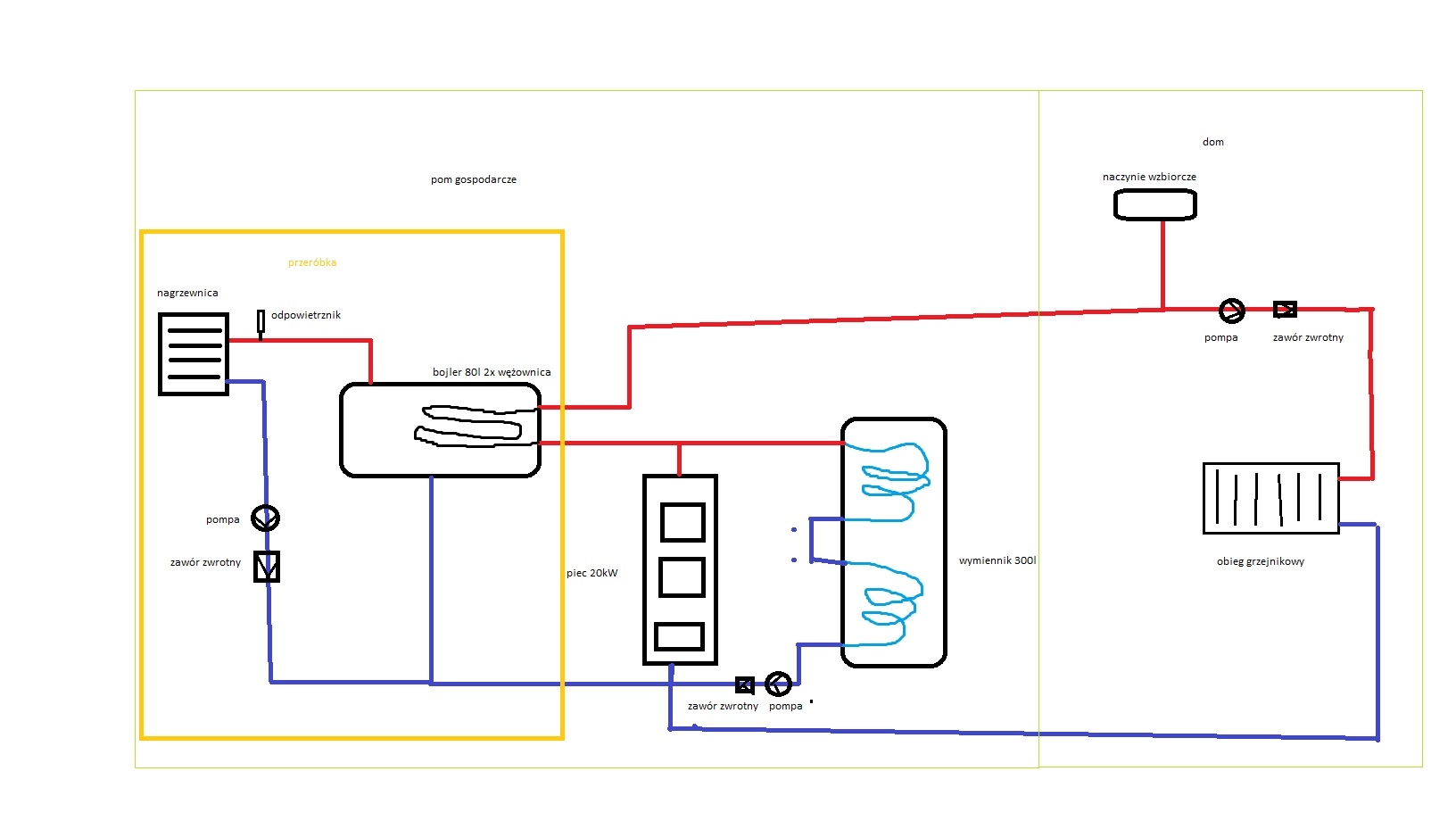
    I know that heaters "extract" heat from virtually the entire installation, so the idea of using an old but in very good condition 80l boiler with a double coil connected in series with the radiator circuit came to my mind.
    Tell me what you think about it?
    The diagram does not include shut-off valves.
    Upgrading Workshop Heating: Volcano VR Mini & 80L Boiler w/Double Coil in Poorly Insulated Space
  • ADVERTISEMENT
  • #2 16742187
    guciq
    Level 18  
    Posts: 206
    Help: 24
    Rate: 134
    The boiler is not needed. If you want to choke, just put the ball valve in front of the heater. You just have a small stove. Besides, you can put a weak fan in the heater so that it does not pull everything out of the installation. Either way you will not use its power.
  • #3 16742425
    marcin_marcepan
    Level 18  
    Posts: 438
    Help: 7
    Rate: 36
    The furnace is oversized and most of the time it works in sustaining (180m2 heating surface, thermostatic valves on all radiators plus a small floor with RTL valve).
    It is not about muffling the heater but about quickly heating the workshop without much damage to the central heating installation.
    I use the workshop only in the afternoons - evenings and weekends.
    The boiler is to act as a heat buffer that is stored when the heater is not working.
    I know that these types of storage tanks release heat relatively slowly, hence the idea of including a coil in series with the radiator circuit. When the heater is not working and the water in the boiler is heated, practically all the heat will go into the radiator circuit.
    When we start the heater, it will quickly consume hot water from the boiler, however, it will not cool down the radiator system significantly. I will add that the workshop has about 55m3 so the heater will work at max 50%.
  • ADVERTISEMENT
  • #4 16742451
    Strumien swiadomosci swia
    Level 43  
    Posts: 27411
    Help: 1403
    Rate: 6379
    For me, the tiny Tico heater heats up quickly 50m2 of one room and here 20kW it will cook you.

    I would put some car heater in series with the heater, if you don't need Power, you just don't turn on the blower motor.
  • #5 16742456
    marcin_marcepan
    Level 18  
    Posts: 438
    Help: 7
    Rate: 36
    I had an additional car with a VW T4 and unfortunately too weak. 20 radiator ribs were in contact. Hot in one place and 3m further cold.
    The door leaks straight outside and a large window (plastic but old)
  • #6 16742460
    Strumien swiadomosci swia
    Level 43  
    Posts: 27411
    Help: 1403
    Rate: 6379
    marcin_marcepan wrote:
    I had an additional car with the VW T4


    First, what is the water temperature in the installation?
  • #7 16742470
    marcin_marcepan
    Level 18  
    Posts: 438
    Help: 7
    Rate: 36
    The oven set to 60
    Required in workshop 21
  • #8 16742608
    Inkwizycja
    Level 30  
    Posts: 1315
    Help: 165
    Rate: 414
    First calculate the power demand for this workshop, and only then buy the heater (take into account the time of heating the room). If you look at the DTR carefully, you will see that the heat output strongly depends on the supply temperature of the heater http://www.tanie-og Heating.pl/download/volcano/nagrzewnica_volcano_mini.pdf " target="_blank" rel="nofollow noopener ugc" class="postlink inline" title="" > http://www.tanie-og Heating.pl/download/volcano/nagrzewnica_volcano_mini.pdf .
  • #9 16742645
    Magister_123
    Level 36  
    Posts: 2888
    Help: 378
    Rate: 967
    Powder masking.
    The basis is to eliminate heat leakage spots. This will reduce heating costs and will pay off in the future.
    If the door is leaking, replace it with a tight one. Brick up a large window and insert a smaller one. Insulate the walls.
    Comfort of work will decrease from the wind and sound produced by the heater.
    I wouldn't play any old boilers, just plug the heaters directly into the installation.
  • ADVERTISEMENT
  • Helpful post
    #10 16743751
    roman 18
    Level 24  
    Posts: 526
    Help: 66
    Rate: 143
    hello, buddy, the heater connected directly from the furnace by pipes such as the output from the heater preferably on a separate pump, give the temperature much higher than 60 degrees. connecting the heater inversely than drawn, power supply from the bottom and will be added. greetings.
  • #11 16747620
    sparkson
    Level 3  
    Posts: 198
    Rate: 11
    Hello, not wanting to create a new topic, I will ask here.

    I have a Ferroli heating oil stove with a maximum power of 25kW, together with a Ferroli Sun burner with a capacity of up to 58kW. At the moment, the furnace is connected to the heating of social rooms (about 42m2, 5 aluminum radiators of this type: https://goo.gl/images/4uNfhA), and heating of utility water.

    I would like to connect to the existing installation a water heater to heat part of the hall, unfortunately I do not know what the maximum power of the heater can be and will this furnace handle such an installation at all?
  • #12 16747743
    Magister_123
    Level 36  
    Posts: 2888
    Help: 378
    Rate: 967
    sparkson You have 25kW available. The heaters in total are able to download 11.5kW. You only have 13.5kW of power for the heater. In fact, you have to count on having 10kW available.
    Isn't it better to buy a heater with your own burner?
  • #13 16747905
    sparkson
    Level 3  
    Posts: 198
    Rate: 11
    I already have two furnaces and burners in them, I do not really want to invest in a third and hence another chimney, passage through the roof, etc. Too high costs, so I was thinking about using the furnace.
  • #14 16774825
    marcin_marcepan
    Level 18  
    Posts: 438
    Help: 7
    Rate: 36
    I listened to my colleague roman 18 and I am pleasantly surprised because my fears turned out to be unfounded.
    The LEO FB 20V heater is perfect even when the oven is set at 50 degrees Celsius and it doesn't get all the heat out of the installation.
    It takes no more than 5 minutes to heat up my workshop from 17 to 24st.
    The only thing that bothers is the fan or rather a blast of air even in 1st gear.
    Maybe you would advise something to regulate RPM?
  • #15 16775577
    sparkson
    Level 3  
    Posts: 198
    Rate: 11
    How many radiators do you have connected to this installation?
  • ADVERTISEMENT
  • #16 16775704
    marcin_marcepan
    Level 18  
    Posts: 438
    Help: 7
    Rate: 36
    9 heaters, large dryer, small floor and 300l exchanger with two coils connected in series
  • #17 18237891
    Maras_88
    Level 2  
    Posts: 3
    Rate: 10
    How much can it cost to install 4 heaters in a facility such as a hall + of course a stove. Water heaters, the price of the material is about 20,000 PLN. I would like to know how to price labor because I have not dealt with installations of this type so far.

Topic summary

✨ The discussion revolves around upgrading heating in a poorly insulated workshop using a Volcano VR Mini heater and an 80L boiler with a double coil. The user seeks advice on the effectiveness of this setup, particularly in terms of quickly heating the space without significantly impacting the central heating system. Responses suggest that the boiler may not be necessary, and alternatives like using a fan or adjusting the heater's output are recommended. The importance of calculating the heating demand and addressing insulation issues is emphasized, with suggestions to improve heat retention in the workshop. The user also shares positive experiences with a LEO FB 20V heater, noting its efficiency in heating the workshop quickly.
Generated by the language model.

FAQ

TL;DR: In one real build, a LEO FB 20V warmed a 55 m³ workshop from 17°C to 24°C in ~5 minutes; “the heater is perfect even at 50°C.” [Elektroda, marcin_marcepan, post #16774825] Why it matters: If you heat a poorly insulated shop only when you’re there, the right water fan heater and hookup can deliver fast warm‑up without starving the rest of the system.

This FAQ is for DIYers and installers upgrading workshop heat using water fan heaters, small boilers, and buffer ideas in leaky spaces.

Quick Facts

How do I quickly heat a poorly insulated workshop without cooling my house radiators?

Feed a water fan heater directly from the boiler on its own pump. Use higher supply temperature for fast response and aim the discharge away from workstations. This setup avoids pulling down the rest of the radiator loop during short, on‑demand sessions. “Give the temperature much higher than 60 degrees.” [Elektroda, roman 18, post #16743751]

Should I add an 80 L double‑coil boiler as a buffer before the heater?

Forum experience suggests skipping the small buffer. A direct connection with adequate supply temperature and fan control delivered very fast warm‑up without starving the system. Small domestic tanks release heat slowly and add complexity for little gain in short, intermittent heating. [Elektroda, guciq, post #16742187]

What is a Volcano VR Mini (or LEO FB 20V) heater?

They are water fan heaters (fan coils) that blow room air across a hot‑water coil. They deliver rapid air temperature rise when supplied with sufficiently hot water and adequate flow. Users reported excellent performance even with 50°C water in a small workshop. [Elektroda, marcin_marcepan, post #16774825]

How much heater power can my 25 kW oil boiler spare for a hall unit?

If your existing radiators absorb about 11.5 kW, you have roughly 13.5 kW remaining, but plan on ~10 kW available in practice. Size the hall heater accordingly or consider staged fans. This headroom figure came from a working calculation in the thread. [Elektroda, Magister_123, post #16747743]

Does supply temperature really change heater output that much?

Yes. Water fan heater capacity depends strongly on supply temperature and flow. Before buying, calculate the room heat demand and the target warm‑up time. “First calculate the power demand…” is sound advice echoed with documentation references. [Elektroda, Inkwizycja, post #16742608]

What if I tried a car heater core—it felt hot nearby but cold a few meters away?

That’s an edge case seen in leaky shops. Small car cores concentrate heat locally; airflow and coil area are limited. Result: hot spot near the unit, cold three meters away, and poor mixing. A purpose‑built water fan heater solves this distribution gap. [Elektroda, marcin_marcepan, post #16742456]

What water temperatures and setpoints worked for fast warm‑up?

One user ran the boiler at 50–60°C, wanted 21°C room temperature, and achieved 17→24°C in ~5 minutes using a LEO FB 20V. Higher supply (>60°C) further improves response if your system and controls allow it. [Elektroda, marcin_marcepan, post #16742470]

How do I reduce fan blast or noise from a water fan heater?

Use the lowest fan speed that meets warm‑up time, then switch off or cycle the fan to maintain. If airflow is still too strong, consider a speed controller rated for your fan motor and reposition the unit. “The only thing that bothers is the fan.” [Elektroda, marcin_marcepan, post #16774825]

Is it better to throttle the heater with a valve or change the fan speed?

Change fan speed first. Throttling flow reduces coil delta‑T and can waste boiler output, while slower airflow keeps coil hot and quieter. If needed, add a balancing valve, but prioritize fan control for comfort and stability. [Elektroda, guciq, post #16742187]

What is an RTL valve?

An RTL (return temperature limiter) is a thermostatic valve that limits the return water temperature, often used on small floor heating loops connected to radiator circuits. It protects against too‑hot floors without mixing stations. [Elektroda, marcin_marcepan, post #16742425]

How should I pipe the heater—any orientation tips?

Connect the heater directly from the boiler, ideally on a separate pump. Some installers prefer reversed coil connections with bottom supply for better air purge on specific units. Ensure proper air venting and service valves. [Elektroda, roman 18, post #16743751]

How many emitters were on the system that still heated the workshop fast?

A reported setup ran nine radiators, a large towel dryer, a small floor loop, and a 300 L domestic exchanger with two coils in series—and the workshop still warmed rapidly. That shows adequate boiler headroom and correct heater choice. [Elektroda, marcin_marcepan, post #16775704]

What’s a simple 3‑step method to size and select a workshop heater?

  1. Estimate heat demand from temperature rise, volume, and leakage, then set a target warm‑up time.
  2. Choose a water fan heater whose output at your supply temperature meets that demand.
  3. Plan a direct, dedicated‑pump circuit and verify boiler headroom. [Elektroda, Inkwizycja, post #16742608]

Can a mini water heater work in a 55 m³, leaky shop used only evenings and weekends?

Yes. A mini water fan heater at ~50% output met the need in a similarly sized, poorly insulated workshop used intermittently. Fast warm‑up and acceptable comfort were reported, with only fan blast noted as a trade‑off. [Elektroda, marcin_marcepan, post #16742425]

How much does it cost to install four water heaters plus a stove for a hall?

One user cited materials around 20,000 PLN but asked how to price labor. Labor varies with pipe runs, pumps, controls, and venting. Use a detailed bill of quantities and bid per heater circuit plus boiler tie‑in to avoid surprises. [Elektroda, Maras_88, post #18237891]

Will a heater starve the rest of my radiators of heat?

Not if you design correctly. A direct, dedicated‑pump feed and sufficient boiler temperature prevented system cooling in the reported case. The rest of the radiators continued operating normally during workshop warm‑up. [Elektroda, marcin_marcepan, post #16774825]
Generated by the language model.
ADVERTISEMENT