


logo elektroda
logo elektroda
X
logo elektroda

Laptop Hard Drive Knocking: Potential Contact Issue with Plug or Frame

turczy 4632 20
Best answers

Why does a laptop hard drive click only when it is mounted in the laptop frame/caddy, but work normally when used without the frame?

If the drive only knocks when installed in the laptop frame, the caddy/frame is likely pressing the HDD PCB too tightly against the hermoblock or causing a contact/short issue; one user with a similar Seagate/Samsung ST500LM012 found that some frames have high walls that press the PCB too hard [#18850169] Back up the data first, then test the drive in the laptop without the frame and secure it so it cannot move, for example with a piece of paper, to confirm whether the frame is the trigger [#18851648] If the problem still appears without the frame, the fault may be in the drive electronics or the laptop’s SATA connector/power supply rather than the caddy itself [#16893940] [#16893941] Also note that some Samsung/Seagate Spinpoint M8 drives are known to fail with head problems that can cause buzzing/clicking on startup even when SMART does not look obviously bad [#18851285]
Generated by the language model.
ADVERTISEMENT
Treść została przetłumaczona polish » english Zobacz oryginalną wersję tematu
  • #1 16893873
    turczy
    Level 11  
    Posts: 11
    Hello
    I have such a problem.
    My sister's laptop came to me.
    Such a story, sometimes it started normally, and sometimes it knocked and the computer did not get up. The symptom intensified until the whole thing died.
    Obviously, the first diagnosis is an obvious garbage disk.
    But I wanted to check if something can be recovered from it and I connected it to a desktop computer, it is normal.
    After a few minutes, the parameters looked normal in the smart. Hd tune found nothing.
    So I plugged the drive to the laptop - it works normally. I came to the conclusion that maybe there was a problem with the contacts in the plug (something came loose).
    I mounted the drive in the frame and screwed it to the laptop - it knocks. K ....
    removed from the frame - it works, to the frame - it knocks.
    I don't know anymore - some breakthrough to ground? but on the disk or with the laptop at all?
  • ADVERTISEMENT
  • #2 16893878
    Kasek21
    Level 43  
    Posts: 45513
    Help: 4962
    Rate: 3503
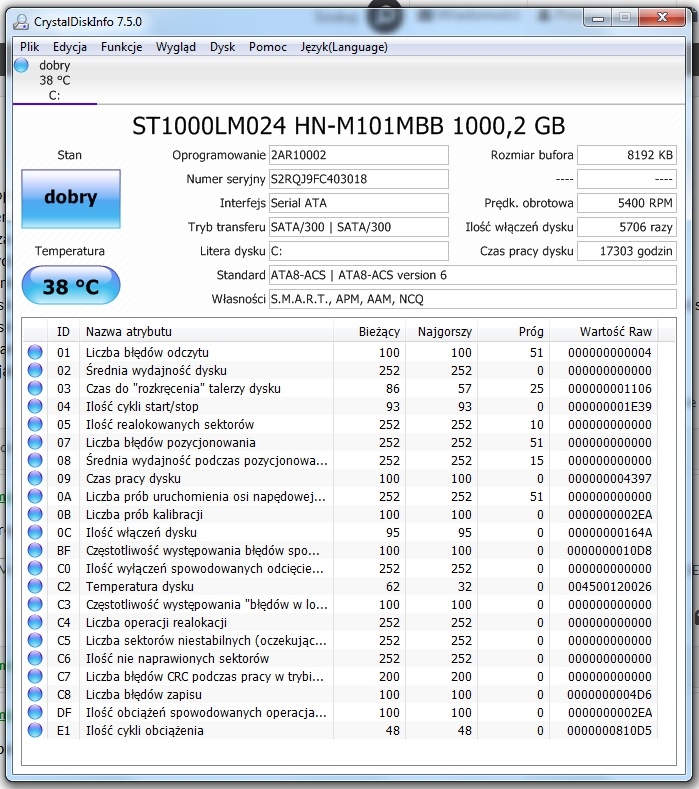
    Post the screen from CrystalDiskInfo.
  • #3 16893884
    Pedros050
    Level 43  
    Posts: 17906
    Help: 2471
    Rate: 3901
    Hello. And you do not have a skewed bezel and the disk enters the slot crookedly? Bends the disk?
  • #4 16893909
    turczy
    Level 11  
    Posts: 11
    Laptop Hard Drive Knocking: Potential Contact Issue with Plug or Frame
    frame like new
  • #5 16893933
    miecho18
    IT specialist
    Posts: 18696
    Help: 3085
    Rate: 2771
    And the pocket has a protective film stuck to the electronics of the drive?
  • ADVERTISEMENT
  • #6 16893938
    turczy
    Level 11  
    Posts: 11
    Yes. I also used the second frame - same
    the only thing that changes the frame is it screws the mass of the disk to the mass of the laptop
  • ADVERTISEMENT
  • #7 16893940
    miecho18
    IT specialist
    Posts: 18696
    Help: 3085
    Rate: 2771
    In that case, "cold February" on the electronics of the disk, possibly on the SATA connector in the laptop.
  • #8 16893941
    Kasek21
    Level 43  
    Posts: 45513
    Help: 4962
    Rate: 3503
    This may be some kind of problem with the drive power supply in the laptop.
  • #9 16893952
    mati211p
    HDD and data recovery specialist
    Posts: 16915
    Help: 2584
    Rate: 1129
    Despite everything, and SMART is uninteresting, but it may be the result of a malfunction in the laptop. Attributes 01, 03, 0B, C8 - mechanical problems of the drive. Throw a photo of what it looks like.
  • #10 18850169
    Gelip
    Level 36  
    Posts: 5202
    Help: 321
    Rate: 607
    turczy wrote:
    I mounted the drive in the frame and screwed it to the laptop - it knocks. K ....
    removed from the frame - it works, to the frame - it knocks.
    I don't know anymore - some breakthrough to ground? but on the disk or with the laptop at all?

    I had the same thing in a very similar disk model: ST500LM012 knocks and does not take off

    I also thought it was a short circuit, but it turned out that some laptop frames have high walls and press the PCB too tightly to the hermoblock. Apparently, these Samsung drives, or rather Seagate -> Link
  • #11 18851087
    artaa
    Level 43  
    Posts: 15050
    Help: 1811
    Rate: 1683
    But you get your doctorate ;-)
    As mati221p wrote:
    Attributes 01, 03, 0B, C8 - mechanical problems of the drive
    the drive is over and that's it.

    Buy a good SSD and it will be after the problem and also much faster.
  • #12 18851285
    Gelip
    Level 36  
    Posts: 5202
    Help: 321
    Rate: 607
    artaa wrote:
    But you get your doctorate ;-)
    As mati221p wrote:
    Attributes 01, 03, 0B, C8 - mechanical problems of the drive
    the drive is over and that's it.

    Buy a good SSD and it will be after the problem and also much faster.

    Certainly not me.

    The parameters, by the way, regarding the surface condition, but they have nothing to do with the fact that the disk does not want to work in a frame in a laptop and it works without a frame. Yesterday I spent half a day to figure out what it was all about. The first time I have encountered such a thing, the disk in the frame does not work and without the frame it works. In my post, I provided a link to my topic with such a problem and wrote a way around it.

    Added after 5 [minutes]:

    Interestingly, the author of the topic had an identical problem with the frame and a very similar disk model.

    Added after 16 [minutes]:

    The datarecovery company confirms that the drives of this Samsung / Seagate Spinpoint M8 series are very prone to failure of the heads, but they do not damage the surface on the plate:
    Quote:
    Failure Issues for the Seagate ST1000LM024 and Seagate ST1000LM025 Series

    In any case, these 1TB hard drives often suffer from a read / write head failure. The heads may lock in place (an issue data recovery engineers refer to as stiction), often creating a telltale buzzing sound when the drive attempts to boot or access data. This doesn't necessarily result in substantial data loss, since the heads don't damage the platters where the data is stored.


    Source: Seagate ST1000LM024 and ST1000LM025 Drives Appear to be Prone to Head Failures
  • #13 18851648
    kaleron

    HDD and data recovery specialist
    Posts: 7028
    Help: 957
    Rate: 2316
    Secure the data on this drive. Then insert it without a frame, mechanically securing it with even a piece of crumpled paper so that it does not slide out. The SMART parameters come from somewhere and finding the cause makes sense even if this disk is withdrawn from further use, so that the bobble does not repeat itself with the next one.
    Company Account:
    Kaleron sp. z o. o.
    Hirszfelda 4/18, Jelcz-Laskowice, 55-231 | Tel.: 713XXXXXX (Show) | Company Website: https://kaleron.pl
  • #14 18852241
    artaa
    Level 43  
    Posts: 15050
    Help: 1811
    Rate: 1683
    The best workaround for the problems will still be to buy an SSD.
    ;-)
  • #15 18852253
    kaleron

    HDD and data recovery specialist
    Posts: 7028
    Help: 957
    Rate: 2316
    artaa wrote:
    The best workaround for the problems will still be to buy an SSD.
    - by the way, you can add new problems. Why not just buy a whole laptop?
    Company Account:
    Kaleron sp. z o. o.
    Hirszfelda 4/18, Jelcz-Laskowice, 55-231 | Tel.: 713XXXXXX (Show) | Company Website: https://kaleron.pl
  • #16 18852656
    artaa
    Level 43  
    Posts: 15050
    Help: 1811
    Rate: 1683
    Price ;-)
    and second: if the new laptop will be with HDD, it will collapse at its speed under WIndows10. ;-)
  • #17 18852667
    kaleron

    HDD and data recovery specialist
    Posts: 7028
    Help: 957
    Rate: 2316
    artaa wrote:
    Price
    - this is one of the reasons why we do not avoid looking for the causes of problems. The second, much more important reason is that the problems should not recur in the future.
    Company Account:
    Kaleron sp. z o. o.
    Hirszfelda 4/18, Jelcz-Laskowice, 55-231 | Tel.: 713XXXXXX (Show) | Company Website: https://kaleron.pl
  • ADVERTISEMENT
  • #18 18852688
    artaa
    Level 43  
    Posts: 15050
    Help: 1811
    Rate: 1683
    And they won't happen again, SSD is smaller than HDD ....
    that's why the set often includes thickening frames, which usually no one uses ... ;-)
  • #19 18852748
    kaleron

    HDD and data recovery specialist
    Posts: 7028
    Help: 957
    Rate: 2316
    Are you sure it's the frame's fault, not some power problem?
    Company Account:
    Kaleron sp. z o. o.
    Hirszfelda 4/18, Jelcz-Laskowice, 55-231 | Tel.: 713XXXXXX (Show) | Company Website: https://kaleron.pl
  • #20 18852788
    artaa
    Level 43  
    Posts: 15050
    Help: 1811
    Rate: 1683
    This is what it looks like from the description, if it works OK without a frame.
    And there is no certainty in IT ;-) unless we think about the universal 99%. ;-)
  • #21 18853295
    kaleron

    HDD and data recovery specialist
    Posts: 7028
    Help: 957
    Rate: 2316
    That is why I suggested that the Author verify the behavior of the disk in a laptop without a frame.
    Company Account:
    Kaleron sp. z o. o.
    Hirszfelda 4/18, Jelcz-Laskowice, 55-231 | Tel.: 713XXXXXX (Show) | Company Website: https://kaleron.pl

Topic summary

✨ The discussion revolves around a laptop hard drive that intermittently knocks and fails to boot, leading to a diagnosis of potential contact issues with the drive's plug or frame. The user initially suspects a faulty hard drive but finds it operates normally when connected to a desktop. The knocking occurs when the drive is mounted in the laptop frame, suggesting a possible grounding issue or misalignment. Various responses suggest checking for physical obstructions, ensuring proper grounding, and considering the power supply to the drive. Users also mention that certain models, particularly from Seagate and Samsung, are prone to mechanical failures. Recommendations include securing data and considering an SSD upgrade for better reliability and performance.
Generated by the language model.

FAQ

TL;DR: Laptop HDD knocks only when screwed into a caddy? Some 1TB Spinpoint M8 units can bind under pressure—“heads may lock (stiction)”—and fail to boot. “Loosen the squeeze” or test outside the frame before declaring the disk dead. “Why it matters:” this can mimic a fatal drive failure you can avoid. “Seagate ST1000LM024 and ST1000LM025 Drives Appear to be Prone to Head Failures”

Quick Facts

Why does my laptop hard drive knock only when mounted in the frame?

Some caddies have tall sidewalls that press the drive’s PCB toward the hermoblock. This slight flex or contact can cause head parking/knock and prevent boot. Users reported normal operation when the same disk was loose, but knocking once screwed down. Test outside the frame to confirm. If the noise stops, add spacing or change the caddy. “If it works bare and fails in the frame, reduce pressure.” [Elektroda, Gelip, post #18850169]

Could this be a grounding or short-to-chassis issue?

Yes. Screwing the caddy bonds the drive’s ground to the laptop chassis differently than a loose connection. The original poster noted the only change with the frame was that it ties the drive’s mass to the laptop’s mass. If symptoms appear only when grounded via the frame, inspect shielding, standoffs, and any metal tabs that might touch the PCB. [Elektroda, turczy, post #16893938]

Is a bad laptop power rail a possible cause of knocking?

Yes. Weak or unstable 5V supply on the laptop’s SATA power can cause spin retries and knocking. A drive that runs fine on a desktop but misbehaves in the laptop suggests a platform power issue. Check the laptop’s connector, flex, and power circuitry before condemning the disk. [Elektroda, Kasek21, post #16893941]

What do SMART attributes 01, 03, 0B, C8 mean here?

These attributes often correlate with mechanical health: read error rate (01), spin-up time (03), calibration retry count (0B), and write error rate (C8). Elevated values can reflect head/servo problems. Capture SMART with CrystalDiskInfo before further tests and after each change to see trends. “SMART tells the story of mechanics under stress.” [Elektroda, mati211p, post #18893952]

How do I test safely if the frame is the problem?

  1. Back up all data first.
  2. Insert the drive without the frame and seat the connector gently.
  3. Temporarily secure with a non-conductive wedge (paper/card) so it doesn’t slide, then boot and observe. If it works bare but fails when screwed in, the frame fit is at fault. [Elektroda, kaleron, post #18851648]

What is “stiction” and why does it matter?

Stiction is when read/write heads stick and fail to lift from the platter, often producing buzzing or repeated clicking attempts. Some 1TB Spinpoint M8 models are noted for head issues that can resemble frame-pressure faults. Reduce mechanical stress first to avoid masking real head failures. “Heads may lock (stiction) and buzz.” “Seagate ST1000LM024 and ST1000LM025 Drives Appear to be Prone to Head Failures”

The disk works loose but knocks when screwed in—how can I fix the caddy fit?

Shim or replace the caddy. Add thin insulating spacers so the PCB doesn’t contact metal or flex when tightened. Avoid over-torquing screws. Users have seen normal behavior return when removing frame pressure, confirming a fitment issue rather than immediate head damage. [Elektroda, Gelip, post #18850169]

Should I just replace the HDD with an SSD?

An SSD avoids head/platter mechanics and greatly improves responsiveness. If the laptop supports 2.5-inch SATA, this is a fast, durable fix. However, still diagnose the caddy or power path so a fit or power fault doesn’t affect the new drive or future upgrades. [Elektroda, artaa, post #18851087]

Is there an edge case where the frame isn’t guilty?

Yes. A marginal power rail or flaky SATA connector can fail under the extra mechanical coupling introduced by the frame, mimicking a pressure issue. Verify by repeating tests without the frame and inspecting the laptop’s SATA socket and board for cracks or lifted pads. [Elektroda, Kasek21, post #16893941]

What is S.M.A.R.T. in this context?

S.M.A.R.T. is drive self-monitoring that logs error rates, spin-up time, and other health metrics. Use CrystalDiskInfo to capture a snapshot before and after caddy changes. Track attributes 01, 03, 0B, and C8 for mechanical stress signals during troubleshooting. [Elektroda, mati211p, post #18893952]

Can a photo of the caddy help diagnosis?

Yes. Photos reveal bent bezels, skewed mounts, or tall sidewalls that could press the PCB. One user shared a seemingly “like new” frame, yet the fit still caused problems when installed. Visual evidence helps decide whether to shim, file, or replace the caddy. [Elektroda, turczy, post #16893909]

Do multiple frames rule out a frame-related fault?

Not always. The OP tried two frames with identical behavior, yet both changed grounding and pressure. If two similar caddies share the same high-wall geometry, both can reproduce the fault. That repetition is a useful statistic when triaging. The OP confirmed testing with 2 frames. [Elektroda, turczy, post #16893938]

Could a protective film or missing insulator cause shorts?

Yes. Some drive enclosures and pockets include protective films over the drive electronics. Ensure the film or insulating pads are present and correctly placed so the PCB doesn’t meet metal under screw pressure. Lack of insulation can produce intermittent faults. [Elektroda, miecho18, post #16893933]

If the drive is failing mechanically, what should I do first?

Secure your data immediately. Avoid repeated power cycles that worsen head or surface damage. Then continue testing without the frame only to validate chassis-related issues. If data matters and knocking continues, stop and consult a recovery lab. [Elektroda, kaleron, post #18851648]

Will buying a whole new laptop solve this kind of problem?

Replacing the laptop may dodge caddy or power quirks, but it’s expensive and avoids root cause analysis. Fixing the frame fit or power issue prevents recurrence with any future drive. Solve the cause so it doesn’t return. [Elektroda, kaleron, post #18852667]

What if the frame diagnosis is inconclusive after testing?

Re-run tests: capture SMART, boot loose, then boot in-frame with minimal torque, observing changes. Swap the caddy brand or use an alternate bay. Persistent knocking with correct fit points to internal drive failure, not framing. Proceed to replacement or recovery. [Elektroda, Gelip, post #18851285]
Generated by the language model.
ADVERTISEMENT