


logo elektroda
logo elektroda
X
logo elektroda

Windows 10 Update Interrupted: Error 0xc0000428, Intel Core i7-8700K, ASUS Prime Z370-A & GTX 1060

Bullitt 3315 19
Best answers

How can I fix the Windows 10 installation boot errors 0xc0000428 / 0x0000225 on a new PC with an NVMe SSD after an interrupted install?

Wipe the NVMe SSD completely, recreate it as GPT with a proper UEFI EFI partition, and reinstall Windows 10 from fresh official media. Use a live CD with GParted to create a new partition table as GPT, then make a small FAT32 partition (about 512 MiB) and another NTFS partition, and mark the FAT32 one as EFI System with `cfdisk` [#16927433] Before installing, make sure the motherboard boots in UEFI/EFI mode (EFI First), then start Windows Setup and install to the empty NTFS partition [#16927506] The thread also suggests using GParted/live CD instead of only formatting inside the installer, because that did not fix the boot errors [#16926753] If the install media may be the problem, create fresh Windows 10 installation media from Microsoft and try again [#16927107][#16927273]
Generated by the language model.
ADVERTISEMENT
Treść została przetłumaczona polish » english Zobacz oryginalną wersję tematu
  • #1 16925057
    Bullitt
    Level 11  
    Posts: 134
    Rate: 8
    Board Language: polish
    Hello

    The gentlemen picked up a new computer from the store and turned off the electricity when installing the W10.

    Computer specification:

    Case SilentiumPC Gladius M35 (SPC128)
    Asus PRIME Z370-A motherboard
    SilentiumPC Supremo L2 550W (SPC139) power supply
    CPU cooler SilentiumPC Fera 3 HE1224 v2 (SPC144)
    Corsair Vengeance LPX memory, DDR4, 16GB (2x8GB), 3000MHz (CMK16GX4M2B3000C15R)
    Samsung 960 Evo 500GB M.2 PCIe SSD (MZ-V6E500BW)
    Intel Core i7-8700K, 3.70GHz, 12MB, BOX (BX80684I78700K) processor
    Graphics card Asus GeForce GTX 1060 6GB GDDR5 (192 bit) 1x DVI-D, 2x HDMI, 2x DisplayPort (STRIX-GTX1060-6G-GAMING)

    When firing, I have these situations:

    Error 0xc0000428 after loading
    I choose instalke from UEFI - crashes error 0xc0000428
    I choose 64x in - windows \ system32 \ boot \ winload.exe + error 0x0000225
    installs in 32 (copies files) - after reset (copying files) crashes error 0xc0000428
    Only at 32 the installation window pops up. In case of 64 standard rules in 3 points ... put cd, choose language etc.

    Question no:

    1. How to fix error 428?

    2. Isn't it better - faster to do the ssd format (I think there is the main problem here) from the usb level and starting the computer.

    I am with computers from 10 years back so I am asking for detailed guidelines ;)
  • ADVERTISEMENT
  • #2 16925148
    barton21
    Level 26  
    Posts: 688
    Help: 79
    Rate: 192
    Board Language: polish
    Format the disk and try to run the installer.
  • ADVERTISEMENT
  • #3 16925201
    Bullitt
    Level 11  
    Posts: 134
    Rate: 8
    Board Language: polish
    Formatting in the installer does not do the trick - it passes the stage of copying the installation files and then crashes an error after the reset. Is there any possibility, for example, a format from the USB level? (Some Samsung Magician or another solution).
  • #4 16925215
    barton21
    Level 26  
    Posts: 688
    Help: 79
    Rate: 192
    Board Language: polish
    Connect the USB drive to the second computer and try to delete the existing partition with EaseUS Partition Master and then with the same program, partition the disk again and format the partitions
  • #5 16925274
    Bullitt
    Level 11  
    Posts: 134
    Rate: 8
    Board Language: polish
    This is a disk per m2, so how to connect it to another computer (except one that has a port in the board)?
  • #6 16925300
    barton21
    Level 26  
    Posts: 688
    Help: 79
    Rate: 192
    Board Language: polish
    For example something like this: Delock Adapter SATA 22PIN-> M.2 NGFF or other m2 to sata adapter
  • ADVERTISEMENT
  • #7 16925338
    Bullitt
    Level 11  
    Posts: 134
    Rate: 8
    Board Language: polish
    What if you put the system on a regular disk and make ssd format from the elevator and regular disk? What is it best to do? In disk management (where are partitions set, etc.)?
  • ADVERTISEMENT
  • #8 16925386
    icooz
    Level 16  
    Posts: 329
    Help: 14
    Rate: 43
    Board Language: polish
    Use live cd and reset your unlucky hard drive there. Let it be clean. In total, I do not know if there is a possibility of damaging the installation CD, as long as you do not install the system using a USB stick.
  • #9 16925837
    barton21
    Level 26  
    Posts: 688
    Help: 79
    Rate: 192
    Board Language: polish
    You can do it with the program I wrote to you about.
  • #10 16925850
    Magic_moon
    Level 32  
    Posts: 2040
    Help: 193
    Rate: 335
    Board Language: polish
    Hello.
    Is it the original system CD?
    When the installer goes to the partition, do you see the SSD partition together in the 100MB partition? if so, delete the current one then create a new system partition and create a new 100MB partition with it and format both and then install the system on the GB partition
  • #11 16926753
    Bullitt
    Level 11  
    Posts: 134
    Rate: 8
    Board Language: polish
    Magic - yes. Original ver.boxowa. I'm doing a live cd format and we'll see.
    Added after 2 [hours] 14 [minutes]:
    I made the format with the "Gparted" program - everything was done smoothly. However, the problem with Selecting 64x in - windows \ system32 \ boot \ winload.exe + error 0x0000225 remained. Could Pen with windows hit something? I'm sucking bootable windows from microsoft and I'll try. However, yesterday I tried so and stuck to the license number) - it can be somehow circumvented to possibly replace the number after installation?
  • #12 16927107
    Magic_moon
    Level 32  
    Posts: 2040
    Help: 193
    Rate: 335
    Board Language: polish
    Download Windows 10 and burn to disc and try to install.
  • #13 16927248
    Bullitt
    Level 11  
    Posts: 134
    Rate: 8
    Board Language: polish
    I recorded and installed - (I did not enter the installation number, I will have fun later).
    However, after the reset, I have a blue screen and the operating system cannot be loaded because there is no kernel or it contains errors - windows \ System32 \ ntoskrnl.exe ... And after the reset, for example, it shows error 428 and the digital signature of the file cannot be verified.
  • #14 16927258
    Magic_moon
    Level 32  
    Posts: 2040
    Help: 193
    Rate: 335
    Board Language: polish
    Under the link where you download Windows 10 from, Because something does not suit me here.
  • #17 16927301
    Bullitt
    Level 11  
    Posts: 134
    Rate: 8
    Board Language: polish
    Windows 10 Update Interrupted: Error 0xc0000428, Intel Core i7-8700K, ASUS Prime Z370-A & GTX 1060
    From here it was exactly on the usb .. but okay. I'll try. Maybe the cd will start .... it is possible that the disk has died? you can see him normally .. partitioning ... only has a problem with windows. Maybe something in Bios rearranged? (standard settings)
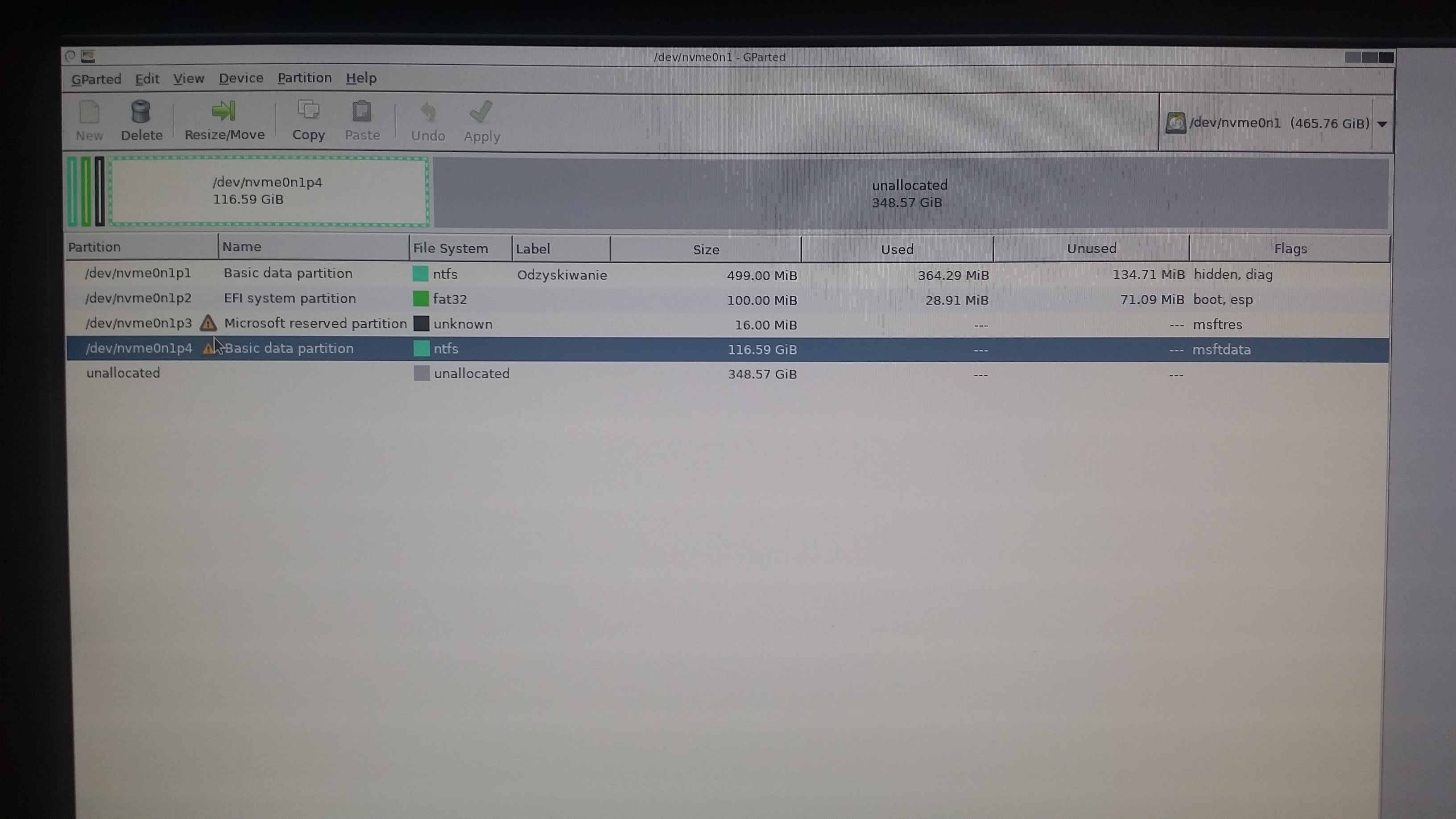
    I also fired up the partitioning program and I see exclamation marks - what is it?
    It is possible that the partition that you need is not booting?

    After expanding the exclamation mark, I have:

    unable to read the contents of this file system!
    Because of this some operations may be unavailable
    the cause might be a missing software package

    Nowadays:
    I did a re-format, but I did not set anything (partition and file system), the installation from usb does not go (this downloaded znetu - hal.dll file is missing) are damaged during installation?
  • #18 16927433
    marcinadd
    Level 23  
    Posts: 481
    Help: 69
    Rate: 86
    Board Language: polish
    Hmm .. Interesting case. Recently, I have switched to a computer with a very similar specification, even with this disk, but I did it like that. Download some Linux for yourself (I don't know if this GParted will have it installed, or it can be installed). I recommend downloading Ubuntu.
    1. In GParted you create New Partition Table-> GPT
    2. You have free space at your disposal. You create a new partition -> FAT32 Capacity for example 512MIB aligned to cylinders
    3. You create another NTFS-formatted data partition (Reserve Partition, I can't remember whether it will create itself or not, but in any case it is not required).
    4. You go into Terminal and type sudo cfdisk / dev / nvme0n1
    5. You select this FAT32 partition and set TYPE to EFI Partition (or EFI System I don't remember exactly). Write and you're done.
    6. You boot Windows and select that empty created partition and it must spin :D
  • #19 16927474
    Bullitt
    Level 11  
    Posts: 134
    Rate: 8
    Board Language: polish
    I'm after trying to install from CD now - won't even groan and move :|
    Marcinadd - what do I need Linux for? I have Gparted for live cd - need something extra?
  • #20 16927506
    marcinadd
    Level 23  
    Posts: 481
    Help: 69
    Rate: 86
    Board Language: polish
    To execute the cfdisk command. You can try this command (it should be built-in, but I'm not sure). Besides, check if you have UEFI of the motherboard set to EFI First.

Topic summary

✨ The discussion revolves around a user experiencing installation issues with Windows 10 on a new computer setup, specifically encountering error 0xc0000428 and other related errors during the installation process. The user has attempted various solutions, including formatting the disk, using different installation media, and checking BIOS settings. Suggestions from other participants include using partition management tools like EaseUS Partition Master, creating a new partition table with GParted, and ensuring the correct UEFI settings. The user also considers using a regular hard drive for installation and then formatting the SSD afterward. Despite multiple attempts, the user continues to face errors related to the installation media and partitioning.
Generated by the language model.

FAQ

TL;DR: New Z370/i7-8700K build showed 3 boot errors after a power-cut; "Use live CD and reset your unlucky hard drive." [Elektroda, icooz, post #16925386] Why it matters: This FAQ helps Windows 10 installers fix error 0xc0000428/0x0000225 on NVMe M.2 systems using clean-media and correct UEFI partitioning.

Quick Facts

How do I fix Windows 10 error 0xc0000428 after a power outage on a new build?

Boot a Linux live CD, wipe the NVMe partitions, then reinstall Windows from fresh official media in UEFI mode. This resets boot records and removes corrupted files. As one expert put it, "Use live CD and reset your unlucky hard drive." [Elektroda, icooz, post #16925386]

Does formatting the NVMe SSD with GParted actually help here?

Yes. The user performed a full GParted wipe, confirming the process runs cleanly. That removes broken partitions and stale boot data. If errors persist afterward, suspect installation media or firmware settings rather than disk health, since partitioning completed without faults. [Elektroda, Bullitt, post #16926753]

What UEFI/GPT layout should I use on ASUS Prime Z370‑A for Windows 10?

Create a GPT, add a small FAT32 partition, mark it as EFI System, and then create an NTFS partition for Windows. Install Windows to the NTFS partition while booted in UEFI mode. This aligns with community guidance for this platform. [Elektroda, marcinadd, post #16927433]

Why do I get winload.exe error 0x0000225 or missing kernel after setup?

Those symptoms point to corrupted install media or wrong boot mode. The thread shows blue screens citing ntoskrnl.exe and changing driver errors after reboot. Recreate media and ensure UEFI boot to a GPT disk. Use a different USB port if needed. [Elektroda, Bullitt, post #16927248]

Should I install from DVD instead of USB to avoid signature errors?

It can help isolate USB issues. One advisor recommended downloading a clean image and burning it to disc, then installing from the DVD. Quotes: "Download Windows 10 and burn to disc and try to install." [Elektroda, Magic_moon, post #16927107]

Where do I download legitimate Windows 10 installation files?

Use the official Microsoft download page and create media with the Media Creation Tool. In the thread, the installer was made from that source on two separate USB drives, which helps rule out a bad image if both fail. [Elektroda, Bullitt, post #16927273]

Can I skip entering the product key during installation and activate later?

Yes. The user completed installation without entering a key and planned to handle activation afterward. That approach lets you focus on resolving boot issues first, then manage the license once Windows is stable. [Elektroda, Bullitt, post #16927248]

Why does 32‑bit setup start but fail after reboot on this hardware?

The thread shows 32‑bit copied files but crashed post‑reboot with 0xc0000428. On modern UEFI systems with NVMe, use 64‑bit Windows 10. Mixing legacy modes or 32‑bit media can break the boot chain. [Elektroda, Bullitt, post #16925057]

My drive is M.2 NVMe. How can I connect it to another PC for a wipe?

Use an M.2 to SATA or USB NVMe adapter. The helper suggested a Delock-type M.2 adapter to attach the module externally, then repartition it from another system. This method works when the host PC is unstable. [Elektroda, barton21, post #16925300]

How can I completely remove old partitions from a second computer?

Attach the drive and delete all existing partitions with a partitioning tool. The advisor named EaseUS Partition Master to delete and recreate partitions, followed by formatting before returning the drive to the target PC. [Elektroda, barton21, post #16925215]

Which BIOS setting matters most: UEFI or Legacy on Z370?

Set the firmware to prioritize EFI/UEFI first. That ensures the installer creates and uses the EFI System Partition correctly on a GPT disk, preventing mixed‑mode boot issues after installation. [Elektroda, marcinadd, post #16927506]

GParted shows exclamation marks and “unable to read the contents.” What does that indicate?

It indicates an unreadable or unsupported filesystem on a partition. After wiping and recreating GPT/EFI, create fresh partitions, then let the Windows installer format them. That cleared similar warnings in the thread. [Elektroda, Bullitt, post #16927301]

Could repeated errors mean my USB installer is corrupted?

Yes, especially when errors vary between boots. The user tried two USB installers from Microsoft, which is useful A/B testing. If both fail, switch to a DVD burn to eliminate USB or port issues. [Elektroda, Bullitt, post #16927273]

Quick 3‑step: How do I prep the disk for a clean UEFI install?

  1. In GParted, create a new GPT on the NVMe.
  2. Make a small FAT32 partition and mark it as EFI System.
  3. Create an NTFS partition, then install Windows in UEFI mode to that partition. [Elektroda, marcinadd, post #16927433]

Edge case: The CD won’t boot at all—what next?

If a burned DVD won’t start, revisit BIOS boot order and ensure UEFI optical boot is enabled. Then verify the disc image and reburn. The thread notes a case where the CD "won't even groan and move." [Elektroda, Bullitt, post #16927474]

Any data point on attempts made in this case?

Yes. The user tested two separate USB sticks created with Microsoft’s tool, then also tried a CD. That breadth helps isolate root causes between media and firmware. [Elektroda, Bullitt, post #16927273]
Generated by the language model.
ADVERTISEMENT