logo elektroda
logo elektroda
X
logo elektroda

HP 15 - AC134NW - Does not charge, does not start, nothing lights up

damian13m 7788 17
Best answers

Why does an HP Pavilion 15-ac134nw not power on at all, with no LEDs and a heating PU2 chip, and what should I measure on this board?

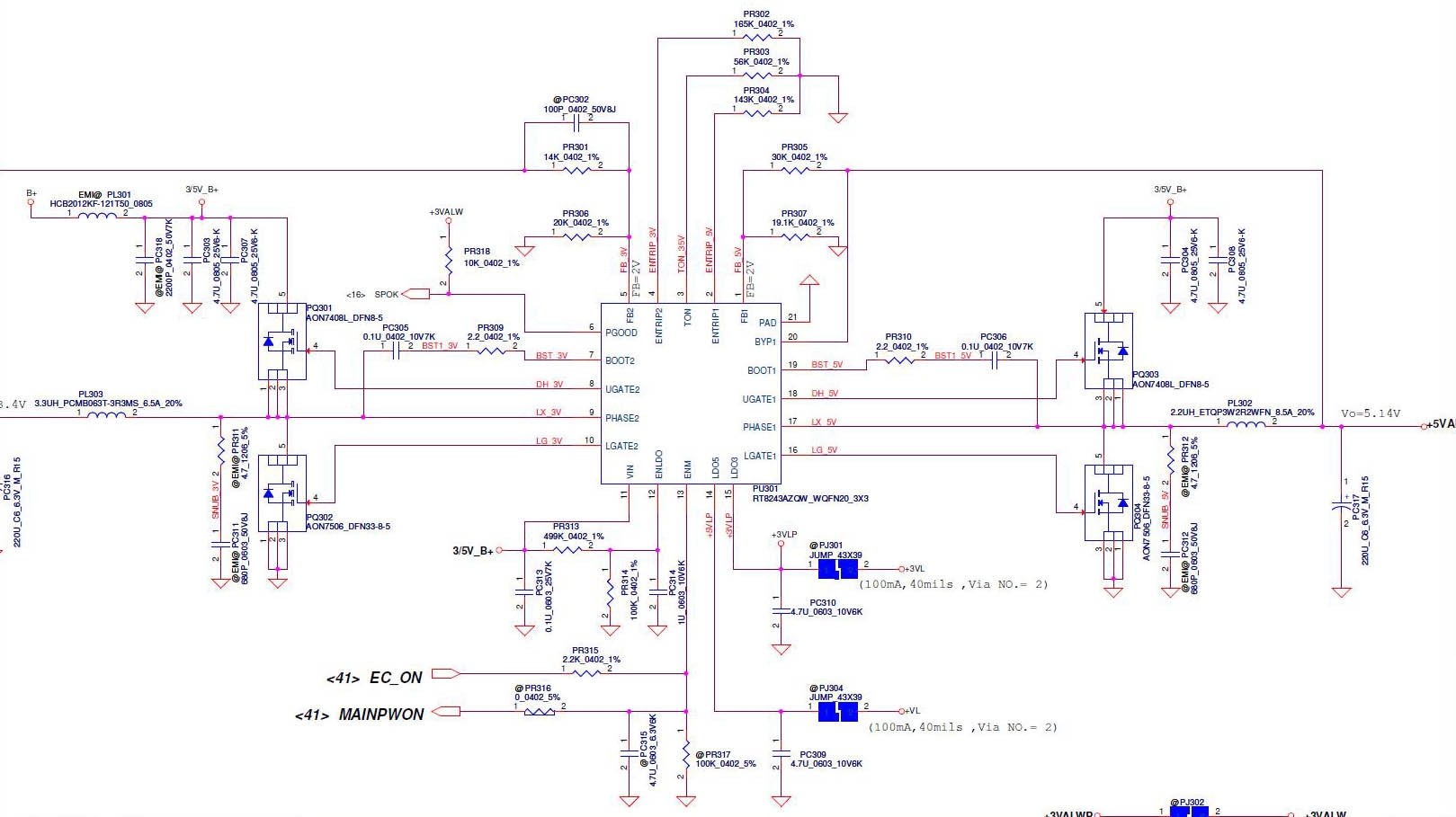
PU2 is the RT8243AZQW 3.3V/5V converter, and pin 15 should have 3.3V; the reported 0.7V there points to a short or overload in the KBC/NCB area rather than a normal startup state [#17131924][#17133863] The board signals mentioned for this platform are EC_ON to KBC pin 112 and MAINPWON to KBC pin 104, so if those are not present the KBC section is a prime suspect [#17132441] One reply judged the fault to be about 90% likely the KBC [#17134555] The later update confirmed a short circuit on the KBC system; the chip was desoldered and ordered for replacement, which matched the earlier diagnosis [#17544633] After replacement, the KBC must be programmed to work, and the thread notes that KB901x-style programming information exists, but the user clarified the board uses KB9022QD [#17544910][#17545175][#17633387]
Generated by the language model.
ADVERTISEMENT
Treść została przetłumaczona polish » english Zobacz oryginalną wersję tematu
  • #1 17131831
    damian13m
    Level 8  
    Posts: 9
    Board Language: polish
    Hello,
    Laptop: HP Pavilion 15 - AC134NW
    Motherboard Markings AHL50 / ABL52 LA-C701p Rev: 1.0
    The hob does not turn on, neither on the battery nor the power supply, and no LEDs are on.
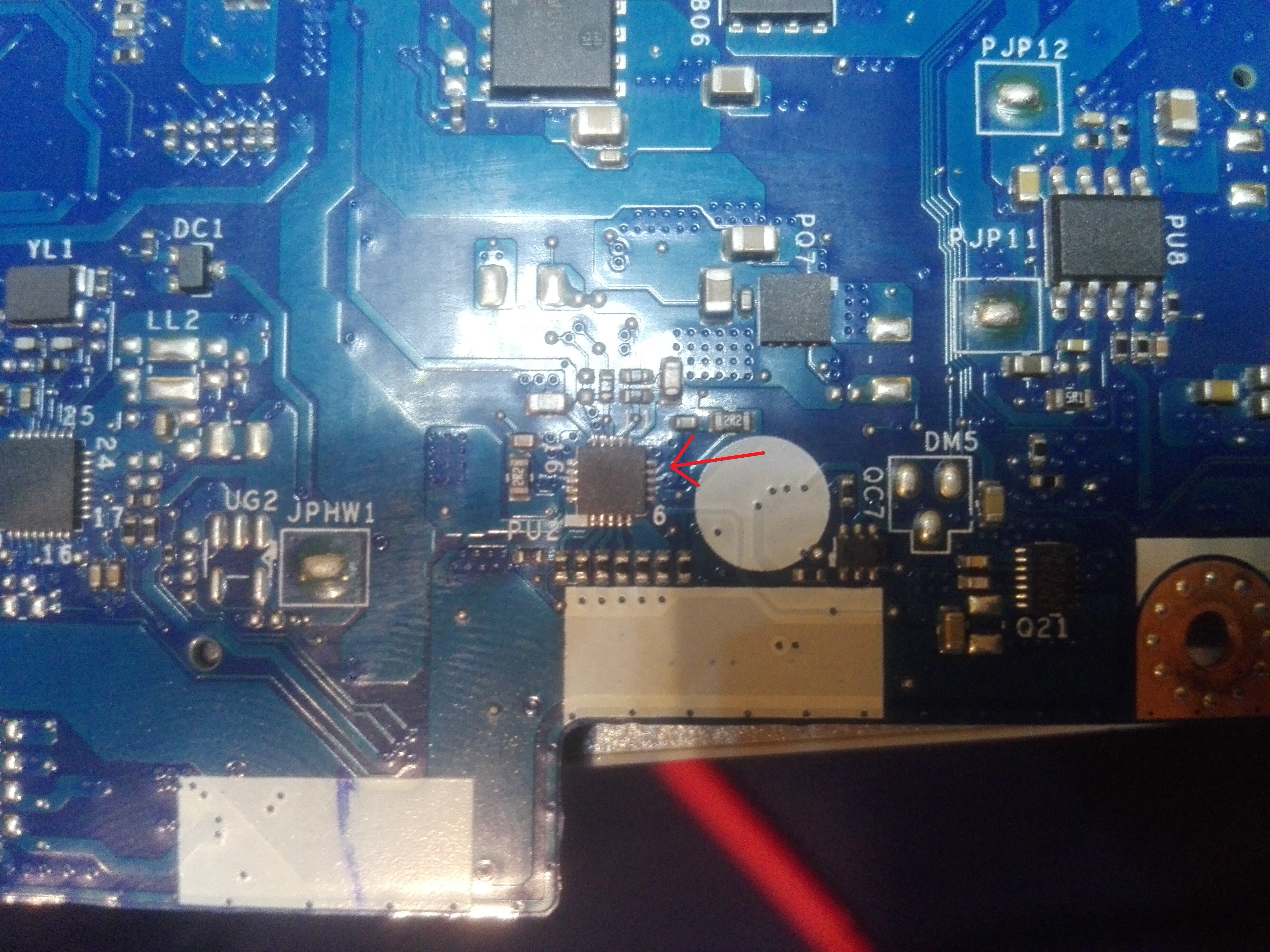
    I noticed that the chip with the signature PU2 is heating up on the board and I cannot identify it, its designation is BA 2F 520 (it is marked in the photo) HP 15 - AC134NW - Does not charge, does not start, nothing lights up .
    Could someone help me find the problem, or if someone had a diagram or some voltages what should be on this system, then he could give me a measurement?
    Best regards and thank you in advance for your help :D
  • ADVERTISEMENT
  • #2 17131924
    JayRo
    Level 38  
    Posts: 2407
    Help: 698
    Rate: 934
    Board Language: polish
    PU2 is a 3.3V / 5V Richtek RT8243AZQW converter, a fragment of the diagram can be found e.g. in the diagram from LA-A998P under PU301.
  • #3 17131964
    boro1234567
    IT specialist
    Posts: 26420
    Help: 2772
    Rate: 1534
    Board Language: polish
    damian13m wrote:

    I noticed that the chip with the PU2 signature is heating up on the disc and I cannot identify it with its marking BA 2F 520 (marked in the photo)

    PU2 is RT8243AZQW inverter driver, code 8A .
    It is possibly heating up due to LDO overload.
    damian13m wrote:
    Could someone help me find the problem, or if someone had a diagram or some voltages what should be on this system, then he could give me a measurement?

    In the attachment you have a pdf of the layout.
    Measure, publish the results.
    Attachments:
    • RT.pdf (302.71 KB) You must be logged in to download this attachment.
  • ADVERTISEMENT
  • #4 17132441
    lisek
    Service technician RTV
    Posts: 39699
    Help: 6305
    Rate: 6794
    Board Language: polish
    There is no MS or boardview.
    After HP solutions, others are based on the same systems.
    Read e.g. Link

    Broadwell series cpu, e.g. i3-5010U (SR23Z)
    KB9022Q x, where x: revision
    SPI Bios 25L6473EM
    charger PU201 (bq 735 / 725A)
    RT9711BGJ5 (BA) switch USB
    PU2 to RT8243A (8A)
    PU4 G5719C, 1.05V
    US1 SY6288D20AAC

    It fits e.g. Compal LA-C501P / LA-B181P (there are modifications to the KBC system) / LA-A998P / ...

    You have the PU2 work system, i.e. "what heats up" 8A = RT8243AZQW, signal:
    - EC_ON goes to KBC pin 112
    - MAINPWON goes to KBC pin 104.
    HP 15 - AC134NW - Does not charge, does not start, nothing lights up
  • #5 17133827
    damian13m
    Level 8  
    Posts: 9
    Board Language: polish
    Hello,
    Thank you all for guiding me to what system it is (I'm a beginner in motherboard diagnostics).
    I measured the voltage on the system and it looks like this:
    from 1 to 6 pin has nothing;
    on 7pin - 4.75;
    from 8 to 10 there is nothing;
    on 11pin - 19.7;
    on 12pin - 4.5;
    at 13 nothing;
    on 14pin - 4.9;
    on 15pin - 0.7;
    from 16 to 18 nothing;
    on 19pin - 4.7;
    at 20 nothing.

    lisek wrote:
    You have the PU2 work system, i.e. "what heats up" 8A = RT8243AZQW, signal:
    - EC_ON goes to KBC pin 112
    - MAINPWON goes to KBC pin 104.

    There is nothing on pin 13, i.e. this system does not start KBC?
  • #6 17133863
    boro1234567
    IT specialist
    Posts: 26420
    Help: 2772
    Rate: 1534
    Board Language: polish
    damian13m wrote:

    on 15pin - 0.7;

    You have the wrong voltage here, it should be 3.3V.
    It probably includes the NCB.
    A short-circuit test will explain everything.
  • ADVERTISEMENT
  • #7 17134086
    damian13m
    Level 8  
    Posts: 9
    Board Language: polish
    boro1234567 wrote:
    A short-circuit test will explain everything.

    And how to make such an attempt?
  • #8 17134104
    boro1234567
    IT specialist
    Posts: 26420
    Help: 2772
    Rate: 1534
    Board Language: polish
    damian13m wrote:

    And how to make such an attempt?

    Do you have a power supply with current and voltage regulation?
  • #9 17134116
    damian13m
    Level 8  
    Posts: 9
    Board Language: polish
    boro1234567 wrote:
    Do you have a power supply with current and voltage regulation?

    I only have voltage regulation but no current regulation.
  • #10 17134344
    boro1234567
    IT specialist
    Posts: 26420
    Help: 2772
    Rate: 1534
    Board Language: polish
    damian13m wrote:

    I only have voltage regulation but no current regulation.

    Unsuitable.
  • #11 17134356
    damian13m
    Level 8  
    Posts: 9
    Board Language: polish
    boro1234567 wrote:
    Unsuitable.

    And if I had such a power supply, how should I do this test?

    Added after 15 [minutes]:

    I think I found the culprit, it is the capacitor marked in the picture
    HP 15 - AC134NW - Does not charge, does not start, nothing lights up
    Both sides have continuity with ground
  • #12 17134417
    boro1234567
    IT specialist
    Posts: 26420
    Help: 2772
    Rate: 1534
    Board Language: polish
    damian13m wrote:
    Both sides have continuity with ground

    Desolder it and check it.
    I bet it's not him.
  • Helpful post
    #13 17134555
    lisek
    Service technician RTV
    Posts: 39699
    Help: 6305
    Rate: 6794
    Board Language: polish
    You have (90%) a kbc
  • #14 17544633
    damian13m
    Level 8  
    Posts: 9
    Board Language: polish
    Hello,
    Recently I bought a laboratory power supply and it turned out that there is a short circuit on the kbc system, I desoldered the system and ordered a new one. And from what I read, this kbc needs to be programmed to work. Can I do it with a CH341A programmer (because I have the same one so far).
  • ADVERTISEMENT
  • #15 17544910
    boro1234567
    IT specialist
    Posts: 26420
    Help: 2772
    Rate: 1534
    Board Language: polish
    damian13m wrote:
    Can I do it with a CH341A programmer (because I have the same one so far).

    You don't need a dedicated programmer for the KBC.
  • Helpful post
    #16 17545175
    lisek
    Service technician RTV
    Posts: 39699
    Help: 6305
    Rate: 6794
    Board Language: polish
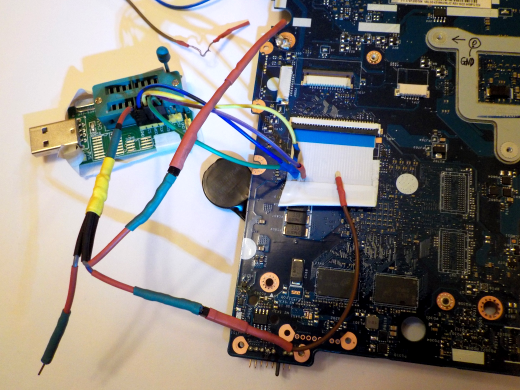
    He's on the net Link description how to program KB9012 (9010 and 9016 have the same pin "y) using CH341.
    The website of the manufacturer CH341 (http://wch.cn)

    Quote:
    KB9010, KB9012, KB9016 - pins for programming identical
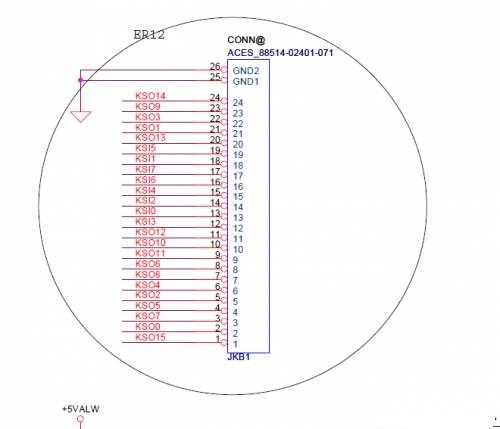
    42 - KSO3, 59 - KSI4, 60 - KSI5, 61 - KSI6 and 62 - KSI7

    Having a schematic of the platform (board) can either be done through the programmer or keyboard connector
    * as long as the pins 59,60,61,62 and 42 kbc KB901x are led out to the connector.
    :idea: :!:
    Connect the programmer and board weights to each other!
    Apply 3.3V from the programmer to the pin. kbc power supply / or use external. power supply
    _________________________
    e.g. for LA-8224p
    * for ease of work (no soldering to the board) you can use org. ribbons for the keyboard badge
    Spoiler:
    HP 15 - AC134NW - Does not charge, does not start, nothing lights up

    Spoiler:
    HP 15 - AC134NW - Does not charge, does not start, nothing lights up

    that is on the keyboard
    KSO3 - 22 pin, KSI4 - 15 pin, KSI5 - 19 pin, KSI6 - 16 pin and KSI7 - 17 pin

    Interesting about CH341 Link
  • #17 17633387
    damian13m
    Level 8  
    Posts: 9
    Board Language: polish
    Only I need to program KB9022QD. And this is the instruction for kbc901x
  • Helpful post
    #18 17633427
    lisek
    Service technician RTV
    Posts: 39699
    Help: 6305
    Rate: 6794
    Board Language: polish
    Watch out for this forum Link
    :!: especially the answer # 19 15 Nov 2018 09:44 (lower part of answer ..)

Topic summary

✨ The HP Pavilion 15 - AC134NW laptop is experiencing a complete failure to power on, with no LED indicators lighting up. The user identified that the chip labeled PU2, a Richtek RT8243AZQW voltage converter, is overheating. Various responses suggest that the overheating may be due to an LDO overload and recommend measuring voltages at specific pins on the motherboard. The user reported abnormal voltage readings, indicating potential issues with the KBC (Keyboard Controller) system. After further investigation, a short circuit was discovered on the KBC, leading to the decision to replace it. Guidance was provided on programming the new KBC using a CH341A programmer, with references to specific pin connections and schematics for successful programming.
Generated by the language model.

FAQ

TL;DR: 90% of no‑power cases on this platform trace to the KBC. "You have (90%) a kbc." Begin diagnostics there to resolve no‑charge/no‑boot. [Elektroda, lisek, post #17134555] Why it matters: This FAQ helps bench technicians quickly isolate KBC‑related shorts and 3.3V/5V rail faults on HP 15‑ac134nw.

Quick Facts

Why wont my HP 15ac134nw power on and why does PU2 heat up?

PU2 is the RT8243AZQW that generates 3.3V/5V. It can heat when its LDO is overloaded. A common overload is a short on the 3.3V rail driven by the KBC. "It is possibly heating up due to LDO overload." Check for a low 3.3V and isolate downstream loads. [Elektroda, boro1234567, post #17131964]

Is the KBC the most likely culprit on LAC701P when theres no power?

Yes. "You have (90%) a kbc." That rate reflects repeated field observations on this platform. If the 3.3V rail is dragged low and PU2 warms, suspect the keyboard controller first before replacing PU2. Replace only after confirming the short clears. [Elektroda, lisek, post #17134555]

What exactly is PU2 BA 2F 520 on this board?

PU2 is a Richtek RT8243AZQW 3.3V/5V inverter driver. The package code reads "8A" on many boards. Quote: "PU2 is RT8243AZQW inverter driver, code 8A." Use this to locate the correct datasheet and expected rails. [Elektroda, boro1234567, post #17131964]

Which PU2 pin should have 3.3V, and what if its low?

Check PU2 pin 15 for 3.3V. "You have the wrong voltage here, it should be 3.3V." If you read around 0.7V, the 3.3V rail is loaded. Disconnect consumers stepwise or lift coils to localize the short before swapping chips. [Elektroda, boro1234567, post #17133863]

How do EC_ON and MAINPWON relate to the KBC and PU2?

EC_ON routes to KBC pin 112, and MAINPWON routes to KBC pin 104. These signals orchestrate enabling the 3.3V/5V power rails around PU2. If one is missing, the KBC may not assert the rails, yielding a dead board symptom. [Elektroda, lisek, post #17132441]

How do I perform a safe shortcircuit test on this board?

"A shortcircuit test will explain everything." Use a bench PSU with current limiting. Typical: set 1.0V and 1–2A limit, inject on the 3.3V rail side of a coil, and locate the hottest part. Do not exceed safe limits. This quickly reveals the shorted device. [Elektroda, boro1234567, post #17133863]

Can I do the short test without current limiting on my PSU?

No. You need both current and voltage regulation to inject safely. Using a supply without current limiting risks further damage. Quote: "Unsuitable." Acquire a lab supply with adjustable current first, then proceed with the injection method. [Elektroda, boro1234567, post #17134344]

My capacitor near PU2 beeps to ground on both sides. Is it the culprit?

Not necessarily. Caps across power rails often read near short incircuit. "Desolder it and check it. I bet it's not him." Remove and test out of circuit; many times the real short is an IC loading the rail, not the decoupler. [Elektroda, boro1234567, post #17134417]

If PU2 pin 15 shows ~0.7V instead of 3.3V, what should I suspect?

Suspect a KBCrelated short on the 3.3V rail. That symptom aligns with the high KBC failure rate here. "You have (90%) a kbc." Confirm by isolating the rail, then replace or reprogram the KBC once the short is verified. [Elektroda, lisek, post #17134555]

Do I need a dedicated KBC programmer for this repair?

No. "You don't need a dedicated programmer for the KBC." Community workflows use general USB programmers and adapters. Ensure proper 3.3V power and ground when interfacing, and follow the specific KBC pinout. [Elektroda, boro1234567, post #17544910]

Can CH341A be used to program the KBC on this platform?

Yes, CH341Abased methods exist, but the KB9022 workflow has caveats. Review the referenced discussion before proceeding, especially the noted reply. Follow modelspecific guidance to avoid bricking. Quote: "Watch out for this forum link... especially the answer #19." [Elektroda, lisek, post #17633427]

How do I wire CH341A to KBC lines via the keyboard connector?

Example for KB901x: use KSO3 and KSI4–KSI7 lines. Pins: 42=KSO3, 59=KSI4, 60=KSI5, 61=KSI6, 62=KSI7. "Connect the programmer and board weights to each other! Apply 3.3V." Many techs use the keyboard FFC to avoid soldering. Verify your boards routing first. [Elektroda, lisek, post #17545175]

What BIOS and charger parts are used on this HP 15ac134nw board?

The platform lists SPI BIOS 25L6473EM and a charger at PU201 (bq735/725A). It also references KB9022Qx KBC, RT8243A at PU2, G5719C for 1.05V, and other power switches. Use this map for sourcing and tracing rails. [Elektroda, lisek, post #17132441]

How do I start measuring the RT8243A rails quickly?

Begin at PU2. Verify VIN present, then check the LDO outputs. Critically, confirm pin 15 is 3.3V under standby. "You have the wrong voltage here, it should be 3.3V." If low, isolate consumers before replacing regulators. [Elektroda, boro1234567, post #17133863]
Generated by the language model.
ADVERTISEMENT