logo elektroda
logo elektroda
X
logo elektroda

No Internet at RJ45 Wall Sockets After Fiber-Optic Installation: How to Connect Attic Cables

stachurson110 11598 22
Best answers

How do I connect the loose attic ends of my in-wall RJ45 cables so the wall sockets get internet from a router that is downstairs?

Connect the router to the wall socket whose cable goes to the attic, then terminate the loose attic cable ends and patch them into a switch in the attic so all room cables are linked together [#17217922] If you only have two cables to join and do not need to split anything in the attic, you can connect them directly with an RJ45 coupler/barrel instead of using a switch [#17218565] Another suggested workaround is PLC or a client-mode AP in the attic if you do not want to run or reconnect cables [#17217636]
Generated by the language model.
ADVERTISEMENT
Treść została przetłumaczona polish » english Zobacz oryginalną wersję tematu
  • #1 17217390
    stachurson110
    Level 8  
    Posts: 18
    Rate: 1
    Hello. Yesterday I had a technician to install fiber-optic internet. The internet via wifi works, the cable from the router also works, the problem arises when I want to use the rj45 cable sockets in the wall, because the internet does not work :( I have 2 sockets in the wall in the house (2 different rooms), in the attic I found the other end of the cables from the sockets in the wall, the cable itself without a plug - admittedly I have just moved into a new house and have not seen them before. I am green in these matters, please explain to me how to make the internet in the sockets, the problem is that the router is in the living room downstairs, and the other ends of the cables from the sockets are in the attic and I have no idea how to connect it :(

    The photo shows the ethernet cables that are in the attic.
    Attachments:
    • No Internet at RJ45 Wall Sockets After Fiber-Optic Installation: How to Connect Attic Cables D56951F4-3EC4-457A-971F-BC00520D14BE.jpeg (829.45 KB) You must be logged in to download this attachment.
    • No Internet at RJ45 Wall Sockets After Fiber-Optic Installation: How to Connect Attic Cables C633E268-BCFE-4D98-81E5-E21CE0294DFF.jpeg (617.64 KB) You must be logged in to download this attachment.
    • No Internet at RJ45 Wall Sockets After Fiber-Optic Installation: How to Connect Attic Cables 7B95A96E-CDE8-4EB5-9289-19EFCEFFF52D.jpeg (913.6 KB) You must be logged in to download this attachment.
  • ADVERTISEMENT
  • #2 17217434
    Wojtek(KeFir)
    Level 42  
    Posts: 7605
    Help: 678
    Rate: 559
    The router and the optical fiber would also have to be in the attic. Now you won't do anything.
  • ADVERTISEMENT
  • #3 17217450
    stachurson110
    Level 8  
    Posts: 18
    Rate: 1
    What can you do now? I guess the team that built this house must have known about it, and the fiber optic cable is not long enough, on the other hand, I also do not want to hammer in the wall to let the cables from the attic down: /

    Added after 59 [seconds]:

    Before connecting the router, the installation was ready - the cables were sticking out of the walls and so it was from the building shell.
  • #4 17217474
    Wojtek(KeFir)
    Level 42  
    Posts: 7605
    Help: 678
    Rate: 559
    One must connect to the other. Those cables that stick out in the attic have to be tucked into the router so that there is communication at the other ends - logical. Either router for cables or cables for router.
  • #5 17217480
    Arr0w
    Level 8  
    Posts: 17
    Help: 1
    Rate: 6
    If you don't want to forge, install some AP in the attic (with at least 2 LAN sockets) in Client mode, assuming there is WiFi coverage there.
  • #6 17217481
    stachurson110
    Level 8  
    Posts: 18
    Rate: 1
    In that case, the specialist who installed it had to be drunk: /

    Added after 6 [minutes]:

    And if I connect it to the ap, the connection will not be as stable as during the direct one?
  • #7 17217550
    Arr0w
    Level 8  
    Posts: 17
    Help: 1
    Rate: 6
    Every cable is a cable ;)

    There are many variables with WiFi - the distance, type and thickness of the walls, the angle at which the signal passes through the walls ...

    And in this room with the router, you don't have a power outlet?
    The operator's router could be connected to it, and a switch in the attic.
  • #8 17217618
    stachurson110
    Level 8  
    Posts: 18
    Rate: 1
    Yes, in this room I have a wall socket and a router next to it.
  • #9 17217636
    makosuu
    Network and Internet specialist
    Posts: 2984
    Help: 369
    Rate: 369
    You can also connect something via PLC, e.g. a switch in the attic and these sockets to the switch.
  • #10 17217637
    hermes-80
    Level 43  
    Posts: 12013
    Help: 1177
    Rate: 740
    Sketch a diagram of cables around the apartment, because no one knows how and where you have it going.
  • ADVERTISEMENT
  • #11 17217922
    rafish
    Level 13  
    Posts: 54
    Help: 3
    Rate: 3
    stachurson110 wrote:
    Yes, in this room I have a wall socket and a router next to it.


    then check if this cable "flies" to the attic, if so, connect the router to this socket, and install a switch in the attic and plug in all cables there, the one coming from the router and those going to other rooms
  • #12 17217927
    Ture11
    Level 39  
    Posts: 5406
    Help: 573
    Rate: 1116
    And the optical fiber goes into what? Directly to the router, or maybe to a device that is connected to the router via WAN?
  • #13 17218224
    stachurson110
    Level 8  
    Posts: 18
    Rate: 1
    The optical fiber is plugged straight into the router, I am not able to do that as far as the sketch is concerned. So in these cables in the attic I have to put on 2 ends, connect the router to the wall socket at the bottom with a rj45 cable, connect 2 cables to the switch in the attic and there will be internet in the second socket?
    Maybe by the way I will ask what switch do you recommend? I can see that there is a wide offer on the Internet.

    Added after 2 [minutes]:

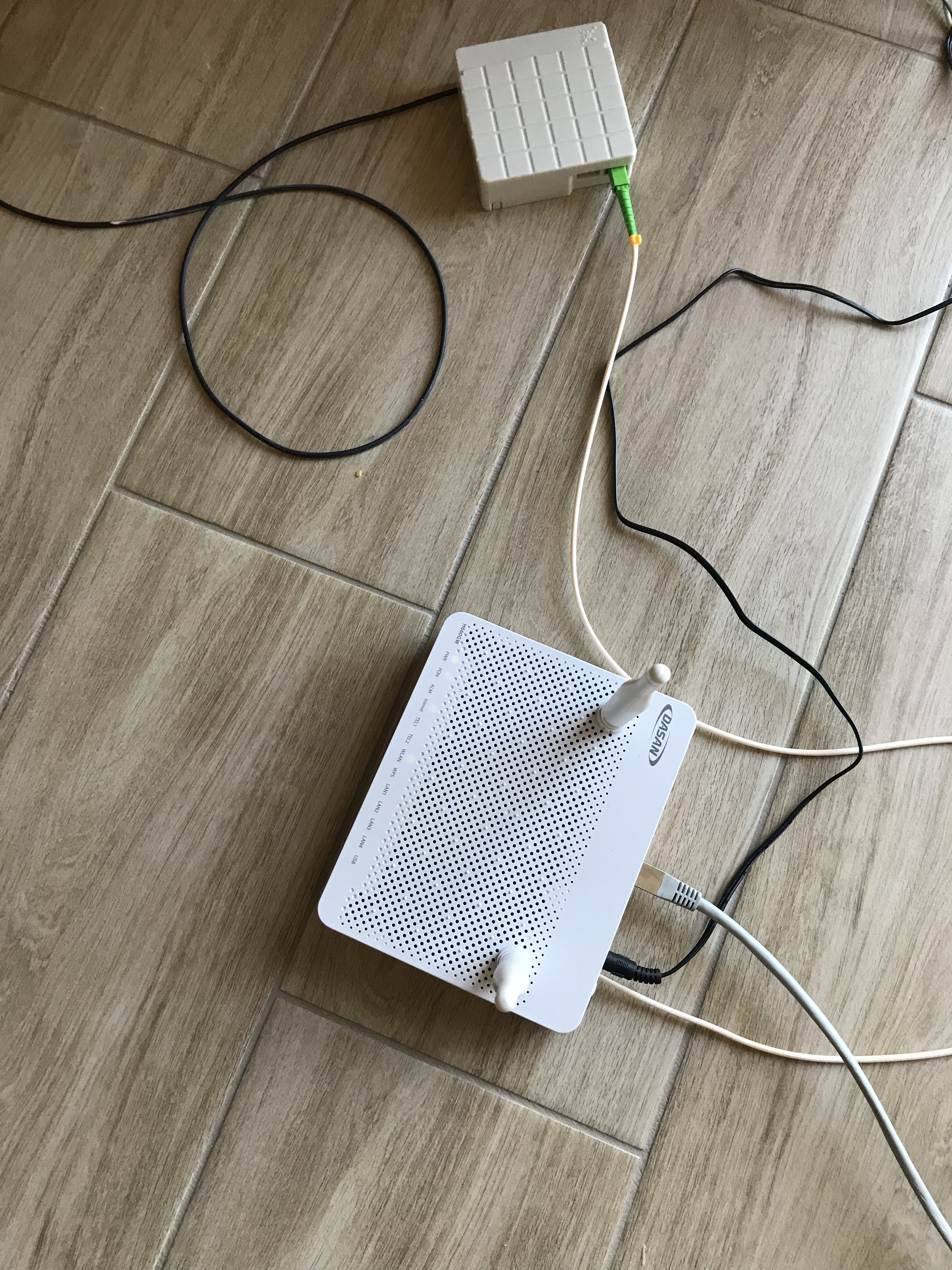
    In total, now I am not sure whether it is directly to the router - I am posting a photo of what it looks like. No Internet at RJ45 Wall Sockets After Fiber-Optic Installation: How to Connect Attic Cables
  • ADVERTISEMENT
  • #14 17218520
    Ture11
    Level 39  
    Posts: 5406
    Help: 573
    Rate: 1116
    It looks like directly to the router ...
    Well, it probably remains to buy a switch to the attic ... And what - I think, any one, equipped with Gigabit ethernet connectors (a bit more expensive).
  • #16 17218565
    Wojtek(KeFir)
    Level 42  
    Posts: 7605
    Help: 678
    Rate: 559
    Come on. But if you have 2 cables in your attic, no switch is needed. Just connect the cables behind you and that's it. There are special "barrels" for this.
  • #17 17218568
    stachurson110
    Level 8  
    Posts: 18
    Rate: 1
    Meaning ? It seems to me that there are other ends of the cables from the sockets in the walls (2 sockets), how would I connect them, it will be internet in the sockets ??
  • #18 17218594
    Wojtek(KeFir)
    Level 42  
    Posts: 7605
    Help: 678
    Rate: 559
    How-how? Just like that. The switch is used to split the connection. In the attic, you don't want to separate anything and you don't want to connect anything. As I understood there will be no computer or printer or anything in the attic. So if you have a Router (and the router has a switch, these are 4 sockets) then you just have to "extend" the cables further, to the second socket.
  • #19 17218600
    stachurson110
    Level 8  
    Posts: 18
    Rate: 1
    So I would have to pull cables from the attic two floors below to connect them to the router and then there will be internet in the sockets?
  • #20 17218651
    makosuu
    Network and Internet specialist
    Posts: 2984
    Help: 369
    Rate: 369
    I have already written to connect via PLC or some router in client mode. You don't have to pull the cables down.
  • #21 17218652
    Wojtek(KeFir)
    Level 42  
    Posts: 7605
    Help: 678
    Rate: 559
    Draw it, show a diagram. Because I can see you struggle with it. And even more so we.
  • #22 17218655
    stachurson110
    Level 8  
    Posts: 18
    Rate: 1
    Okay, I'm gonna come home tonight and I will.
  • #23 21259498
    Wojtek_J
    Level 10  
    Posts: 29
    Rate: 1
    stachurson110 wrote:
    Okay, I'll come home tonight and do that.


    Stachurson110, I'm worried about you.
    I don't think you've come home yet, and it's been over 6 years!

Topic summary

✨ After a fiber-optic internet installation, the user is experiencing connectivity issues with RJ45 wall sockets in their new home. The router is located downstairs, while the other ends of the cables from the wall sockets are found in the attic. Suggestions include connecting the attic cables directly to the router, using a switch in the attic, or employing Powerline Communication (PLC) to extend the network. The user is advised to ensure that the cables are properly connected and to consider using a switch with Gigabit Ethernet capabilities if needed. The discussion emphasizes the importance of proper cable management and connectivity to achieve internet access through the wall sockets.
Generated by the language model.

FAQ

TL;DR: 90 % of Ethernet faults come from loose or unpatched cables [Fluke, 2023]. “Just connect the cables behind you” [Elektroda, Wojtek(KeFir), post #17218565] Patch attic runs to the router or a gigabit switch and the wall sockets come alive.

Why it matters: A five-minute attic patch can restore full-speed wired internet to every room.

Quick Facts

• Cat-5e supports 1 Gbps to 100 m [TIA, 2018] • Unmanaged 5-port gigabit switch: €15–€25 in EU [PriceSpy, 2024] • PLC adapters add 3–10 ms latency, lose ≈30 % throughput [SmallNetBuilder, 2022] • RJ45 inline coupler inserts <0.3 dB loss [Belden, 2021] • Wi-Fi 5 loses ≈50 % signal after two 30 cm brick walls [Cisco, 2020]

Why is there no internet in my wall RJ45 jacks after the fibre install?

Because the attic cable ends are not linked to the router. The fibre enters the living-room router, but the house wiring was left unterminated, so no data reaches the jacks [Elektroda, stachurson110, post #17217390]

Do I need to move the router to the attic?

No. Keep the router where the fibre terminates and extend its LAN port upstairs via one existing cable or a switch [Elektroda, Arr0w, post #17217550]

How can I tell which attic cable belongs to each room?

Use a cheap tone generator and probe set. Clip the toner to the room jack, then listen for the beep in the attic. Typical kits cost €15 [Klein, 2023].

When is a gigabit switch required in the attic?

Add a switch only if more than one attic cable must reach the router. One uplink from the router plugs into the switch; the other room cables plug into its LAN ports [Elektroda, Ture11, post #17218520]

Can I skip the switch and just join two cables?

Yes. Crimp RJ45 plugs on both cables and link them with an inline coupler (“barrel”). This method carries full gigabit speeds and costs under €3 [Belden, 2021].

Will a Wi-Fi client bridge be as stable as cable?

No. Walls, distance and interference cut Wi-Fi throughput by up to 70 % [Cisco, 2020]. Wired links offer consistent latency under 1 ms, while bridges can spike to 40 ms [SmallNetBuilder, 2022].

Are power-line (PLC) adapters a good alternative?

They work, but add 3–10 ms latency and lose about 30 % bandwidth every hop [SmallNetBuilder, 2022]. Performance drops sharply on split-phase wiring or old breakers—an edge-case many users hit.

What tools do I need to terminate the attic cables?

Buy an RJ45 crimp tool, Cat-5e keystone jacks or plugs, a cable stripper and tester. Starter kits cost approx. €25 [Amazon, 2024].

How to wire the attic so every room jack is live? (3-step)

  1. Crimp an RJ45 plug on the cable that runs from the living-room jack to the attic.
  2. Plug that cable into a gigabit switch or coupler.
  3. Crimp plugs on the remaining attic cables and insert them into the switch; test each room jack.

Is the TP-Link TL-SG1005D a suitable switch?

Yes. It offers five gigabit ports, fanless design, and draws under 3 W. Users report line-speed transfer at 940 Mb/s [TP-Link, 2023].

What if a wall jack still shows no link?

Check pin order (T568B standard). A single swapped pair blocks gigabit negotiation. Replace damaged keystone or re-crimp the plug, then retest with a continuity checker [TIA, 2018].

Will linking two cables with a coupler reduce speed?

Insertion loss is under 0.3 dB—far below the 24 dB limit for Cat-5e, so speed remains unaffected [Belden, 2021].
Generated by the language model.
ADVERTISEMENT