logo elektroda
logo elektroda
X
logo elektroda

[Solved] Ender 3 v1.1.3 Atmega1284P: Hotend Smoking & Thermistor Issue - Voltage Regulator Problem?

Marqee 7362 14
ADVERTISEMENT
Treść została przetłumaczona polish » english Zobacz oryginalną wersję tematu
  • #1 17557840
    Marqee
    Level 6  
    Posts: 9
    Hello all,

    I have a problem with the new Creality Ender 3 version 1.1.3 printer. After many struggles with leveling the curved table and reassembling the crooked frame at the factory, I managed to bring it to service.
    Unfortunately, yesterday, during a quick print in PLA, the hotend started to smoke, after opening it, I saw a burnt cotton wool (?) With a kapton, a heating block flooded with PLA with a melted thermistor. It was not a problem because it can be quickly cleaned and replaced, but the fault was the fault of the controller and not the thermistor.
    When turned off and on, it shows a temperature of 162 * even though the block is cold and the thermistor off, in this case it should indicate MINTEMP or MAXTEMP error. The motherboard voltage to the Hotend thermistor is 700mV, and to the table thermistor is 4.7V.
    What could be causing the fault? Defective voltage regulator or Atmega 1284P?

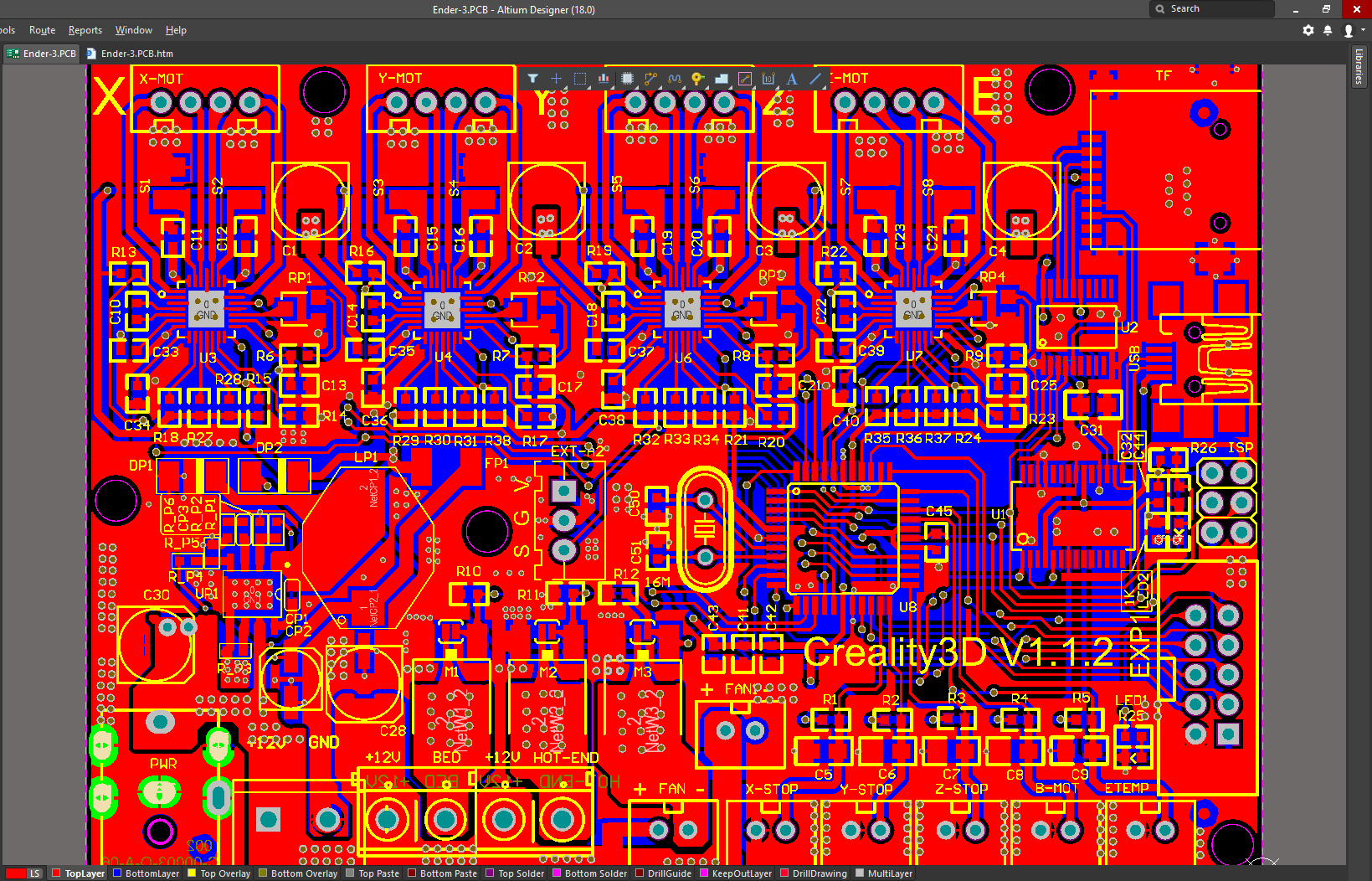
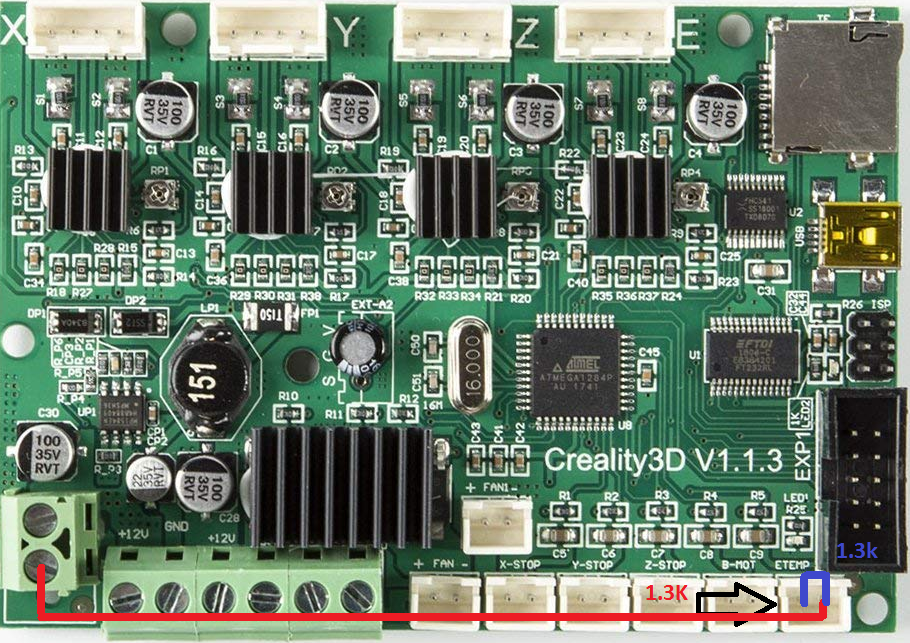
    In the photo I marked the hotend thermistor input Ender 3 v1.1.3 Atmega1284P: Hotend Smoking & Thermistor Issue - Voltage Regulator Problem? Ender 3 v1.1.3 Atmega1284P: Hotend Smoking & Thermistor Issue - Voltage Regulator Problem?
  • ADVERTISEMENT
  • #2 17558050
    11111olo
    Level 42  
    Posts: 13609
    Help: 1
    Rate: 793
    Marqee wrote:
    during a quick print in PLA, the hotend started to smoke, after unscrewing it I saw burned cotton wool (?) along with a kapton,

    Where?
    Marqee wrote:
    After turning off and on, it shows the temperature of 162 * although the block is cold

    and
    Marqee wrote:
    in this case it should indicate MINTEMP or MAXTEMP error.

    And what conclusion?
    I already know what is damaged, but if you have taken so many measurements and you still don't know how do you want to fix it?
  • #3 17558140
    Marqee
    Level 6  
    Posts: 9
    11111olo wrote:
    Marqee wrote:
    during a quick print in PLA, the hotend started to smoke, after unscrewing it I saw burned cotton wool (?) along with a kapton,

    Where?
    Marqee wrote:
    After turning off and on, it shows the temperature of 162 * although the block is cold

    and
    Marqee wrote:
    in this case it should indicate MINTEMP or MAXTEMP error.

    And what conclusion?
    I already know what is damaged, but if you have taken so many measurements and you still don't know how do you want to fix it?


    Do you like making posts? Your answer added nothing to the topic except "I know but won't say".
  • ADVERTISEMENT
  • Helpful post
    #4 17558490
    11111olo
    Level 42  
    Posts: 13609
    Help: 1
    Rate: 793
    You didn't even want to write that the software is MARLIN!
    If disconnecting the thermistor does not change anything, the damage is on the board. I do not have a diagram of this crap but the thermistors are most likely made in the same way as in other crap plates of this type, such as RAMPS.
    Compare, measure and maybe we can fix it.
  • ADVERTISEMENT
  • #5 17558710
    Marqee
    Level 6  
    Posts: 9
    11111olo wrote:
    You didn't even want to write that the software is MARLIN!
    If disconnecting the thermistor does not change anything, the damage is on the board. I do not have a diagram of this crap but the thermistors are most likely made in the same way as in other crap plates of this type, such as RAMPS.
    Compare, measure and maybe we can fix it.


    11111olo did not mention Marlin as Creality uses it but changed and it is from a proprietary source which people hold against them.
    I checked the voltages on the other components and they are normal. In your opinion, Atmega's fault, or maybe any of the resistors fell and so lowers the voltage from 4.7V to 700mV?
  • Helpful post
    #6 17559238
    11111olo
    Level 42  
    Posts: 13609
    Help: 1
    Rate: 793
    I don't know what your concept of electronics is, but you don't really have one.
    You will write right away that I do not want to help and it is quite the opposite.
    Help is not pointing with a finger, but directing (guiding).

    Something short circuit. I do not know how it is done on this board, but usually there is a 4k7 resistor connected to Vref and a 10uF capacitor in parallel to the thermistor.
    If the second thermistor shows the temperature correctly and the pull-up resistor has the correct resistance and the capacitor is not short-circuited, it all indicates that the microcontroller is damaged.

    If you don't get it, write to PW.
  • ADVERTISEMENT
  • #7 17560323
    Marqee
    Level 6  
    Posts: 9
    11111olo wrote:
    I don't know what your concept of electronics is, but you don't really have one.
    You will write right away that I do not want to help and it is quite the opposite.
    Help is not pointing with a finger, but directing (guiding).

    Something short circuit. I do not know how it is done on this board, but usually there is a 4k7 resistor connected to Vref and a 10uF capacitor in parallel to the thermistor.
    If the second thermistor shows the temperature correctly and the pull-up resistor has the correct resistance and the capacitor is not short-circuited, it all indicates that the microcontroller is damaged.

    If you don't get it, write to PW.


    I have no idea yet, I'm learning all the time. I appreciate your method, I came here to confirm my suspicions about the fault and not to ask for help like 'the printer doesn't work, what to do ?!'.
    I checked the resistor of the second thermistor on the PCB, although I know that it would be better to desolder it, but I cannot return for warranty.
    The value of 'suspect' is 1.95K, adjacent to the second good thermistor is 4.52K. Both resistors are SMD 472 like you mentioned 4.7K
  • Helpful post
    #8 17561282
    11111olo
    Level 42  
    Posts: 13609
    Help: 1
    Rate: 793
    You cannot measure it correctly without desoldering.
    If you can take advantage of the guarantee, take advantage. I think that the repair cost will literally be a few cents, but you have to decide for yourself.
  • #9 17565819
    Marqee
    Level 6  
    Posts: 9
    I desoldered the 4.7K resistor, it is working. To be sure, I gave a new one and unfortunately the problem is still there. There is still a capacitor, if it is not, it is possible that the controller is dead but it still transmits this lower voltage?
    I would not count on the guarantee, I bought a GB from the Czech warehouse, I would have to send it back to China and the whole procedure would take at least 2 months.
  • #10 17566116
    11111olo
    Level 42  
    Posts: 13609
    Help: 1
    Rate: 793
    After desoldering the resistor, it was necessary to check what the display shows. You can shorten this pin to ground (after desoldering the resistor, and even connect the potentiometer between ground and AVCC, the slider to the atmega pin) and you will know everything.

    First, unsolder the capacitor and without the thermistor connected, it should show -14 * C (or something near it). You can check by disconnecting the second thermistor.

    If atmega has fallen, maybe it is possible to use a free pin from the ADC?

    Can you replace the microcontroller yourself?
  • #11 17566333
    Marqee
    Level 6  
    Posts: 9
    Thanks for the tips, no resistor temperature unchanged, on the display 160-162 * C after unsoldering the capacitor the same. Only the display is connected, the hotbed temperature is correct, i.e. 0 * C on the disconnected thermistor.

    Technically, I can replace it, I just don't know if I will program it properly.
  • #12 17566356
    11111olo
    Level 42  
    Posts: 13609
    Help: 1
    Rate: 793
    Before you desolder, check the resistance between the ground and the ADC pin from the thermistor on the turned off electronics.
  • #13 17566583
    Marqee
    Level 6  
    Posts: 9
    With 1.30K resistor and capacitor, with 1.18K desoldered. I measured in two ways as in the picture, correct?
    Ender 3 v1.1.3 Atmega1284P: Hotend Smoking & Thermistor Issue - Voltage Regulator Problem?
  • #14 17566689
    11111olo
    Level 42  
    Posts: 13609
    Help: 1
    Rate: 793
    If there is no damage to the PCB, the atmega must be replaced.
  • #15 17635528
    Marqee
    Level 6  
    Posts: 9
    Burnt ATMEGA.

Topic summary

✨ The discussion revolves around a malfunction in the Creality Ender 3 v1.1.3 3D printer, where the hotend began smoking during a print, leading to a burnt thermistor and issues with temperature readings. The user suspects a defective voltage regulator or the Atmega1284P microcontroller due to abnormal voltage levels (700mV for the hotend thermistor and 4.7V for the bed thermistor). Various responses suggest checking the board for short circuits, measuring resistances, and the possibility of a damaged microcontroller. The user has desoldered components for testing but continues to face issues, indicating a potential need for microcontroller replacement.
Generated by the language model.

FAQ

TL;DR: Typical Ender 3 thermistor circuits use a 4.7 kΩ pull-up and 10 µF filter; "it all indicates that the microcontroller is damaged." This FAQ helps fix false hotend temps and smoking on Ender 3 v1.1.3 (Atmega1284P). [Elektroda, 11111olo, post #17559238]

Why it matters: A stuck temperature reading can cause uncontrolled heating, smoke, and permanent board damage on Creality printers.

Quick Facts

Why does my Ender 3 show 162°C on a cold hotend?

A faulty hotend ADC input can lock the display near 160–162°C, even when cold. In this case, removing the pull-up or capacitor did not change the reading. The bed thermistor channel still reported 0°C when unplugged, indicating the hotend channel failed. [Elektroda, Marqee, post #17566333]

Does unplugging the hotend thermistor trigger MINTEMP/MAXTEMP on this board?

On a healthy input, unplugging should change the reading and trigger a fault. If disconnecting the thermistor does nothing, the board input is damaged. "If disconnecting the thermistor does not change anything, the damage is on the board." [Elektroda, 11111olo, post #17558490]

What does ~700 mV on the hotend thermistor input mean?

The hotend thermistor node should sit near Vref via the pull-up, similar to the bed at ~4.7 V. Seeing ~700 mV alongside a stuck high temperature suggests a shorted input path on the hotend channel. This matched the case that produced smoke and a melted thermistor. [Elektroda, Marqee, post #17557840]

How is the Ender 3 thermistor circuit built on the 1.1.3 board?

It mirrors common RAMPS designs: a 4.7 kΩ pull-up to Vref and a 10 µF capacitor across the thermistor. This RC network feeds the ATmega1284P’s ADC channel to stabilize readings. "There is a 4k7 resistor connected to Vref and a 10uF capacitor in parallel to the thermistor." [Elektroda, 11111olo, post #17559238]

How do I test the ADC input without a thermistor? (How-To)

  1. Unsolder the input’s capacitor.
  2. Power on; with the thermistor disconnected, the LCD should show about −14°C.
  3. For dynamic testing, wire a potentiometer between GND and AVCC, and connect the wiper to the ATmega pin. These steps verify the ADC channel’s behavior end-to-end. [Elektroda, 11111olo, post #17566116]

I measured low resistance from the ADC pin to ground. What does that imply?

Low resistance to ground on the ADC pin, with the pull-up and capacitor removed, indicates an internal short in the microcontroller. If the PCB has no damage, replace the ATmega1284P. "If there is no damage to the PCB, the atmega must be replaced." [Elektroda, 11111olo, post #17566689]

Could a bad voltage regulator be causing these false temperatures?

Unlikely, if the bed thermistor channel behaves normally. When one channel fails while others work, the specific ADC input or its local components are suspect. If the second thermistor reads correctly and passives test OK, the microcontroller is indicated. [Elektroda, 11111olo, post #17559238]

What should I expect the LCD to show with the thermistor and cap removed?

With the capacitor unsoldered and the thermistor unplugged, expect approximately −14°C on the display. That negative reading confirms the input is floating as expected, not clamped. "It should show −14 °C (or something near it)." [Elektroda, 11111olo, post #17566116]

My hotend smoked and the thermistor melted—what failed?

In the reported case, the hotend overheated until insulation burned, PLA flooded the block, and the thermistor melted. The display showed a high temperature even when cold. This behavior aligns with a failed hotend sensing path causing heater control to misbehave. [Elektroda, Marqee, post #17557840]

Can I remap the hotend thermistor to a spare ADC pin in Marlin?

Yes, if the ATmega1284P has a spare ADC channel, you can reroute the thermistor and adjust Marlin pins. "If atmega has fallen, maybe it is possible to use a free pin from the ADC?" This avoids replacing the chip but requires firmware changes. [Elektroda, 11111olo, post #17566116]

How do I properly check the 4.7 kΩ pull-up resistor?

Desolder it before measuring. In-circuit readings can be misleading due to parallel paths. Once removed, verify it reads near 4.7 kΩ, and replace if out of tolerance. "You cannot measure it correctly without desoldering." This ensures an accurate diagnosis of the input network. [Elektroda, 11111olo, post #17561282]

Does firmware matter here? What firmware does Creality 1.1.3 run?

Creality’s 1.1.3 board runs a Marlin-based firmware with vendor modifications. This issue stems from hardware, not firmware settings. "Creality uses [Marlin] but changed and it is from a proprietary source." Firmware changes are only needed if remapping pins. [Elektroda, Marqee, post #17558710]

What was the final fix reported in this thread?

The root cause was a burned ATmega. Replacing the ATmega1284P, or swapping the control board, resolves the stuck temperature and heater control issues. This confirmed an internal failure of the microcontroller’s input. [Elektroda, Marqee, post #17635528]

Is pursuing warranty worth it for a Gearbest Czech-warehouse purchase?

In this case, the buyer expected a return to China with about two months’ turnaround and chose local repair. Consider your downtime tolerance and shipping costs before deciding. Local component-level repair can be faster. [Elektroda, Marqee, post #17565819]

What’s a quick bench test to simulate a thermistor signal?

Connect a potentiometer between GND and AVCC, with the wiper feeding the ATmega ADC pin. Adjust it and watch the temperature reading move. This confirms the ADC and firmware scaling path. It’s a practical way to isolate sensor-side faults. [Elektroda, 11111olo, post #17566116]
Generated by the language model.
ADVERTISEMENT