logo elektroda
logo elektroda
X
logo elektroda

Title: DIY Photovoltaic Panel Installation: Subsidy, Qualifications, Warranty & User Experiences

jx123jx 31827 47
Best answers

Can I install ground-mounted photovoltaic panels myself and still get the 'My Electricity' subsidy, what qualifications are needed for the DSO paperwork, and how does self-installation affect inverter warranty?

Yes, you can self-install, but for the 'My Electricity' subsidy the program distinguishes between third-party installation and self-assembly: if you do it yourself, you must have the proper qualifications and submit a self-assembly declaration; if a company installs it, you attach the installation invoice instead [#18513010][#18498568] The official reply quoted in the thread says self-assembly means you performed the entire installation, including electrics, on your own because you have the appropriate qualifications, and in that case the operator can connect the system to the grid [#18513010] For the DSO/ZE paperwork, the installer declaration must be signed by a person with electrical qualifications such as SEP E, and several replies say the grid operator may also want that person to handle the notification and meter replacement paperwork [#18495223][#18498568] For the subsidy paperwork, thread participants say you usually submit invoices for the purchased components plus the self-assembly declaration, not an installation invoice, when the system was mounted by the applicant [#18495935][#18499026] Warranty is separate: many inverter manufacturers require installation by an authorized person, so self-installation can affect warranty support unless the company’s warranty terms accept it [#18495223]
Generated by the language model.
ADVERTISEMENT
Treść została przetłumaczona polish » english Zobacz oryginalną wersję tematu
  • #31 18861301
    Citek
    Level 22  
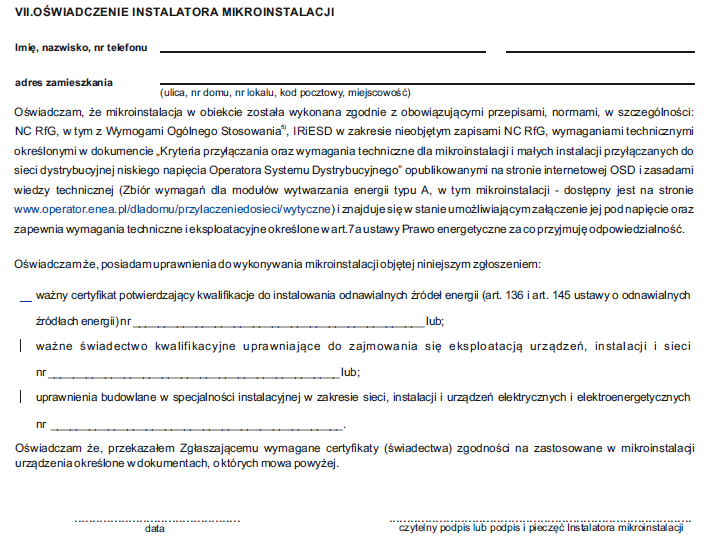
    Maybe I misspelled it, but my point was that when you do the report to the EC, there is a point like the installer's statement and at this point there is such a matter as "Declaration that I have the authorization to perform the micro-installation covered by this report:", i.e. if you do not have the rights you will he needed a person with such powers.
    Title: DIY Photovoltaic Panel Installation: Subsidy, Qualifications, Warranty & User Experiences
  • ADVERTISEMENT
  • #32 18894407
    damianlodz
    Level 8  
    You can install it yourself according to the design and the design of the photovoltaic installation should be made by a person who has:

    building qualifications for designing in the installation specialization in the field of networks, installations, electrical and power devices (Journal of Laws of 2018, item 1202, as amended) or
    certificate issued by the President of the Office of Technical Inspection in the field of photovoltaic systems.
    You decide what to do for yourself and make sure you don't regret the decision.
    Read about granting permissions directly on the UDT website.
    It's like with a driving license. Some have and ride, others don't, and they drive too.
    The assembly can be done by an electrician with an "E" Qualification Certificate and the measurements are not checked by anyone yet, but someone has to sign you that you have.
    But I don't know if someone who is in the UDT installers database will tap you installations when something happens.
    The cost of installing it on the ground is raised by the frame and don't listen to the stories.
    For the subsidy, it is enough that you have installed it yourself having the right.
    Until recently, the installer could not take advantage of the subsidy, but that has changed.
    And do your job, because in September you will have to have a firefighter's opinion above 6.5 kWp.
  • #33 18895862
    Jan_Werbinski
    Level 33  
    Citek wrote:
    Maybe I misspelled it, but my point was that when you do the report to the EC, there is a point like the installer's statement and at this point there is such a matter as "Declaration that I have the authorization to perform the micro-installation covered by this report:", i.e. if you do not have the rights you will he needed a person with such powers.

    Do you understand written text? The fact that there is a column DOES NOT MEAN THAT IT MUST BE FILLED IN. Just because there is a place for "X" DOES NOT MEAN THAT YOU NEED TO INSERT IT.

    Laws and regulations constitute law in Poland and not a private company form.
  • ADVERTISEMENT
  • #34 18896081
    damianlodz
    Level 8  
    Well, I do not know if you know what you are writing. You select one and you come to the counter. And if someone is unhappy, another sad Lord comes and asks for copies of all documents, including measurements.
    And then he asks who designed the installations, so say that you designed it yourself because you have SEP.
    This adds nothing to the discussion.
    Everyone does as they see fit.
    greetings
  • #35 18897475
    Jan_Werbinski
    Level 33  
    Well, something will happen to someone, because you have a TN-C without an RCD and everything will be fine because you have the measurements and compliance with the design from 50 years ago. Do what you want.
  • #36 19026462
    cielak94
    Level 10  
    I warmly welcome
    Is Sep E enough or something else to report micro-installations to Tauron now?
    There is real estate for dad and mom and the invoices would be for his personal details. No invoice for the assembly, as it would be done by me, i.e. my son. Is it possible to obtain a grant in this case? So the owner of the plot without SEP qualifications will have papers filled in to Tauron by a person with SEP E qualifications. The question is whether the owner of the property has electrical qualifications when submitting the papers?
    The second thing, "And get your job done, because in September you will have to have a firefighter's opinion above 6.5 kWp."
    - it is necessary to have the opinion of this fireman or not when installing the installation of such power? How is it?
    greetings
  • #37 19026520
    damianlodz
    Level 8  
    Parents do not have to have. They will not reimburse you for the assembly. Is E enough in Tauron?
    Rather yes, but it depends on the ward. They demanded D somewhere, but it did not happen to me.
    From September you need to have over 6.5 kWp opinions from the fire specialist.
    Nobody checks it on the property but there must be paper. Cost from 300 to 1000 ..
    And they require a disconnect on the DC side, unless you have done it with microwaves, you don't have to.
  • #38 19026579
    toolpusher
    Level 23  
    To report to the DSO, you need the authorizations from what your colleagues write, eg E. So the application to the DSO must be signed by a person who has qualifications.
    As for the "my current" program, you only select self-assembly and that's it. The fund does not check this at the stage of submitting the application, although in the definition of the fund, self-assembly is assembly on a property whose owner has the appropriate permissions.
  • ADVERTISEMENT
  • #39 19204204
    Preve
    Level 2  
    Everything important here (attachment):
    Attachments:
    • Informacja_nr_40_z_2013_roku.pdf (114.66 KB) You must be logged in to download this attachment.
  • ADVERTISEMENT
  • #40 19350539
    Piotr_Krasy
    Level 11  
    One little ale
    Installations located on the ground are excluded from the my electricity and thermal modernization program (tax deduction).
  • #41 19350734
    adse
    Level 27  
    Piotr_Krasy wrote:
    One little ale
    Installations located on the ground are excluded from the my electricity and thermal modernization program (tax deduction).
    Is it something new or outdated data from 2 years ago?
  • #42 19352178
    Piotr_Krasy
    Level 11  
    adse wrote:
    Piotr_Krasy wrote:
    One little ale
    Installations located on the ground are excluded from the my electricity and thermal modernization program (tax deduction).
    Is it something new or outdated data from 2 years ago?

    A small correction, because I introduced a certain inaccuracy. ?
    "The micro-installation should be connected by the Distribution Network Operator to a bidirectional meter at the given Energy Collection Point (PPE), a comprehensive contract was concluded and the energy from the installation should serve residential purposes."
  • #43 21037204
    rutas15
    Level 11  

    Hello,
    I am planning to install photovoltaic panels on my roof (3.6 kWp) with a connection to the ENERGA network.
    I would like to do all the work myself and here are some questions:
    1. What permissions will I need? I have a SEP for Supervision and Operation, but I do not have UDT qualifications, and I do not have my own business.
    2. The installation is to be single-phase, but the meter and connection are three-phase. Will there be a problem with this on ENERGA's part?
    3. And is there anything else I should know about before starting the investment (purchasing materials)?

    Best regards and thank you for your help.

    I am asking about the current situation (2024).
    I don't want to invest in materials and then find out that for some reason I won't be able to install it myself.
  • #44 21037253
    Janusz_kk
    Level 39  
    rutas15 wrote:
    I have a SEP for Supervision and Operation

    I also did them at SEP but at Tauron and that was enough, I don`t have a company.

    rutas15 wrote:
    The installation is to be single-phase, but the meter and connection are three-phase. Will there be a problem with this on ENERGA`s part?

    It shouldn`t, 3.6kW is probably the maximum allowable, but why not 3F? you can then add an inverter, e.g. 5kW, and expand the installation.

    rutas15 wrote:
    And is there anything else I should know about before starting the investment (purchasing materials)?

    read about installation, buy appropriate roof holders, place the panels as high as possible above the roof, secure the connectors under the panels with black cable ties so that the sun does not burn and snow and ice do not damage or wet the connectors, do not stretch the cables, use conduits to pass through the roof and into the box preferably metal, a box with lightning arresters too, everything well grounded.
    rutas15 wrote:
    I don`t want to invest in materials and then find out that for some reason I won`t be able to install it myself.

    Well, you`ll assemble it and look for someone with permission to sign it for a small fee, but I doubt you`ll have to do that, supervision is probably sufficient for Eneia.
  • #45 21037315
    rutas15
    Level 11  

    Janusz_kk wrote:
    It shouldn't, 3.6kW is probably the maximum allowable, but why not 3F? you can then add an inverter, e.g. 5kW, and expand the installation.


    For auto consumption to be at a good level. I am planning to switch loads such as water heating, washing machine and oven to the phase to which the photovoltaics will be connected. I read somewhere that interphase balancing works, but is this really the case?
  • #46 21037320
    adse
    Level 27  
    Interphase balancing works very well, there is no point in focusing on one phase if you have 3F at home. It is best to have 3 microwaves, one on each phase, then any voltage overshoots should be less painful.

    By the way, if you connect a boiler, kettle and oven on one phase, will the fuse blow? And certainly when you turn on the iron or the vacuum cleaner.
  • #47 21037384
    rutas15
    Level 11  

    I checked the voltages on individual phases and it turned out that one of the phases has 6 volts less than the other two. I think it is worth going for a single-phase installation because the inverters turn off. With a 3f inverter, it is enough for any phase to exceed the voltage threshold and the entire photovoltaics will turn off. Alternatively, divide the system into 3 microwaves as my colleague mentioned.

    Either way, the apartment has always been powered from one phase. The 3f connection was only used in the garage.

    I am glad that there is such good help from colleagues :)
    The most important thing for me now is that I can handle the installation myself :)
    By the way... Can I connect such an installation only to the meter/connection that is in my name or can I also help, for example, at my parents' place? Of course, I mean bureaucracy because, as I mentioned above, I only have SEPs (our supplier is ENERGA).

    Added after 16 [minutes]:

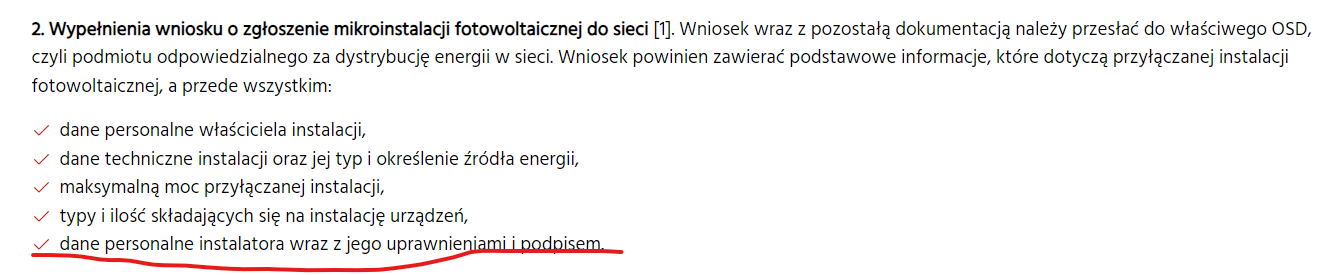
    Screenshot of a regulation point regarding the application for connecting a photovoltaic micro-installation to the grid.

    I found this point in the regulations.
  • #48 21037478
    adse
    Level 27  
    People wrote here on the forum that with only the simplest SEP they had no problems with accepting the application. But it is not known whether all ZEs treat it the same way. This quote does not indicate what specific permissions these should be, so by default, basic permissions should be enough.

Topic summary

✨ The discussion revolves around the installation of photovoltaic panels, focusing on self-assembly, subsidies, qualifications, and warranty issues. Users share insights on the "My Electricity" subsidy program, emphasizing that self-installation is permissible if the applicant has the necessary qualifications. Documentation required includes invoices for components and a declaration of self-assembly. Concerns about warranty coverage for inverters installed by non-professionals are raised, with some brands requiring authorized installation for warranty validity. Participants discuss the economic benefits of DIY installation versus hiring a company, noting significant cost savings when purchasing materials directly. The importance of having an electrician involved for grid connection and compliance with local regulations is also highlighted.
Generated by the language model.

FAQ

TL;DR: Up to 5 000 PLN subsidy is still payable for 2–10 kWp PV, but only if an authorised installer issues an invoice or the owner files a signed self-assembly declaration with valid SEP/UDT papers; “permissions are needed to ‘pick up’ the installation” [Elektroda, jx123jx, #18495135; Elektrode, Rhaavir, #18861292].

Why it matters: Missing a single form or qualification voids both the grant and inverter warranty.

Quick Facts

• Subsidy: 5 000 PLN per installation, 2–10 kWp range, call 5.0 [gov.pl/Program-Mój-Prąd]. • DIY route: SEP E/D or UDT-PV certificate required for DSO acceptance [Elektroda, damianlodz, post #18894407] • Labour invoice waived if Annex 4 self-assembly statement attached [Elektroda, comer3, post #18498568] • Fire-safety opinion mandatory for > 6.5 kWp since 09-2020 [Elektroda, damianlodz, post #19026520] • VAT: 8 % turnkey vs 23 % materials-only; typical saving ≈15 % [Elektroda, theo33, post #18498648]

Can I install photovoltaic panels myself and still receive the 5 000 PLN “My Electricity” grant?

Yes. File the application online, attach equipment invoices and Annex 4 self-assembly declaration. You must also hold recognised electrical credentials (SEP E/D, RES, UDT-PV) and be the contract holder with the DSO. Otherwise an external firm must invoice the labour [Elektroda, comer3, #18498568; gov.pl/Program-Mój-Prąd].

Which permissions qualify as “appropriate” for self-assembly in 2024?

Distribution operators accept: 1. SEP Group 1 certificate for Operation (E) or Supervision (D); 2. UDT PV installer certificate; 3. Building-design licence for electrical installations. One of these must appear in the installer declaration sent to the DSO [Elektroda, damianlodz, post #19026520]

Do I need an invoice for assembly if I build the system myself?

No. Submit only equipment invoices plus the signed Annex 4 statement. The Fund verified that self-installers are exempt from labour invoices in the second and later calls [Elektroda, comer3, post #18495935]

How will the inverter warranty work without an authorised company?

Read the inverter T&Cs. Brands such as Fronius reserve the right to refuse claims if a certified installer did not commission the unit [Elektroda, Rhaavir, post #18861292] Some makers still honour parts warranties but may deny on-site service. Get written confirmation before purchase.

Are ground-mounted arrays eligible for the subsidy and tax deduction?

Yes, provided the array feeds a residential meter and the DSO installs a bidirectional meter. Earlier drafts suggested an exclusion, but NFOSiGW clarified that location (roof or ground) does not limit eligibility [Elektroda, Piotr_Krasy, post #19352178]

Single-phase or three-phase inverter—what does the DSO expect?

Operators allow up to 3.6 kW on one phase. Above that, they can demand a three-phase inverter for network balance. Inter-phase energy settlement works automatically in net-billing, so 3-phase usually reduces voltage trips [Elektroda, adse, post #21037320]

What documents must I send to the DSO when I finish the build?

  1. Micro-installation notification form with installer declaration. 2. Single-line diagram and panel layout. 3. Copy of electrical measurements (PE, insulation, RCD tests). 4. Copy of your SEP/UDT certificate. The DSO swaps the meter within 30 days [Energa “Przyłączenie M-instalacji” 2024].

How big are the DIY cost savings?

Forum users reported material cost 13 000 PLN vs turnkey quote 25 000 PLN for a 5 kWp system—about 92 % higher if outsourced [Elektroda, leonada, post #18498696] VAT savings partly offset this gap when a firm installs at 8 % VAT.

What new fire-safety rule applies above 6.5 kWp?

Since September 2020, installations > 6.5 kWp need a written opinion from a certified fire-protection expert and a DC disconnect accessible to firefighters [Elektroda, damianlodz, post #19026520] Missing this stops the meter change.

Edge case: What if grid voltage on one phase exceeds 253 V?

A three-phase inverter shuts down entirely when any phase breaches the limit. Using three micro-inverters (one per phase) localises the trip and keeps two phases generating [Elektroda, rutas15 & adse, post #21037320]

How do I claim the thermal-modernisation tax deduction?

Enter the sum of VAT invoices (materials and/or labour) in PIT-O Part B, Field 6. The owner’s name on the invoice must match the property deed; installation method is irrelevant [Elektroda, leonada, post #18500342]

Quick 3-step How-To: filing a self-assembly grant application

  1. Scan equipment invoices and the signed Annex 4 declaration. 2. Complete the online form at mojprad.gov.pl, selecting “montaż własny”. 3. Upload the DSO meter-installation confirmation and submit. NFOSiGW issues the decision within 30 working days [mojprad.gov.pl FAQ, 2024].
Generated by the language model.
ADVERTISEMENT