
logo elektroda
logo elektroda
X
logo elektroda

Irrigation of the lawn - cooperation of the rainwater tank with the water supply system

alchi8 3588 19
Best answers

How can I control irrigation so it uses rainwater from a tank by default and switches to mains water when the tank is empty?

Yes: the thread’s practical solution is to use a float switch in the tank, a 24 V irrigation solenoid valve for mains top-up, and a transformer such as the F&F TR-24, with the irrigation controller running the pump only during watering and leaving it inactive when the tank is empty [#18731079] When the tank is full, watering runs from rainwater; when the tank is empty, the controller opens the mains-water valve and waters from the supply instead [#18731079] Earlier advice was to let the tank-level sensor drive relays/contactors: the sensor can switch the solenoid valve and a stronger relay or modular contactor for the pump, because the level-controller relay output is only about 1 A [#18641363][#18642699] One reply also said that a single solenoid valve for filling the tank is sufficient, and that two probes can be tied together to form the full-tank level [#18642699] However, another reply warned that directly connecting mains water and rainwater is not compliant; the two sources must be separated by an air gap or similar BA-type break [#20070624]
Generated by the language model.
ADVERTISEMENT
Treść została przetłumaczona polish » english Zobacz oryginalną wersję tematu
  • #1 18641280
    alchi8
    Level 10  
    Posts: 11
    Rate: 3
    Hello, everybody!
    I apologise at the outset if this is not the category. However, I know you know your stuff ;)
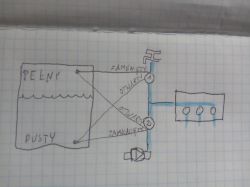
    Irrigation of the lawn - cooperation of the rainwater tank with the water supply system
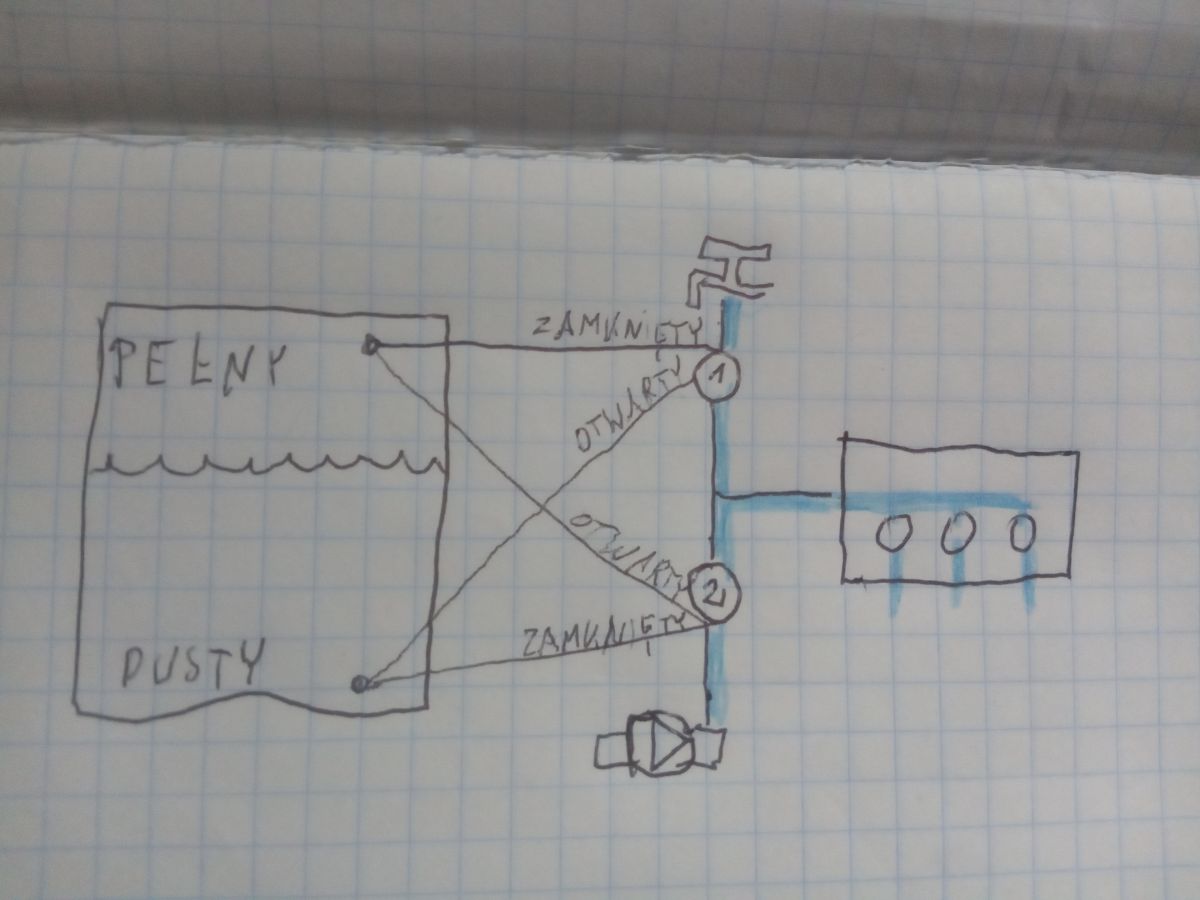
    I am doing irrigation for the garden. I would like the default to use rainwater from the tank (via a pump).
    When the tank is emptied, the feed water would flow from the mains water supply. I thought of two solenoid valves.
    1 - from the water mains
    2 - from the tank (via a garden pump).
    There would be some water level sensors in the tank
    A) tank full - electro-valve 1 closed, electro-valve 2 open
    B) tank empty - electro-valve 1 open, electro-valve 2 closed.
    The pump would only start when there is water in the tank, and its activation and deactivation would be managed by the irrigation controller (rainBird RZX4) as of course the other irrigation sections. Please find attached drawings.
    How do I do this? Is this even possible? If so, please explain in "simple terms" the connections and the things I need to use.
    Best regards and best wishes.
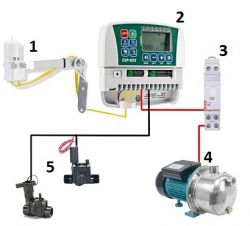
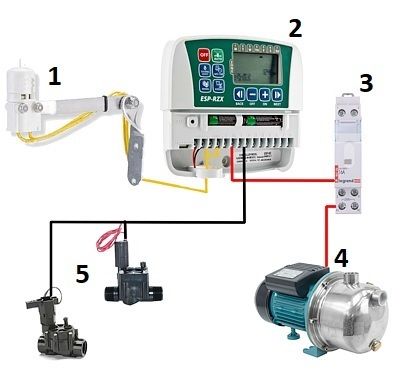
    Ps. What is that under "3" in the picture below?

    [/url] Irrigation of the lawn - cooperation of the rainwater tank with the water supply system
  • ADVERTISEMENT
  • #2 18641363
    nikusert
    Level 41  
    Posts: 5428
    Help: 699
    Rate: 1747
    Hello .
    You can use a CP-2 liquid level sensor.
    Powered 230V , relay output without voltage , changeover contacts.
    For this, depending on the load (especially), the pump should be used an additional stronger relay, or a small contactor (for example DILEM -10).
    The relay output is not very powerful (relay up to 1A).
    You use three measuring probes SO-common to the levels.S1 minimum,S2 max.
    This is what it looks like Link
  • #3 18641597
    alchi8
    Level 10  
    Posts: 11
    Rate: 3
    Thank you for your reply. And how do you control solenoid valves 1 and 2? Can you draw the connection of everything on a piece of paper and paste it into the topic?
  • ADVERTISEMENT
  • #4 18641971
    nikusert
    Level 41  
    Posts: 5428
    Help: 699
    Rate: 1747
    You supply the sensor to terminals 4-(L) , 5-(N)
    -from terminal (4) you make a bridge with a wire to terminal (8)
    connect additional relays (their coils) to terminals (9)(10), the relays will control the solenoid valves and the modular contactor that runs the pump.
    Tomorrow I will draw you a sketch of how this should look.
  • Helpful post
    #5 18642699
    nikusert
    Level 41  
    Posts: 5428
    Help: 699
    Rate: 1747
    In your situation, one solenoid valve for filling the tank is sufficient.
    When the tank is full, the pump relay will allow the pump to be started by your controller at the appropriate time of day. When the tank is empty, even if the controller allows the pump to be started (current watering time), the pump will not start anyway until the tank is full.
    Relays of any 230V type R2M, R15 etc
    Through the contacts of both relays P1 you will supply the phase (you did not write what voltage the solenoid valves are for), under the output of the relay contacts connect the solenoid valve.
    Connect the operating contacts in series with the coil supply wire of the pump module contactor.You can use three or two courts for the tank.When there are two, S1 and S2 are connected together and it will be a full tank probe.
  • #6 18660055
    alchi8
    Level 10  
    Posts: 11
    Rate: 3
    Thank you for your help. My colleague EL-Szwed suggested a different and cheaper solution.
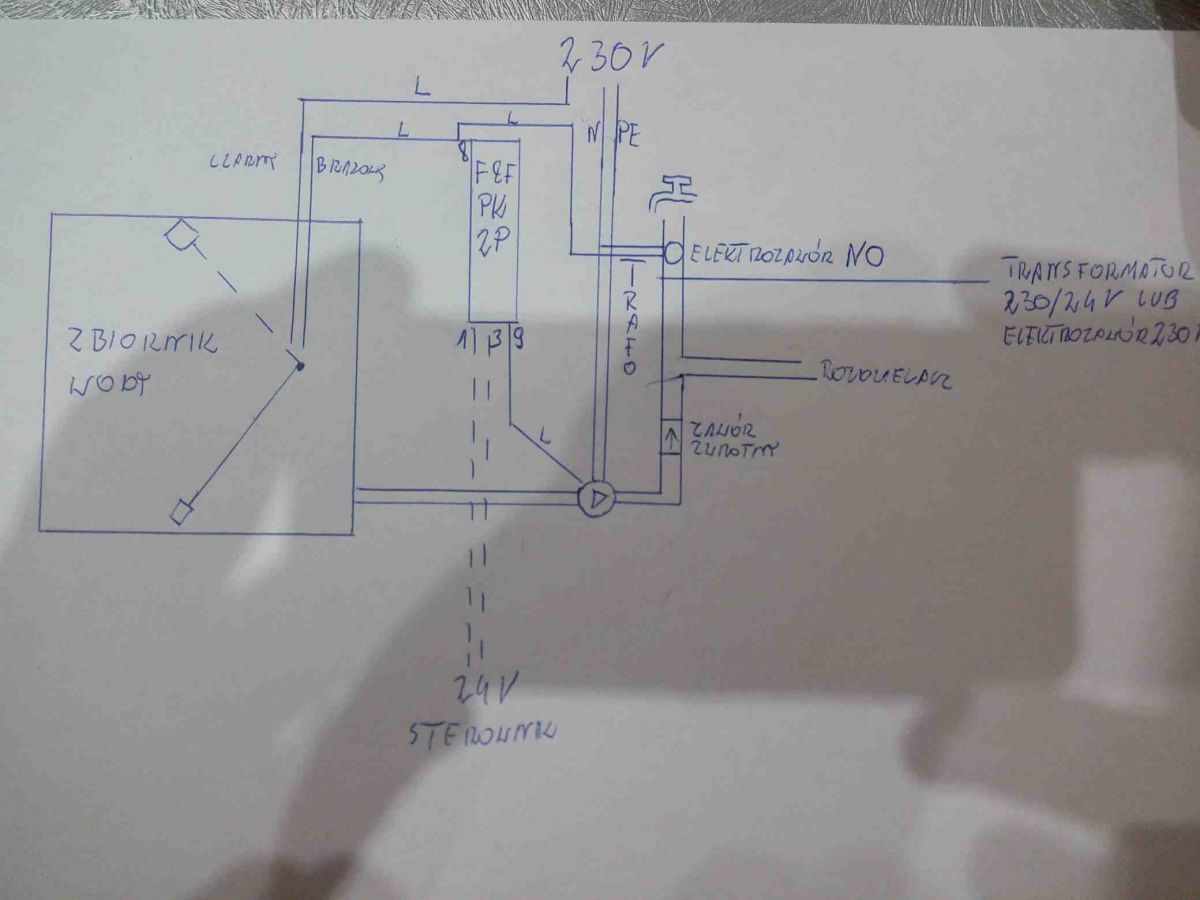
    I am adding a drawing if anyone else is interested in the subject.
    Greetings! Irrigation of the lawn - cooperation of the rainwater tank with the water supply system
  • #7 18662777
    nikusert
    Level 41  
    Posts: 5428
    Help: 699
    Rate: 1747
    It may be so, but it all depends what kind of float you are going to use because of the voltage of 230V you are going to apply to it.Additionally, it should have a PE wire.My solution is safe because there is no such voltage there.Maybe if you specify the kind of float you are going to use, it will dispel my doubts about such a solution.Using a float from a submersible pump is unlikely to work.
  • #8 18662895
    retrofood
    VIP Meritorious for electroda.pl
    Posts: 31317
    Help: 1140
    Rate: 4781
    nikusert wrote:
    Maybe if you state the type of float you intend to use , it will dispel my doubts about such a solution.

    For safety reasons, I would rather see a hydrostat (from a washing machine or dishwasher) or maybe even two here. The biggest problem, however, would be protecting the whole thing from the weather and/or users.
    Because the technical solution to such an issue is as simple as a stick of hazelnut. The problem, however, is safety. How about using a reduced voltage of 12 or 24 volts for the control and automation system? It would then be easier to enclose the actuators (relays or contactors) in some kind of sealed box.
  • ADVERTISEMENT
  • #9 18663938
    masonry
    Level 30  
    Posts: 2742
    Help: 106
    Rate: 831
    nikusert wrote:
    Additionally, it should have a PE cable.

    Float switches generally do not have a PE cable.
    retrofood wrote:
    For safety reasons I would rather see a hydrostat (from a washing machine or dishwasher) or maybe even two.

    Unnecessary complication of the design.
    Let's not knock down an open door gentlemen.
    Just use the simplest float switch, not a combination.
    https://sklep-hydros.pl/sterowniki-zabezpiecz...wnik-05m-20m-plywak-do-pomp-zatapialnych.html
    I use similar floats to control pumps in sewage pumping stations and they work faultlessly for years.
  • #10 18666449
    alchi8
    Level 10  
    Posts: 11
    Rate: 3
    This is exactly what the float is about. The switchboard with fittings will be installed in the basement together with the controller, cables buried in the ground. All connections will be made in waterproof boxes, safety being paramount. To control the water from the water supply I will use a 24V valve such as for sprinklers with a trasformer. A garden pump will be used (I will mount it in the valve box so there is access).
  • #11 18668166
    nikusert
    Level 41  
    Posts: 5428
    Help: 699
    Rate: 1747
    I have not tested this type of float, hence my concern as to its operating range. Will such a float have the operating range you expect (won't it overshoot the minimum level and undershoot the maximum level).The other thing, if you are going to use a 24V solenoid valve, I would of course power the float with the same voltage, which is safe.
  • #12 18731079
    alchi8
    Level 10  
    Posts: 11
    Rate: 3
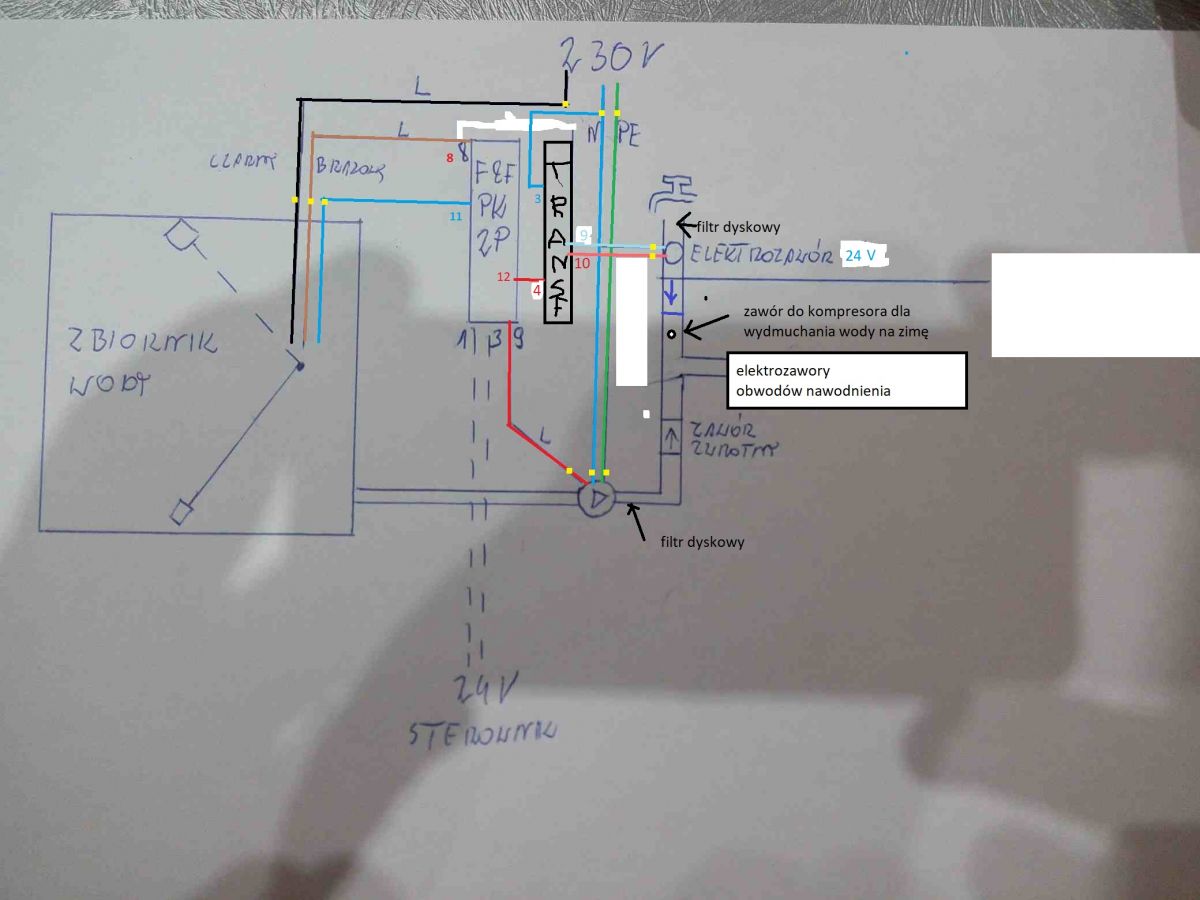
    For those interested, the final version modified with a 24V (irrigation) valve and F&F 230V/24V AC TR-24 transformer

    Irrigation of the lawn - cooperation of the rainwater tank with the water supply system

    Operation:
    Direct control via a float switch in the tank.
    1. Tank full. Rain watering.
    At a set time for a set period, the controller starts the pump opens the individual irrigation circuits. Water supply solenoid valve closed.

    2. Tank empty. Watering with water from the water supply system.
    The controller opens the water supply solenoid valve and the individual irrigation circuits at a set time for a set period. When watering is complete, the water supply solenoid valve is closed.
    In this case, the pump is inactive.
    After filling the tank with rainwater, see point 1 etc.
    ============================================
    In connection with the "My Water" programme, I plan to add a second large tank to connect the other side of the roof and modify the installation additionally so that rainwater is also used if a tap is turned on outside.
    Attachments:
    • Irrigation of the lawn - cooperation of the rainwater tank with the water supply system IMG_20211006_203852.jpg (172.57 KB) You must be logged in to download this attachment.
  • ADVERTISEMENT
  • #13 20070624
    Ojtoja
    Level 10  
    Posts: 11
    Searching for the topic of water make-up control for a water tank I came across this one, so for the sake of completeness I'll just add: the above diagram is not compliant with the regulations. It is not allowed to connect the water supply system with the water supply system from another source (in this case, the rainwater tank) without separation by an air gap. There must be a non-pressurised connection between these sources (e.g. with a BA leakage valve of some kind). I am planning to top up the water at a low level in the rainwater storage tank directly into the rainwater storage tank when the water level in the tank is too low at a certain time before starting to water
  • #14 20160546
    Przemek_Zelgoszcz
    Level 2  
    Posts: 2
    Hi
    i, too, want to solve this by topping up the rainwater tank - how did you manage this?
  • #15 21148421
    klosmariusz007
    Level 1  
    Posts: 1
    There is another important piece to this puzzle. You need to buy an irrigation controller that operates a relay. I have an RC2 Rainbird, which has an output to control the main valve/relay. I control the relay, which only supplies current to the submersible pump in the rainwater tank when irrigation is in progress. The submersible pumps when they have current all the time run every so often to maintain pressure and readiness. Which is unnecessary if the irrigation only runs, for example, every 2 days. I had one pump go out this way, so I learned from my mistakes.
  • #16 21844053
    dzikson88
    Level 11  
    Posts: 10
    Hi, I'm rehashing the topic as the next iteration of the My Water programme is starting in 2026 so it might be of use to someone, and I have a question for the author alchi8, namely what electro-valve he used, as according to his diagram after a voltage loss from the transformer it should change position to admit water from the water supply. I haven't seen that there are solenoid valves on the market that return to their position after a voltage loss, so I guess its return to the water supply has to be controlled by another relay and transformer....
  • #17 21844744
    stomat
    Level 39  
    Posts: 5600
    Help: 256
    Rate: 1953
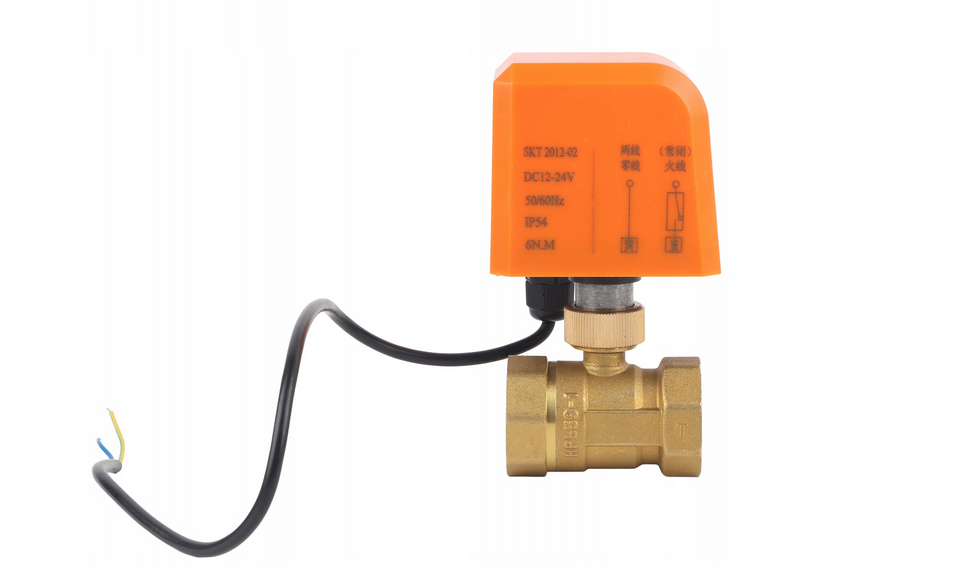
    I don't know if the author still remembers about this thread, but there are easily available solenoid valves that return to the "open" position after a voltage loss. I know because I have one myself, I was very surprised that it only has two wires and when 12V is applied it switches to "open" and when the voltage is removed it returns to the "closed" position. Of course, I wouldn't be myself if I didn't see how it's done, there's simply a supercapacitor in the housing that charges when the valve is open and powers the motor when the voltage is removed.
    It looks more or less like this:

    Brass valve with an orange electric actuator and a black cable on a white background
  • #18 21847275
    dzikson88
    Level 11  
    Posts: 10
    >>21844744 >>21844744 At his place there is probably an ordinary one, one from irrigation and it returns to the closed state after a power failure:
    Black solenoid valve with coil, cable, and threaded ports on a white background

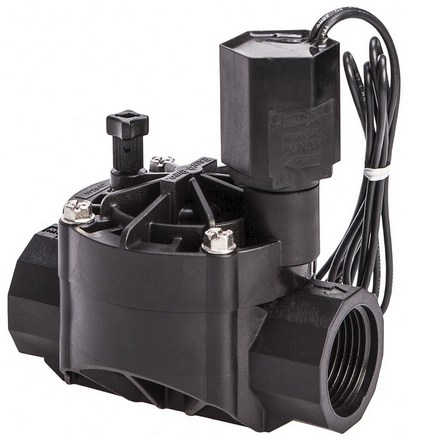
    It's a pity they don't make 2-3 way ones for 12-24 VAC (I've only seen on DC)
  • #19 21847705
    zbich70
    Level 43  
    Posts: 17116
    Help: 1166
    Rate: 6570
    stomat wrote:
    I don't know if the author still remembers this thread
    Hopefully the moderation remembers that posts older than twelve months are considered archived.
    And the previous post #14 was written in 2022, another in 2024.
    So another golden shovel goes to dzikson88.
  • #20 21847728
    gulson
    System Administrator
    Posts: 29238
    Help: 148
    Rate: 5984
    zbich70 wrote:
    Hopefully the moderation remembers that posts older than twelve months are considered archived.

    There is an exception if a user has added advice to an old topic. Other than that apparently users look in and still have a problem. Don't be so harsh :)
ADVERTISEMENT