






The NE555 astable circuit - how to make a flashing LED
The NE555 chip is one of the most popular and widely used integrated circuits in electronics. Due to its simplicity, versatility and low cost, it is used in many projects such as pulse generators, clocks, timers and flashing LEDs. In this article, I will present a simple circuit with the NE555 chip that makes an LED flash at a set time.
What is the NE555 circuit?
The NE555 is an integrated circuit that can operate in three different modes: astable, monostable and bistable. In astable mode, it acts as a pulse generator, producing alternating high and low states. It is an astable circuit because it has no stable state and its operation is continuous.
It is an ideal circuit for applications that require pulse generation, such as flashing LEDs, clock signals, and the generation of PWM (pulse width modulation) signals.
Circuit design with the NE555 circuit
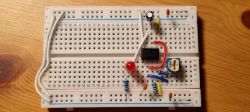
To create a circuit that generates a flashing LED, we will use the NE555 chip in astable mode. Here is the list of components needed to build the circuit:
Components:
- NE555 integrated circuit - the main component of the circuit that will generate the pulses
- resistors (R1, R2) - resistors that, together with the capacitor, determine the frequency of the generated pulses
- capacitor (C1) - capacitor that works with the resistors to set the pulse duration
- LED (D1) - a diode that will flash in response to the generated pulses
- potentiometer (P1) - adjusts the frequency of the LED flashes
- power source (e.g. 9V battery) - provides power to the circuit. (I used the power supply I presented in the previous article)
How does the circuit work?
The NE555 chip in astable mode acts as a continuous pulse generator. This works as follows:
Capacitor charging - The capacitor (C1) charges through the resistor (R1) until it reaches a voltage of about 2/3 of the supply. At this point, the output (pin 3) of the circuit is in a high state and the LED lights up.
Capacitor discharge - when the voltage reaches 2/3 of the supply, the NE555 circuit starts to discharge the capacitor through resistor (R2). When the capacitor discharges to a voltage of 1/3 of the supply, the circuit output switches to a low state and the LED goes off.
Repeat cycle - the process of charging and discharging the capacitor repeats, resulting in the generation of rectangular pulses. The LED flashes in response to these pulses.
Summary
The NE555 astable circuit is a simple but very versatile circuit that can be used in many electronics projects. Its use for a flashing LED is just one of many possible applications. Thanks to the easy frequency adjustment, we can tailor the circuit's operation to our needs. This is an ideal project for beginners as well as more advanced electronics enthusiasts.
Here I add a diagram from another article, but the construction is similar for each circuit.
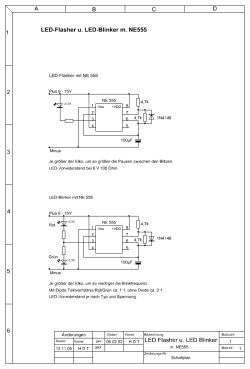
The NE555 chip is one of the most popular and widely used integrated circuits in electronics. Due to its simplicity, versatility and low cost, it is used in many projects such as pulse generators, clocks, timers and flashing LEDs. In this article, I will present a simple circuit with the NE555 chip that makes an LED flash at a set time.
What is the NE555 circuit?
The NE555 is an integrated circuit that can operate in three different modes: astable, monostable and bistable. In astable mode, it acts as a pulse generator, producing alternating high and low states. It is an astable circuit because it has no stable state and its operation is continuous.
It is an ideal circuit for applications that require pulse generation, such as flashing LEDs, clock signals, and the generation of PWM (pulse width modulation) signals.
Circuit design with the NE555 circuit
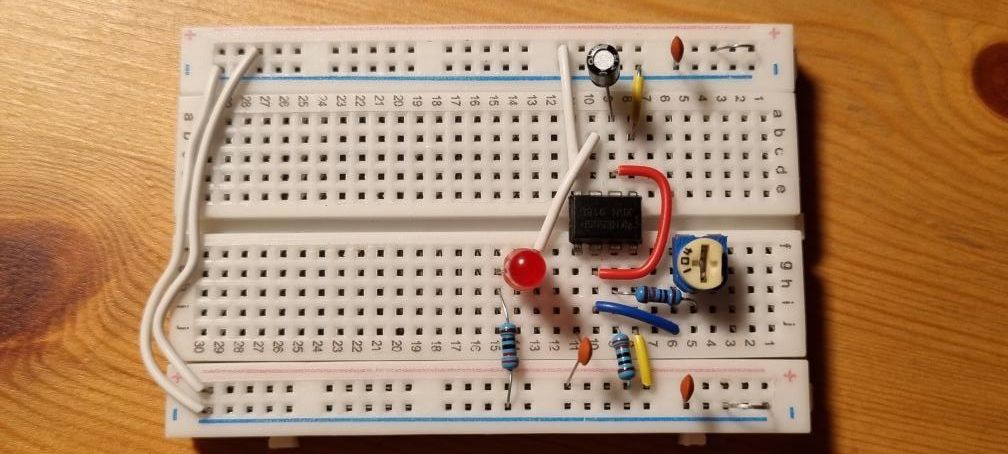
To create a circuit that generates a flashing LED, we will use the NE555 chip in astable mode. Here is the list of components needed to build the circuit:
Components:
- NE555 integrated circuit - the main component of the circuit that will generate the pulses
- resistors (R1, R2) - resistors that, together with the capacitor, determine the frequency of the generated pulses
- capacitor (C1) - capacitor that works with the resistors to set the pulse duration
- LED (D1) - a diode that will flash in response to the generated pulses
- potentiometer (P1) - adjusts the frequency of the LED flashes
- power source (e.g. 9V battery) - provides power to the circuit. (I used the power supply I presented in the previous article)
How does the circuit work?
The NE555 chip in astable mode acts as a continuous pulse generator. This works as follows:
Capacitor charging - The capacitor (C1) charges through the resistor (R1) until it reaches a voltage of about 2/3 of the supply. At this point, the output (pin 3) of the circuit is in a high state and the LED lights up.
Capacitor discharge - when the voltage reaches 2/3 of the supply, the NE555 circuit starts to discharge the capacitor through resistor (R2). When the capacitor discharges to a voltage of 1/3 of the supply, the circuit output switches to a low state and the LED goes off.
Repeat cycle - the process of charging and discharging the capacitor repeats, resulting in the generation of rectangular pulses. The LED flashes in response to these pulses.
Summary
The NE555 astable circuit is a simple but very versatile circuit that can be used in many electronics projects. Its use for a flashing LED is just one of many possible applications. Thanks to the easy frequency adjustment, we can tailor the circuit's operation to our needs. This is an ideal project for beginners as well as more advanced electronics enthusiasts.
Here I add a diagram from another article, but the construction is similar for each circuit.
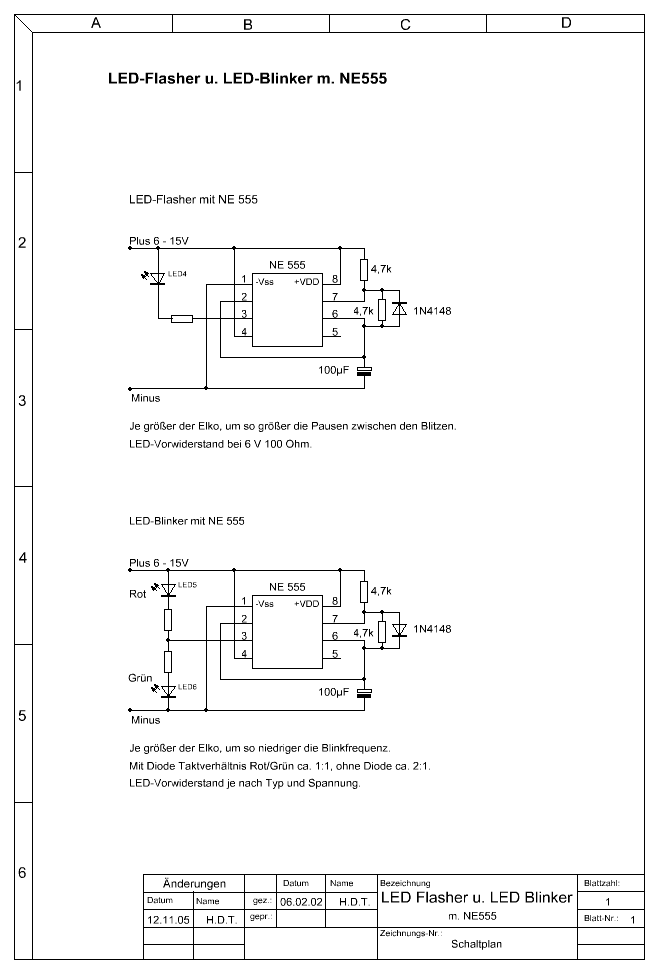
Cool? Ranking DIY
 Ben Eater has developed a type of clock for electronic circuits
  in the lead role 555 in three different working arrangements 🛠️ exact description is on YT in four parts 🎥
 ... well, the second half of the '80s
