logo elektroda
logo elektroda
X
logo elektroda
Dostępna jest polska wersja

Czy wolisz polską wersję strony elektroda?

Nie, dziękuję Przekieruj mnie tam

High-power 60V / 20A / 1200W workshop power supply based on XY6020L + S-1200-60 module

kjoxa 2379 21

TL;DR

  • A high-power workshop bench PSU combines an XY6020L control module with an S-1200-60 60V/20A supply inside a reused e-bike service housing.
  • The front panel came from a trimmed yellow number-plate frame, and the XY6020L was mounted on a plastic stand with a rubber washer and double-sided tape.
  • The supply is rated for 0–60V, 0–20A, and a theoretical 1200W, with 0.01V and 0.01A resolution.
  • Testing with 43V and 21A drove a scooter wheel to over 700W, and the S-1200-60 heatsink stayed at 31°C.
  • The XY6020L is not very convenient for daily parameter changes, ripple measurements were inconclusive, and CC protection only reduces voltage instead of cutting output.
ADVERTISEMENT
Treść została przetłumaczona polish » english Zobacz oryginalną wersję tematu
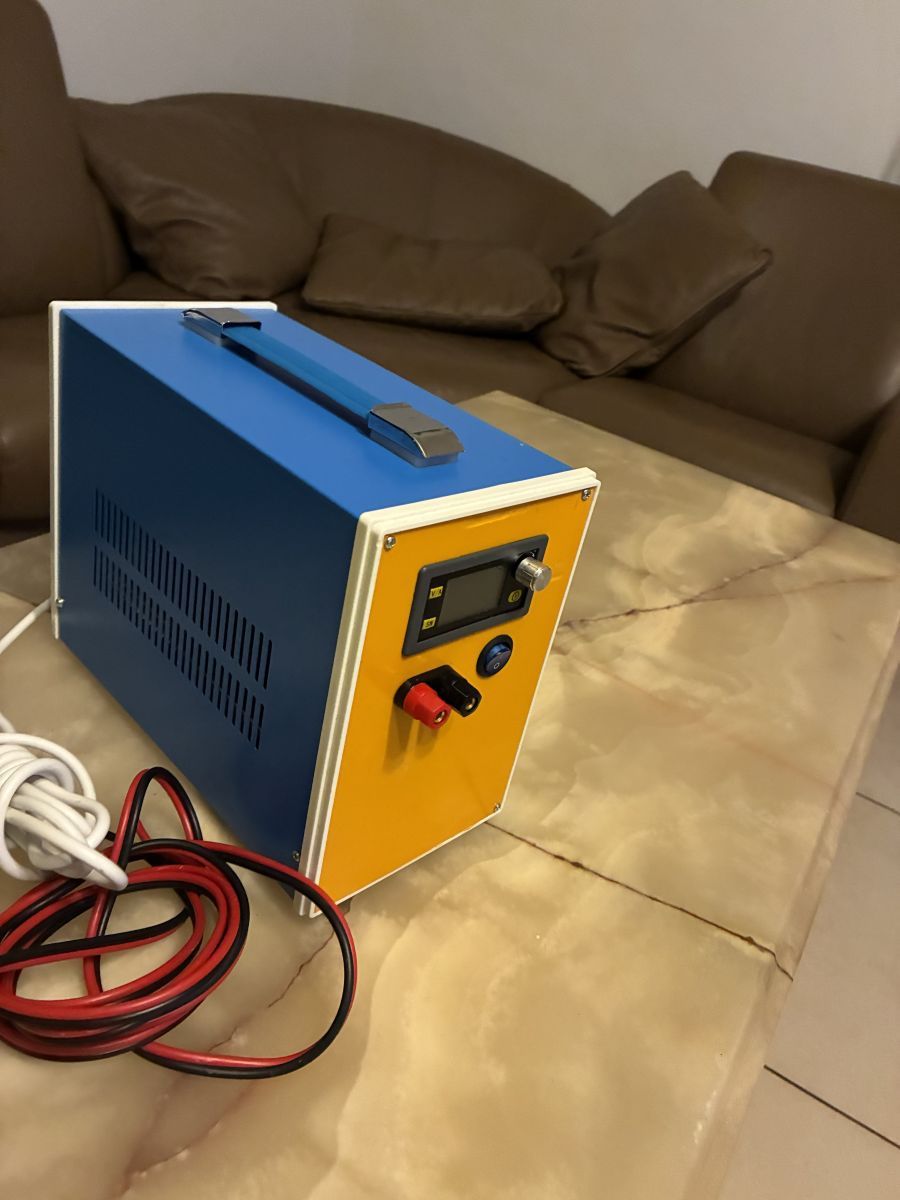
  • DIY bench power supply in a blue case with a yellow front panel, banana jacks, and a control module with a knob

    Hi everyone!

    I would like to present the construction of a WAREHOUSE POWER SUPPLY quite powerful, as it is almost 1200W .
    The power supply came about as an idea to get a cheaper equivalent to the Riden RD6018 kit.

    Parameters of the power supply, are:
    - voltage regulated 0 - 60V with 0.01V resolution
    - regulated current 0 - 20A with 0.01A resolution
    - theoretical total power 1200W (20A available over the entire output voltage range)

    As a housing I used the housing from an unfinished (and abandoned under construction) electric vehicle service unit (e-bike, scooters).
    I attach the front plate of the above mentioned device:
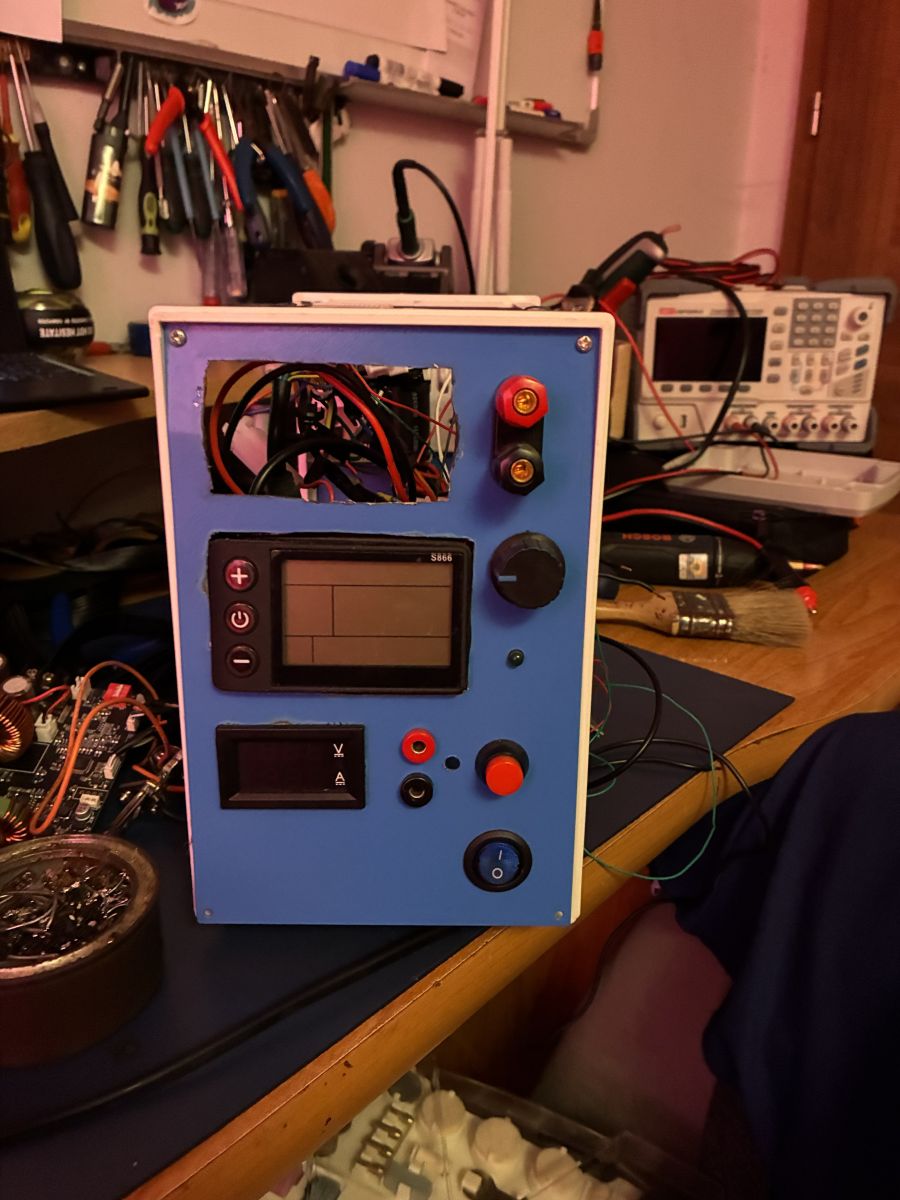
    Homemade bench power supply on a workbench with display, knob, and banana terminals on a blue front panel

    The power supply itself consists of two main - finished components:

    XY6020L (a module known and discussed here on the forum):
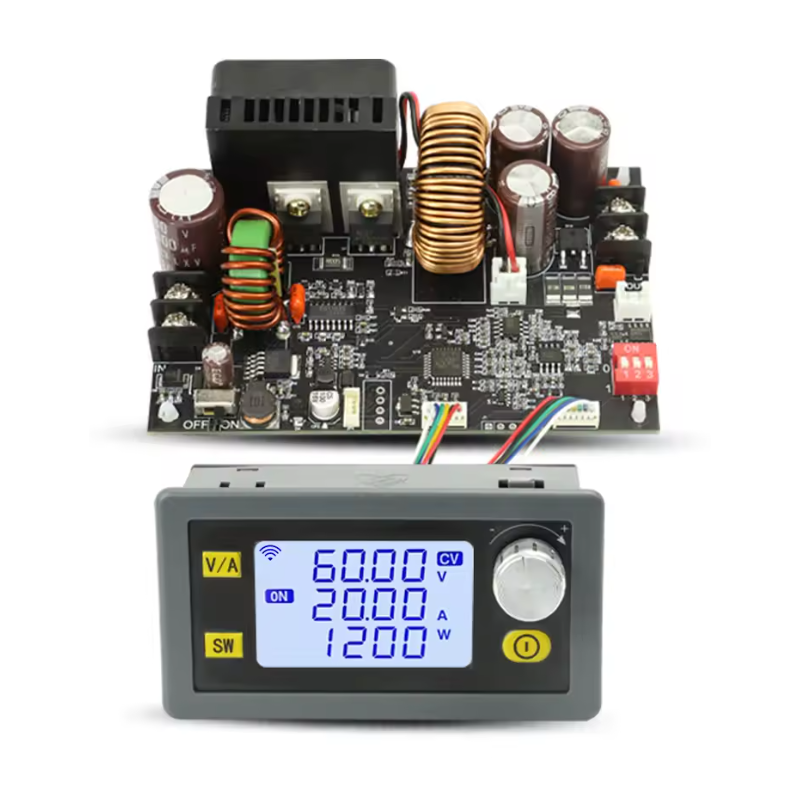
    DC-DC converter board with coils and capacitors plus LCD control panel showing 60.00 V and 20.00 A

    and from a somewhat less well-known, probably 1200W inverter with the designation
    S-1200-60 (giving 60V with sensitive regulation and a maximum current of 20A):
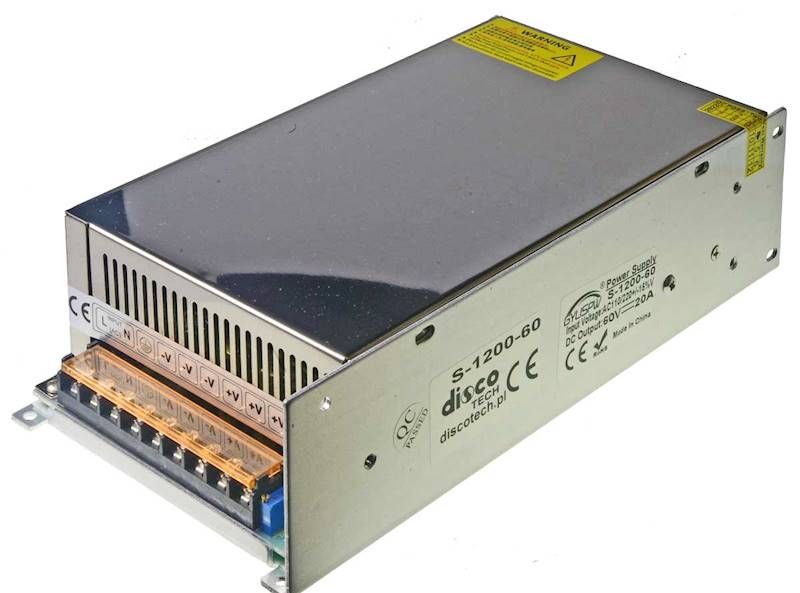
    Metal power supply converter S-1200-60 1200W with screw terminals and side ventilation slots

    The total cost of the power supply I closed in the amount:
    XY6020L => ~120 PLN (possible cheaper from aliexpress, but I already had this module, I give the price from algo)
    S-1200-60 => 295 PLN
    Body: cost about 60 PLN , I do not know the manufacturer.
    Yellow - plastic number plate mount => 9.90 PLN

    Yes, you read correctly - I made the front plate of the housing from a yellow number plate mounting frame.
    I just found it in the garage as I was looking for something to replace the front with, and somehow it came up.
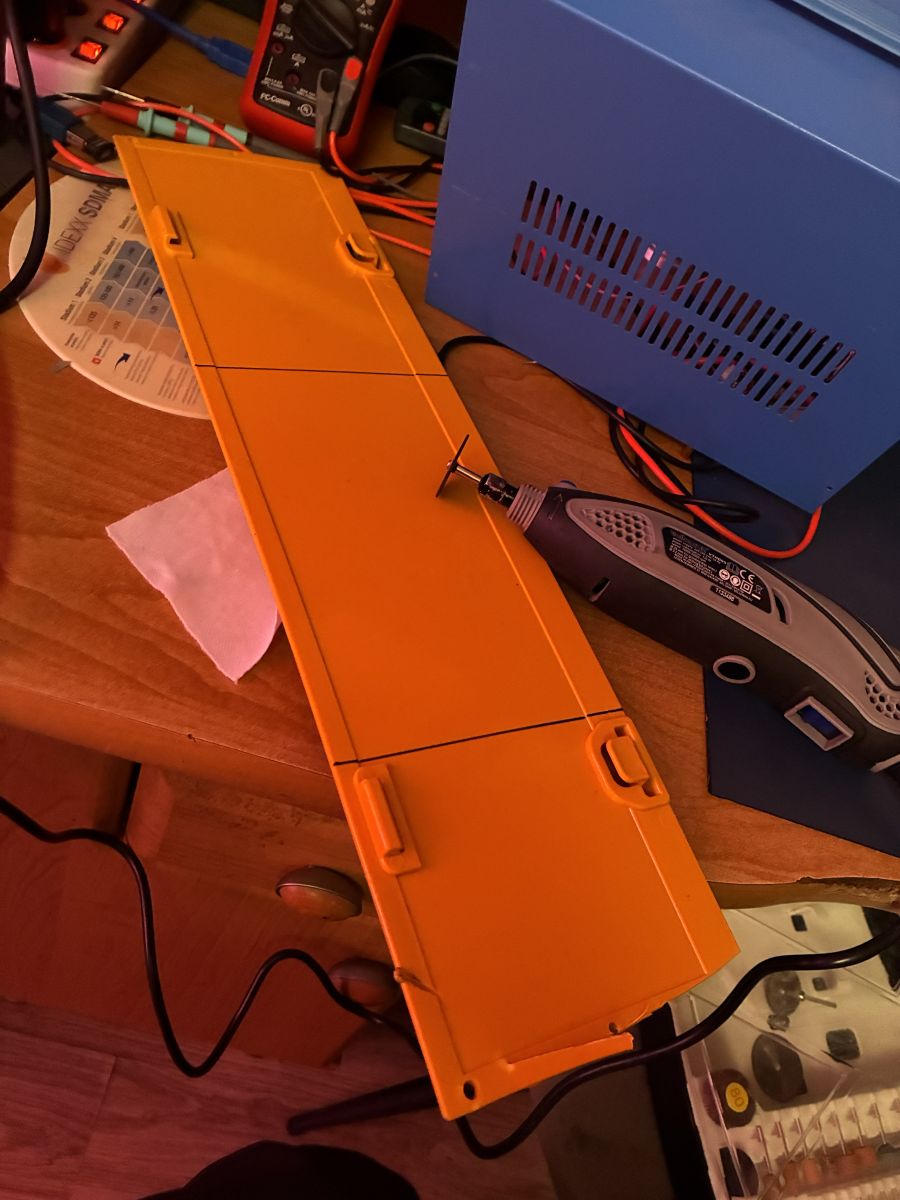
    Yellow plastic panel on a workbench beside a rotary tool and a blue vented device housing

    I trimmed accordingly, cut out space for the display, output connectors, ON/OFF button and the result:
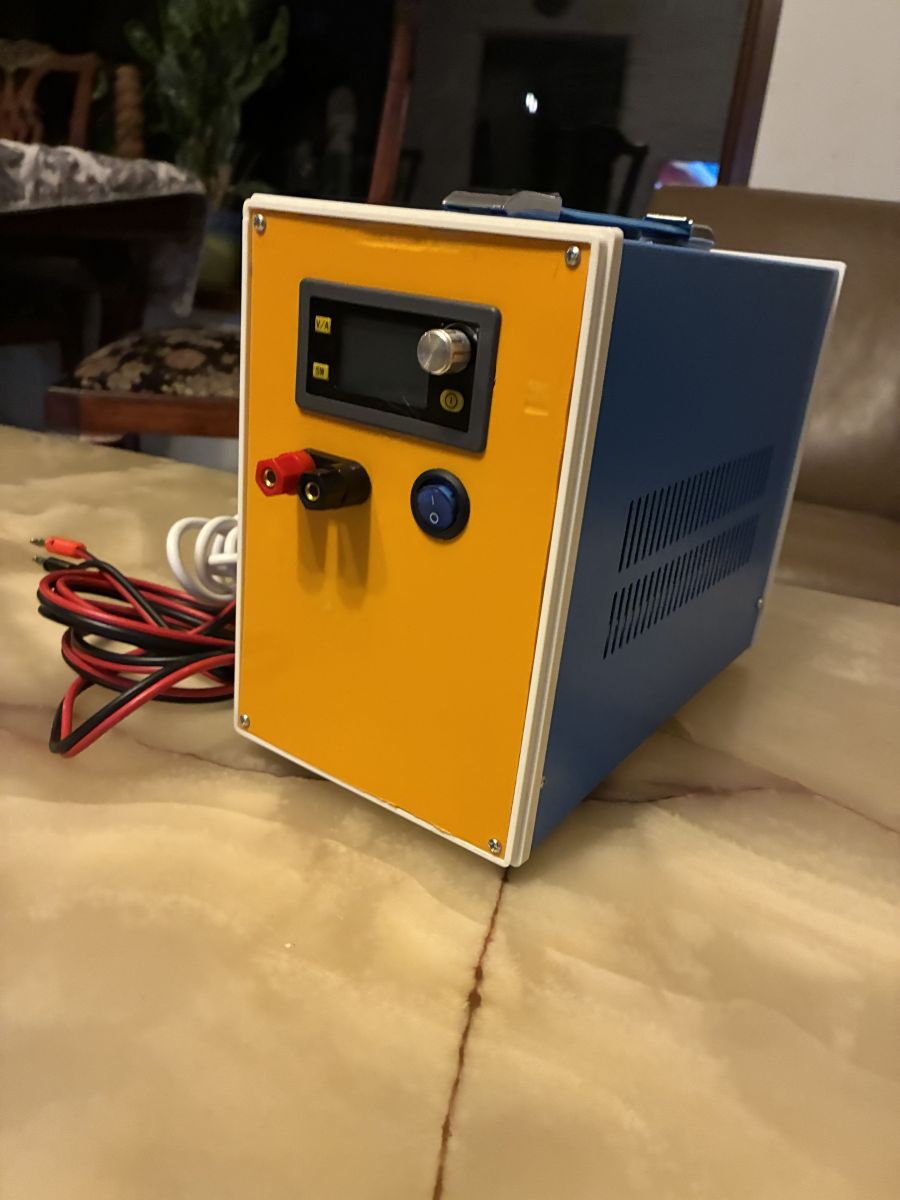
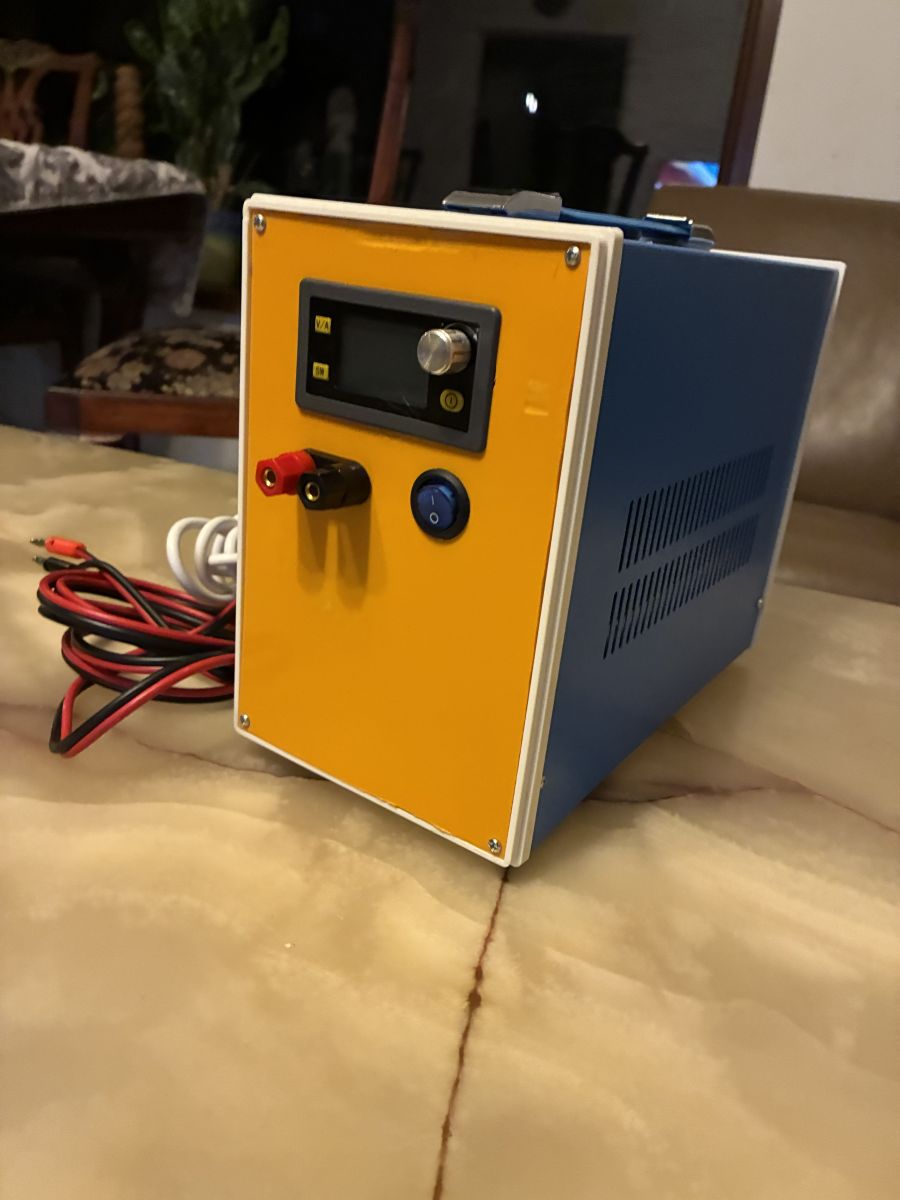
    DIY bench power supply with yellow front panel, display/knob module, banana sockets, and round power switch

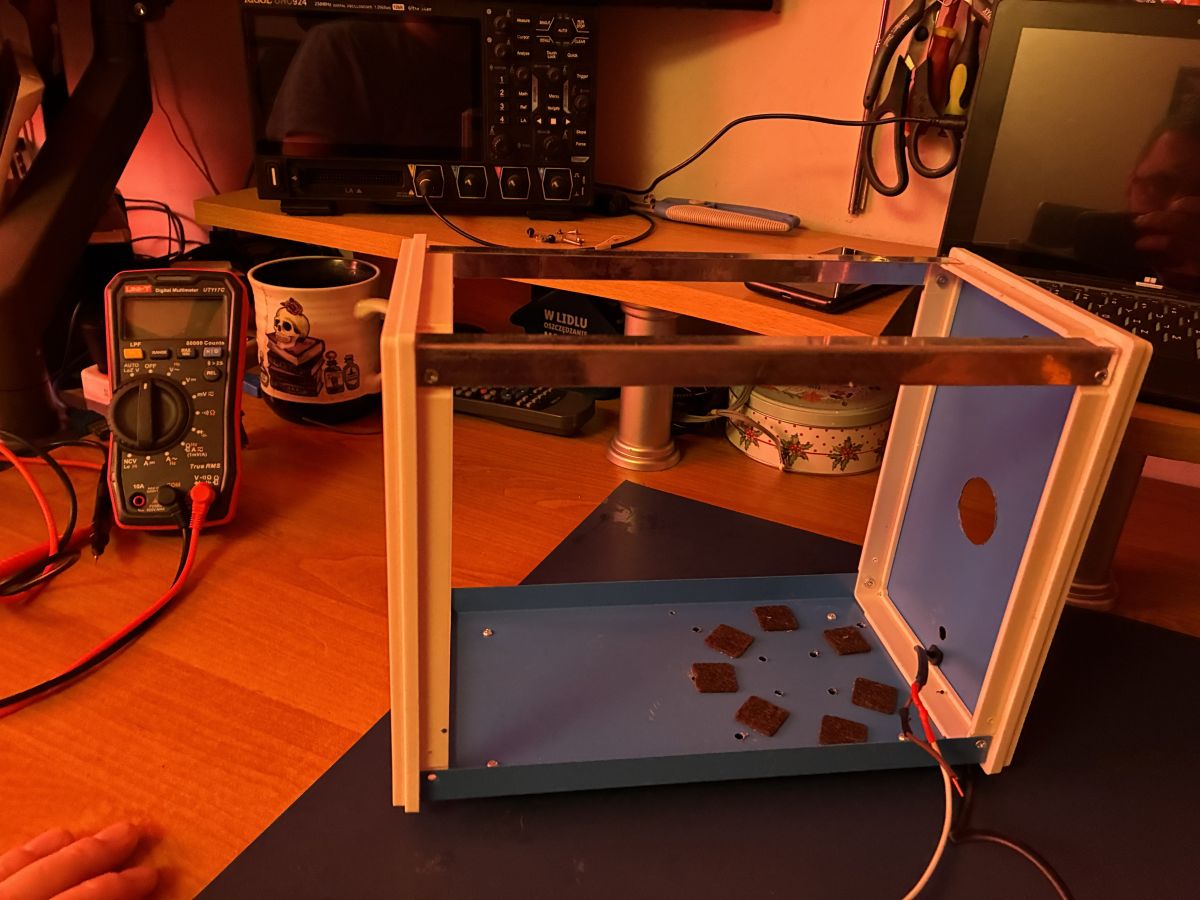
    Interior prepared for new device:

    Open metal power-supply case on a desk, with a multimeter and test leads nearby

    Conceptual arrangement of components:
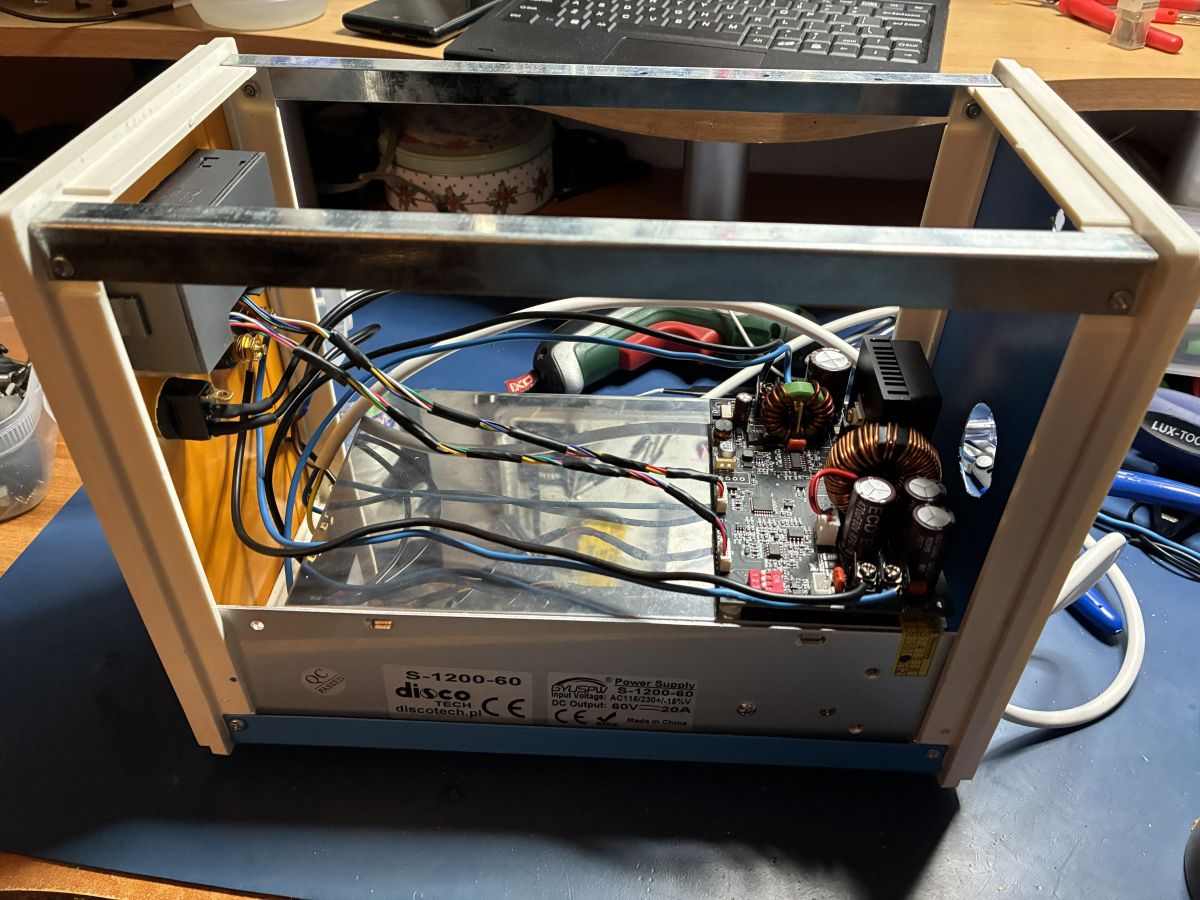
    Open bench power supply case with converter board, wiring, and a label reading S-1200-60

    I had a conundrum: how best to fix the module inside the housing? Well, that's where the leftover frame, double-sided tape and
    one of the rubber washers once bought in Lidl or Biedronka. Maybe I will attach pictures:
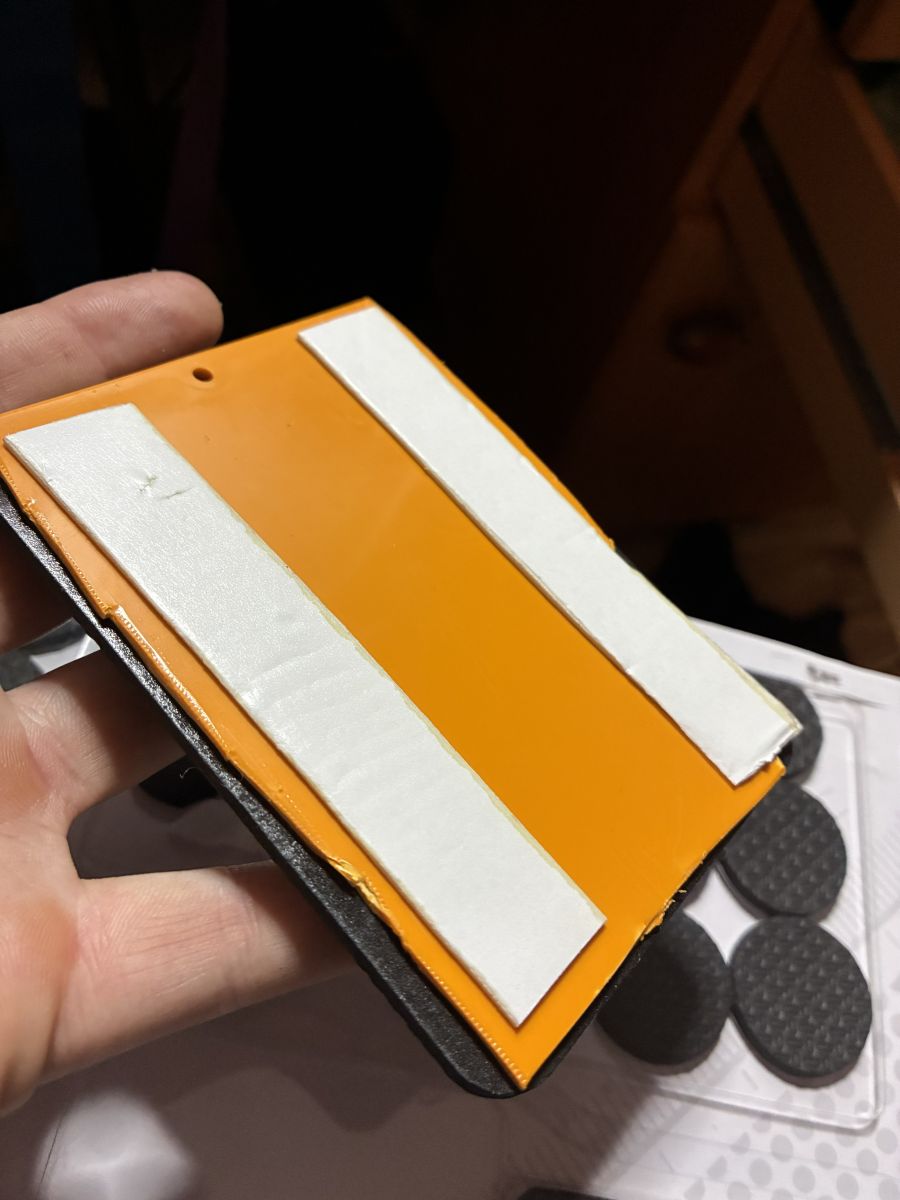
    A hand holds an orange rectangular piece with two white adhesive strips on top

    I screwed the module through a rubber washer to a plastic stand, which I glued to the S-1200 inverter housing with double-sided tape
    with - as it turned out later - very high adhesive strength. The module is immovable, of course with a knife you can peel it off, but even in case of failure,
    i did not stick on any of the mounting or ventilation elements of the inverter.
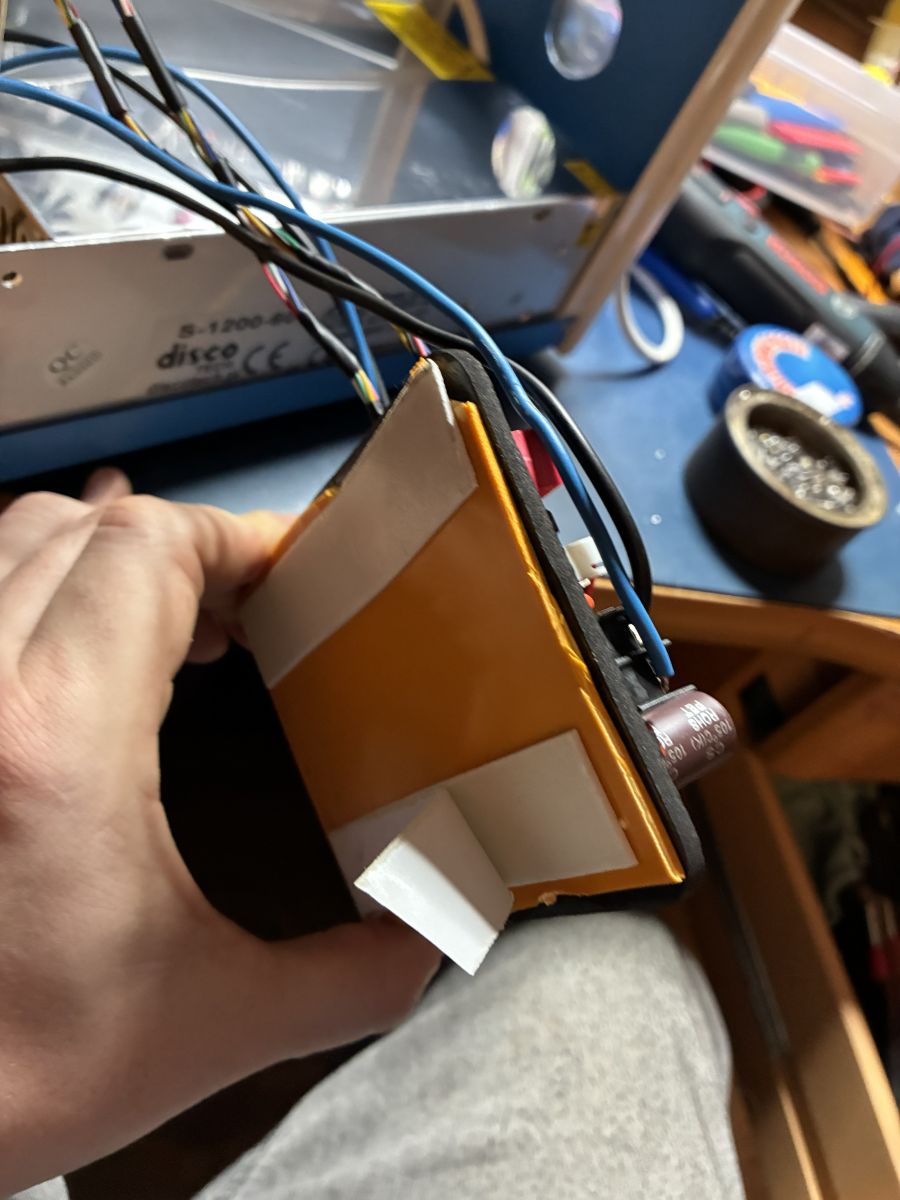
    Hand holding a yellow enclosure piece with wires; S-1200-60 power supply in the background

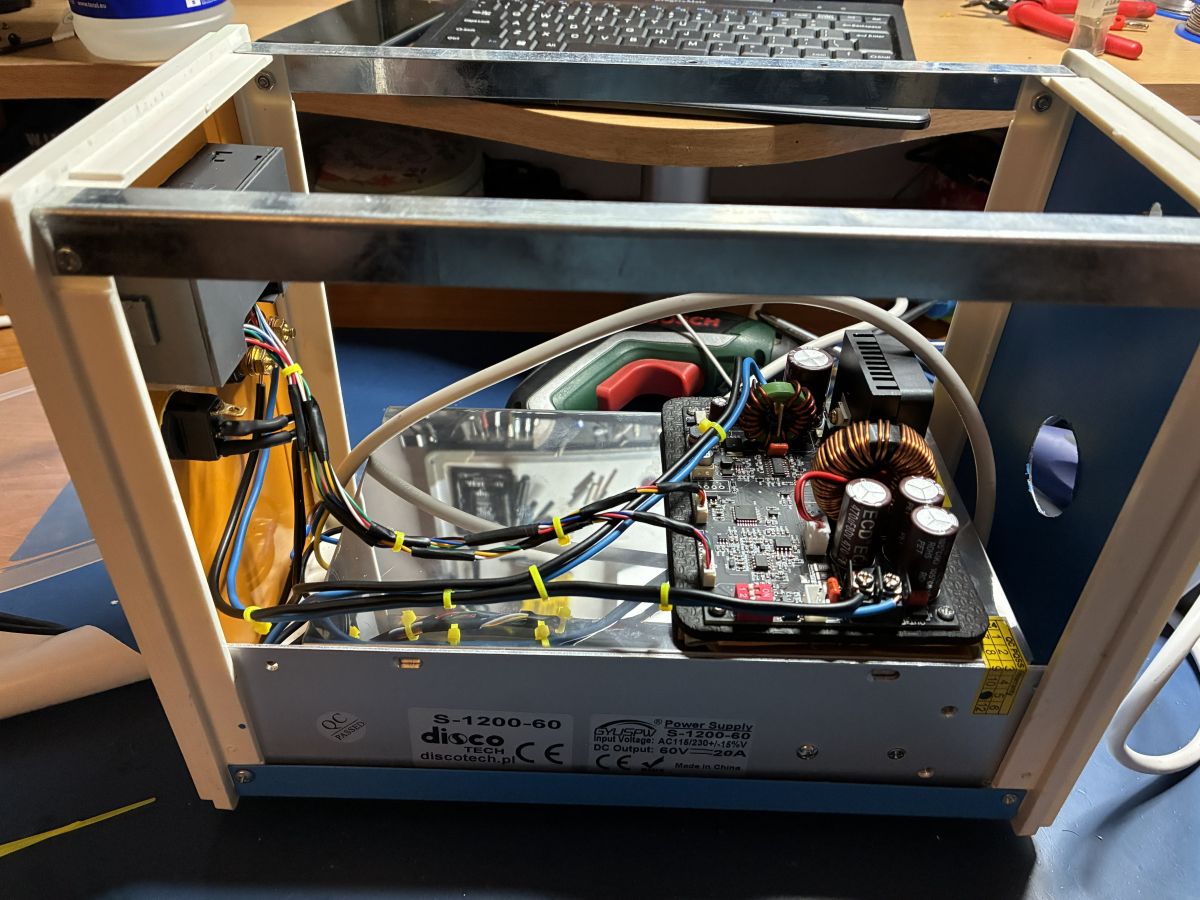
    Finally the inside looks like this:

    Inside a power supply case: converter module, wiring bundles, and a metal frame on a workbench

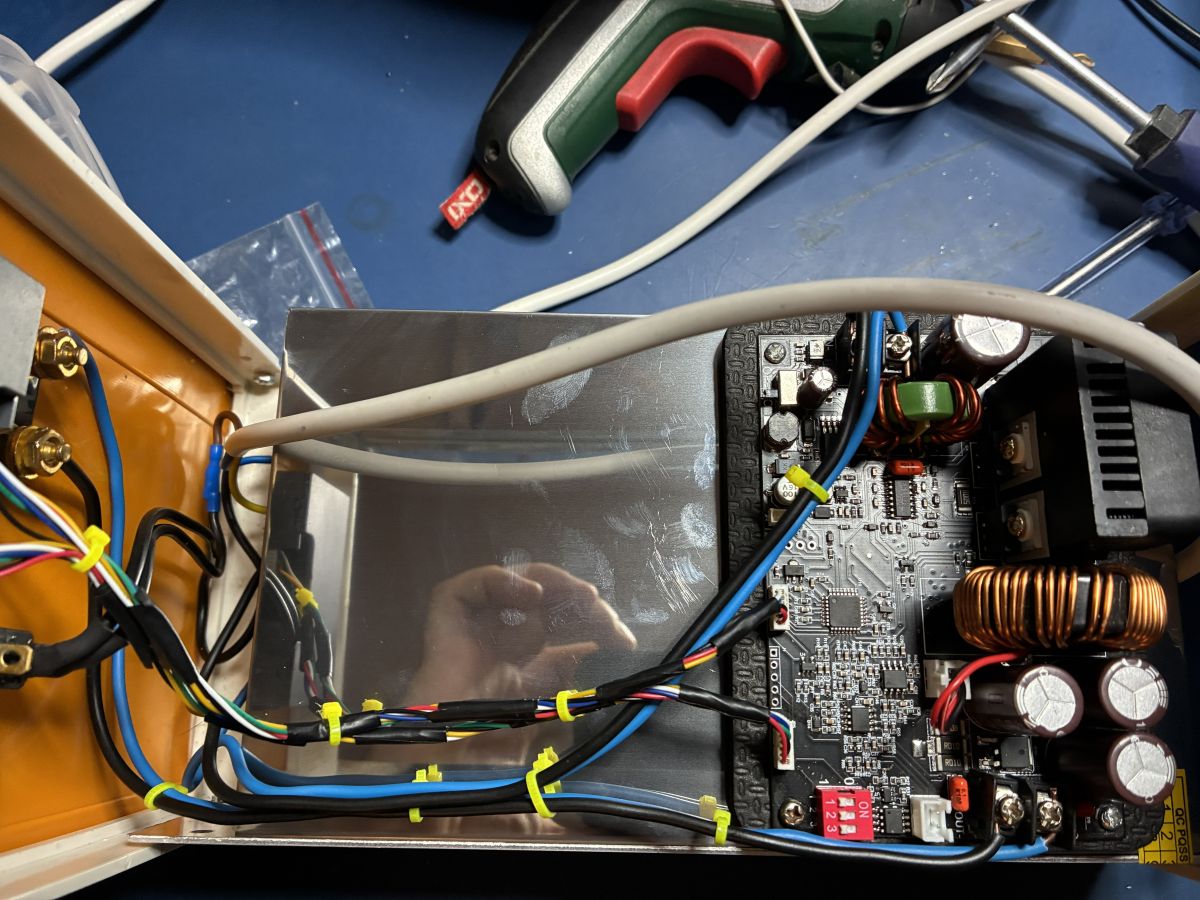
    from above:

    Inside a metal enclosure with an electronics module, cable ties, and a large copper inductor coil

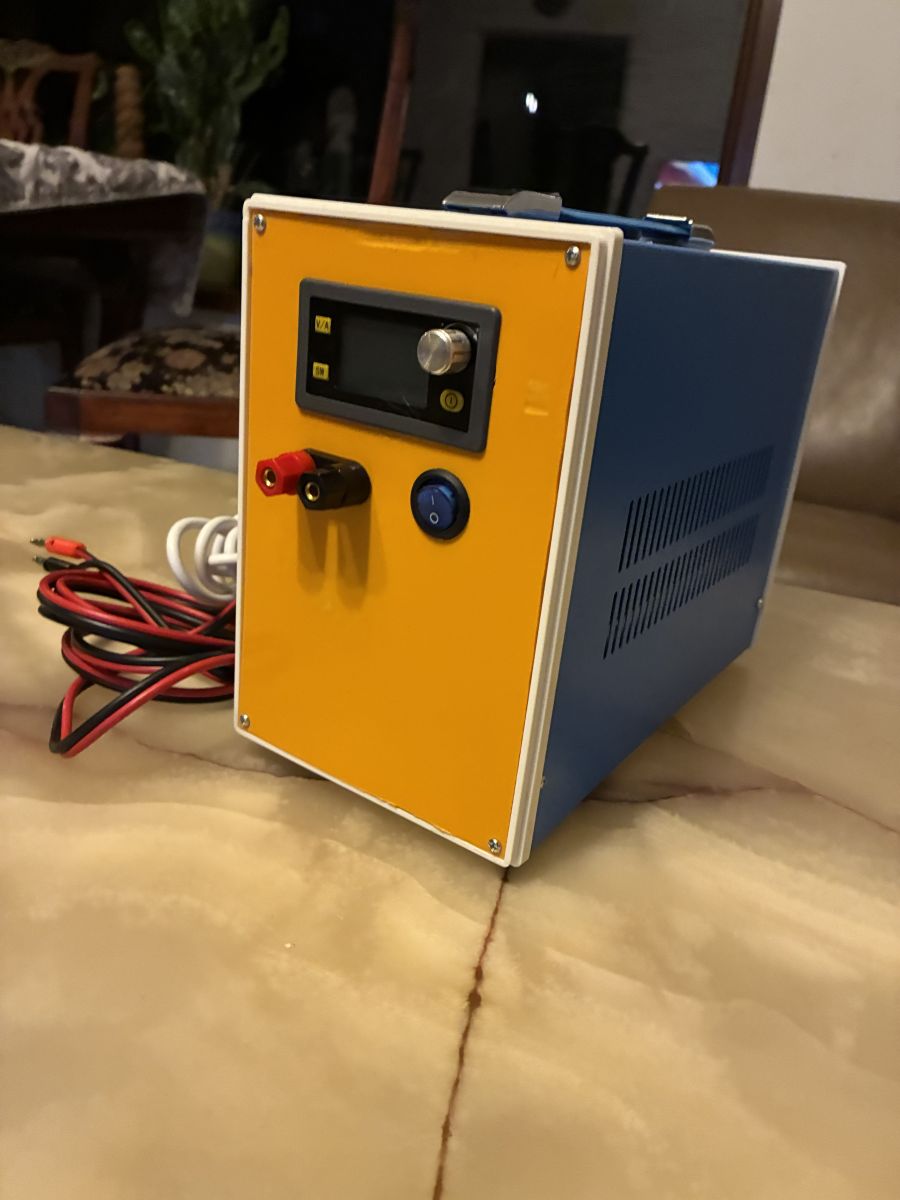
    Generic device:

    DIY bench power supply with yellow front panel, display, knob, banana jacks, and a round power switch
    Blue bench power supply with a yellow front panel, display, knob and red/black terminals on a table by cables

    Summary

    The power supply has power. I loaded it for several tens of seconds with 250W, 2x55W car halogens. But it was low, and I didn't know how to load more.
    So it was necessary to get more involved.

    I built myself a small test rig: a 350W e-bike controller (at peak double the rated power) + LCD S866, a 350W scooter wheel and gloves.
    I set the voltage at 43V, the current at 21A (that's the maximum you can set on the module), the handlebars at maximum. Once the cruise control engaged in the controller, I could manually (literally) modulate the load. I will say this: I was unable to stop the wheel in my hands. On the LCD, the highest reading was over 700W after which the vise in which the wheel was screwed in farted out onto the floor (it twisted away from the load) which was the end of testing for me.
    The module shows the temperature of the heatsinks - after my tests 31'C, the fan in the S-1200-60 did not switch on once, the XY6020 standard as any
    load, the fan was gently audible.

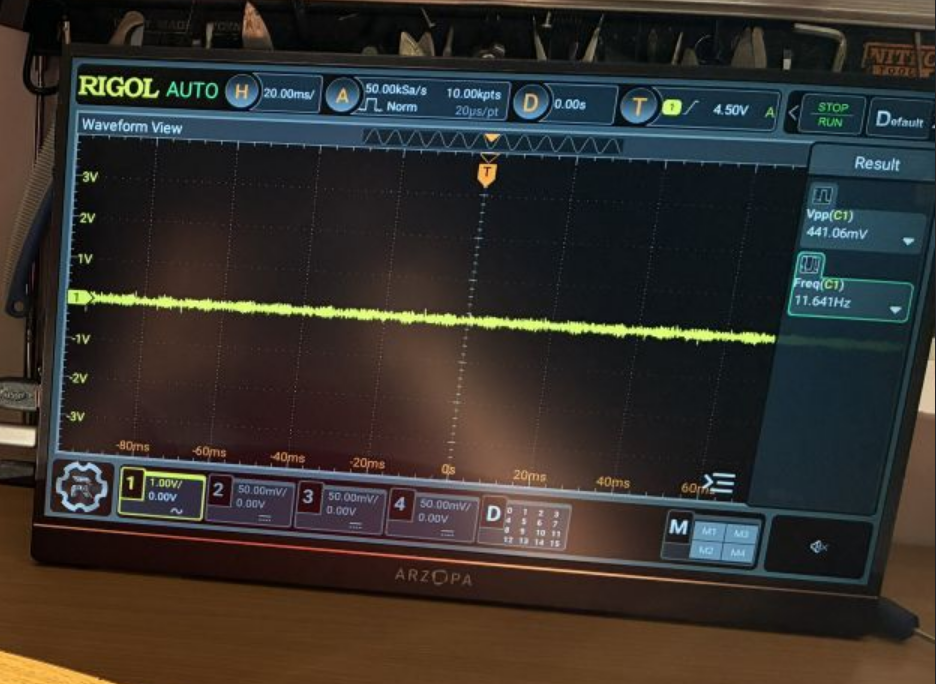
    I wanted to sit down for some ripple testing:
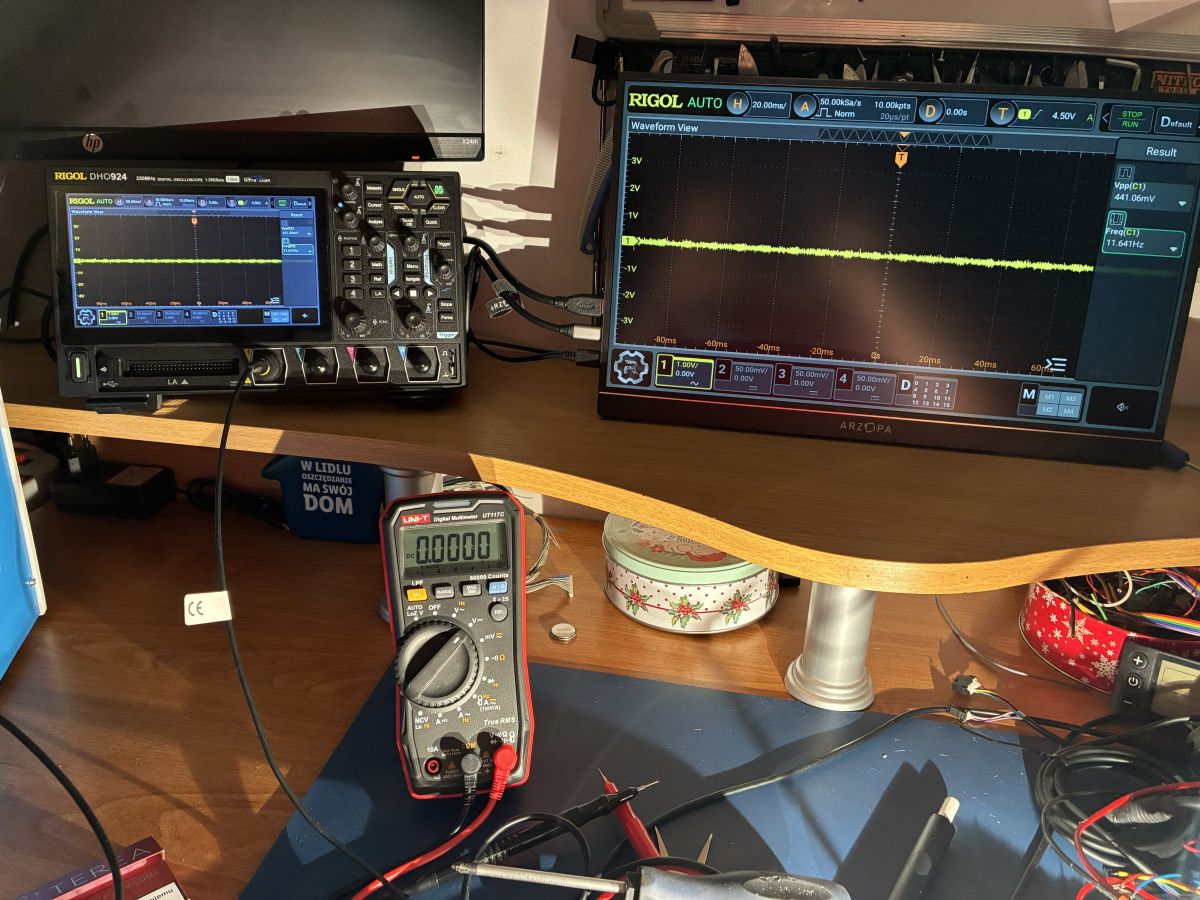
    Workbench with Rigol oscilloscope, Arzopa display showing a waveform, and a UNI-T multimeter on the desk

    I have a possible measurement to compare to:
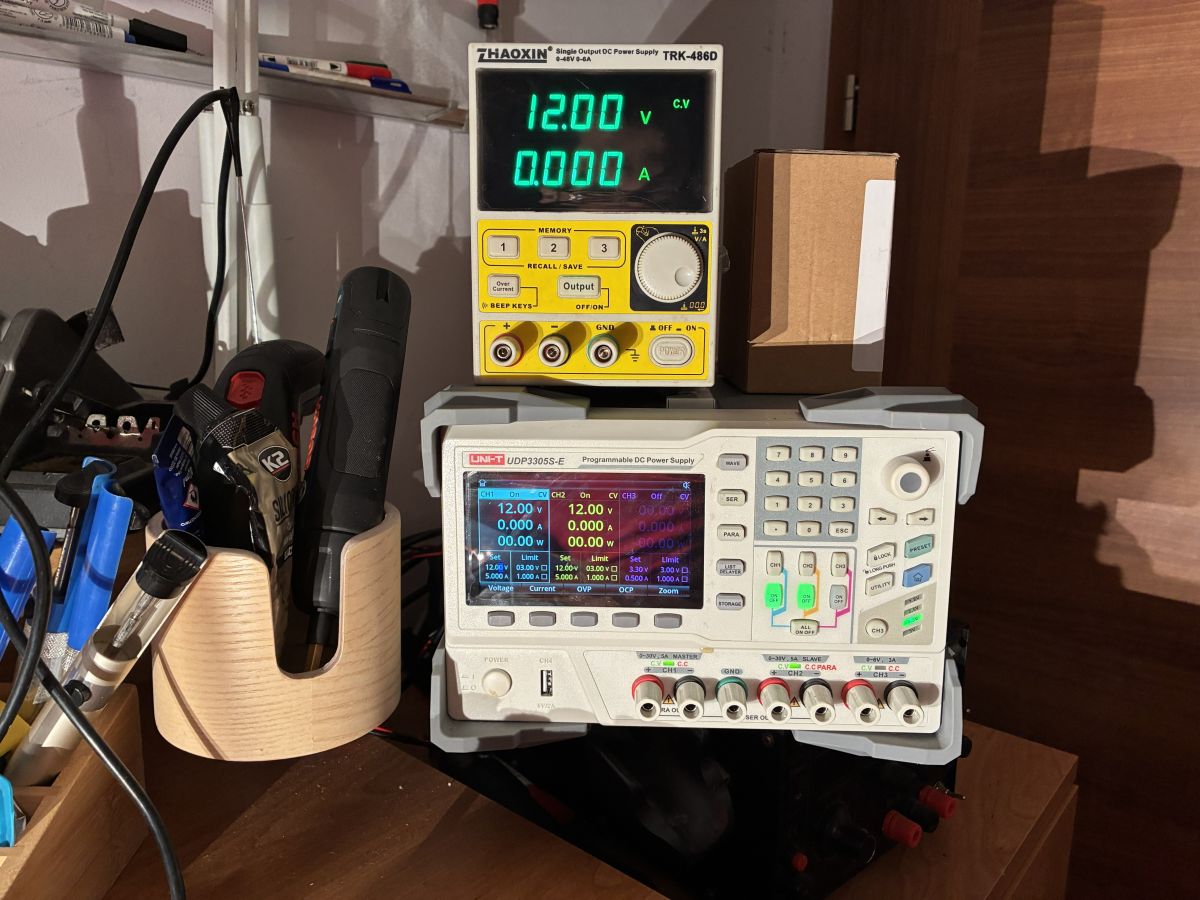
    Two DC bench power supplies on a workshop shelf, both showing 12.00 V and 0.000 A

    But I don't quite know how to do them right, because I don't have a fixed load (and a supply of gloves). I can tell you one thing: the ripples vs
    UDP3305S are, I don't want to talk about the values because I don't know if I set the oscilloscope right (coupling AC, x10, the rest is in the picture with a 120W load).

    If you'd like me to do some tests, go ahead - I'll post in the discussion when I find the time.

    Overall, I'm happy with workshop equipment of this power. It's worth having on hand, sometimes it's been lacking.
    The XY6020L module itself is rather uninviting to use as something you can use every day if you want to change parameters. At the same time, its
    options to show the current parameters: power, capacity, temperature, time.

    I have not performed tests of the correctness of the CC protection, nor have I presented here the accuracy of the indications with the Brymen 869S, but should anyone
    need: I can. But at the same time I will say this: the overcurrent protection works ok, it does not cut off the power supply, it only reduces the voltage.
    The accuracy of the voltage indication for a workshop power supply is consistent to tenths of a volt. For me ok.

    Best regards,
    Marcin

    Cool? Ranking DIY
    About Author
    kjoxa
    Level 23  
    Offline 
    kjoxa wrote 572 posts with rating 230, helped 45 times. Live in city Gdańsk. Been with us since 2008 year.
  • ADVERTISEMENT
  • #2 21850652
    LEDówki
    Level 43  
    As a load, either a mechanical brake, a hydraulic brake, an electrodynamic brake or a fan with a clutch. In almost every case, there will be problems with the dissipation of the separated power.
    Pion for the honest name of the power supply. 3+ for the so-called modules and power supply in the power supply. Redundancy and redundancy ensure safe operation. One power supply breaks down, the other works. Just like in a server. The chassis is probably at 5. On the phone, it's poor to see. The android developers can't scale bitmaps. A chaff is always displayed when trying to scale.
  • #3 21850723
    Andrzej_Tomaszewski
    Level 13  
    LEDówki wrote:
    As a load a mechanical brake, a hydraulic brake, an electrodynamic brake or a fan with a clutch. In almost every case there will be problems dissipating the power dissipated.

    I use ordinary high wattage bulbs. One too few is 2 or more in parallel.

    Nice workmanship but if the module has fixing holes it would be worth using them and simply screwing on and not gluing on tape. It would be worth examining the voltage drop on the wires connecting the module to the output terminals when these terminals are shorted and operating in CC mode at these 20A, or whether they also heat up because they seem too thin. And I still have a question- does the module have the ability to compensate for the voltage drop on the output wires? E.g. if you were testing the circuit at 3.3V at 10A consumption, the voltage could already drop a lot and there would be a big discrepancy between the indication on the display and the voltage on the circuit under test. Oh, and it would also be good to add an extra fan to induce air movement inside, because this big power supply I think would prefer to be mounted vertically looking at the layout of the vents. But overall it worked out nicely for you :) Greetings
  • ADVERTISEMENT
  • #4 21850757
    jarekgol
    Level 40  
    As a load you can still use a steel cable wound on something and if it gets too hot then into a bucket of water. Or 2 electrodes into a container of salted water, this also has good cooling.
    I have at my place 16 24V/100W bulbs connected in series/parallel to test 48V power supplies, only that the power supply has to be able to CC, because the bulbs have a much higher inrush current and the ones that block easily from slight overruns will not test like that.
  • #5 21850788
    LEDówki
    Level 43  
    The bulbs illuminated another solution for me - resistors immersed in a bucket of water. The water picks up the heat, the bucket radiates, some heat is taken away by evaporation (sounds better than evaporation). And you can still use a computer CPU cooler - lovely 'water cooling'. Possibly a heater from a beetle, if you can find one in some junkyard. Other heaters I haven't seen, then I won't offer any. Car radiators are usually rated for a few tens of ponies, then they certainly won't overheat, but that's like shooting a cannon at a fly. Well, and Chinese products are not durable. The Chinese like aluminium radiators, they are brittle, crack and can't be soldered as easily as radiators made of copper.
  • #6 21850972
    Nargo
    Level 23  
    >>21850788 Exchanger from old gas cooker. Power 19-24kW. Computer windmill and you can cool the water in an electric kettle :)
  • ADVERTISEMENT
  • #8 21851160
    slavo666
    Level 23  
    I have a question related to one photo

    Portable ARZOPA monitor showing a RIGOL oscilloscope interface with a yellow waveform trace on the screen
    What is the model of the monitor? Have you checked any other touchscreen ones? Apparently not everyone wants to work with the Rigol.
  • #9 21851217
    kjoxa
    Level 23  
    slavo666 wrote:
    I have a question related to one photo

    Portable ARZOPA monitor showing a RIGOL oscilloscope interface with a yellow waveform trace on the screen I have a question regarding one picture
    What is the model of the monitor? Have you checked any other touchscreen ones? Apparently not everyone wants to work with the Rigol.


    This is the ARZOPA Z1FC model. It is not touchscreen.
    16.1'' and 144Hz. A cool way to connect and transfer images via USB-C (for a laptop). With an oscilloscope all you need is the oscilloscope power supply, the monitor is a power hub.
  • #10 21851481
    Mastertech
    Level 30  
    I made myself a 50V/20A on RD module
    On the primary flatpack 48V/15A turned up to 52V
    Due to RD efficiency and power balance, I have the full 20A available up to about 35V, above that "only" 15.
    The first thing I looked at was the wire cross sections. As the flatpack has 6 pairs of pins in the current connector we isolate ALL of them and only on the XY module do we connect them together. If we can get a 2.5mm copper cable out of the flatpack, it can handle up to 10A, but a 4mm2 copper cable can handle 20A.
    The same applies to the output terminals, I have these bananas as auxiliary, I have the main one on an XT60 connector.
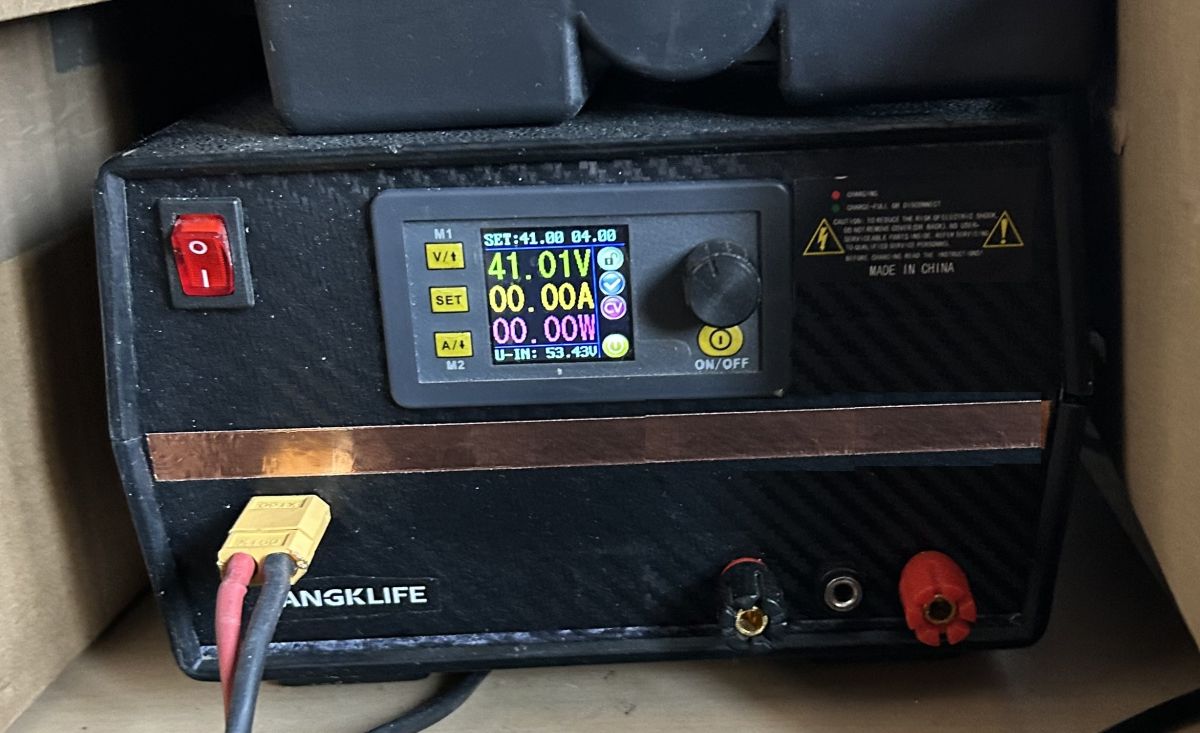
    I attach a photo of my monster: (yes, it used to be C1-112)

    Power supply front panel with display showing 41.01 V and 0.00 A, banana jacks, and an XT60 connector
  • #11 21851793
    CosteC
    Level 39  
    Quite a nice design. I am missing the IEC socket with fuse on the back :) to complete the set
    But tried, including the wires inside.

    Regarding noise measurements:
    Typically you measure AC RMS noise voltage and Vpp in the band up to 20 MHz. Some people use a 1:10 classic (1 M) probe, which is what you should have included with your oscilloscope.
    Sometimes a 1:10 but 50 Ohm probe is used. This is easy to make. However, I don't think it is necessary in this case.

    I am concerned about the power supply: the S-1200-60 - the manufacturer, or rather the importer, does not give documentation. Which is pathetic to say the least.
    I'm basically sure that you'll have to improve the ventilation of the case - at 90% efficiency, the main power supply will give off 120 W of power + losses on the XY6020L. the holes in the top of the case may not be able to convectively remove that much heat.

    Let us know how much noise the S-1200-60 is making and how noisy the whole thing is. High noise is a moderate problem in a design like this, this is supposed to be over 1 kW, not low noise.
    Testing something like this requires pretty massive load resistors.... You could make something out of an old heater :)
  • ADVERTISEMENT
  • #12 21852068
    mmaker
    Level 19  
    I have had a bad experience with this module, I bought it out of curiosity because it had quite a few options and after one switch on it crashed the ADC in the microcontroller by some miracle and I can't do anything with it now. The overcurrent protection kicks in straight away. People also tested it on YouTube and I can honestly say I had mixed feelings. Overall the workmanship is cool for the time, the important thing is that it works as it should.
  • #13 21852080
    kjoxa
    Level 23  
    CosteC wrote:
    Quite a nice design. I'm missing the IEC socket with fuse on the back for completeness :)
    But tried, including the wires inside.

    Regarding noise measurements:
    Typically you measure AC RMS noise voltage and Vpp in the band up to 20 MHz. Some people use a 1:10 classic (1 M) probe, which is what you should have included with your oscilloscope.
    Sometimes a 1:10 but 50 Ohm probe is used. This is easy to make. However, I don't think it is necessary in this case.

    I am concerned about the power supply: the S-1200-60 - the manufacturer, or rather the importer, gives no documentation. Which is pathetic to say the least.
    I'm basically sure you'll have to improve the ventilation of the case - at 90% efficiency, the main power supply will give off 120 W of power + losses to the XY6020L. the holes in the top of the case may not be able to convectively remove that much heat.

    Let us know how much noise the S-1200-60 is making and how noisy the whole thing is. High noise is a moderate problem in a design like this, this is supposed to be over 1 kW, not low noise.
    Testing something like this requires pretty massive load resistors.... You could make something out of an old heater :)


    Thanks for the good word and guidance.
    I will of course add in the discussion with the parameters as soon as I figure out some load.
    Some idea I have, but that's for testing :) I'll share the concept later.
  • #14 21852332
    Olkus
    Level 32  
    I think it would be worth adding a fan to the back of the whole thing. Those speaker bananas I'm afraid might have a problem at 20A. The wires look a bit thin but maybe I'm wrong.
    I'm curious what the interference issue is, the whole thing as well as that 1200W power supply, well does it heat up a lot? And what is the ripple on its output, I'm also curious about its design.
    Overall quite OK :)

    Regards,
    A.
  • #15 21852346
    Mastertech
    Level 30  
    Olkus wrote:
    does it heat up a lot?

    You're asking because you couldn't hear the built-in fan. It blows like a hurricane but it's impossible to sleep in the house when it's running. I mean the one in the power supply, because the one on the module runs practically silently.
    And also the output protection against reverse battery connection, because that 60V smells like a 13S bicycle battery to me. The SMD diode on the module will evaporate along with the whole half-bridge, I added an additional diode on the terminals themselves in parallel to the output but in series with the 20A fuse on the plus side. The diode in the TO-247 housing is to give me a guarantee that it is the fuse that will evaporate and not the diode itself.
  • #16 21852404
    CosteC
    Level 39  
    kjoxa wrote:
    This is the ARZOPA Z1FC model. It is not touchscreen.
    16.1'' and 144 Hz. A cool way to connect and transfer images via USB-C (for a laptop). With an oscilloscope, all you need is an oscilloscope power supply, the monitor is a power hub

    The oscilloscope talks to it over USB-C while receiving power at the same time?
    Or does it output the image over HDMI though?
    Write something more please.

    Mastertech wrote:
    A 2.5mm copper cable will handle up to 10A, unfortunately for 20A it is already 4mm2 copper.

    The load tables for non-thermally insulated conductors say otherwise.
    Obviously the voltage drops on a 2.5mm2 conductor will be greater than on a 4mm2 conductor but generally 2.5mm2 should be able to cope thermally, especially in a ventilated enclosure.
  • #17 21852421
    Staszek_Staszek
    Level 34  
    The specific heat of water is 4.19 kJ/kg-K.
    By the time 10 litres of water has boiled, it is safe to make estimated measurements.
    Current control can be achieved by gradually immersing the electrodes.
    Steel is suitable for the electrodes.
    If measurements need to be taken at lower voltages, it may be necessary to increase the conductivity of the water.
    Soda is suitable for this purpose. I do not recommend table salt because it smells of chlorine.
    The conductivity of water solutions is strongly dependent on composition, voltage and temperature, which can be a problem for accurate measurements.
    If you just want to check whether smoke is coming out of the power supply, it is easy to make a very large load out of water.
  • #18 21853261
    acctr
    Level 39  
    Staszek_Staszek wrote:
    For electrodes, steel is suitable.

    As long as there is no chromium, especially if you use soda as an electrolyte. Hexavalent chromium is not very good for your health.
    Helpful post? Buy me a coffee.
  • #19 21853436
    Staszek_Staszek
    Level 34  
    At the polyclub we had some water barrels with a simple mechanism to lower the electrodes. I don't remember if any salts were added to the water there.
    I decided not to build or buy a 60V - 20A power supply although I was tempted to do so.
    I decided that I would buy myself 3 pieces of 230/24VDC 500W fleXPower X7-2L2L power supplies and combine them in the desired configurations.
    The power supplies were from some demob.
    I tested each separately with kanthal spirals because 500 watts is not a problem as with 1500.
    I didn't check if the short-circuit protection worked or if it was immune to reverse voltage.
    I always connect a 600 V - 20 A diode between the power supplies and the motor.
    I feel safer with this because I don't always know what will appear to me when the circuit is broken.
    I try to remember that I am also fallible.
  • #20 21853505
    Mastertech
    Level 30  
    When the carousel starts up, films sometimes show the operator putting 2 electrodes into a 10-litre bucket of some kind of electrolyte. I just don't know if this current doesn't decrease over time and if you don't have to adjust these electrodes to keep it constant.
    On a 6P bicycle battery you can easily apply 18A at a moment's notice, but this will be a capacitive load, not the same as a resistor. in the workshop you will be hard pressed to find something with that much power.
  • #21 21853550
    Olkus
    Level 32  
    Mastertech wrote:
    You ask because you haven't heard the built-in fan. It blows like a hurricane but it's impossible to sleep at home when it's running.


    I haven't heard because I don't have such an inverter either....

    Mastertech wrote:
    Well, then there's the output protection against reverse battery connection because that 60V smells like a 13S bicycle battery to me. That SMD diode on the module will evaporate along with the whole half bridge, I gave an additional diode on the terminals themselves in parallel to the output but in series with a 20A fuse on the plus side. The diode in the TO-247 housing is to give me a guarantee that it is the fuse that will evaporate and not the diode itself.


    I understand that this diode is in parallel and not in series?

    Greetings,
    A.
  • #22 21853565
    Mastertech
    Level 30  
    Olkus wrote:
    I understand that this diode is in parallel and not in series?

    In series the fuse between the module output and the power supply terminal. I mainly meant that this diode should be at the output of the module and not the power supply, so that the short-circuit current flows through the fuse and the diode and not just through the diode itself.
ADVERTISEMENT