Several articles have already been devoted to transistor radios in matchboxes on ‘Elektroda’. These were circuits built using discrete components and integrated circuits. But would the same level of miniaturisation also be possible if vacuum tubes were used to build such a radio?
A few people seem to have tried, or wanted to build, such a valve radio, but I haven’t seen any working designs, which is why I decided to try making one myself.
Admittedly, there is one article online dating from 1947, but it’s hard to imagine that this radio would fit inside a matchbox:
https://onetuberadio.com/2017/10/29/1947-one-tube-matchbox-radio/
A Google search for ‘Were there valve radios in a matchbox?’ yields the answer: ‘A matchbox is far too small to accommodate glowing electron valves, high voltage and batteries.’ The iconic miniature matchbox radios (which amateur radio enthusiasts built, particularly during the communist era in Poland) worked slightly differently: transistor receivers […] were based on miniature transistors and integrated circuits. Detector radios: even simpler designs that did not require batteries […].
The task may seem impossible at first glance, but that is not the case. When I set about building the radio, I made the following assumptions:
0) The radio must be capable of receiving PR1, 225 kHz AM.
1) The power supply must fit inside a matchbox and must last for at least 4–5 hours of playback
2) Reception should be possible via headphones; these may be high-impedance headphones
3) The circuit must have the highest possible sensitivity whilst remaining simple
4) It is permissible to include an antenna and earth connection, but it is desirable for the receiver to be able to operate with a magnetic antenna
5) The receiver must be continuously tunable
Let us analyse these requirements. The first requirement can be met, provided we accept the conditions described below. The anode voltage should be within a range of a few… to a dozen or so volts. The anode battery can be constructed from button cells, or an A27 remote control battery can be used – this provides a voltage of 12V and has a capacity of approximately 55 mAh. The filament power supply can be provided by a NiMH rechargeable battery. Assuming the receiver is a single-tube design, utilising a battery-powered tube, and assuming its filament current does not exceed 25 – 50 mA, a NiMH rechargeable battery with a capacity of approx. 200 mAh and a voltage of 1.2V would be sufficient. Of course, the above conditions dictate that the tube used must be a small-sized battery-operated tube, but one with ‘good’ performance parameters, i.e. the lowest possible filament current combined with the steepest possible characteristic curve.
The second requirement does not necessitate any special measures. Connecting high-impedance headphones directly to the lamp’s anode circuit does not require the use of any transformer.
The third requirement immediately dictates that the receiver must be a reactive type, and ideally a reflex receiver. This is because such circuits are the simplest, and their sensitivity is the highest.
The fourth requirement – or rather, concession – means that earth may be connected to the receiver’s ground, and the antenna may be connected directly to the resonant circuit via a shorting capacitor. This simplifies the receiver circuit and means that a separate antenna coil is not required. However, to ensure that the antenna’s influence on the tuning process is as minimal as possible, the short-circuit capacitor should have as low a capacitance as possible. Reducing the capacitance, however, implies a loss of sensitivity, so a compromise must be found here.
The fifth requirement dictates that tuning must be either capacitive or inductive. Given that tuned capacitors, even the smallest ones, can take up 25–50 per cent of the radio’s available ‘internal volume’, inductive tuning is the only viable option.
After analysing these requirements, a few further points can be clarified. The aim is to use a valve with the steepest possible characteristic curve, the lowest possible filament current and the smallest possible dimensions. For this reason, it made no sense to build my own valve. Whilst the dimensions of such a self-built valve could certainly be reduced considerably, it is difficult to achieve the desired electrical parameters in the process. However, I may well try to build my own valve for this application in the future. After some research, the choice of a commercial tube fell on the DL68 pentode. It has a catalogue characteristic slope of 0.42 mA/V at an anode voltage of 22.5 V and a grid voltage of –2.2 V, and a filament current of 25 mA. In the radio circuit, this valve operates at an anode voltage almost half that specified in the catalogue, but the grid voltage is close to 0 V, as a result of which the characteristic slope remains significant. It is to be expected that the Soviet 1Ż29b tube should also yield good results. By using one section of this tube’s cathode, the filament current can be limited to 33 mA. The slope of this tube’s characteristic curve is 2 mA/V at an anode voltage of 45 V, and it is likely that this will remain significant even after reducing the anode voltage. However, I have not tried using this tube, and its dimensions are slightly larger than those of the DL68. Perhaps someone will be willing to try using this tube, in which case the matter will finally be clarified.
The resonant circuit must be built as a miniature design. In such a situation, one cannot expect to construct coils with a high Q-factor. A Q-factor of around 60 is the best that can be achieved under these conditions. Tests have shown that by using a split frame and a small ferrite core screwed into this frame, it is possible to wind 600 turns of 0.05 mm in diameter, thereby obtaining a coil with a maximum inductance of around 6 mH, whilst without the core this coil has an inductance of approximately 2.5 mH. Given that the reaction coil should have approximately one-third the number of turns of the resonant (mesh) coil, we arrive at an approximate number of turns for the reaction coil equal to 200 turns.
The classic reaction radio I built as a test worked well at an anode voltage of 9V, but I had to consider how best to control the reaction and how to make this radio a reflex-type radio, so as to make better use of the valve. Having considered various methods of reaction control, I came to the conclusion that voltage control in the second grid using a miniature potentiometer is the most practical, whilst control by moving the reaction coil had to be rejected as impractical. Adjustment via the potentiometer in the second grid is smooth, operates ‘softly’ and there is no need to manipulate the position of the feedback coil. A miniature interstage transformer (probably from a hearing aid) with a 1:3 ratio was used to feed the FM signal back to the valve once more. The primary winding has a resistance of approximately 400 ohms (connected to the second grid of the valve), whilst the secondary winding has a resistance of approximately 1200 ohms; however, there is no further information regarding the winding specifications of this transformer. If anyone wishes to build this or a similar radio, they will probably have to wind the coil themselves onto a slightly larger bobbin with a permalloy core. Ultimately, the radio circuit shown in the diagram was produced.
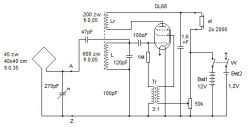
The amplified signal m.cz. , tapped from the primary winding of the transformer, was fed into the lamp’s grid circuit. This resulted in a several-fold increase in gain. If the potentiometer had a resistance of 500 kiloohms rather than 50, it would have been possible to connect it between the second grid and the anode positive terminal; however, I was unable to find such a miniature potentiometer. It would then have been possible to switch off the receiver using a single-pole switch by turning off the filament and further reducing the current drawn from the battery, without the need for this current to flow to earth via the potentiometer. However, as I only had a 50 kiloohm potentiometer available, I earthed its lower terminal and used two miniature switches to switch off the radio. The current draw from the anode battery does not exceed 0.7 mA, which, with an anode battery capacity of 55 mAh, provides approximately 80 hours of operation without needing to replace the battery. As the tube draws a filament current of 25 mA, with a filament battery capacity of 170 mAh, this provides approximately 7 hours of filament battery life. After this time, the battery recharges without needing to be removed from the radio.
The radio is tuned using a miniature screwdriver by turning the ferrite core. Tuning is necessary when changing the connected antenna.
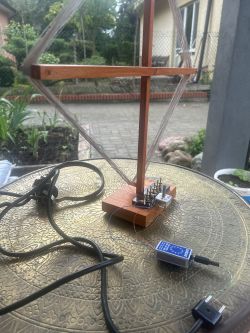
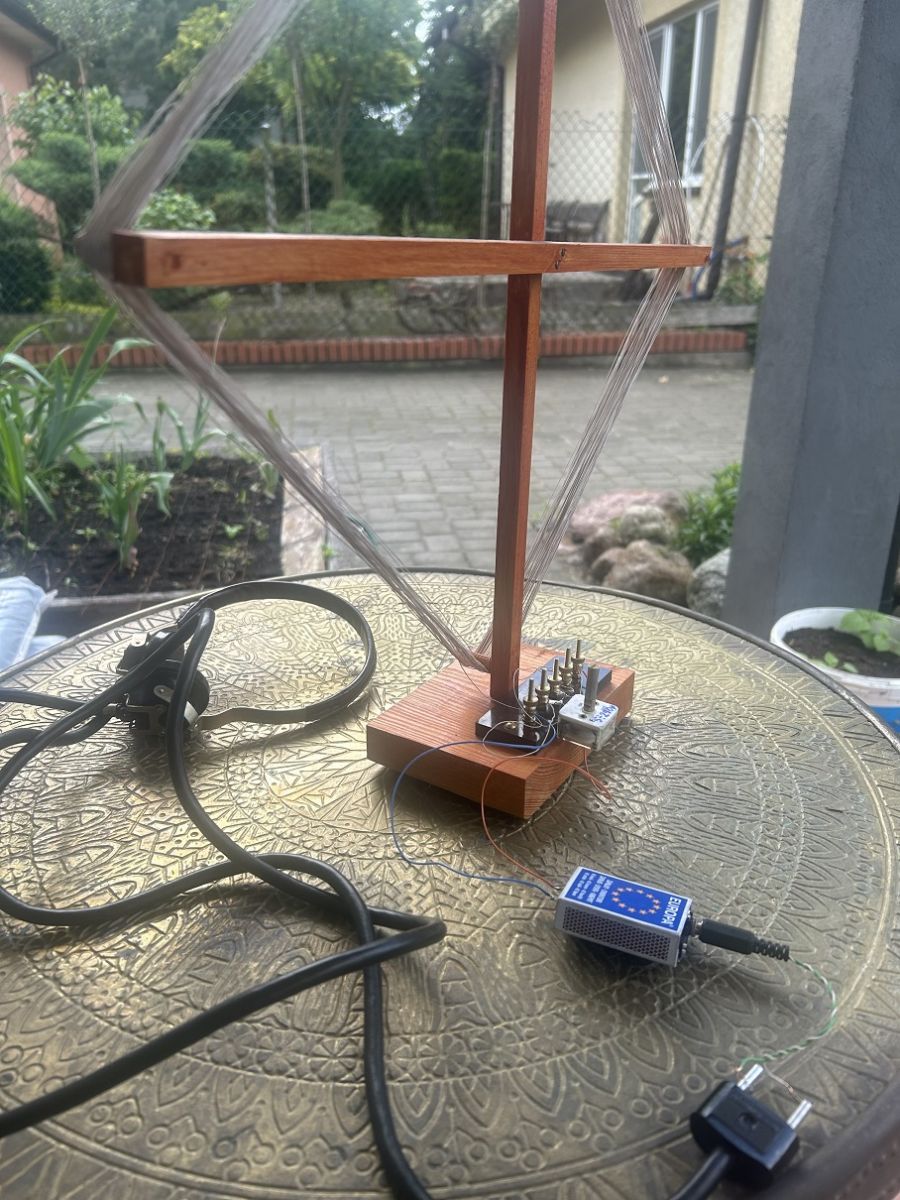
Tests have shown that the radio can operate with a frame antenna. With a frame span of 40 x 40 cm and 50 turns, the antenna’s inductance is approximately 2.5 mH. The winding was made using 0.35 mm diameter cotton-insulated copper wire. By connecting a tuning capacitor from a transistor radio to this antenna, the optimal operating conditions for the antenna can be selected. Tuning is then carried out as follows: First, when the feedback threshold is exceeded, the coil core in the radio is adjusted. When the broadcast becomes audible against the background of the feedback whistle, the feedback is reduced until the excitation ceases, and the capacitor connected to the antenna is used to find the optimal tuning for maximum volume and clarity of reception. If the frame antenna is to be used exclusively with this radio, a capacitor can be permanently soldered to the antenna, and tuning can then be carried out solely by turning the coil core inside the radio. Reception via the loop antenna at a distance of approximately 190 km in a straight line from the transmitter is clear, but reception is louder when using a conventional antenna (approximately 20 m) and earth connection. The audio level is so high that when listening through headphones, it is necessary to adjust the potentiometer well before the point where feedback occurs. Tests using a conventional antenna and earth connection, carried out in Kraków, approximately 330 km from the transmitter, were also successful.
Reception tests using a ferrite antenna yielded poorer results. Although reception was possible, the audio level was nevertheless low.
The tube was mounted on a ‘base’ made from five pins cut from a precision IC socket. This socket was glued to the coil frame. Most of the receiver’s components were assembled on this ‘chassis’ and glued to a Bakelite board the size of the base of “matchbox tray”. Nickel plates were soldered to the filament battery (0.15 mm thick sheet metal), and the resulting “whiskers” were then soldered to the solder lugs attached to the Bakelite board.
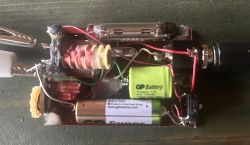
To make it easy to disconnect the headphones, the receiver is fitted with a ‘Jack’ headphone socket, which also fits inside the receiver.
A few people seem to have tried, or wanted to build, such a valve radio, but I haven’t seen any working designs, which is why I decided to try making one myself.
Admittedly, there is one article online dating from 1947, but it’s hard to imagine that this radio would fit inside a matchbox:
https://onetuberadio.com/2017/10/29/1947-one-tube-matchbox-radio/
A Google search for ‘Were there valve radios in a matchbox?’ yields the answer: ‘A matchbox is far too small to accommodate glowing electron valves, high voltage and batteries.’ The iconic miniature matchbox radios (which amateur radio enthusiasts built, particularly during the communist era in Poland) worked slightly differently: transistor receivers […] were based on miniature transistors and integrated circuits. Detector radios: even simpler designs that did not require batteries […].
The task may seem impossible at first glance, but that is not the case. When I set about building the radio, I made the following assumptions:
0) The radio must be capable of receiving PR1, 225 kHz AM.
1) The power supply must fit inside a matchbox and must last for at least 4–5 hours of playback
2) Reception should be possible via headphones; these may be high-impedance headphones
3) The circuit must have the highest possible sensitivity whilst remaining simple
4) It is permissible to include an antenna and earth connection, but it is desirable for the receiver to be able to operate with a magnetic antenna
5) The receiver must be continuously tunable
Let us analyse these requirements. The first requirement can be met, provided we accept the conditions described below. The anode voltage should be within a range of a few… to a dozen or so volts. The anode battery can be constructed from button cells, or an A27 remote control battery can be used – this provides a voltage of 12V and has a capacity of approximately 55 mAh. The filament power supply can be provided by a NiMH rechargeable battery. Assuming the receiver is a single-tube design, utilising a battery-powered tube, and assuming its filament current does not exceed 25 – 50 mA, a NiMH rechargeable battery with a capacity of approx. 200 mAh and a voltage of 1.2V would be sufficient. Of course, the above conditions dictate that the tube used must be a small-sized battery-operated tube, but one with ‘good’ performance parameters, i.e. the lowest possible filament current combined with the steepest possible characteristic curve.
The second requirement does not necessitate any special measures. Connecting high-impedance headphones directly to the lamp’s anode circuit does not require the use of any transformer.
The third requirement immediately dictates that the receiver must be a reactive type, and ideally a reflex receiver. This is because such circuits are the simplest, and their sensitivity is the highest.
The fourth requirement – or rather, concession – means that earth may be connected to the receiver’s ground, and the antenna may be connected directly to the resonant circuit via a shorting capacitor. This simplifies the receiver circuit and means that a separate antenna coil is not required. However, to ensure that the antenna’s influence on the tuning process is as minimal as possible, the short-circuit capacitor should have as low a capacitance as possible. Reducing the capacitance, however, implies a loss of sensitivity, so a compromise must be found here.
The fifth requirement dictates that tuning must be either capacitive or inductive. Given that tuned capacitors, even the smallest ones, can take up 25–50 per cent of the radio’s available ‘internal volume’, inductive tuning is the only viable option.
After analysing these requirements, a few further points can be clarified. The aim is to use a valve with the steepest possible characteristic curve, the lowest possible filament current and the smallest possible dimensions. For this reason, it made no sense to build my own valve. Whilst the dimensions of such a self-built valve could certainly be reduced considerably, it is difficult to achieve the desired electrical parameters in the process. However, I may well try to build my own valve for this application in the future. After some research, the choice of a commercial tube fell on the DL68 pentode. It has a catalogue characteristic slope of 0.42 mA/V at an anode voltage of 22.5 V and a grid voltage of –2.2 V, and a filament current of 25 mA. In the radio circuit, this valve operates at an anode voltage almost half that specified in the catalogue, but the grid voltage is close to 0 V, as a result of which the characteristic slope remains significant. It is to be expected that the Soviet 1Ż29b tube should also yield good results. By using one section of this tube’s cathode, the filament current can be limited to 33 mA. The slope of this tube’s characteristic curve is 2 mA/V at an anode voltage of 45 V, and it is likely that this will remain significant even after reducing the anode voltage. However, I have not tried using this tube, and its dimensions are slightly larger than those of the DL68. Perhaps someone will be willing to try using this tube, in which case the matter will finally be clarified.
The resonant circuit must be built as a miniature design. In such a situation, one cannot expect to construct coils with a high Q-factor. A Q-factor of around 60 is the best that can be achieved under these conditions. Tests have shown that by using a split frame and a small ferrite core screwed into this frame, it is possible to wind 600 turns of 0.05 mm in diameter, thereby obtaining a coil with a maximum inductance of around 6 mH, whilst without the core this coil has an inductance of approximately 2.5 mH. Given that the reaction coil should have approximately one-third the number of turns of the resonant (mesh) coil, we arrive at an approximate number of turns for the reaction coil equal to 200 turns.
The classic reaction radio I built as a test worked well at an anode voltage of 9V, but I had to consider how best to control the reaction and how to make this radio a reflex-type radio, so as to make better use of the valve. Having considered various methods of reaction control, I came to the conclusion that voltage control in the second grid using a miniature potentiometer is the most practical, whilst control by moving the reaction coil had to be rejected as impractical. Adjustment via the potentiometer in the second grid is smooth, operates ‘softly’ and there is no need to manipulate the position of the feedback coil. A miniature interstage transformer (probably from a hearing aid) with a 1:3 ratio was used to feed the FM signal back to the valve once more. The primary winding has a resistance of approximately 400 ohms (connected to the second grid of the valve), whilst the secondary winding has a resistance of approximately 1200 ohms; however, there is no further information regarding the winding specifications of this transformer. If anyone wishes to build this or a similar radio, they will probably have to wind the coil themselves onto a slightly larger bobbin with a permalloy core. Ultimately, the radio circuit shown in the diagram was produced.
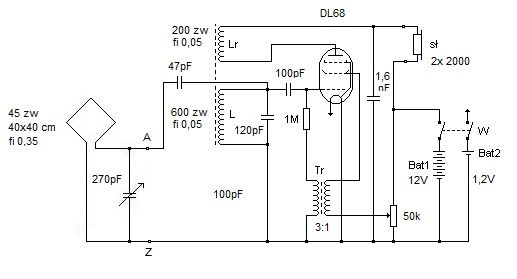
The amplified signal m.cz. , tapped from the primary winding of the transformer, was fed into the lamp’s grid circuit. This resulted in a several-fold increase in gain. If the potentiometer had a resistance of 500 kiloohms rather than 50, it would have been possible to connect it between the second grid and the anode positive terminal; however, I was unable to find such a miniature potentiometer. It would then have been possible to switch off the receiver using a single-pole switch by turning off the filament and further reducing the current drawn from the battery, without the need for this current to flow to earth via the potentiometer. However, as I only had a 50 kiloohm potentiometer available, I earthed its lower terminal and used two miniature switches to switch off the radio. The current draw from the anode battery does not exceed 0.7 mA, which, with an anode battery capacity of 55 mAh, provides approximately 80 hours of operation without needing to replace the battery. As the tube draws a filament current of 25 mA, with a filament battery capacity of 170 mAh, this provides approximately 7 hours of filament battery life. After this time, the battery recharges without needing to be removed from the radio.
The radio is tuned using a miniature screwdriver by turning the ferrite core. Tuning is necessary when changing the connected antenna.
Tests have shown that the radio can operate with a frame antenna. With a frame span of 40 x 40 cm and 50 turns, the antenna’s inductance is approximately 2.5 mH. The winding was made using 0.35 mm diameter cotton-insulated copper wire. By connecting a tuning capacitor from a transistor radio to this antenna, the optimal operating conditions for the antenna can be selected. Tuning is then carried out as follows: First, when the feedback threshold is exceeded, the coil core in the radio is adjusted. When the broadcast becomes audible against the background of the feedback whistle, the feedback is reduced until the excitation ceases, and the capacitor connected to the antenna is used to find the optimal tuning for maximum volume and clarity of reception. If the frame antenna is to be used exclusively with this radio, a capacitor can be permanently soldered to the antenna, and tuning can then be carried out solely by turning the coil core inside the radio. Reception via the loop antenna at a distance of approximately 190 km in a straight line from the transmitter is clear, but reception is louder when using a conventional antenna (approximately 20 m) and earth connection. The audio level is so high that when listening through headphones, it is necessary to adjust the potentiometer well before the point where feedback occurs. Tests using a conventional antenna and earth connection, carried out in Kraków, approximately 330 km from the transmitter, were also successful.
Reception tests using a ferrite antenna yielded poorer results. Although reception was possible, the audio level was nevertheless low.
The tube was mounted on a ‘base’ made from five pins cut from a precision IC socket. This socket was glued to the coil frame. Most of the receiver’s components were assembled on this ‘chassis’ and glued to a Bakelite board the size of the base of “matchbox tray”. Nickel plates were soldered to the filament battery (0.15 mm thick sheet metal), and the resulting “whiskers” were then soldered to the solder lugs attached to the Bakelite board.
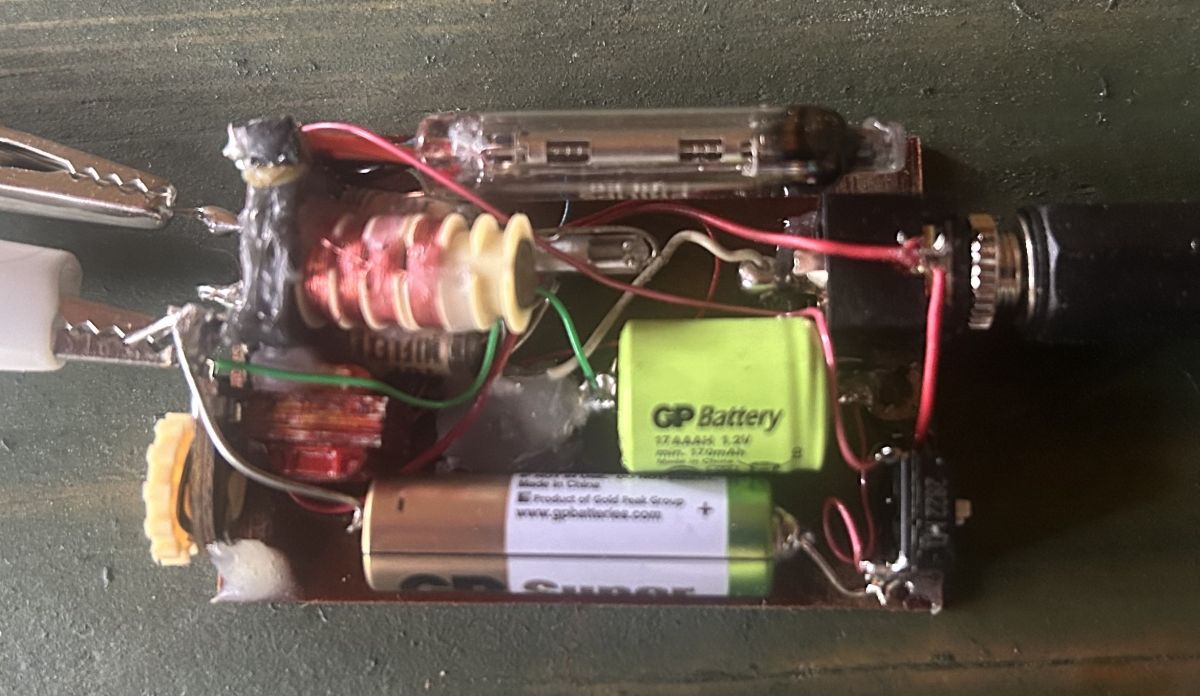
To make it easy to disconnect the headphones, the receiver is fitted with a ‘Jack’ headphone socket, which also fits inside the receiver.
Cool? Ranking DIY