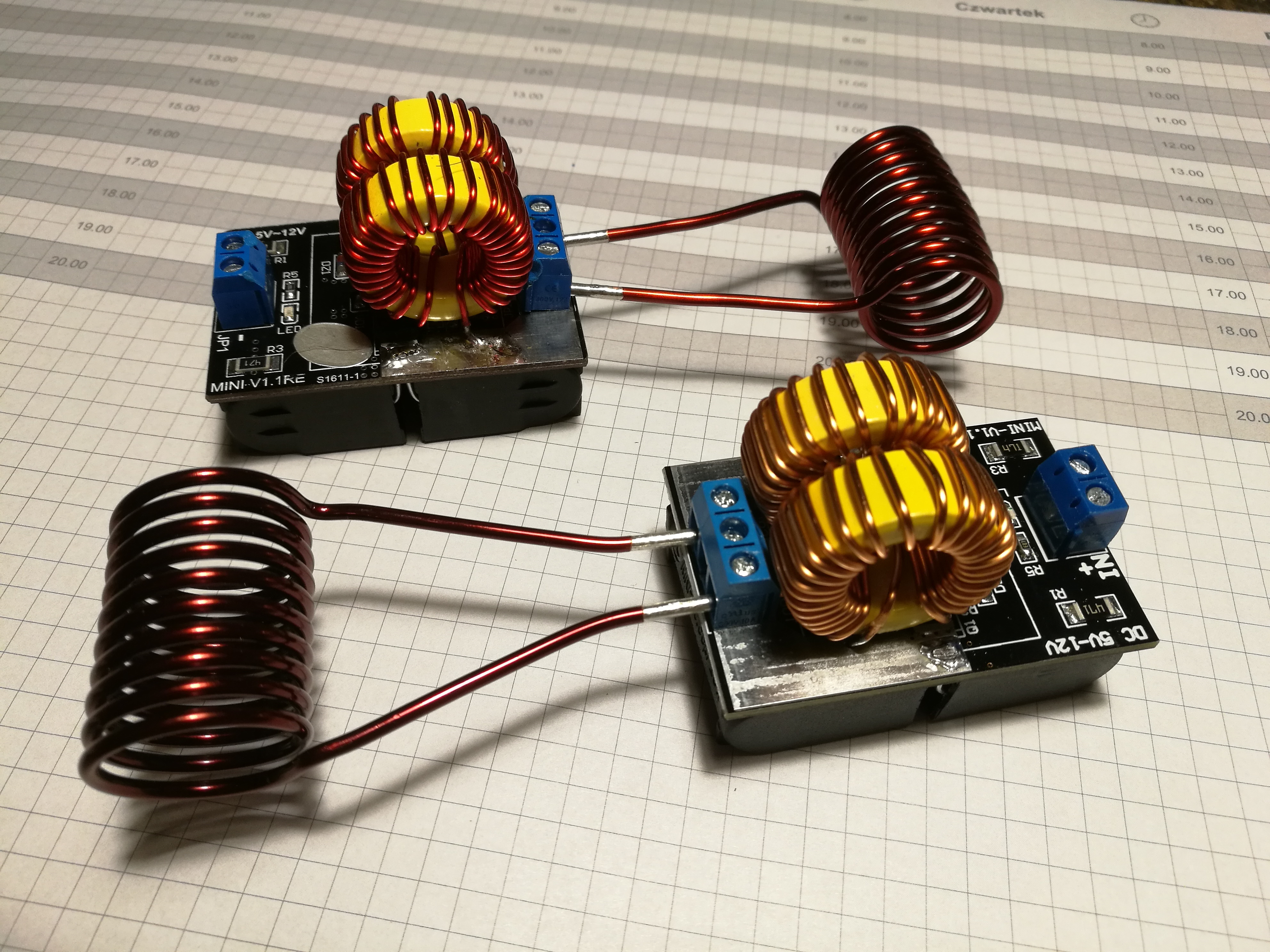
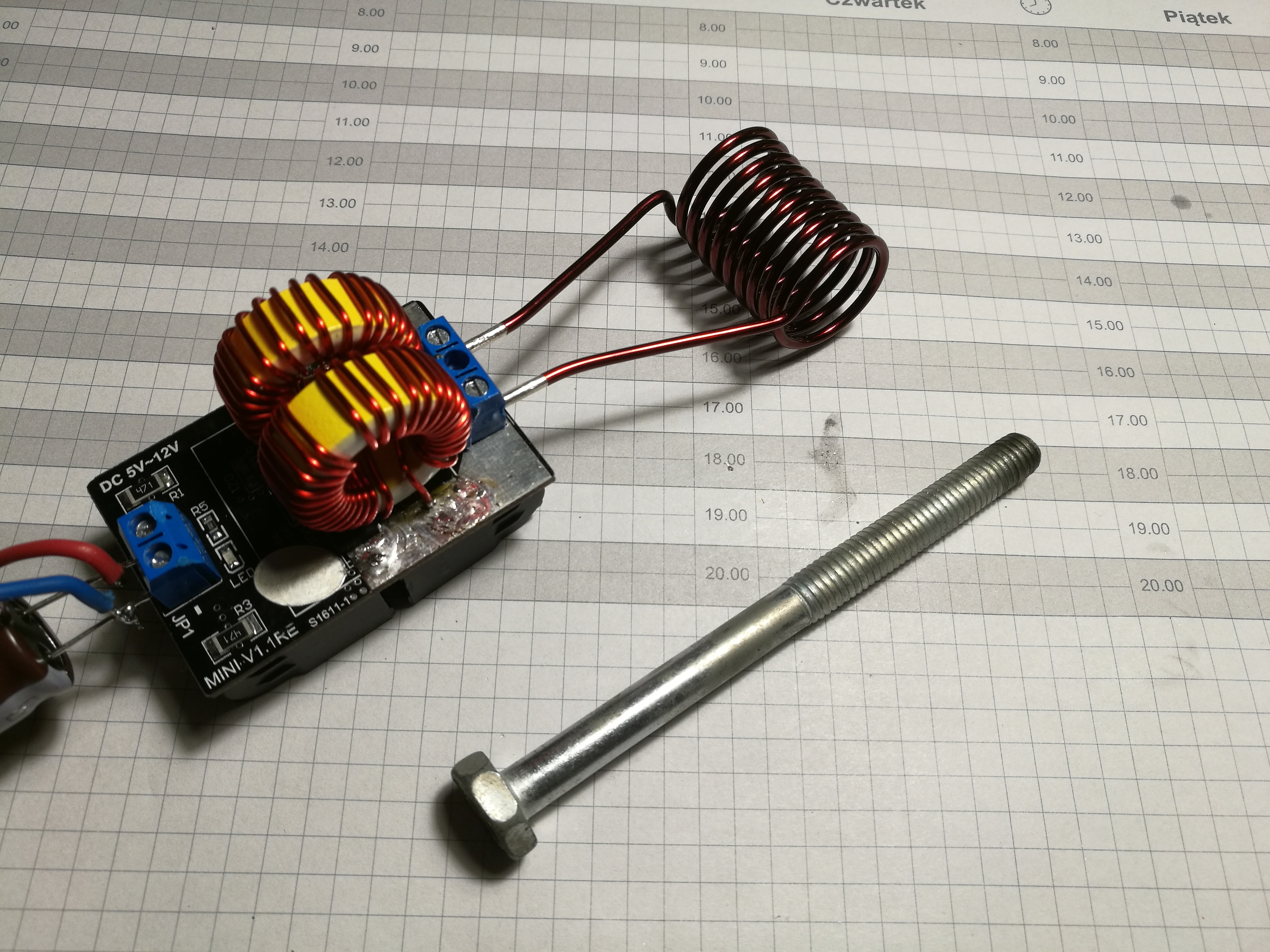
Some time ago I bought 2 induction converters in China, hoping that despite the simple-looking structure and a really small number of elements, it will be possible to use this device in a workshop, e.g. as an aid in unscrewing stuck screws or, for example, in the process of hardening small metals. 120W of power is unfortunately very little for this type of construction, but the device is really decent.
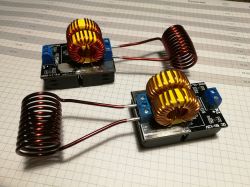
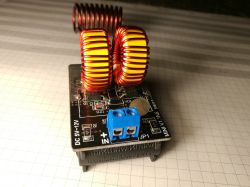
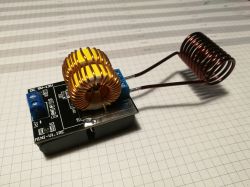
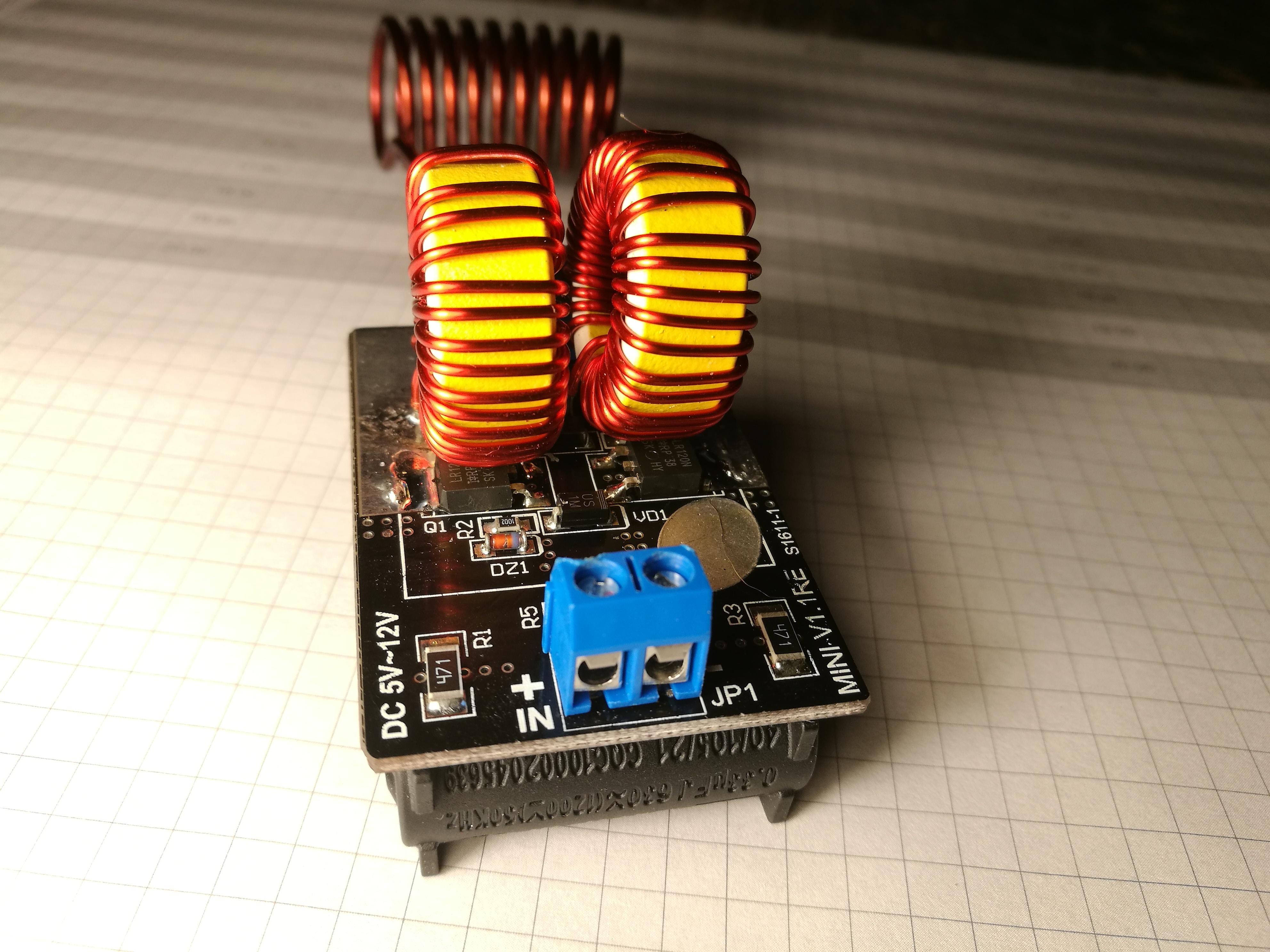
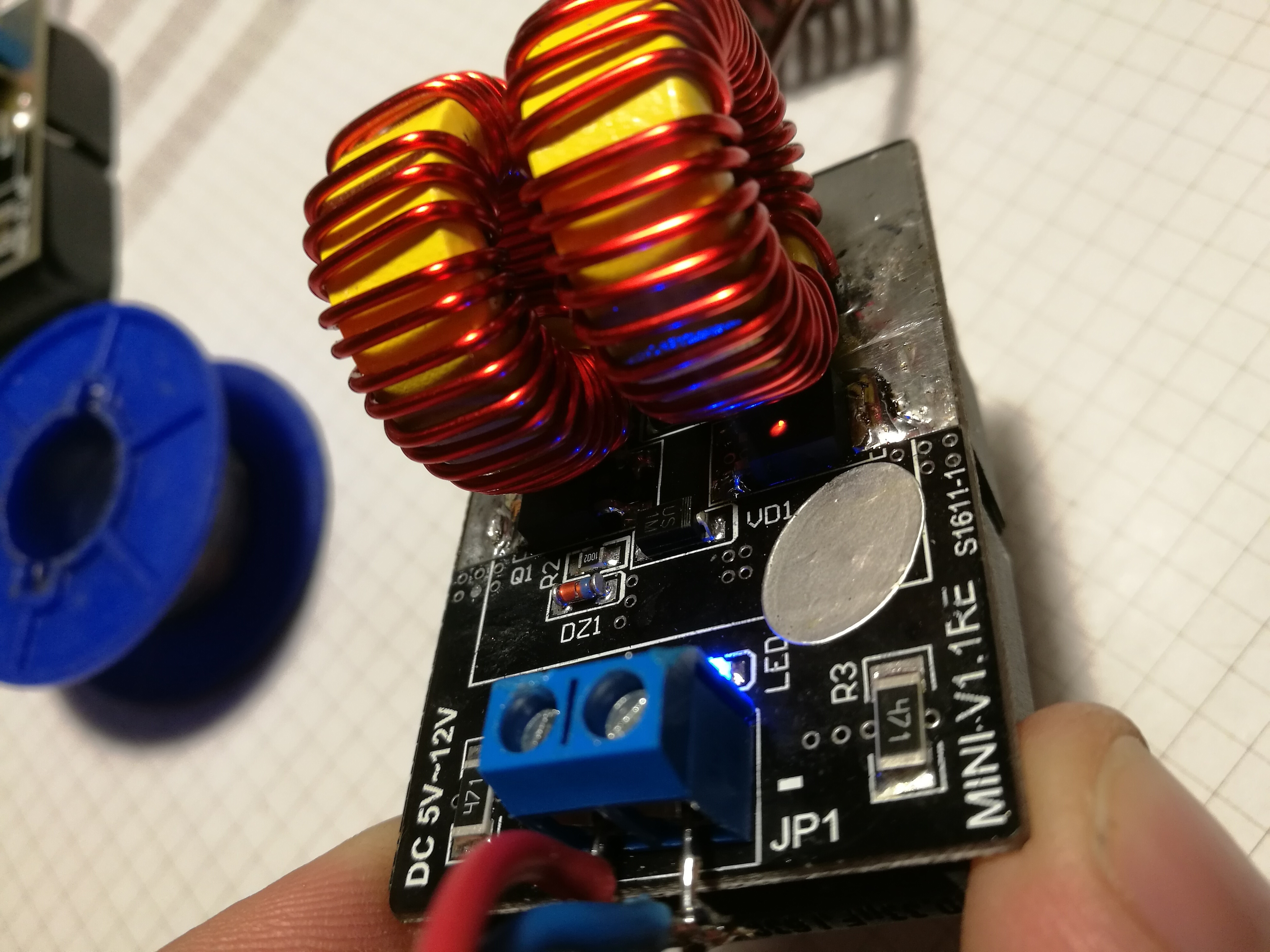
You can see at first glance that the number of elements is limited to the necessary minimum. The system consists of two mosfet transistors, two fast diodes, two inductances, resistors and resonant elements, i.e. an external coil and high capacity. During the first attempts, and basically when squeezing "as much as possible", I managed to damage the circuit, the transistors burned out. At first I inserted the IRFR120, but due to the low maximum current, they lasted only a moment. Then I soldered the IRFR2905 - 50A low voltage transistors, which seem to be appropriate - the heater works better than on the original mosfets, the marking of which is unfortunately not visible. The photos show a burning transistor.
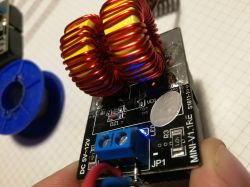
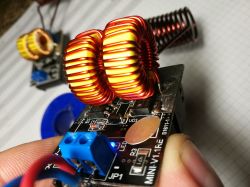
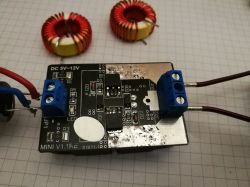
Let's move on to the tests.
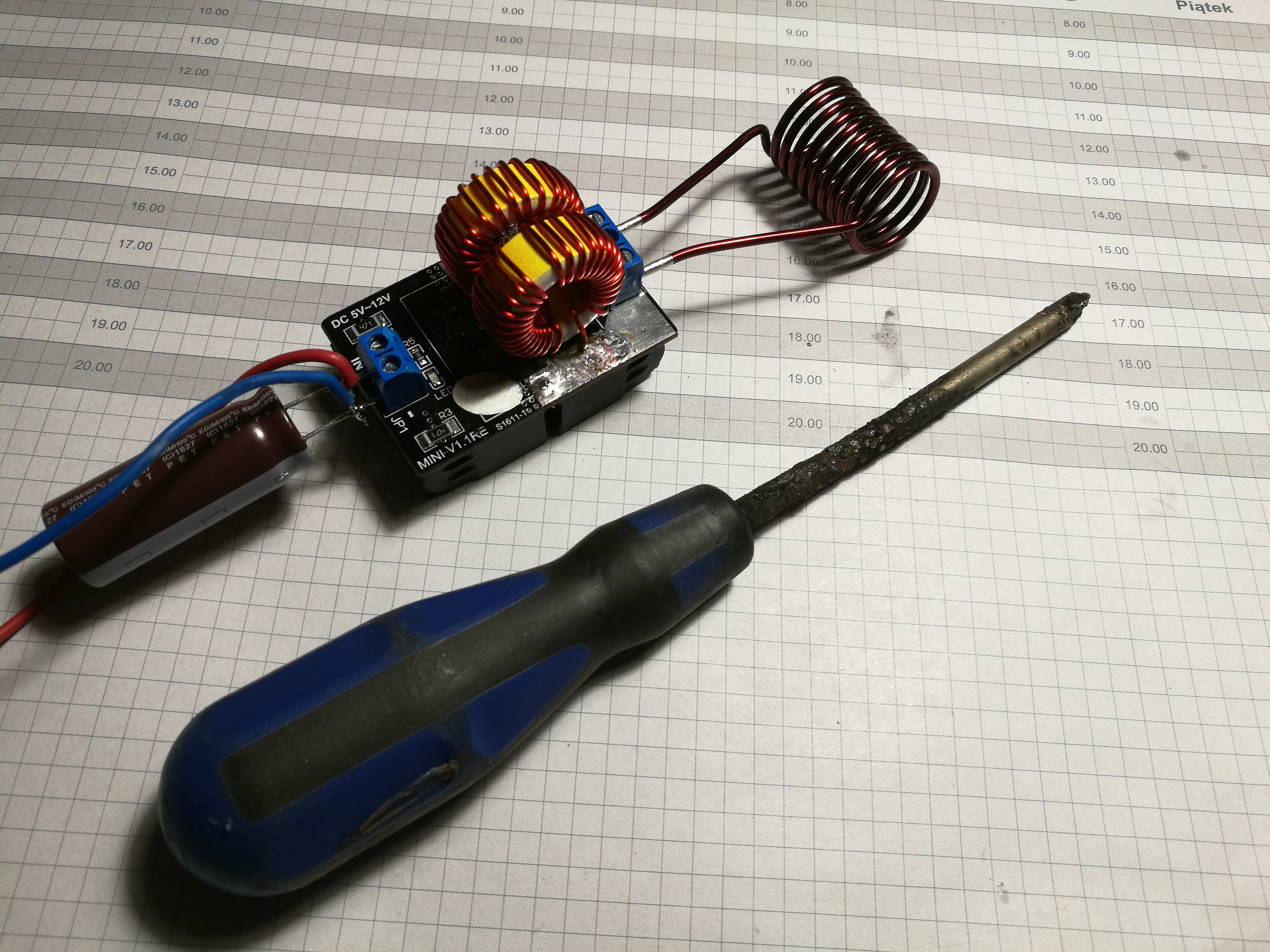
After connecting the 12V DC voltage, the device consumes about 1.8A. As soon as the metal element is brought closer to the coil, the current begins to increase. At its peak, I managed to achieve a current of about 12A, which gives almost 150W, which is more than the manufacturer declares. During the idle run, despite the power consumption of about 20W, nothing heats up, rather a little bit of everything, which may prove the correct operation of the entire structure. At first, I connected the device to a universal power supply, which in its design has several taps on the transformer and relays that activate the appropriate voltage. Unfortunately - the heater most likely generates large disturbances that destabilize the operation of such a power supply, causing its chaotic switching. I built a simple transformer power supply quickly in order to be able to further test the device.
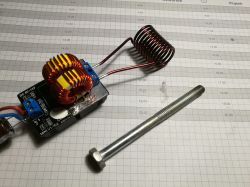
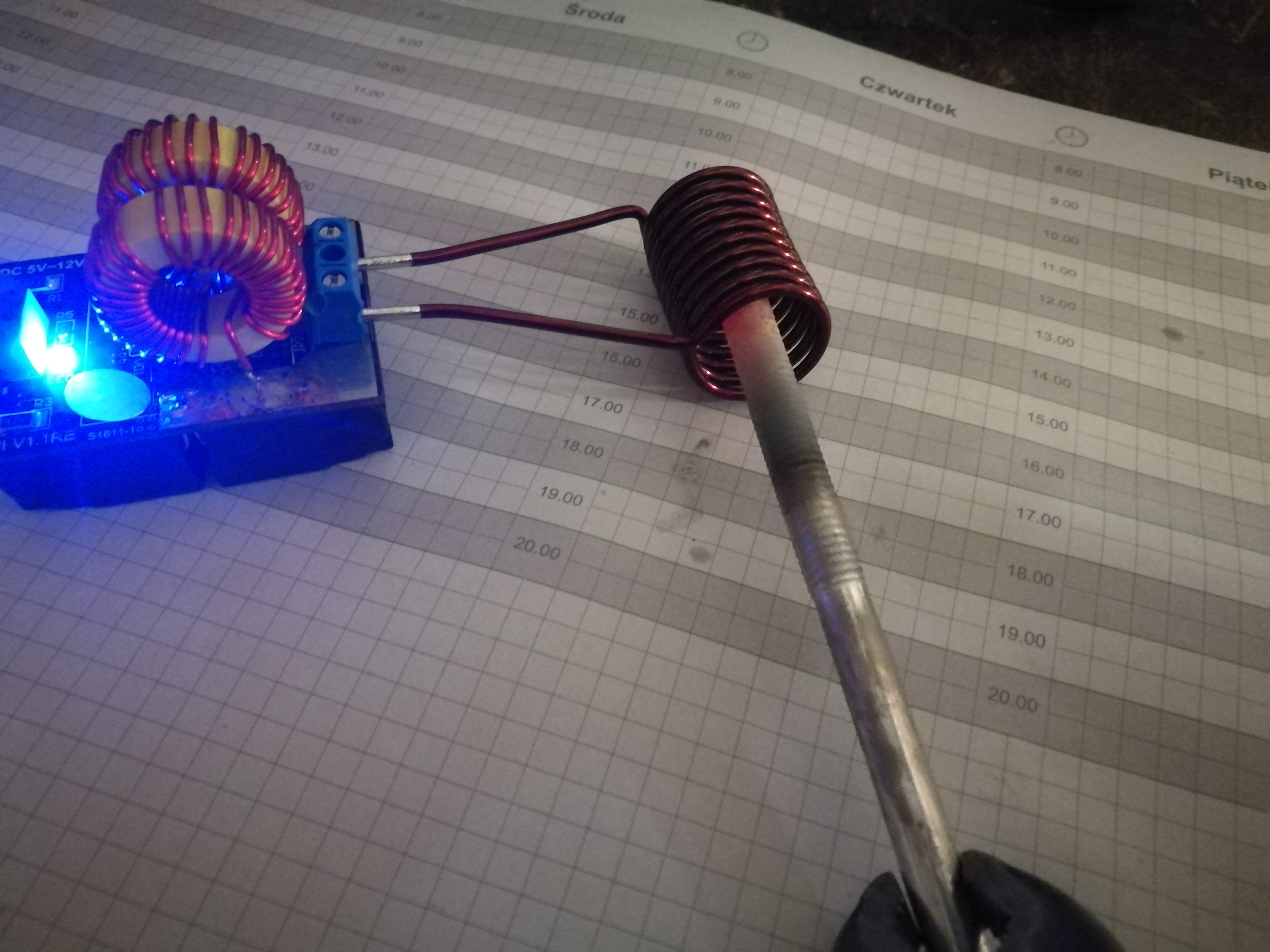
I tested three elements: a 6.5mm screwdriver, a figure-eight screw, and the same screw with two nuts. All three cases can occur in reality, so let's check how our heater will meet the set bar.
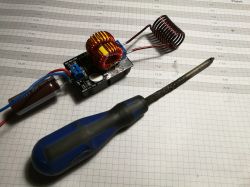
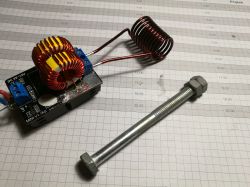
Screwdriver:
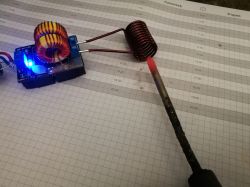
As you can see, a medium-sized screwdriver can be heated to redness with this device within 2 minutes. This is a pretty decent result in my opinion. If we can harden the tip of a screwdriver at home, then such a heater will be a great help here!
Eight screw:
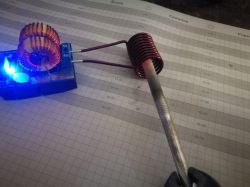
It takes about 3 minutes to make this screw red hot - it also seems to be a good result, of course considering the simplicity of the device. Also in this case, we can use this device to harden to a diameter of 8mm.
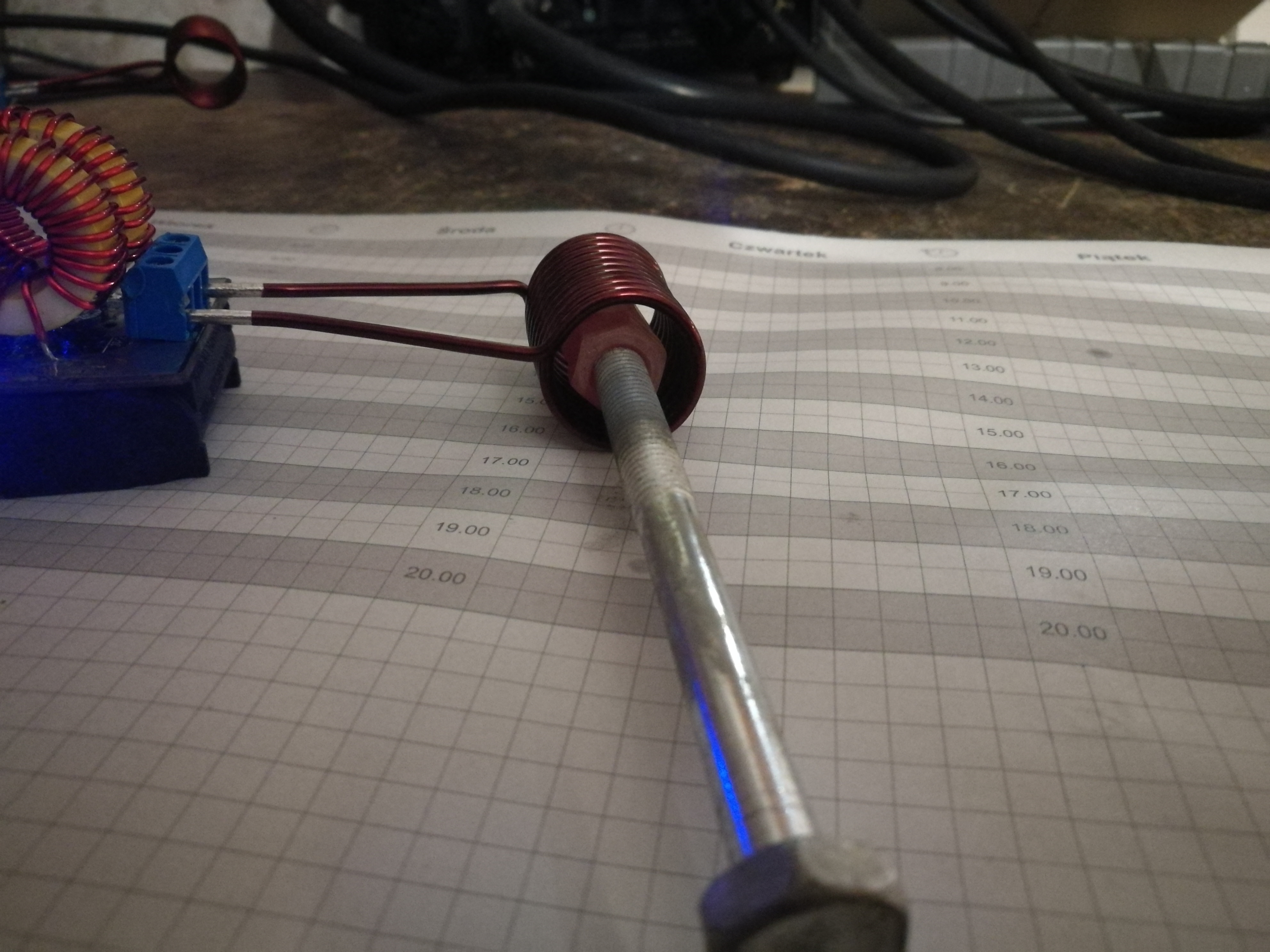
Bolt with nuts:
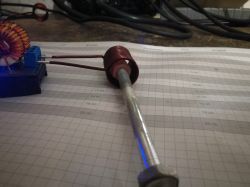
In this case, it took 4 minutes to warm up such a kit to a barely visible redness - a long time. The device under test can be used in this way to heat the baked cap in order to unscrew it easier, but the process will be long and inconvenient. In addition, in our case, we could put the heated elements inside the coil - in the real case it may not be possible, which will significantly reduce the efficiency of such an operation.
Summarizing...
one piece of "induction heater" cost about $ 9, which is less than PLN 35. In my opinion, this is a low amount for a device that is able to heat efficiently with low power, but small metal objects. Of course, this heater cannot be compared to company equipment for a few thousand zlotys, but it is also not just a worthless gadget and it will work for home, hobby or even small workshop applications.












Comments
On Allegro, they once cost PLN 50, I was wondering whether to buy such something, but I was always curious about the maximum temperature that can be obtained. The seller said that there is no possibility... [Read more]
You can buy something stronger: https://pl.aliexpress.com/item/50A-ZVS-induction-pok-adzie-DC12V-40V-DIY-nagrzewnica-indukcyjna-Kuchenka-Elektryczna-1000-W/32862105651.html?spm=a2g17. 10010108.1000016.1.20837546PRLGSR... [Read more]
But nowhere in these converters does it write what maximum temperature can be obtained only from the maximum power. Maybe the maximum temperature depends not only on the power but also on the physical... [Read more]
For the workshop, it is a rather useless toy. He's already writing why before Comrade Admin launches a counteroffensive :) : Contrary to appearances, iron conducts heat quite well, so when heating... [Read more]
Just remember that there are very different industries and therefore different workshops. As for 120W - which I noted in many places - the device does the job. In most small elements, a popular 5A power... [Read more]
Not sure, just note that the heating power of this device is about the same as a better lighter. For PLN 5 or a small burner for PLN 20. In the "entertainment" application - in professional applications,... [Read more]
https://obrazki.elektroda.pl/4762394100_1527261028_thumb.jpeg I made a spider from what was in the box. It worked elegantly. I had a video somewhere. Imbus 6 heated up to redness in half a minute,... [Read more]
And tell me, good people - will the mosfet-to-igbt conversion work directly for this application? I would do it too. But from the mosfets I have the most powerful at 17A, and the welding "igiebets" are... [Read more]
It seems to me that the system will work, the isolated gate will probably not be an obstacle. [Read more]
Ignoring the heater's power, the maximum temperature that the heated element can reach depends on its magnetic properties, mass and intensity of heat exchange with the environment. In practice, it... [Read more]
he? Can you brighter? The longer I warm up, the colder it will be? [Read more]
No - it's just that the speed of heat emission from the heated object is too high to obtain high temperature. Something like an analogy for the heat balance so briefly. [Read more]
I can brighter. The temperature of cherry heat of iron is approx. 770 ° C, if you reach it within e.g. 10 seconds, the achievable end temperature will be much higher than if you reach 770 ° C after 60... [Read more]
I don't feel like it anymore, because for this project, as shown in the picture above, I would have everything without getting up from the table - the problem would probably only be 5-watt, 12V zener.... [Read more]
What is the radio interference level in the vicinity of a working heater? Is it possible to make the air coil with a shorter length and will this allow for better heating efficiency? What is producing... [Read more]
The thermal imager is probably calibrating - I don't know exactly, but I worked with different cameras and this effect was visible, but here it is quite clear. You can definitely, it must be calculated... [Read more]
Are the FM radio and mobile phone working properly near the heater? The DVB-T receiver on USB + https://www.rtl-sdr.com/ allows you to check what is happening in the air: https://www.elektroda.pl/rtv... [Read more]
I have rtl-sdr - I forgot about it, I will do tests in the evening. [Read more]
As for the maximum temperature, it will depend on the metal being heated. There is something like the Curie temperature above which ferromagnets lose their properties and cannot heat up any further. Aluminum,... [Read more]