logo elektroda
logo elektroda
X
logo elektroda

Which is plus, minus and which is grounding?

stabilizator  1 116535 Cool? (+46)
📢 Listen (AI):

TL;DR

  • The piece explains why mains sockets do not have simple plus and minus terminals and instead use L, N, and PE conductors.
  • It contrasts AC mains with DC battery polarity, showing that phase wire L changes voltage relative to neutral N while protective earth PE provides shock protection.
  • For Poland, it gives a 230 V, 50 Hz example where L swings through zero to about -325 V and +325 V every 0.02 seconds.
  • It warns that older buildings may lack a yellow-green PE wire, so protective pins and N can share a neutral conductor, and DC supplies still require correct polarity.
Generated by the language model.
The question of plus and minus in a mains socket is repeated quite often, it is quite natural to associate the two poles of the socket and the two colors of the wires with the battery but wrong . In the case of a cell or battery, we have direct voltage (DC), the mains supply is alternating voltage (AC). You can find more about direct and alternating current here: AC vs DC .

In the network socket you will most often find:
1. Blue neutral wire (N) connected to ground potential, reference.
2. Phase wire (L) usually brown or black, red, gray, white - this is the second work wire on which the voltage changes with respect to the N wire.
3. The protective conductor (PE), usually yellow-green, which is grounded and connected to the protective pin in the socket, is an important element of electric shock protection.
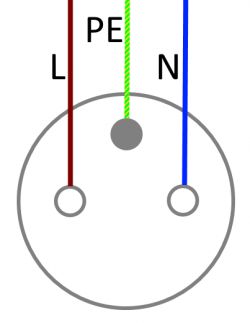

Figure 1. How to connect the socket. L and N terminals may be interchanged.

The shape of the voltage changes with time on the conductor L is similar to a sinusoid. Value effective tension in Poland is 230 V. The frequency of the mains voltage in Poland is 50 Hz, i.e. within 1 second, the voltage on the L conductor changes its polarity "passing through zero" and reaching alternately voltage -325 V and +325 V (maximum voltage, amplitude sine wave). Or else, one cycle takes 0.02 seconds.
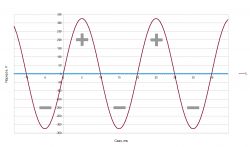

Figure 2. Line voltage waveform - voltage of the L (brown) wire in relation to the N (blue) wire.

Attention!
The PE protective conductor connected to the metal parts of the device housing protects against the appearance of dangerous voltage on these conductive parts. In older buildings, it is possible to find an installation without a yellow-green PE wire, then the protective pins and the N terminal are connected to a common neutral wire. The subject of old installations is difficult, not every two-wire installation can combine the protective contact with a blue or black wire. You need to know your network layout.

In home installations, you can find circuits with DC power supplies, most often in the popular LED lighting. The power supplies are connected to an alternating mains voltage and provide direct current, the voltage at the terminals is from several to several dozen volts.
What colors will be associated with "+" and "-"? The terms + and - are incorrect because it should be used in a symmetrical supply (there are two voltages, e.g.. +24 and -24 relative to the mass of the system). In DC voltage circuits, most often we encounter GND (i.e. the mass of the system), which is often somewhat incorrectly marked as "-" and the second terminal "+" where a specific voltage will be present in relation to GND. In this type of installations, the "+" wire will most often be red or, less often, yellow, while the GND wire insulation will be black or blue. Sometimes both wires are insulated with the same color (e.g. white), while the "+" wire has a strip, e.g. red. In addition to voltage power supplies, you can also find current power supplies, which, instead of a specific constant voltage, maintain a constant current, e.g. for LEDs. In the case of DC current power supplies, the polarity is also important. Current type power supply, how is it different from voltage supply?

[line: d0b7b15bc5]
Please do not report the topic. This is a simple tutorial for those looking for basic information on AC and DC.


About Author
stabilizator
stabilizator wrote 142 posts with rating 359 . Been with us since 2020 year.

Comments

janek.maykowski 19 Aug 2020 18:53

I think I will send all my clients here who constantly have problems with it. [Read more]

FAQ

TL;DR: 50 Hz Polish mains swings ±325 V around neutral [Elektroda, stabilizator, post #18852323]; "Alternating mains has no plus or minus" [Elektroda, stabilizator, post #18852323] Identify L (brown), N (blue) and PE (yellow-green) by colour, not polarity, to avoid a 230 V shock.

Why it matters: One wrong connection can place full line voltage on a metal housing meant to be safe.

Quick Facts

• Nominal supply: 230 V ±10 % single-phase, 400 V ±10 % three-phase [IEC 60038]. • Standard frequency: 50 Hz ±1 % in public grids [EN 50160]. • Conductor colours (IEC 60446): L = brown/black/grey, N = blue, PE = yellow-green. • Schuko socket rating: 16 A continuous at 230 V ["Schuko Standard"]. • Touch-voltage safety limit: 50 V AC under fault conditions [IEC 60364].

Does a household socket have plus and minus?

No. Mains delivers alternating current, so the phase conductor reverses polarity 100 times per second (50 Hz), hitting +325 V and –325 V relative to neutral [Elektroda, stabilizator, post #18852323] Therefore the terms “plus” and “minus” do not apply.

What do the letters L, N and PE mean?

L = Live (phase) conductor carrying the alternating voltage. N = Neutral, bonded to earth at the service entrance and kept near 0 V. PE = Protective Earth, a separate safety conductor bonded to exposed metal parts [Elektroda, stabilizator, post #18852323]

Why can L and N be swapped in a Schuko socket?

Schuko plugs are non-polarised; devices are designed so that either pin may become phase. Safety is maintained because exposed metal connects to PE, not N ["Schuko Standard"].

How dangerous is mistaking PE for N?

Connecting PE to phase can place 230 V on all grounded chassis. Currents above 200 mA through the heart can cause ventricular fibrillation in milliseconds [NIOSH, 2019].

Which wire colours are typical in low-voltage DC circuits like LED strips?

Red usually marks the positive supply, black or blue marks the return (GND). Some cables use a white wire with a red stripe for “+” [Elektroda, stabilizator, post #18852323]

Is polarity important for AC-fed appliances?

Most class II (double-insulated) devices work regardless of plug orientation. Class I metal-cased gear should still have the phase on the fused side to ensure the fuse clears faults quickly [IEC 60364].

What happens if I reverse polarity on an LED strip?

Nothing lights, and many strips include reverse-polarity diodes, but some budget models burn out instantly—a known edge-case failure [“LED Polarity Damage Report”].

How can I locate the phase wire without a tester?

  1. Switch off the breaker.
  2. Open the socket and separate conductors.
  3. Energise and use a neon probe or multimeter between each conductor and a verified earth; the wire showing 230 V is phase [How-To below].

What is the 3-step procedure to wire a new Schuko socket safely?

  1. Strip conductors and connect yellow-green wire to the centre earth pin.
  2. Clamp blue wire to either N terminal.
  3. Clamp brown (or black/grey) wire to the remaining L terminal. Tighten screws and replace cover [Elektroda, stabilizator, post #18852323]

Which regulation defines European conductor colours?

IEC 60446 (merged into IEC 60204-1) standardises brown/black/grey for phases, blue for neutrals, and yellow-green for protective earth.

What if the neutral breaks but phase remains?

All downstream metalwork referenced to neutral may float to 230 V, yet protective devices see no fault current, so nothing trips—an often overlooked failure scenario [“Neutral Loss Hazards”].

How can I upgrade an old two-wire circuit lacking PE?

Install a residual-current device (RCD) and run a dedicated PE conductor back to the distribution board, or replace the cable entirely; never simply link neutral to earth contacts [IEC 60364].
Generated by the language model.
%}