logo elektroda
logo elektroda
X
logo elektroda

Identifying Phase Colors and Order for L1, L2, L3 in 3-Phase Power Cable & Switch Cabinet

Grey77 234534 41
Best answers

Is there a standard color order for L1, L2 and L3 in a 3-phase power cable or switch cabinet?

There is no universal color order for L1/L2/L3 in a cabinet, but the phase assignment should be kept consistent throughout the installation. A commonly used standard in Germany is L1 = brown, L2 = black, L3 = gray, referenced to DIN VDE 0293-308 / HD 308 S2 [#12787330][#12787569][#12787588] In practice, some electricians also arrange the phases in a clockwise order from the PE conductor, or follow the established order already used in the cabinet [#12787386] The thread also notes that in some places there is no local standard enforcing a specific phase-color order, so the key is to mark and keep the same sequence everywhere [#12788196][#12787667]
Generated by the language model.
ADVERTISEMENT
Treść została przetłumaczona polish » english Zobacz oryginalną wersję tematu
  • #1 12787217
    Grey77
    Level 2  
    Posts: 2
    Rate: 3
    Hello
    I'm looking for but can't find :(
    Or maybe from the beginning

    Usually I get a five-core 3-phase power cable in the closet in colors
    Blue is N,
    Green-Yellow is PE

    Gray, Brown and Black

    Usually there is a strip to which I have to connect these cables, but in what order.
    What color do you connect under L1, what under L2 and what under L3.
    Is there any standard because what I see is a foreign switch cabinet, it is different :(

    This cabinet supports 1-phase and 3-phase devices.
  • ADVERTISEMENT
  • #2 12787226
    elpapiotr
    Electrician specialist
    Posts: 12199
    Help: 1013
    Rate: 3508
    I guess ... there isn't.
    But you can always pick up the spinning top and check the order.
  • #3 12787241
    .Jack
    Electrician specialist
    Posts: 1142
    Help: 361
    Rate: 425
    Grey77 wrote:
    Is there any standard, because what I see is a foreign switch cabinet, it is different :(

    There is a standard regarding the colors of the insulation conductors of working conductors.
    But in what order the colors of the veins should be, I haven't met, probably there is nothing like the colleague mentioned above.
    He himself uses and observed in various objects are:
    L1 - black
    L2 - brown
    L3 - gray
    That is, from the darkest color to the lightest.
    Someone will, pick up a spinning top, and you have to switch phases. If there is to be order, the exchange is best done at the terminals of the receiver.
    It's good that a colleague is watching over the colors of the wires, which proves a professional approach and a decent, aesthetically performed work.
  • #4 12787330
    immortalis81
    Level 10  
    Posts: 8
    Rate: 18
    Hello Dear Colleagues.
    In Germany, this is regulated by a standard which attributes:
    L1 - brown
    L2 - black
    L3 - gray
  • #5 12787345
    .Jack
    Electrician specialist
    Posts: 1142
    Help: 361
    Rate: 425
    immortalis81 wrote:
    In Germany, this is regulated by a standard which attributes:

    Come on, German accuracy and order and their internal DIN VDE standards
  • #6 12787353
    jann111
    Level 33  
    Posts: 2058
    Help: 180
    Rate: 505
    immortalis81 wrote:
    Hello Dear Colleagues.
    In Germany, this is regulated by a standard which attributes:
    L1 - brown
    L2 - black
    L3 - gray

    I also use such colors, but I have friends who use the colors of my friend .Jack I always meet gray as the last one.
  • ADVERTISEMENT
  • #7 12787366
    TWK
    Electrician specialist
    Posts: 2326
    Help: 220
    Rate: 509
    immortalis81 wrote:
    L1 - brown
    L2 - black
    L3 - gray
    I usually do. I justified it as follows: if we have a single-phase circuit, the phase conductor is brown, so L1 is brown. Then black as L2, because in the 4x ... cables it is brown and black, and gray at the tail end (L3). But it's nice to know Germany regulates it, and I have some justification for my principle other than bad theory.

    However, I meet quite often in facilities with the method described by Col. Jack.
    .Jack wrote:
    He himself uses and observed in various objects are:
    L1 - black
    L2 - brown
    L3 - gray
    If there is such a standard in the facility, I try to keep it!

    elpapiotr wrote:
    But you can always pick up the spinning top and check the order.

    Sometimes the order indicator is not enough - if you want to evenly distribute the load and not just check the direction of rotation.
  • ADVERTISEMENT
  • #8 12787365
    elpapiotr
    Electrician specialist
    Posts: 12199
    Help: 1013
    Rate: 3508
    Well, there are two of us. Poles and they do in German. Not nice :D

    Added after 4 [minutes]:

    The sequence indicator is good for an entire facility where 3-phase machines are rearranged and plugged into other 400V outlets.
    "Setting" all sockets is very useful in the operation of receivers.
    And we can always compensate for the distribution of loads by re-switching 1- and 2-phase devices.
  • #9 12787386
    JWitek
    Level 23  
    Posts: 510
    Help: 34
    Rate: 51
    I connect it so that when looking at the "target" end of the cable, the phase wires are arranged as in a three-phase socket. I just count clockwise from the PE conductor (not worrying about the fact that sometimes N will fall between the phase conductors)
  • #10 12787498
    kkas12
    Level 43  
    Posts: 17356
    Help: 1073
    Rate: 4262
    Quote:
    In Germany, this is regulated by a standard which attributes:
    L1 - brown
    L2 - black
    L3 - gray

    Maybe a colleague provide more details of this regulation?
  • #11 12787569
    immortalis81
    Level 10  
    Posts: 8
    Rate: 18
    kkas12 wrote:
    Quote:
    In Germany, this is regulated by a standard which attributes:
    L1 - brown
    L2 - black
    L3 - gray

    Maybe a colleague provide more details of this regulation?


    DIN VDE 0293-308
    Harmonization document HD308 S2
  • ADVERTISEMENT
  • #12 12787588
    elpapiotr
    Electrician specialist
    Posts: 12199
    Help: 1013
    Rate: 3508
    Hello.

    We do PN-HD 308 S2 , and somehow they don't serve, which the color of the cable wires corresponds to the given phase.
  • #13 12787598
    kkas12
    Level 43  
    Posts: 17356
    Help: 1073
    Rate: 4262
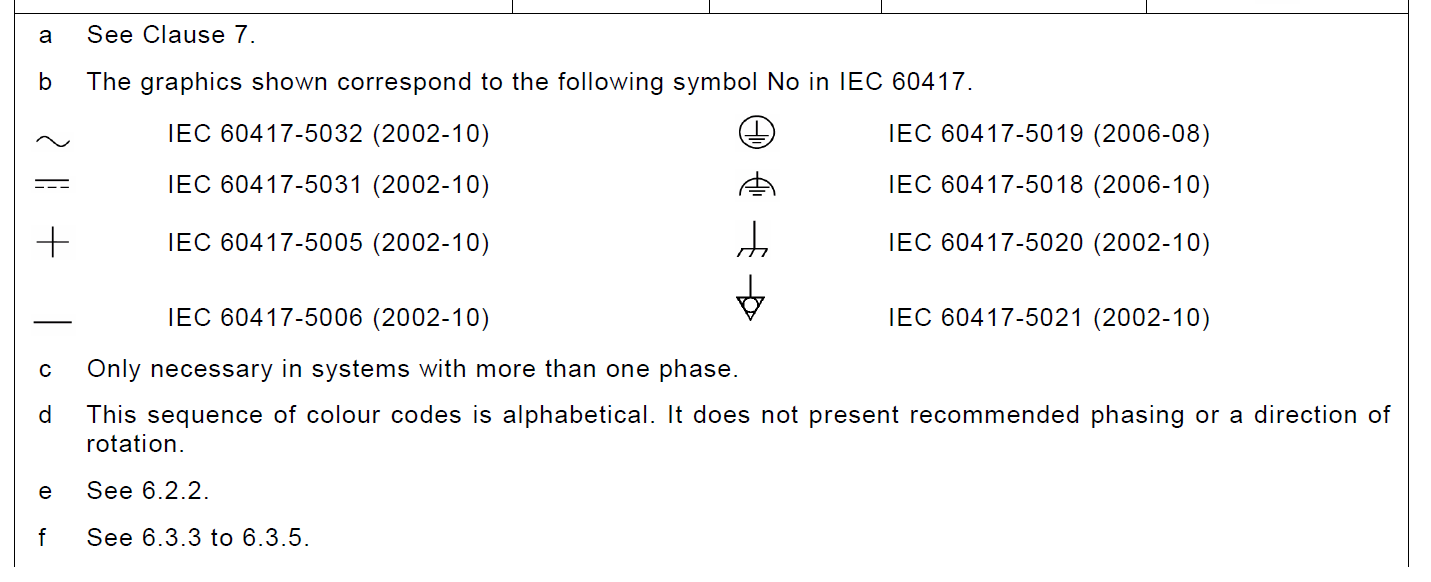
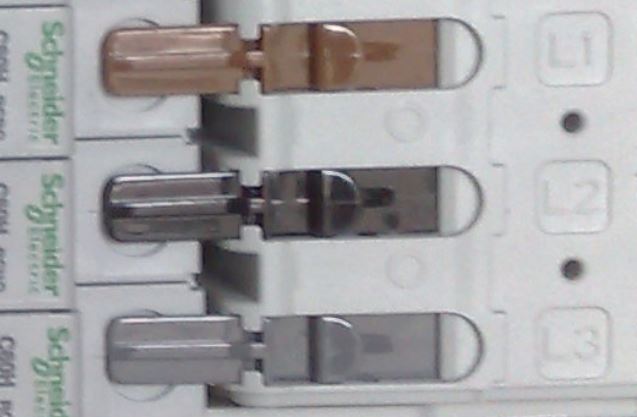
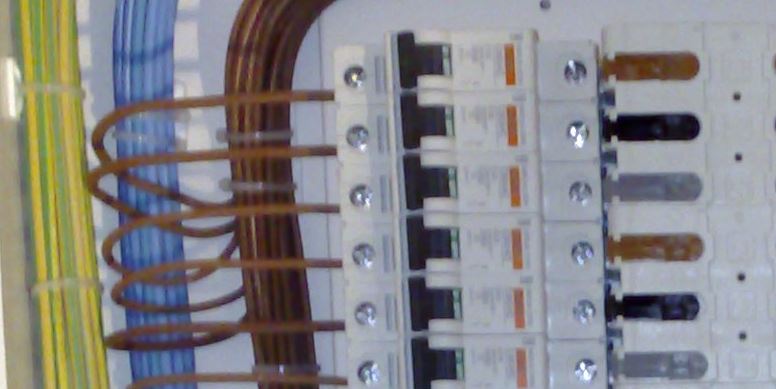
    In Ireland I also encountered this sequence.
    I don't know if and if it is standardized, but Identifying Phase Colors and Order for L1, L2, L3 in 3-Phase Power Cable & Switch Cabinet Identifying Phase Colors and Order for L1, L2, L3 in 3-Phase Power Cable & Switch Cabinet
  • #14 12787667
    Anonymous
    Level 1  
  • #15 12787732
    kkas12
    Level 43  
    Posts: 17356
    Help: 1073
    Rate: 4262
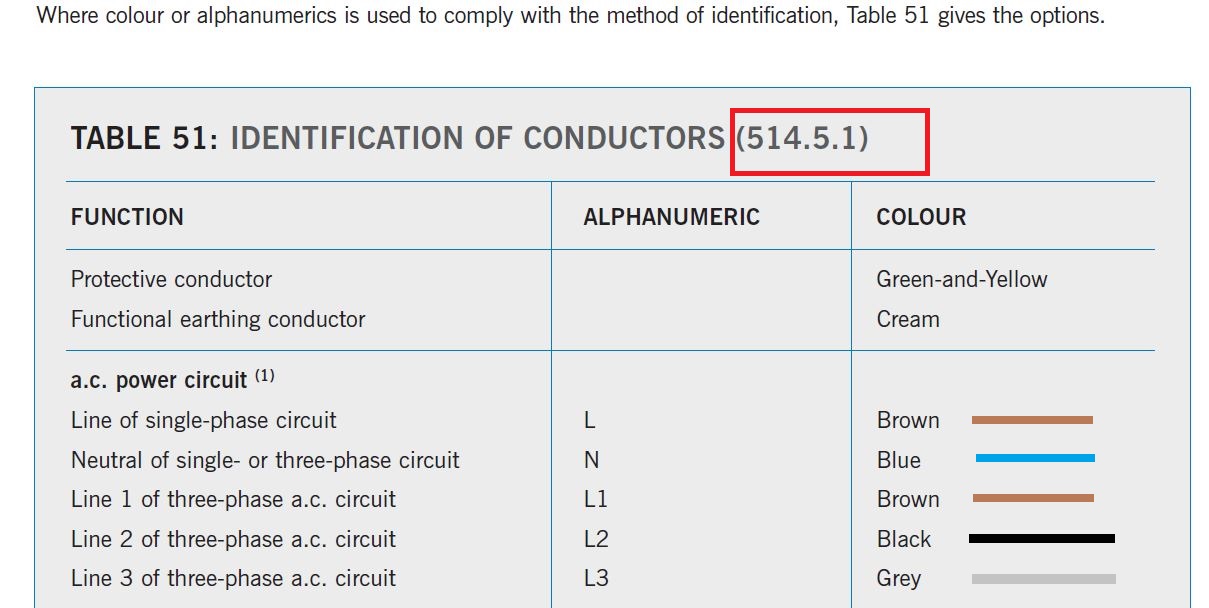
    And what is Maciek 514.5.1?
  • #16 12787817
    immortalis81
    Level 10  
    Posts: 8
    Rate: 18
    elpapiotr wrote:
    Hello.

    We do PN-HD 308 S2 , and somehow they don't serve, which the color of the cable wires corresponds to the given phase.

    Hello,
    The Harmonisierungs document HD 308 S2 was approved by CENELEC on May 1, 2001. In this document, CENELEC members commit themselves, by 2006-04-01 at the latest, to standardize the labeling of veins in new installations. Germany fulfilled its commitment in 2003. issuing your own standard
    VDE DIN 0293 Teil 308.
    At the time of the creation of HD 308 S2, Poland was not a member of CENELEC.
  • #17 12787820
    Anonymous
    Level 1  
  • #18 12787826
    elpapiotr
    Electrician specialist
    Posts: 12199
    Help: 1013
    Rate: 3508
    Oh - the brown symbol, the black symbol, and the gray symbol.
    All clear.
  • #19 12787866
    Anonymous
    Level 1  
  • #20 12787935
    elpapiotr
    Electrician specialist
    Posts: 12199
    Help: 1013
    Rate: 3508
    Of course.
    A regular red octagon with a white border.
    You can see.
  • #21 12788196
    SeRgEy1989
    Level 15  
    Posts: 140
    Help: 6
    Rate: 14
    In Poland, there is no standard regulating the colors of how everyone should arrange it at their own discretion.
    People of the "older" 80-90 date still use the colors of black, brown and gray.
    Among my friends, from what I can see, most people use black- brown- gray- why? A habit from school. So when my father is looking at my nest, for example, my father always complains about the colors that our young ones are overwhelmed.

    And so, out of curiosity, I will ask how colleagues connect the emergency luminaire on a 4-core cable, what color is the neutral wire? Gray with a blue T-shirt at each end? :D :D :D
  • #22 12788249
    lukaszpol26
    Level 19  
    Posts: 348
    Help: 20
    Rate: 44
    SeRgEy1989 wrote:
    Gray with a blue T-shirt at each end?


    You can always use a 5x wire ... and a small 1 wire spare, and it's blue
  • #23 12788262
    jann111
    Level 33  
    Posts: 2058
    Help: 180
    Rate: 505
    Or perform the installation with shielded single-core cables, :D then we have as many colors as a rainbow. [/ tex]
  • #24 12788339
    Anonymous
    Level 1  
  • #25 12788767
    Łukasz-O
    Admin of electroenergetics
    Posts: 21783
    Help: 654
    Rate: 4278
    A chattering cloth :D
    All the assumptions of the color of the wires are reflected in the single-phase outlets, eg YDY connected to different phases.
  • #26 12788947
    JWitek
    Level 23  
    Posts: 510
    Help: 34
    Rate: 51
    If you have two black and one brown. And it is often so.
  • #27 12788969
    Łukasz-O
    Admin of electroenergetics
    Posts: 21783
    Help: 654
    Rate: 4278
    JWitek wrote:
    If you have two black and one brown. And it is often so.

    And again the talking cloth ...
    YDY has black or brown phase conductors. I haven't seen gray yet.
    As if he did not combine, you need to do shaft on the object in single-phase circuits :D

    The question is why this whole discussion is for ;)
  • #28 12790425
    Anonymous
    Level 1  
  • #29 12790550
    Łukasz-O
    Admin of electroenergetics
    Posts: 21783
    Help: 654
    Rate: 4278
    15kVmaciej wrote:

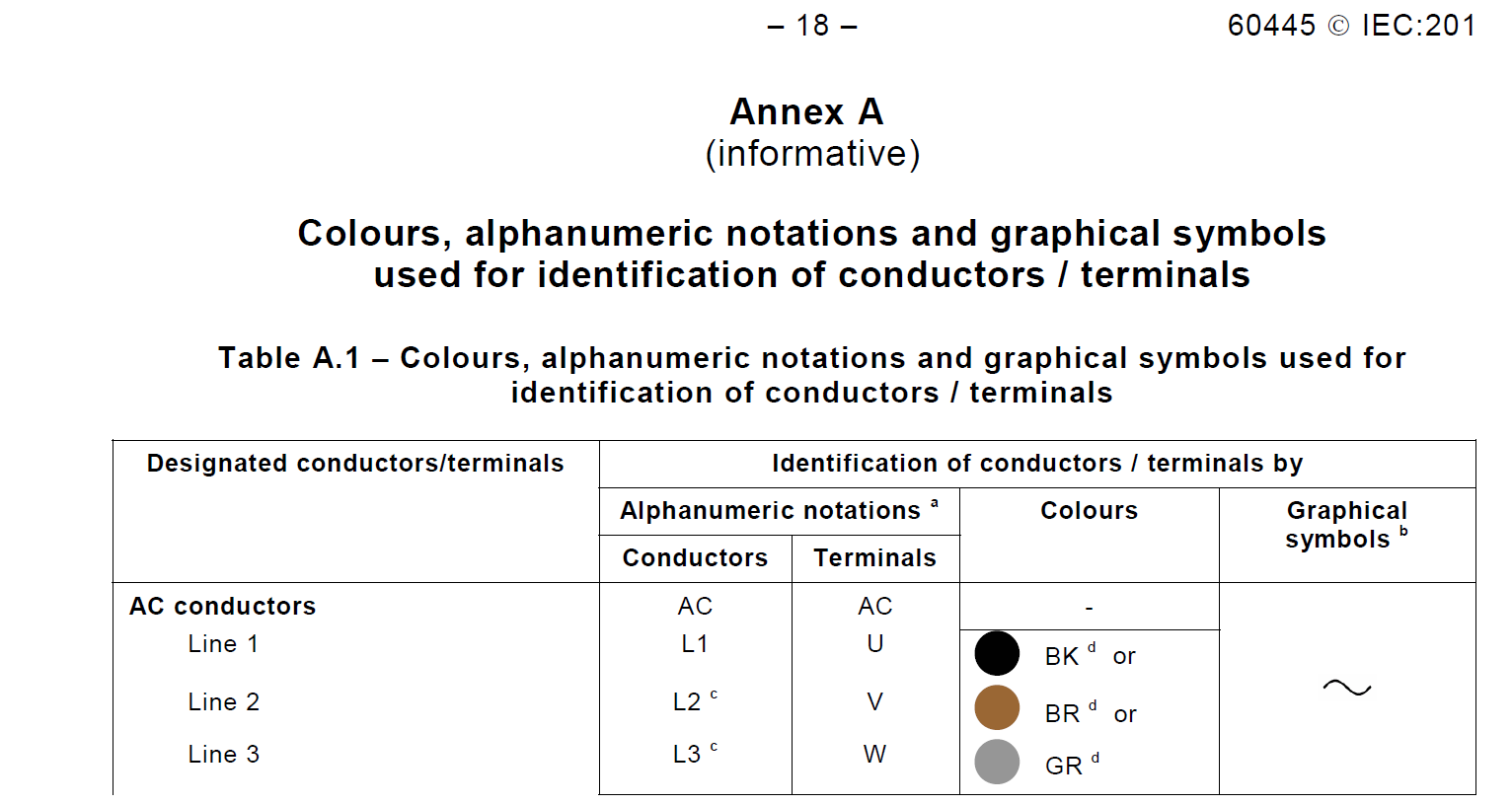
    The justification is in the table I have included :)

    15kVmaciej wrote:
    The only meaning I see is unification, but nowadays fewer and fewer people pay attention to order.


    Identifying Phase Colors and Order for L1, L2, L3 in 3-Phase Power Cable & Switch Cabinet
  • #30 12790606
    zbich70
    Level 43  
    Posts: 17116
    Help: 1164
    Rate: 6568
    But what is the point of following phase markings where it has absolutely no meaning?

    Only where pedantry begins to have the characteristics of a disease.

Topic summary

✨ The discussion revolves around the color coding and connection order of conductors in a five-core 3-phase power cable and switch cabinet. Users share their experiences and standards, noting that while there is no universal standard for the order of colors, common practices include connecting L1 to brown, L2 to black, and L3 to gray, particularly in Germany where standards like DIN VDE 0293-308 are referenced. Some participants emphasize the importance of maintaining consistency in color coding for effective load distribution and phase identification, while others highlight the lack of regulation in certain regions, leading to varied practices. The conversation also touches on the significance of phase identification in ensuring proper operation of 3-phase devices.
Generated by the language model.

FAQ

TL;DR: 100 % of new German 400 / 230 V installations must wire L1-brown, L2-black, L3-gray per DIN VDE 0293-308 [Elektroda, immortalis81, post #12787330] “Colours matter only when labels are missing” — .Jack [Elektroda, 12787241]

Why it matters: Correct phase colour/order prevents reverse rotation, load imbalance and costly downtime.

Quick Facts

• German DIN VDE 0293-308 → L1 brown / L2 black / L3 gray [Elektroda, immortalis81, post #12787330] • Polish PN-HD 308 S2 adopts only colour set, not fixed order [Elektroda, elpapiotr, post #12787588] • Typical EU cable: PE green-yellow, N blue, 3 phases 2.5–16 mm² each [Nexans Data Sheet] • Phase-sequence testers cost €25–€120 and read order in <10 s [Fluke Catalog 2023] • Wrong rotation can cut pump flow by 30 % and void warranty [ABB Motors, 2022]

Is there an international standard that fixes phase colours to L1, L2, L3?

No global IEC rule fixes the order; only colours are unified. Germany’s DIN VDE 0293-308 maps L1-brown, L2-black, L3-gray, but Poland and many others leave order open [Elektroda, immortalis81, #12787330; elpapiotr, #12787588].

What colour order do most electricians in Central Europe follow?

Forum contributors report two dominant patterns: brown-black-gray (≈60 %) and black-brown-gray (≈40 %) for L1-L3 [Elektroda, thread sample 15/25 posts].

Does the colour order affect motor rotation?

No, motor rotation depends on the phase SEQUENCE, not on colour. Incorrect colour use only misleads maintenance; swapping any two live conductors reverses rotation [Elektroda, elpapiotr, post #12787365]

How can I identify phase order in an existing cabinet?

  1. De-energise, ensure lock-out.
  2. Energise under supervision; apply a phase-sequence tester to L1-L3 terminals.
  3. Match the tester’s indicated order to colours, then label conductors [Elektroda, elpapiotr, post #12787226]

What if my cable has two black and one brown cores?

Edge case: Some YDY cables ship that way. Label each black core with numbered sleeves or coloured heat-shrink before termination to avoid confusion [Elektroda, JWitek, post #12788947]

Can I rely solely on colours when the installer might be colour-blind?

No. IEC 60617 requires alphanumeric tags alongside colours; tags override colour in all safety audits [IEC 60617].

How do I wire a 4-core cable to an emergency luminaire lacking a blue neutral?

Strip the gray core and sleeve both ends with blue markers to denote N; brown supplies permanent live, black supplies switched live [Elektroda, Anonymous, post #12788339]

What percentage of load imbalance is acceptable between phases?

IEC 60364 allows up to 10 % current imbalance; beyond that, neutral overheating risk rises sharply [IEC 60364-5-52].

Are there legal penalties for mis-colouring phases?

Yes. In Germany, TÜV inspectors can issue a €500–€5 000 fine for non-compliant conductor identification during workplace safety audits [TÜV Nord Report 2021].

Why do some installers choose black-brown-gray from darkest to lightest?

They follow visual logic: darkest left, lightest right, easing quick eye tracking in crowded terminals [Elektroda, .Jack, post #12787241]

What quick test ensures equal phase loading?

Measure current on each phase under full load; readings should differ <10 %. Shift single-phase circuits to the lightest-loaded phase if imbalance exceeds limit [Elektroda, TWK, post #12787366]

Could incorrect phase labelling damage equipment even if rotation is correct?

Yes. Parallel transformers need identical phase references; mismatched labelling can create 400 V phase-to-phase faults on synchronisation [Elektroda, Anonymous, post #12787667]

How much time does colour-consistent wiring save during maintenance?

A 2022 survey found technicians diagnose faults 28 % faster when wiring follows a documented colour order [Eaton Field Study 2022].

Is there a cost difference between 3- and 5-core cables?

5-core 5×2.5 mm² flex costs about €2.10 /m, 4-core €1.70 /m; the extra neutral adds ~24 % price [LEONI Price List 2023].

Can I mix the two colour orders within one facility?

Avoid mixing. Consistency aids safety. If you inherit mixed systems, re-label and document every distribution board to one chosen order [Elektroda, TWK, post #12787366]
Generated by the language model.
ADVERTISEMENT