logo elektroda
logo elektroda
X
logo elektroda

A selection of bistable relays for hallway and stairwell lighting control

ekmir 4746 18
Best answers

How can this hallway-and-stairwell lighting scheme be implemented with bistable relays?

It can be done with DIN-rail bistable relays, and one forum reply claimed the whole scheme is possible with four ordinary bistable relays [#14128721] A more concrete proposal was to treat the installation as three lighting circuits and use three bistable relays, for example BIS-411, matched to the momentary pushbuttons for each circuit [#14130683] If only single-contact pushbuttons are available, add two 2-pole 230 V relays to create the needed double contacts for the combined control functions [#14130683] For the more complicated floor-to-floor interlocking where one action must switch the stair light and one hallway light off/on together, another reply suggested using 4 bistable relays plus 2 electromagnetic relays [#14130841]
Generated by the language model.
ADVERTISEMENT
Treść została przetłumaczona polish » english Zobacz oryginalną wersję tematu
  • #1 14128141
    ekmir
    Level 24  
    Posts: 1761
    Help: 18
    Rate: 406
    I would very much appreciate your help in selecting the most favourable solution for the implementation of the lighting control of the hallway (ground floor) - staircase - hallway (attic).

    The lighting on/off would be realised as follows:
    1. switching on/off only the lighting in the hallway on the ground floor (momentary switch in the hallway on the ground floor),
    2. switching on/off the lighting in the entrance hall on the ground floor and in the stairwell at the same time (second momentary switch in the entrance hall on the ground floor),
    3. switching on/off only the lighting in the first floor entrance hall (momentary switch in the first floor entrance hall),
    4. switching on/off the lighting in the first floor entrance hall and the staircase at the same time (second momentary switch in the first floor entrance hall),
    5. switching on/off the lighting in the hallway on the ground floor + in the staircase (one momentary switch in the hallway/mezzanine) and switching on/off the lighting in the hallway on the first floor + in the staircase (second momentary switch in the hallway/mezzanine).

    Please give me a hint as to how such a lighting arrangement can be implemented using bistable relays.
  • ADVERTISEMENT
  • #2 14128233
    charrlie
    Level 13  
    Posts: 56
    Help: 3
    Rate: 9
    Hi. Is there any installation already done or are the wires yet to be laid?
  • #3 14128302
    ekmir
    Level 24  
    Posts: 1761
    Help: 18
    Rate: 406
    The installation is already done. The wires from the lighting points and the boxes (PK60) of the on/off buttons are led to the electrical board.
  • #4 14128336
    elpapiotr
    Electrician specialist
    Posts: 12200
    Help: 1013
    Rate: 3512
    Well, merge in this board and you have a problem.
  • #5 14128387
    ekmir
    Level 24  
    Posts: 1761
    Help: 18
    Rate: 406
    Yes, I would like colleagues who have or have done such controls to suggest which solution is best to use ?
    Based on which relays?
  • #6 14128467
    qadam12
    Level 27  
    Posts: 1034
    Help: 62
    Rate: 254
    ekmir wrote:
    what is the best solution to use ?
    Based on which relays ?

    Hello.Solution recommended by relay manufacturer.Which relays-bistable.
  • ADVERTISEMENT
  • #7 14128471
    elpapiotr
    Electrician specialist
    Posts: 12200
    Help: 1013
    Rate: 3512
    Based on bistable relays, for TH 35 rail. :D
  • #8 14128478
    djrobak81
    Level 10  
    Posts: 27
    Help: 2
    Rate: 7
    i've been reading about the various solutions people install in their homes and I've come to the conclusion that sometimes it's too much form over substance, because from what our colleague writes, we have 5 switches in 3 rooms
  • #9 14128492
    ekmir
    Level 24  
    Posts: 1761
    Help: 18
    Rate: 406
    elpapiotr wrote:
    Based on bistable relays, for TH 35 rail. :D

    Very funny. Likes a Fellow to entertain like this ...
  • ADVERTISEMENT
  • #10 14128504
    retrofood
    VIP Meritorious for electroda.pl
    Posts: 31317
    Help: 1140
    Rate: 4785
    Are you expecting a commercial offer or an advertisement, my friend? There are many manufacturers, offers even more.
  • ADVERTISEMENT
  • #11 14128619
    ekmir
    Level 24  
    Posts: 1761
    Help: 18
    Rate: 406
    I would like to implement this via BIS-412. However, I wonder if I will still need to use SEP-01.
    1 and 2 could be solved by one BIS-412 applied to hallway lighting (local control) and hallway and staircase lighting (central control). Analogously, 3 and 4 could probably be solved.
    Only how to implement 5 ? There is still the problem of one and the other BIS-412 turning on/off the light in the staircase.

    How to solve this ?
  • #12 14128629
    BILGO
    Level 38  
    Posts: 4452
    Help: 393
    Rate: 723
    On the bis-412 you need TWO momentary switches for the central control.... and on yours you probably have one ?

    Added after 1 [minute]:

    Item 5 will be linked to items 1,2 and 3,4 at the same time ;)
  • #13 14128676
    Anonymous
    Anonymous  
  • #14 14128721
    BILGO
    Level 38  
    Posts: 4452
    Help: 393
    Rate: 723
    Bronek22 wrote:
    I don't see how this can be done on "off-the-shelf pads" for 230V.

    There is an option, but it will have one disadvantage.... ;)
    It is possible to do all this on 4 ordinary bistable relays....
  • #15 14128782
    ekmir
    Level 24  
    Posts: 1761
    Help: 18
    Rate: 406
    Integra is planned. However, realising this on Integra requires the use of actuators anyway.
  • #16 14128832
    akard
    Level 13  
    Posts: 56
    Help: 5
    Rate: 4
    If you are planning an Integra, after all, you have the INT-IORS module as an executive device (relay outputs) for ~230V control.
  • #17 14128882
    ekmir
    Level 24  
    Posts: 1761
    Help: 18
    Rate: 406
    Yes, you can use the INT-IORS expander. However, in the event of its failure, we have no lighting in this part :(
    For this reason, I am planning an STR-421 for local control of the roller shutters and an INT-IORS expander for central control.

    Besides, in the case of controlling this lighting, the cost of the INT-IORS expander would be higher.
  • #18 14130683
    pafciowaw
    Automation specialist
    Posts: 2439
    Help: 480
    Rate: 364
    I don't really understand what the problem is.
    From points 1-6 it appears that you have 3 "light points" (ground floor hallway, ground floor hallway and staircase) -> you can use the simplest 3 bistable relays, e.g. BIS-411 http://fif.com.pl/produkt/26/247;
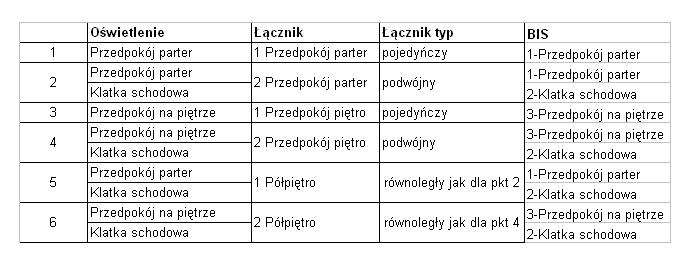
    Match them accordingly with single or double contact momentary switches:
    A selection of bistable relays for hallway and stairwell lighting control
    Table created from the contents of post#1 (points 1-6)

    Added after 45 [minutes]:

    If the connectors are only single pin then you can for para. 2,4,5 and 6 use an additional two 2P relays for 230 V and double connections can be obtained on their contacts.
  • #19 14130841
    BILGO
    Level 38  
    Posts: 4452
    Help: 393
    Rate: 723
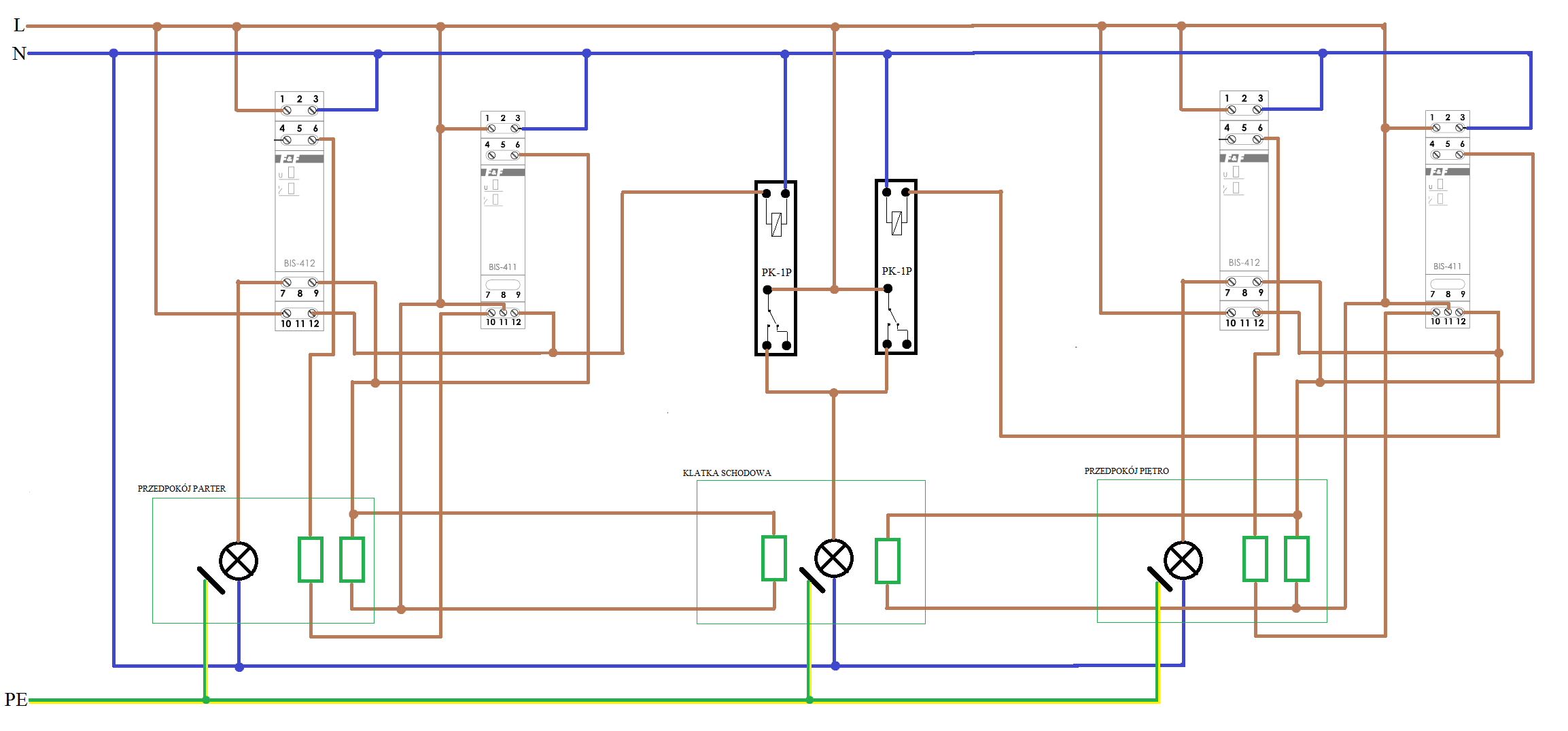
    Yes, but what if the light in the entrance hall on the ground floor is on and someone leaving the halfway house wants to switch on the light in the cage and in the entrance hall on the ground floor (there is one button for this).... the light in the staircase will automatically switch on and the light in the hallway will switch off....

    It is necessary to use 4 bistable and 2 electromagnetic.

    EDIT
    I am inserting a simple diagram of my idea, to my mind it should work as intended :D
    A selection of bistable relays for hallway and stairwell lighting control
ADVERTISEMENT