







I have a Raspberry Pi Zero and I'm thinking of remotely automating my house light switches. I was thinking about Z-wave but this solution is very expensive and as I will only be taking delivery of the flat in a few months I will be able to pull the cables up to the switches quietly.
What I want to do
The aim is to enable remote control of the lights using a Raspberry Pi Zero (e.g. Home Assistant), while still being able to switch the lights on/off with switches in the rooms.
What's my idea
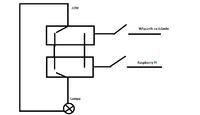
I'm not a professional electrician so I came up with something like this for now:
1. For now my idea is to run a cable from the Raspberry Pi GPIO (5v) and an additional circuit from the 220v box under each switch I want to automate.
2. Next, I would mount 2 relays under the switch on the wall - one 220v (switched on/off by an additional 220v circuit) and one controlled from the Raspberry Pi GPIO (5v).
3. I would connect both relays to each other so that the light would switch on when either voltage is on or off on both relays)
This way, I assume I will be able to control the light remotely as well as the switch on the wall and protect myself from the situation if my Raspberry Pi dies.
My questions
1. Does this diagram/solution above make sense?
2. What relays will work best for this? The cheaper the better. I don't know.
3. The disadvantage of this solution is that by controlling the light I won't have any feedback (whether it's currently on or not). I can pull another input circuit from the Raspberry Pi GPIO but don't know the best way to do this.
What I want to do
The aim is to enable remote control of the lights using a Raspberry Pi Zero (e.g. Home Assistant), while still being able to switch the lights on/off with switches in the rooms.
What's my idea
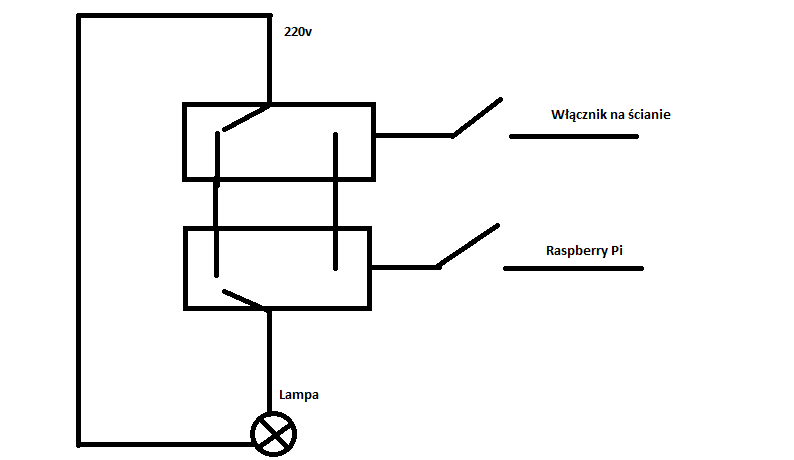
I'm not a professional electrician so I came up with something like this for now:
1. For now my idea is to run a cable from the Raspberry Pi GPIO (5v) and an additional circuit from the 220v box under each switch I want to automate.
2. Next, I would mount 2 relays under the switch on the wall - one 220v (switched on/off by an additional 220v circuit) and one controlled from the Raspberry Pi GPIO (5v).
3. I would connect both relays to each other so that the light would switch on when either voltage is on or off on both relays)
This way, I assume I will be able to control the light remotely as well as the switch on the wall and protect myself from the situation if my Raspberry Pi dies.
My questions
1. Does this diagram/solution above make sense?
2. What relays will work best for this? The cheaper the better. I don't know.
3. The disadvantage of this solution is that by controlling the light I won't have any feedback (whether it's currently on or not). I can pull another input circuit from the Raspberry Pi GPIO but don't know the best way to do this.
