logo elektroda
logo elektroda
X
logo elektroda

How to Power and Control a 12V Danfoss Solenoid Valve via Arduino Uno and Wireless Sensor

PawelP930 4899 10
Best answers

Can I power a 12V Danfoss solenoid valve from an Arduino Uno and control it wirelessly, or do I need additional power supplies and switching hardware?

Yes, but you should power the 12V valve from a separate 12V supply and let the Arduino control it through a relay, not try to make 12V directly from the Arduino’s 5V output. The valve coil is 18W, so at 5V it would need over 3A even before inverter losses, and the inverter would also have to run continuously to keep the valve energized [#15444898] A 5V relay module with protection is a suitable interface: when the received temperature drops below 50°C, the Arduino can set an output high, energize the relay, and the relay contacts switch the 12V line to the solenoid valve [#15445632][#15447071] If the valve must stay powered for hours, this is a rather uneconomical solution, so it may be better to choose a valve that only draws power while opening or closing [#15447104]
AI summary based on the discussion. May contain errors.
ADVERTISEMENT
This content has been translated flag-pl » flag-en View the original version here
  • #1 15444829
    PawelP930
    Level 8  
    Posts: 10
    Hello

    I'd like to put an electro-valve in my house, which will cut off the water supply to my boiler if the temperature of the circulating water drops below 50 degrees C. I would like to put the whole thing on an arduino, which would receive the temperature measurement via radio from another arduino already mounted, then convert the 5V voltage into the 12V necessary to control the electro-valve.

    Can it be done this way, or is it necessary to use what additional power supplies?

    I have decided on a solenoid valve like this:
    http://valveselector.danfoss.com/showresult.aspx?v=pl&system=Heating&medium=Water&function=NO&size=G34&coilvoltage=DC_12V

    Inverter (I don't want to make an advertisement here, just the first image from the internet)
    http://www.bro.net.pl/Obrazki/2AB88EC1-0B42-4770-A373-D93B4FCDD75F.JPEG
  • ADVERTISEMENT
  • #2 15444898
    kindlar
    Level 42  
    Posts: 7864
    Help: 916
    Rate: 1616
    Have you checked the wattage of the 5V power supply to power this valve? The solenoid is 18W which at 5V gives you over 3A not counting the losses on the inverter, which also has to withstand continuous operation to hold the solenoid of the valve closed.
    If you pulled up 12V to power the valve you could easily drop down to 5V for the other circuits.
  • ADVERTISEMENT
  • #3 15444913
    Krzysztof Kamienski
    Level 43  
    Posts: 21893
    Help: 2033
    Rate: 5162
    Relays missing ?
  • ADVERTISEMENT
  • #4 15445632
    PawelP930
    Level 8  
    Posts: 10
    The relay is a good solution, but I have a few doubts:

    1) I receive the temperature measurement via radio, that is, when I receive a temperature lower than 50 degrees, I put a high state on a given pin which is connected to the relay and it activates the circuit with the coil ?

    2) which relay should I choose?

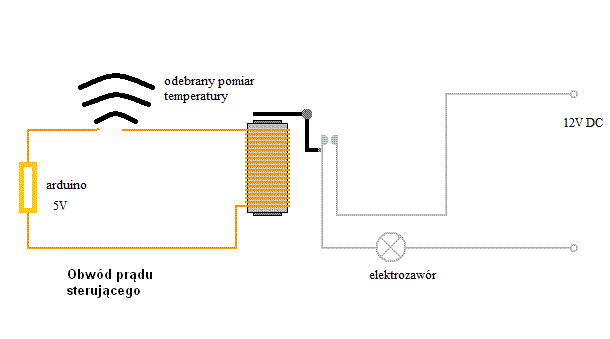
    3) this is more or less how it should look like ? :)
    How to Power and Control a 12V Danfoss Solenoid Valve via Arduino Uno and Wireless Sensor

    So I then quietly use the power supply to turn on the valve, yes?
  • #5 15445674
    Krzysztof Kamienski
    Level 43  
    Posts: 21893
    Help: 2033
    Rate: 5162
    PawelP930 wrote:
    3) this is more or less how it should look like
    This diagram of yours sorry, scares you :cry: Relay dedicated to Arduino, 5V, with protection, some pennies.....Temperature too high, you set ,,0'' on output µC, relay lets go and disconnects solenoid valve or this ,,something''. Is that so difficult? By the way, familiarise yourself with the symbols of the electrical and electronic components, because from this it hurts your eyes :D
  • ADVERTISEMENT
  • #7 15445788
    Krzysztof Kamienski
    Level 43  
    Posts: 21893
    Help: 2033
    Rate: 5162
    Yes, that's the transmitter.
  • #8 15446902
    kindlar
    Level 42  
    Posts: 7864
    Help: 916
    Rate: 1616
    Are you assuming that the 12 V coil of the central heating valve will be controlled by 5 V?
  • #9 15447071
    PawelP930
    Level 8  
    Posts: 10
    So what should it look like in the end?
    I thought the relay solves everything, the valve would be powered by a 12V supply with one wire going to the relay and the relay would be controlled by this 5V?
    Is there anything else I'm missing from this circuit?
  • #10 15447104
    andrzej55
    Level 37  
    Posts: 3000
    Help: 306
    Rate: 373
    And so for hours this valve will draw ~20W from the grid? A very uneconomical solution.
    Maybe look for another solenoid valve that only draws power when closing/opening.
  • #11 15448296
    PawelP930
    Level 8  
    Posts: 10
    Andrew55, thanks for the valid observation.
    Thank you all for your help, do you have any suggestions? anything else I should pay attention to?
ADVERTISEMENT