logo elektroda
logo elektroda
X
logo elektroda

How to modernise old aluminium wiring for future home automation in OWT-67 flat?

marcintr 18354 26
ADVERTISEMENT
Treść została przetłumaczona polish » english Zobacz oryginalną wersję tematu
  • #1 15536010
    marcintr
    Level 9  
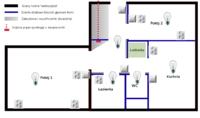
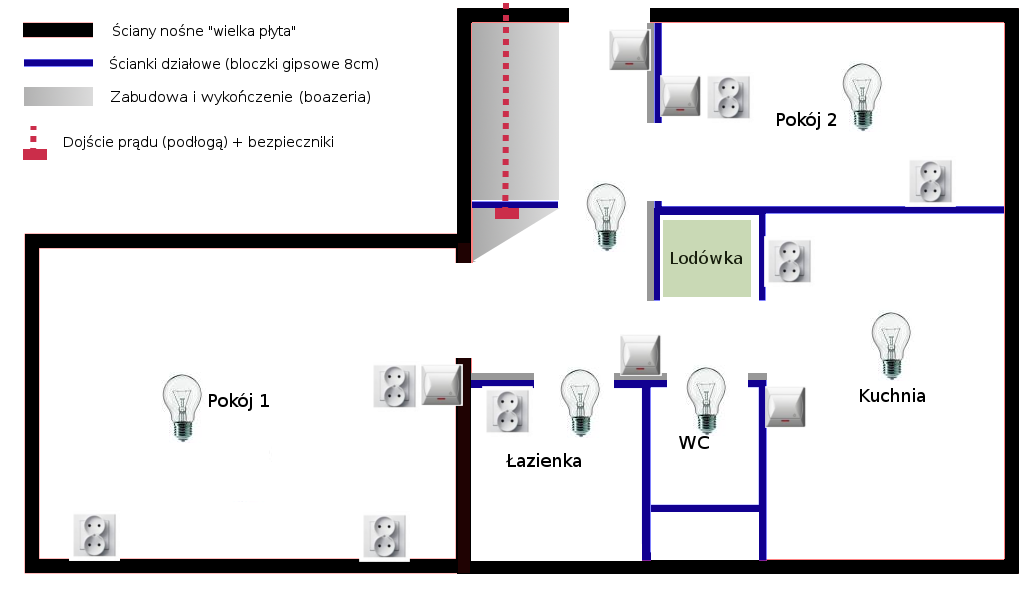
    In connection with a small renovation (floors, tiles, smooth walls), I would like to modernise the electrical installation which is in a deplorable state (mostly aluminium) and is becoming increasingly difficult for me to service (crumbling wires, oxidation on connectors). The topic is on the borderline between the Electrical and Automation sections, but I am posting it here because it is mainly about adapting it for automation in the future. I attach below a diagram of the flat with the most important things marked (block OWT-67):
    How to modernise old aluminium wiring for future home automation in OWT-67 flat?

    Major General Objectives
    1) To improve the safety of the installation.
    2) The refurbishment is to be carried out at the lowest possible cost.
    3) The installation is to allow future use of home automation (min control of lighting and individual sockets) without a major replacement of the entire installation
    4) I am not ripping out the panelling and built-in wardrobe (they are in relatively good condition)
    5) I am not cutting furrows in the large slab
    6) An extra 2 sockets in the kitchen (one high up for the cooker hood and gas hob)

    I have adopted solutions on this basis:
    Central large surface-mounted switchgear above the fridge. The location is in the centre of the flat, unobtrusive, on the intersecting partitions where I can comfortably make furrows. Each point separately pulled up to the distribution board with separate cables:
    Sockets: 3x2.5
    Lighting switches: 3x1.5 or 2x1.5
    Lighting: 3x1.5 or 2x1.5
    In the switchgear the cables will be connected by WAGO connectors or some kind of rail in the „classic”way, so that they work as standard and in the future allow for the connection of some electronics (relays, PLC or whatever will be done there)
    Switchgear connected to the current „plugs” with two 3x4mm cables (I have two fuses: lighting and sockets and I would like to leave it that way).

    Cable routing
    I cut the furrows and lay the cables myself. Before covering the cables, I call in an electrician who connects everything for me and then takes measurements.
    I forget about the old installation – I disconnect the circuits at the fuses, disconnect and insulate all the cables in the current boxes.
    Luckily I already have the lighting supplied to the boxes with copper cables, so I don't have to forge the ceilings – in the box connecting to the new installation :)
    The sockets in the rooms are connected to the distribution box via channels in the floor (the floor is approx. 5-6 cm thick, there is some kind of insulation layer below, only underneath is the reinforced concrete slab)
    The sockets in the bathroom, kitchen and light switches go in the wall upstairs as standard.

    The wiring diagram itself is presented here:
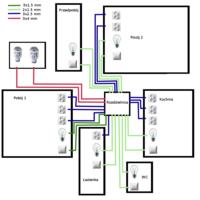
    How to modernise old aluminium wiring for future home automation in OWT-67 flat?

    Questions:
    1) Is the idea itself ok? The flat is small, the switchboard is in the centre, the cables won't be that much more.
    2) Can the switchboard be above the fridge (30-40 cm)? Could it be disturbed by any moisture from behind the fridge?
    3) How close to the electrical cable can a shielded twisted pair go in the wall? Is it worth redundantly running it to all points (socket, switch, light).
    4) What would you recommend for a switchboard to professionally splice the wires? I'd like to point out that right now it's only supposed to be connecting wires. Electronics/automatics only in the future. It would be worthwhile if it could be easily „undone” in the future.
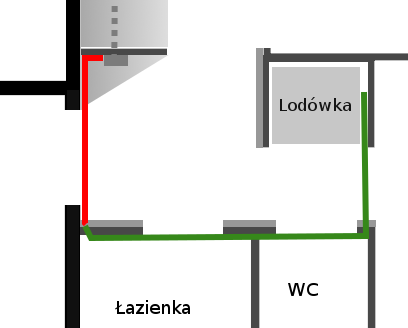
    5) Can the 2 main cables supplying power from the fuses to the switchgear go as below (red - PVC cable duct screwed to the load-bearing wall in the pavilion, green - standard in the wall, all "up")
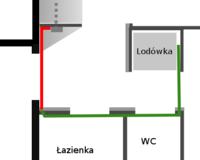
    How to modernise old aluminium wiring for future home automation in OWT-67 flat?
    6) When using decent cables, can I let go of the cable grommets in the walls? The walls are 8cm thick, there are already micro cracks in a couple of places and I'm worried that tearing out the grooves for the conduits might weaken them too much - I'm talking of course about the partition walls (probably made of gypsum blocks).
  • ADVERTISEMENT
  • #2 15536073
    Łukasz-O
    Admin of electroenergetics
    Completely wrong assumptions. Don't take on something you don't understand yourself. Reading your post it is obvious that you have little to do with installations.
    First of all, invite an electrical company for a site visit and explain your intentions. This is where you should start, and it should be a company, not Mr Mietek the maintenance electrician.
    You can't do it cheaply, and there is no such thing as a system for the future. After a while, all innovations become backward and incompatible.
  • #3 15536094
    marcintr
    Level 9  
    Thank you Luke for your interest in the topic, I presume you are well versed in installations, I am even more sorry that your criticism is not substantive and does not direct me to gain additional knowledge. I don't expect anyone here to teach me how to create an installation or design it for me for free. On the other hand, writing out some of the main objections would point me to the points where I need to look for information.

    Quote:
    Totally wrong assumptions.

    You are thinking of assuming
    1) A single central switchboard?
    2) Connections in the switchboard 'hard wired' with no relays/controllers?
    3) A separate circuit to each socket?
    4) Thickness of cables? (I've heard to do all 2.5, but these days it's rare for a bulb to be >10W)

    Quote:
    Don't take on something you don't understand yourself.

    That's why I'm writing on the forum and not sitting around with an impact hammer :) I also have no intention of doing this without the supervision of a qualified electrician. I do have some expectations, i.e. the ability to cut individual socket circuits and control lighting both from switches and externally from 'software' (arduino/raspberry pi). When building a house before you buy a project with certain solutions, you would want to know the possibilities and make an informed choice. Then you can also participate in simple works with a professional.

    Quote:
    Reading the post it is clear that you have little to do with installations.

    I have helped an electrician do a "classic" installation several times. I also searched this forum before asking. Although I have little knowledge on the subject I know, unfortunately, that the installation that the "professionals" did cries to heaven. The cables go quite "fancy", there are "pins" in the sockets but they are not earthed. The state of this installation endangers the health and lives of the residents. Simple cable replacement is out of the question - there are no pessels.

    Quote:
    It can't be done cheaply, and there is no such thing as a system for the future.

    A cheap smart home can't be done - that's why I'm not doing it now. My expectations, on the other hand, are pretty simple - cut off sockets and control the lights. That's it.
    If there is to be a relay on the circuit with the socket - I want the cable to be laid that way, only that I don't want to put a relay there now and have the current in the socket "permanently". The issue of allowing lights to be switched on/off from outside the circuit in the future is probably not insurmountable either - it has been covered many times on this forum.

    Quote:
    First invite the electrical company for a site visit and outline your intentions. This is where you should start, with the company, not Mr Mietek the maintenance electrician.

    I spoke to one company recently and they told me that they have such equipment that they will rip out grooves in reinforced concrete with no problem. I don't think I need to explain to you what such a thing can end up with.
    I have been involved in programming professionally for many years and I know very well that inviting a company guarantees nothing, after the miracles I have seen. I think it works the same way in installations. Anyway, before renovating the flat I need to improve this installation, because leaving it is a very bad solution. I'm not going to do it "foolishly" myself. I'll have the initial design done by someone who deals with installations and who will sign off on it, connecting the cables too. However, I need the concept itself so that someone doesn't push me into a solution that is only convenient for them and so that I can control these two functions (sockets, lights) from outside the electrical installation in future.
  • Helpful post
    #4 15536521
    pafciowaw
    Automation specialist
    Not a bad concept, plus you can see that you know what you want :)
    To start with a switchgear-crossover, and then a switchgear-control room....
    I would bring 3x1.5+PE to the lighting switches (e.g. touch dimmers in a traditional installation), and for automation it will also be useful (e.g. low voltage switch + infrared port).
    On the other hand, the switchgear must "for today" include RCDs for "wet" rooms - and this will hopefully be handled by a professional as you yourself have pointed out:
    "...The initial design will be done for me by someone who deals with installations and who will sign off on it, the cable connection also..."
    Good luck :)
  • ADVERTISEMENT
  • Helpful post
    #5 15537414
    Łukasz-O
    Admin of electroenergetics
    To begin with:
    marcintr wrote:
    I do not forge furrows in the great slab

    i
    marcintr wrote:
    Recently I spoke to one company and they told me that they have such equipment that they cut furrows in reinforced concrete without any problem. I don't think I need to explain to you what such a thing can end up like.

    and
    marcintr wrote:

    I forge the furrows and lay the cables myself.

    So are you finally forging or not forging, because one contradicts the other.

    marcintr wrote:
    You are thinking of setting up
    1) A single central switchboard?
    2) Connections in the switchboard "hardwired" without relays/controllers?
    3) A separate circuit to each socket?
    4) Thickness of cables? (I've heard to do all 2.5, but these days it's rare for a bulb to be >10W)


    Re.1 This is going to be a big cabinet, you are planning to mount the switchgear above the fridge. What do you want to fit in it? Right now I am putting together a 12x24mod cabinet and I barely fit in it, it is 206cm high. Not to mention that fitting a switchboard over the fridge is nonsense.

    Re.2. You already need to plan and leave space for relays and junction strips. By the time the target installation is up and running you will have put bridges on them I would also use operating type switches if I were you. Sometimes it is useful to be able to quickly "bypass" the system during a failure of e.g. a controller - and this happens.
    Ad.3: Yes and no. It all depends on how you want to expand the installation and what you expect from it.
    Ad.4 Not cables! Cables are terrestrial, packing them in walls is a waste of money and time. Use wires. Don't bother running wires to the 2x1.5 switches. At least 4x1.5 plus twisted pair.

    I think you should read up on smart installations and how to run wires first. There are several systems.
  • Helpful post
    #6 15545112
    ditomek
    Level 22  
    @Lukasz-O as I read your posts I get the impression that you want to disgust a colleague marcintr doing this installation. I know, you're probably about to write that this is constructive criticism :-)
    @marcintr , What logic do you want to base the system on, is it going to be a PLC or some dedicated controller, Which one?
    It depends on this what to do next....
    Greetings
  • #7 15550747
    marcintr
    Level 9  
    Thanks for your replies :)

    Quote:
    It's finally forging or not forging, because one contradicts the other.

    @Lukasz-O I am forging, but not in load-bearing inputs (reinforced concrete), only in partitions. The professionals said that they have such furrowing machines that it's all the same to them. And I don't care. I cut 2cm, my neighbour cuts 2cm and the floors above rest on an 11cm slab instead of 15.

    Quote:
    You are planning to install a switchboard above the fridge. What do you want to fit in it?

    It's a small flat. 2 rooms and a kitchen. The choice fell on this wall because of the "logistics" ;) It's the focal point of the flat and the descent of virtually all the partitions (in which I can forge as much as I want). If I were designing the installation for a new house, I certainly wouldn't choose this location. But this cloister is in the hallway all built up with wardrobes and panelling and it's hard to make a convenient space there.
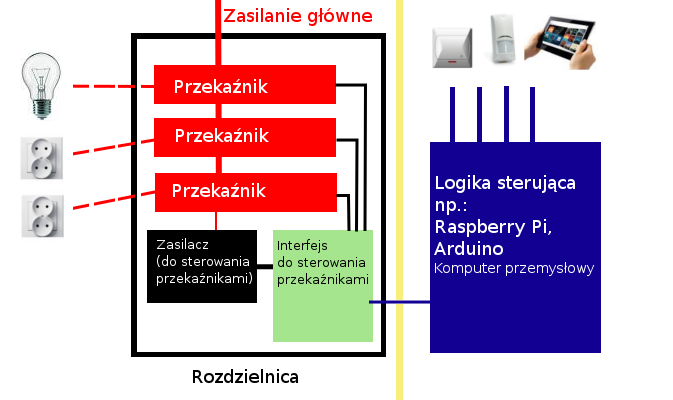
    All in all, the target is to fit some 14 relays (light bulbs, sockets), a differential, a couple of overcurrent circuit breakers in the switchboard. Well, and possibly something to "read" from the cables routed from the switches (although it's possible that the switches will fall completely out of the switchboard). For the moment as you wrote - I'll bridge it all.

    My initial design envisaged this content of the switchboard (to convey the idea I reduced the number of relays, omitted the fuses):

    How to modernise old aluminium wiring for future home automation in OWT-67 flat?

    On the other hand, you pointed out to me a very important thing - leaving the "manual" mode on the switchgear. And I can see that I will have to give the possibility to control the lighting via the (bell) switches and some kind of manual switching of all the sockets at switchboard level in case the "Control Logic" fails

    Do you think that having to control:
    9 sockets and 7 light bulbs a 3x20 switchboard will suffice (one that will fit above the fridge with no problem)?

    I'd like to point out once again that I won't be bridging this myself in the switchboard, but will have a professional do it for me. Both the current bridging and later switching on the automation with manual mode.

    Quote:
    What logic do you want to base the system on, should it be a PLC or some dedicated controller, Which one?


    @ditomek

    I was thinking of my own solution (have a look at the attached diagram). Except that I have a teensy bit of experience in programming, as opposed to electrical, and I know I can handle it.

    However, I would like to point out that these are very(!) preliminary thoughts and I will be interested in ready-made complex solutions (including PLC), and the possibility of integration, before successively implementing this. I am in no hurry to introduce automation as opposed to replacing the plant.

    I was tentatively thinking of using 2 * raspberry Pi (both in the diagram in the blue section):
    Main system:
    As the main control, both electrical and other systems such as alarm, audio system, weather station, displays, communication with android, etc.

    Security system
    Isolated from the LAN, as an "adapter" (between the main system and basic components such as switchgear, alarm) for safety and to respond to unusual situations (failure, intrusion into the main system, software error), e.g:
    - exceeding the on/off limit of relays within a reasonable time period.
    - receiving information from a switch and not reacting by switching the light on
    - lack of communication with the main system
    - attempt to activate an alarm when there were no signals from sensors
    - other critical parameters
    This system would cut the main system off from control when safety parameters are exceeded and take over control of very basic elements (light switching), powering the service socket.

    The possibilities of 'smart' homes are almost limitless and are developing very rapidly - so I am not focusing on this at the moment. On the other hand, I would like to lay the electrical installation so that it does not block the possibility of control in the future.
  • #8 15550858
    ditomek
    Level 22  
    @marcintr All in all, you still haven't shown a concrete solution.
    I'm currently developing my "line" of home control devices myself so I know that things like this don't take off overnight.
    If you arrange the cables in a star topology with the switchgear as the focal point, then this solution has the greatest potential and is the most expensive to implement. As long as you do not build all the devices, the sockets will be powered continuously and you will use ordinary switches to switch off the lights
    The switchboard you propose is too small - at least twice as big

    To conclude, I will briefly describe the project (in fact, the idea) I am working on

    I am going to make a standard electrical installation (single-family house).
    I am going to run a twisted-pair cable to points such as the roller shutter switches.
    In the box I mount a small board with relays which are controlled from the switchboard, they directly switch the motor in the roller shutter
    The push button in this box is connected to the controller via the same twisted pair.
    The board is roughly half the size of the modules placed in the boxes. Even though much stronger relays are used than, for example, in Fibaro, the module easily fits into the box. Its cost is PLN 5. Thanks to this, I do not have to lay current cables for each blind separately and the solution is so universal that I can use other popular roller shutter automation systems at any time or not use them at all. The switchboard is tidy and doesn't have to be that big. Similarly with sockets and other lighting points. I will additionally make some boxes with just twisted-pair wiring for tablets, other dedicated switches.

    Regards
  • ADVERTISEMENT
  • #9 15564087
    marcintr
    Level 9  
    Quote:
    All in all, you still have not shown a concrete solution.

    Because this is a strongly future-oriented issue and such a concrete solution does not exist. Momentarily there is only a refurbishment of the flat and currently it is supposed to be a standard working installation (stupid ;) .

    Quote:
    I intend to do a standard electrical installation (detached house).
    I am running a twisted pair cable to points such as the switches from the roller shutters.

    @ditomek I thought about this too. However, when I counted the "cans" at the light switches (doing a standard installation) it came out that one of the cans would be 2 metres from my planned switchboard (fridge bay), one 1.5 metres, and the others < 30 cm - 1 metre :) However, I think I'll let go of those cans and draw everything to the switchboard. I'll have an electrician weld it all together in the switchboard and it will stay that way. And if I want to expand the installation in the future and run out of space on the relay rail - I'll look for a new/larger switchboard.
  • #10 15566308
    ditomek
    Level 22  
    A standard installation (but with a twisted pair in each box) is the easiest way to make quick changes in the future. No changes will be necessary on the distribution board side; you will only have to play with the individual boxes. If you ever sell your flat, you won't have to worry that your (extensive) installation will be perceived by a potential buyer as a factor that lowers the value of the flat. Not everyone will drool with delight when they see (building) automation. For some grandparent, this can be quite a problem. In extreme cases, he may even want to replace it with a standard solution.
  • #11 15569631
    kasprzyk
    Electrician specialist
    ditomek wrote:
    .... all that will be left is to play with individual cans. ..

    Preparing an installation with lozenges in cans, is the worst possible solution if someone is building installations from the ground up - beware of installations scattered around the flat.
    The most convenient, safe, easy to maintain, repair, maintain, fault detection, transparent and tidy is a centralised system, modules on DIN rails in the switchboard, avoiding long buses, ingress from the network, etc.

    marcintr - if you use in the beginning, the traditional installation, the connections in the switchboard - that is, from each circuit breaker to the main point of a person's circuit breaker, you must use 4x1.5mm (because of the function - the colour of the wires)
    The truth is that if you don't foresee now what kind of system it will be, what modules, their dimensions, the connectors brought out - this is how a big mess will arise when trying to switch / change the type of installation.
    The solution may be to prepare ZUG-type connectors - but that's all additional costs and space, and thus a larger switchboard.
  • #12 15570087
    pafciowaw
    Automation specialist
    It is possible to use crossover switches inside the switchgear instead of ZUGs. I specially wrote "crossover" because here you would have to think about the way of later control from automation, and at the same time so that switching such a switch would cut off the automatic control and simultaneously switch on the traditional way of control (installation). In the event of a control failure (PLC, other...), we quickly enable proper "manual" control of lighting, sockets, etc.
    Such a solution has another plus - we have the switchgear already wired in the target way, and the automation ...we add successively.
    Coming back to ditomek's idea - actuators in the cable junction boxes - if an actuator module is damaged (recently there has been a lot of publicity about the Fibaro extra-duct elements), there is no possibility to quickly restore the functional state. In the case of extensive installations, there is some profit on cables, but nothing more. As for "twisted-pair" as a super remedy for everything...on Zlota 44 I did the buses with 2 x 2 x 0.5 mm²
  • #13 15571219
    ditomek
    Level 22  
    @pafciowaw I defend my solution because my canned modules are based on omron G5L relays. Compared to Fibar farts ... almost armoured solution :-) . Despite the use of such large relays, the board for the box is smaller anyway because there are only 2 relays and control transistors.
    I have thought about replacement in case of failure and see no apparent advantage of an "all in switchboard" solution
    The most serious type of failure is a glued relay. Replacing a module in the box is a simple matter. Replacing a module on the TS rail is even simpler, but each module would have to be in a separate housing, and then most of the switchboard would be relays. And by "build" I mean make everything yourself, including the components.
    Regards
  • ADVERTISEMENT
  • #14 15572693
    pafciowaw
    Automation specialist
    @ditimek I have seen in other posts your achievements with regard to the systematic grasp of the topic of home automation...respect :)
    Nevertheless...if something "breaks" only you will be able to repair/replace it, and if you run out of ready-made modules, you will have to reinstall PCBs and sit around with a soldering iron.
    I prefer universal installations (and the easiest for an electrician to handle).
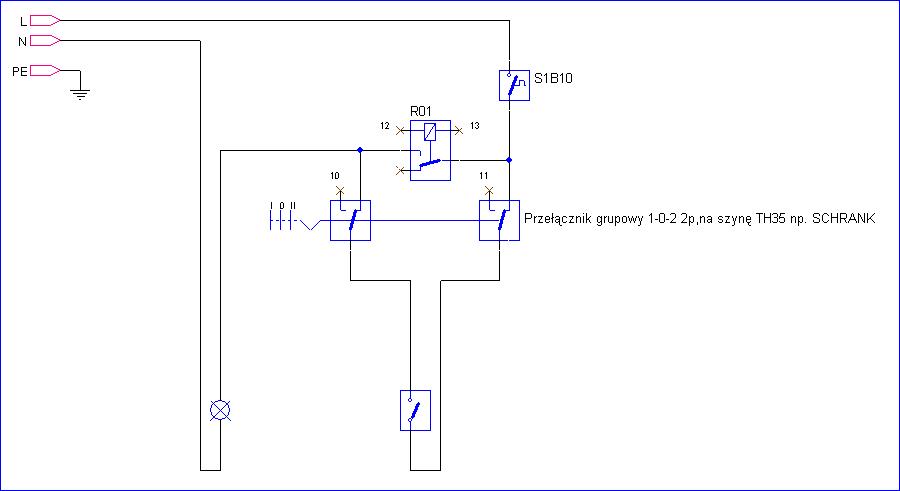
    Regarding the light - as I wrote earlier a small sketch of an example solution:
    How to modernise old aluminium wiring for future home automation in OWT-67 flat?
    Please note points 10/11 - at the moment of switching, a low control voltage can be passed through the light switch (to the controller) (if someone fastens a PLC to this solution, it will be 24 Vdc without additional interface/separating relays);
    and here we have a 12/13 relay coil to control/switch the light.
  • Helpful post
    #15 15651261
    eachflash
    Level 10  
    I don't know if the topic is still relevant, but in any case, when it comes to electrical installation from the point of view of automation, I think you can find a lot of interesting information in the Moeller guide, "Contemporary electrical installations
    in single-family houses".

    Link:
    http://www.moeller.pl/documentation/poradniki/poradnik.pdf


    When it comes to control, I recommend the simple logic module Logo! from Siemens. Especially as starter kits are available in the shops at good prices.
  • #16 15694793
    marcintr
    Level 9  
    eachflash wrote:
    I don't know if the topic is still relevant


    The topic is as relevant as ever. I didn't write it off, because forging in walls and floors and sapholing and carpeting can consume a person :)
    Thanks for the tutorial, I'm already sitting down to it.

    As I wrote, I pulled everything to the central switchboard. The electrician looked at the whole thing before taping the wires and said there was nothing to attach to it, so it's fine :) I need to order the contents of the switchboard and in view of temporarily wiring this up without automation I have this idea:
    Top rail: differential and overcurrent circuit breakers to group individual circuits
    Bus 2 and 3 - empty
    Bottom rail: WAGO connectors and inputs of individual circuits. These connectors give me the convenience of modifying the connections in the future.

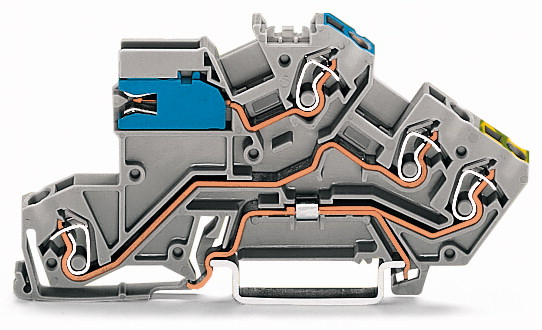
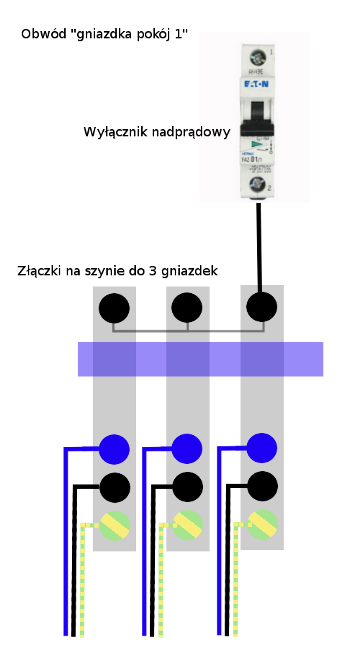
    I will perhaps start with a diagram for one circuit of sockets I was thinking of using a 775-641 connector:

    How to modernise old aluminium wiring for future home automation in OWT-67 flat?

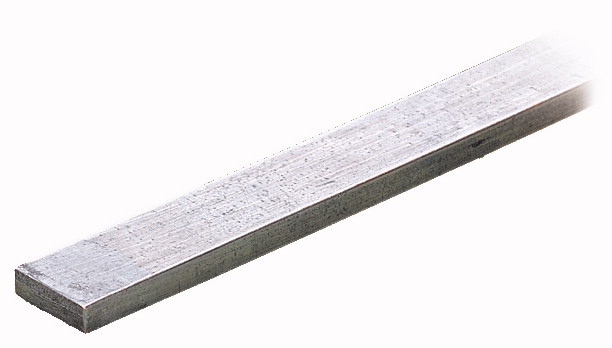
    On the input side of the wires from the sockets, it has three connectors (L, N, PE). On the other side, however, only the phase connector. The neutral connector is the input to the N busbar:

    How to modernise old aluminium wiring for future home automation in OWT-67 flat?

    This is still quite understandable to me. On the other hand, I have concerns about using PE as a connector "foot". In that case, the din rail becomes part of the installation. Is it only possible to rely on such a connection, or is it better to bridge the PE wires over the connector after all?

    Below is a diagram showing one 'circuit' of sockets. Three phase wires bridged over the connector (WAGO plug-in bridges with 24A nominal current).

    How to modernise old aluminium wiring for future home automation in OWT-67 flat?
  • #17 15695171
    pafciowaw
    Automation specialist
    The connector you have chosen has a nominal size of 2.5 mm - so it is practically IMPOSSIBLE to bridge the power cable coming from the "S" - as marked on the drawing; of course you can use three wires going directly from the "S";
    There are WAGO connectors that have three/four connection points per floor - then you can bridge "horizontally" or choose connectors with a larger nominal size, e.g. 6 mm.
  • #18 15698544
    kleki
    Level 28  
    Check out the in-line connectors from Wago or Weidmüller - you'll plumb even a tight switchboard. Prepare yourself for the cost. Nowadays practically every manufacturer of in-line connectors offers something for electrical installation, of course with the possibility of mounting bridges (such yellow combs in the case of Weidmüller - for "hot" circuits and a copper tinned rail - for N, or earth). It's worth considering the markers - much easier to get to grips with later. See terminals like this: ZDL 2.5S/NT/L/PE. Don't forget the end wall.

    For light switches, give as many conductors as possible (e.g. 5G1.5) - as much as you can afford, of course. You dock the box, add a socket below.... I have done it this way and I can say that I am satisfied. It's a strange Polish custom to put sockets near the floor. It is awfully inconvenient. Next to the switch - great. You don't bend down, you give a shelf for the phone, your wife plugs in the hoover....

    I recommend (as far as possible) deep sockets - there is never enough space.

    It would be optimal to drape peschl over everything, but it gets VERY cramped at the switchgear - it's worth thinking about right away. This way you pull in single wires, you can play around with colours, there's no hassle of adding e.g. stranded wire, and you're always ready for re-stringing or some sort of upgrade. Another advantage - a single wire in a tube under the plaster can be loaded with up to 16A, I think - you save on cables. The obvious thing - a lot more work, you need twice as much time, you need a lot more connectors (invest in as small as possible, boxes are not made of rubber). Such a solution costs a bit more in effect, but if there is enough money, it is worth the push in my opinion.

    Switchgear - as large as possible - sooner or later there is always a shortage of space. You will think about the control system when you have the money for it, but you won't be able to replace the switchboard. You can put at least two sockets next to it (modem, router, etc.).

    It is worth adding fuse protection. Not necessarily for the sake of protection per se, but rather because of their phenomenal feature of limiting current at short circuit. You win on selectivity (no more running up and down the staircase to switch on the protections), the sockets don't suffer so much after connecting faulty equipment (you burn the contacts and buy the same ones here after a few years - it happens, too), the short-circuit current is less likely to damage the relays (you mention future control). Holidays = I switch off unnecessary sockets, only switch on fridge, freezer, power to IT equipment, alarm. I switch on the heating boiler remotely when returning from holiday - the day before. The number of possibilities in this case increases considerably.

    Another cool idea is to run wires from the sockets to the switchboard so that they can be separately controlled and protected. In this case, in-row connectors with integrated 5x20 fuses and, as mentioned above, single wires in the installation are recommended. Of course, the complexity of the whole project increases, which entails time and money plus the possible support of some expert electrician. In Polish conditions, the subsequent problems with measurements on such an installation are enviable - after all, you won't do extra school and authorisations for one installation. Any electrician will be annoyed by such a complication - whether because of the amount of extra work involved or for other reasons (you name them).

    See a switchboard like this
    How to modernise old aluminium wiring for future home automation in OWT-67 flat?2014-06-28....13.48.jpg (1.33 MB)You must be logged in to download this attachment.
    One floor of a kindergarten with KNX control.
    I have not complained at all about the excess space. The wires enter from the top.

    Remember that it all comes down to:
    - knowledge (and the forum is a rather poor place to get it)
    - conscientiousness (especially towards the end, when the enthusiasm has subsided)
    - money (you're doing it yourself ≈ you can't afford to outsource it to a company)
    - organisation (you probably want to settle in as quickly as possible, and this sometimes gets in the way)

    These factors you MUST take into account before you get down to work.

    Regards

    @pafciowaw - these also have a bridging option. This is done by that rectangular cutout between the right L and N. You get these grey plug-in bridges available in several versions, or possibly bridges with a section of flexible wire, but these are only loadable up to 9A.
  • #19 16491547
    szawel1312
    Level 8  
    Welcome,

    i'm fairly new to the forum and don't know if I'm posting in the right thread....

    i am also automating my house. Everything will be controlled by a PLC. I have the following question - can I use a 63A 3-phase differential - contacts as a circuit breaker ? (protection head B25 or B32) - to disconnect the power in the building e.g. in case of fire. In the house, of course, there will be individual circuits also protected by differential switches, but I would like to place this particular one on the main supply. I've modified it slightly - I've removed the measuring/supply circuit (secondary winding of the Ferranti transformer) - and in its place I'll connect the 24VDC voltage from the PLC to the polarised relay - to automatically switch off the power supply. This seems sensible to me - simple to do, achieves what I want and works, requires manual switching on after power is disconnected, and is relatively cheap.

    What do you guys think of this? Is the contact resistance of a 63A differential too low? Or take a larger one? Does it make sense - from the safety side and from the legal side?
  • #20 16491639
    Łukasz-O
    Admin of electroenergetics
    There is nothing to combine, use FRX with a boost coil.
  • #21 16491929
    szawel1312
    Level 8  
    Welcome,

    Thanks for the feedback and information. I will think about it.

    Best regards
  • #22 16493450
    szawel1312
    Level 8  
    Welcome,

    FRX-304 63A 4P + 110-415V AC TX3/DX3/FRX surge arrester 406278 costs about £500. Would it be possible to replace this with - CLS6-B63/4-DP 270516 4P B 63A 6kA AC overcurrent circuit breaker + 12-110V AC/DC surge arrester ZP-ASA/24 248438 - this costs around £250. Will it work the same way? Can it be done/applied like this?
  • #23 16493472
    Łukasz-O
    Admin of electroenergetics
    Not suitable. One, it is not designed to disconnect the N track, and two, it will spoil the selectivity of the protections brilliantly.
  • #24 16493503
    szawel1312
    Level 8  
    Could I ask for a fuller explanation? - why does it spoil the selectivity of the protections?
  • #25 16493575
    Łukasz-O
    Admin of electroenergetics
    That's because when there is a short circuit in some circuit, the overcurrent circuit breaker responsible for that particular circuit and the four-pole 'main' circuit breaker will trip.
    Read about the selectivity of protection.

    PS. For what purpose do you want to disconnect the N track? It's asking for trouble, especially if the apparatus is not designed for it.
  • #26 16493720
    szawel1312
    Level 8  
    I would like to disconnect the N track because of the possibility of connecting power from the genset.
  • #27 16493735
    Łukasz-O
    Admin of electroenergetics
    Use a special switch (mains-0-aggregt) for the genset.
    Then give the FRX a three-field with a boost coil and don't combine.
ADVERTISEMENT