logo elektroda
logo elektroda
X
logo elektroda

TL;DR

  • A 3D-printable resistor container/organizer replaces an older matchbox-based parts box.
  • The organizer was sculpted as a design-education exercise, and the files are provided for anyone to download and improve.
  • The original matchbox container lasted for thirty years.
Generated by the language model.
ADVERTISEMENT
Treść została przetłumaczona polish » english Zobacz oryginalną wersję tematu
📢 Listen (AI):
  • 3D printable file resistor container

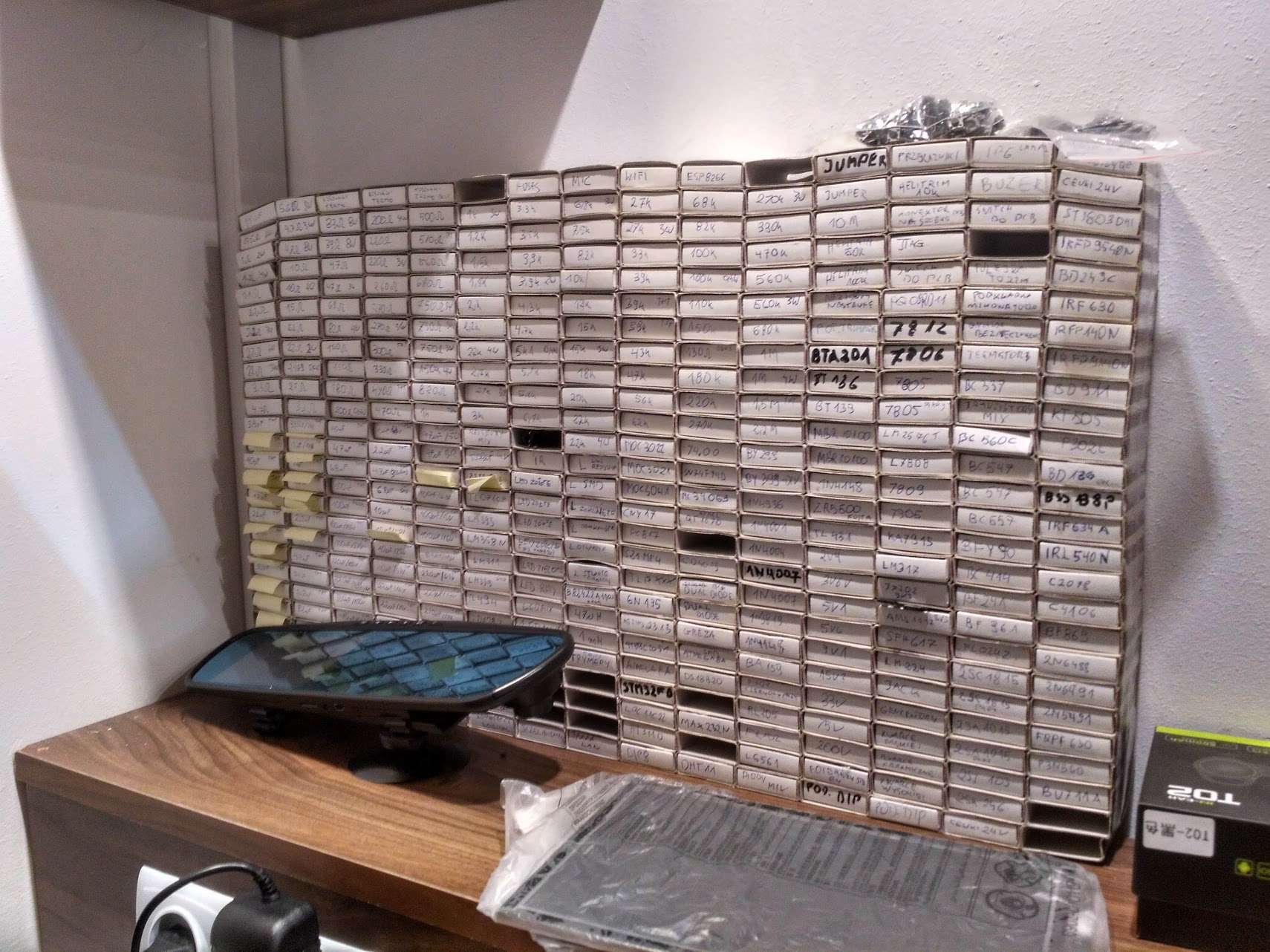
    At one time, and it will be thirty years with a cover, I glued together a resistor container from matchboxes.
    Since my wife promised to buy me a 3D printer, I sculpted such an organiser as part of my design education. I attach the files. If anyone wants to comment along the lines of:
    "this is wrong, that is wrong", then give it a go. The files are downloadable and anyone can improve it themselves.
    Attachments:
    • 3D.rar (669.29 KB) You must be logged in to download this attachment.

    Cool? Ranking DIY
    About Author
    janjjw
    Level 11  
    Offline 
    janjjw wrote 20 posts with rating 17. Live in city Gdynia. Been with us since 2007 year.
  • ADVERTISEMENT
  • #2 17619783
    LA72
    Level 41  
    Posts: 6582
    Help: 646
    Rate: 1648
    Here you can also find an interesting drawer in 3D.
    3D printable file resistor container
  • ADVERTISEMENT
  • #4 17620220
    Xaveri
    Level 17  
    Posts: 460
    Help: 13
    Rate: 77
    I'm just stating the fact that it's not worth printing - body about 14h of printing, drawer (one) 40 minutes (nozzle 0,4mm, layer 0,24mm thick, printing speed about 55-60mm/s).
    A body of 194g of the cheapest plastic at 50pln per kilo gives 9,70pln + 16x10g = 8,00pln. Total 17,70pln,and still electricity....
  • ADVERTISEMENT
  • #5 17620227
    zaxoniec
    Level 14  
    Posts: 190
    Rate: 835
    The frame alone is more than a day's printing on my M200, plus 16 drawers of an hour and 40 minutes each. No point in expatiating on a machine for something that can be bought for petty cash ?
  • ADVERTISEMENT
  • #6 17620530
    janjjw
    Level 11  
    Posts: 20
    Rate: 17
    No problem, you are probably right that printing will take a very long time. There is one problem:
    buy something like this then we'll talk.
    JanJJW regards
  • #7 17620557
    LA72
    Level 41  
    Posts: 6582
    Help: 646
    Rate: 1648
    A big plus of the design is that it can be modularly combined.
    Think further about securing the drawers to slide out completely.
  • #8 17620634
    noel200
    Level 27  
    Posts: 1891
    Help: 36
    Rate: 812
    The polemic about cost is pointless. Printed items are always much more expensive than mass-produced ones. But owning a printer isn't about saving money, it's about being able to make unique things or things that are very hard to buy.
    And here the author is learning how to design and he is doing it by printing just the objects he needs.
  • #9 17620925
    xdiax
    Level 22  
    Posts: 712
    Help: 36
    Rate: 212
    janjjw wrote:
    buy something like this then we'll talk

    I bought and am using it. It works perfectly. The only downside was having to remove the lint in the individual drawers, but this is nowhere near the machining you need to do to make a 3D print look like something.
    3D printable file resistor container
  • #10 17621225
    lvy
    Level 12  
    Posts: 36
    Help: 1
    Rate: 35
    Opie
    janjjw wrote:
    "this wrong, that wrong", then let him give it a go. The files are downloadable and anyone can correct themselves.


    Acct idea not a bad one, if like me he has printers that just stand idle, IMO a great idea. BUT I have to complain because it's such a tradition here. what if you set the drawer handle lower, i.e. put it on the printer table and make it slightly longer? this would make printing and ergonomics easier.
  • #11 17621271
    sundayman
    Level 26  
    Posts: 1620
    Help: 11
    Rate: 397
    Quote:
    And besides, you are, simply rude


    No, it's not rude. This is not a gathering at your aunt's where it's only appropriate to praise but a DIY forum where you comment on the pros and cons.
    And I totally agree that printing drawers for components when better and more aesthetically pleasing ones can be bought cheaply is pointless.
    I write this as the owner of several 3D printers. They are very useful tools but it's worth using them to make something you can't buy for a few quid.

    Otherwise it's fun for fun's sake.
    And of course you can and do - but don't expect delight. For me, above all, your workmanship is not even partly as aesthetically pleasing as ready-made drawers, because it's less about the cost. And aesthetics and convenience in the workplace are not unimportant.
  • #12 17621276
    noel200
    Level 27  
    Posts: 1891
    Help: 36
    Rate: 812
    By the way, once you have the drawers printed, maybe you could post a picture of them here.
  • #13 17621410
    Szyszkownik Kilkujadek
    Level 37  
    Posts: 5011
    Help: 211
    Rate: 1008
    @janjjw I think a photo of an old "drawer" made from matchboxes is nowhere near what you have done. I suggest you post at least one visualisation of your design.
  • #14 17621416
    Hetii
    Level 17  
    Posts: 518
    Help: 4
    Rate: 420
    And I like the idea there.

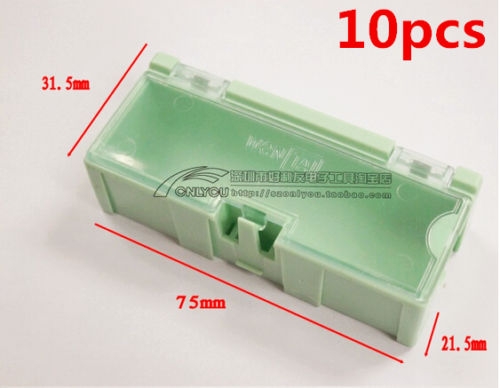
    Generally the problem with bought drawers is that they are too big for small electronics.

    I too have built a binder based on matchboxes and wanting to transfer this now to factory drawers would take up a huge amount of space.

    3D printable file resistor container

    I think drawers slightly larger than matchbox dimensions would work best, but unfortunately there is no such product on the market.

    Once again, I had the idea of making the whole thing out of laminate, with the option of illuminating the drawer with the searched item by means of an LED.
  • #15 17621560
    Janusz_kk
    Level 39  
    Posts: 5681
    Help: 216
    Rate: 1427
    For resistors, capacitors and similar small THT components, envelopes are the best, they cost pennies and take up little space.
    They cost pennies and take up little space. Put them in a shoebox or smaller and you have several hundred elements in one place, easy to sort and search.
    The drawers are good for large, angular components, e.g. relays, transformers, lamps, etc. They can even be printed out.
    There you can even print for specific components and it will be cost-effective.
  • #16 17621609
    mrrudzin
    Level 39  
    Posts: 5940
    Help: 516
    Rate: 580
    To the cost of material and electricity and the time it takes to print you forgot to add the time it takes to design and refine the design so that it can be printed.
    In my opinion, "as part of learning to design" as my colleague above wrote, the cost of printing, operating the machine, etc. does not matter at all. What matters is the experience one has gained.

    I would recommend trying to draw and print some everyday objects to make them at least as good as the ones bought for a few pennies.

    => janjjw - can you show what the container looks like after printing?
  • #17 17621612
    Szyszkownik Kilkujadek
    Level 37  
    Posts: 5011
    Help: 211
    Rate: 1008
    From what I understand it @janjjw no printer yet.
  • #18 17621705
    mrrudzin
    Level 39  
    Posts: 5940
    Help: 516
    Rate: 580
    Shepherd of Several Yes, but hopefully he will come back here and show what came out of his project.
  • #19 17621743
    LA72
    Level 41  
    Posts: 6582
    Help: 646
    Rate: 1648
    Szyszkownik Kilkujadek wrote:
    785bbfbcf @janjjw I think the photo of the old "drawer" made of matchboxes is nowhere near what you have done. I suggest you post at least one visualisation of your design.


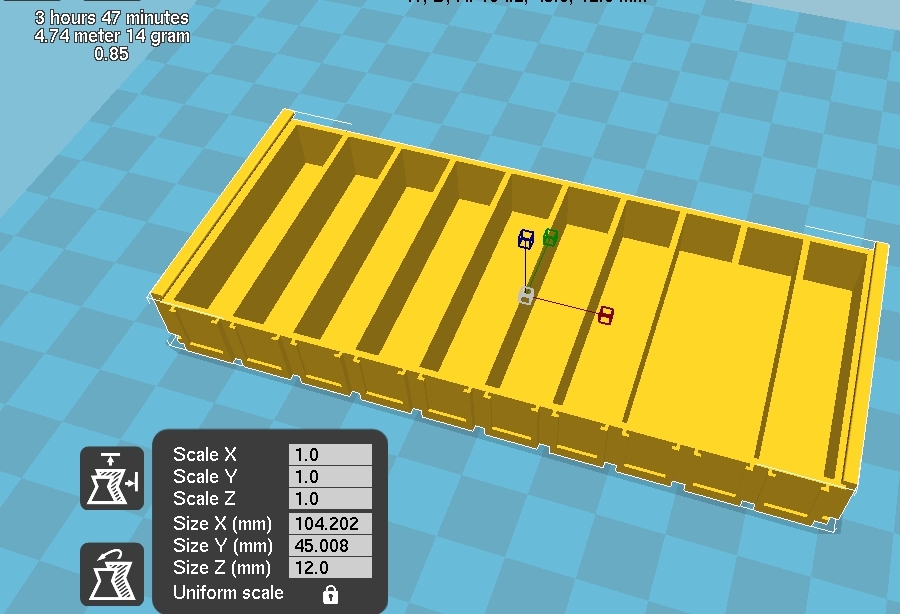
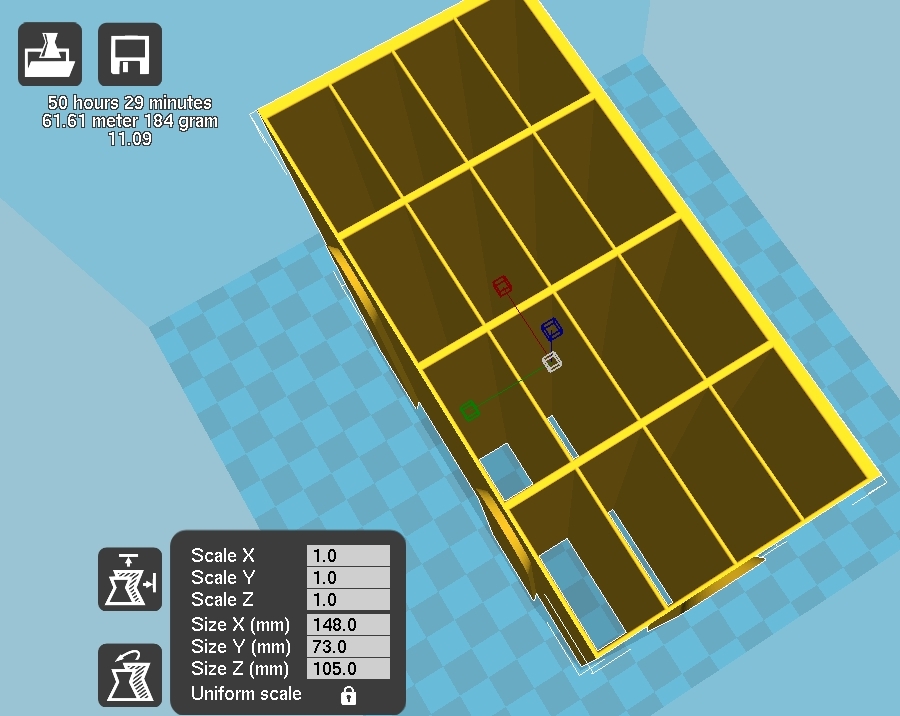
    Visualisation in Cura 15.
    3D printable file resistor container 3D printable file resistor container
  • #21 17621810
    Hetii
    Level 17  
    Posts: 518
    Help: 4
    Rate: 420
    Mishot wrote:
    Mishot wrote:


    I still stand by my opinion, note that the binder you depicted is in the horizontal plane, here actually goes something else, but for the wall this is not suitable.
  • #22 17621838
    zybex
    Helpful for users
    Posts: 15888
    Help: 2093
    Rate: 2916
    I got several of these sets from matchboxes. Between each level I gave some cardboard or bristol. I covered the whole set on the outside with, for example, vinyl wallpaper.
    I divided the resistors into groups, e.g. 0÷50Ω, 51Ω÷100Ω, 101Ω÷470Ω etc. up to >10MΩ.
    I have glass fuses in a similar way.
  • #23 17621884
    janjjw
    Level 11  
    Posts: 20
    Rate: 17
    Thank you for your constructive comments. I don't have a printer yet, but I'm aiming for a Prusa. Once it arrives at home, I'll be sure to print it out and show it off.

    JanJJW regards
  • #24 17621893
    brzydal91
    Level 12  
    Posts: 116
    Rate: 3
    And the cheapest way would be to make something like this out of wood :)
    Seriously, you can cut the plywood in Casto or other liroju. Add a few strips for the slides and you can either print or glue the drawers yourself. It's a bit of work, but it puts money in your pocket. It depends on who has a lot. Some have too much money and others too much time ;)
  • #25 17622976
    sundayman
    Level 26  
    Posts: 1620
    Help: 11
    Rate: 397
    Quote:
    I would like the forums to refer to each other GRACEFULLY


    I didn't notice the rudeness, but never mind that....
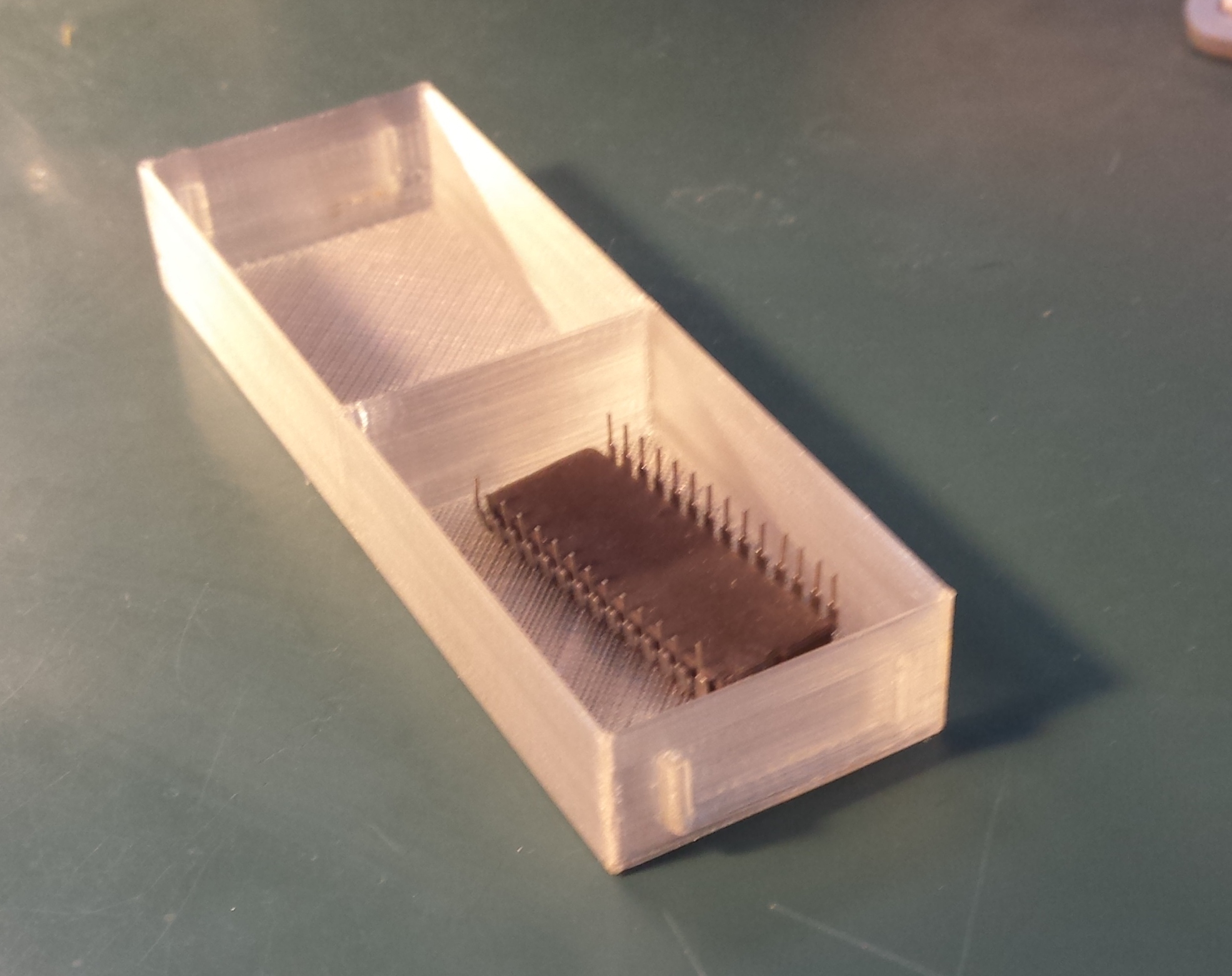
    So that it's not just complaining - I printed this drawer.
    I did with colourless PLA, because I have one I don't need.

    3D printable file resistor container

    This drawer takes about an hour to print. Now multiply that by the number of drawers you need. The body will print for several hours.

    With generally printing poorly for objects with thin walls. In the case of the drawer, the time is further increased because of the slide needed to print the 'handle' for the description label.
    This should either start flush with the bottom or have a 'chamfered' bottom edge so that no support is needed.

    I haven't checked this, but you need to remember to maintain adequate spacing (clearance) between the drawers and the body. Hooks to connect multiple bodies are also a slippery thing. I doubt you'll be able to make it so that it "works", especially on a simple Prusa type printer.

    Anyway - I still think the idea is of the "good but sucks" genre :)
    That is, it would make some sense if it was about something unusual that you can't buy for a couple of zlotys.
  • #26 17623503
    janjjw
    Level 11  
    Posts: 20
    Rate: 17
    My Lords (I did not notice the ladies),
    one simple conclusion follows from what you write:
    the 3D printer is just a toy with severely limited utility. The design I have drawn is a few simple solids. That's as much as I can do for now. You have proved, beyond a shadow of a doubt, that printing it makes no sense. Since the device cannot print something so simple with reasonable accuracy and in a reasonable amount of time, it is just a toy.
  • #27 17623522
    LA72
    Level 41  
    Posts: 6582
    Help: 646
    Rate: 1648
    janjjw wrote:
    ....
    one simple conclusion follows from what you write:
    a 3D printer is just a toy with severely limited utility. The design I have drawn is a few simple solids. That's as much as I can do for now. You have proven, beyond a shadow of a doubt, that printing it makes no sense. Since the device cannot print something so simple with reasonable accuracy and in a reasonable amount of time, it is just a toy.


    I have to disagree with this statement very much.
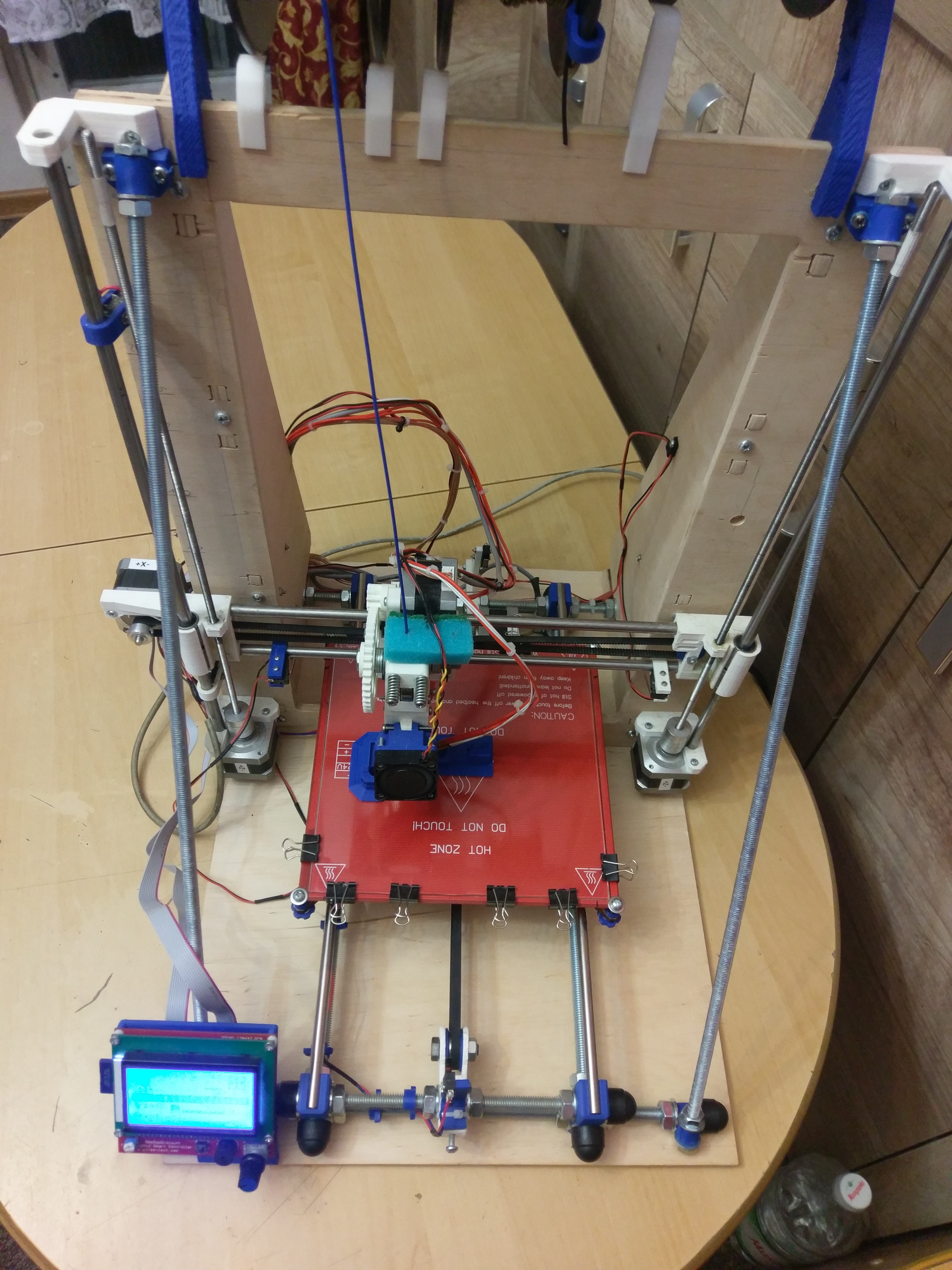
    About 1/2 a year ago I built myself a "3D printer".
    3D printable file resistor container

    This forced me to familiarise myself with CAD software.
    I cannot call devices of this type toys.
    You can really "conjure up" a lot of useful things with them.

    As far as cost-effectiveness is concerned.
    Hmm. I agree with the previous speakers. Many items, such as the parts tray presented, are expensive to make relative to the masses.
    But it was (will be) made for the author of the project.
    Many items, devices in the DIY section are form over substance and are expensive to make, however, is that the point ....

    In conclusion, in my opinion, the 3D printer is most suitable for producing prototypes, single copies, something unique.
  • #28 17623757
    Szyszkownik Kilkujadek
    Level 37  
    Posts: 5011
    Help: 211
    Rate: 1008
    LA72 wrote:
    In summary, in my opinion, the 3D printer is most suitable for producing prototypes, single copies, something unique.


    This is what it was invented for after all.
  • #29 17623851
    elektronik2018
    Level 11  
    Posts: 197
    Help: 2
    Rate: 28
    I bought a wooden bookcase to put on my desk for 2 quid at Biedronka. It has only (or maybe as many?) 3 large capacious drawers and it is enough for me! :D
  • #30 17624138
    Qbas060
    Level 14  
    Posts: 134
    Rate: 24
    In my opinion, the 3D printer works best for printing dedicated enclosures and I use it most often for this purpose. I also often print components or parts to improve the printer itself. It also happens to me that I do something unprofitable, for example, I recently printed a frame for a GoPro which costs a few zlotys, but I needed it quickly and there was no time to order it, so a file from the Internet, a little over two hours of printing and it was ready. After I bought the printer I printed everything myself and flew around every few minutes to watch the layers appear, although I made quite a few mistakes in my designs and the print parameters were not perfect either :) . I have been using cad programs for many years, but after I bought the printer I had to acquire some habits in designing components so that their strength was satisfactory and their printing time did not take many hours. And the best way to do this is by printing and analysing the printed stuff.
📢 Listen (AI):

FAQ

TL;DR: Printing the body takes ~14 hours and each drawer ~40 minutes; “it’s not worth printing.” [Elektroda, Xaveri, post #17620220]

Why it matters: You’ll avoid wasted filament and pick the right build vs buy path for small resistor storage.

Quick Facts

Who is this 3D‑printable resistor drawer for?

Makers learning CAD/3D printing who need compact, modular drawers sized for resistor series. It suits users who cannot find small commercial drawers and value customization over price. As one expert put it, owning a printer is about making unique or hard‑to‑buy things, not saving money. [Elektroda, noel200, post #17620634]

Is it cheaper to 3D print or buy ready‑made drawers?

Buying is cheaper and looks neater. Several owners of multiple printers said printing mass‑market items makes little sense when better drawers are cheap and available. “Use printers for what you can’t buy for a few quid.” [Elektroda, sundayman, post #17621271]

What print times should I expect for this organizer?

Reported settings: body ~14 hours; each drawer ~40 minutes at 0.4 mm nozzle, 0.24 mm layers, ~55–60 mm/s. Filament use was 194 g for the body and ~160 g for drawers, excluding electricity. [Elektroda, Xaveri, post #17620220]

How can I speed up printing the drawers without wrecking strength?

Use larger nozzles for thicker lines and fewer perimeters. One user achieved ~36 minutes per drawer with a 0.6 mm nozzle and suggested ~15 minutes with 1.0 mm for simple bins. Tune layer height and infill to suit. [Elektroda, romulus73, post #17650713]

How do I keep drawers from sliding all the way out?

Integrate a backstop nub or internal lip, or add a small latch ridge near the frame’s front. The design is modular, so you can extend sides or add clips between frames. Plan retention early in CAD. [Elektroda, LA72, post #17620557]

What design tweaks improve printability and fit?

Maintain clearance between drawer and body, start the label slot flush with the bottom, or add a chamfer to avoid supports. Expect tolerance drift on basic Prusa‑style machines; hook‑style frame connectors can be tricky. [Elektroda, sundayman, post #17622976]

Which materials and printers were discussed or tested here?

PLA was used for trial drawers. Printers mentioned include Zortrax M200 and Anet A8, with prints used for functional parts and fixtures. This shows practical, good‑quality outcomes for dedicated applications. [Elektroda, jamtex, post #17667587]

Are there ready‑made small drawers or alternatives to print?

Yes. Users linked compact commercial bins and showcased small parts containers available online. Evaluate size and orientation for wall use if choosing binder‑style boxes. [Elektroda, Mishot, post #17621803]

How should I store SMD and semiconductor parts safely?

Use antistatic (ESD‑safe) bins or bags. Passive parts are tolerant, but semiconductors can be damaged by insulating plastic drawers. Move parts from ESD bags only into ESD‑safe storage. [Elektroda, Anonymous, post #17658105]

Is a 3D printer a toy or a real tool for this job?

It’s a tool best for prototypes, single copies, and unique parts. Printing commodity drawers is rarely optimal, but designing and printing custom storage can be valuable learning and utility. [Elektroda, LA72, post #17623522]

What are real examples where 3D printing shines for electronics?

Custom test fixtures, faceplates with exact holes, and bespoke mounting pieces. One member built a 14‑pin spring‑loaded test connector and printed tailored panels that drop into housings. “I would find it hard today without a 3D printer.” [Elektroda, sundayman, post #17632391]

Can I make this organizer without 3D printing?

Yes. Laser‑cut plywood or acrylic drawers cut in ~30 seconds each are fast and cheap. Wood builds with cut plywood and glued slides also work well and scale quickly. [Elektroda, jamtex, post #17667587]

How big is the proposed organizer and what does it hold?

The author targeted very small drawers to hold the entire E48 resistor series within a compact 218 × 105 × 239 mm footprint. He noted such small drawers are hard to find in stores. [Elektroda, janjjw, post #17626818]

What do FDM and SLA mean here, and which suits small drawers?

FDM extrudes melted filament; it’s affordable but limited in fine detail. SLA cures resin with light; it’s more precise and suits small, accurate containers, but costs more in hardware and materials. [Elektroda, sundayman, post #17633993]
Generated by the language model.
ADVERTISEMENT