

logo elektroda
logo elektroda
X
logo elektroda

[Solved] The UPC Connect Box router connected to the antenna cable (?) and the TV

14286 39
Best answers

Czy kabel podłączony do gniazda COAX w routerze UPC może być kablem od anteny telewizyjnej i czy da się połączyć sygnał UPC z anteną na jednym przewodzie?

Nie — kabel wpięty do złącza COAX w Connect Boxie niesie tylko sygnał UPC, a sygnału DOCSIS nie wolno łączyć z innymi sygnałami, więc nie jest to przewód od zwykłej anteny naziemnej [#19021605][#19026280] Jeśli chcesz mieć na telewizorze kanały UPC, potrzebny jest TV z DVB-C/QAM albo dekoder, a wtedy można rozdzielić kabel UPC odpowiednim splitterem, np. Teleste DSS2, tak aby jedna gałąź szła do routera, a druga do TV, o ile poziomy sygnału są poprawne [#19021605][#19031047] Do telewizji naziemnej potrzebujesz osobnego przewodu z instalacji zbiorczej/AIZ albo trzeba taki przewód dociągnąć z klatki schodowej do mieszkania [#19021858][#19031047] Internet UPC i naziemna TV muszą więc iść dwoma niezależnymi kablami [#19021858]
Generated by the language model.
ADVERTISEMENT
Treść została przetłumaczona polish » english Zobacz oryginalną wersję tematu
  • ADVERTISEMENT
  • #32 19032855
    Grzegorz740
    Level 37  
    Posts: 4135
    Help: 313
    Rate: 551
    _cheetah_ wrote:
    Grzegorz740 wrote:
    Because the one you gave is an ordinary splitter that is designed to split the TV signal.

    This is no ordinary splitter.

    Grzegorz740 wrote:
    Isn't it sometimes necessary to use such a splitter: http://www.satserwis.pl/pokaz.php?nazwa=oferta/24/2489.dat to have an IP on the router?

    UPC no longer uses such solutions with the kz blocker.


    Approx. I see.

    How is it the way you write it. :)
  • ADVERTISEMENT
  • #33 19032884
    Anonymous
    Level 1  
  • #34 19033040
    KOCUREK1970
    Network and Internet specialist
    Posts: 35142
    Help: 3787
    Rate: 5328
    _cheetah_ wrote:
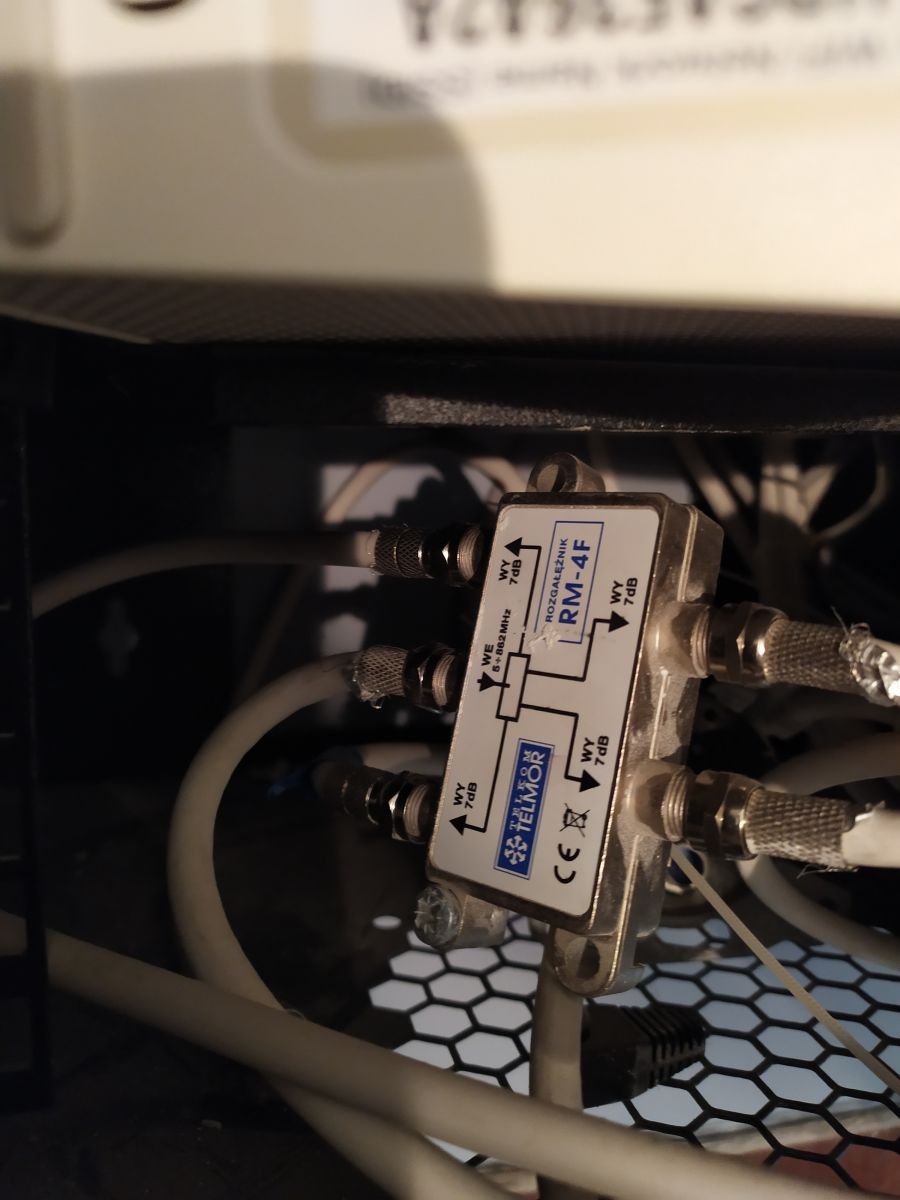
    Well, it's definitely not UPC, but it's a kind of sculpture.

    Well, it is, look at the F plugs - no installer who has his own business and knows that they can inspect it and thus release it financially for such a sloppy job, would not go for such crap, which in addition sows the operator's network like a seeder .
    For such rummaging in the operator's network, fines for the client should go to PLN thousand.

    @xyz0123
    You have to buy a splitter, it was indicated which one and buying it is not easy at all - the cost of the splitter, shipping, some compression F, crimper (self-compression F as the customer tinkers) and no certainty that the internet will not crash after something like that. And if it sits down (and there is a chance for it, because there are still some sockets and they also dampen, and if these sockets are good for anything at all), you still have to call the operator's service, because you can't do anything with the signal yourself.

    My good advice, call the operator's service, PLN 50 will be added to the invoice (if the contract is for someone else, you will somehow settle it with him) - a technician will come, give you a splitter, earn plugs, connect and adjust the signal - the cost for the whole is 50 PLN GROSS. You don't have to fly, combine and make prostheses for anything, worrying about whether the money will go down the drain.
  • #35 19033144
    marmon
    Level 17  
    Posts: 317
    Help: 13
    Rate: 30
    KOCUREK1970 wrote:
    _cheetah_ wrote:
    Well, it's definitely not UPC, but it's a kind of sculpture.

    Well, it is, look at the F plugs - no installer who has his own business and knows that they can inspect it and thus release it financially for such a sloppy job, would not go for such crap, which in addition sows the operator's network like a seeder .
    For such rummaging in the operator's network, fines for the client should go to PLN thousand.

    @xyz0123
    You have to buy a splitter, it was indicated which one and buying it is not easy at all - the cost of the splitter, shipping, some compression F, crimper (self-compression F as the customer tinkers) and no certainty that the internet will not crash after something like that. And if it sits down (and there is a chance for it, because there are still some sockets and they also dampen, and if these sockets are good for anything at all), you still have to call the operator's service, because you can't do anything with the signal yourself.

    My good advice, call the operator's service, PLN 50 will be added to the invoice (if the contract is for someone else, you will somehow settle it with him) - a technician will come, give you a splitter, earn plugs, connect and adjust the signal - the cost for the whole is 50 PLN GROSS. You don't have to fly, combine and make prostheses for anything, worrying about whether the money will go down the drain.


    Ok... Why is this going on the net? There is a terminator at the end of each cable. Plus the only difference in what you write is the compression F endings.
    It's been working for 4 years. The technician once was like a storm knocked out the equipment in the basement and did not pick on anything.
  • ADVERTISEMENT
  • Helpful post
    #36 19033163
    Anonymous
    Level 1  
  • ADVERTISEMENT
  • #37 19033191
    marmon
    Level 17  
    Posts: 317
    Help: 13
    Rate: 30
    Ok thanks ... Ok will have to replace ...
    Interesting signal on the tv is cool and the internet also flies without a problem.
  • Helpful post
    #38 19033223
    KOCUREK1970
    Network and Internet specialist
    Posts: 35142
    Help: 3787
    Rate: 5328
    marmon wrote:
    Ok... Why is this going on the net?

    Because every electromagnetic interference, even cellular, penetrates through the wires and can cause ingress in the entire operator's network in the block or even the entire street.
    This installation is not airtight.
    marmon wrote:
    It's been working for 4 years. The technician once was like a storm knocked out the equipment in the basement and did not pick on anything.

    And it's not a technician who will get his ears for it either - you tinkered, you "burp".
    And for how you've done it, your neighbors will thank you in a while, and even the operator may appreciate such arbitrariness.
    You have no idea how doing it like this interferes with the DOCSIS signal - you did it, someone else will report the problem and the line service will look for it (and be sure they will find it) for weeks and the punishment for you is certain.

    If you've already tinkered with it, do it at least as precisely as possible and throw out the crap F and buy self-compression F - the installation will not look like the original and as required by art, but it will be more correct.
  • #39 19059586
    Anonymous
    Level 1  
  • #40 19063274
    Anonymous
    Level 1  

Topic summary

✨ The discussion revolves around the possibility of using a UPC Connect Box router with an antenna cable for both internet and television services. The user inquires whether the coaxial cable connected to the UPC router can also serve as a TV cable from a collective antenna. Responses clarify that the UPC signal typically carries internet data and may include television packages, but these services usually require separate cabling. Users suggest using a splitter to manage connections between the UPC router and the TV, while emphasizing the importance of ensuring proper signal levels and compliance with installation standards. The conversation also touches on the need for appropriate equipment, such as a DVB-C compatible TV, and the potential necessity of consulting with the service provider for installation and service options.
Generated by the language model.

FAQ

TL;DR: 96 % of EU cable broadband uses a dedicated 75 Ω DOCSIS line [Cable Europe, 2020]; “Don’t mix DOCSIS with antenna feeds” [Elektroda, KOCUREK1970, post #19026280] A UPC Connect Box must stay on its own coax; digital-terrestrial (DVB-T/T2) or satellite need separate cabling or a properly rated splitter.

Why it matters: wrong joins can drop internet, kill TV reception and trigger operator fines.

Quick Facts

• UPC Poland technician visit: 50 PLN flat charge [Elektroda, KOCUREK1970, post #19033040] • Teleste 3DSS2 splitter: 5-1000 MHz, ≤3.6 dB loss per port [Teleste Datasheet] • Free UPC DVB-C “Pakiet Startowy”: ~25 SD/HD channels [UPC PL, 2021] • DOCSIS 3.0 modem input window: −15 dBmV to +15 dBmV [CableLabs, 2017] • Polish TV sets must decode H.265/HEVC for DVB-T2 after 2022 [Regulation Dz.U.2015.1042]

Does UPC internet travel on the same coax as the TV antenna?

No. The Connect Box receives DOCSIS data on a dedicated 75 Ω coax that belongs to UPC, not to the building’s communal antenna system [Elektroda, Anonymous, post #19021156]

Can I just unplug the router and screw that cable into my TV socket?

Doing so gives no DVB-T/T2 signal and risks contract violation. UPC’s line carries DOCSIS and QAM for DVB-C only; terrestrial channels are absent [Elektroda, KOCUREK1970, post #19021605]

Which splitter safely feeds both the router and a TV from one UPC line?

Use a 5-1000 MHz two-way splitter such as Teleste 3DSS2; it preserves upstream (5-65 MHz) and downstream bands [Elektroda, cheetah, post #19031047]

Is combining DOCSIS with terrestrial DVB-T/T2 in one cable allowed?

No. Mixing DOCSIS with terrestrial signals breaches UPC rules and can desynchronise modems across the street [Elektroda, KOCUREK1970, post #19026280]

How much does a UPC technician charge to install the splitter?

UPC Poland adds 50 PLN gross to the next bill for on-site splitter installation and signal alignment [Elektroda, KOCUREK1970, post #19033040]

What tuner must my TV have to view free UPC channels?

It needs a DVB-C tuner; most 2018+ sets include it. Ensure HEVC support for future DVB-T2 needs [Regulation Dz.U.2015.1042].

How do I locate the communal-antenna coax inside the flat?

Trace cables from the staircase shaft; collective-antenna lines usually end in an RTV socket plate or are taped near the ceiling [Elektroda, Anonymous, post #19021913]

Edge-case: I have only one serial-wired coax run—what fails?

Series wiring adds >15 dB loss after two sockets; modems fall below −15 dBmV and drop sync [CableLabs, 2017].

3-step How-To: adding a splitter without hurting signal

  1. Power-off modem, unscrew UPC coax. 2. Attach Teleste 3DSS2; tighten F-compression connectors. 3. Connect modem to OUT-1 and TV-feed coax to OUT-2; fit a 75 Ω terminator on any unused port.

Can an indoor antenna replace the communal system?

If you live within 15 km line-of-sight to a DVB-T transmitter, a powered indoor antenna often delivers 70 dBµV—enough for error-free HD [ETSI EN 300 744].

Will a splitter affect internet speed?

A quality 3.6 dB splitter keeps signal inside the DOCSIS window. Speeds remain at 99 % of direct-feed throughput in lab tests [Teleste Datasheet].

What happens if I leave a splitter port open?

An unterminated port reflects RF, raising error-vector magnitude by up to 3 dB; always fit a 75 Ω load [Elektroda, cheetah, post #19031137]

Is satellite (DVB-S/S2) distributable on the same coax?

Not with UPC’s DOCSIS. Satellite L-band (950-2150 MHz) conflicts with the cable spectrum ceiling of 1000 MHz, so run a separate RG-6 line [“CENELEC EN 60728-1”].
Generated by the language model.
ADVERTISEMENT

