logo elektroda
logo elektroda
X
logo elektroda

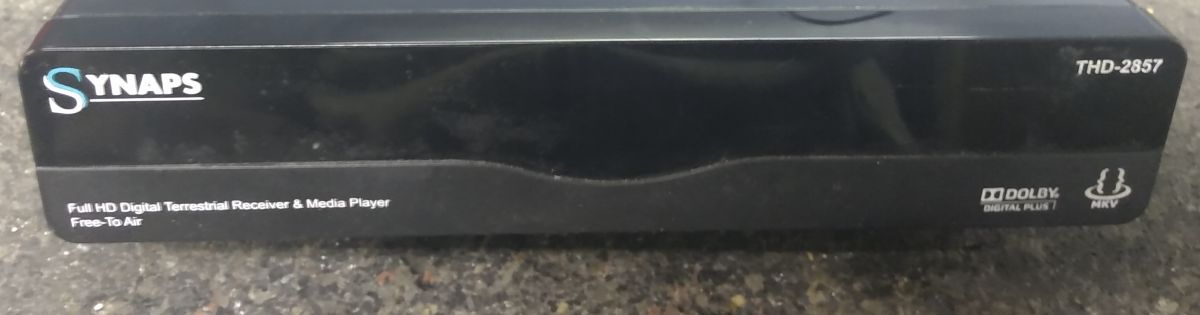
DVBT decoder Synaps THD-2857, looking inside

ArturAVS 3897 35
ADVERTISEMENT
Treść została przetłumaczona polish » english Zobacz oryginalną wersję tematu
📢 Listen (AI):
  • DVBT decoder Synaps THD-2857, looking inside
    Nearly twelve years have already passed since the introduction of digital terrestrial television in Poland ( Digital Video Broadcasting - Terrestrial ) and a newer version, DVB-T2, is already being launched. The very introduction of DVB-T was a kind of revolution, and the complete switching off of analogue transmitters forced the purchase of new TV sets or external decoders. Any day now, the new technology will come into permanent use and the majority of current devices will be discarded or replaced with newer ones supporting the new standard.

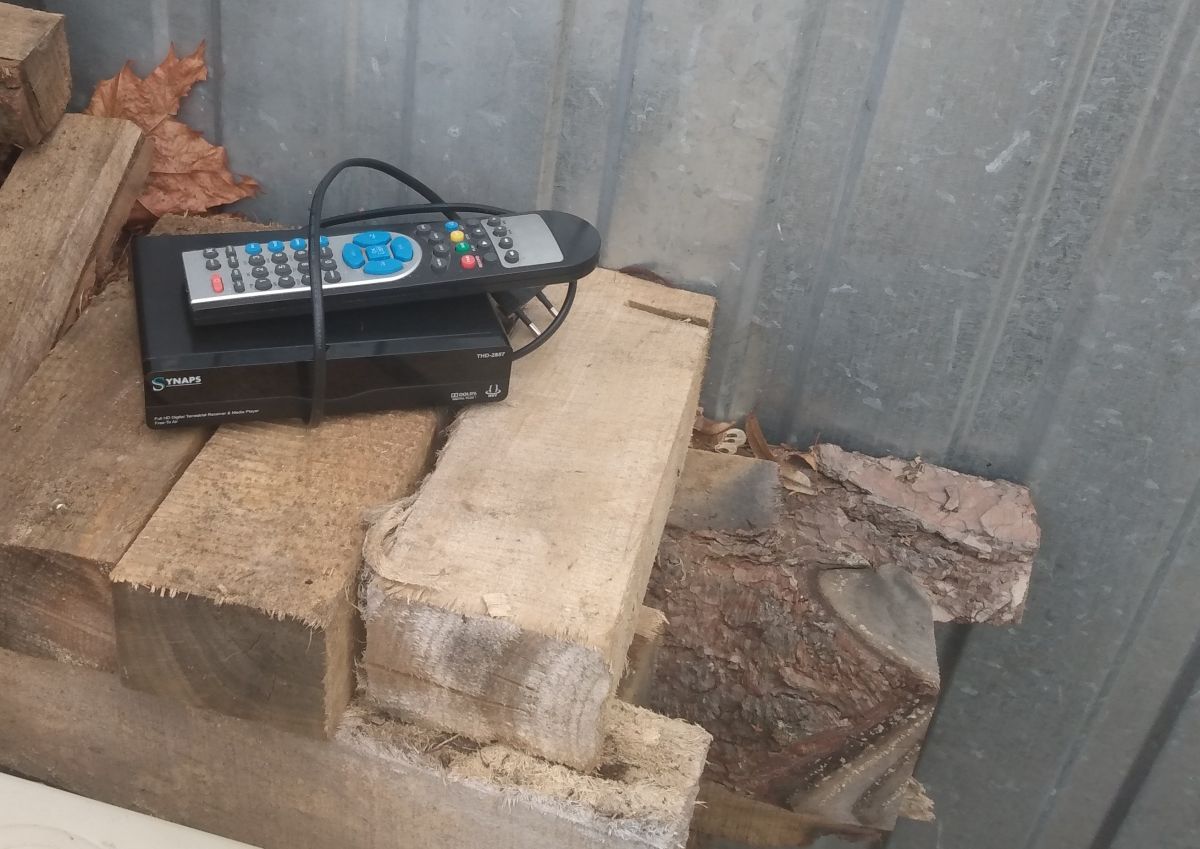
    A lot of completely working equipment will simply go to waste :-( . One of my neighbours has a habit of 'tossing' me all sorts of equipment that he wants to get rid of and I may be able to use something of it :D . Walking into the workshop this morning I saw the title character waiting for me;

    DVBT decoder Synaps THD-2857, looking inside


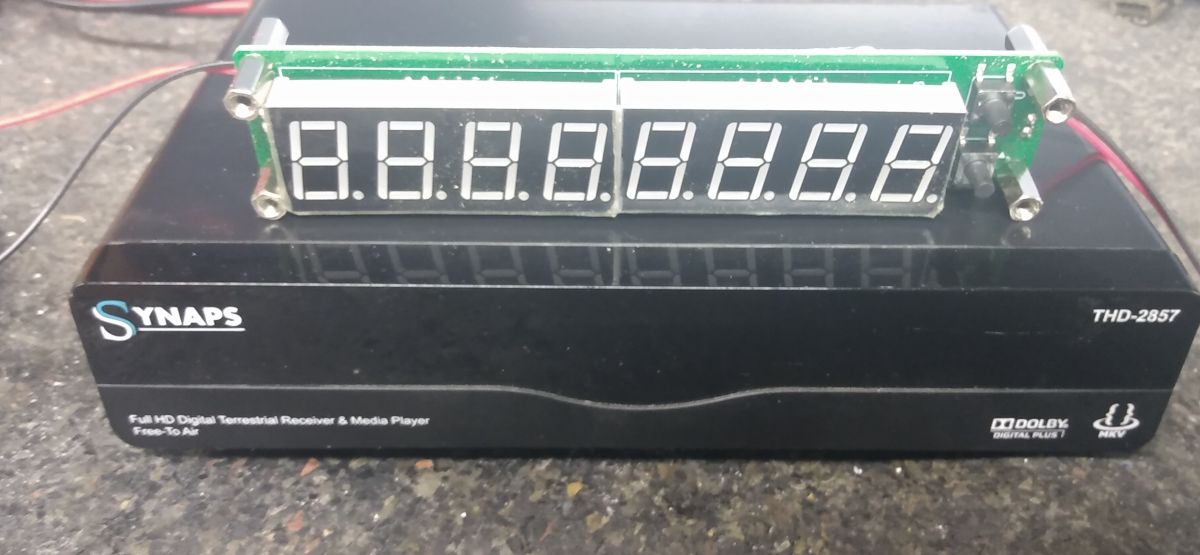
    The decoder is complete with remote control and completely operational. I don't use DVB-T (I don't even have an aerial) and anyway a change in broadcast standard will make reception impossible. The case is not a typical plastic box and is, apart from the front panel, made of steel, the first thing that came to mind was the use of the case. It even fits perfectly into this frequency killer .

    Fitting

    DVBT decoder Synaps THD-2857, looking inside


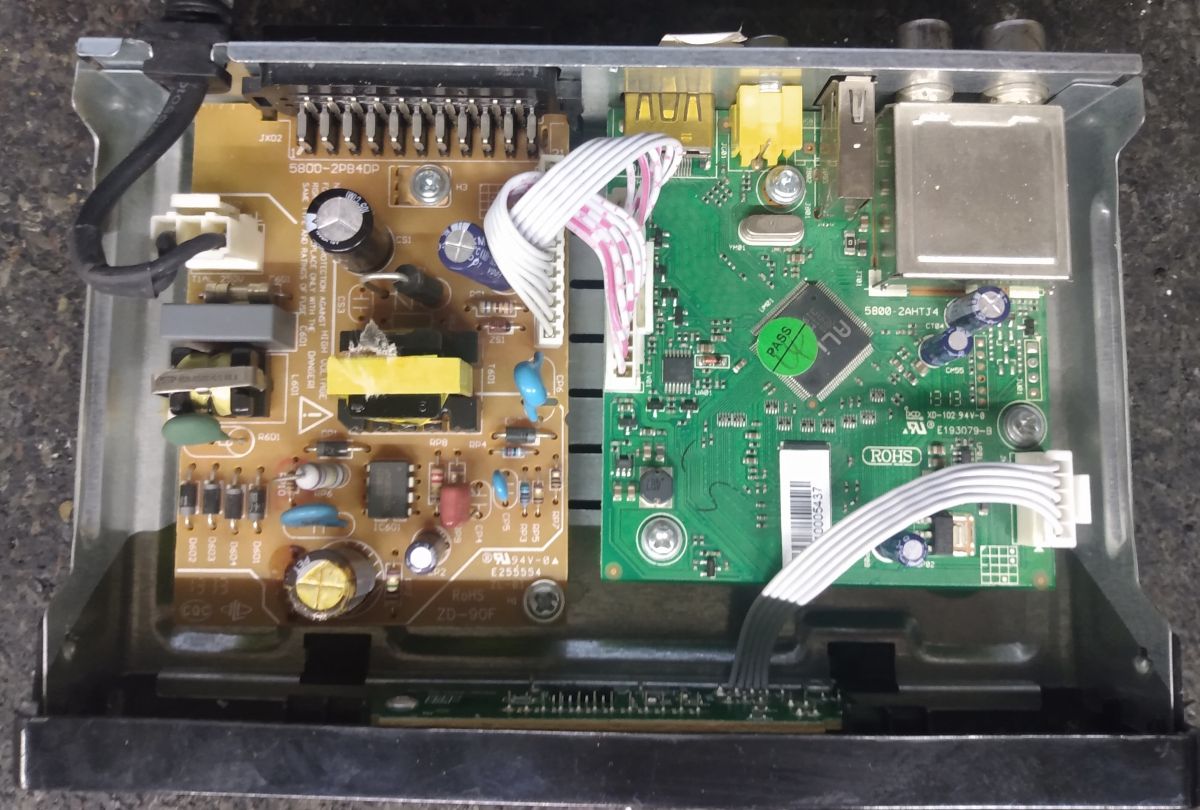
    So let's take a look at what can be used in addition to the housing :D . The interior, as you can see from the photograph below, is relatively poor, which was to be expected given the manufacturers' use of highly specialised integrated circuits :D .

    DVBT decoder Synaps THD-2857, looking inside


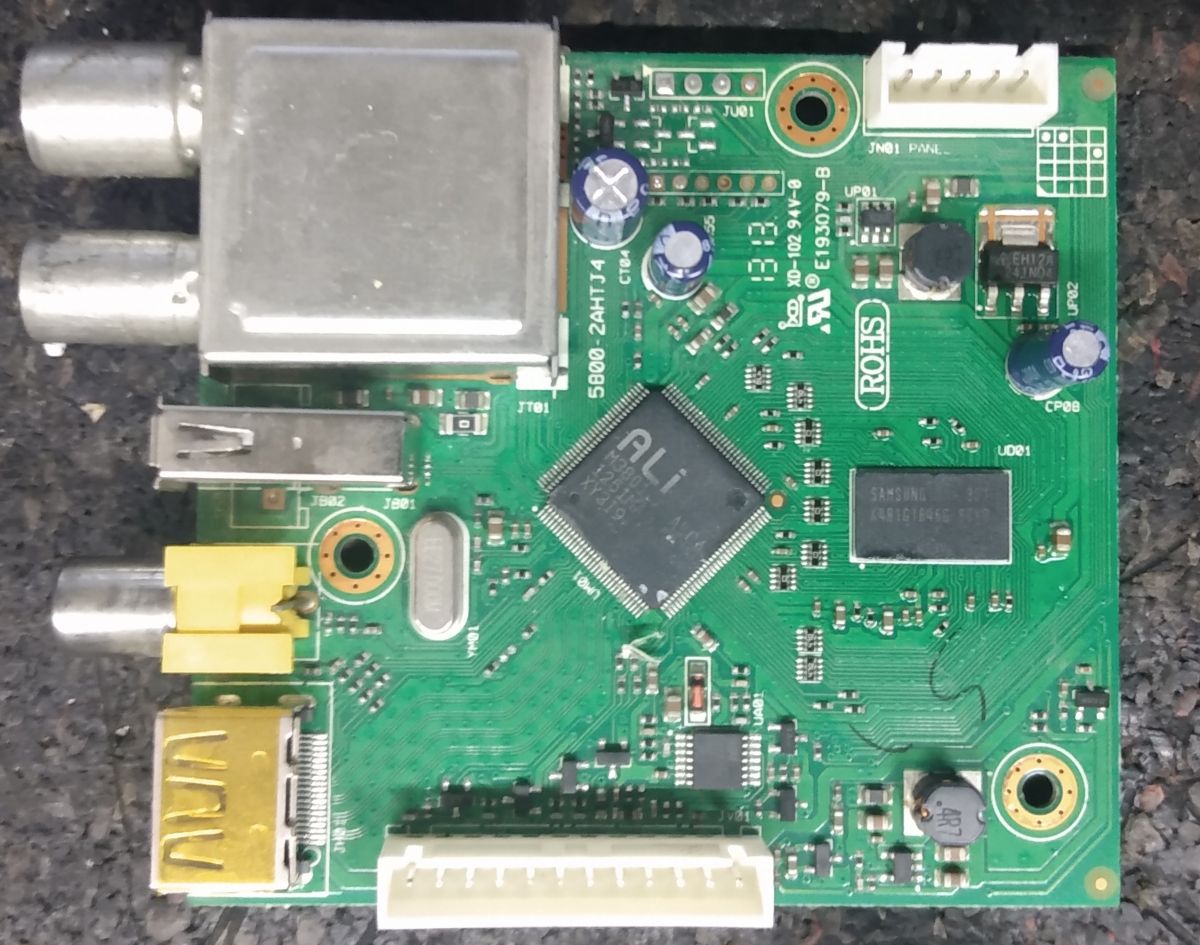
    So let's take a look at the main PCB;
    DVBT decoder Synaps THD-2857, looking inside


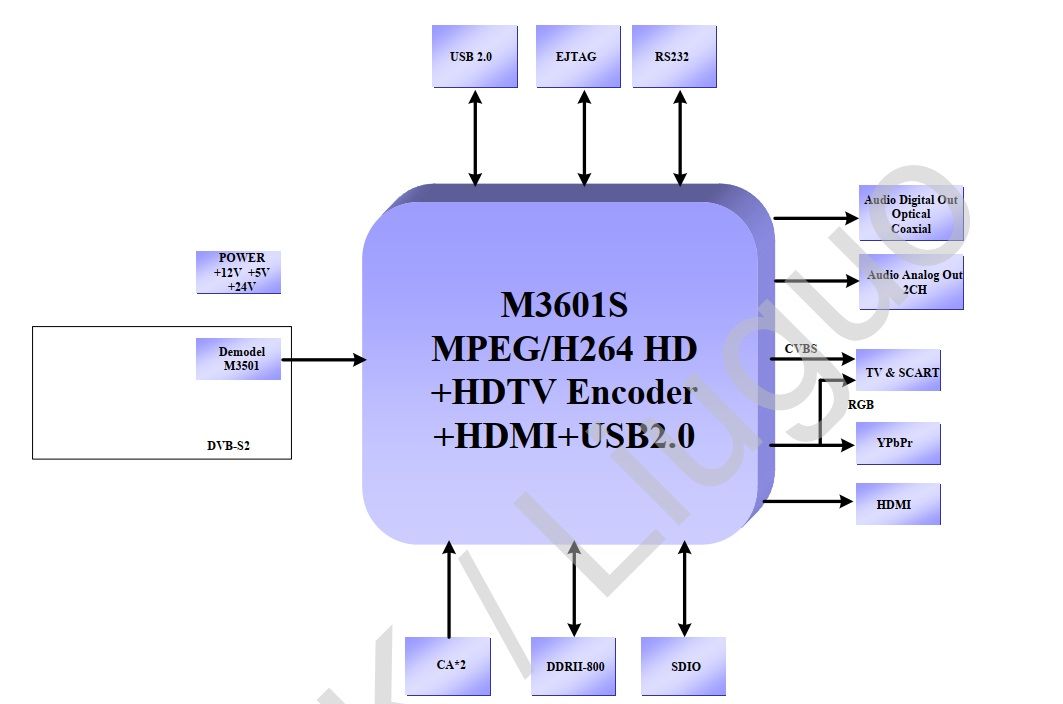
    At the heart of the decoder is the ALi M3801 ALCA, it is a so-called STB or Set Top Box. This is what manufacturers call complete decoders as well as specialised processors for video and audio processing. On the web I was only able to find information about the M3601S, but here there are probably no major differences;
    DVBT decoder Synaps THD-2857, looking inside


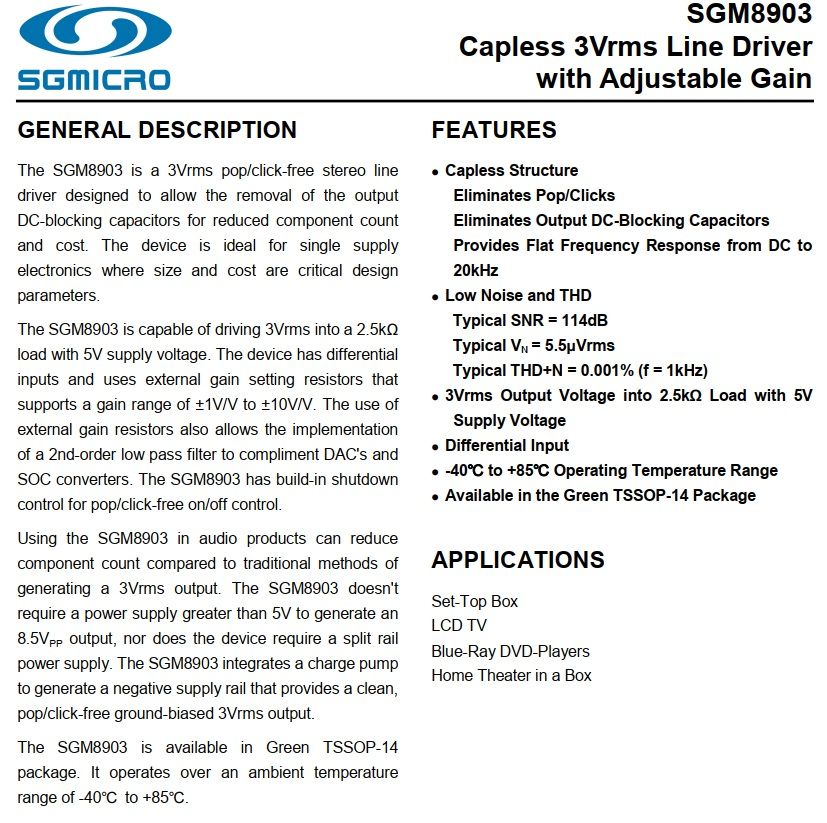
    Right next to it is the RAM K4B1G1646G-BCK0 from Samsung, this is a 1Gb DDR3-based SDRAM in a 64M x 16bit organisation. Right next to the power/SCART connector is the SGM8903, this is a dedicated line buffer for stereo analogue audio;
    DVBT decoder Synaps THD-2857, looking inside


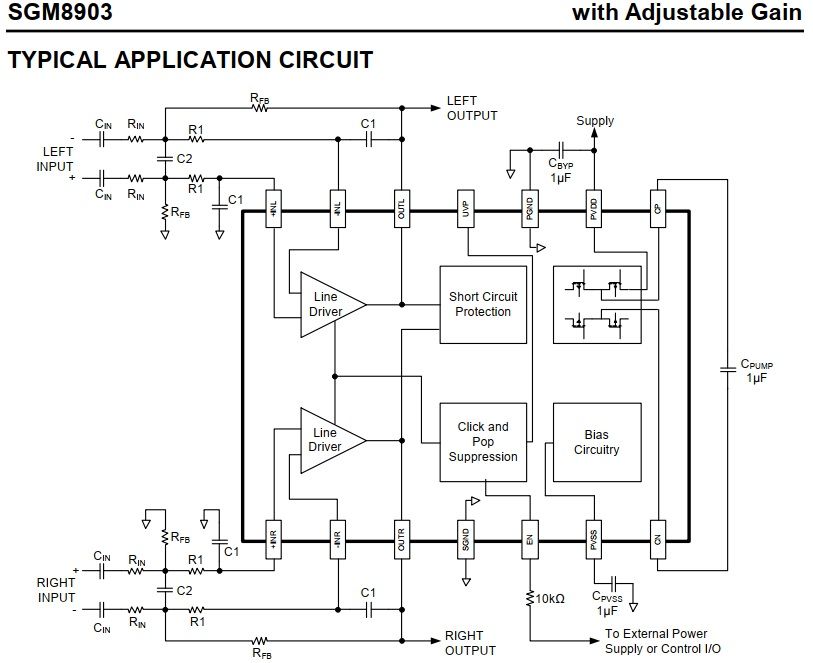
    This acts as a match for the differential signals from the output of the ALi M3801 DAC to a typical line audio input (SCART), below is a typical circuit application;
    DVBT decoder Synaps THD-2857, looking inside


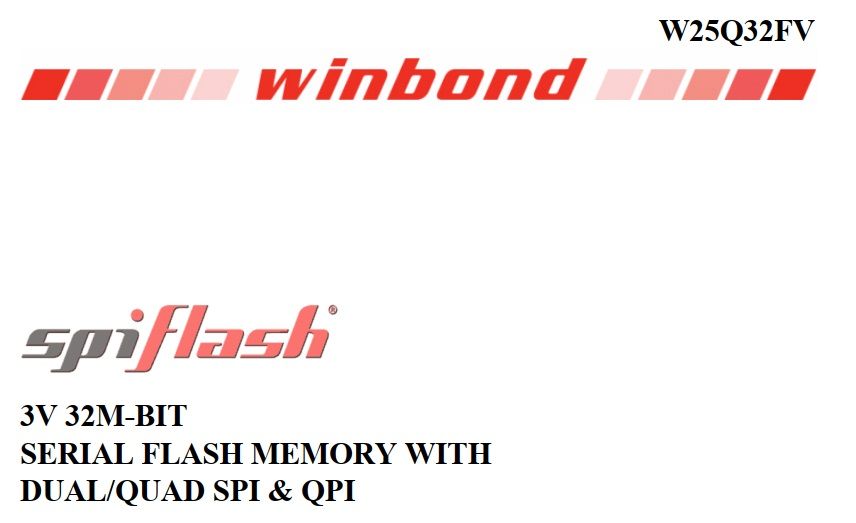
    Near the front panel connector you will find a UH12A which is the 1.2V equivalent of the LM1117 in a SOT223 housing. On the board there are also two pulse stabilisers in SOT23-6 (KG2UB) and SOT23-5 (AB3BA) housings, which I could not identify clearly. I didn't check the RF part located under the screen, because it would require minor devastation of the PCB and it may still be useful. On the other side, apart from a few transistors and RC elements, there is a 25Q32FVSIG memory from Winbond.

    DVBT decoder Synaps THD-2857, looking inside


    DVBT decoder Synaps THD-2857, looking inside


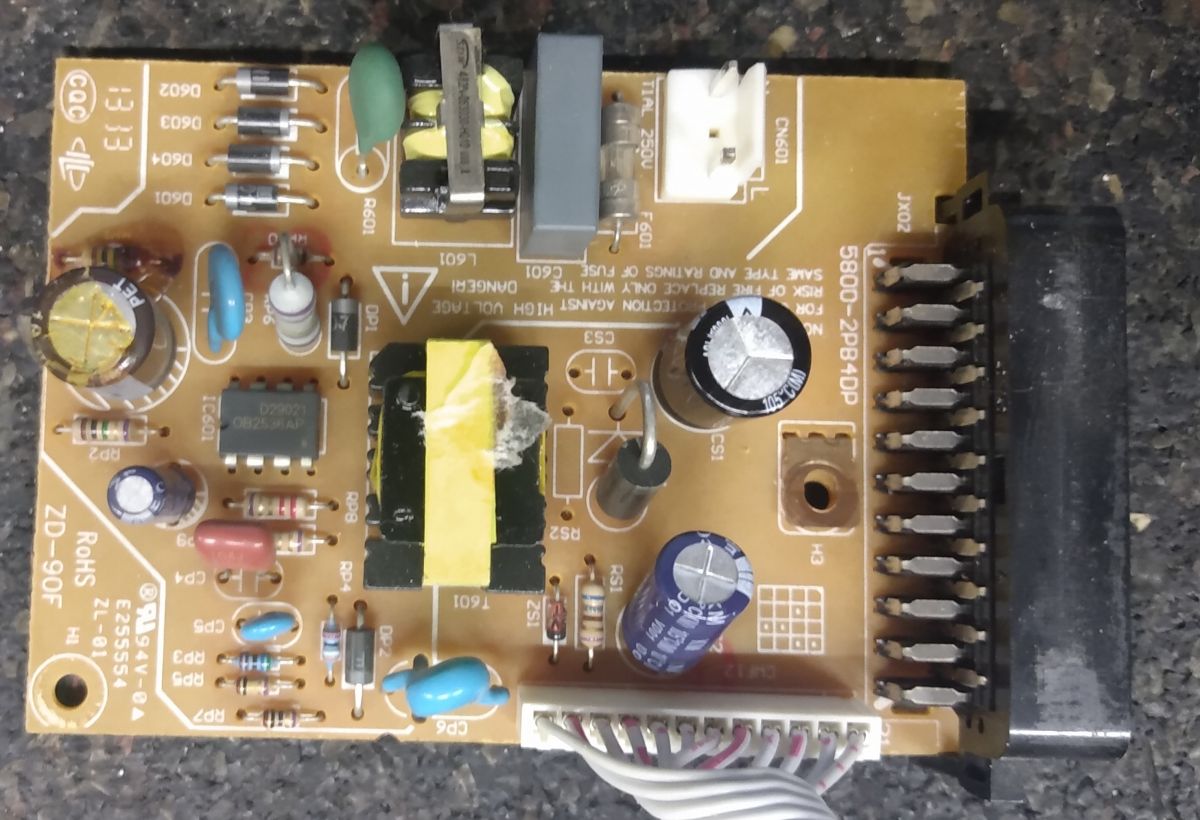
    This flash memory and SPI interface contains the decoder's firmware. Another component is the power supply unit which also contains the SCART connector;

    DVBT decoder Synaps THD-2857, looking inside


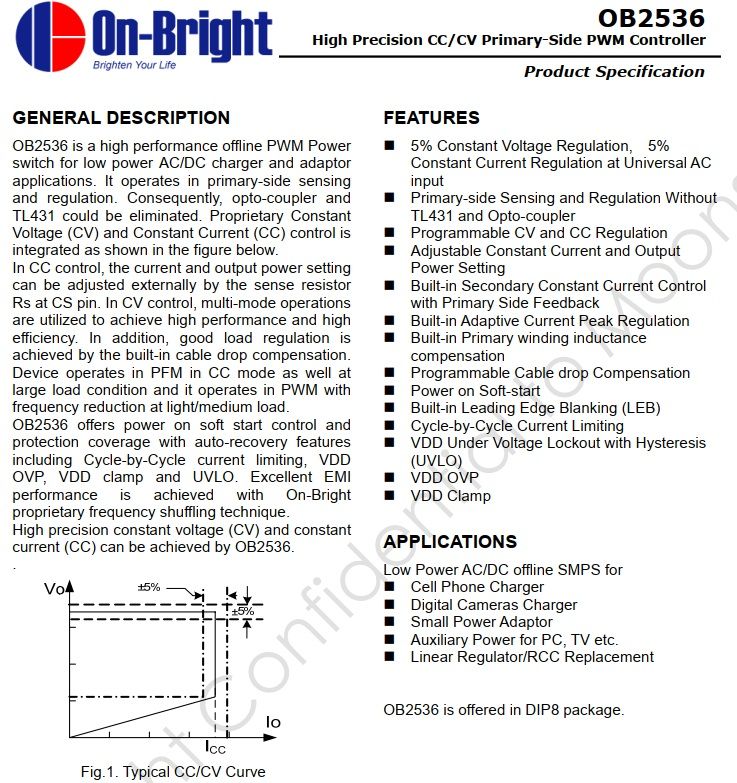
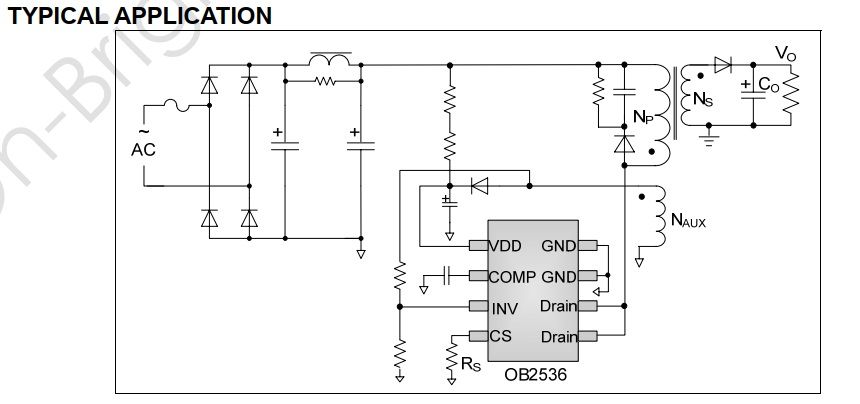
    The role of the power supply controller is performed by the OB2536 chip from On Bright, this is a specially designed driver for low-power power supplies or chargers;
    DVBT decoder Synaps THD-2857, looking inside


    DVBT decoder Synaps THD-2857, looking inside


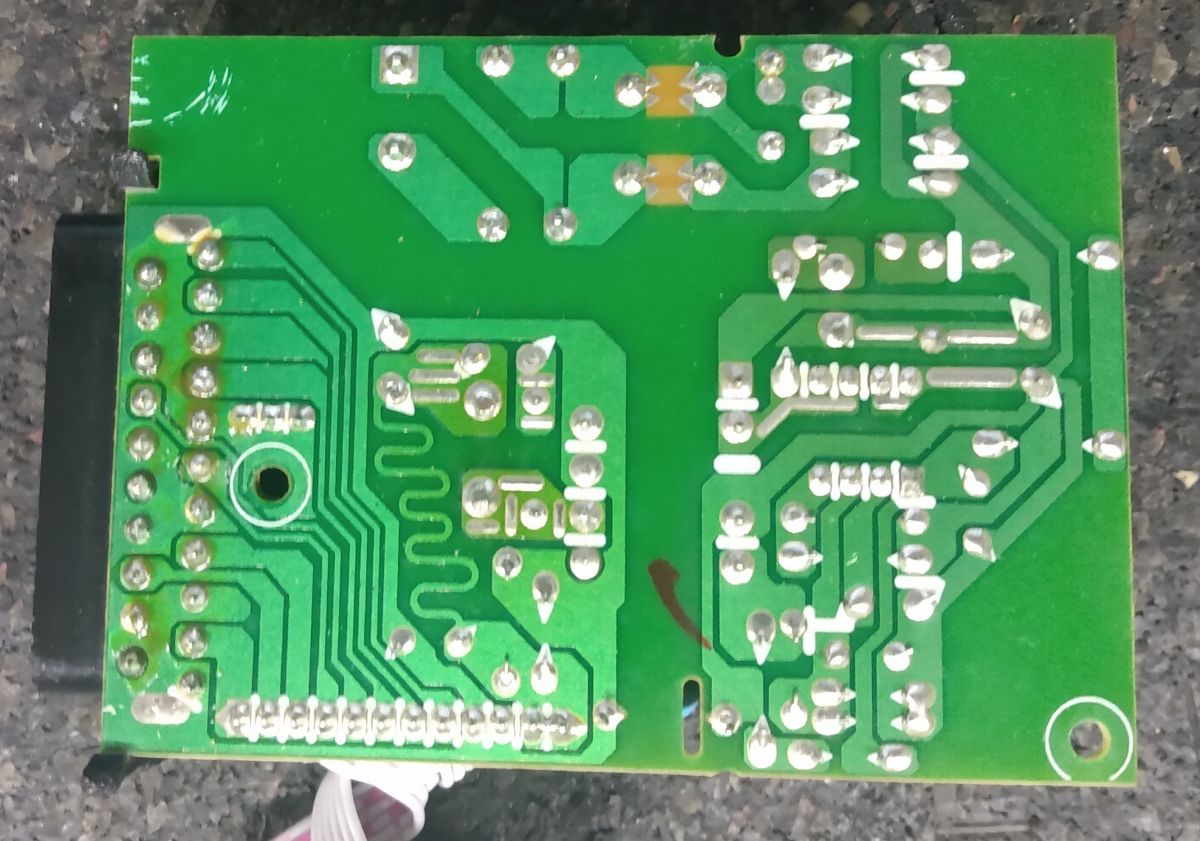
    The power supply provides 5VDC and about 1.5~2A max, the SB360 diode (3A/60V) acts as a rectifier. According to the description on the decoder case, the power consumption from the mains is 12W max. The power supply board has been made quite decently with a sufficiently large insulation gap;

    DVBT decoder Synaps THD-2857, looking inside


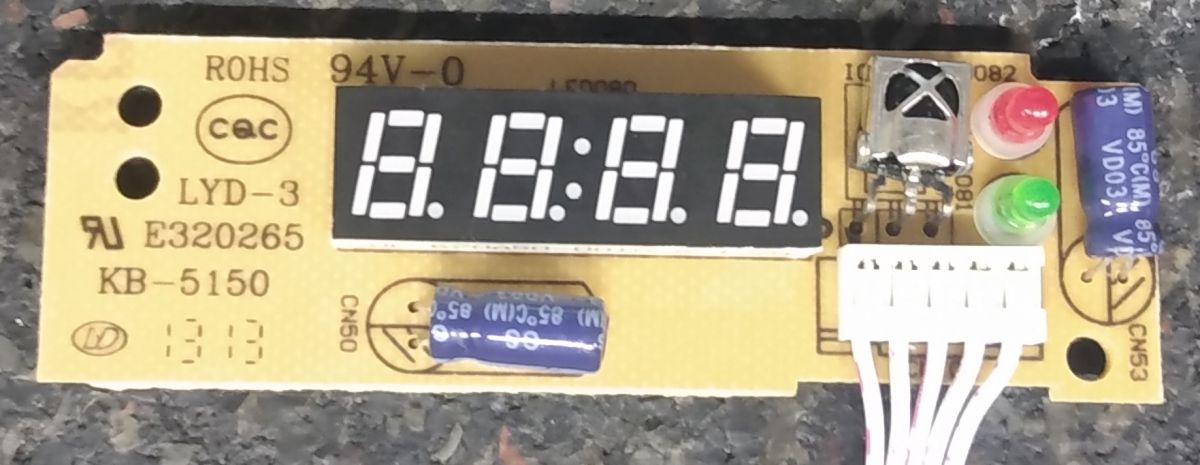
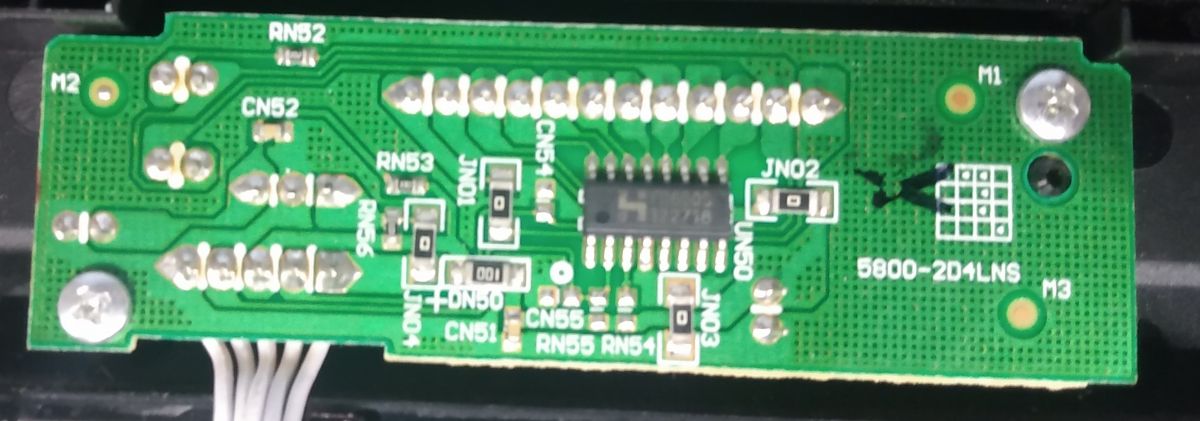
    The visible narrowing of the path is probably meant to act as a fuse :D There is still the front panel left, this one has been simplified to the limit;

    DVBT decoder Synaps THD-2857, looking inside


    DVBT decoder Synaps THD-2857, looking inside


    DVBT decoder Synaps THD-2857, looking inside


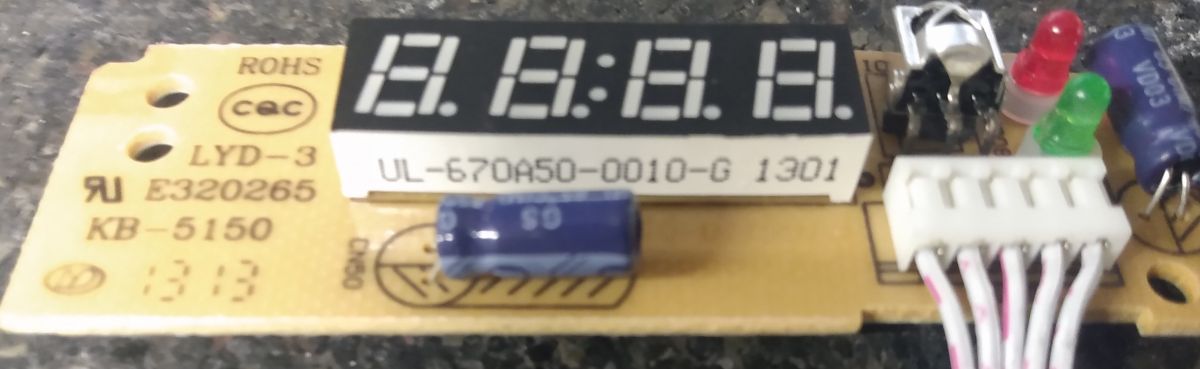
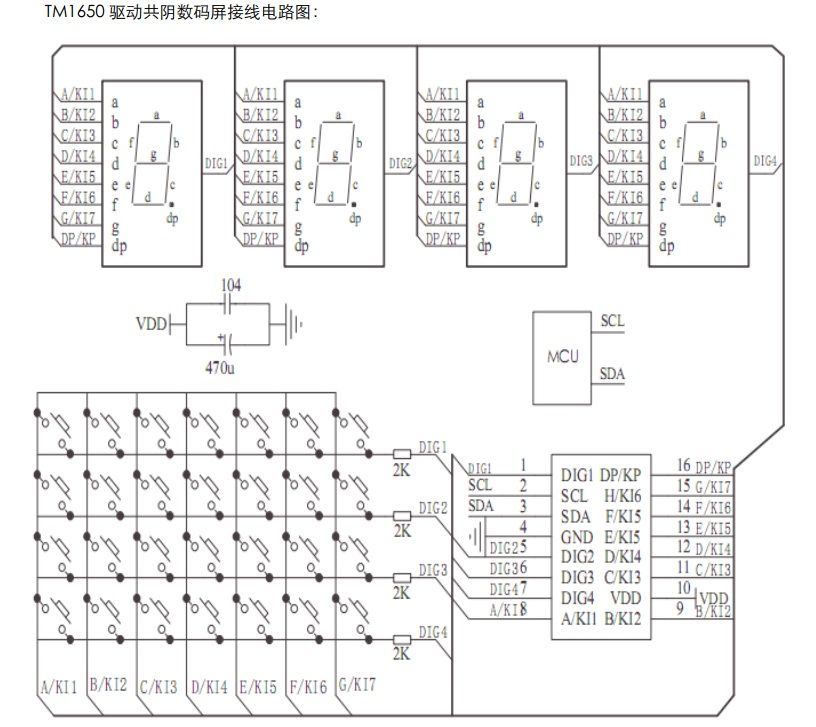
    Responsible for display control is the FD650S which is a clone of the TM1650S, it provides four seven-segment displays and a 28-button keypad, communicating via an I²C interface;

    DVBT decoder Synaps THD-2857, looking inside


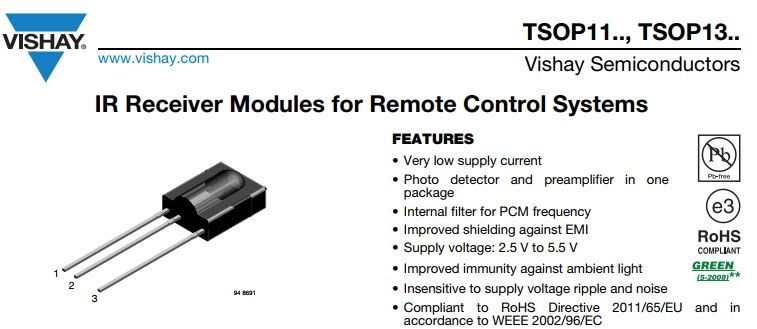
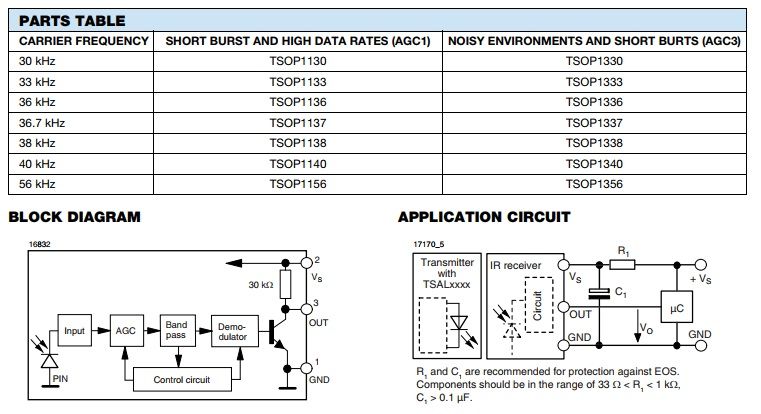
    The infrared receiver is a TSOP1338 manufactured by Vishay, admittedly not recommended for new devices but.... The receiver operates at 38kHz (IR carrier);
    DVBT decoder Synaps THD-2857, looking inside


    DVBT decoder Synaps THD-2857, looking inside


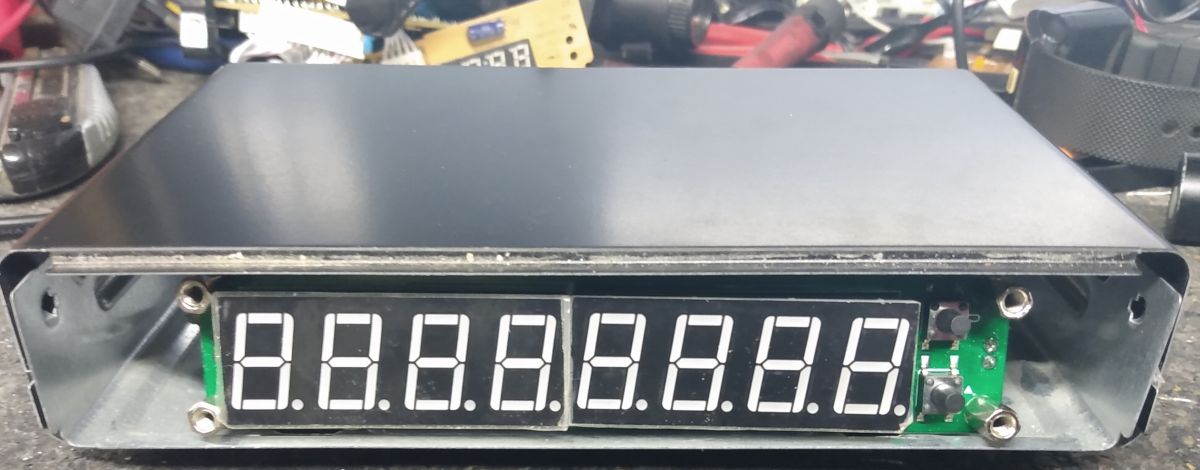
    The LED display is also interesting, the character and segment shapes are reminiscent of those used in communist times :D . We have a +5V power supply ready to go, and with the main board removed, there is room left to put in a couple of 18650 Li-Ion cells. Perhaps a battery-network version could be made?

    DVBT decoder Synaps THD-2857, looking inside


    I need to look for material for the front panel acting immediately as a bezel for the very bright meter display. Let's not throw away immediately used equipment, let's first check what we can use :D .

    Cool? Ranking DIY
    About Author
    ArturAVS
    Moderator
    Offline 
    ArturAVS wrote 25434 posts with rating 7482, helped 2254 times. Live in city Grajewo. Been with us since 2005 year.
  • ADVERTISEMENT
  • #2 19953762
    HD-VIDEO
    Level 43  
    ArturAVS wrote:
    More than twelve years have already passed since the introduction of digital terrestrial television in Poland

    You have exaggerated a bit
  • ADVERTISEMENT
  • #3 19953776
    ArturAVS
    Moderator
    HD-VIDEO wrote:
    You have gone a bit overboard

    Are you sure? Per wikipedia;
    Quote:
    The first regularly operating transmitters were launched on 30 September 2010.


    Well, I have changed it. That's how I went :D .
  • #4 19954413
    398216 Usunięty
    Level 43  
    ArturAVS wrote:
    I need to look for material for the front panel acting immediately as a bezel for the very bright meter display.
    Maybe laminate? I'll post a topic any minute about the practical use of laminate as a case material - front panel too.
    https://www.elektroda.pl/rtvforum/topic3882992.html
  • #5 19954780
    ArturAVS
    Moderator
    398216 Usunięty wrote:
    Maybe laminate?

    Only as a mounting bracket. If the original panel had a homogeneous structure it would stay as it is itself a filter for the green display.
  • #6 19954845
    szeryf3
    Level 29  
    Old DVBT decoders will work until the end of this year. You don't look a gift horse in the mouth.
    You have described the decoder topologies nicely.
    It is good that you will use the chassis and the power supply circuit.
    When you finish this project, please brag about it.
  • #7 19954867
    żarówka rtęciowa
    Level 38  
    Hello

    As for the power supply, you should include an RC cell in parallel with the output rectifying diode, its function is to suppress parasitic oscillations caused by the transformer dissipation inductance. These elements need to be selected experimentally using an oscilloscope.

    ArturAVS wrote:
    398216 Usunięty wrote:
    Maybe laminate?

    Only as a mounting bracket. If the original panel had a homogeneous structure then it would stay as it is itself a filter for the green display.


    Instead of the laminate, you could use 0.7-1mm thick galvanised steel sheet or an ABS plastic plate cut from an RTV case found in the woods.
  • ADVERTISEMENT
  • #8 19954927
    ArturAVS
    Moderator
    żarówka rtęciowa wrote:
    With regard to the power supply, there should be an RC cell included in parallel to the output rectifying diode, its task is to suppress parasitic oscillations caused by the dissipation inductance of the transformer.

    Here apparently some savings have been made as there is space for these components on the board but unoccupied.


    szeryf3 wrote:
    When you have finished this project, please let us know.

    Not likely to happen soon, current priority is building and commissioning an inverter for my PV :D .
  • #9 19955139
    sq3evp
    Level 38  
    Maybe off the top of my head - does anyone make any add-on so that I can receive DVT-T2 on a DVB-T tuner?
    I'm afraid that apart from the head unit nothing can be used, but maybe someone knows something?
  • #10 19955197
    ArturAVS
    Moderator
    sq3evp wrote:
    I'm afraid that apart from the head nothing can be used, but maybe someone knows something?

    Not necessarily here either, depends on front-end capabilities.
    sq3evp wrote:
    Does anyone produce an add-on so that you can receive DVT-T2 on a DVB-T tuner?

    Respectable companies, if the main processor allows it, may implement HEVC decoding in a new firmware version. On the other hand, it is a shot in the foot for them and a cut of their profits. Another thing is the inclusion of hardware MPEG/HEVC decoders in the front-processors, and this cannot be bypassed with software.
  • #11 19955202
    sq3evp
    Level 38  
    That's what I felt too. The good thing is that new decoders are not a big cost. The question is what to do with the old one?
    DAB+ radio cannot be received on such an old DVB-T tuner either.
  • #12 19955219
    ArturAVS
    Moderator
    sq3evp wrote:
    The only question is what to do with the old one?

    Toss the neighbour's :D like the title one. To be honest I haven't connected it to a monitor, and according to the documentation it allows you to play music and movies from USB. Perhaps it will work well in this role? By the way, my brother-in-law, a transport driver, is already bothering me about what to do with the two TVs mounted in the trucks (here, rest assured, they are connected in such a way that starting is only possible with the "slack" and the handbrake on).
  • #14 19956460
    szeryf3
    Level 29  
    So those who bought the new DVB-T2 set-top boxes got a bit carried away?
  • #15 19956471
    sq3evp
    Level 38  
    Why? Will there be new DVB-T2?
    As far as I remember, you could read a long time ago that these must be HEVC decoders. The fact that retailers had decoders without HEVC is another matter

    DVB-T2 tuners are compatible with DVB-T
  • #16 19956846
    ladamaniac
    Level 40  
    szeryf3 wrote:
    So those who bought the new DVB-T2 set-top boxes were a bit hasty?


    No, the rest will gradually switch to Hevc:

    "The process of transitioning channels from DVB-T to DVB-T2/HEVC encoding is expected to be completed by 30 June 2022. According to the announcement, it will be divided into four phases, starting successively on 28 March, 25 April, 23 May and 27 June 2022. The dates given will vary depending on the region of Poland."
  • #17 19956855
    ArturAVS
    Moderator
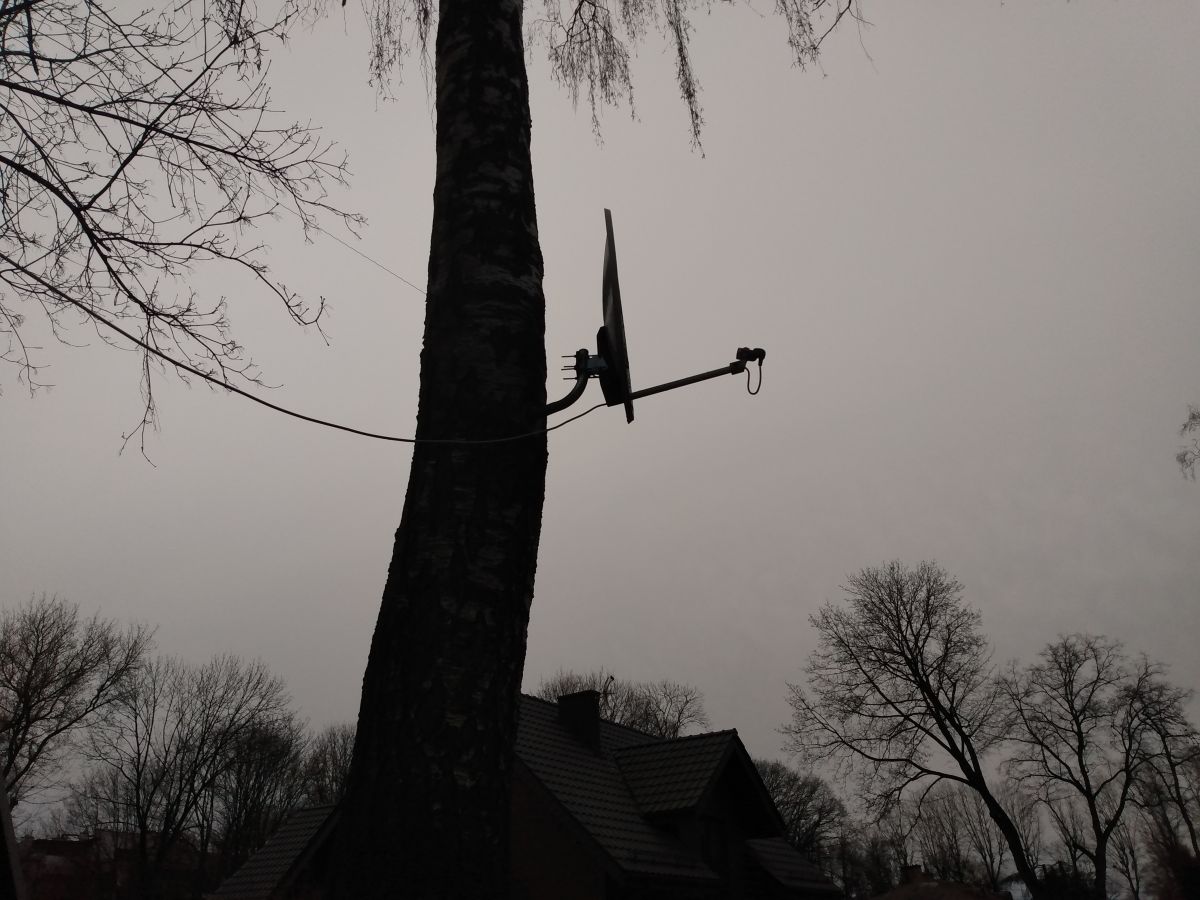
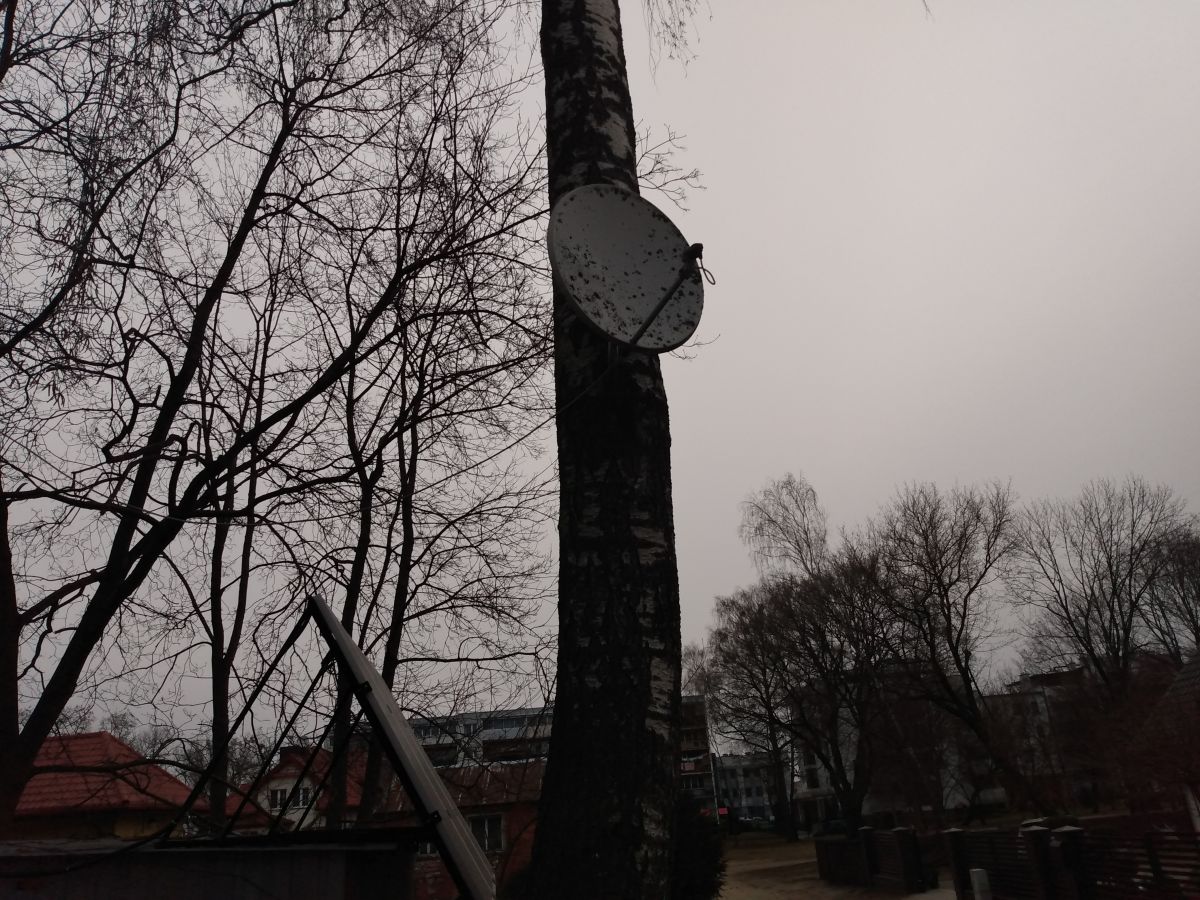
    Fortunately I do not use terrestrial TV :D . I have such a location that no reception is an option, even in the days of analogue TV something with "snow" could be received. Even with SAT there were a lot of problems, but the installation of an antenna on a tree (birch tree :D ) solved the problem and for almost twenty years now it works :D . One problem is the growth of trees and, for example, last year neighbours had to raise their masts with SAT antennas upwards as the tops of the trees were effectively attenuating the signal.
  • ADVERTISEMENT
  • #18 19957173
    Pan.Kropa
    Level 35  
    ladamaniac wrote:
    The transition from DVB-T to DVB-T2/HEVC encoding of channels is to be completed by 30 June 2022.
    This does not apply to TVP which can broadcast in DVB-T until the end of 2023.
    ArturAVS wrote:
    however, mounting the antenna on a tree (birch tree ) solved the problem and it has been working for nearly twenty years now .
    Forgive me, but I don't want to believe it. While a terrestrial antenna attached to a tree will receive. A satellite dish will not necessarily. However, the tree sways and grows. And as we all know, even a few millimetres of sway of such an antenna will result in a lack of reception.
  • #19 19958051
    ArturAVS
    Moderator
    Pan.Kropa wrote:
    Forgive me, but I don't want to believe it. As far as a terrestrial antenna attached to a tree will receive. A satellite dish will not necessarily. However, the tree sways and grows. And as we all know, even a few millimetres of sway of such an antenna causes a lack of reception.

    You are partly right, however it is not just any "birch". At breast height I can't manage the trunk, about five years ago I slightly corrected the positioning because after quite a storm a fallen branch broke the cable and dented the plate a bit. Cloudy and a bit dark in the morning but this is more or less how it looks;

    DVBT decoder Synaps THD-2857, looking inside


    DVBT decoder Synaps THD-2857, looking inside


    As you can see the plate has already started to grow moss :-( , unfortunately I am not physically able to go in and clean it (partial paralysis/disability). This summer a familiar installer will be replacing with a new larger one and correcting the settings. In stronger wind/rain there are signal fades, plus the overhanging young branches sometimes already start to reach the dish. I still have to cut some branches because they will obscure the photovoltaics, but I need to organise a lift. Mounting it on a building would be even more troublesome, as it would require at least a five-metre high mast. Most of the surrounding trees still remember the Tsar :D . Interestingly, the base of the antenna mount grew into it for about 3~4cm.
  • #20 19965933
    dgolf
    Level 15  
    You know, I've been looking at these DVBT-2 decoders and I don't know how you can put such a clunker that looks like analogue satellite tuners from the 1990s under the TV.
  • #21 19966200
    szeryf3
    Level 29  
    Some are really small in size.
    A few days ago I replaced an old Polsat decoder with a new one and this new one is three times smaller than the old one.
  • #22 19966309
    sq3evp
    Level 38  
    You can also buy ones directly for HDMI. They are very small.
  • #24 19966753
    sq3evp
    Level 38  
    I've seen the ranking - Wiwa generally performs nicely, fast and pretty good sensitivity compared to the old DVB-T in the same place on the same antenna installation
  • #25 21774650
    p.kaczmarek2
    Moderator Smart Home
    A topic more than three years old, but I'll try to ask.
    @ArturAVS do you still have that ALI M3801? Or the contents of the flash memory? In this topic I presented a project found on GitHub that compiles and starts:
    How to compile and run your own firmware for ALI M3801 and other chips from tuners?
    Helpful post? Buy me a coffee.
  • #26 21774681
    ArturAVS
    Moderator
    p.kaczmarek2 wrote:
    you may still have this ALI M3801?

    I should have it, I need to check the depths of the workshop (haven't looked in a while).

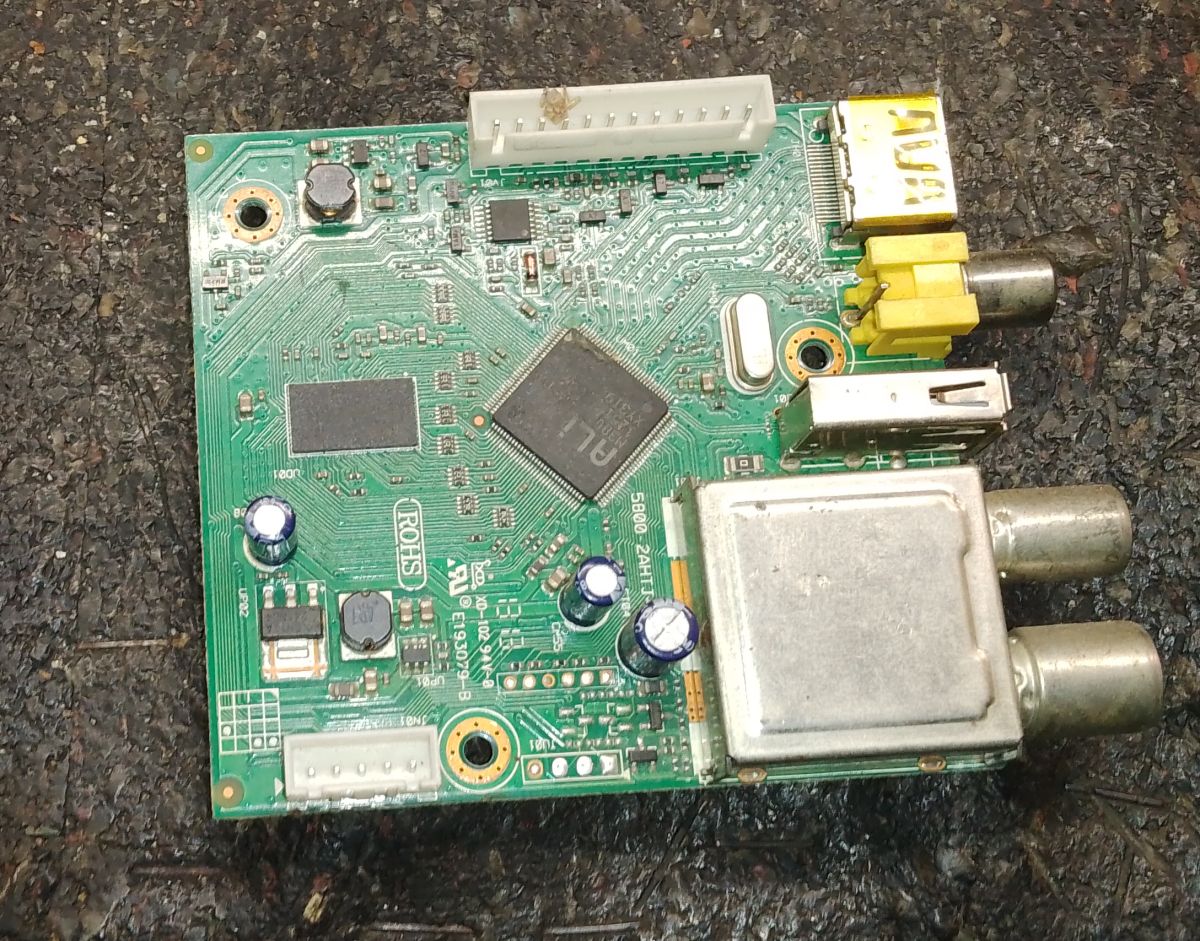
    Edit;

    Got it, barely avoided getting trampled :D ;
    PCB with ICs, RCA connectors, USB port, and TV tuner module


    Write what is needed, I will take home and use CH341.
  • #27 21775014
    p.kaczmarek2
    Moderator Smart Home
    That's a pleasant surprise, I thought you no longer had any. My old tuners have drowned, and as much as I'd love to come back with new information to test other ALIs, I don't stock them anymore.

    I'd love to see a snapshot of the 4 MB Flash memory, and yes keep that board safe, I'll see how much I can get going with it.
    Helpful post? Buy me a coffee.
  • #28 21775086
    ArturAVS
    Moderator
    I'll look for the power supply and front panel tomorrow (they were waiting to be unsoldered).
    p.kaczmarek2 wrote:
    I would love to see a dump of the 4 MB Flash memory

    That 25Q32? I'll solder in the adapter tomorrow and read it.
  • #29 21775286
    p.kaczmarek2
    Moderator Smart Home
    Yes, the one with eight legs, for the CH342 fits.

    The power supply and display don't matter much, but if you want them, keep them, you may get to the stage that they are useful.

    I only sat down to this 4 MB today, but from the side not of partitions, but of machine code.
    I described the partitions here:
    Interior of Comsat TE 1050 HD tuner, firmware ripping, partition format from Flash memory
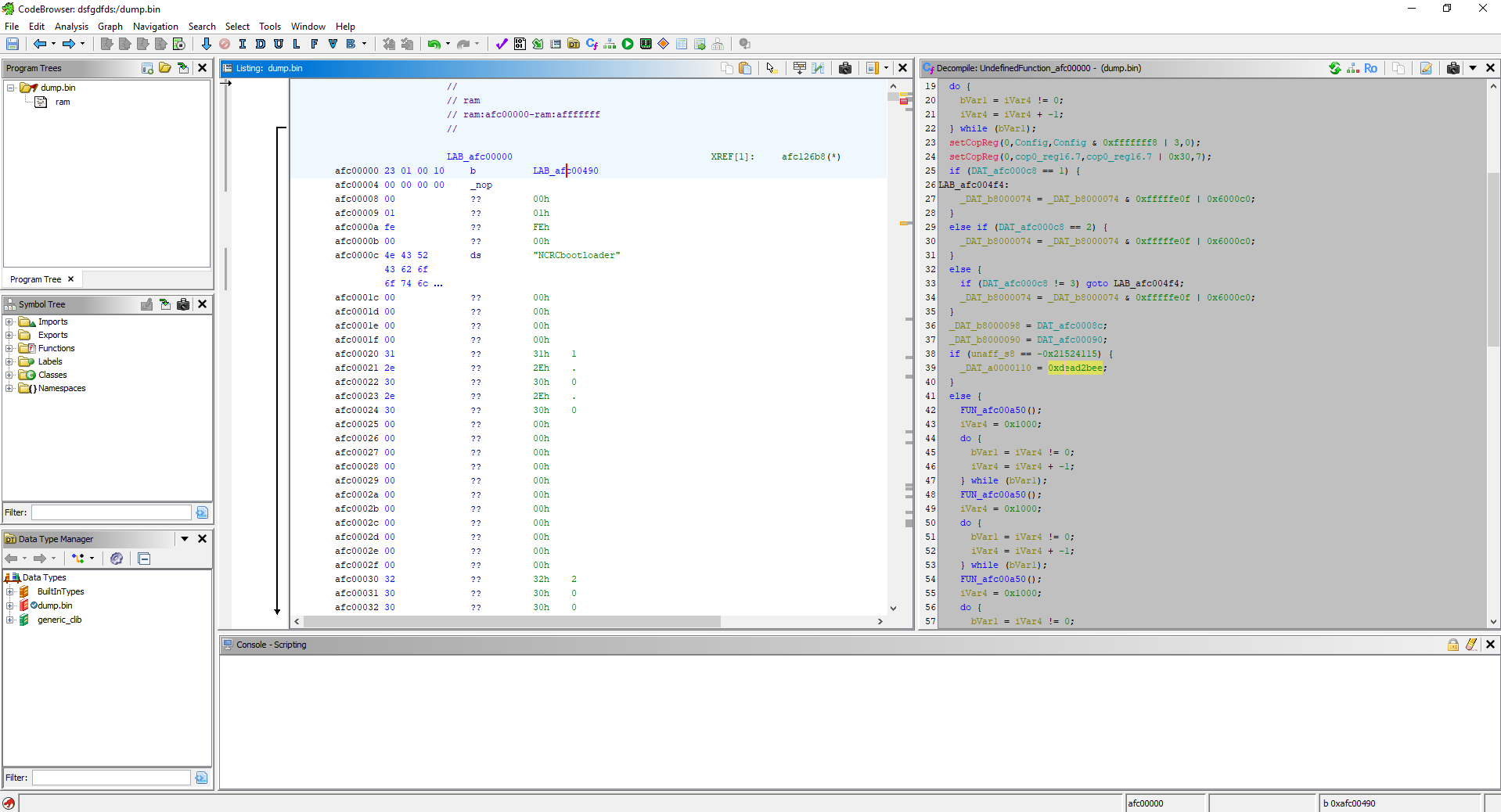
    I have now loaded a copy of the 4 MB from myself in Ghidr (mips architecture, base address afc0000) and I can see that this first "magic" value (4 bytes) is actually a jump instruction that jumps behind the header to offset afc00490:
    Screenshot of Ghidra analyzing dump.bin file in MIPS architecture
    There my attention was caught by the constant 0xdead2bee, quite distinctive, there you go:
    https://github.com/search?q=0xdead2bee&type=code
    Other interesting sources.
    Helpful post? Buy me a coffee.
  • #30 21775551
    ArturAVS
    Moderator
    Another problem has arisen, I have found a programmer, I have been looking for an adapter or clip for an hour, and cannot find :-( . It's been a long time since I used it, and I can't remember how to get it to work in Linux.
📢 Listen (AI):
ADVERTISEMENT