>>21788386 The worst thing is for someone who wants to "get posts" and has no idea what they are writing about.
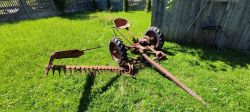
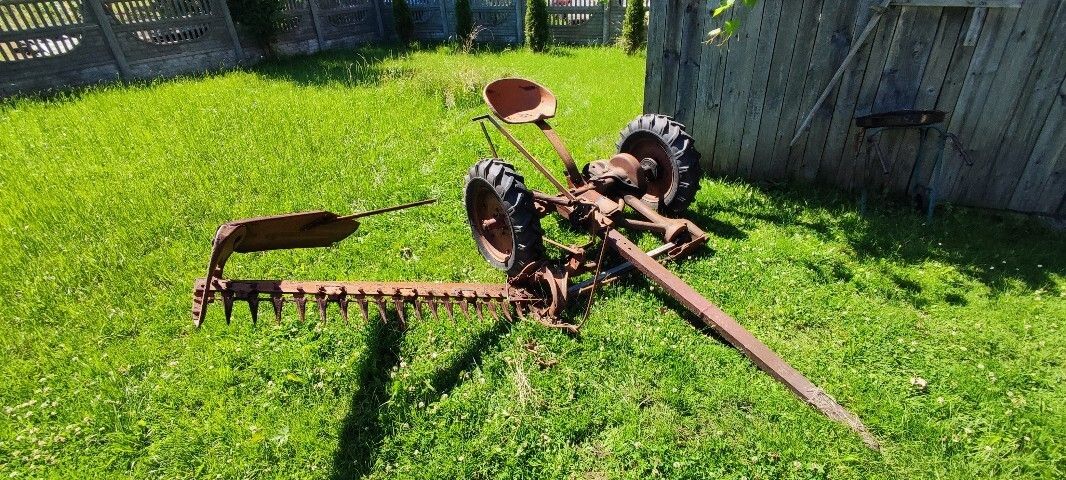
The horse-drawn mower, originated somewhere in the early 20th century. And it was called a mower from the beginning. An improved version was the reaper.
Horse mowers, developed sometime in the early 20th century.
"The first mowers were built around 1850 in the USA; due to the design of the cutting unit, mowers are divided into scissor and rotary mowers."
after: https://encyklopedia.pwn.pl/haslo/3926100/kosiarka.html and:
"The first full-fledged combine harvester was invented by two Americans - Obed Hussey and Hiram Pitts in 1836. Their invention, called the 'Hussey-Pitts Reaper', was the first machine to combine mowing, threshing and separating grain from the stalks."
That is, first the harvester was created and then the mower. Something doesn't add up here.
" "Lawn mowing machine"
The first patent for a mechanical mower described as a "Machine for mowing lawns, etc." was granted on 31 August 1830 to engineer Edwin Beard Budding (1795-1846) of Stroud, Gloucestershire, England. Budding's design was based on a cutting tool used for uniform carpet cutting. It was a drum mower with a series of blades arranged around a cylinder. John Ferrabee, owner of Phoenix Foundry at Thrupp Mill, Stroud, first produced Budding lawnmowers, which were sold to the Zoological Gardens in London.
In 1842, Scotsman Alexander Shanks invented the 27-inch roller mower.
The first US patent for a reel mower was granted to Amariah Hills on 12 January 1868. Early mowers were often designed to pull horses, with horses often wearing oversized leather boots to prevent damage to the lawn. In 1870, Elwood McGuire of Richmond, Indiana, designed a very popular human-powered push mower; although not the first human-powered design, his design was very lightweight and commercially successful.
Powered mowers appeared in the 1890s. In 1902. Ransomes produced the first commercially available mower powered by an internal combustion petrol engine. In the United States, internal combustion mowers were first produced in 1919 by Colonel Edwin George.
on 9 May 1899, John Albert Burr patented an improved rotary mower.
It may be taken from some device, but it is an industrial gearbox that can be purchased as normal, like an electric motor, actuator or spring. Such gearboxes can be found, for example, in roller shutters, conveyors, mixers, etc. They are not found in vehicles, and if they are, they are used as drives for accessories.
They are not found in vehicles, but if they are, they are used as accessory drives. Prices of these gearboxes start at 150PLN.
TL;DR: DIY mini hauler uses a 3 hp engine and 60:1 worm gearbox; “The 3hp internal combustion engine…is connected to a 60:1 worm gearbox.” [Elektroda, Sqerty, post #21788361]
Why it matters: Builders searching “how to build a small powered hauler” get specs, trade-offs, and fix-it tips distilled from the thread. This FAQ is for hobby fabricators comparing combustion vs. electric drives and looking to avoid common pitfalls.
What exactly powers this mini hauler and how is torque multiplied?
It’s driven by a 3 hp petrol engine from a NAC brushcutter, feeding a 60:1 worm gearbox, then a mower-tractor differential. This setup provides high torque at low speed for hauling. Wheels are 18×8.00-8, which suits low-speed traction on uneven ground. [Elektroda, Sqerty, post #21788361]
How do you change driving direction on this build?
There is no reversing gearbox. The operator rotates the entire front axle by 180 degrees, and the hauler drives the other way. This keeps the drivetrain simple and robust for a garage build without complex linkages. [Elektroda, Sqerty, post #21788361]
What’s the total gear reduction and why does it matter?
A user identified a secondary chain reduction around 4:1. Combined with the 60:1 worm stage, total reduction is roughly 240:1. This large ratio trades speed for strong tractive effort, ideal for starts on soft ground and heavy loads. [Elektroda, E8600, post #21789556]
Can you push the hauler by hand if the engine stops?
Manual pushing can be difficult because worm gears resist back-driving. A commenter flagged this as a practical failure case when the engine is off or stalled. Plan for a clutch, freewheel, or tow-point if manual movement is required. [Elektroda, acctr, post #21789141]
How loud is the drivetrain and how to reduce noise?
Commenters noted two-stroke exhaust noise and smoke. A practical fix is upgrading to a better muffler for sound attenuation and directing gases away from the operator. “I would change the muffler for more soundproofing.” [Elektroda, E8600, post #21789556]
Does the exhaust blow toward the operator when reversing?
Yes, one user observed that reversing directs exhaust toward the operator’s face. Consider rerouting the muffler outlet or adding a deflector to protect the operator during reverse movements. [Elektroda, kkknc, post #21789035]
What is a worm gearbox and why use it here?
A worm gearbox uses a screw-like worm driving a gear for large single-stage reduction and inherent back-drive resistance. It simplifies the layout and delivers high torque for a compact hauler, at the cost of manual back-drive. [Elektroda, Sqerty, post #21788361]
What is the load-box capacity and frame load rating?
The author did not state volume or payload. Users asked about load-box capacity and frame load rating, implying interest in quantified specs. You’ll need measurements and material data to calculate safe limits. [Elektroda, LEDówki, post #21788386]
Is electric drive better than the petrol setup here?
Opinions were split. Some favored electric for quiet operation and easy reversing; others preferred petrol for sustained power without battery concerns. Battery performance in winter and waterproofing electronics were raised as drawbacks. [Elektroda, 21789126/21789666/21790693/21792981]
How does battery performance change in cold weather?
A participant cautioned that batteries don’t perform the same in winter, highlighting reduced effectiveness compared with warm conditions. This impacts runtime and peak power for electric conversions. [Elektroda, partyzancik, post #21792981]
Are there waterproofing concerns for an electric conversion?
Yes. A user warned that controllers, BMS, and chargers can fail from water, vibration, and contamination. Improper storage may also deep-discharge lithium cells via leakage. Protect and seal electronics if you go electric. [Elektroda, satanistik, post #21790693]
Any bearing or retention issues to fix on this build?
One commenter flagged taper roller bearings seemingly secured only by a seger. The recommendation was to improve retention and protection to handle axial loads and shocks. [Elektroda, E8600, post #21789556]
Does the builder have a full workshop like in the video?
A user asked about the workshop seen in the video, but the author did not respond with details. The visible fabrication quality suggests solid tooling and welding capability. [Elektroda, LEDówki, post #21788386]
What is the tire size 18×8.00-8 and why choose it?
It indicates an 18-inch diameter, 8-inch width, for an 8-inch rim. This footprint suits low-speed traction and load distribution on grass, dirt, and yard surfaces. [Elektroda, Sqerty, post #21788361]
Is the finish overkill for a work tool?
One user praised the careful, exhibition-like finish while acknowledging it’s a working dumper. Good finishing improves durability and user pride without reducing utility. [Elektroda, Erbit, post #21794816]
AI summary based on the discussion. May contain errors.