FAQ 
TL;DR: With 12-hour keep-warm and the expert observation "WBR3 seems to be a common choice," the Harmony 50 smart kettle suits Home Assistant users and hardware tinkerers who want app control or cloud-free local control. The thread shows Tuya pairing, internal teardown, UART dpID mapping, and OpenBeken flashing on the WBR3 Wi-Fi module. [#21889268]
Why it matters: This FAQ explains what the Wi-Fi hardware actually adds, what risks exist inside a mains-powered kettle, and how to replace cloud control with local automation.
| Feature |
Harmony 50 |
Svenson SMART06B |
| Wi‑Fi module placement |
In the base |
In the handle |
| Menu emphasis |
Two clear modes: boil+hold or hold-only |
Similar functions, different menu layout |
| Hacking workflow |
Author simplified OpenBeken to 3 mapped dpIDs |
Earlier kettle required a separate prior walkthrough |
Key insight: The Wi‑Fi module does not directly run the heater. It talks over TuyaMCU UART to the main controller, so local control becomes possible once the key dpIDs are mapped and the WBR3 firmware is replaced.
Quick Facts
- The kettle costs about £120, pairs through 2.4 GHz Wi‑Fi with Bluetooth enabled, and can maintain temperature for up to 12 hours. [#21889268]
- The touch and app interface expose target temperatures such as 45°C, 60°C, 85°C, 90°C, and 100°C, plus countdown examples of 4 h, 18 h, and 24 h. [#21889268]
- The internal board is marked GS-EK17C1 KH:2024.8.19 and carries a WBR3 module, a 3.3 V LDO, transistors, a buzzer, and a varistor. [#21889268]
- The author flags the power supply as uninsulated, which makes direct UART-to-PC probing unsafe on a live kettle and raises real electrical-risk concerns during analysis. [#21889268]
- OpenBeken local control worked with just 3 mapped datapoints: channel 1 for power, 2 for current temperature, and 8 for target temperature, then Home Assistant discovery paired it as a local device. [#21889268]
What does the Wi-Fi module in the Harmony 50 electric kettle actually do in everyday use?
It adds remote control and automation rather than new heating physics. In daily use, you can start heating, choose a target temperature, keep water warm for up to 12 hours, schedule actions, and receive notifications from the Tuya app, while the kettle still works from touch buttons on the body.
[#21889268]
How do you pair the Harmony 50 kettle with the Tuya app, and why does it require 2.4 GHz Wi-Fi and Bluetooth?
You pair it through the Tuya app using 2.4 GHz Wi‑Fi with Bluetooth turned on. 1. Install the app. 2. Confirm your phone is on a 2.4 GHz network and enable Bluetooth. 3. Start pairing exactly as shown in the kettle instructions. The thread states those two radio settings are required for the pairing process; it does not describe a 5 GHz path.
[#21889268]
Which functions are available in the Tuya app for this kettle, such as boiling, temperature hold, scheduling, and notifications?
The app offers boiling, keep-warm, hold-only heating, timed scheduling, and notifications. It shows two main operating modes, lets you set a specific temperature, schedules a chosen action for a chosen time, and even exposes notification options including SMS alerts.
[#21889268]
What is the difference between the two operating modes in the Harmony 50 kettle: boiling to 100°C with keep-warm versus heating/maintaining a selected temperature?
One mode first boils to 100°C, then holds the chosen temperature, while the other only heats or maintains to the selected setpoint. The author describes the menu as emphasizing exactly those two paths: full boil plus hold, or maintenance alone at values such as 45°C, 60°C, 85°C, or 90°C.
[#21889268]
How long can the Harmony 50 kettle maintain water temperature, and how is that configured from the app or touch panel?
It can maintain temperature for up to 12 hours. You configure the target temperature from the app or by pressing the Warm touch control through preset values, and the app also shows countdown-style settings such as 4 hours, 18 hours, and 24 hours for timed actions.
[#21889268]
What error codes and safety protections does the Harmony 50 kettle have for NTC faults, low water, or overheating?
It reports basic faults on the display and includes dry-run protection. The thread explicitly mentions error handling for an open NTC circuit, a shorted NTC circuit, a warning for too little water, and protection against overheating or starting without water. That gives the kettle more diagnostics than many cheap small appliances.
[#21889268]
Where is the WBR3 Wi-Fi module located inside the Harmony 50 kettle, and how is its internal hardware laid out?
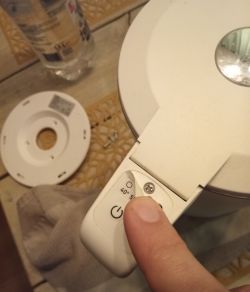
The WBR3 module sits in the base, not in the handle. The author removed the screws and found the Wi‑Fi section on the bottom board with a 3.3 V LDO and transistors, plus a buzzer, a varistor, and a board marked GS-EK17C1 KH:2024.8.19. He also notes the supply appears uninsulated.
[#21889268]
What is the WBR3 module, and why does it appear so often in Tuya-based kettles, heaters, ovens, and similar appliances?
"WBR3 is a Wi‑Fi module that handles network communication for a Tuya-style appliance, and in this kettle it exchanges UART data with the main controller rather than driving the heater directly." The thread shows another WBR3-based kettle and a reply notes that WBR3 seems common across ovens, stoves, kettles, and heater-type products, making it a recurring target for firmware replacement.
[#21889308]
What is the TuyaMCU protocol, and how do dpIDs map kettle functions like power, current temperature, target temperature, mode, timer, and sound?
"TuyaMCU is a serial control protocol that links a main appliance MCU with a Wi‑Fi module, using numbered dpIDs to represent functions such as switches, values, enums, and timers." In this kettle, the author intercepted UART traffic and matched dpIDs to features like power, current temperature, target temperature, operating mode, countdown hours, and buzzer state.
[#21889268]
How do you safely sniff UART communication in a mains-powered kettle without risking a short circuit from a non-isolated power supply?
You avoid connecting the live kettle directly to a computer UART. 1. Tap the MCU-to-Wi‑Fi RX/TX lines with a separate listener device. 2. Use that listener as a UART-to-TCP bridge. 3. Capture packets remotely. The author chose this method because products like this may expose mains potential on the control circuit through a non-isolated supply.
[#21889268]
Which dpIDs were identified in the Harmony 50 kettle for on/off state, current temperature, target temperature, mode selection, countdown hours, and buzzer control?
The mapped datapoints are clear enough for practical control: dpID
1 is on/off, dpID
2 is current temperature, dpID
8 is target temperature, dpID
15 is operating mode, dpID
17 carries countdown hours, and dpID
102 controls sound. The thread also shows dpID 102 set true as sound off, and false as sound on.
[#21889268]
How do you flash OpenBeken onto a WBR3 module from the Harmony 50 kettle and configure it for local control with Home Assistant?
You must desolder the WBR3, flash it, then map the needed dpIDs in OpenBeken. 1. Remove the module because its programming pads are on the underside. 2. Flash it following the linked WBR3 tutorial. 3. In
autoexec.bat, start
TuyaMCU, set Wi‑Fi state 4, and map channels 1, 2, and 8 for power, current temperature, and target temperature. After that, Home Assistant discovery can pair it locally.
[#21889268]
Why does changing the target temperature in OpenBeken start the kettle automatically without separately setting the power dpID?
Because this kettle treats a new target temperature as an implicit start command. The author states that after entering and changing the target temperature value, the kettle starts itself, so dpID 1 does not need a separate true command for start, although it still works for turning the kettle off.
[#21889268]
Harmony 50 versus the earlier Svenson SMART06B kettle — what are the main differences in Wi-Fi module placement, menu layout, and firmware-hacking workflow?
Harmony 50 moves the Wi‑Fi module to the base, while the earlier Svenson model placed it in the handle. The Harmony 50 menu more clearly highlights two modes, and the author says he simplified the OpenBeken work here to only three mapped dpIDs for classic heating to a set temperature up to 100°C.
[#21889268]
Why would someone heat distilled water in a smart kettle like this, and what practical use cases are there for that setting?
The thread does not give a practical justification for heating distilled water in this kettle. A commenter explicitly questions why someone would do it at all, so the screenshot reads more like a preset or labeling curiosity than a demonstrated real-world feature with a defined use case in this discussion.
[#21889629]
AI summary based on the discussion. May contain errors.