




logo elektroda
logo elektroda
X
logo elektroda

Controlling a 12V relay directly from a 5V MCU using a Zener diode and a PNP transistor

petrykcom 2103 38

TL;DR

  • A 5V MCU can drive a 12V or 24V relay directly using a PNP high-side switch and one Zener diode.
  • The Zener sits between the PNP base and MCU pin, so a LOW output turns the transistor on and a HIGH output keeps it off.
  • For 12V, a 9.1V Zener fits; for 24V, 20V or 22V works, with the condition VCC-5.7V < Vz < VCC-0.7V.
  • The circuit tolerated ±5% Zener variation and supply changes, but it still needs a 1N4148 flyback diode and a sensible base resistor, such as 1kΩ.
Generated by the language model.
ADVERTISEMENT
Treść została przetłumaczona polish » english Zobacz oryginalną wersję tematu
📢 Listen (AI):
  • #31 21893897
    viayner
    Level 43  
    Posts: 10546
    Help: 1557
    Rate: 2004
    Welcome,
    Andrzej_Tomaszewski wrote:
    ....
    The uC pin controls several components in series and there is a +12Vdc potential on the other side. In my opinion this is not correct.

    here I agree, if the GPIO pin is in the H state without any 'pull' e.g. OC or OD output, then the resistance of this output to ground will be equal to infinity, so the anode of the Zener diode hangs in 'air' and we have a potential of 12V here, i.e. we have 12V on GPIO, which is strongly unhealthy for most circuits.
    Of course, in real-world conditions it doesn't have to be like this, well, and the components have some finite resistance after all, but this is not a good approach in my opinion, balancing on the limit.
    Regards
  • ADVERTISEMENT
  • #32 21893942
    pawlik118
    Level 33  
    Posts: 2405
    Help: 201
    Rate: 596
    Andrzej_Tomaszewski wrote:
    pawlik118 wrote:
    the approach is unusual

    agreement

    pawlik118 wrote:
    it may arouse resistance to the unknown

    And what is the unknown here? Unless the arrangement is unknown because it is unused because it is incorrect.

    pawlik118 wrote:
    from an electronic point of view it is correct

    The uC pin controls several components in series and there is a +12Vdc potential on the other side. In my opinion this is incorrect.


    Let's assume we have a (relay) supply of 12V and a zener diode at 8.2V. The voltage the processor "sees" is 12-8.2=3.8V. This is just right, as the processor is powered by 5V.
    The fact that "somewhere" further down the line there is 12V is irrelevant.
  • ADVERTISEMENT
  • #33 21893949
    HD-VIDEO
    Level 43  
    Posts: 7946
    Help: 1255
    Rate: 1844
    From the calculations yes and in the actual system how much will it be?
  • #34 21893971
    Andrzej_Tomaszewski
    Level 13  
    Posts: 270
    Help: 2
    Rate: 335
    pawlik118 wrote:
    Assume we have a (relay) supply of 12V and a zener diode at 8.2V. The voltage the processor "sees" is 12-8.2=3.8V. This is just right, as the processor is powered by 5V.
    The fact that "somewhere" further down the line there is 12V is irrelevant.


    Your calculations for ideal components, mainly assuming zero current of the Zener diode below the threshold are ok. But in this circuit, disconnect the uC leg and measure with a voltmeter the voltage at the anode of the Zener diode relative to ground.
  • ADVERTISEMENT
  • #35 21893990
    pawlik118
    Level 33  
    Posts: 2405
    Help: 201
    Rate: 596
    >>21893971 The voltage drop across the diode depends on the current flowing through it. The current in turn must not exceed Ue-b / Re-b. This can be counted, measured. It is not a contact operation, and zener diodes do not have such a large spread of parameters. I deal with this on a daily basis.
  • #36 21894205
    mkpl
    Level 37  
    Posts: 5637
    Help: 306
    Rate: 839
    The circuit looks like a dig at the early years of MCU production. Still from the days where the processor port was an open manifold type with a small pull-up. Often an external pull-up was done. The trouble was that it was hard to put out a current-efficient high state that reliably quenched the NPN transistor. Added to this was the behaviour in the reset state. Such a processor in reset mode had a high state on its leads that would drive the relays with the NPN transistor.
  • #37 21894966
    Janusz_kk
    Level 39  
    Posts: 5681
    Help: 216
    Rate: 1427
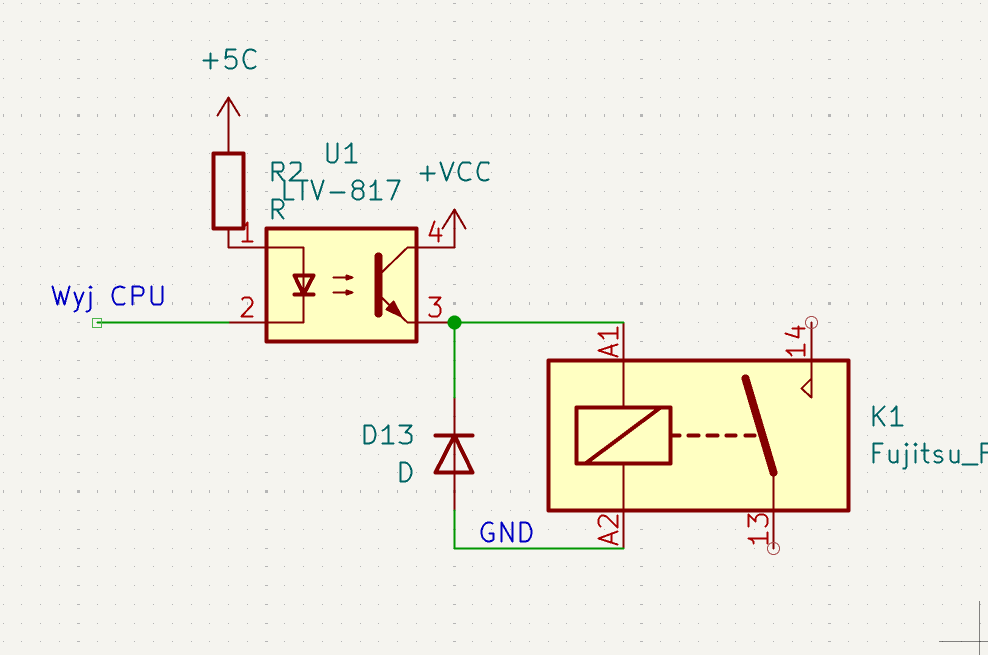
    Someone mentioned the optotransistor, this is the best and simplest solution.
    It eliminates all the disadvantages and you can control the low level (as in the figure) or the high level by changing the diode control.

    Schematic: LTV-817 optocoupler driving relay K1 with flyback diode D13, supplies +VCC and GND

    Added after 1 [minute]:

    The optotransistor in the darlington has sufficient current for most relays and even large ones.
  • ADVERTISEMENT
  • #38 21894977
    HD-VIDEO
    Level 43  
    Posts: 7946
    Help: 1255
    Rate: 1844
    And this for this AT

    petrykcom wrote:
    When the microcontroller (the one I just needed and many others) is switched on, there is a logical 1 at its output, so when the power is switched on for a short while until the IO is initialised, the relay controlled by the NPN transistor would be switched on
  • #39 21894983
    Janusz_kk
    Level 39  
    Posts: 5681
    Help: 216
    Rate: 1427
    HD-VIDEO wrote:
    As for this AT

    But what, because I don't understand.
📢 Listen (AI):

FAQ

TL;DR: At 24V with Rb = 1kΩ, the MCU pin may sink about 23mA, and one commenter called the idea “not very elegant but it works.” This FAQ is for engineers deciding whether a Zener-plus-PNP relay driver solves startup-safe 5V MCU control of 12V or 24V relays better than NPN, level-shifter, or optocoupler alternatives. [#21893578]

Why it matters: If a legacy 8051-family MCU briefly presents a logic-high-like state at reset, the wrong relay driver can energize loads at power-up.

Approach Parts discussed Main benefit Main drawback
PNP high-side + Zener transistor + Zener + base resistor Can keep relay off during certain 8051 startup states Sensitive to rail tolerance and GPIO behavior
Classic NPN low-side NPN + resistor Familiar, simple, widely used May turn relay on during reset in some 8051 cases
Common-base level shifter 2 transistors + resistor(s) More robust level shifting More parts than the Zener trick
Optocoupler / module optocoupler + driver stage Isolation, less dependence on coil rail stability More components and cost

Key insight: The thread’s consensus is not that the Zener-plus-PNP circuit never works. The real takeaway is that it only makes sense for narrow startup-behavior problems in older MCU families, and even then several participants prefer more robust alternatives.

Quick Facts

  • The proposed Zener window is 6.3V < Vz < 11.3V for a 12V rail and 18.3V < Vz < 23.3V for a 24V rail, derived from keeping the PNP off at 5V and on at 0V. [#21893011]
  • Suggested nominal Zeners were 9.1V for 12V rails and 20V or 22V for 24V rails; the post names BZX55C9V1, BZX55C20, and BZX55C22. [#21893011]
  • The original sizing advice was Rb = 1kΩ as a default, 2.2kΩ to reduce MCU pin current, and 470Ω for collector currents above about 100mA. [#21893011]
  • One practical warning is that at 24V with Rb = 1kΩ, the author estimated about 23mA into the MCU pin in LOW state, which sits near the lower edge of the cited 20–40mA typical GPIO range. [#21893011]
  • The flyback diode was specified as 1N4148, connected across the relay coil with cathode to collector and anode to GND, even though it was omitted from the ASCII sketch for readability. [#21893011]

How do I choose the Zener diode voltage for driving a 12V or 24V relay from a 5V MCU with a PNP transistor?

Choose Vz so it conducts when the MCU outputs 0V and stops conducting at 5V. The thread gives this range: VCC - 5.7V < Vz < VCC - 0.7V. For 12V, that means 6.3V to 11.3V, with 9.1V recommended. For 24V, that means 18.3V to 23.3V, with 20V or 22V suggested. A 20V Zener gives more turn-on margin, while 22V gives more turn-off margin. [#21893011]

Why would someone use a PNP high-side relay driver with a Zener diode instead of the classic NPN low-side transistor circuit?

They use it to avoid relay activation during power-up on some older MCUs. The author says certain controllers, including AT89C2051-class parts, can present a startup condition that would turn on a classic NPN low-side relay stage before I/O initialization. The Zener-plus-PNP approach makes the relay active on MCU LOW, not HIGH, so the default startup behavior can be safer for that narrow use case. Several participants still judged the classic NPN or two-transistor alternatives better overall. [#21893158]

What base resistor value should I use in this Zener-plus-PNP relay driver, and when should Rb be changed from 1kΩ to 2.2kΩ or 470Ω?

Start with 1kΩ. The original post calls 1kΩ a universal value, suggests 2.2kΩ to reduce the current the MCU must sink, and suggests 470Ω when collector current exceeds about 100mA. In practice: 1. Use 1kΩ for ordinary relay coils. 2. Raise to 2.2kΩ if GPIO current margin is tight. 3. Drop to 470Ω only when the PNP needs more base drive for heavier loads. [#21893011]

Why does this relay control method matter with AT89C2051 or AT89S8252 microcontrollers during power-up and reset?

It matters because these older 8051-family parts were discussed as problematic during reset and early startup. Multiple posters linked the idea specifically to AT89C2051 and AT89S8252, where a classic NPN relay stage can briefly energize the relay before firmware initializes the port. That makes the topology relevant when a short unwanted relay pulse could cause a fault, especially in legacy industrial controllers. [#21893165]

What is a common-base level shifter circuit, and how could it replace the Zener diode approach in relay control?

“Common-base level shifter” is a transistor stage that translates one logic voltage to another, keeping the base at a fixed reference while the signal passes through the emitter-collector path. In the thread, it was proposed as a long-used alternative that handles “unruly” MCU outputs better than the Zener trick. Several users preferred it because it avoids depending on a narrowly chosen Zener voltage and is less sensitive to supply variation. [#21893324]

What is an open-collector (OC) or open-drain (OD) output, and why was it mentioned in the discussion about GPIO safety?

“Open-collector” or “open-drain” output is a switching output stage that actively pulls low but does not actively drive high, so an external pull-up defines the HIGH level. It was mentioned because one poster argued that if the GPIO is effectively high-impedance in HIGH state, the Zener anode can float upward toward 12V, which raises safety concerns for the MCU pin. That criticism targeted the schematic’s behavior, not just its math. [#21893897]

How should the flyback diode be connected across a relay coil in this PNP high-side circuit, and why was 1N4148 suggested?

Connect the flyback diode directly across the relay coil, with cathode to the transistor collector and anode to GND. The original post explicitly recommends 1N4148 and says the diode is essential, even though it was omitted from the ASCII drawing for readability. Its job is to clamp the coil’s inductive kick when the relay turns off and protect the switching transistor. [#21893011]

PNP with Zener diode vs NPN transistor vs optocoupler module like LTV817 or HL-525: which relay driver approach is better for 5V-to-12V or 24V control?

The better approach depends on the failure you must prevent. The thread treats the Zener+PNP stage as workable but niche, the NPN stage as the normal simple option, and the LTV817/HL-525 optocoupler style as better when you want galvanic isolation and less dependence on a stabilized coil rail. One participant also preferred a shared P-channel MOSFET power gate for all coils over changing every single relay driver. [#21893669]

Why do some users report getting about 11V on the GPIO in LTspice when simulating this circuit, and what does that say about the schematic?

They report it because the schematic representation was disputed and likely misleading. One user said LTspice showed about 11V on the GPIO, while another clarified that the image posted later was only a redraw of the original ASCII art and was not analyzed or corrected. That means the simulation result says as much about the ambiguous drawing as about the intended circuit. [#21893524]

Which 8051-family MCU pin behavior during reset is relevant here, and how do the AT89C2051 ports actually behave at startup?

The relevant behavior is that some 8051-family ports do not act like modern push-pull GPIO at reset. In the thread, users say the AT89C2051 startup state is effectively an input with a pull-up, not a strong logic-high output, and another poster says there is “only a weak one or a strong zero.” That distinction matters because startup relay behavior depends on weak pull-up current, not just voltage level. [#21893669]

How much current does the microcontroller pin really sink in this circuit at 12V or 24V, and is that safe for typical AVR, PIC, or 8051 GPIO limits?

The original estimate is about 23mA at 24V with Rb = 1kΩ, ignoring Zener dynamic resistance. The same post says this sits within a typical 20–40mA GPIO limit for many MCUs, including AVR, PIC, and 8051-class devices, but recommends 2.2kΩ if you want more safety margin. That makes the circuit plausible, but it leaves little headroom on weak or legacy ports. [#21893011]

What happens in the real circuit, not just in ideal calculations, if I disconnect the MCU pin and measure the Zener anode voltage with a voltmeter?

In the real circuit, the node may not stay at a safe logic-level voltage. One participant challenged the idealized math and said to physically disconnect the MCU pin and measure the Zener anode to ground, implying the node can rise due to leakage and non-ideal Zener behavior. Another poster separately warned that the anode can effectively “hang in air,” which is the core practical objection to the design. [#21893971]

How can I stop relays from briefly turning on during MCU reset without using this Zener diode trick?

Use a driver topology that blocks relay power until firmware is alive. The thread suggests three practical alternatives: 1. Use a two-transistor stage instead of the Zener trick. 2. Use a common-base level shifter. 3. Gate the relay supply with a shared circuit, such as a watchdog-controlled stage or a P-channel MOSFET, then enable it only after initialization. Those methods target the reset glitch directly. [#21893578]

When is it better to use a hardware watchdog or a P-channel MOSFET relay power gate instead of changing the individual relay driver topology?

Use them when many relays share the same risky startup condition. One poster recommended a hardware watchdog that applies power to all relays only when it sees a square wave on one MCU pin. Another described using a P-channel MOSFET plus LTV817 so one control line disconnects power to every coil until initialization finishes. That can simplify a multi-relay design more than redesigning each channel. [#21893669]

What supply-voltage tolerance problems can make all relays switch on in this design, and how stable does the 12V or 24V rail need to be?

If the supply rises enough, the Zener threshold window can shift from “relay off” to “relay on.” One critic warned that “just a jump of a few V” could switch on all relays, especially on a 24V industrial rail. The author answered that the rail must be stabilized and cited using a 7812 regulator in practice. So this design needs a controlled coil supply more than a classic low-side NPN stage does. [#21893158]
Generated by the language model.
ADVERTISEMENT