logo elektroda
logo elektroda
X
logo elektroda
Dostępna jest polska wersja

Czy wolisz polską wersję strony elektroda?

Nie, dziękuję Przekieruj mnie tam

Pulsar – a retro sound card with an MP3 decoder and up to 16MB of DRAM

CHOPIN66 2718 48

TL;DR

  • Pulsar is a retro Sound Blaster clone built to add hardware MP3 playback for 386/486-era PCs, with up to 16 MB of DRAM.
  • An AT89S8253 replaces the 8051 and manages SPI communication with the VS1063 plus ISA bus control and DREQ/SS/DSS lines.
  • A 673104ANL DRAM controller addresses up to 16 MB, generating addresses from a 4-bit BCD code through three 74LS138 decoders.
  • The board also adds OPL3 YMF262 synthesis, two YAC512 DACs, digital potentiometers, microphone inputs, relay switching, and an op-amp mixer.
  • It deliberately omits Game Blaster support and the Game Port, though J6 leaves room for a Game Port daughterboard.
Generated by the language model.
ADVERTISEMENT
Treść została przetłumaczona polish » english Zobacz oryginalną wersję tematu
  • Incompatible serial header standards caused mouse failure

    #31 21918555
    bsw
    Level 22  
    Posts: 697
    Help: 5
    Rate: 731
    _ACeK_ wrote:
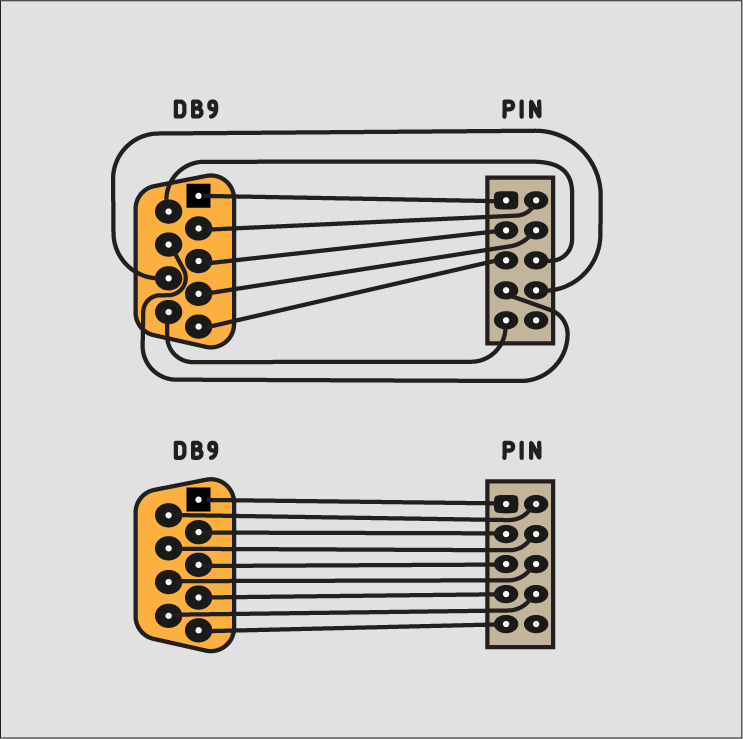
    What a surprise I had when I used the mouse from another computer. I plugged in the mouse and it didn’t work 🤔 I plugged it back into the first one – it worked 👀 I racked my brains trying to figure out why it wouldn’t work. After analysing the ribbon cable connections, it turned out that two different standards were being used :wink:

    Yes – there were two incompatible standards:
    https://pinoutguide.com/Motherboard/rs232_header_pinout.shtml
    Helpful post? Buy me a coffee.
  • ADVERTISEMENT
  • #32 21918567
    _ACeK_
    Level 15  
    Posts: 166
    Help: 6
    Rate: 195
    :smile: Once I’d figured out what the problem was no there was a problem :lol: But I’d better not admit just how many strange ideas popped into my head, hehe :wink:
    Pulsar – a retro sound card with an MP3 decoder and up to 16MB of DRAM
  • #33 21918574
    gemiel
    Level 26  
    Posts: 579
    Help: 79
    Rate: 305
    Pi111 wrote:
    Found on YouTube: COVOX – a free sound card [FASHION ITEMS 322]


    Those who used COVOX would never have called it a sound card. It was a makeshift solution dictated by the exorbitant prices of sound cards at the time. I used to tinker with such contraptions myself. Rubbish, that’s all. I have much fonder memories of the AY-8910 chip, which I added to my TIMEX 2048.
  • AY-8910 offered better game audio than PC speaker

    #34 21918603
    bsw
    Level 22  
    Posts: 697
    Help: 5
    Rate: 731
    gemiel wrote:

    Those who used COVOX would never have called it a sound card. It was a makeshift solution dictated by the exorbitant prices of sound cards at the time. I used to tinker with such contraptions myself. Rubbish, that’s all. I have much fonder memories of the AY-8910 chip, which I added to my TIMEX 2048.

    Nobody listened to music on it. But the sound from games was incomparably better than from a PC speaker.
    Helpful post? Buy me a coffee.
  • AY-8910 as a game effects generator

    #35 21918608
    ArturAVS
    Moderator
    Posts: 26270
    Help: 2298
    Rate: 7786
    gemiel wrote:
    AY-8910

    It was designed as an effects generator for video games (arcade machines). Covox, however you look at it, was a fully-fledged D/A converter (simplified to the point of absurdity). I built an extension for the Timex 2048 myself, but someone foisted an YM2149 on me at Wolumen as a replacement... And so it lay in a drawer for a few years until I managed to get hold of its documentation, and in the ‘meantime’ the Timex had met its electronic demise (ULA).
  • ADVERTISEMENT
  • #36 21918723
    toriman
    Level 15  
    Posts: 234
    Help: 9
    Rate: 44
    Hi,

    The SAA1099 is surprisingly cheap :) – nothing expensive

    tOri
  • #37 21918922
    CHOPIN66
    Level 15  
    Posts: 650
    Help: 3
    Rate: 245
    toriman wrote:
    Hi,

    The SAA1099 is surprisingly cheap :) it’s not expensive at all

    tOri


    Can you show me where I can buy them so cheaply?
  • #38 21919135
    toriman
    Level 15  
    Posts: 234
    Help: 9
    Rate: 44
    Hi,

    Have a look for SAA1099 on AliExpress: I bought some myself when I was designing the SAMari cartridge for the 8-bit Atari. Just in case, I’ve still got a few of them stashed away in the cellar...

    But back to the main topic. Great board. I’m really impressed.

    Best regards,
    tOri
  • Question about how the hardware MP3 decoder is driven

    #39 21919331
    Sam Sung
    Level 33  
    Posts: 2014
    Help: 227
    Rate: 583
    TechEkspert wrote:
    This computer won first prize in the Silesian University of Technology’s competition ‘Electronics – making life easier’.
    https://portal.polsl.pl/konkurs-elektronika/ps-fotoreportaz/
    Quote:
    The final of the ninth edition of the nationwide competition for secondary school pupils, “Electronics – Making Life Easier”, which took place on 9 April 2026, is now behind us.

    Unfortunately, the jury did not publish their reasoning as to how life is made easier in 2026 by having a new 486-compatible motherboard; nevertheless, it is a commendable achievement.

    Of course, the feat of building an ISA sound card with hardware MP3 decoding is also commendable. As far as I recall, the 486 could only keep up with decoding 128kbps joint stereo MP3 files at 80 MHz and above.
    TechEkspert wrote:
    A question has arisen as to how to utilise the hardware MP3 decoder on the card. Does a dedicated application send a stream of bytes from the file to the codec (perhaps via a RAM buffer on the card) and is that how the decoder plays the MP3?
    I’m also curious to know how this is (or will be) ‘driven’ by the driver. I suppose only a special DOS programme will be able to play MP3s on it :?:

    And somewhere in the meantime (which doesn’t exist), the KYRON processor :)
  • Driver support for Windows 3.1, 9x and DOS

    #40 21919371
    CHOPIN66
    Level 15  
    Posts: 650
    Help: 3
    Rate: 245
    Sam Sung wrote:
    TechEkspert wrote:
    Disc I reckon only a special DOS programme will be able to play MP3s on this :?:
    :)
    Windows Media Player too :D
    A driver is being developed for the system, based on the Sound Blaster 1.5 and Sound Blaster 16 drivers, to ensure support in Windows 3.1, Windows 9x and DOS. The card will operate in DirectSound mode, meaning data will be sent via DMA directly to the card – the card is responsible for decoding the audio, not the processor. The processor is only responsible for handling the player’s interface, including text commands.
    The Sound Blaster 1.0, 1.5 and 2.0 cards had the option to enable or disable DMA via a jumper – on mine, DMA is permanently enabled.
  • CM6631A-based PCI music player with AD1860/65 DACs

    #41 21920239
    _J23
    Level 6  
    Posts: 3
    Rate: 3
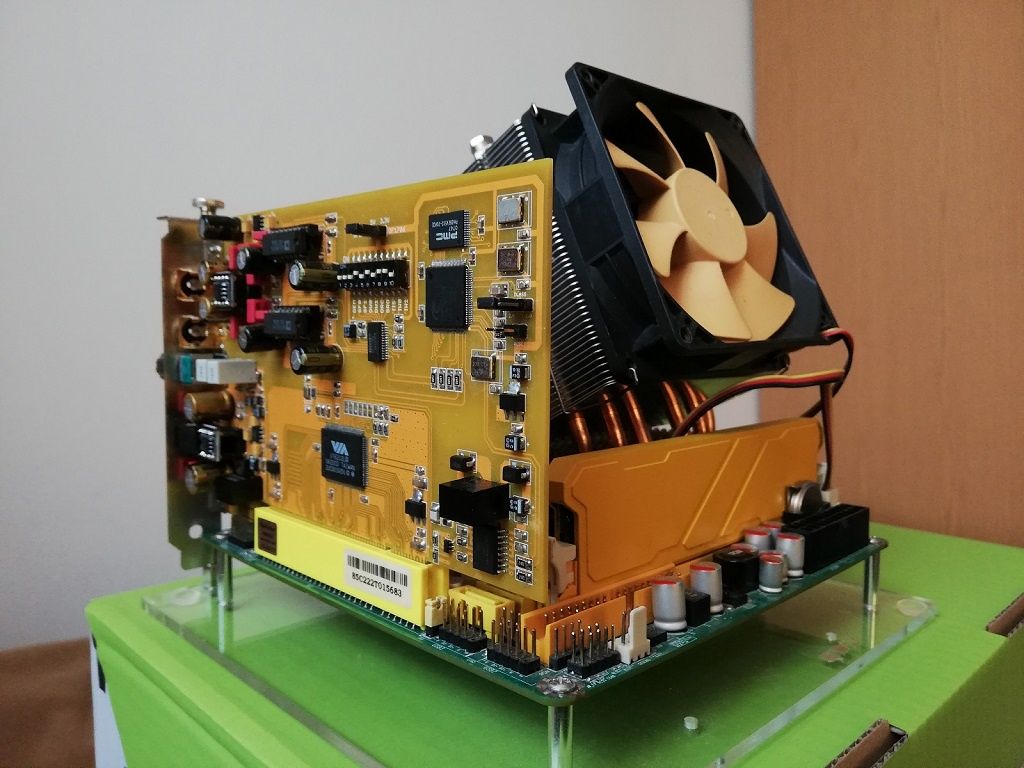
    The card design is brilliant! I imagine the PCB must be quite expensive. My approach to an ‘audio card’ was a bit different. I was more interested in a music player (not MP3 :P ) for use on old systems/computers with a PCI slot. The priority was audio quality + the legendary sound of R2R converters… no, not Covox ;) ; the card is meant to sound good, not look good. I didn’t use the classic SAA7785 controller, VIA Envy24 or anything similar from that era, because I couldn’t find one to buy, and I didn’t want to desolder any components. In the end, I used a VIA USB controller – the CM6631A – with AD1860/65, and it sounds brilliant :) .
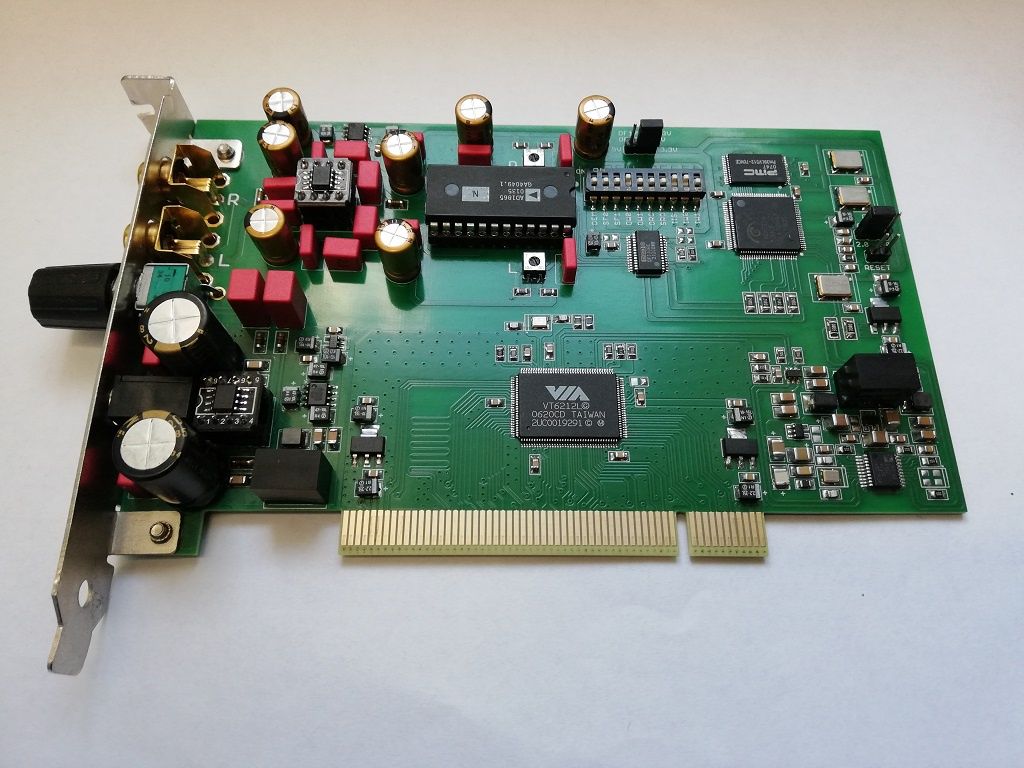
    Green PCI card with a knob, audio jacks, and many capacitors on a white background

    Expansion card with yellow PCB and a large fan on a heatsink, mounted on a clear standoff base

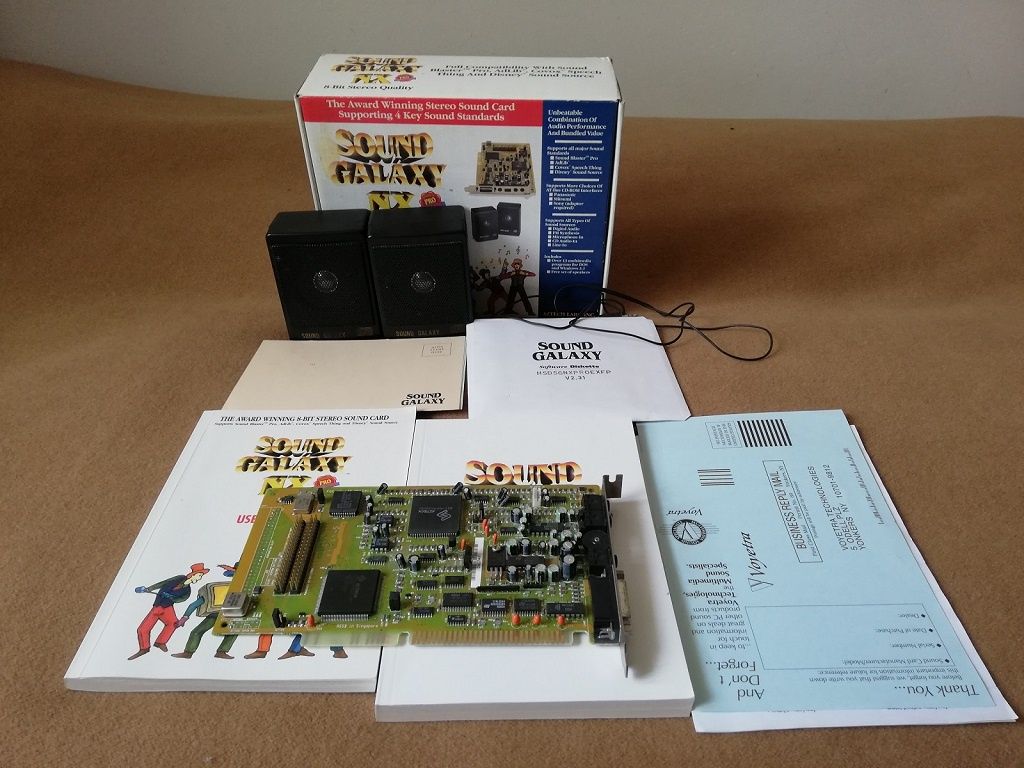
    Someone mentioned the company AZTECH. Here you go – it’s in the safe ;) , a complete box :D from the early ’90s.

    Sound Galaxy set: product box, ISA sound card, two speakers, and manuals on a beige background
  • CM6631A-based PCI audio card with AD1860/65 DACs

    #42 21920320
    CHOPIN66
    Level 15  
    Posts: 650
    Help: 3
    Rate: 245
    _J23 wrote:
    The card design is brilliant! I imagine the PCB must be quite expensive. My approach to an ‘audio card’ was a bit different. I was more interested in a player for listening to music (not MP3s :P ) on old systems/computers with a PCI slot. The priority was audio quality + the legendary sound of R2R converters… no, not Covox ;) ; the card is meant to sound good, not look good. I didn’t use the classic SAA7785 controller, VIA Envy24 or anything similar from that era, because I couldn’t find one to buy, and I didn’t want to desolder anything. In the end, I used a VIA USB controller – the CM6631A – with AD1860/65, and it sounds brilliant :) .
    75950cbcb0

    e2a8196540

    Someone mentioned the company AZTECH. Here you go – it’s in the safe ;) , a complete box :D from the early ’90s.

    068a8242c5


    Normally the PCB would have been expensive, but as a new customer at Allpcb I got a $30 discount – the card ended up costing $15 instead of $45 – I had to extend it from 27 cm to over 33 cm in length. I had a riser for a Zenith motherboard made by the same company and paid $1.50.

    Blimey, that card of yours turned out really well, and it’s a PCI one :D
  • ADVERTISEMENT
  • #43 21920799
    DJ_KLIMA
    Level 25  
    Posts: 661
    Help: 67
    Rate: 220
    I used to have a Sound Blaster Gold AWE64 in my desktop back when ISA was still around – it was a great card.
  • ENIG plating needed for reliable ISA contact

    #44 21921755
    _J23
    Level 6  
    Posts: 3
    Rate: 3
    33 cm in length is quite a lot for my 386DX; I don’t think it’ll fit in a midi tower case ;) . What about the port cover/bracket? Are you making it yourself or taking it from a donor? The cost of the PCB itself is low, but gold-plating (e.g. Immersion Gold – ENIG) the card’s connectors is quite an expense, and it’s essential if you want a good connection between the card’s connector and the ISA slot.
  • ADVERTISEMENT
  • 33 cm ISA card size and ENIG cost tradeoff

    #45 21921766
    CHOPIN66
    Level 15  
    Posts: 650
    Help: 3
    Rate: 245
    _J23 wrote:
    33 cm in length is quite a lot for my 386DX; I don’t think it’ll fit in my midi tower case ;) . What about the port covers/plugs? Are you making them yourself or sourcing them from a donor? The cost of the PCB itself is low, but the gold plating (e.g. Immersion Gold – ENIG) of the card’s connectors is quite an expense, and it’s essential if you want a good connection between the card’s connector and the ISA slot.


    As for the bracket, perhaps I’ll adapt a ready-made one – you can buy ready-made brackets without holes.
    It would fit into a midi tower – 33 cm is the standard ISA card dimension set by IBM – AT-standard motherboards always had one dimension of around 34 cm so that they could accommodate the cards from the PC XT era.
    The gold-plating of the connector is by far the biggest cost – that’s why I compromised and went for HALS with Lead. But I think that if this one works, I’ll then pack all the control logic into an FPGA. That way, the card will be smaller in size.
  • #46 21921806
    TechEkspert
    Editor
    Posts: 7188
    Help: 16
    Rate: 5568
    Porting it to an FPGA would be an equally interesting project; one could consider adding other accelerators or emulators once the FPGAs support, for example, 16/8-bit ISA or additional IDE, COM and LPT interfaces.
  • #47 21922886
    Tommy82
    Level 41  
    Posts: 12141
    Help: 455
    Rate: 1073
    A mate had a Covox for the Mini; he soldered a jack output onto it and plugged it in where the read head would normally go. You had to press play, and to stop the humming noise, the jack would cut the power to the motor. So, with the jack plugged in, the cassette wouldn’t work either, by the way.
  • Question about driver handling of the hardware MP3 decoder

    #48 21926989
    mkpl
    Level 37  
    Posts: 5668
    Help: 306
    Rate: 856
    Nicely put together. A bit of a TTL mess that can be sorted out with a simple CPLD. I understand it was meant to be period-accurate.

    An interesting idea with the hardware MP3 decoder. How is this handled by the driver and the system? For me, that’s quite a challenge.

    Nowadays, you just need to switch from PCIe to USB and use any chip, and it works a treat, but ISA is a different story and requires more creativity :)
  • #49 21927014
    bsw
    Level 22  
    Posts: 697
    Help: 5
    Rate: 731
    mkpl wrote:
    Nowadays, all you need to do is switch from PCIe to USB

    In 1998, I bought another PC – this time an ATX – a Pentium II Celeron 300A (Slot 1).
    In the shop (where they were assembling it), they asked me if they should drill holes in the case for USB, as there were two sockets on the motherboard.
    I asked – what’s that? It’s a new standard, but I don’t think it’ll catch on...
    ;-)
    Helpful post? Buy me a coffee.
ADVERTISEMENT