logo elektroda
logo elektroda
X
logo elektroda
Dostępna jest polska wersja

Czy wolisz polską wersję strony elektroda?

Nie, dziękuję Przekieruj mnie tam

A tour of the Odra computers – computers designed and built in Poland

TechEkspert 3864 82

TL;DR

  • The tour traces the Polish Odra computer series built by Elwro in Wrocław, from valve-and-transistor prototypes to TTL-based third-generation machines.
  • Odra 1002 used 36-bit words, drum storage with 4,096 words, valve modules, and transistor modules connected by shielded coaxial cables.
  • Later transistor models improved steadily: Odra 1003 reached 500 additions per second, Odra 1103 5,000, and Odra 1204 60,000.
  • Odra 1304 became software-compatible with the British ICL1904, while Odra 1305 and 1325 adopted TTL integrated circuits and raised production above 1,000 machines.
  • The piece notes missing circuit diagrams, asks for corrections, and laments that Poland later lost continuity in large-scale computer production.
Summary generated by AI based on the discussion content.
ADVERTISEMENT
Treść została przetłumaczona polish » english Zobacz oryginalną wersję tematu
📢 Listen (AI):
  • #61 21933370
    gregor124
    Level 29  
    Posts: 1616
    Help: 99
    Rate: 857
    My mistake – I was misled by the similar name. Of course, the PT-3 is a magnetic recording device, whereas the paper tape devices had a similar name. Does anyone have any information about them?
    PT-304 Tape Perforator 1968–1972
    CK-304 Card Reader 1968–1987
    CT-304 Tape Reader 1968–1987
    Helpful post? Buy me a coffee.
  • ADVERTISEMENT
  • South Korea’s industrial rise contrasted with Poland

    #62 21933391
    andreyatakum
    Level 15  
    Posts: 825
    Rate: 1150
    gulson wrote:
    What did South Korea do differently?

    South Korea had no choice but to develop its technology; let’s look at the map and the population. 100,000 km² and 51 million inhabitants. Poland: 320,000 km² and 37 million inhabitants. 60 per cent of South Korea’s land area is mountainous. It is unsuitable for agriculture, and consequently there was a shortage of food that could be bought by selling goods made by hand and with ingenuity. In Poland, there was never a shortage of land or food.

    After the war, Korea’s situation was far worse than Poland’s. There was nothing to eat. Moreover, Korea was under the influence of the United States, whilst Poland was under that of its eastern neighbour. The former helped, the latter…you know the rest. Poland was very fortunate that North Korea did not emerge alongside it.

    There’s an interesting book called *Every Street Is Paved With Gold: The Road to Real Success* by Kim Woo-Chong (founder of Daewoo). It explains the conditions under which South Korea’s industry was established.

    gulson wrote:
    But here, concrete and banks reign supreme

    Well, it’s not quite that bad.

    AI Perspective: Polish goods exports are based on industrial and processed goods. Machinery, equipment and transport equipment clearly dominate the sectoral structure (accounting for approx. 35–40 per cent), including the automotive and household appliances sectors. Other key pillars include metals, chemical products, furniture and agri-food products.
  • Asian cloning and copyright shaped computer markets

    #63 21933495
    gregor124
    Level 29  
    Posts: 1616
    Help: 99
    Rate: 857
    What held back computer production in Poland the most was our mindset and our attachment to Western culture – and thus our perception of copyright as understood within Western civilisation.

    Asians view intellectual property quite differently; in practice, it does not exist there in the way we understand it.

    They simply took Western solutions, copied them and produced them in huge quantities, practically flooding the world with their products.
    Over time, they developed their industry to such an extent that Western companies themselves relocated their production there in order to remain competitive in their own markets. This went on for decades and, in fact, continues to this day.

    First, the Japanese flooded the market for programmable calculators – a sector in which Olivetti had been the leader in the 1960s and 1970s – and later turned their attention to copying American products. When the Apple II appeared, it almost immediately became the most frequently pirated product in the world.

    It reached the point where Apple released only a small batch of the Apple II+ for the Japanese and European markets. And as it turns out, copies of their computers were still the most popular in schools in Australia, China and many other countries in Africa and the Americas as late as the 1990s. Genuine Apple products were, in fact, sold only in the US, and even there they faced stiff competition from illegally imported clones.

    The Australian press of the 1980s is full of advertisements from companies offering Asian Apple II clones and complaints from experts about their quality, particularly the ‘quality’ of Asian power adaptors, which had a reputation amongst firefighters similar to that of Rubin televisions ;)

    Here is an interesting video from 1984 showing something of a computer market in Japan.
    Towards the end, there is an interview with a seller offering Apple II copies, and when asked whether this is legal, he replies honestly that he does not know.


    This video illustrates the difference in how Europeans and Asians perceive property rights: for a European, adding an empty base unit still constitutes a clone and a breach of the law, whereas for a manufacturer in Asia, it is a completely different product ;)

    And the fact that Poland didn’t get into this business is perhaps just as well; we’d probably not have stood a chance against the Asians, especially after IBM granted them the rights to manufacture PCs and sell them legally everywhere, whilst the Poles were being cut off at the time by COCOM.
    https://pl.wikipedia.org/wiki/Coordinating_Committee_for_Multilateral_Export_Controls

    IBM, together with Intel and the Chinese, cemented their grip on the computer business so firmly that to this day we have to put up with the worst computer ever made.
    And only once did the British manage to break into this market for a short while, but even they eventually had to shift their processor to the entirely new mobile sector.
    Helpful post? Buy me a coffee.
  • ADVERTISEMENT
  • West lagged behind due to microprocessor missed opportunity

    #64 21933598
    _ACeK_
    Level 15  
    Posts: 172
    Help: 6
    Rate: 197
    :smile: You’re writing about something that you don’t know, youdon’t understand. The link I provided earlier shows what was happening in 1978 in the West. In that very same 1978 I remember going with my school ID to KSM (the same one Liroy sings about) ⬇️


    :idea: to collect the sugar ration card I was entitled to :roll: Hardly anyone had a landline at home, not because they didn’t want one, but because you had to wait years to get one installed. Black-and-white cathode-ray tube televisions reigned supreme. In the film linked above, William Shockley was given 15 million dollars for development in the late 1950s . In 1985 I was earning $20 . The progress that was possible in the West stood no chance in the Comecon , because we copied and improved upon what we copied, but we were still lagging behind 10 years behind IBM . The fact that we missed the microprocessor revolution wasn’t something that happened to us alone. The most famous computer from the film *WarGames* Cray shared the fate of ODRA ⬇️


    The same thing happened to SUN ⬇️


    :?: None of them foresaw the potential of the Intel . You keep going on about conspiracies IBM and Intel 😎 The truth is that PC was made from parts that were available off the shelf. The only proprietary component was the BIOS , which was cracked and IBM lost the case in court :cunning:

    😛 And here’s another interesting fact: back in the 80s you could borrow a computer from a public library ⬇️ Oh, that loathsome, rotten West 👀


    Btw This photo ⬆️ for the film is just a fake photomontage, because we’ve got a loaf of bread behind the station at an inch, and next to it a floppy disk 3.5 :twisted:
  • #65 21933643
    andreyatakum
    Level 15  
    Posts: 825
    Rate: 1150
    gregor124 wrote:
    That was our mindset and our attachment to Western culture, and thus our perception of copyright within Western civilisation.

    In the late 1980s and early 1990s, Poles did not take copyright all that seriously. Pirated software and CDs found their way onto Eastern markets via Poland.
  • MIPS supply constraints shaped workstation market decline

    #66 21933696
    gregor124
    Level 29  
    Posts: 1616
    Help: 99
    Rate: 857
    >>21933643
    I find it hard to imagine that such a ‘pirate’ product could have been a serious Polish export, and the small domestic market was dominated more by gamers than by people looking for a computer for work.
    By the late 1980s, the global computer market was contracting, not expanding.
    Companies that, just a few years earlier, had set the trend for home computers and produced a host of gadgets such as Atari and Commodore, were already going bankrupt.
    And dozens of smaller firms, such as HP and Matel, had withdrawn from the business much earlier.
    British firms were still just about hanging on, but they had effectively tailored their computers to their own market with its specific requirements.
    However, British customers had different requirements; they preferred a computer for work rather than a toy for playing hundreds of not particularly clever games for hours on end ;)

    In Poland, any computer would have lost out to a cheap gaming toy anyway; let’s not kid ourselves. And any potential manufacturer could, at best, have sold a few thousand – or perhaps more like a few hundred – genuine microcomputers, and even then would probably have had to rely on components from Asia for any customer to even consider their product.
    >>21933598
    Sun went under because, in the end, the line between PCs and professional computers became blurred.

    In any case, this once again demonstrated how cleverly IBM and Motorola had held back the mass production of MIPS processors until Intel was in a position to compete with them.

    When, in the mid-1980s, it became clear that the old processor designs had reached their limits, it was suddenly realised that they could be redesigned using a fresh approach to their architecture, such as MIPS or RISC.
    And then it suddenly transpired that Motorola was unable to supply sufficient quantities of these processors to the companies associated with Jobs for their new computers. And later, when IBM took over, it suddenly began developing some sort of universal architecture and tacked on dubious and unnecessary Intel compatibility to MIPS.
    When that too was finally overcome, it turned out that the only possible alternative supplier could be none other than Motorola. And here history repeated itself, because instead of putting a processor for Apple into production, Motorola began manufacturing a stripped-down version for which there were no customers at all – well, perhaps apart from a few Amiga 4000 owners, for whom perhaps a few dozen accelerator cards featuring this stripped-down processor were produced, and which, in turn, were unsuitable for running the Apple/NEXT system.

    In this situation, Apple withdrew from the IBM/Motorola partnership fairly quickly and eventually switched to the Intel platform.

    Ultimately, Apple continues to manufacture its computers, albeit, unfortunately, on the Intel platform, whilst IBM and Motorola have gone out of business ;)
    Helpful post? Buy me a coffee.
  • ADVERTISEMENT
  • Proprietary IBM PC architecture criticized as outdated

    #67 21933728
    stachu_l
    Level 38  
    Posts: 2981
    Help: 480
    Rate: 1125
    gregor124 wrote:
    that to this day we still have to put up with the worst computer ever made.

    Can you specify which one is ‘the worst’? If you mean the IBM PC, we’re hardly struggling with it in the form IBM offered in the early 1980s.
    What’s it missing?
    Originally, it was essentially text-only, although CGA offered a graphics mode, but MDA didn’t have one. It was only the Hercules clone that defaulted to MDA, but you could switch to monochrome graphics mode.
    No sound apart from the PC speaker
    Of course, this is quite a deal-breaker for users of the C64 or similar machines, but I suppose IBM’s target audience was different – office work, and certainly people who’d already been trained on the terminals of ‘big’ computers, where such operating modes were sufficient.
    Lotus 123 ran in text mode – a sort of text-based Excel; even Tetris had a built-in mechanism to switch to the Lotus 123 screen with three key presses, a special ‘boss is coming’ mode.
    By the way, the first song I ever heard coming from a PC (through the speaker) was ‘Mushroom’: https://www.youtube.com/watch?v=mqf95ETHSzE
    However, if my memory serves me correctly, in order to play it, the programme would block all or almost all interrupts and take complete control of the PC for the duration of the playback. DOS, however, wasn’t multitasking, so it was normal for a given programme to control the system until it finished; only system interrupts worked as normal.

    What is missing from today’s PCs?
    Let me put it this way – in certain discussions between Intel and Apple, there were suggestions that there were too many. Jobs had a pretty good sense of what people needed and, to some extent, he shaped those needs, much like fashion designers. An example of the spirit of the negotiations: ‘Hey Intel, your chipset has 10 USB ports, but I reckon 4 are enough for my laptop and people don’t need any more; cut out 6 ports for me, and the chipset will consume less power in the process.’

    _ACeK_ wrote:
    The only thing that was proprietary was the BIOS, which was cracked, and IBM lost the case in court

    But what exactly was proprietary? As far as I know, it was the binary copying of it. In IBM’s official documentation for the PC/XT, there was a printout of the BIOS at the end. It was possible to write a BIOS that performed the same functions, but not to copy IBM’s code. Some programmes were capable of making direct jumps to the BIOS code, and that’s when there was a problem with alternative BIOS codes. However, if a programme correctly used the BIOS functions described in the comments of the attached code, it would also work with alternative versions of the BIOS. The functions were called via interrupts with the appropriate parameters in the registers, so the location of the code didn’t matter.
  • ADVERTISEMENT
  • Apple II drove early home computer adoption

    #68 21933756
    gregor124
    Level 29  
    Posts: 1616
    Help: 99
    Rate: 857
    stachu_l wrote:
    Hey Intel, your chipset has 10 USB ports, but I reckon 4 are enough for my laptop and people don’t need any more – cut out 6 ports for me and the chipset will use less power whilst it’s at it.


    I don’t know where these claims are coming from, but a PC could have had as many as 100 USB ports. The problem was that, until the release of Windows 98, the system couldn’t support anything on USB ports apart from, I think, two specific keyboards.
    Anyway, even USB made its way to the PC via Apple ;)
    The 1981 IBM was designed as if it had been made in 1977, and by some rather incompetent engineers at that.
    It was actually quite laughable how, back in ’81, IBM boasted that 100 of its most talented engineers had designed a computer in 100 days to mid-’70s standards – and yet they hadn’t even managed to reach that level ;)
    Anyway, if the Apple II hadn’t been created earlier, this PC probably wouldn’t have been made either, and computer cabinets like the Odra might still be selling very well today ;)
    And that’s how it’s practically always been; that’s why even computers that cost next to nothing still took years to completely dominate the market.

    Jobs had a different vision of the home computer to Commodore or Atari; for him, it was to be a tool on which people could work and create at home, rather than a toy to kill time.
    This required cheap and reliable floppy disk storage, and that’s exactly what the Apple II had.
    In fact, the floppy disk drive – or rather, the two drives in the Apple II – became, in a sense, the standard choice for users, even before Commodore offered one for its computers at all, as a very expensive option.
    The C64 was a closed system; on top of that, it came with a blurry text mode as standard – it’s not even worth mentioning how terribly slow it was – which immediately ruled it out for any even semi-professional applications.
    Yes, I know, its supporters always say it was the computer with the largest number of programmes, but 99.99 per cent of them were games ;)
    Helpful post? Buy me a coffee.
  • #69 21933767
    TechEkspert
    Editor
    Posts: 7232
    Help: 17
    Rate: 5609
    The algorithm suggested an IBM tape storage promotional video to me :) – I’ve come to the conclusion that videos like these used to contain more technical information than today’s training materials...

    The method of writing data to 9 tracks and the challenges involved:


  • #70 21933791
    gregor124
    Level 29  
    Posts: 1616
    Help: 99
    Rate: 857
    >>21933767

    Because engineers used to make videos like this, but nowadays training courses are run by marketing people due to a lack of the former ;)

    By the way, this sort of ‘error correction’ system was useless when there was an even number of errors.
    Helpful post? Buy me a coffee.
  • PC expansion cards and doubled address bus workaround

    #71 21933798
    jajacek44
    Level 26  
    Posts: 718
    Help: 76
    Rate: 171
    And then I remembered that back in the early eighties I used to build expansion cards for PCs and ATs.
    I was still a kid back then (but that’s a bit embarrassing).
    The industry had latched onto the PC (why bother making and testing when you could just get hold of a PC and knock together an expansion card?)
    For example, the GERBER photoplotter on a 68XXX microcontroller had a rubbish Z80 for reading floppy disks.
    Enter the doubled address bus.

    PS. The I8088 is a neutered I8086 (the top eight data bits have been truncated).
  • #72 21933809
    andreyatakum
    Level 15  
    Posts: 825
    Rate: 1150
    gregor124 wrote:
    In the late 1980s, the global computer market was in decline rather than expanding.


    All the more so because, prior to that period, Poland was not entirely independent, and its ‘guardian’ never respected copyright. Although it had not achieved any significant successes in the field of computing either. Just like other countries in the Eastern Bloc.
  • 8086 needed DMA and disk controller support

    #73 21933814
    gregor124
    Level 29  
    Posts: 1616
    Help: 99
    Rate: 857
    >>21933809
    The problem with the property manager was that not only did he fail to respect property rights, but he also treated everything as his own and wasn’t really willing to pay.
    So it was better to do nothing than to do something and still have to pay the ‘curator’ extra.
    >>21933798
    The Intel 8086, just like the Z80, required a special controller and a DMA chip for reading, as they were too slow to handle disk drives on their own.
    I think the only CPU that could do this without DMA and an elaborate controller was the 6502 in the Apple II.
    Helpful post? Buy me a coffee.
  • Property manager ignored rights and demanded payment

    #74 21933821
    andreyatakum
    Level 15  
    Posts: 825
    Rate: 1150
    gregor124 wrote:
    The problem with the property manager was that not only did he fail to respect property rights, but he also treated everything as his own and wasn’t really willing to pay.
    So it was better to do nothing than to do something and still have to pay the ‘curator’ extra.

    Yes, that’s exactly what I mentioned above in the example from South Korea:

    andreyatakum wrote:
    Apart from that, Korea was under the influence of the United States, whilst Poland was under the influence of its eastern neighbour. The former helped, the latter…you know the rest. Poland was very fortunate that North Korea didn’t emerge alongside it.
  • Mazovia 1016 and E801AT design details

    #75 21933822
    CHOPIN66
    Level 15  
    Posts: 653
    Help: 3
    Rate: 249
    andreyatakum wrote:
    gregor124 wrote:
    In the late 1980s, the global computer market was contracting rather than expanding.


    All the more so because, prior to that period, Poland was not entirely independent, and its ‘guardian’ never respected copyright. Although it had not achieved any significant success in the field of computing either. Just like other Eastern Bloc countries.


    Not entirely – the Mazovia 1016 was an entirely Polish design based not on the 8088, like the IBM XT and most clones, but on the 8086, with a proprietary solution for keyboard handling and DRAM on TTL chips– but software-compatible with the IBM XT. Then came the Elwro E801AT, which utilised imported components (processor, 8259, 8237, etc.) – some of the logic was TTL (counters, multiplexers), implemented in PROMs; the E801 AT was intended to be a synchronous machine. Presumably, the aim was to enable synchronisation with mainframe computers such as the Odra.
  • #76 21933833
    jajacek44
    Level 26  
    Posts: 718
    Help: 76
    Rate: 171
    To @CHOPIN66: the i8086 was 100 per cent software-compatible with the i8088 (plus a full 16 bits).
  • 8086 16-bit bus offered little real speed gain

    #77 21933839
    gregor124
    Level 29  
    Posts: 1616
    Help: 99
    Rate: 857
    >>21933822
    And what was so interesting about it that would persuade someone to buy the Mazovia 1016 specifically, rather than some cheap knock-off?
    Perhaps those non-standard expansion slots?

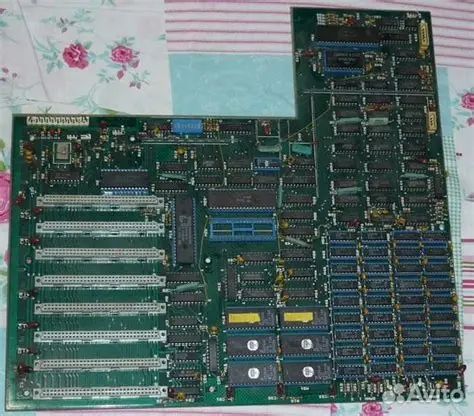
    Two green PCBs with DIP chips and many edge expansion connectors on patterned fabric

    >>21933833
    That 16-bit thing was a bit of a theoretical concept; generally, it caused more problems than it actually provided in terms of speed ;)

    The PC was designed as an 8-bit system, and it used I/O chips designed for the 8-bit 8080 system.
    If you were to connect it to a 16-bit bus, you’d find that in an 8-bit system the registers of a given chip would be at consecutive addresses, whereas in a 16-bit system they’d be at every other address.
    So, as a rule, everything worked just as it did in an 8-bit system anyway.
    On top of that, x86 instructions varied in length – sometimes even, sometimes odd – so here too you had to get creative to squeeze them through the pseudo-16-bit bus whilst maintaining compatibility with the 8-bit system.
    All in all, the 8086 system was considerably more expensive, and yet it was just as sluggish as the one on the 8088 ;)

    So this ‘16-bit’ business was really only good for marketing.

    The 68000-based system was truly 16-bit, to the point of being a bit of a pain – for example, all opcodes were 16-bit, even though all instructions fit within 8 bits. On top of that, even 8-bit data took up 16 bits in memory; as a result, for example, an instruction loading an 8-bit register took up 32 bits, whereas on the 6502 it took 2 bytes. To make matters worse, its execution time was still longer than that of a similar instruction on the 6502 8-bit processor.
    Furthermore, it required more clock cycles to perform an operation on its registers than the 6502 did on its RAM ;) .
    Helpful post? Buy me a coffee.
  • Mera 9150 was a licensed Seecheck-O 1200 clone

    #78 21933922
    tzok
    VIP Meritorious for electroda.pl
    Posts: 38788
    Help: 3174
    Rate: 6527
    Janusz_kk wrote:
    Perhaps I should add that I didn’t work on the Odra, but on the Mera 9150 – that is, the licensed Seecheck-O 1200 (for 7 years from ’85 to ’92) The tape standard was the same there, as those tapes were read and processed on the Odra.
    My mum worked on a Mera 9150 at WPHW. The history of that system was rather more complicated. It was a Redifon Seecheck licence, which in turn was a licensed Entrex 480, also manufactured as the Nixdorf 620. All these machines were derived from the Data General Nova 1200 minicomputer (and there were the Nova 1200 and SuperNova 800 models). The Entrex and its derivatives were not actually computers, but multi-user data recording systems (key-to-tape), designed for processing on a ‘mainframe’ computer (in our context, this was probably some model of the Odra). The terminals themselves were not capable of operating independently; they had neither a processor nor memory and were entirely dependent on the central processing unit.

    gregor124 wrote:
    They simply took Western solutions, copied them and produced them in huge quantities, practically flooding the world with their products.
    They copied because they had something to copy. The West wanted to manufacture there and supplied them with technology, machinery and documentation. At the same time, clones were produced for the domestic market, as the West did not allow them to be exported.

    _ACeK_ wrote:
    The most famous computer from the film *WarGames*, the Cray, shared the fate of the ODRY
    This statement is a serious overinterpretation. Supercomputers are still being manufactured today, and their leading manufacturer is HPE Cray (i.e. a division of HP, formed following the acquisition of Cray). Three of the five most powerful supercomputers in the world are HPE Cray products.

    gregor124 wrote:
    What hampered computer production in Poland the most was our mentality and our attachment to Western culture, and thus our perception of copyright within Western civilisation.
    I beg to differ. If we could copy something, we did so. Take, for example, our ‘national pride’, the MERA-Elzab Meritum, which is an unlicensed clone of the TRS-80, and whose system software has its text ‘guerrilla-style’ (in the binary image) replaced with Polish.

    Added after 28 [minutes]:

    gregor124 wrote:
    The PC was designed as an 8-bit system and, moreover, used I/O chips designed for the 8-bit 8080 system.
    First and foremost, it was a question of memory. The (asynchronous) DRAMs of the time were 1-bit. Addressing is ‘word-by-word’. So an 8-bit machine only needed 8 chips (in practice 9, as the memory was unreliable and required ECC), whilst a 16-bit machine would have needed 16 (or 18).
  • Meritum timing missed the early home-computer market

    #79 21933956
    gregor124
    Level 29  
    Posts: 1616
    Help: 99
    Rate: 857
    >>21933922
    This TRS-80 is a computer from 1977, which had already been out of production for several years by the time the Meritum went into production.
    Perhaps if Meritum had gone into production in 1981 at the latest, it might even have had a chance of some success; after all, it was certainly more interesting than the ZX80 or ZX81.
    It’s quite interesting that systems such as the ZX81 sold well, not only in England but also in the USA.
    Unfortunately, customer demands changed significantly, and in Poland the government somehow missed the early days of computerisation and failed to lay the foundations for a domestic IT market, such as the one successfully established in the UK.
    Here, such simple domestic systems – but ones linked to education – are actually still selling today, such as the BBC Microbit or the Raspberry Pi.


    Helpful post? Buy me a coffee.
  • Copyright and software piracy in 1980s Poland

    #80 21933963
    _ACeK_
    Level 15  
    Posts: 172
    Help: 6
    Rate: 197
    tzok wrote:
    ...This statement is a serious over-interpretation. Supercomputers are still being manufactured today, and their leading manufacturer is HPE Cray (a division of HP, formed following the acquisition of Cray). Three of the world’s five most powerful supercomputers are HPE Cray products...


    :smile: I agree with all your posts, I agree ✅ Except that the company itself Cray was first taken over by Silicon Graphics
    and then, for a fraction of what they paid, by HPE , so they effectively took over the company name 😇 and the supercomputers they produce use processors 🙃

    stachu_l wrote:
    But what was copyrighted? As far as I know, it was the binary code. In IBM’s official documentation for the PC/XT, there was a printout of the BIOS at the end. You could write a BIOS that performed the same functions, but you couldn’t copy IBM’s code


    🧐 Publishing the code was, at the same time, copyrighted. This is explained very well in this video ⬇️


    andreyatakum wrote:
    In the late 1980s and early 1990s, Poles did not take copyright all that seriously. Pirated software and CDs found their way to Eastern markets via Poland...


    :idea: In another post, I wrote about copying music officially broadcast on Polish Radio :roll:

    _ACeK_ wrote:
    In the 1980s, it was difficult to buy original records or cassettes  That’s why the radio was the source of songs to record onto tape. Back then, nobody found this strange, and the radio had an output for recording 😎 Songs were usually broadcast in full ✅ Not only that, but there were programmes where entire albums were played 👀 e.g. ‘Album Evening’; people would come to the radio station (Channel II, the only one broadcasting in stereo) with their own CD players (as the radio station wasn’t equipped with any)  or the programme hosted by Tomasz Beksiński, which, in addition to the albums, featured translations of the lyrics 🤣


    gregor124 wrote:
    ...The problem with the curator was that not only did he have no respect for property rights, but he also treated everything as his own and wasn’t really willing to pay.
    So it was better to do nothing than to do something and still have to pay the ‘curator’ extra...


    :twisted: That was the arrangement ==> we gave them butter, and in return they took ships from us <== 🙃

    gregor124 wrote:
    In this situation, Apple withdrew from its business with IBM/Motorola fairly quickly and eventually switched to the Intel platform.

    Ultimately, Apple continues to manufacture its computers, albeit, unfortunately, on the Intel platform, whilst IBM and Motorola have gone under


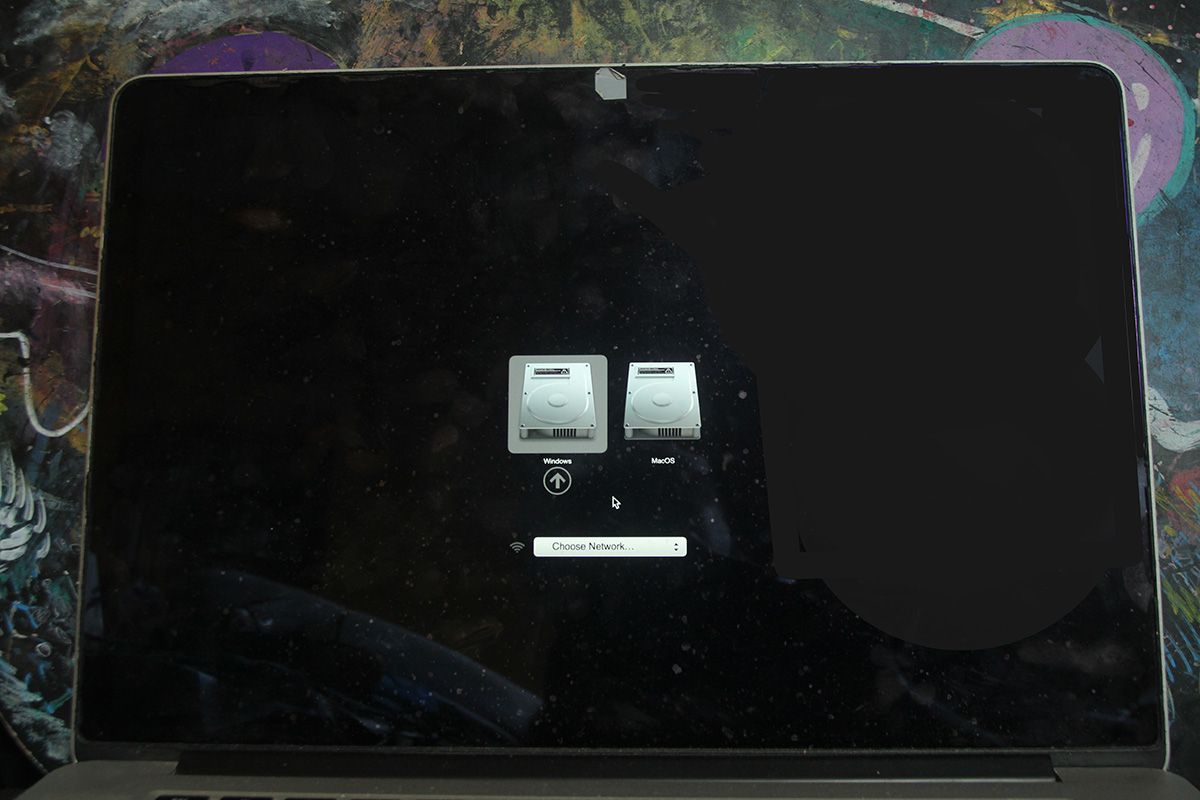
    🤔 Thanks to the switch to Intel From my point of view, this was the best option for the user. This made it possible to use the same computer as a Mac OS or Windows or even Linux . However, for several years now Apple computers have been based on Apple Silicon , and the option to install Windows has now ended :neutral:

    MacBook screen with startup disk selection: Windows and MacOS icons and a Wi‑Fi network dropdown.


    :idea: On my MacBook I have two operating systems, which you select by pressing the [alt] after hearing the sound :cunning:
  • Supercomputers can still use processors

    #81 21934194
    tzok
    VIP Meritorious for electroda.pl
    Posts: 38788
    Help: 3174
    Rate: 6527
    _ACeK_ wrote:
    The supercomputers being manufactured use processors 🙃
    What’s wrong or strange about that? Processors were originally built as electronic circuits, filled with discrete components, then integrated circuits, until they were fully integrated and became microprocessors. The Motorola MC68000, for example, originally consisted of several PCBs packed with integrated circuits. In turn, many computers (not supercomputers) started out with processors (processor boards) before eventually switching to microprocessors, such as the PDP series. The absence of microprocessors is not, and never has been, a distinguishing feature of supercomputers.
  • #82 21934199
    andreyatakum
    Level 15  
    Posts: 825
    Rate: 1150
    tzok wrote:
    Processors were originally built as electronic circuits, consisting of discrete components, and later as integrated circuits,

    This was the Soviet clone of the Apple https://www.elektroda.pl/rtvforum/topic.html
  • Apple II clones, ROM licensing, and compatibility limits

    #83 21934242
    gregor124
    Level 29  
    Posts: 1616
    Help: 99
    Rate: 857
    >>21934199
    But not every computer modelled on the Apple II automatically became a clone.
    In practice, it was the trademarks, the contents of the ROM and the distinctive case design that were protected.
    In any case, Apple published the source code for its firmware – which was actually revolutionary at the time.
    Whereas other companies even prevented the contents of the ROM from being viewed from within the system, to prevent it from being disassembled.
    Another point is that, for example, the floppy disk drive controller was 90 per cent based on software stored in its ROM, where the ROM served both as the source of the driver and an integral part of the driver itself.
    It was so cleverly designed that it was virtually impossible to implement it differently whilst maintaining full compatibility with the software.
    Many companies tried to resolve this without breaching the licence, but their drivers never ensured 100 per cent compatibility; this was mainly due to the various software protection measures employed by different manufacturers.

    Furthermore, many clones infringed other licences, such as trademarks, or failed to comply with US standards (few people realise that the Apple II casing wasn’t entirely made of plastic; embedded within the plastic is a copper shield to meet RFI standards), or, for example, whether the power supply bore Apple markings, as the Asian ones had a very bad reputation, etc.

    Here is a film from that period showing the scale of the problem with the smuggling of Apple II clones into the US.


    Many clones – or rather, designs modelled on the original but not infringing the licence – were produced.
    For example, the British ITT2020 or the German Basic 108, which in turn sold its licence to countries such as Australia.

    At a certain point, Microsoft became a problem for Apple, as it began selling licences for its BASIC – which was also part of the original Apple II’s ROM – to companies in Asia.
    Helpful post? Buy me a coffee.
📢 Listen (AI):
ADVERTISEMENT