logo elektroda
logo elektroda
X
logo elektroda

Small two-way speakers with very good sound

viayner  11 5739 Cool? (+12)
📢 Listen (AI):

TL;DR

  • Built compact two-way loudspeakers for a family gift that had to fit in airline luggage.
  • They use the proven Visaton Fontana concept, adapted with Visaton W130S woofers and DTW72 tweeters, plus a floor-firing bass reflex port and 5 cm legs.
  • The drivers cost 35 and 17 euros, with about 10 euros for connectors and crossover parts, plus another 20-30 euros for wood, glue, paint, and diffuser hardware.
  • Listening tests found balanced sound, enough bass, clear low-octave instruments, and surprisingly high volume for such small cabinets, though final measurements were missing and the build was not fully finished correctly.
Generated by the language model.
Hello,
I would like to present one of my altogether recent projects, which arose from the need of the moment.
It concerns a small loudspeaker with a surprising sound.
Unfortunately, due to time, not everything was completely done correctly, for example the final measurements were missing, which I am not completely satisfied with.

- Idea:
The idea came about before Christmas, as a gift idea for a family member.
There wasn't much time and the requirement was a bit strange, but how practical - the whole thing had to fit into the main luggage to be flown on a plane :) . As I live quite far away and the gift was intended for a resident of Poland. This determined the wattage, dimensions and type of speakers used.

- Why/why not?
The speakers were intended for a person who really enjoys listening to different genres of music and really listens and hears a lot of what he listens to. So far he had used various amplifiers and older Polish speakers, something ZgC, with as I recall GDN25/40, GDM and GDWK, kind of like a prototype of Altus. Then came the amplifier with the hope that more power and "effects"/additional speakers would improve something, there were even dummies in the form of a subwoofer. There was always something missing, something in the bandwidth was wrong, the bass somehow muffled, etc. This is where the idea of making these loudspeakers came in, to provide what is needed on 2 loudspeakers without dummies.

- Design:
I relied on the long-proven and, for me, wonderful Visaton "fontana" design, omnidirectional loudspeakers, have been in operation at my place for a few nice years and so far I have not heard anything better.
Because of the size and design, I had to choose slightly different loudspeakers that work well in a limited design. The choice fell on the Visaton W130s and DTW72s, they are not high end speakers but still very good for their price shelf.

- Construction:
I didn't keep too many photos, what remains I attach:
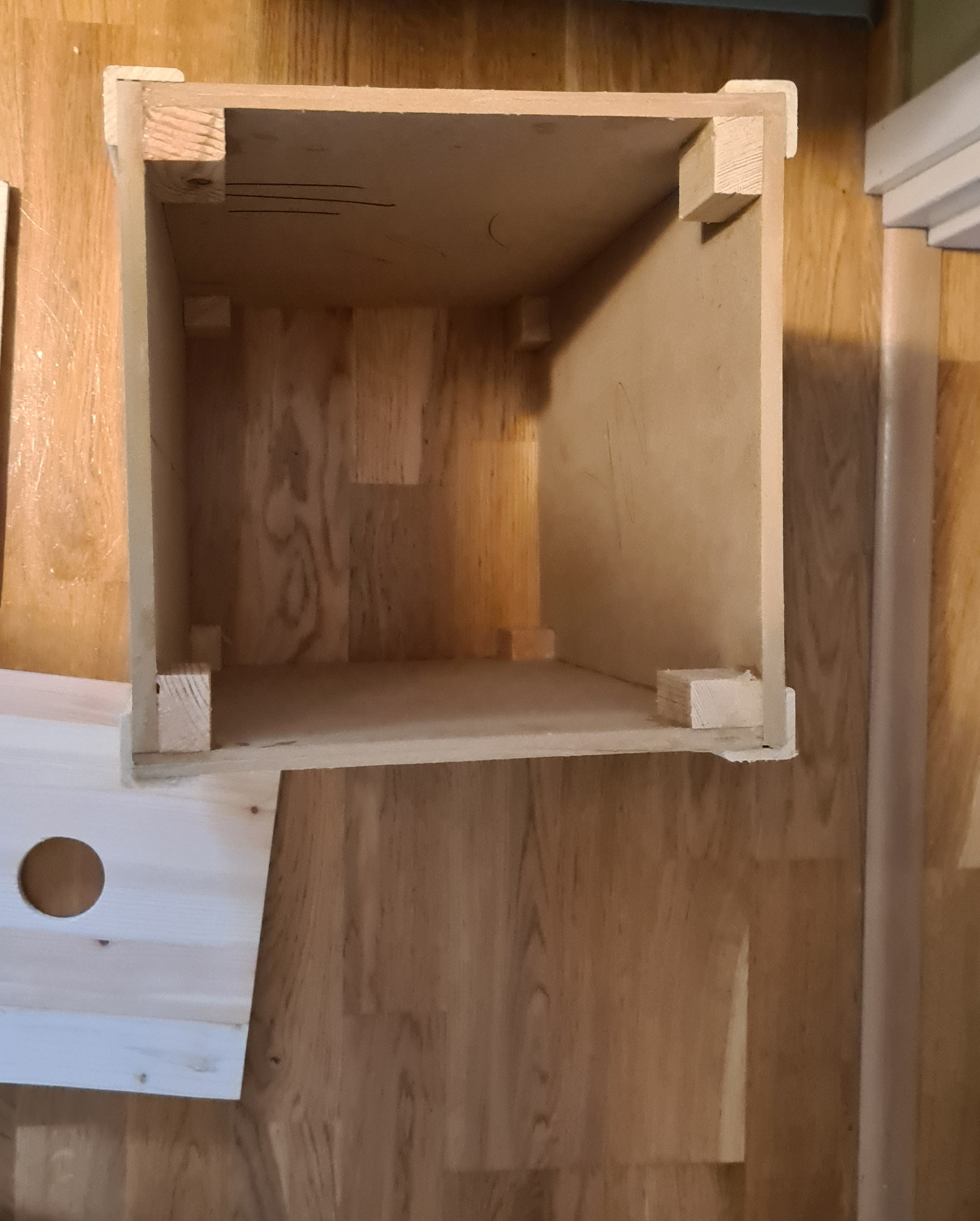
1) construction details of the main cabinet:
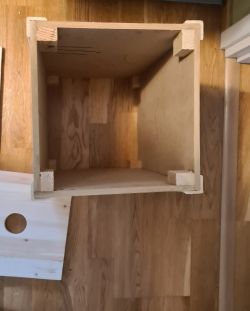
View of the interior of a wooden speaker cabinet against a wooden floor
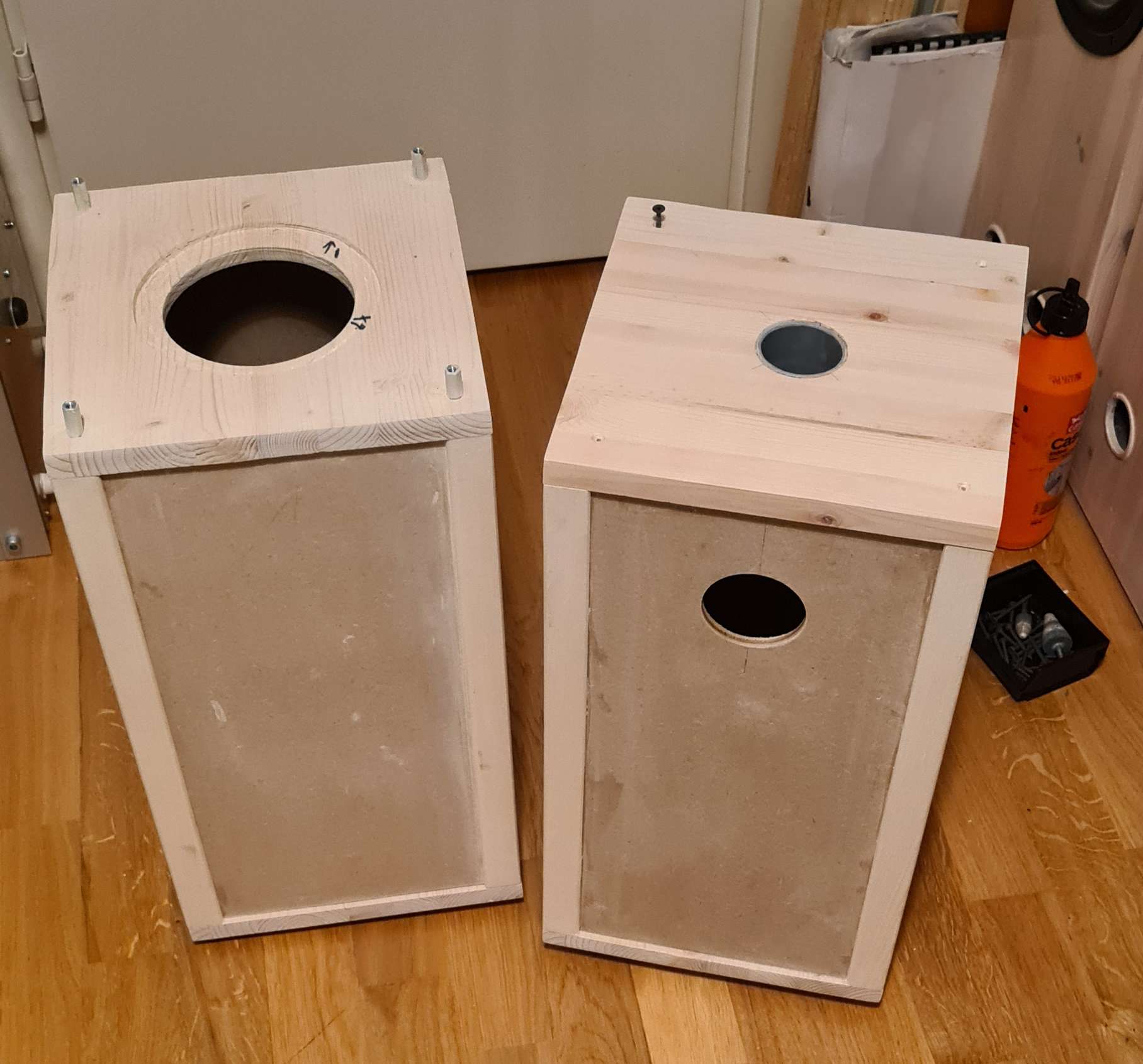
2) assembled enclosure, on the right the hole for the woofer/midrange speaker, on the left you can see the BR and connector holes
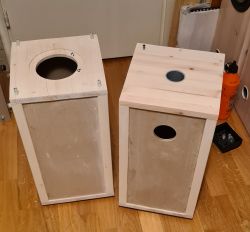
Two wooden speaker enclosures with holes for drivers and connectors.
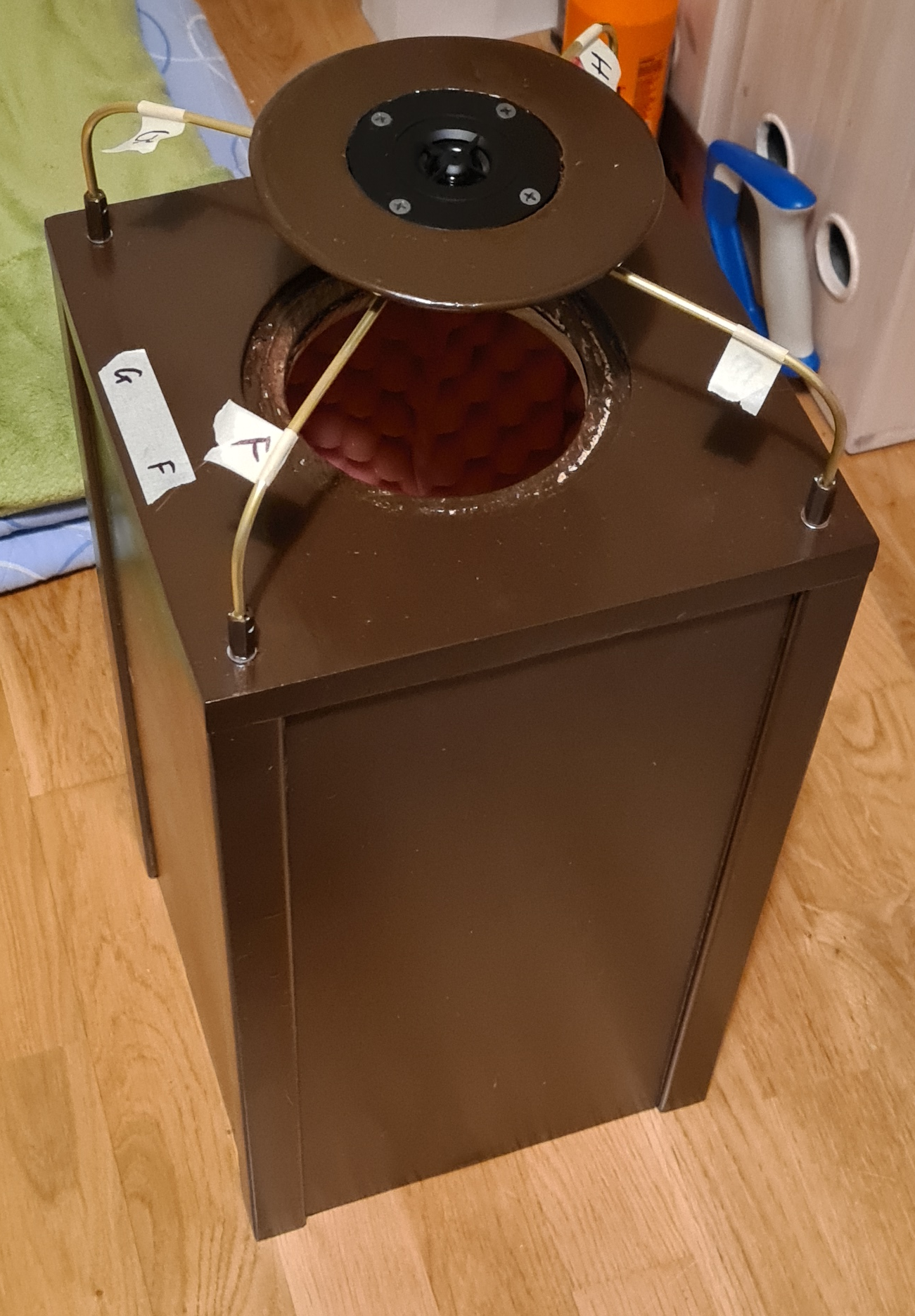
3) almost finished column after the first paint jobs, tweeter mounted for test but no woofer
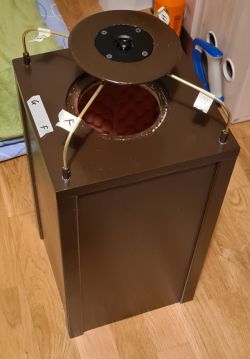
Speaker cabinet with a mounting hole for the speaker.
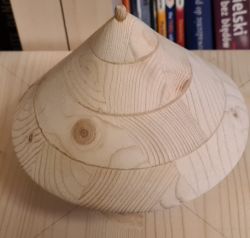
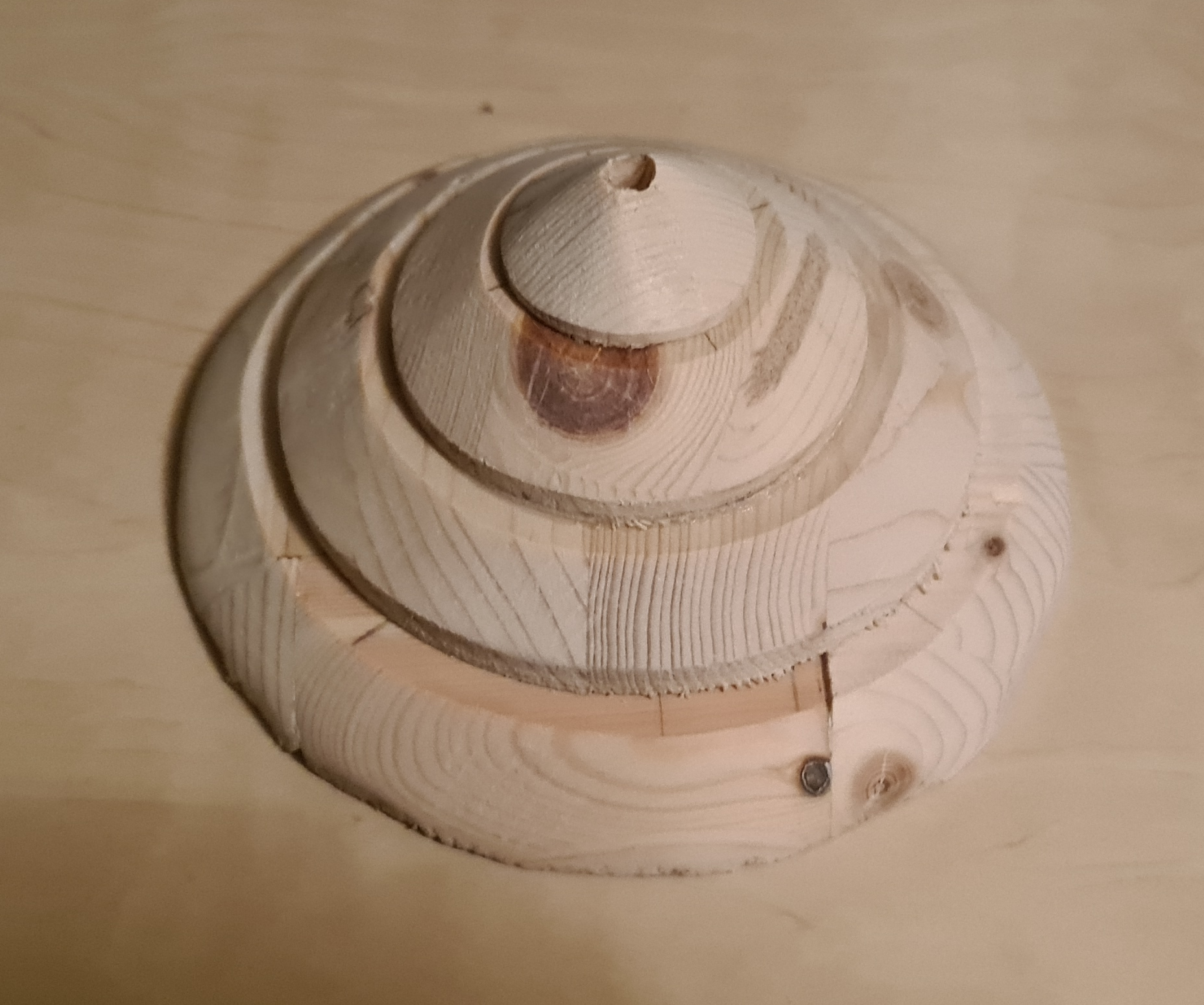
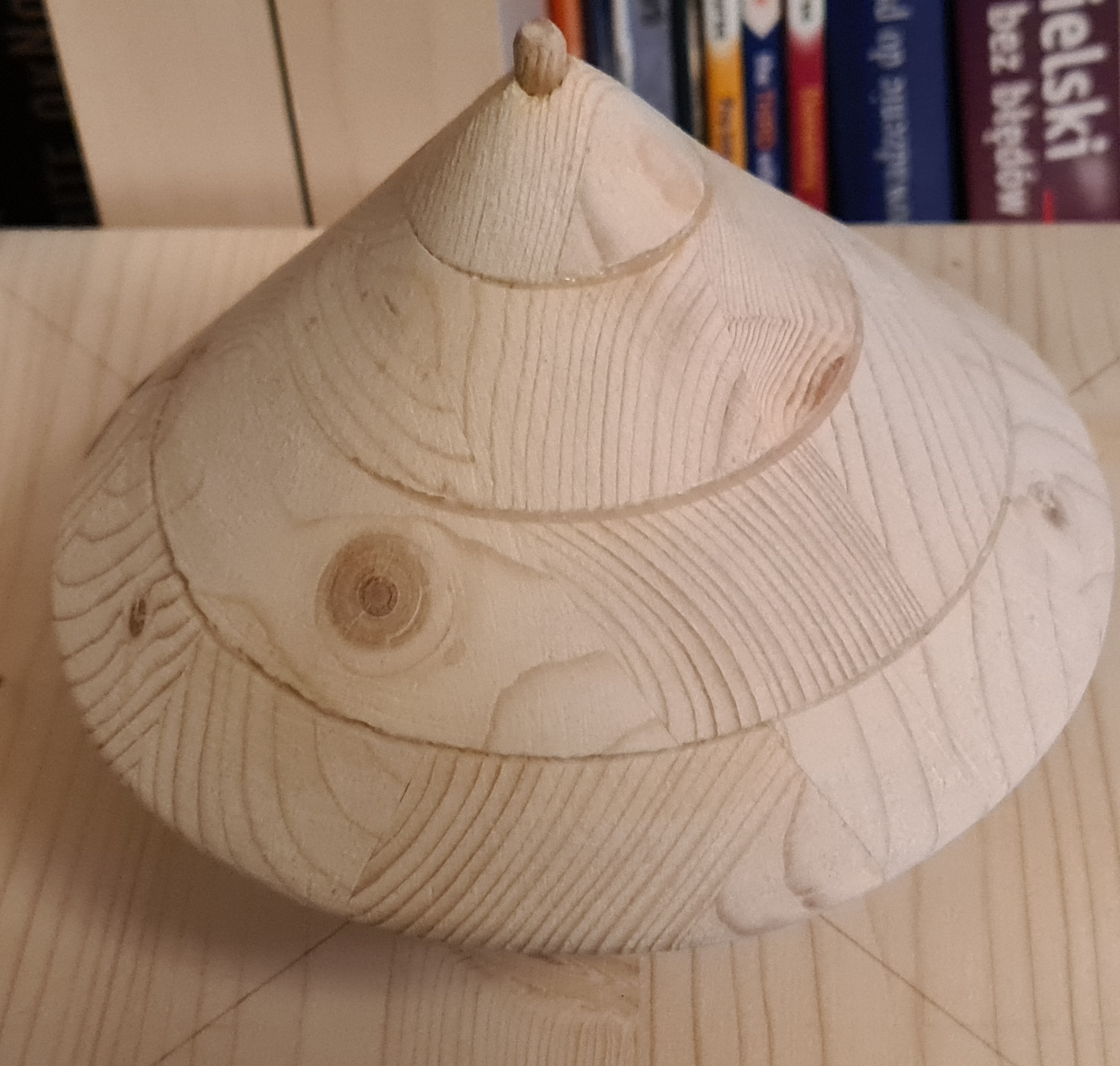
4) construction details of the cone/diffuser,
Wooden cone made from assembling several discs. Wooden cone with visible layers against a background of books.

It is/was glued together from several (4 circles of appropriate thickness) and sanded to final shape.

You can't see it on the pictures, but due to the fact that the BR is facing the floor, the columns stand on 5 cm legs.
Unfortunately I didn't take pictures of the final product, but for those interested I can ask the owner for such pictures.
Interested in the details of the construction, please contact me, there are a few difficult places here, but everything is manageable for a person with tools and able to use them.

- How do they play?

I carried out listening tests at home, unfortunately standing next to large fountains, they do not present themselves in any outstanding way. However, it was enough to listen to them, just like in the originals, everything is balanced, nothing stands out or colouration. There is enough bass and surprisingly you can really hear the instruments playing in the lowest octaves, the sound is quite detailed.. In general, these are loudspeakers for people who do not have too much space (although I tested in rooms from 15-40 m²) and want to enjoy the full sound. Tests at the current owner's house can be compared to a huge surprise (that these are such small constructions) combined with a long moment of silence (that they are so small and have so much to offer).
Maybe as a summary let us say that all other speakers were practically "thrown away" within a few days, the owner returned to the stereo amplifier without a subwoofer and claims that he no longer misses anything in the sound. With the amplifier "cranked up" they can play really loud, I even surprised myself how loud for such small speakers.

- Costs:
When I bought the speakers, they cost me 35 and 17 euros, plus about 10 euros for the connectors and crossover components. The wood I had in 'home stock', the glues, paint, diffuser mounting parts were an additional 20-30 euros.

Finally, it might be worth putting a bit more work into the project and enjoying the final result, rather than encasing something weak with dummies. These are not speakers for those who want to listen loudly and the bass must make the glasses vibrate.
Greetings


About Author
viayner wrote 10546 posts with rating 2004 , helped 1557 times. Live in city Oulu. Been with us since 2006 year.

Comments

rach_UMK 08 May 2024 11:45

I used to be curious to see how these types of kit played. Well, some designs captivated me, i.e. their appearance. As for the sound, it was different and I was not impressed by any of them. I do not... [Read more]

viayner 09 May 2024 07:16

Hello I can only refer to my constructions, I have already made a couple of them, from simple 2-way through 2.5-way, classic 3-way, but there was always something missing, so I ventured into omnidirectional... [Read more]

kotbury 12 May 2024 07:20

"Large" Montanas also have a smaller diffuser for the treble (photo left bottom) https://obrazki.elektroda.pl/7907030700_1715491092_thumb.jpg In your speakers too? My impression is that without... [Read more]

viayner 12 May 2024 18:33

Hi Yes, both of my fountains have two diffusers, and you correctly noted that the sound would be "impoverished" due to the different way the sound propagates and builds up the panorama. I'll look for... [Read more]

mfac 14 May 2024 20:56

All right, but how about stereo space? Is it well enough defined or does it blur across the room? Doesn't it sound like it's coming through the fabric or off the wall? [Read more]

viayner 15 May 2024 07:04

Hi The stereo base is very good, (I can only refer to my design), everything is very detailed (but here there is a big influence of the speakers themselves), as I mentioned with directional/traditional... [Read more]

stellardrone90 15 May 2024 10:39

Congratulations on the idea, but I would nevertheless choose something better in the 'middle'. :) . [Read more]

kotbury 15 May 2024 16:48

You made the columns in the shape of a quadrangular box. The originals were octagonal in horizontal section. Did you not think to make the enclosure a cylinder? You can easily get a 'tube' made of plywood.... [Read more]

viayner 15 May 2024 19:07

Hello My home big fountains are octagonal/valley, these as I mentioned had a bit of construction and transport constraints, that's why there was a forced shape and size. I personally like Visaton speakers,... [Read more]

kotbury 16 May 2024 06:25

I suspect that the phrase: something better "inside" means, according to the previous speaker, better components (speakers). Let him explain it himself. [Read more]

viayner 16 May 2024 06:53

Hello, Please explain maybe what you mean, is it the midrange or the components? As I mentioned in the case of these small "fountains" there were some design limitations, hence the specific choice of... [Read more]

FAQ

TL;DR: For 15–40 m² rooms, these compact 2-way Visaton speakers sound “balanced” and unexpectedly full without a subwoofer. This FAQ helps DIY builders who need small, transport-friendly speakers understand what this Fontana-inspired omnidirectional design does well, where it compromises, and why a tiny pair can replace much larger boxes in normal home listening. [#21071844]

Why it matters: This thread shows how careful driver choice, diffuser geometry, and enclosure compromises can deliver room-filling stereo from a compact DIY speaker that still fits strict transport limits.

Option Drivers / format Room behavior Bass character Practical note
Small omnidirectional 2-way Visaton W130S + DTW72S Broad, stable panorama around the room Full enough without subwoofer Built to fit airline luggage
Larger traditional directional speakers Older Polish 3-way types Best straight ahead, weaker off-axis Bass described as muffled in prior systems Needed more boxes and effects
Larger home “Fontana” builds Bigger omnidirectional design Reference point for this project Stronger overall scale Fewer size constraints

Key insight: Small omnidirectional speakers can sound much bigger than they look when the diffuser system and crossover are matched well. The thread’s strongest claim is not deep bass quantity, but balanced sound that stays convincing well off-axis.

Quick Facts

  • The build used Visaton W130S and DTW72S drivers, chosen because they worked within a compact enclosure and transport-limited concept. [#21071844]
  • The speakers were tested in rooms from 15 m² to 40 m², where the builder still described the sound as full, balanced, and detailed. [#21071844]
  • The bass-reflex opening points downward, so the cabinets stand on 5 cm legs to preserve port clearance and airflow. [#21071844]
  • Approximate parts cost was €35 + €17 for the drivers, about €10 for connectors and crossover parts, plus €20–30 for glue, paint, and mounting materials. [#21071844]
  • The treble section uses two diffusers; omitting the smaller upper one was said to make the highs horizontally poorer and reduce panorama build-up. [#21079648]

How do small two-way omnidirectional speakers based on Visaton W130S and DTW72S perform compared with larger traditional three-way speakers in normal home listening?

They can sound more balanced and more satisfying than larger traditional three-way boxes in everyday home use. The builder compared them against older Polish speakers with GDN25/40, GDM, and GDWK drivers and said those systems still lacked something, with bass described as muffled. In contrast, this small 2-way pair gave enough bass, audible low-octave instruments, and enough output to surprise listeners. The owner reportedly returned to a stereo amplifier without a subwoofer and discarded the other speakers within days. [#21071844]

What is an omnidirectional loudspeaker and how does it differ from a typical directional speaker in room coverage and sound panorama?

An omnidirectional loudspeaker spreads sound around the room much more evenly than a typical forward-firing box. The builder said this design gives similar sound intensity and panorama regardless of where you are in the room, while directional speakers sound best straight ahead and degrade as the listening angle increases. He also noted the trade-off clearly: that broad coverage can be an advantage or a disadvantage depending on the intended use. [#21075228]

What does BR mean in a speaker enclosure, and why would a bass-reflex port be aimed at the floor on 5 cm legs?

"BR" is a bass-reflex port that vents a loudspeaker enclosure, tunes low-frequency output, and uses the air mass in the opening to reinforce bass around the cabinet’s tuning region. In this build, the BR faces the floor, so the cabinets stand on 5 cm legs. That clearance keeps the port open to airflow and lets the downward-firing opening work as intended instead of being blocked by the floor. [#21071844]

How can I build the cone diffuser for a Fontana-style speaker from stacked wooden circles and sand it to the final shape?

Build it as a laminated wooden blank, then shape it by sanding. The thread gives a simple 3-step method:
  1. Cut 4 wooden circles of suitable thickness.
  2. Glue them into one stacked block.
  3. Sand the block to the final cone profile.
The builder used exactly that approach for the diffuser and said the process is manageable for someone who has tools and knows how to use them. The difficult areas are real, but he presented them as practical rather than exotic. [#21071844]

Why do omnidirectional speakers use two diffusers for the treble section, and what happens to the highs if the smaller top diffuser is omitted?

They use two diffusers to preserve high-frequency spread and help the soundstage build correctly around the room. A commenter noted that the larger Fontana design also has a smaller treble diffuser, and the builder confirmed both of his versions use two. He agreed that without the smaller top diffuser, the highs would be horizontally impoverished because the sound would propagate and form panorama differently. [#21079648]

How well is stereo space defined with omnidirectional speakers, and what makes the stereo image stay stable farther off-axis than with conventional speakers?

Stereo space can stay very well defined, especially away from the center seat. The builder said the stereo base in his design is very good and remains convincing even at a considerable angle, while traditional directional speakers give the nicest image straight ahead and worsen as the angle increases. Here, the broad radiation pattern keeps sound present around the whole room instead of becoming muffled or collapsing off-axis. [#21082743]

What crossover design and simulation should be used for a small Visaton Fontana-inspired two-way speaker with W130S and DTW72S drivers?

Use the dedicated crossover and simulation prepared for this exact build, because the thread does not publish any text values you can safely recreate from memory. The builder later added that he had found and linked the crossover and simulation images for the finished speaker. That confirms a custom network was used, but the post gives no written component values, crossover frequencies, or topology details in the text itself. [#21079648]

Which enclosure shape works better for compact omnidirectional speakers: a square box, an octagonal cabinet, or a plywood cylinder?

The thread does not prove a single winner, but it does show why each shape appears. The small speaker used a square-like box because of size and transport limits, while the builder’s larger home fountains are octagonal. A commenter suggested a plywood cylinder might suppress reflections better than a regular box, yet no listening or measurement result in the thread confirms that idea. In this project, practical constraints clearly outweighed enclosure-shape purity. [#21083601]

How much does it realistically cost to build a small DIY two-way speaker pair like this using Visaton drivers, crossover parts, and basic finishing materials?

A realistic budget is about €82 to €92 if you already have the wood. The builder paid €35 and €17 for the two driver types, about €10 for connectors and crossover parts, and another €20–30 for glue, paint, and diffuser-mounting hardware. That total reflects a practical DIY parts bill, not a luxury finish or premium cabinet material bought specifically for the project. [#21071844]

Why can small omnidirectional speakers sound surprisingly full without a subwoofer, yet still not be suitable for heavy 'umc umc' bass listening?

They sound full because the builder voiced them for balance, not exaggerated bass. He reported enough low end to hear instruments in the lowest octaves and said the owner stopped missing a subwoofer. At the same time, he drew a hard line: these are not speakers for listeners who want bass strong enough to make glasses vibrate. As he put it, the bass was “perfect” for his ear, but not for heavy club-style impact. [#21075228]

What room sizes are practical for compact omnidirectional speakers, and how does their sound change between rooms of about 15 m² and 40 m²?

The practical range shown in the thread is roughly 15 m² to 40 m². The builder said he tested the speakers in rooms across that span and still considered them full-sounding, balanced, and detailed. He did not report a collapse in larger rooms, but he also did not claim giant-room output. The safe conclusion is that normal domestic spaces are suitable, while very large spaces or bass-heavy use remain outside the project’s stated goal. [#21071844]

How do Visaton speakers compare with older Tonsil-based Polish speaker designs when the goal is balanced sound without adding subwoofers or dummy drivers?

In this thread, Visaton comes across as the cleaner route to balanced sound. The builder said older Polish speaker systems and later “effects” boxes still left bandwidth problems and muffled bass, even with extra drivers and a dummy subwoofer in the system. He described Visaton units as reasonably priced, a bit more expensive than Tonsils, but on another shelf for reproduction quality. His main practical claim is simple: spend a little more first, and you may stop chasing subwoofers and filler drivers later. [#21083601]

What does 'stereo base' mean in loudspeaker discussions, and how is it affected by directional versus omnidirectional speaker design?

"Stereo base" is the perceived left-right spatial spread between speakers that locates voices and instruments, defines image width, and helps listeners judge whether the soundstage stays coherent as they move away from the central axis. In the thread, directional speakers were said to give a nice stereo base straight ahead but a worse one at larger angles. The omnidirectional design kept that base usable even farther off-axis. [#21082743]

How should I choose better 'middle' components for a DIY two-way speaker—does that mean improving the midrange driver, the crossover, or the overall driver class?

In this thread, “better in the middle” is ambiguous and should not be reduced to one part. A commenter likely meant better components or a higher driver class, not a separate midrange, because this is a 2-way design. The builder pushed back and said nothing was missing in the band, while also noting that the small project had design limits and the larger versions used aluminum drivers without reservations about reproduction quality. Start with the whole driver-and-crossover concept, not one buzzword. [#21084147]

What construction compromises matter most when a DIY speaker has strict size and transport limits, such as fitting into airline luggage as a gift?

The biggest compromises are cabinet shape, driver choice, and how much final validation you can finish on time. This project had to fit into main luggage for air travel, so transport limits directly fixed the dimensions, power expectations, and selected drivers. The builder also admitted that not everything was completed perfectly and that final measurements were missing. That is the key failure case in the thread: a workable speaker can still ship successfully, but incomplete measurements leave unresolved performance questions. [#21071844]
Generated by the language model.
%}