logo elektroda
logo elektroda
X
logo elektroda

Exta Free – is it worth investing in this smart building system?

mierzwik 37988 60
Best answers

Is Exta Free worth investing in for a straightforward smart building / home automation system?

Exta Free is worth buying if you need a cheap, straightforward system for simple automation, but it is not a good choice for complex logic or fully autonomous smart-home functions [#11264615][#16168098] It works reliably, is about three times cheaper than X-Comfort, and is easy to implement for basic lighting and other simple control tasks [#11264615] One user retrofitted an existing flat with Exta Free, integrated it with an alarm system and presence simulation, and reported around 2,000 zł total cost versus about 7,000 zł for X-Comfort, with the system working flawlessly for three years [#11264615][#13308543] It can be used as an “expander” for a more advanced controller, where Exta Free only carries commands and actuates loads, while the logic is handled elsewhere [#11263268][#11264615] The main drawbacks are one-way communication, no feedback on device state, batteries in transmitters, incomplete/confusing manuals, poor availability, and difficult programming once the installation becomes more advanced [#11262869][#11264615][#15733444] So the practical advice from the thread is: choose Exta Free for low-cost, simple wireless automation; if you want richer scenes, status feedback, or more sophisticated integration, look elsewhere or pair it with another controller [#16168098][#13308543]
AI summary based on the discussion. May contain errors.
ADVERTISEMENT
Treść została przetłumaczona polish » english Zobacz oryginalną wersję tematu
  • #1 10846458
    mierzwik
    Level 10  
    Posts: 16
    Rate: 3
    Whilst looking for ideas on how to build a straightforward IB system, I came across something like this Exta Free . At first glance, it seems that these components will allow me to achieve all the functionality I’m looking for, and the whole thing will be considerably cheaper than, say, X-Comfort.
    However, I’m puzzled by the fact that I can’t find any information practically anywhere from people who’ve actually tried using this system themselves. Here on Elektroda, a search for ‘Exta Free’ doesn’t return a single post.
    Does this mean that nobody is using it? I’d be very grateful for any tips and opinions...
  • ADVERTISEMENT
  • #2 11262869
    INTOUCH
    Level 30  
    Posts: 1581
    Help: 99
    Rate: 199
    These companies don’t produce such rubbish.
    It’s ideal for relatively simple applications.
    The system isn’t very popular, isn’t very advanced and is fairly straightforward.
    A competent electrical and automation engineer should be able to handle the system.
    You can even mount the light switch on the windscreen.
    The downside of this system is that you have to replace the batteries in all the transmitters.

    X-Comfort is more expensive, offers greater functionality, and is more complex.

    The choice is yours.
  • #3 11263268
    stkop
    Level 15  
    Posts: 121
    Help: 14
    Rate: 7
    And what do you think of Exta Free as a wireless ‘expander’ for more advanced systems? The idea is not to force Exta Free to handle these simple logic functions, but to use a more advanced controller for logic functions and user interfaces (Ethernet, GSM), and to regard Exta Free merely as a carrier of ‘information and commands’ and an actuator, particularly in situations where running a cable uphill is a challenge?
  • #4 11264615
    mierzwik
    Level 10  
    Posts: 16
    Rate: 3
    Thanks for your reply.
    As quite a bit of time has passed since I asked my question :) and I’ve had a bit of a play around with it in the meantime, I can now give my own opinion on the matter.

    1. Pros
    - it works
    - about three times cheaper than, for example, X-comfort
    - easy and effective implementation of simple automation
    - a few very clever solutions, such as the RNP-02 receiver, which can be activated simultaneously via radio and a physical button
    - good and prompt technical support from Zamel
    2. Disadvantages
    - a nightmare to programme for more complex systems
    - instructions that are at times incomplete and confusing
    - poor availability

    I set up the entire lighting control system in a sizeable flat in a block of flats using Exta Free (based on the existing, ill-conceived traditional wiring). On top of that, I integrated it with the alarm system and added presence simulation, control via a Harmony remote, etc.
    The cost was around 2,000 zł (I estimated a similar installation with X-Comfort at around 7,000).
    I did the whole thing myself with only very basic knowledge of ‘electrics’.

    To sum up – a cool solution, but you’ve got to ‘tinker’ with it a bit…

    Added after 5 [minutes]:

    stkop wrote:
    And what do you think of Exta Free as a wireless “expander” for more advanced systems? The idea is not to force the use of Exta Free’s simple logic functions, but to rely on a more advanced controller for logic functions and user interfaces (Ethernet, GSM), and to regard Exta Free solely as a carrier of “information and commands” and an actuator, particularly in situations where running cables is a struggle?


    Absolutely...
    In my case, for example, part of the logic is handled by the alarm control panel, whilst Exta acts as the ‘carrier’.
    It works perfectly, and it’s hard to find anything cheaper.
  • #5 11265039
    INTOUCH
    Level 30  
    Posts: 1581
    Help: 99
    Rate: 199
    Please report any faults to Zamel, providing a detailed description.
    As for X-Comfort, the price of this system includes training and a few other bits and bobs that Zamel doesn’t offer. For larger orders, you could even buy X-Comfort at a discount of less than 30 per cent off the list price.
    mierzwik wrote:
    Cost in the region of 2,000 zł

    I understand that you estimated the cost of the material yourself.
  • #6 11265058
    mierzwik
    Level 10  
    Posts: 16
    Rate: 3
    INTOUCH wrote:
    I understand that you estimated the material yourself.

    As I mentioned, I did all the work myself (sometimes by trial and error).

    X-Comfort is certainly more sophisticated and easier to install.
    There’s a lot more faff with the Ext version, but if you put in the effort, the results are similar :)
  • #7 11265100
    INTOUCH
    Level 30  
    Posts: 1581
    Help: 99
    Rate: 199
    Exta Free is almost like X-Comfort.
    ‘Almost’ makes a huge difference – and not just in terms of price.
    By the way, even without training, you’d still have trouble setting up the X-Comfort system.
  • ADVERTISEMENT
  • #8 11265167
    mierzwik
    Level 10  
    Posts: 16
    Rate: 3
    INTOUCH wrote:
    Exta Free is almost like X-Comfort.
    ‘Almost’ makes a huge difference – and not just in terms of price.
    Incidentally, even without training, you’d still have problems configuring the X-Comfort system.

    The most important thing is to have a choice :)
  • #9 12731377
    dominr1
    Level 1  
    Posts: 1
    mierzwik MIERZWIK...
    He would like to get in touch with you and ask for some advice. Please do write to dominr1(_at_)wp.pl.

    Added after 3 [minutes]:

    Perhaps I’ll explain: I need to use a single Logitech remote to control my blinds (4 motors) and lighting (TV and audio equipment go without saying). Will the EXTA FREE controllers work with Logitech remotes? If so, please could you let me know which model? Many thanks in advance...
  • ADVERTISEMENT
  • #10 13308543
    mierzwik
    Level 10  
    Posts: 16
    Rate: 3
    As I get quite a few questions via private messages, I’ve decided to write down the most important points in one place, in the hope that it might be of help to someone else.

    1. I was retrofitting a traditional, pre-existing installation. The changes relating to lighting automation mainly involved replacing bistable switches with monostable (bell-type) switches and fitting ROP-02 receivers into the switch boxes. They have the handy feature of being controllable using both buttons and Exty transmitters. In this way, any existing traditional circuit can be turned into a controllable circuit using just this one junction block (I can still switch it on with the same push-button, but I can also control it simultaneously using any other element of the system). No chiselling required!

    2. Integration with Satel is done in the simplest possible way, namely by connecting Exty transmitters/receivers to the physical inputs/outputs on the control panel.

    3. The lighting simulation is also based on Zamel components. To put it simply:
    - I convert the 12V signal from the alarm control panel indicating that the system is armed into high voltage via the PEM-01/012 relay
    - this activates the control input on the ZCM-31 programmer (which tells me when the sun rises and sets, and allows me to programme a night-time break, etc.)
    - this, in turn, activates the PCM-10 timer relay, where I programme the switch-on times for the two lighting zones independently (so that the lighting changes rather than staying the same all the time)
    - finally, the signal for the Exta Free receivers is sent via the RNM-10 transmitter (some of the lights are on one channel, some on the other)

    So, to summarise:
    - Arming the control unit supplies power to all these modules
    - On the ZCM programmer, I set when the simulation is to start in relation to sunrise and sunset
    - the timer relay determines how the lights should switch when the simulation is active
    - the RNM transmitter actually switches them on and off (in monostable mode)

    All in all, it works out cheaper than some advanced control modules and works very well :)

    4. Other examples of integration with the control panel
    - An Exty transmitter connected to the appropriate Satel output switches off all lights when the system is armed
    - Similarly, a transmitter connected to another output switches on all the lights when the alarm is triggered (the control panel allows you to set the output to flash, so when connected in monostable mode, the lights also flash in the set pattern)
    - I won’t reveal the other solutions, but you can have a play around :)

    5. Control via the Harmony remote is based on the RTI-01 translator. I actually consider this to be the least successful component of the Exta Free range; it can freeze up and play up for no reason, although it generally works :) With Harmony, you basically need to add any device that doesn’t conflict with others you’re actually using, then adjust the descriptions accordingly and map the signals from the individual buttons when programming the RTI-01.

    Overall, as you can see, there are plenty of possibilities. The only problem is the initial programming of the whole system, as you have to spend half a day running from switch to switch. Help from a second person is essentially essential, and you need to plan it all out properly on paper first. The whole thing cost next to nothing (at least compared to competitors’ solutions) and has been working flawlessly for three years now...
  • #11 13379592
    mac_77
    Level 9  
    Posts: 10
    Hi,
    Re: 4 – are you referring to the same RNM-10 transmitter?
  • #12 13380298
    mierzwik
    Level 10  
    Posts: 16
    Rate: 3
    As far as I can remember, it’s a separate one, because you can’t use a single receiver to control two functions at once...
  • #13 13888772
    sowalski
    Level 10  
    Posts: 40
    Rate: 1
    Hello!
    I’m planning to set up some simple home automation. Zamel has recently introduced a control unit to its system (at last) – has anyone had any experience with it? Apart from the remote control with a timer, does it have any other uses? Would it be possible, for example, to set up a scenario where, at dusk (the time of dusk on a given day retrieved from the internet), the control unit closes the roller blinds the moment the light in the room is switched on? And what about access from a platform other than Android? The manual mentions an app that’s supposedly available on the App Store :cry: . Is there any way to access it via a web browser? Thanks in advance for your reply!
  • #14 14084931
    cezar8421
    Level 12  
    Posts: 6
    Rate: 1
    Hello.
    I need an answer to the following question:
    In practice, how long does it take between battery changes in a flush-mounted transmitter, such as the RNP-02?
    Thank you in advance for your reply.
  • #15 14109435
    mierzwik
    Level 10  
    Posts: 16
    Rate: 3
    I’ve been using it for over three years and haven’t needed to replace it.
  • #16 14217888
    piotr411
    Level 22  
    Posts: 483
    Help: 43
    Rate: 45
    I've had it for two years and the batteries have lasted since I first bought it.
  • #17 14763276
    hojnas
    Level 2  
    Posts: 2
    Hello,

    I have one question for mierzwika – you wrote that there’s no need for chiselling or changes to the existing installation. Does that mean that, for example, in the switch junction boxes you also had an N wire, and not just an L wire, as is usually the case? Because, if I understand all the diagrams correctly, we need to have the neutral connected to external loads – is that right? So, without an N wire in the junction box, there’s really nothing you can do apart from permanently short-circuiting the wires in the box and fitting a load, e.g. a ceiling light (if that’s possible)? But in that case, there’s no option to control it via a push-button in that junction box, unless we install an additional transmitter there – is that correct?

    Kind regards,
    Michał
  • #18 14937688
    meak
    Level 10  
    Posts: 9
    I’m not sure if we’ve got a bit confused by all this?? :-) . It says at the start of the post about the “Extra Free” controller . On Zamel.pl, I found the Extra Free controller “http://www.zamel.pl/pl,220,0,exta-free” and it states there that it operates at 868.4 MHz (868.32 MHz). The 868.4 MHz frequency is used in the “Z-WAVE” wireless communication protocol, designed for home automation, where the best-known company on the Polish market is probably “FIBARO”. This frequency is registered by the European Telecommunications Organisation “CEPT”, which brings together 45 countries, including Poland, for use by companies in the “Z-Wave Alliance” such as Fibaro. more official information on the Z-Wave frequency used worldwide can be found here: “http://z-wave.sigmadesigns.com/docs/Z-Wave_Frequency_Coverage.pdf”
    To sum up, is Extra Free Z-Wave? I don’t think so; I haven’t noticed that the Polish company Zamel is a member of the Z-Wave Alliance, unlike Fibaro, for example (full list of companies and members: "http://z-wavealliance.org/z-wave_alliance_member_companies/") so it just uses the same frequency – I’m just not sure why?
    Sorry for the lack of Polish characters, but I’m writing from my work PC.
  • #19 15182042
    cezar8421
    Level 12  
    Posts: 6
    Rate: 1
    meak wrote:
    I’m not sure if we’ve got a bit confused by all this?? :-) . It says right at the start of the post about the “Extra Free” controller . On Zamel.pl I found the Extra Free controller “http://www.zamel.pl/pl,220,0,exta-free” and it states there that it operates at 868.4 MHz (868.32 MHz). The 868.4 MHz frequency is used in the “Z-WAVE” wireless communication protocol, designed for home automation, where the best-known company on the Polish market is probably “FIBARO”. This frequency is registered by the European Telecommunications Organisation “CEPT”, which brings together 45 countries including Poland, for use by companies in the “Z-Wave Alliance” such as Fibaro. more official information on the Z-Wave frequency used worldwide can be found here: “http://z-wave.sigmadesigns.com/docs/Z-Wave_Frequency_Coverage.pdf”
    To sum up, is Extra Free Z-Wave? Probably not; I haven’t noticed that the Polish company Zamel is a member of the Z-Wave Alliance, unlike Fibaro, for example (full list of companies and members: "http://z-wavealliance.org/z-wave_alliance_member_companies/") so it just uses the same frequency – I’m just not sure why?
    Sorry for the lack of Polish characters, but I’m writing from my work PC.


    Hello, the frequency and radio band are not owned by Fibaro. Just like the Z-Wave standard, Extra Free also operates using digital addressable communication between transmitters and receivers. You purchase a licence to use a specific frequency and can then transmit. You pay patent fees to the owners of the Z-Wave standard, and your devices communicate with Fibaro.
  • #20 15733359
    rolekk
    Level 2  
    Posts: 4
    I have an Integra 64 control panel installed, with the option to upgrade to the 128 (not WRL). The control panel is expanded with an ACU270 and an ACX200 controller.
    Essentially, I need the ABAX system to control gates (using the APT 100 remote control) and, potentially, wireless sensors at a later date (e.g. glass break, flood, etc.; fire, gas and carbon monoxide sensors are already wired in as inputs to the Integra). And this is where the question arises, as I wanted to use ZAMEL/Z-Wave modules, FF modules, or others? Their use is justified by the desire to automate processes. At first I was thinking about Fibaro, but… I’m not sure anymore after reading the forums.

    How it works – gates:
    A button on the remote control activates, via SATEL’s logic, control outputs that trigger the radio module directly or via an ACX relay. The signal is transmitted via radio to the receiver module in the entrance gate (I can’t run a cable there now) and activates the motor. However, as I don’t have a motor yet, the question is how to control the movement – using a timer (opening/closing time)? Which one would you recommend, if any? It’s a small gate – about 4–5 metres, a lattice gate from Wiśniowski.
    I want to trigger the garage door operator from the ACX relay via a cable connection.

    Heating:
    Underfloor heating – control only for longer periods due to thermal inertia. I already know that. So it basically comes down to on/off.
    Radiators – controlled via room thermostats (wireless) + actuators in the distribution board controlled from a power strip/wireless control unit? Or perhaps radiator heads mounted on the radiators and controlled wirelessly from the power strip. I was considering Danfoss thermostatic heads and the Danfoss system, but opinions vary here too… Particularly regarding Z-Wave for Fibaro.
    I have reed switches on the windows, so I’d like to use the option to detect an open window and switch off the heating in that room.
    My question is: how can I use the signals from the SATEL OUT outputs to control a specific heating zone – a room?


    Roller shutters:
    Theoretically the simplest… radio-controlled.

    Lighting is a similar issue to the roller shutters.

    For now, I’m keen to integrate the system with gate and heating control, but with the option to expand the functionality as described above. Zamel Exta Free theoretically fits the bill for the gates. Are these only 230V-controlled modules? Perhaps Z-Wave and Vera, or something of a similar class, would be better??
  • #21 15733444
    piotr411
    Level 22  
    Posts: 483
    Help: 43
    Rate: 45
    Zamel works very reliably; I’ve never had it lose a frame.
    At home, instead of off-the-shelf control units, I’ve used an ESP8266 to act as a keypad, remote control and monitor, replacing my tablet and smartphones. The downside of Zamel components is the lack of a feedback channel, which is why I’ll eventually be replacing the ROPs with my own modules – and everything points to it being the RFM69 or something similar. As a ready-made component, Zamel is worth recommending, and if the lack of a feedback channel isn’t an issue, it’s worth using this manufacturer’s modules – especially as their support team is always happy to help with any problem. And it’s a Polish product :)
  • #22 15753453
    zoltar_vero
    Level 12  
    Posts: 27
    Help: 2
    Rate: 6
    I use the EFC-02 together with temperature modules, modules for controlling roller shutters, gates, doors and windows, and lighting – a total of about 40 modules. After about a year of use, the central unit stopped communicating with the rest of the system. A call to Zamel’s technical support resolved the issue in 10 minutes. As they themselves admitted, they’d had a problem with a particular batch of power supplies for the EFC-02. A quick replacement and delivery of a new unit within two days. One advantage was the ability to connect a standard USB charger as a temporary fix, which restored the system to full working order.
    Advantages of the system:
    1) the ability to create scenes and rules for how devices operate,
    2) the modules’ long radio range – the central unit is 50 metres away and separated by four thick 30-centimetre walls from the garage door opener module, which has a 10-centimetre antenna made from standard 1.5 mm² cable.
    3) a wide selection of modules for controlling lighting, roller shutters, gates and other 12/24/230-volt devices, as well as temperature, motion and sunlight sensors
    4) the option to purchase individual modules before buying the control unit and operate them using standard switches.
    5) Installation in 60mm electrical boxes and local control via standard switches
    6) Price
    7) Technical support – fast and professional
    Disadvantages:
    1) One-way communication with modules – for some, this is a major issue,
    2) It is also a bit of a faff when adding further modules, as each user must be programmed individually, meaning every user must be present with their phone and the app.
    3) Without a static public IP address, there is no access to features such as viewing temperatures, motion sensor statuses, etc.
    3) No option to programme via a PC
    4) No RS-485 receiver module; there is only a transmitter
    To sum up, as a user I’m satisfied with the system, and I’m also looking forward to the more advanced EFC-01 controller, the development of which is dragging on a bit. It’s supposed to support certain components using the Z-Wave standard whilst retaining the system’s existing functions. According to the technical support team, Zamel is due to be released this autumn.
  • #23 15753847
    piotr411
    Level 22  
    Posts: 483
    Help: 43
    Rate: 45
    The price is another drawback: one-way systems, such as the Exta Free, are very expensive. For example, the Elro Easy Home costs half the price – or even less – and is available in the same shops.

    Your other issues aren’t down to the components, but to the very limited functionality of the ECM02. Build your own router for next to nothing using an ESP8266, and you’ll discover what true functionality and convenience are all about. In time, you’ll also come to realise that your own two-way ROPs are better and three times cheaper. Mind you, you’ll need to spend a bit of time on the design and build.
  • ADVERTISEMENT
  • #24 15753920
    zoltar_vero
    Level 12  
    Posts: 27
    Help: 2
    Rate: 6
    As for the EFC-02’s functionality, I agree – that’s why I wrote that I’m waiting for the EFC-01. Well, the price, at least when compared to Elro, isn’t a drawback. That so-called ‘Elroshit’ isn’t even fit for the bin. I did a quick test and sent it straight back to the wholesaler.
    My hands have a longer range than their radio. I’ll leave aside the aesthetics, which Elro, hmm, lacks; compared to the Exta, it looks like an S5 next to an S7-1200.
    I’ve neither the inclination nor the time to build my own circuits. I spend too much time programming various PC-PLC-HMI systems at my day job and in my own business to want to spend more time at home tinkering with yet another circuit. The system was meant to be reasonably simple, wireless and requiring no mental effort.
    In my opinion, it’s achieved that goal; the only thing missing is a good RS-485 interface so that the system can communicate fully with the Proface LT 3000, which controls all the lighting in my 100-metre garage: ceiling lights, side lights, duct lighting, 400V, 230V and 24V sockets (including outside), temperature and humidity measurement in the duct, supply fans, heating and the duct drainage pump.
    It only took me about two weeks, working at night, to build and programme this system with nearly 80 control points.
    So if I managed to set up 40 Exta Free points in two days, that’s exactly the point.
    And if something breaks down and I’m away for two months, my wife doesn’t need to ring a programmer friend who happens to be familiar with that particular PLC – or any other system – to switch on her kitchen light; she simply takes a second, pre-programmed module from the cupboard, known as the spare, and has Mr Kazio, the neighbour, fit it.
  • #25 15754015
    piotr411
    Level 22  
    Posts: 483
    Help: 43
    Rate: 45
    RS-485 is pointless for unidirectional transmission. It’s exactly the same as adding a CRC during transmission. If the ROP misreads a frame, there’s no way to inform the transmitter of the error. Due to the lack of a return channel, Zamel cannot inform the system of its status – whether it is ON or OFF. That is why I am gradually moving away from Zamel. This does not detract from Zamel’s very good performance and, as you rightly pointed out, the quality of its build, both in terms of the electronics and the casing. The new Elro looks good too; as for reliability, you’re right ;) – it’s poor.
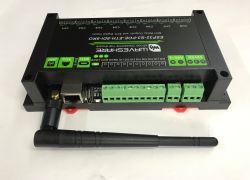
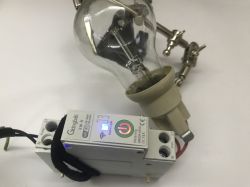
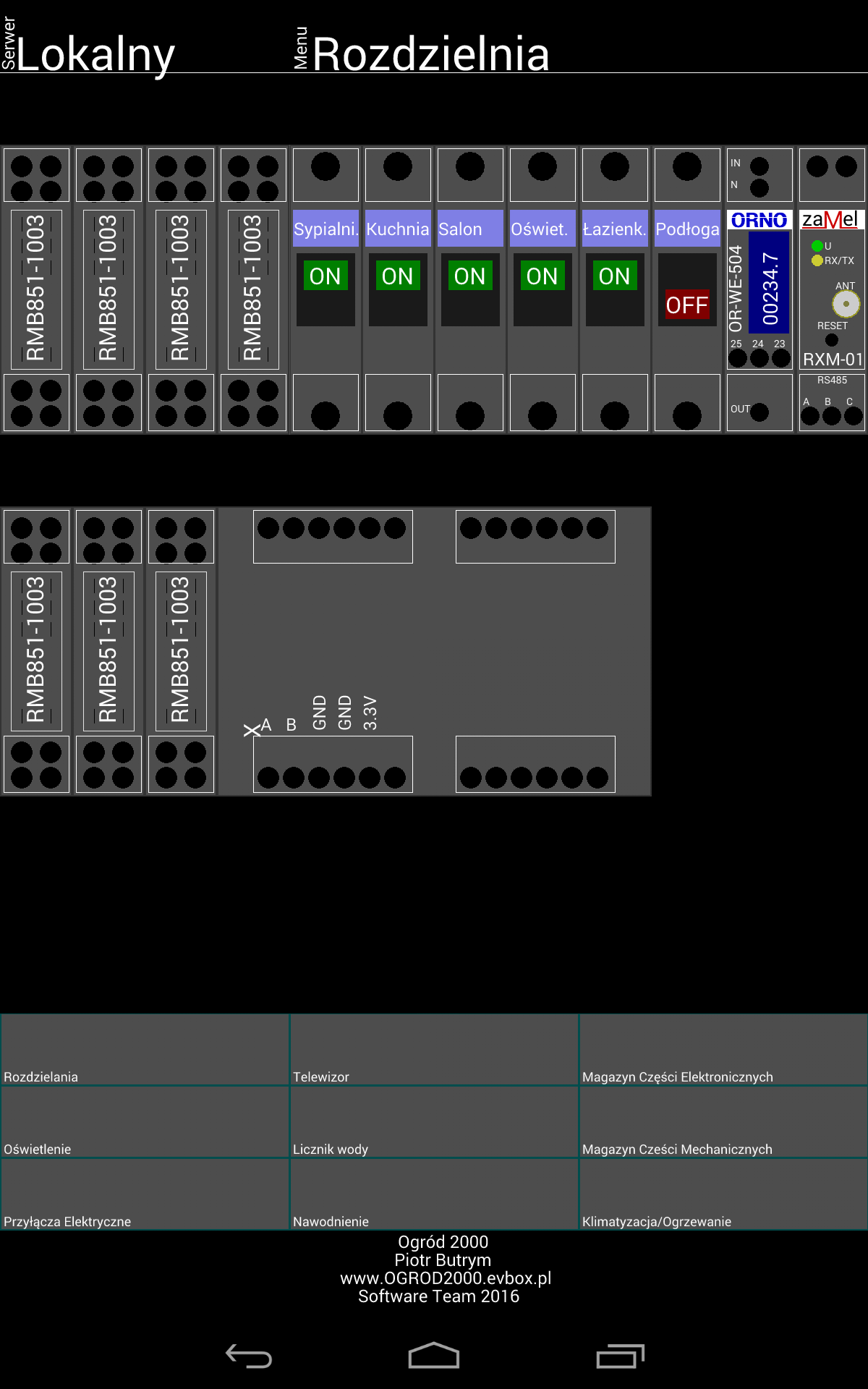
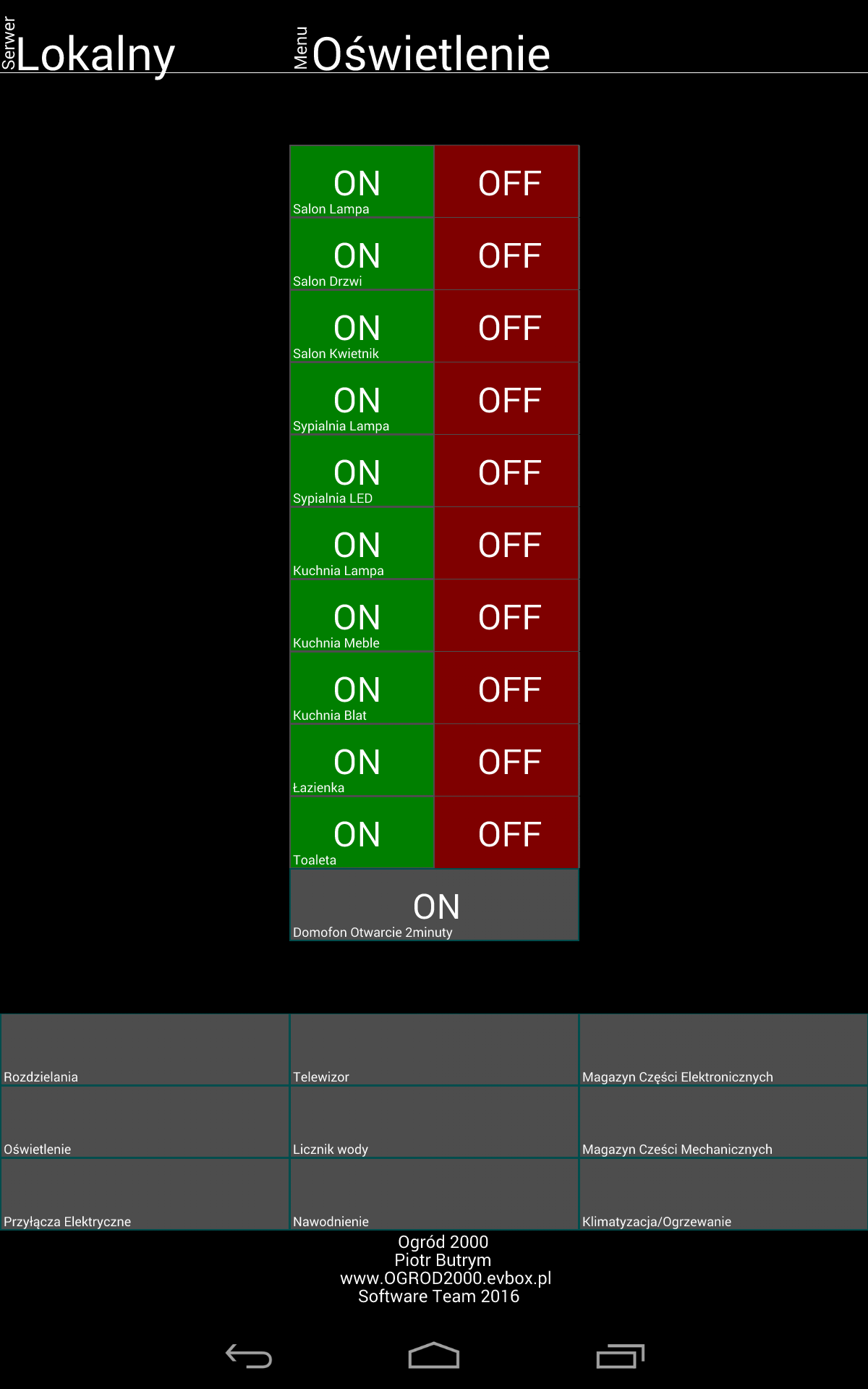
    Zamel operates using SI chips – exactly the same as those in the RFM01/02 modules. That’s why it’s easy to make bidirectional modules that are 100% compatible with the RFM22 modules. However, I’ve chosen a different path and am using the newer RFM69 modules, which are bidirectional and cheaper. The unfortunate thing is that even the new version of the EFC01 won’t change this, as it would involve replacing all the ROPs with two-way ones – which is economically unjustifiable, as it would be like buying a whole new system. When I have a spare moment, I’ll post some photos showing how my modification of the Zamel works bidirectionally, allowing me to read the status of ROPs, meters, fuses, manage storage facilities, heating and air conditioning. I’ve written the apps for Android, and from my tablet I have access to all the system components and more :) As I have my own router rather than the rather limited EFC, the IP address isn’t an issue, because locally the server is the ESP, and on the public network it’s an FTP server, so I don’t need a public IP address. :)

    Exta Free – is it worth investing in this smart building system?

    Exta Free – is it worth investing in this smart building system? [/img]
  • #26 15757069
    zoltar_vero
    Level 12  
    Posts: 27
    Help: 2
    Rate: 6
    Well, it’s already looking very good. I’m writing this as a professional PLC, HMI and PC programmer – I’m impressed by the commitment shown in building the system. Unfortunately, I don’t have the time at the moment to mess about writing software from scratch or tinkering with the modules. I’d need an Exta RS-485 transmitter so that I can control the garage from a single Exta application whilst I’m inside – the garage itself is based on an industrial Proface LT, and its surroundings are based on Exta. I could probably add three or four Exta transmitters and feed the signals into the PLC inputs, but where’s the point in that, and how would it make diagnostics any easier? Personally, having had various – and sometimes not particularly pleasant – experiences with industrial communication standards, I wanted to set up something simple at home without delving too deeply into the subject. Even two-way communication won’t protect you from, for example, relay contacts sticking together. The coil might give out, but the contacts will remain shorted, and even this communication won’t help here; it will indicate that the module is in the ‘off’ state, whilst physically, for example, a lamp or a pump will still be live. And in that case, what will you do? Will you add analogue modules to monitor current draw, or modules to check light levels and logic: it’s daytime, the sun is shining brightly, so the difference between the switched-on lighting and natural light at this time of day is X – does that mean we have a faulty module? Having learnt from experience in industry, I won’t complicate my life with such things. Even in industry, an over-engineered system will fail sooner rather than later. Well, unless we follow the example of our Coal Company and implement double redundancy for controls and actuators, plus PC control, plus remote manual control (Drutex), plus local control (Drutex) from the control station. Well, but then you’ll realise that the systems are reliable, but they cost what you might call a gazillion PLN. That’s exactly how Kompania Węglowa went under, having ordered machinery such as stackers, amongst other things.
  • #27 15757432
    piotr411
    Level 22  
    Posts: 483
    Help: 43
    Rate: 45
    It is precisely because off-the-shelf systems are not very intelligent that I am replacing them with my own. Note that the system includes an ORNO 504; the meter measures total consumption, but via the pulse output I can check the instantaneous consumption on any circuit. Now, if the load sends a signal indicating it is switched off whilst there is a load on that line, the ESP checks what is switched on and compares it with the status; therefore, there is no possibility of an incorrect reading. In the event of a short circuit, the ESP will detect that the load is switched on and attempt to switch it off again; if this fails, it reports a system fault. This is precisely the advantage of homemade modules over shop-bought ones: they can do more and are usually waaaaaaay cheaper. So, my home system is a spin-off from a major project I was working on in DIY stores; the only difference is that, whereas there I was working with Zamel, here I’m using RX/TX434 modules and Attiny chips, with an Odroid running my software acting as the server. Recently, I was writing such a large piece of software for the ESP that I had to use the ESP8266 13, because the 12F couldn’t accommodate the database – and even that turned out to be insufficient – so I bought the ESP chips themselves and, instead of on-chip memory, used memory cards: two 32GB cards switched via the app. I think the two-way modules I’ve developed based on the RFM69 could be brought to market as mass-produced commercial products in a short space of time, and in terms of price, with larger orders, they could compete with Elro. That’s about 30 zł. I also have some very nice modules of my own based on the HC-11 434 MHz, but commercially they’d cost about the same as the Zamel modules, though they’d be two-way. I’m also tempted to make a module based on a more powerful version of the RFM69, but the 150mA current poses a power supply problem; the modules would be too large to fit into 60mm enclosures.
  • #28 15883812
    Lukasino
    Level 16  
    Posts: 583
    Help: 2
    Rate: 71
    Hello,

    Can this device send an email when it detects movement, for example, using the RCR-01 sensor?
  • #29 15884571
    piotr411
    Level 22  
    Posts: 483
    Help: 43
    Rate: 45
    It can be done
  • #30 15885726
    Lukasino
    Level 16  
    Posts: 583
    Help: 2
    Rate: 71
    piotr411 wrote:
    It’s possible to do this


    Just using the device itself? (or the software?), because I can do it with additional drivers, but I don’t see that option in Zamel.
ADVERTISEMENT