







I’d like to share the different types of antennas I encountered after testing several batches of NFC products recently. The three mainstream types are PCB onboard antennas, FPC flexible antennas, and enameled wire wound antennas. All of them perform the same core function: facilitating data communication and energy conversion within transmitting and receiving modules. However, they differ greatly in materials, cost, manufacturing processes, installation methods, and applicable scenarios. The distinctions of each antenna type are elaborated separately as follows:
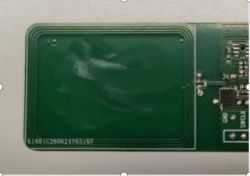
PCB Onboard Antenna
It is formed by etching PCB copper-clad laminates, featuring flat structure, low cost, and high dimensional accuracy. Its thickness ranges from 0.5 mm to 1.0 mm, depending on the PCB substrate thickness, and the NFC chip is mounted on the same circuit board.
It is suitable for meeting room door signs, desktop nameplates, flat electronic shelf labels, and fixed flat-panel devices. Its advantages include stable mass production consistency, vibration resistance, no extra assembly required, and compatibility with isolation designs for metal enclosures.
FPC Flexible Antenna
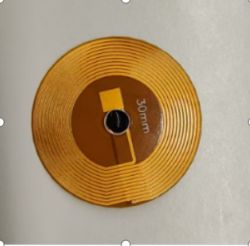
It is made of FCCL flexible copper foil with a minimum thickness of 0.08 mm. Bendable and conformable to curved surfaces, it can be directly attached to the sensing area via 3M double-sided adhesive, and connected to the main control board through 2-pin pads or connectors.
It boasts stronger compatibility and higher sensing tolerance. Ideal for curved wearable devices, narrow inner spaces of phone cases, curved door signs, and special-shaped passive tags such as smart rings and e-ink phone cases.
Enameled Wire Wound Antenna
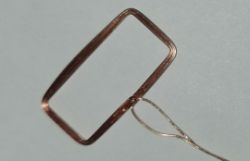
It features thick copper layer and high energy harvesting efficiency, with a short production cycle and moderate cost performance, suitable for large-size 7.5-inch three-color e-ink door signs and high-power passive display devices. It delivers excellent LCR electrical performance. However, its winding manufacturing process leads to inferior RF consistency compared with FPC antennas. On the other hand, it can be easily wound into various custom shapes to match different housing structures. The antenna is generally positioned by clamping slots and soldered, making it a perfect fit for large-sized products.
All three types of antennas mentioned above are widely adopted in the market. If you pursue low cost and have sufficient space on the PCB, you can choose the PCB onboard antenna. It requires customized design, yet most EDA tools now come with dedicated plug-ins for NFC antenna design to assist you in rapid layout development.
If your housing has limited internal space and curved structures, the FPC flexible antenna is your ideal pick. It can be bent and customized into special shapes to fit different housing contours.
If you demand high energy harvesting efficiency for both communication and power pickup, go for the enameled wire wound antenna, which also boasts a short production lead time.
Each antenna type carries unique strengths for distinct application scenarios, so you can make the selection based on your actual project requirements.
PCB Onboard Antenna
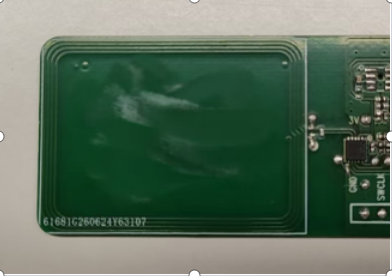
It is formed by etching PCB copper-clad laminates, featuring flat structure, low cost, and high dimensional accuracy. Its thickness ranges from 0.5 mm to 1.0 mm, depending on the PCB substrate thickness, and the NFC chip is mounted on the same circuit board.
It is suitable for meeting room door signs, desktop nameplates, flat electronic shelf labels, and fixed flat-panel devices. Its advantages include stable mass production consistency, vibration resistance, no extra assembly required, and compatibility with isolation designs for metal enclosures.
FPC Flexible Antenna
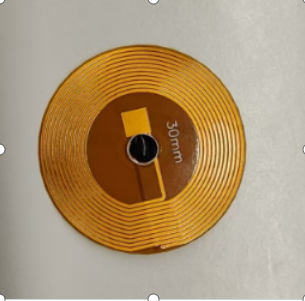
It is made of FCCL flexible copper foil with a minimum thickness of 0.08 mm. Bendable and conformable to curved surfaces, it can be directly attached to the sensing area via 3M double-sided adhesive, and connected to the main control board through 2-pin pads or connectors.
It boasts stronger compatibility and higher sensing tolerance. Ideal for curved wearable devices, narrow inner spaces of phone cases, curved door signs, and special-shaped passive tags such as smart rings and e-ink phone cases.
Enameled Wire Wound Antenna
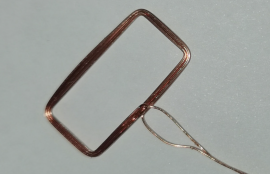
It features thick copper layer and high energy harvesting efficiency, with a short production cycle and moderate cost performance, suitable for large-size 7.5-inch three-color e-ink door signs and high-power passive display devices. It delivers excellent LCR electrical performance. However, its winding manufacturing process leads to inferior RF consistency compared with FPC antennas. On the other hand, it can be easily wound into various custom shapes to match different housing structures. The antenna is generally positioned by clamping slots and soldered, making it a perfect fit for large-sized products.
All three types of antennas mentioned above are widely adopted in the market. If you pursue low cost and have sufficient space on the PCB, you can choose the PCB onboard antenna. It requires customized design, yet most EDA tools now come with dedicated plug-ins for NFC antenna design to assist you in rapid layout development.
If your housing has limited internal space and curved structures, the FPC flexible antenna is your ideal pick. It can be bent and customized into special shapes to fit different housing contours.
If you demand high energy harvesting efficiency for both communication and power pickup, go for the enameled wire wound antenna, which also boasts a short production lead time.
Each antenna type carries unique strengths for distinct application scenarios, so you can make the selection based on your actual project requirements.
