



logo elektroda
logo elektroda
X
logo elektroda

Open source smart home planning with wired appliance control

Voder 14790 36
ADVERTISEMENT
Treść została przetłumaczona polish » english Zobacz oryginalną wersję tematu
  • #31 15716502
    Jado_one
    Level 22  
    Voder wrote:

    Let's put the limiters on the GPIO of the Raspberry (although this is the least important whether the Raspberry or avr etc). A switch on the top down to another GPIO of the Raspberry, and another GPIO to a relay with two NO outputs, or two NO relays. The controller will be the raspberry - something has to control these roller shutters after all. It will also be able to control, for example, LEDs when it has free ports. And if I add some Domoticz to it, it won't be a roller shutter controller anymore? :o

    As for the raspberry, you might want to consider adding a buffer power supply from the battery.
    Unfortunately, this type of computers with linux bootable from SD card on board are quite sensitive to power surges - during a sudden power outage, file system errors may appear on the SD card, which after rebooting the computer will require manual fsck in root mode (the system then does not boot, but waits for user action) - personally this happened to me several times.

    The second thing about the Raspberry - it will not directly handle an LED or a relay (too low current capacity of the port) - you need to give intermediate buffers.
    From my side, I can recommend Micropchip's I2C/16bit expander - MCP23017. Port load capacity up to 20mA.
    Up to 8 chips can be connected to one I2C bus, which gives 128 I/O ports ;-)
  • ADVERTISEMENT
  • ADVERTISEMENT
  • #33 15720481
    Voder
    Level 11  
    @jado_one it was the use of expanders that I was thinking about the most. And probably with some AVR/Arduino though and a raspberry pi or some WYSE as a server for Domoticz/HomeGenie like visual part. This probably gives the greatest possibilities for future development and modification of the installation. Theoretically the fsck can be switched off although it's not a nice solution to the problem ;) Support will certainly be some.

    @freeh gateway + 1 temperature sensor for 240zl ? I didn't even want to look at the transmission protocol because the price effectively scared me off :D
  • ADVERTISEMENT
  • #34 15720639
    TvWidget
    Level 38  
    Voder wrote:
    gateway + 1 temperature sensor for 240zl ? I didn't even want to look at the transmission protocol, because the price effectively scared me off :D

    There are sensors for temperature, humidity, pressure etc with BT4.0 interface available for around 100£.
  • #35 15720737
    Voder
    Level 11  
    @TvWidget but you don't mean 100zl a sensor but a set ?
    What I need for my weather station is temperature, humidity, pressure, wind direction, wind strength, rainfall. The biggest challenge for me in DIY is wind direction and precipitation, but maybe here I can use ready-made sensors from the cheapest stations.
  • ADVERTISEMENT
  • #36 16481495
    ajarzyn
    Level 2  
    At the outset, I will just write, gentlemen, that great admiration for your patience with Mr "zmyslonyy".

    And straight to the topic @Voder how is the project going? Have you managed to finalise the project? What solutions did you finally decide on?

    In general, I stood in the place where you stood at the founding of this topic, the decision has been made, I will do it on my own however I am looking for the best possible solutions. At the moment I'm considering OpenHUB and Domoticz, because reinventing the wheel is a significant overkill, although I can't hide the fact that this was the plan until recently.

    I wanted to ask you what the situation is with the sensors. I now have DS1820 temperature sensors placed in a small room and have already had the unpleasantness of replacing one of them.
    I'm wondering if, with the longer distances between the rooms and the control room, the 1-wire will be too unreliable or if interference will interfere. Every engineer I speak to recommends the RS458 via differential outputs, but I don't know if this would be overkill, besides, these are further modules needed to be incorporated into the installation and yet with small 1-wire modules you have simplicity in installation and they are just cheap.

    Are the fuses finally mechanical or solid state? I am looking for ready-made boards with solid state ones unfortunately I can't find them anywhere.

    Unfortunately at the moment I have plaster laid so I'm in for a bit of grubbing so I want to prepare myself as much as possible before the work starts.
  • #37 16568503
    robja
    Level 15  
    You can find the boards - relay modules here: accessories and relays for automation relay+din/th rail. They are better than electronic you can connect whatever you want under them (for 12pcs or 18pcs) + IDC-50 flat tape connector.
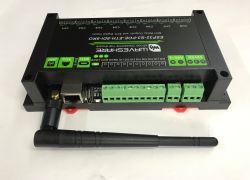
    There are also mentioned i2c buffers for raspberry 128pcs outputs (8*MCP) 128 outputs with relay drivers for raspberry and other clones.
    And input buffers 127 inputs with 5 relay outputs.
    You can also buy the whole system for a central switchboard in the PRO tab or components for small switchboards if you still have the choice of LAN.
ADVERTISEMENT