A programme for certified smart home installers - FIBARO EKIPA - was launched in May. Installers receive a cash bonus for purchasing FIBARO devices. The opportunity to participate in attractive incentive programmes organised by the manufacturer of smart home solutions is only the beginning of the benefits of being a certified FIBARO smart home system installer.
Let your business become smart .
Interest in smart home systems continues to grow, with 93% of respondents familiar with smart home solutions and 46.6% interested in installing a smart home. FIBARO is the most commonly considered home automation system and device provider.
If you are an installer of a related industry such as gate installation, alarm systems, CCTV, HVAC or other – this is an opportunity to grow your business. Take advantage of the current trend, offer your customers smart home solutions.
.
I have been installing the FIBARO system for many years. I myself have been continuously developing FIBARO in my own home and company, which is why I always recommend it to my customers with full conviction. Why? It has never let me down, and its possibilities never end! .
- says Mariusz Chrzanowski, Certified FIBARO Installer
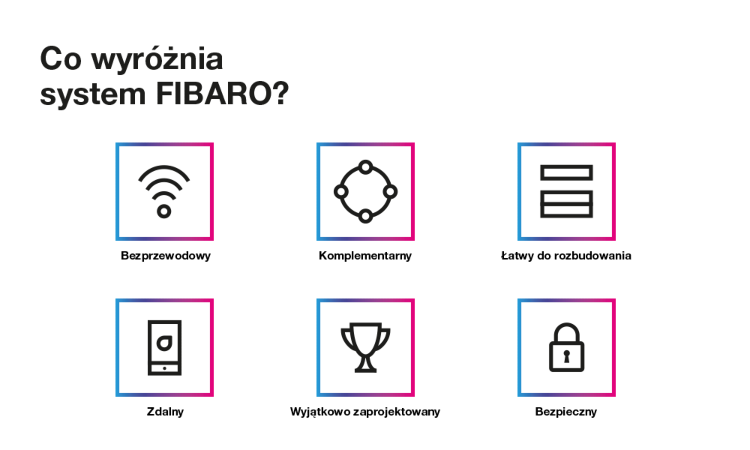
The modularity of the FIBARO system allows the system to be expanded at any time, which means that the customer can start with one of many areas of automation: heating, lighting, control of gates and roller blinds or electrical appliances. The FIBARO Smart Home includes monitoring of door opening, windows, temperature, multimedia management, HVAC systems, protection against fire, flooding, burglary and chimney.
.
The FIBARO system works with devices from other manufacturers, including: Nice, Sonos, Satel, Philips Hue, Dahua, Gerda or the voice assistants Amazon Alexa and Google Home. The benefits of the system are appreciated by customers all over the world, and those who have become partners of FIBARO by expanding their range of services respond perfectly to the requests coming from the market.
The FIBARO Smart Home responds to customer needs by offering high-quality devices manufactured in Poland and providing comprehensive smart home solutions. FIBARO provides friendly and easy-to-use solutions for comfort, convenience and peace of mind. Installers cooperating with the brand also appreciate the intuitive interface, which easily guides the installer through the entire process of configuring the smart home system at the user's premises.
.
Develop your skills with FIBARO .
Every installer - FIBARO offers participation in a professional product and technical training course.
After the training, each participant receives access to the FIBARO Academy knowledge platform, to the FIBARO Installer App - the only application for professionals which allows for remote and comprehensive management of the FIBARO system.. In addition, the installer receives technical support during his first installations. He or she also has the opportunity to purchase the FIBARO system once at a special price.
Develop your business with FIBARO .
An additional benefit of cooperation with FIBARO is the possibility to obtain a bonus for each purchase of products in the EKIPA FIBARO programme - everyone wins here! Take part in the training, join the FIBARO EKPA and install the benefits.
Wondering whether to sign up for a training course, would you like to learn about the product in practice? We have a good alternative for you - a new solution for installers considering working with FIBARO.
Would you like more details, do you have questions about training?
trainingcenter(_at_)fibaro.com
[Sponsored article] .
About Author
magic9magic9
Editor
Offline
Joined: 07 Feb 2010
Posts: 1318
Help: 20
Posts rating: 519
Points: 6722
magic9 wrote 1318 posts with rating 519, helped 20 times.
Live in city Kielce.
Been with us since 2010 year.
ADVERTISEMENT
Skepticism about the 93% smart home awareness survey
Well, I can see that the marketing department has gone for broke: "93% of those surveyed are familiar with smart home solutions and 46.6% are interested in installing a smart home."
Then I'll ask for the details of this research, because somehow I can't believe that in a country where electric roller shutters are still considered a technical marvel from sci-fi movies and the use of modern house construction technologies is at the level of statistical error 93% "know smart home solutions".
I am an automation specialist by training, which is why something like this is of great interest to me, i.e. I would very much like someone to convince me that something like a smart home makes sense.
What can such a system do that makes sense in the home of an average Pole.
The aforementioned roller blinds ? no I don't
Controlling the central heating boiler I already have a controller controlling the temperature e.g. from any place on earth - what for ?
I also do not have a folding awning when the wind is too strong.
A light which turns on when I enter a room ? That's what the very cheap motion detectors are for, if anything, and it's simpler to pull out.
Alarms ? there are cheaper and probably much better systems for this, and here I am afraid that if something is for everything, it is for nothing.
Turning on the kettle with water in the morning to make a cup of tea hmm I don't drink coffee or tea in the morning, if this system made sandwiches for work I would start to think.
Visualising the temperatures in the rooms so that you can set different temperatures on the radiators and save something on heating ? suuuper potential is there but the profits will come in ? I don't think it will be in my lifetime that these systems are cheap.
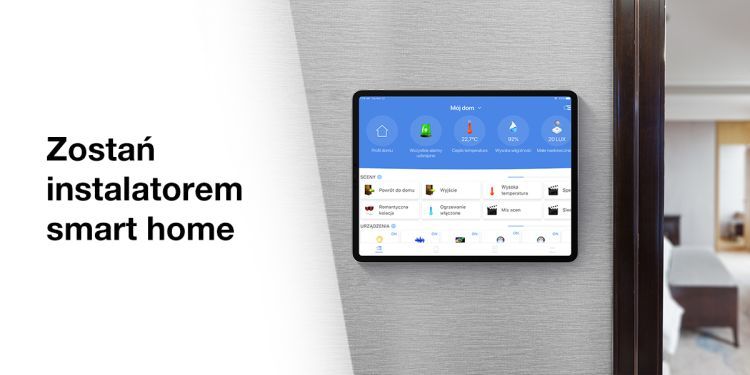
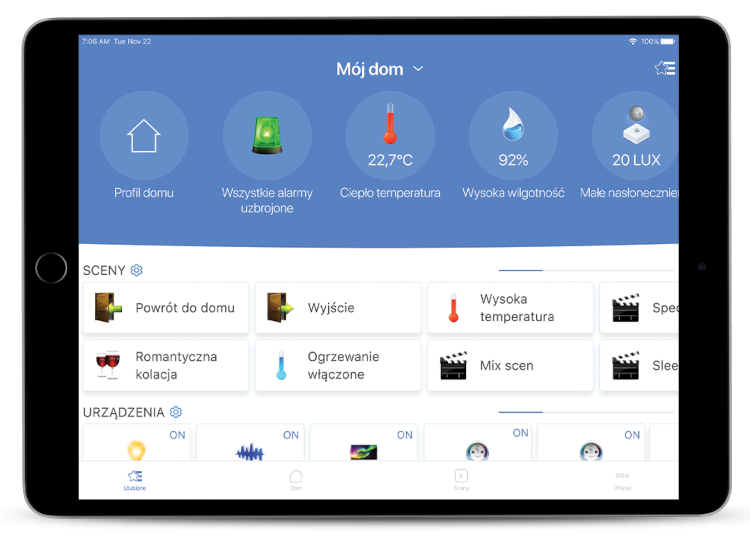
The system will inform me of a romantic dinner ? (I can see from the picture) what does this have to do with the smart home ? unless it's like sandwiches ...
Please give me some examples, it seems to me that the statistical error quoted by my colleague is very real. These systems are more for bragging to friends than making any sense but ... maybe I am wrong ?
believe me industrial automation is much more profitable and rather no one would want to deal with something like this unless once on a "what's it with" basis.
I look at it as a toy for the rich rather than something useful, unfortunately.
I can see the point of smart home installations, but it has to be done from start to finish and the house has to be designed for such installations.
For example, matrix room lighting - when you get up at night, it gently lights your way to the toilet or the fridge without turning on all the lighting (optionally locking the fridge door after 6pm).
Or automatic control of roller blinds according to the time of day and weather. Automatic switching off of lights in unoccupied rooms, possibility to switch off lights from a mobile phone so that you don't have to move your ass to the wall switch. Automatically turning down the temperature when nobody is home and turning it up, for example, an hour before you get home from work (although with a properly insulated building this makes no sense). There are really many possibilities.
And now yes:
- firstly, this is an electrode forum. Most of us know that something like this can be done. Most of us know that it can be done much more cheaply than some system.
- To suggest that 93% of the public have a clue (there is no information on which group the survey was conducted, judging by the results among installers) is simply manipulative.
- To suggest that almost half of the people in this country would want to install something like this at home is also manipulation.
The customers for such systems (and we are talking about serious projects here, not some trifles to be handled with a sonoff) are exclusively rich people (because it is not a cheap event) who additionally understand that such things are possible and see the sense of spending money on something like this - and this drastically narrows the group of potential customers. In my opinion (not backed up by market research so perhaps wrong) it will be maybe a few thousand investments a year.
So suggesting unknown markets and mountains of gold using data out of your arse is reminiscent of the strategy of financial pyramids.
It is very unfortunate that the smart home only inspires hilarity .
Two words about not moving the D4 from the sofa.
I have a work phone so all I can think about after I leave work is fucking.... it against the wall. So as soon as I get home it lands on the furthest shelf. Unfortunately, I'm not a member of the younger generation who doesn't part with their phone for a second, and if I need to call them, there's no chance. I have a son around this age, so I know what I'm talking about.
So it's getting dark and I want to turn on the light, so I get up from the sofa, unlock the phone, launch the app, choose the right room and turn on the light... am I the only one who thinks it's quicker to turn it on with an old-fashioned switch?
OK we have a smart home so maybe there is an Alexa but it's evening and my little daughter is asleep so how am I supposed to snooze to Alexa ?
Hang on, let's just let these 93% of "respondents" know that this is a possibility, they will immediately force Fibaro engineers to operate drones not only walking their dogs, but also monitoring their "smart properties" from the air.
....
So that suggesting out-of-the-blue runes and mountains of gold using data out of your ass ....
.
This is called "creative marketing" and I don't think anyone believes in it anymore ( I hope somewhere internally). On the other hand, on the sidelines of a colleague's statement (with which I somewhat agree) I will ask about this phrase.
Armadon wrote:
.... smart home...
.
I completely fail to grasp why the 'smart home' is called the 'smart home' and where the intelligence of those who use this phrase has gone.
Returning a little closer to the subject I would ask: who among you who have spoken has home automation elements in your home?
You can make fun of automation, but I will describe in a few points the elements that work very well for me:
- each room is a separate heating zone in my house (this is where my building automation started)
- when the alarm is armed, all the lights inside the house are switched off automatically (I don't have to check whether I switched off the lights on the first floor)
- when the alarm is disarmed, the lights in the hallway and possibly in the living room are switched on. Each of these lights is only switched on when "it is suitably dark outside")
- during ventilation, the radiators in the rooms being ventilated are turned off
- when leaving, I don't wonder if it's going to rain and whether I've closed the roof windows. If it rains, they close by themselves and open when the rain is over, provided it is warm enough outside.
Of course, you can laugh about walking the dog and the date but I am a practitioner and my examples are not made up. I use them and I assure you there are many, many more. I have accumulated over 180 pieces of home automation.
[edit]
I am not advertising FIBARO. I have a system from another company .
It is a great pity that the smart home induces only hilarity (...)
.
The very name - smart home - elicits sympathy because it is the invention of a half-wit rather than an engineer.
The mindless duplication of such a name also reflects badly on those who do it.
Home automation - gentlemen - not smart home.
And smart - that's smart here.
Someone had to prove themselves or something...
During the construction process, I asked a colleague what he had "thought up" for the house?
The short answer: in addition to radiators, there will be supply heating with recuperation and ventilation; experience has taught him what is important and what is not worth bothering about.
.
After reading some of the posts here I also come to similar sad conclusions....
Haven't seen, haven't heard, but will comment There really is nothing like a substantive discussion by experts on everything on the electrode.
...
Well okay we have a smart home so maybe there is Alexa but it's evening and the little daughter is asleep so how can I snooze to Alexa ?
...
.
If you had then you would know that "you don't have to snarl". In silence even a whisper is very well recognised. If you don't believe it, test voice search on android (smartphone). Other than that, it's a bit of "looking for arguments by force". When your daughter is not asleep, "sound off" when you need to, and when she is asleep, "don't sound off", just run something traditionally.
mumin wrote:
....
Two words about not moving the D4 from the sofa.
I have a work phone so all I think about after I leave work is f*cking.... it against the wall. So as soon as I get home it lands on the furthest shelf. Unfortunately I'm not a representative of the younger generation ....
So it's getting dark and I want to turn on the light, so I get up from the sofa, unlock my phone, launch the app, choose the right room and turn on the light... am I the only one who thinks that turning it on with an old-fashioned switch would be a lot quicker?
...
Not representative of the younger generation but by virtue of different needs to yours my phone is usually 'nearby'. For me it's quicker to reach for my phone than to go upstairs to turn off the lights I've left on thinking I'll be back "in a minute" or, for example, to close the roof windows because the evening is chilly. As you can see, it's all a question of needs - you have one and I have another, but that doesn't mean that either mine or yours are the only needs in this world and that opinions should be based on them. You simply don't need it (or are looking for arguments by force) and I use it and it is useful to me.
As usual, you end up pointing out spelling nomenclature etc. this is so typical of the forum and probably only in Poland.
I say e.g. "led bulb" you know what I mean ? yes, but no, the best thing to do is to write an elaboration about the meaninglessness of this name. And of course invoke intelligence.
I asked for examples and so far only colleague Erbit has risen to the challenge. .
I haven't seen such a system live which I don't think prevents you from imagining how it might (which is why I asked for examples) work and what it should do.
If I plan to close the roller shutters then I need to know what the controller for it looks like ? I just need to know that I can program it to open the roller shutters e.g. at 7:00 a.m. and start closing them at 9:00 p.m. provided it is already sufficiently dark etc. or if I have anti-burglary roller shutters they will start closing if someone enters the property and I am not at home ?
I was looking for ideas on what could be done with such a system and maybe if it makes sense to install something like this.
...
I was going for ideas on what could be done with such a system and ...
With me, it all started with the CO system. I wanted to be able to maintain different conditions in each room. Each room is used differently and at different times - so why should one central measuring point control all the rooms ? I'd also like to add that especially in late autumn when the sun, being low, can peep deeply through the windows and thus heat up the illuminated rooms - heating zones also come in handy. I have traditional radiators so the inertia of the central heating system is small compared to the underfloor heating system so the heating zone system can react quickly to changes in individual zones. I also know from the charts that wind direction also influences which part of the building is slightly "more strongly reheated" and I would not know this if it were not for the "automation".
The CO system - was the sticking point. Then (since there was already a central control unit) other elements came in. I started with the lighting. Then (as the need arose) others as well but usually most were driven by need rather than 'whim' although I admit that some elements (e.g. collecting environmental data from the house and gas boiler operation data) have long since ceased to interest me and this element is now redundant however, the charts used to allow me to draw some interesting conclusions.
[edit]
I might add that for lighting, indeed most users (including myself) use the traditional method. Automation is used more as an 'emergency' when I don't want to 'zip' up the stairs or in similar situations. What I am getting at is that having an automation does not preclude the use of the traditional functionality that the householders use most often. So it's a 'nice to have' (giving other possibilities too) and not an obligatory element.
Added at 36 [minutes]:
mumin wrote:
...
I have asked for examples ... .
.
Don't ask because I can write an elaboration about it but I doubt that my needs (and therefore solutions) will coincide with yours.
Forum etiquette on speaking normally versus whispering
If you had you would know that "a snarl is not necessary". In silence, even a whisper is very well recognised.
Ok I admit I didn't check I didn't know. Is this not, by any chance, what discussion is all about and the point of a discussion forum ? one doesn't know something the other does and shares the knowledge. All in all, everyone ends up satisfied. I'm sorry for the "shouting", I meant it as a way of easing the atmosphere as it was getting thicker. I rather meant to say something out loud (normally) and not in a whisper.
Android voice recognition works well in noisy cars
.... Rather, I meant that it needed to be said out loud (normally) and not in a whisper.
I was greatly surprised (I'm still surprised) how when I start the ignition in the car the radio automatically fires up and I say to the "google map" where I want to go without any problems, despite the "radio sounds".
I used to play around a bit with both speech synthesis and recognition (old times) and I realise "what I've come to" and what such voice dialing can do today. I am really impressed. Test it on android. Of course it's not perfect but I have to admit that any "outside interference" is well "drowned out" and the commands are well filtered from the surrounding sounds (including music and Polish words in songs). I don't know what this is based on but.... it works. Perhaps the algorithms recognise what the background is and somehow filter out the background noise (even when it's song lyrics). Interestingly when, in the meantime, the 'wife is chattering something' the map is obviously 'listening to her too'. We humans are able to talk in tum and "hear" only the interlocutor (focus on what they are saying). Automata still have a problem with this.
As for stationary speech recognition devices - there are probably two leading the way. Both use an external engine (online connection). Anything else that can be installed on your own server/device to work locally (without an internet connection) is a piece of cake.
Practical home automation for heating, lighting, and gates
"Smart home" - I've written in inverted commas just in case - is first and foremost something for people who want it and understand it. It should never be made happy for people "who need it". It's just that such a person will come home early and it'll be cold and they won't know how to turn the heating on and so with everything. It gives an unpleasant feeling of not being in control of your own home.
I 'smart home' myself and build it where I need it. I have electric heating and the radiators have a separate signal cable for control. The control is almost trivial. I could equip the house with temperature sensors placed in representative places (not at the radiator) and control the temperature accordingly. Of course, there is also the possibility of time control and cooperation with the alarm - if it is activated, the temperature is slightly reduced. Incidentally, the alarm (when the occupants leave the house) also performs other functions, e.g. it switches off the circulation pump. I also found the automation system useful in controlling the external lighting - when I open the gate from the remote control and it's dark, the external lighting in the house lights up, which turns off by itself after a few minutes. When I went on holiday - I lowered the temperature in the boilers considerably. Before returning, I switched on the remote so that the water would not be cold when I arrived.
As much of the automation is controlled via WiFi (ESP8266) I could control circuits that didn't have an on/off switch (e.g. the road lighting, which I added later). I also found the remote gate opening function useful.
Skepticism about smart home use cases in average homes
I am forwarding the official FIBARO responses below:
Armadon wrote:
Well, I can see that the marketing department has gone thick: "93% of respondents are familiar with smart home solutions and 46.6% are interested in installing a smart home."
I'll be the one to ask for the details of this research, because somehow I can't believe that in a country where electric roller shutters are still considered a technical marvel from sci-fi movies and the use of modern house building technologies is at the level of statistical error 93% "know smart home solutions".
.
Details of the survey can be found here: FIBARO the best known brand among manufacturers of smart home systems and solutions - Newsroom | smart home FIBARO .
The survey was conducted by a professional research agency Pollster on a sample of 1,000 people, so it is a representative research sample At FIBARO, we have been working for more than 10 years to build awareness not only of our brand, but also of smart home solutions or, if you prefer, building automation.
mumin wrote:
I am an automation specialist by training so something like this is of great interest to me, i.e. I would very much like someone to convince me that something like a smart home makes sense.
What can such a system do that makes sense in the home of an average Pole.
The aforementioned roller blinds ? no I don't
Controlling the central heating boiler I already have a controller controlling the temperature e.g. from any place on earth - what for ?
I also do not have a folding awning when the wind is too strong.
A light which turns on when I enter a room ? That's what the very cheap motion detectors are for, if anything, and it's simpler to pull out.
Alarms ? there are cheaper and probably much better systems for this, and here I am afraid that if something is for everything, it is for nothing.
Turning on the kettle with water in the morning to make a cup of tea hmm I don't drink coffee or tea in the morning, if this system made sandwiches for work I would start to think.
Visualising the temperatures in the rooms so that you can set different temperatures on the radiators and save something on heating ? suuuper potential is there but the profits will appear in ? I don't think it will be in my lifetime that these systems are cheap.
The system will inform me of a romantic dinner ? (I can see from the picture) what does this have to do with the smart home ? unless it's like sandwiches ...
Please give me some examples, it seems to me that the statistical error quoted by my colleague is very real. These systems are more for bragging to friends than making any sense but ... maybe I am wrong ?
Examples of the use of smart home systems for small houses and flats can be multiplied. Not everyone has roller shutters, not everyone has central heating boilers, but everyone has sockets, doors and windows. Everyone may want protection against flooding, fire or chimney flue. Our devices are capable of doing just that. The undeniable advantage of our system is its mobility (you can “move with it”from one flat to another), its modularity (you can expand it at any time), and also (or perhaps above all) its non-invasiveness - you don't have to hammer in walls to have the system.
We have had the opportunity to realise many interesting projects including Homo Smartus Fibaro: a smart home reduces the stress of everyday chores (dobreprogramy.pl) in which we show possible scenarios for the use of smart home solutions, and in which we have shown that a smart home will help to “combat” habits and whether it helps in everyday life by, among other things, reducing stress levels in stressful situations. The proper configuration of the system (either on your own or entrusted to a Certified Installer) will make it possible to forget about all the “little” things we waste time on every day, such as lowering the roller blinds and raising them in the morning, adjusting the temperature (e.g. in rooms where no one is present - a motion sensor will send a signal to the head unit to turn down the temperature, or the light in the bathroom will go out when no one is in it for, say, 5 minutes).
As for the statistical error - many people see owning a smart TV, for example, as having a smart home. There is nothing wrong with that, however, we want to show that a smart home is more than that. We have been putting a very strong emphasis on building awareness for the past 10 years and over these years we have seen that this work is paying off, but there is still a lot of work to be done. This is where our partners - distributors and installers - play a very important role: they tell us, suggest possibilities for the application of home automation in a particular case, etc. Nevertheless, the survey results show one thing: Poles know the smart home, they want to own it. Our role is to show that these solutions make sense and are not just for showing to friends, but provide real benefits - convenience, security, control and much more.
mumin wrote:
Brivido wrote:
This may be so that automakers have a job?
.
believe me industrial automation is much more profitable and rather no one would want to deal with something like that unless once on a "what's it with" basis.
I unfortunately look at it as a toy for the rich rather than something useful.
Indeed, previously the smart home was mainly seen as a fashionable (and expensive) gadget. Fortunately, thanks to the popularisation of this type of solution and the significant drop in component prices and developments in technology, home automation has become more accessible. Today, it is possible to “construct” an intelligent building system at a cost of around PLN 1,000/ 10 m² of building. Of course, everything depends on the sophistication of the system, the number of devices, etc.
Armadon wrote:
I can see the point in smart home installations, but it must be done from start to finish and the house must be designed for such installations.
For example, matrix room lighting - when you get up at night, it gently lights your way to the toilet or the fridge without turning on all the lighting (optionally locks the fridge door after 6pm).
Or automatic control of roller blinds according to the time of day and weather. Automatic switching off of lights in unoccupied rooms, possibility to switch off lights from a mobile phone so that you don't have to move your ass to the wall switch. Automatically turning down the temperature when nobody is home and turning it up, for example, an hour before you get home from work (although with a properly insulated building this makes no sense). There are really many possibilities.
And now yes:
- first of all, this is an electrode forum. Most of us know that something like this can be done. Most of us know that it can be done much cheaper than some system.
- suggesting to suggest that 93% of the public have a clue (there is no information on which group the survey was conducted, judging by the results among installers) is simply manipulative.
- To suggest that almost half of the people in this country would want to install something like this in their home is also manipulation.
The customers for such systems (and we are talking about serious projects here, not some trifles to be handled with a sonoff) are exclusively rich people (because it is not a cheap event) who additionally understand that such things are possible and see the sense of spending money on something like this - and this drastically narrows the group of potential customers. In my opinion (not backed up by market research so perhaps wrong) it will be maybe a few thousand investments a year.
So suggesting unknown markets and mountains of gold using data out of your arse is reminiscent of the strategy of financial pyramids.
EDIT: typos
.
In a way, you are right that home automation “performs best” when it is carried out from A to Z. But a system that is “done” from A to G” also performs well, really. We are aware of a couple of constraints we face at the stage of buying an apartment/home and then possibly renovating etc. First and foremost: time, money, ideas.
We often lack the time and the idea to deal with all the aspects we would like to have in our M. Priorities and the mundane of life win out. This is why our system can be installed at any stage of the project in an already existing installation. All we need to do is think (more or less) about where we want to start. Example: a single person living in a bedsit wants to start, for example, only with light management and a few sensors (e.g. flooding, smoke, opening of doors/windows - so that he doesn't have to wonder whether his flat will flood during the next cloudburst ). Another example: A family with a child: they want to take care of security, manage the lights, and remotely switch off, for example, the socket after 6pm so that the child is doing homework and not playing on the console - anything is possible. Or “from a different angle”: a parent wants to get up to see the child at night, but does not want to switch on the lights: the system can switch on the lights at 20% power when movement is detected in the corridor and room after 22:00, for example.
Money: here we all know it all too well. When we renovate a flat or house we look at the zloty from all sides, so we can decide on a smart home later or decide “now” but, for example, only on temperature management - because we want to return to a heated apartment/home in winter.
At FIBARO, we are open to both “serious” customers and customers who are interested in “farts”. Everyone is important to us, for each of them we want to make their life in a smart home easier, more comfortable, safer. These are not empty slogans for us, in the past people were defensive about getting into cars, they didn’t understand why they had “a brick” in their pocket (we are talking about phones). We believe that such a future awaits our industry as well. That is why we invite anyone who wants to become an installer of our system to experience its possibilities, gain new “skil” and “earn money in the process”. If any of you have any questions about the training, please feel free to contact us: trainingcenter(malpa)fibaro.com
"The results of a survey conducted on behalf of FIBARO among 1,000 Poles aged 25-55 with a household income of more than PLN 3,000 gross are therefore not surprising. According to them, 20% of the respondents already have smart home solutions in their homes and flats, and 58% of the rest are interested in installing this type of system."
No actually, a detailed report. Not even information on what specifically people were asked about....
But if we include the setting of the temperature in the central heating or the alarm under smart home solutions, it might even be true that most people have heard that such a thing exists.
But then again, everyone has a smart home solution at home because they don't have a light on all the time, they can just switch it off! And a TV with a remote control!
It reminds me of the famous sponsored article by greencells where an ambitious marketer tried to argue with electronics manufacturers about the quality of their appliances, with the result that was obvious.
Let me remind you again: THIS IS NOT THE ONET FORUM, there are technical people here, the vast majority are probably even intelligent. This is not a forum for technical people, the vast majority of whom are probably even intelligent.
Wouldn't it be better to insert a nice chart of sales volume or the number of installed systems in Poland - that is hard data showing a trend - to show how dynamically the market is growing? Well, unless there is nothing to brag about because it is not growing...
A little respect for the intelligence of users.
It's a pity that more people aren't interested in this topic when they're still in the home.
Automatic closing of windows when it starts to rain, switching lights on/off and the like - it's a waste of money. I can understand if someone does something like this as a hobby, but paying someone to have the lights in the hallway switched on at 6 a.m. in December is, imho, a misunderstanding.
In addition, automation based on „voice astistants” is itself burdened with many original sins, starting with the need for a constant connection to the internet to listen in and send out no one knows what, no one knows where, no one knows to whom, no one knows why.
I don't know, maybe that last paragraph is my personal paranoia, but in general any home automation application that starts with „I don't have to get my arse off the sofa to (…) " is a created need. A harmful „need” in the context of (too little) movement in everyday life. What's different is applications starting with „I don't need to remember (…) ”, especially if what we (don't) need to remember directly translates into a reduction in current bills....
Automation should save energy, not just add convenience
Imho automation that has an impact on energy consumption - yes, I'm all for it
.
This bit of the Colleague's view I think everyone supports.
oshii wrote:
...
Automatic closing of windows because it starts to rain, switching on/off of lights and the like - a waste of money. ...
.
It depends but about that in a moment.
oshii wrote:
...
I can understand when someone does something like this at their home as a hobby, but paying someone to keep the hallway lights on at 6am in December is imho a misunderstanding.
.
Here the Colleague is already being ironic and it is difficult to argue with this. However, just locking up when it's raining and you're not at home is such a very good example of the use of automation so I don't really understand why you would summarise it with "it's a waste of money". I would be happy to hear an extended opinion from you, but not about "turning the lights on at 6 a.m. in December".
oshii wrote:
.
In addition, automation based on „voice astists” is itself burdened with many original sins, starting with the need for a constant connection to the internet to listening and sending no one knows what, no one knows where, no one knows to whom, no one knows why.
.
This is where I fully agree with you. I think you are from the "older generation", but believe me, the younger generations don't give a damn about such concerns, and they are overwhelmingly approving, for example, access to photos on their phone for an app that doesn't need it. They (the young), for the most part, hold it in high regard. Unfortunately, we with our concerns are slowly dying out and the market is moving forward.
oshii wrote:
.
I don't know, maybe that last paragraph is my personal paranoia, but in general any home automation application that starts with „I don't have to get my arse off the sofa to (…) " is a created need. A harmful „need” in the context of (too little) movement in daily life....
.
So why doesn't your colleague cycle to work? A colleague can also cycle to the market and strap on a trailer. Ba... you can even not go to the market but do your own growing, you will get more exercise and eat healthier - so why don't you do it? Well... because that is our civilisation.
What I mean is that I sometimes just don't feel like opening the front door again to check whether I've turned the lights out or closed the roof windows.
But... just as I am entitled to my opinion (and my own choices) so is my colleague.
However, just closing them when it's raining and you're not at home is such a good example of the use of automation so I don't really understand why you commented on it with the phrase "waste of money".
.
Because leaving windows open when no one is home is a misunderstanding in itself.
1. automation can always fail for some reason. It's not the space shuttle that there are several redundant detectors, actuators, controllers etc. each.
2) As a general rule, people don't have bull-proof UPSs in the house so that these windows all close automatically when a power failure is detected.
3. you would have to foresee every possible scenario why the windows would have to close quickly. For example, you go out and your neighbour has a nice barbecue in the meantime, or decides to burn the leaves and will have all the aroma in his bedroom when he returns.
Erbit wrote:
The fellow is already being ironic and it is difficult to argue with that. (…) I would love to hear a developed opinion from the Colleague but not about "turning on the lights at 6:00 am in December".
.
Why am I being ironic? I get up with my phone in my hand, giving off enough light (screen, not to mention torch) to walk 100/100 down that corridor safely. Not to mention the good old tried and tested and unreliable cross switch.
Erbit wrote:
I believe you are a Fellow of this "older generation" (…)
.
Let's put my age this way - I have no memories of the communist era, which doesn't mean I didn't live in those times.
Erbit wrote:
Why doesn't a colleague cycle to work?
.
And where do you get the assumption that I don't? But yes, I drive my car for larger purchases. Just comparing the time/power/sweat savings of bike vs. car for shopping to turning on a light with a physical switch vs. a phone is delicately speaking crippling.
Erbit wrote:
I'm getting at the fact that I sometimes just "don't want" to open the front door again to check if I've turned off the lights or closed the skylights.
.
Well, I had a colleague who was unable to leave for work without taking pictures of all the windows/curtains, and would return to the door a dozen times before she was sure it was locked. I know, it's already an extreme, but discussing home automation in the context of mild obsessive neurosis is a discourse about special cases not the rule.
Btw, I'm told whether all the windows are closed by the alarm when I switch it on, if I've managed to switch it on successfully I haven't forgotten a single window.
Remote controls undermine the no-movement argument
..., I am informed of whether all windows are closed by the alarm when switching on, if I have managed to switch it on successfully, no window is forgotten.
.
So you have some elements to get rid of obsessive neurosis though ?
I think we understand each other perfectly (or at least I do Colleague). We just have different needs and we wouldn't be human if we had identical ones. We both have some boundaries (different ones) and that's the way it should be.
[edit]
The bicycle was merely a figurative device to illustrate to the Colleague that there are many more elements that restrict movement - such as remote controls, which the Colleague does indeed use extensively therefore I do not accept the argument of "no movement" as I believe the Colleague has used this argument knowingly (or not) hiding the fact that in other cases the Colleague allows "no movement".
That is to say, however, does the Colleague have some elements to get rid of obsessive neurosis?
.
I have, but it's a side effect/on occasion, not a feature introduced deliberately.
Erbit wrote:
We simply have different needs and wouldn't be human if we had identical ones. We both have boundaries (different ones) and that's the way it should be.
.
Amen. At the same time, would you agree that needs have it that they can be created (because of advertising, because of neighbours/mates, etc.) in isolation from their „objective” sense (time/money saved and/or significant difference in living comfort in the context of overall installation/maintenance costs)?
Erbit wrote:
Colleague does indeed use it on a recurring basis therefore I do not accept the "no traffic" argument as I believe Colleague has used this argument knowingly (or not) hiding the fact that in other cases Colleague allows for "no traffic".
When I start turning lights on and off 60-100 times per hour instead of 0-3 times per day, I will certainly install appropriate automation .
The argument about motion and the salutary effect on fitness of manually turning off the light is obviously tongue-in-cheek, which doesn't change the fact that without the remote control, the comfort of using the TV drops drastically (which maybe wouldn't be so bad in itself - it would discourage me from using it), whereas depriving me of the option to turn the light on/off from my phone wouldn't have led me to some frustration. It's a nice thing, but imho of marginal importance for everyday life at home. Just something to talk about with friends over a beer.
Unless, of course, you're into it and you do it yourself, then it's a hobby like any other and it's hard to discuss whether or not it makes sense - as a rule, a hobby doesn't have to make sense to be fun, that's all that matters.
Home automation as occasional convenience, not necessity
.... At the same time, would you agree that needs have it in them that they can be created (because advertising, because neighbour/mate etc.) in isolation from their „objective” sense (time and/or money saved in the context of overall installation/maintenance costs)?
.
But of course I agree, and I'm far from "having whatever the marketers saliva brings on their tongue".
oshii wrote:
When I start switching lights on and off 60-100 times per hour instead of 0-3 times per day, I will certainly install the appropriate automation
.
I understand, however, I do not use light switching via my smartphone on a daily basis. The family (including myself) use traditional methods. This lighting automation is such an add-on that is used occasionally and not instead of the traditional method. Nevertheless, in these occasional situations it simply comes in handy, and this was the purpose of installing the automation for me, which is simple laziness (read: remote control). In addition, since there was already automation, I could "play" with further convenience - e.g. automatically turning off the light when the alarm is armed - but I have already written about this.
It is obvious that I used to live without this automation without problems and could still do so. It is obvious that our great-grandmothers were afraid of electricity. Building automation is a kind of gadget, which in my case, however, brings minor benefits and not all benefits are converted through the economics of their use (bike vs car, remote control...).









 believe me industrial automation is much more profitable and rather no one would want to deal with something like this unless once on a "what's it with" basis.
 .
.
 .
.
 the map is obviously 'listening to her too'. We humans are able to talk in tum and "hear" only the interlocutor (focus on what they are saying). Automata still have a problem with this.
