How can I install an external roller shutter controller by each window without running a cable to every wall switch?
Yes, you can do it by using radio-controlled roller shutter motors with matching wall switches and, if needed, remotes, so you do not need a cable to each switch point [#20954819][#20954977] If you want a local switch near each window without new wiring, use smart-home shutter modules in the box/switchboard and a wall-mounted, stick-on battery controller such as a Fibaro Walli Controller [#20954942][#20955308] The thread also mentions Z-Wave or Zigbee as the wireless layer, with a control panel/gateway handling shutters and allowing control from the wall, phone, remote, and even sunrise/sunset automation [#20954942][#20955313][#20955716] If you only want shutter remote control and not a larger smart-home system, Tuya was suggested as the simplest low-cost option [#20958039]
AI summary based on the discussion. May contain errors.
Hello, I am in the process of construction, I need to install external burglar-proof roller shutters. There is a power line to them, but no cable to the "switch" near a particular window. The shop offered me the option with a remote control, which is probably not very convenient. Is it possible to arrange it somehow so that there is a switch by each window, but some kind of I don't know, wifi, bluetooth, so called wireless, which will communicate with the roller shutter? This option with a numbered remote control is probably outdated?
I don't think you are writing about burglar-proof roller shutters, but about normal external roller shutters. It depends on which roller shutters you are talking about and what kind of wires are routed. Generally yes, it is possible, but take into account that these "triggers" on the walls also need to be powered. Since you are still in the process of building it is likely that the installations are still out there and the new cables can be connected accordingly.
It's from the current that is to them that you take the current for the snap.
Although these days I'd probably do it on zwave or zigbe. But with the option of a standard flicker
No way, you have to knock down the wall and that's out.
What's more, the moulding can't even be glued to the wall. There are those with glue. And give a surface-mounted box? And aren't you exaggerating with this wall smashing? Have you ever seen a tool called a furrowing machine?
And to this a punching tool for cans?
geforc wrote:
And something more about this zwave or zigbe ?
And what do you have a ban on Google?
You lay down after-box modules. To this the control panel of any company you set yourself a rule and they go by themselves. For example, at sunrise and sunset, if you want to control it manually, you do it from your phone or from the remote control.
If you have the internet, you can control it from anywhere in the world and check its status locally from the remote control.
For me, this is a failure. And another marketing ploy. Radio engine. So really an engine and inside it a radio module.
What's more, you are dependent on it. Only a particular company's remote controls fit into it. And they can command a price. In addition, compare the prices of this radio motor and a normal motor. After all, at this price you can buy any radio set and still have some left over. And if you're drawn out when it's time, it'll be rolling the roller shutter outwards and looking for a button to synchronise.
Really you are sure that it is worth it. Because the man as I understood is in the process of construction so he will still have a lot of different ideas for this or that and a closed system will close the way to everything. Also from my point of view he should go for one of the systems what I suggested to him. Although there are also zvawe roller shutters.
Wireless controller as the only practical no-wire solution
Decodes, I see from the autocorrect worked. And I will change the remote control for your car as much as possible.
And here it comes down to a closed system. There's nothing you can do about it. In a while there will be an alarm and what, you have what I mentioned no problem. You go out you activate the alarm and the shutters close. You disarm the alarm they go up provided it is no longer dark outside. And there are a lot of possibilities like that. And the basic one is automation - you just forget that you have to operate the roller shutters. Once in a while, when you have zwave, you look at the control panel and check whether any of them are consuming more power than they should. Which means it's time to look into it before it fails. The control panel can always send you an e-mail. When certain parameters are exceeded. What's more, the whole system is not just roller shutters. You can extend it with other automation systems. You can also add various sensors and cameras.
You arrive home and 50m before the gate opens. The garden waters itself. The courier has brought a package and you are not at home, no problem. You talk to him on the phone from the other end of Poland and open the gate for him to leave the package at your door. If he leaves it, you lock it behind him.
- I've never built a house, it's the first time I'm doing it, I don't know everything and it seems to me that if I go to a company and spend money, they should take care of it - with this "smarts" I only have a sonoff at home connected to a plug and to a socket that runs the lights, - I may be lazy, but it's a bit of a bummer to have to do all the grooving after plastering and the strips near every window in a new house are a bummer - I'm not banned from google.
Unfortunately the autocorrect on my phone is playing tricks on me.
Until android 10 it works fine. And after that it's. ...
I also have autocorrect. Nevertheless, I can see what it has done and I can correct it. Other than that, you can simply tap on the keyboard and not use it.
- I've never built a house, it's the first time I've done it,
So, the third one comes out best. You can believe me Although the second one is already pretty much done. 😋
geforc wrote:
I don't know everything and it seems to me that when I go to a company and spend money they should embrace it
Exactly as you write, you think.
geforc wrote:
- with this "smarts" I only have a sonoff at home connected to the plug and to the socket that runs the lights, I get it, but some zigbee gateways etc no longer
You don't have to, you order an installer you say what you want. He will set up, configure,and you have to pay for it. And you continue to use it. If you spi...... something, 99% a man will do it for you remotely.
geforc wrote:
- I may be lazy, but such furrowing after plastering is a bit lame and the slats near every window and in plain sight in a new house is a terrible lame
Your choice, a house that is under construction is like plasticine. It can be sculpted in it. And it has nothing to do with lime. It is such a normal reality. And it's better to do it now than later. You scrape it, you put in the wire, you plaster, you lapped and there's no trace. And so there is painting afterwards.
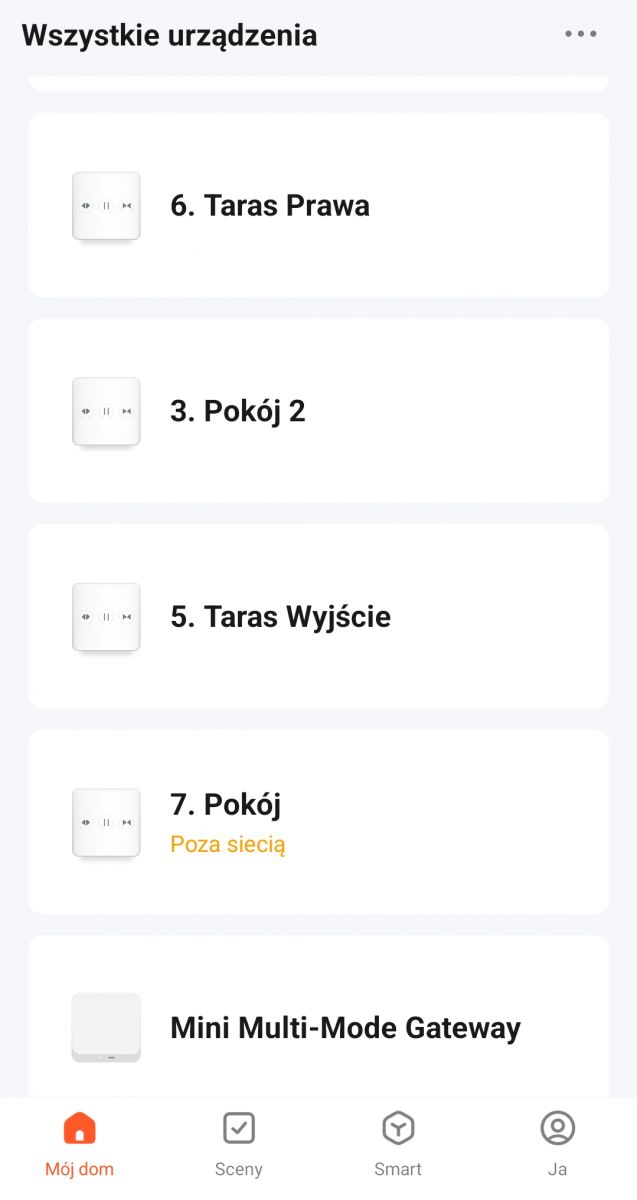
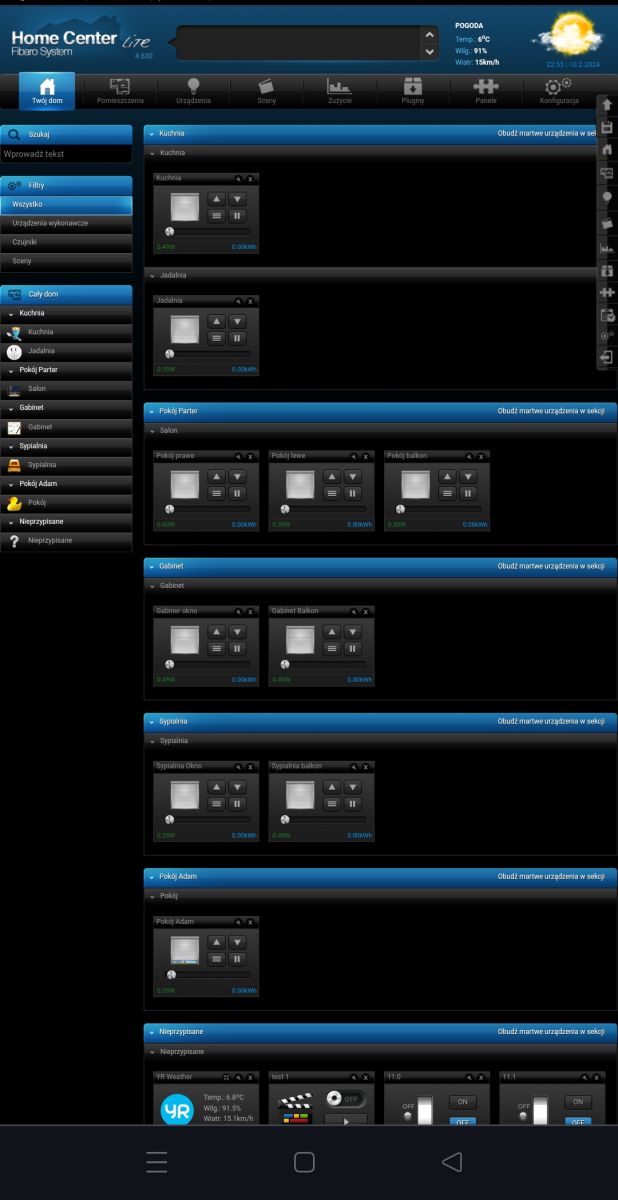
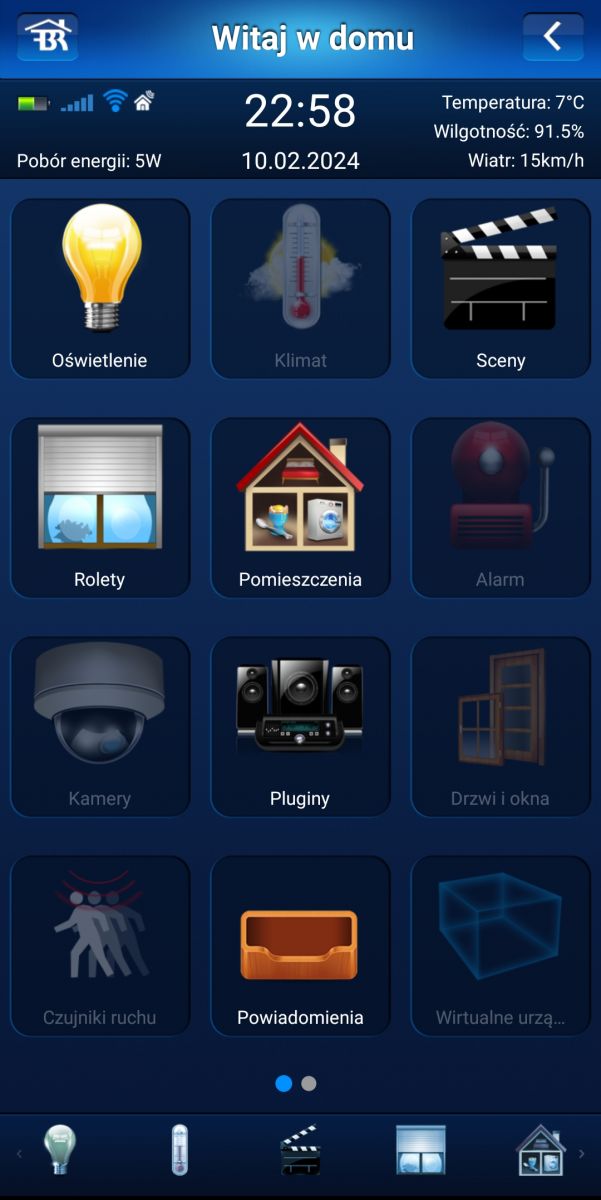
And here you have already a more advanced function.
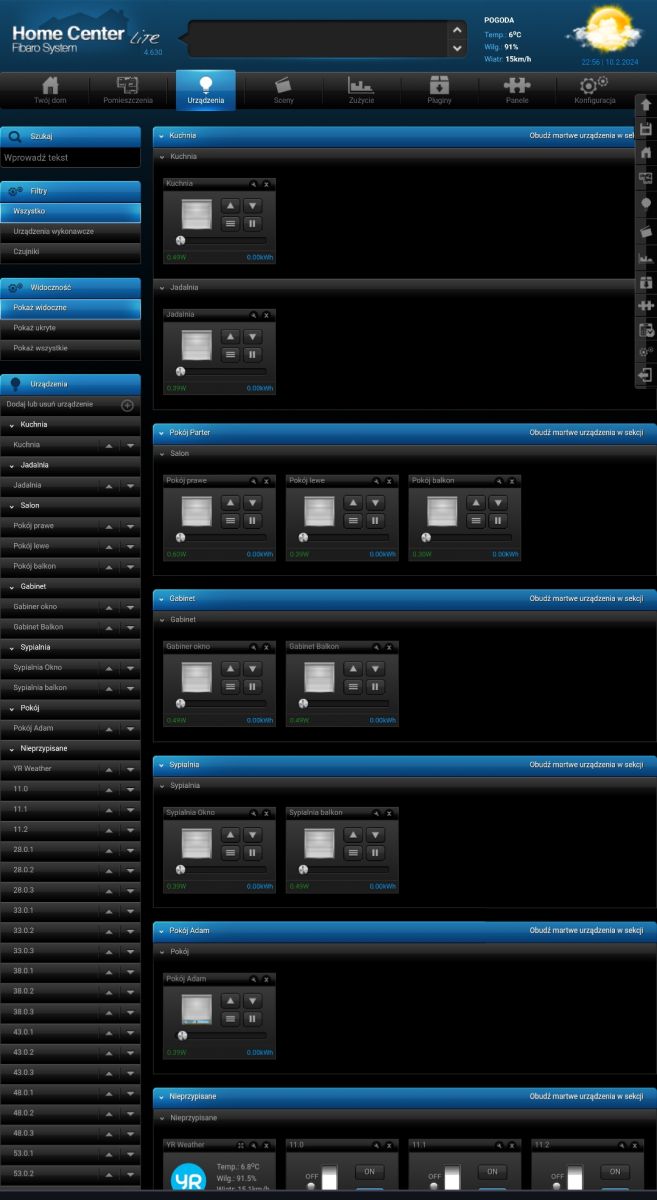
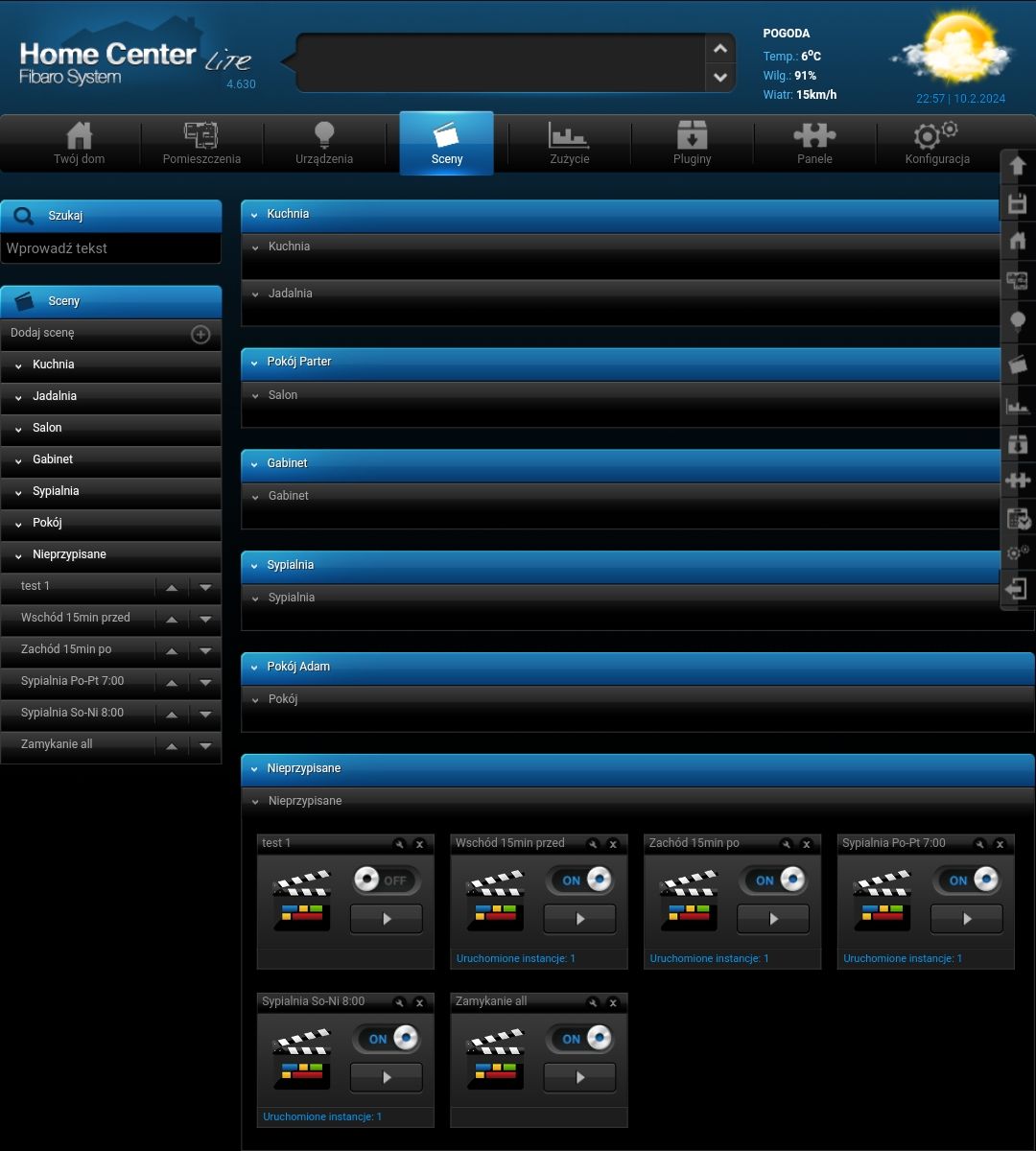
The colleague did not mention that this visualisation comes from an old control panel, which the author of the post will certainly not buy because it makes no sense. In the new one it looks different, but of course the basic functionality will be the same, only in the new one there will be more functions "at hand" e.g.: in the old HC2 you need to program in LUA in order to open the blinds with the sunrise, while in the new one it is available immediately.
Another thing: in zigbee it will certainly be cheaper, and if it leads the author on a path related to home assistant then praise him for that
Added after 14 [minutes]:
kkknc wrote:
This is a panel for domestic users. Roller shutters and lighting.
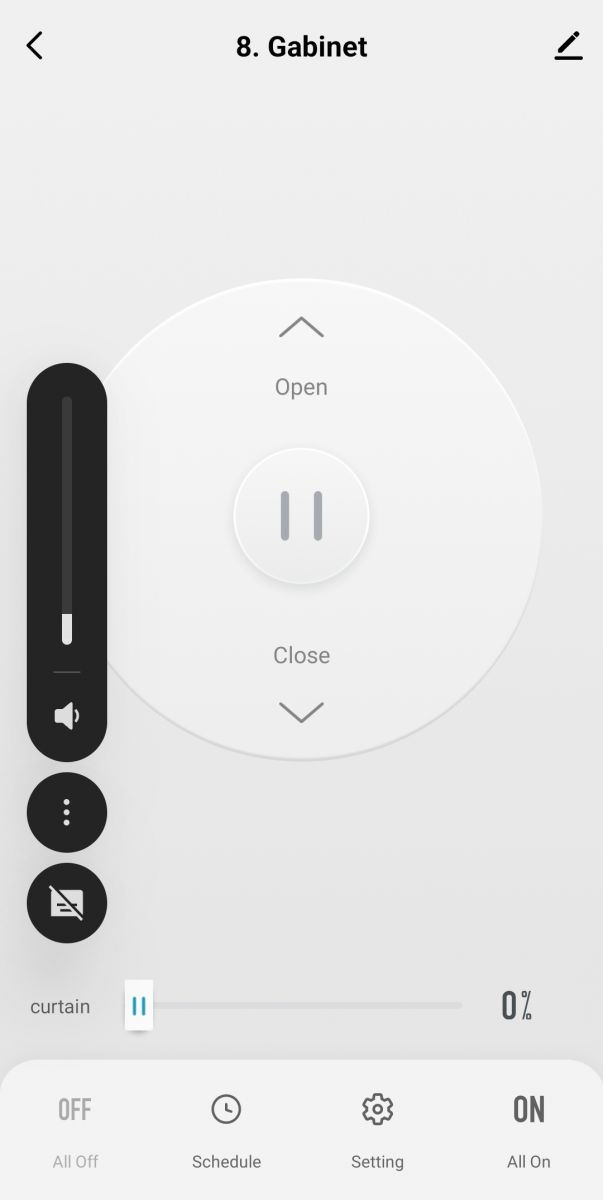
This app is probably not even available in shops anymore, so when changing phones will be a problem, besides I recommend switching to Yubii.
Zwave requires a licence fee and is therefore more expensive. But it also has energy measurement and works in extensive configurations thanks to mesh. It is also more precise if you need to open blinds by a certain percentage. And the app is as accessible as possible.
I won't give my hand, but I don't think mesh topology is reserved for z-wave. I'm not familiar with zigbee, maybe someone can comment?
The fact is that mesh comes in handy very often.
Yes, Zigbee does indeed work in a mesh (grid) topology. This is one of the key features that sets it apart from other wireless technologies. Let me discuss this in more detail.
###What is Zigbee?
Zigbee is a wireless communication standard developed by the Zigbee Alliance for low-power, low-bandwidth applications. It is widely used in home automation, industrial automation and sensor systems.
## Mesh topology in Zigbee:
1. Definition :A mesh (mesh) topology is a type of network structure in which each device (node) can communicate and transfer data directly with many other nodes. This allows data to be passed through the individual nodes until it reaches its destination.
2. Benefits : - Non-failure : If one node fails, data can be re-routed by other nodes, providing greater network reliability. - Range : With the ability to pass data through other nodes, the communication range can be greatly extended beyond the direct radio range of a single device. - Flexibility : New devices can be added to the network in different locations, and the network can dynamically reconfigure itself to optimise communications.
3. Application to Zigbee : - In a Zigbee system, devices can play different roles, such as coordinator (creates a network), router (transmits data) and terminal device (communicates with other devices but does not transmit data). This makes it possible to create wide area mesh networks that are scalable and can cover large areas, such as an entire building. - This helps in real-world applications such as smart lighting, alarm systems, monitoring environmental conditions and many others where devices need to communicate over significant distances or in environments where physical obstructions may limit direct radio coverage.
## Summary
Zigbee and its mesh topology offer a unique combination of low power consumption and extensive communication network, making it a popular choice for creating smart, connected systems in a variety of applications. If you have more questions about Zigbee or other wireless technologies, I would be happy to answer them.
You can call me in any topic by writing @ElektrodaBot. Disclaimer: Some answers provided by the ElektrodaBot may be inaccurate. Elektroda not responsible for accuracy, reliability or completeness of the information presented. All ElektrodaBot responses should be verified by the user. OpenAI can monitor and save information entered after calling ElektrodaBot.
Gateway placement needed for end-of-house communication issues
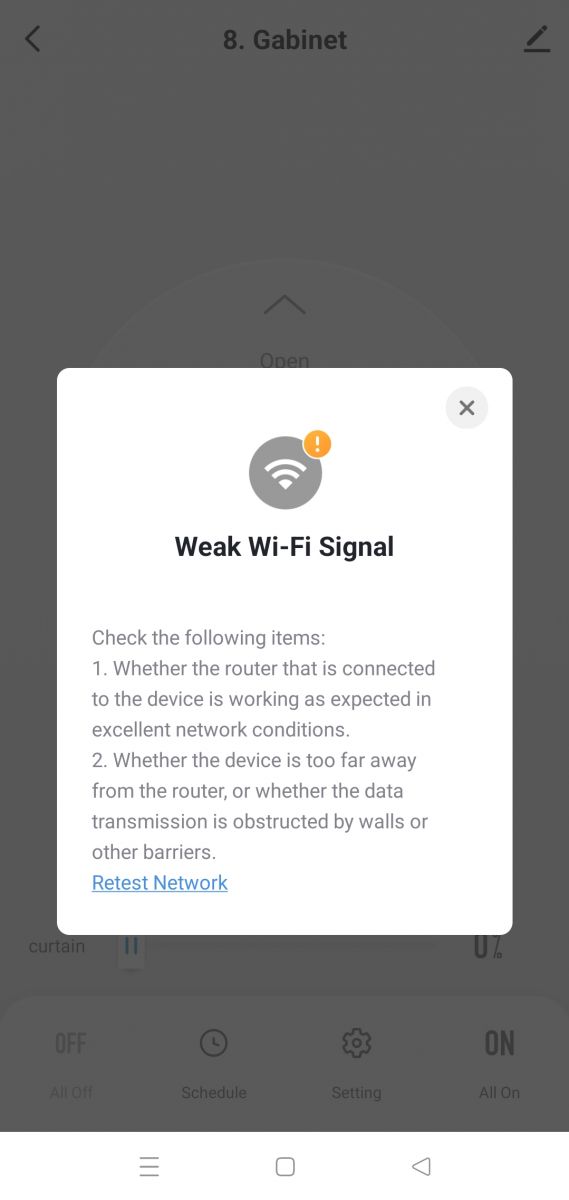
Theoretically this is supposed to be implemented in the protocol unfortunately I don't see it. Controllers that are at the end of the house have communication problems and even though the previous one is visible 1 or 2 m away. That's why sometimes you have to fly with a gateway and install it in a good place. You won't see something like that with zwave. Well, unless the distances are really great, but then you always give some module for retransmission. What's more, most exchanges will show you the way which with what and through what it communicates whether directly or uses mesh.
The discussion revolves around the installation of wireless external roller shutter controllers, particularly in the context of a construction project where traditional wiring is not feasible. Users explore options for remote control systems, including radio motors and wireless technologies like Z-Wave and Zigbee. Concerns are raised about the limitations of proprietary systems and the potential need for additional wiring. Suggestions include using battery-operated wall switches and smart home systems that allow for remote management via apps. The conversation highlights the importance of considering future automation needs and the flexibility of different wireless solutions. AI summary based on the discussion. May contain errors.
TL;DR: If only the power feed is at the window, you still have 3 workable paths: add a cable, use a radio motor, or fit a smart module with a battery wall switch. One installer-level view was "radio motors" to avoid wall chasing. This FAQ is for homeowners who want local shutter control after plastering without rebuilding finished walls. [#20954819]
Why it matters: The thread shows that the best choice is not just wireless convenience; it is the trade-off between wall work, future expansion, app dependence, and local manual control.
Option
Extra wall work
Local wall control
Expansion path
Main drawback
Radio motor
None
Yes, with matching wireless wall switch
Usually closed vendor ecosystem
Brand lock-in and higher motor price
Standard motor + smart module
Low to medium
Yes, with standard switch option
Stronger automation and integrations
May need a box, module space, or a hub
New cable to switch
Medium
Yes, standard wired switch
Most universal later
Requires groove cutting and patching
Tuya-style simple remote control
None
Usually remote/app first
Easy low-cost add-ons
Less suited to deep automation
Key insight: If you want a switch by each window without opening finished walls, the cleanest path is either a radio motor with wireless wall transmitters or a shutter module paired with stick-on or battery controls. Choose radio for simplicity and open modules for future automation.
Quick Facts
The thread names three post-plaster options: groove-cut a cable, mount a surface box, or use glued-on wireless wall transmitters. That means you are not limited to a handheld remote. [#20954942]
Fibaro was described as a full stack: Home Center 3 Lite as the hub, Smart Roller Shutter as the module, and Walli Controller as a stick-on battery wall control. [#20955308]
One field report claimed some Zigbee shutter controllers lost communication at the far end of a house even with another device only 1–2 m away, so placement still matters. [#20955933]
Z-Wave was described in-thread as more expensive due to licensing, but better for precise shutter positioning and power monitoring in larger setups. [#20955716]
A practical automation example in the discussion was geofenced access: the gate can open about 50 m before arrival, while shutters can follow alarm or sunrise rules. [#20955171]
How can I install external roller shutters with a wall switch by each window when only the power cable is already there and no switch cable was run?
Use one of three routes: add a new switch cable, buy radio motors, or keep standard motors and add shutter modules with wireless wall controls. If plaster is finished, the least invasive options are radio motors or stick-on battery transmitters. If you still want a normal wired switch, cut a groove and add one cable plus a wall box. The thread’s practical split was simple radio for no chiseling, or modular smart control for later expansion. [#20955295]
What is a radio motor for roller shutters, and how does it work with wireless wall switches and remote controls?
A radio motor is a shutter motor that includes a built-in radio receiver, so it accepts commands from matching wireless wall switches and remotes without a separate switch cable. In the thread, it was presented as the no-chiseling option for a finished house. You power the motor at the shutter, then pair it with a wall transmitter or remote. The main trade-off is ecosystem dependence, because compatible controls may come from one brand family. [#20955045]
Which is better for controlling roller shutters in a new house: radio motors or standard motors with add-on smart modules?
Standard motors with add-on smart modules are better if you may expand later; radio motors are better if you want the fastest retrofit. The thread criticized radio motors for vendor lock-in and higher price, while praising module-based systems for rules, app control, and wider automation. If you only need shutters, radio stays simple. If you may add alarms, cameras, or scenes later, the modular route gives more room to grow. [#20955171]
How do Zigbee or Z-Wave roller shutter modules let me keep local wall control without chiseling finished walls?
They let you place a shutter module near the motor or in a box and pair it with a local wireless controller, so the wall can still have a control point without running a new switch cable. 1. Install the shutter module on the powered shutter circuit. 2. Add a stick-on or battery wall controller. 3. Pair both devices in the chosen hub or ecosystem. The thread also recommended keeping the option of a standard local switch where possible. [#20954821]
What kind of wireless wall switch can be used for roller shutters after plastering is finished, including stick-on or battery-powered options?
Use a battery-powered wall controller or a glued-on wireless transmitter designed for shutter control. The thread explicitly mentioned stick-on controls with adhesive and cited Fibaro Walli Controller as a wall-mounted, stick-on, battery-operated example. That gives you a switch-like interface by the window without cutting plaster. It suits finished interiors where surface trunking or new grooves would look out of place. [#20955308]
How do I add roller shutter control without demolishing walls: groove cutting, surface-mounted boxes, or glued-on wall transmitters?
All three methods work, but they solve different problems. Groove cutting gives the most universal wired result, surface-mounted boxes reduce damage but stay visible, and glued-on transmitters avoid demolition entirely. One reply also pointed out that even a finished wall can take a shallow groove and a box hole rather than full demolition. If appearance matters most, glued-on transmitters or radio motors are the least disruptive answer. [#20954950]
What is mesh topology in Zigbee and Z-Wave, and why does it matter for roller shutter control around a house?
Mesh topology is a network layout in which devices relay messages through other devices, extending range and improving coverage across a building. In this thread, that mattered because shutters can sit at the far ends of a house, where direct wireless links may weaken. A stronger mesh can keep app control, status reporting, and grouped commands stable. One participant valued Z-Wave highly for larger layouts because of its mesh behavior in extensive configurations. [#20955716]
Why do some Zigbee roller shutter controllers have communication problems at the far end of the house even when another device is nearby?
Because device spacing alone does not guarantee a strong route; hub placement, routing behavior, and actual mesh quality still matter. One field report said some end-of-house Zigbee controllers had issues even when the previous device was only 1–2 m away. The same post said moving the gateway to a better location sometimes fixed the problem. That makes network layout, not just nominal protocol support, the practical limit. [#20955933]
What are the practical differences between Zigbee and Z-Wave for roller shutters, such as cost, precision, energy measurement, and reliability?
In this thread, Zigbee was framed as cheaper, while Z-Wave was framed as pricier but stronger for precise position control, power measurement, and larger mesh-based systems. A contributor also said Z-Wave suits opening shutters by a defined percentage more accurately. The counterpoint was that Zigbee also supports mesh in principle, so price is not the only factor. If you want the lowest entry cost, start with Zigbee; if you value fine control and monitoring, Z-Wave was favored here. [#20955716]
How can a Fibaro setup for shutters be built from Home Center 3 Lite, Smart Roller Shutter modules, and the Walli Controller?
Build it as a three-part system: hub, module, and wall controller. 1. Use Home Center 3 Lite as the main controller. 2. Install Smart Roller Shutter modules on the shutter circuits or in the switchboard if wiring exists. 3. Add Walli Controller units where you want local wall control. That gives app control, automation rules, and a physical control point by the window without needing a traditional wired shutter switch everywhere. [#20955308]
What can roller shutter automation do beyond simple open and close commands, like sunrise and sunset schedules, alarm integration, and remote status checks?
It can run schedules, join security logic, and report status remotely. The thread gave concrete examples: shutters can open at sunrise, close at sunset, react to alarm arming and disarming, and be checked or controlled from anywhere with internet access. One contributor also described proactive maintenance by watching power use and sending an e-mail when values rise. These features matter once shutters become part of a broader home-automation workflow. [#20955171]
How do I choose between Fibaro, Tuya, Sonoff, and Home Assistant if I only want simple roller shutter control now but may expand later?
Choose Tuya for the easiest low-cost start, Fibaro for a more structured Z-Wave setup, and Home Assistant if you expect deeper integration later. The thread treated Tuya as the “lowest line of resistance” for simple remote shutter control. Fibaro was shown as a complete branded stack with hub, module, and wall controller. Home Assistant was mentioned as a promising path if Zigbee leads you into a broader smart-home build. [#20958039]
What is the Yubii app for Fibaro, and how is it different from the older Fibaro mobile app?
Yubii is the newer Fibaro mobile app, and the thread says it receives ongoing fixes while the older Fibaro app is no longer being developed. One participant added that the old app may not even install on some phones, while Yubii replaced it for current use. Another comment estimated the newer app had been around for about 2 years or more. If you build Fibaro today, use Yubii rather than the legacy app. [#20958031]
How much vendor lock-in should I expect with radio-motor shutter systems compared with open smart-home solutions like Zigbee, Z-Wave, or Tuya?
Expect more lock-in with radio motors than with platform-style smart modules. The thread’s clearest warning was that a radio motor can tie you to one company’s remotes, which can raise replacement cost and limit future integration. By contrast, Zigbee, Z-Wave, and Tuya were discussed as broader ecosystems with more add-on choices. If long-term flexibility matters, choose a standard motor plus a separate smart module. [#20955045]
What is the simplest low-cost way to control only roller shutters remotely, without building a full smart home system?
Tuya was the simplest low-cost answer proposed for shutter-only remote control. The thread described it as inexpensive, pleasant to use, and easy to expand later without collecting many separate apps. If your goal is just remote opening and closing, this keeps the project small. If you later add more devices, you can stay inside one compatible ecosystem instead of rebuilding from scratch. [#20958039]
AI summary based on the discussion. May contain errors.