logo elektroda
logo elektroda
X
logo elektroda

Tuya XR806 RT-WT501 flashed with OpenXR806 via phoenixMC, no AP or logs?

mkrum001 588 42
Best answers

How can I troubleshoot an XR806-based RT-WT501 that flashes OpenXR806 but does not start an AP or output any serial logs?

Your RT-WT501 likely needs the INT DCDC OpenXR806 build instead of the current INT LDO build, because some XR806 boards use an internal DCDC power setup that the existing image does not handle [#21886202][#21886226] A DCDC build was later provided as an untested variant, and a matching XR806DCDC branch was created after confirming both power modes boot on WXU [#21886509][#21886514] Also check both UARTs: the original firmware may print boot logs on LOG_TX, while OpenXR806 output is on UART0TX [#21886509] Before reflashing further, make a firmware and KV backup so you can restore the device if needed [#21885180]
Generated by the language model.
ADVERTISEMENT
Treść została przetłumaczona polish » english Zobacz oryginalną wersję tematu
  • #1 21885119
    mkrum001
    Level 2  
    Hello,

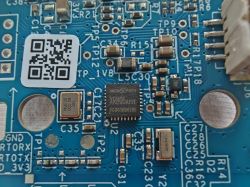
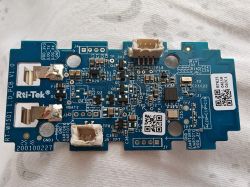
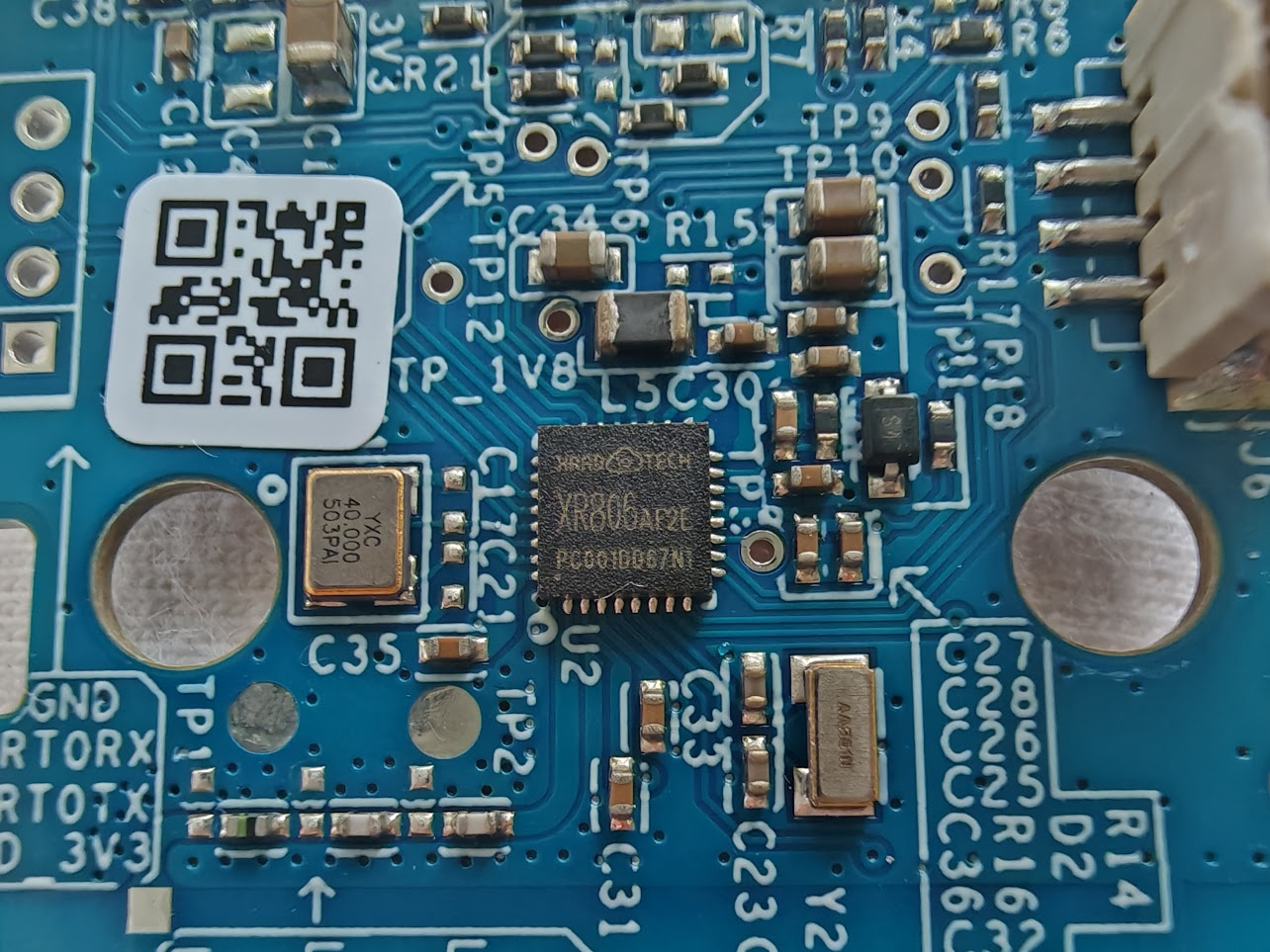
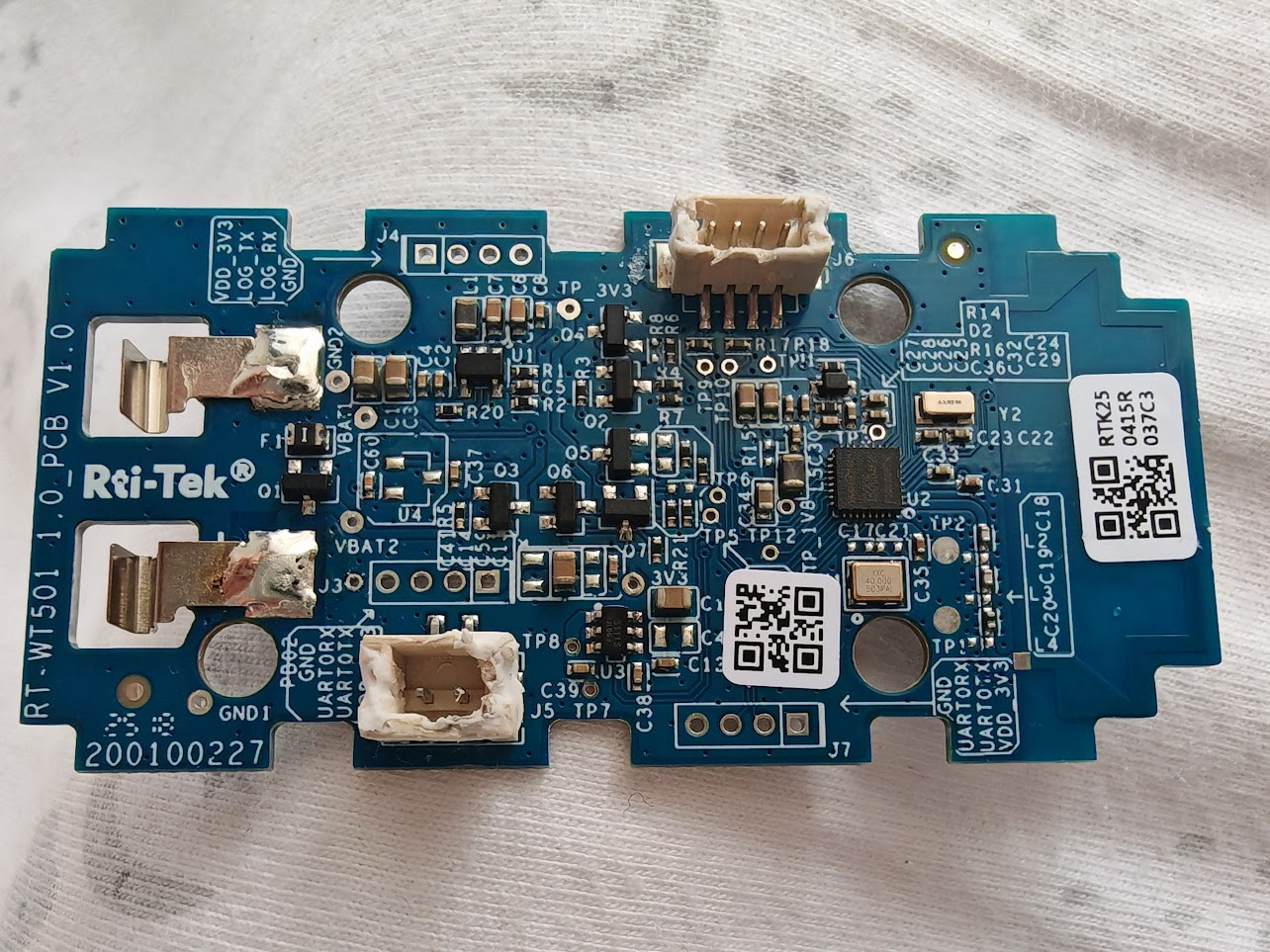
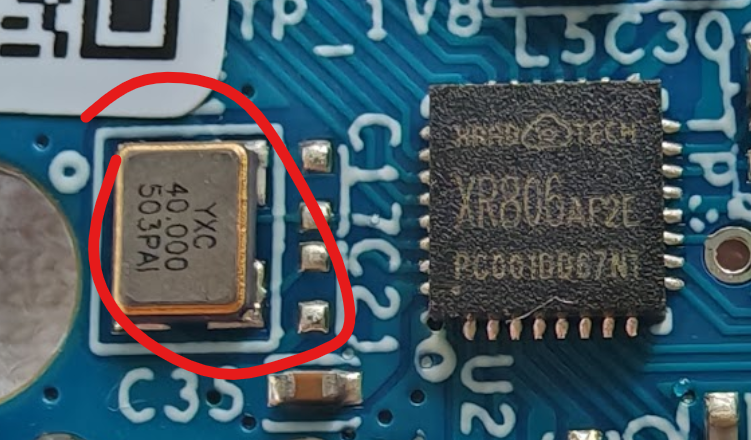
    I know it's for a different board, but if you don't mind I'll ask here. its a RT-WT501. I have access to the board and it has XR806af2e. I was able to flash it with
    OpenXR806_1.18.287.img
    but it does not start any AP or I can't get any logs with
    minicom
    under ubintu. Can you advice how to troubleshoot further?
    Tuya XR806 RT-WT501 flashed with OpenXR806 via phoenixMC, no AP or logs?

    Tuya XR806 RT-WT501 flashed with OpenXR806 via phoenixMC, no AP or logs?

    Tuya XR806 RT-WT501 flashed with OpenXR806 via phoenixMC, no AP or logs?


    Code: Bash
    Log in, to see the code
  • ADVERTISEMENT
  • #2 21885142
    p.kaczmarek2
    Moderator Smart Home
    Are you sure there is no bootlog? Was there bootlog before you flashed OBK? Do you have firmware copy?
    Helpful post? Buy me a coffee.
  • ADVERTISEMENT
  • #3 21885150
    divadiow
    Level 38  
    probably one of those pesky DCDC-powered types. Maybe we need a variant for those. I still don't have a DCDC-capable XR806 test device.
  • #4 21885152
    p.kaczmarek2
    Moderator Smart Home
    What do you mean by DCDC? A voltage converter? Any more information on that?
    Helpful post? Buy me a coffee.
  • #5 21885157
    divadiow
    Level 38  
    we've seen it in a couple of XR806s. @jmkrzyszt was playing with a build. The factory boot log gives away the DCDC/LDO type

    https://www.elektroda.com/rtvforum/topic4115856.html#21746224

    or maybe it's an xtal variant: https://www.elektroda.com/rtvforum/topic4115856.html#21779853 - as highlighted by @insmod

    We have a couple of DCDC dumps that I haven't been able to test. The Avatto smart watering device was DCDC and its image (the OTA file from Tuya which includes bootloader) is what killed my 1st XR806 5v dev board,

    https://www.elektroda.com/rtvforum/topic4064188.html

    Added after 1 [minutes]:

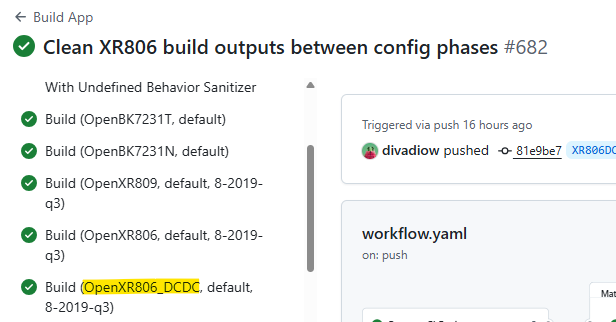
    https://github.com/openshwprojects/OpenBK7231T_App/pull/1893

    Added after 3 [minutes]:

    divadiow wrote:
    or maybe it's an xtal variant

    :) maybe not
    Tuya XR806 RT-WT501 flashed with OpenXR806 via phoenixMC, no AP or logs?
  • #6 21885167
    mkrum001
    Level 2  
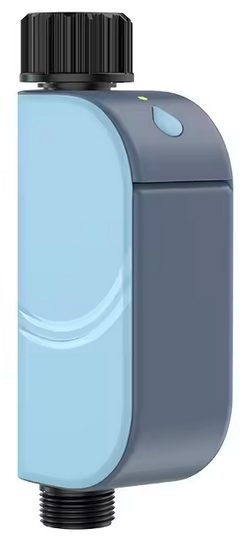
    I have another device, but still can't find a way to dump its firmware. The device is using 4xAA batteries and it must produce 3.3v from them. The valve inside is 3v. Also few labels around the pins for 3.3v...
  • #8 21885576
    mkrum001
    Level 2  
    I was able to dump something with:
    phoenixMC -c /dev/ttyUSB0 -b 921600 -D read -A 0x00000000 -L 0x00200000
    and it is attached.
    Attachments:
    • flash_A_0x0_L_0x200000.bin (2 MB) You must be logged in to download this attachment.
  • #9 21885581
    divadiow
    Level 38  
    ah very good.

    did you happen to capture debug boot log too - plain-text terminal log.

    I'll cautiously flash your backup to WXU module to see if it boots

    Added after 22 [minutes]:

    Code: Text
    Log in, to see the code
  • #10 21885633
    mkrum001
    Level 2  
    I was able to capture logs (from beginning hopefully):
    Code: Bash
    Log in, to see the code
  • ADVERTISEMENT
  • #11 21885767
    divadiow
    Level 38  
    mkrum001 wrote:
    I was able to capture logs (from beginning hopefully):

    sadly not the very beginning, the bit that includes the power info as seen in the log I posted.

    My power info seen in boot log should not be assumed to be the same as yours will show on real device.

    Did you manage to safely power your first device to see if you get any boot log from OpenXR806 at all? Might be an idea to try RX and TX pads for log output

    Added after 42 [minutes]:

    I think we should probably have 3 variants to cover the XR806s power options

    -INT LDO (current OpenXR806)
    -INT DCDC
    -EXT PWR

    Added after 27 [minutes]:

    seems EXT PWR can cover lots of different board implementations, for example:

    external fixed 1.8 V rail
    external switchable 1.8 V / 2.5 V rail
    external LDO
    external buck
    PMIC-controlled rail
    GPIO-controlled voltage select
    inverted/non-inverted control logic
    different settle delays
    different pins used for switching

    so that would be tricky. I wonder if we're ever likely to encounter any
  • #12 21886043
    divadiow
    Level 38  
    Thanks for splitting to new topic @p.kaczmarek2
  • #13 21886178
    mkrum001
    Level 2  
    I have upload the
    OpenXR806_1.18.287.img
    again and nothing came up as logs on any of the ports... As for the process of getting the logs - I'm starting minicom and then plug the USB to TTL device, which is connected to the board. That's why I thought the logs are from the very beginning.
  • #14 21886202
    divadiow
    Level 38  
    OK. no worries perhaps.

    I think your device will require the
    INT DCDC
    power type rather than the current
    INT LDO
    in OpenXR806
  • #15 21886214
    mkrum001
    Level 2  
    I didn't deep dive into it, but is this means that the power from USB to TTL converter is not enough for the OpenXR806 firmware? Or the chip is managing the dcdc converters on the board and with the current version it doesn't do it?
  • #16 21886226
    divadiow
    Level 38  
    mkrum001 wrote:
    Or the chip is managing the dcdc converters on the board and with the current version it doesn't do it?


    This

    I *think* your device needs a different OpenXR806 build type
  • ADVERTISEMENT
  • Helpful post
    #17 21886509
    insmod
    Level 31  
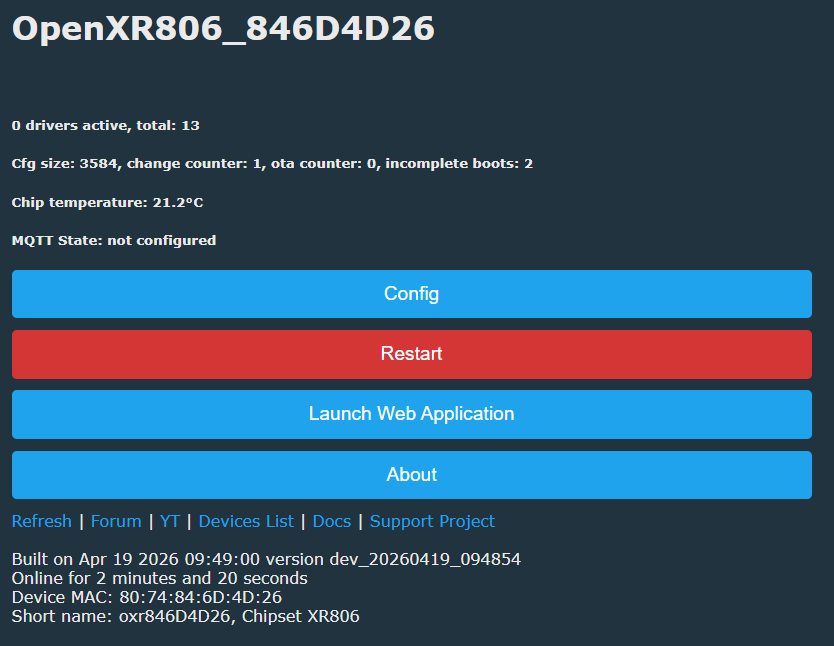
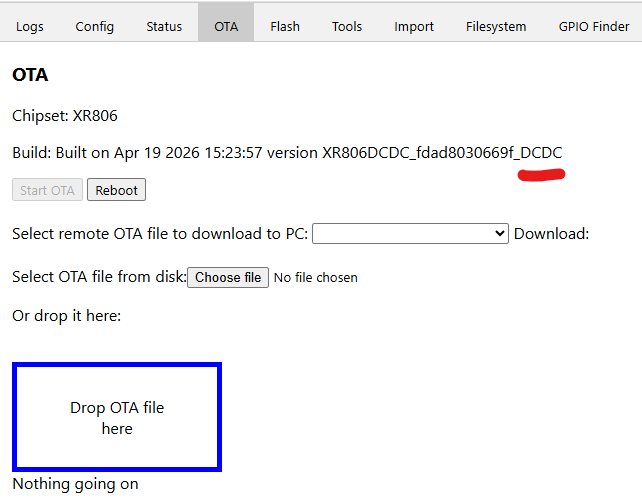
    DCDC build (not tested)
    Check both UARTs, original firmware outputs log to LOG_TX, OBK - to UART0TX
    Attachments:
    • dev_20260419_094854.zip (1.07 MB) You must be logged in to download this attachment.
  • #19 21886520
    insmod
    Level 31  
    Perhaps bootloader must also be rebuilt?
  • #20 21886522
    divadiow
    Level 38  
    Oh. Thought I had catered for that. I'll check. INT DCDC dumps from real devices boot on WXU eg https://www.elektroda.com/rtvforum/viewtopic.php?p=21886190#21886190

    Added after 3 [minutes]:

    Well. That OTA file from Avatto does anyway. That's the file that killed my 1st dev board. I think there's something specific physically about that board that makes DCDC builds deadly, as you pointed out in that aw-ol thread.

    Added after 1 [hours] 21 [minutes]:

    comparing final build binaries, my DCDC variant bootloader does differ from INT LDO

    https://github.com/divadiow/OpenXR806/blob/xr806dcdc/project/bootloader/gcc/defconfig_dcdc
    https://github.com/divadiow/OpenXR806/blob/xr...cdc/project/demo/sharedApp/gcc/defconfig_dcdc

    https://github.com/divadiow/OpenXR806/blob/xr806dcdc/project/bootloader/gcc/defconfig
    https://github.com/divadiow/OpenXR806/blob/xr806dcdc/project/demo/sharedApp/gcc/defconfig

    Added after 17 [minutes]:

    @insmod if a DCDC variant is a thing, a goer, will you do PRs or... is my one any good? would you have done it differently?
  • #21 21886588
    insmod
    Level 31  
    >>21886522
    I think your changes in XR806DCDC branch are fine
  • #22 21886590
    divadiow
    Level 38  
    Oh cool. Cheers

    Added after 17 [minutes]:

    Should standard OpenXR806 be renamed to OpenXR806_LDO or kept as-is?
  • #23 21886625
    insmod
    Level 31  
    As is, since that's the default for both dev board and tuya
  • #24 21886712
    divadiow
    Level 38  
    insmod wrote:
    DCDC build (not tested)


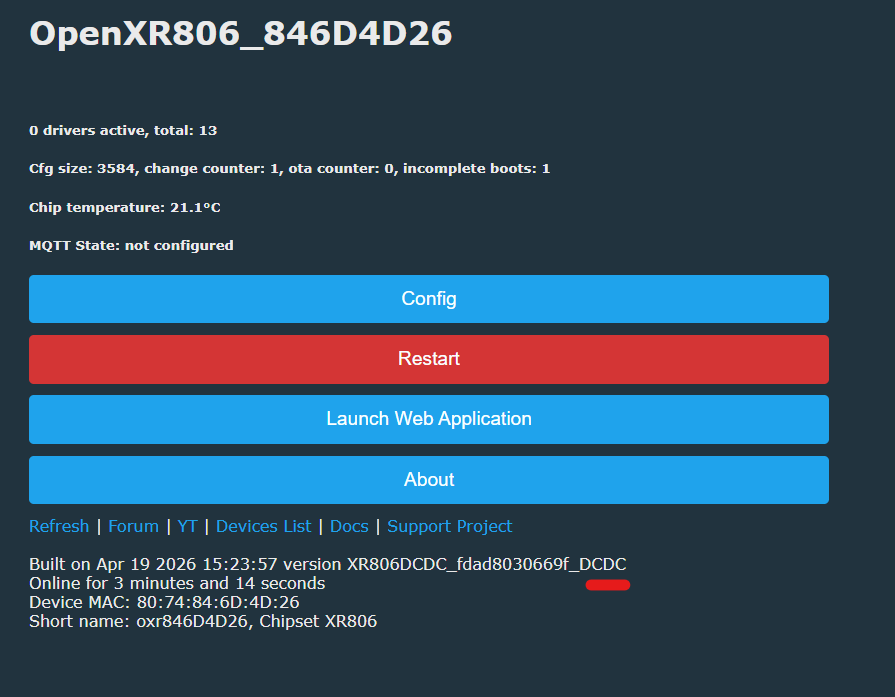
    this build running on WXU
    Code: Text
    Log in, to see the code


    Tuya XR806 RT-WT501 flashed with OpenXR806 via phoenixMC, no AP or logs?

    Added after 46 [minutes]:

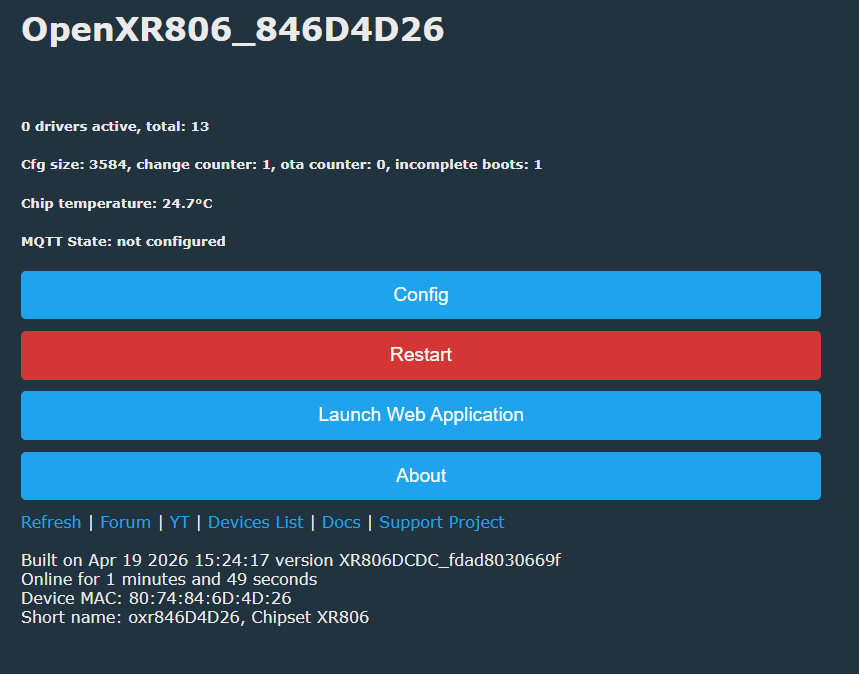
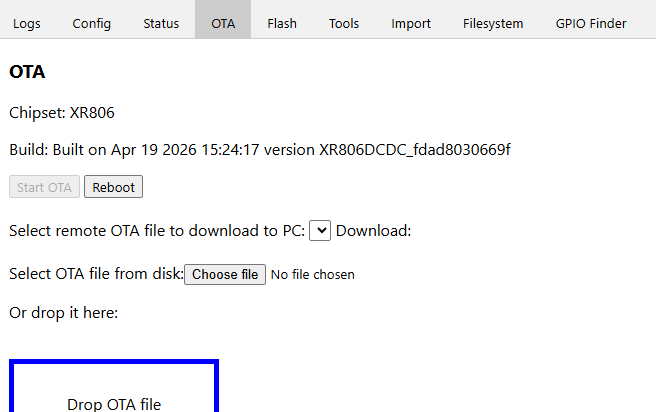
    @p.kaczmarek2 hope this is OK
    https://github.com/openshwprojects/OpenXR806/pull/5
    https://github.com/openshwprojects/OpenBK7231T_App/pull/2093

    Added after 11 [minutes]:

    oh hang on. it won't be known internally as "OpenXR806_DCDC". I'll fix.

    Added after 1 [hours] 34 [minutes]:

    better I believe


    Tuya XR806 RT-WT501 flashed with OpenXR806 via phoenixMC, no AP or logs?
    Tuya XR806 RT-WT501 flashed with OpenXR806 via phoenixMC, no AP or logs?

    Tuya XR806 RT-WT501 flashed with OpenXR806 via phoenixMC, no AP or logs?
    Tuya XR806 RT-WT501 flashed with OpenXR806 via phoenixMC, no AP or logs?
  • #25 21887168
    mkrum001
    Level 2  
    Sorry, I was away for a while and now just tested the
    OpenXR806_dev_20260419_094854.img
    but still doesn't produce any logs. I tried the LOG_TX and the UARTOTX ports. I see there are new changes on a branch but at the moment I'm not sure how to build image from there.
  • #26 21887188
    divadiow
    Level 38  
    and no AP broadcasts? How are you powering the device after flashing?
  • #27 21887205
    mkrum001
    Level 2  
    Powered from the TTL adapter or over the battery - no AP.
  • #28 21887276
    divadiow
    Level 38  
    hmm. I wouldn't expect the USB-TTL to have enough power to get an AP going, but you'd think a populated battery compartment would be OK. um. Not sure what's next, it's difficult not having the real device locally.

    you flashed the non-ota file I assume?
  • #29 21887372
    mkrum001
    Level 2  
    Yes - non-ota file was used.
    With the original firmware the USB-TTL is enough for connection to the cloud (device is online and I'm receiving warning for empty battery which is normal while the battery is not attached). When connected to the battery I'm measuring 3.5v on the VDD points so the boar has power supply. On USB-TTL the voltage is 3.3v, but I don't think this difference is a problem.

    Edit: I just spotted something on the terminal, but I don't know how to reproduce it. It it could be useful:

    Code: Bash
    Log in, to see the code


    Edit:
    I also noted some errors while flasing:

    Code: Bash
    Log in, to see the code


    These errors does not occur when using
    OpenXR806_1.18.287.img
  • #30 21887438
    insmod
    Level 31  
    @divadiow
    Can you generate a DCDC build with DCDC bootloader?

FAQ

TL;DR: For XR806 users: a flash can reach 100% and still not boot. The key thread conclusion is: "your device will require the INT DCDC power type". If an RT-WT501 shows no AP and no serial output after flashing OpenXR806_1.18.287, first capture the factory boot log, back up flash, and test the correct power-type build instead of assuming the flash failed. [#21886202]

Why it matters: This thread shows that a successful phoenixMC write does not prove the firmware matches the board’s power architecture.

OpenXR806 / board case What the thread shows Practical result
INT LDO Described as the current OpenXR806 type May stay silent on some XR806 boards
INT DCDC Suggested for this RT-WT501 Best candidate for battery-powered RT-WT501
EXT PWR Mentioned as a broader class with many implementations Harder to support with one generic build

Key insight: The missing AP and missing UART logs point more strongly to a power-configuration mismatch inside the XR806 startup path than to a simple USB-to-TTL power shortage. The factory firmware boots, connects to Wi‑Fi, and reaches MQTT, so the board itself is alive.

Quick Facts

  • The OpenXR806 flash session completed with 13 blocks, a final 64 kB rest-data stage, OTA data handling, and Upgrade OK! at 100%. [#21885119]
  • The original firmware was dumped with phoenixMC -c /dev/ttyUSB0 -b 921600 -D read -A 0x00000000 -L 0x00200000, which reads 0x00200000 bytes from address 0x00000000. [#21885576]
  • The factory boot log reports XR806 SDK v1.2.1, CPU clock 160000000 Hz, HF clock 40000000 Hz, and INT DCDC : select. [#21885581]
  • The device is battery-powered: it uses 4xAA cells, board markings indicate 3.3 V, and the internal valve is 3 V. [#21885167]
  • In the factory log, the unit obtained IP 192.168.52.236, gateway 192.168.52.1, then connected toward Tuya MQTT at port 8883. [#21885633]

How can I troubleshoot an XR806-based Tuya RT-WT501 that flashes successfully with phoenixMC and OpenXR806 but shows no AP and no serial boot logs?

Start by assuming a board-variant mismatch, not a bad flash. 1. Back up the original flash and any remaining data first. 2. Capture the earliest factory boot log and identify the power type. 3. Test an OpenXR806 build that matches that power type, especially INT DCDC for this board. The write reached 100%, but the thread conclusion was that this RT-WT501 likely needs an INT DCDC build, not the current INT LDO build. [#21886202]

Why would OpenXR806_1.18.287 flash with "Upgrade OK!" on an XR806AF2E device and still fail to boot or print anything in minicom?

Because Upgrade OK! only confirms the image was written and verified, not that the runtime power configuration matches the board. In this case, phoenixMC erased, wrote, read, and verified 13 blocks plus OTA data, yet the device still produced no AP and no logs after flashing OpenXR806_1.18.287.img. That points to a startup mismatch after reset, not a transport error during flashing. [#21885119]

What is the difference between INT LDO, INT DCDC, and EXT PWR power types on XR806 devices?

They are XR806 power-init variants that determine how the chip and board supply internal rails at boot. INT LDO is the current OpenXR806 type, INT DCDC is a different internal regulator mode, and EXT PWR covers boards using external rails such as fixed 1.8 V, switchable 1.8 V or 2.5 V, external LDO, buck, or PMIC-controlled power. The thread notes that EXT PWR is broad and harder to support with one generic image. [#21885767]

How do I dump the original firmware from an XR806 board with phoenixMC before experimenting with OpenXR806?

Use phoenixMC in read mode and save a full flash-range backup before any new write. The working example in the thread was phoenixMC -c /dev/ttyUSB0 -b 921600 -D read -A 0x00000000 -L 0x00200000. That reads from address 0x00000000 for 0x00200000 bytes, giving you a recovery image to reflash later if OpenXR806 does not boot. [#21885576]

What does DCDC mean in the context of XR806 modules, and why can it affect whether OpenXR806 boots?

"DCDC" is a power-conversion mode that regulates board voltage using a switching converter, not a simple linear regulator, and its startup settings must match the hardware design. It matters because the thread identified XR806 boards whose factory log reveals INT DCDC : select, while the current OpenXR806 build is INT LDO. If firmware initializes the wrong power mode, the board can stay completely silent after reset. [#21885581]

Why is capturing the full factory boot log important before building or flashing OpenXR806 on a Tuya XR806 device?

Because the earliest boot lines reveal the board’s power setup and help choose the right build. The thread explicitly says the factory boot log gives away the DCDC or LDO type, and later notes that the shared user log missed the very beginning where the power information appears. Without those first lines, you can misclassify the board and flash the wrong image. [#21885767]

Which UART pads should I probe on an XR806 board when there is no output on the expected serial port after flashing?

Probe both the expected UART pads and the board’s RX and TX pads directly. The thread recommendation was to try RX and TX pads for log output when nothing appears on the first assumed serial port. That matters here because the reflashed RT-WT501 showed no logs on any tested port, so verifying the actual debug pins is part of the fault isolation. [#21885767]

How do I capture the earliest XR806 boot messages with minicom and a USB-to-TTL adapter under Ubuntu?

Open the terminal session before you power the target, then power-cycle the board and watch from reset. 1. Start minicom first. 2. Connect the USB-to-TTL adapter to the UART pads. 3. Plug in or repower the device so the adapter is already listening at first boot. The user followed that sequence under Ubuntu by starting minicom and then plugging in the USB-to-TTL device, but the thread still notes the very first power-info lines may have been missed. [#21886178]

What clues in an XR806 factory boot log reveal whether the board uses an INT DCDC or INT LDO power configuration?

Look for the platform-information section, where the firmware prints the selected power mode explicitly. In the shared factory log, that block lists XR806 SDK v1.2.1, then shows INT DCDC : select alongside other options such as XIP : enable and SIP flash : enable. That single line is the clearest indicator that this board boots with an internal DCDC configuration. [#21885581]

OpenXR806 INT LDO vs INT DCDC builds: which one should be used for a battery-powered Tuya RT-WT501 water valve?

Use an INT DCDC build for this RT-WT501. The thread’s working conclusion is direct: the device likely requires INT DCDC rather than the current INT LDO OpenXR806 build. That fits the factory log, which reports INT DCDC : select, and the hardware context, which is a 4xAA battery water valve rather than a typical 5 V XR806 dev board. [#21886202]

Why might a 4xAA Tuya water valve with an XR806 need a different OpenXR806 build than a typical 5 V dev board?

Because its power path differs from a common 5 V development board. The user states the valve runs from 4xAA batteries, the board has 3.3 V labels, and the valve itself is 3 V. Another participant also notes that a DCDC-capable Tuya image had already caused trouble on a 5 V XR806 dev board. Those details support using a build tailored to the battery-powered regulator setup. [#21885167]

What is a bootlog on XR806 hardware, and what information should I look for in it when diagnosing failed OpenXR806 boots?

"Bootlog" is the serial startup log that prints from reset, exposing early bootloader, platform, and network initialization details before the main application settles. On XR806, look for the first power-mode lines, SDK version, CPU and HF clocks, flash information, and whether Wi‑Fi starts. In this thread, the decisive clue was the platform block showing INT DCDC : select. [#21885581]

How can I back up KV or OTA-related data from an XR806 device so I have a recovery path if OpenXR806 does not work?

Make a full dump before further flashing, and also preserve any surviving KV or OTA areas from the first device. The thread advice was explicit: get a backup first so you have a way back, and even the partially modified device might still keep its KV intact. That gives you both a complete reflash image and a better chance of restoring device-specific data later. [#21885180]

What does it mean when the XR806 factory firmware log shows successful Wi-Fi and MQTT activity but OpenXR806 shows no output at all?

It means the hardware and original firmware are functional, while the replacement image is failing much earlier in startup. The factory log shows association, DHCP, IP 192.168.52.236, and MQTT progress to mqtt state change 5 -> 6, which is far beyond basic boot. When OpenXR806 shows no serial text at all on the same board, the strongest thread diagnosis is an incompatible power-type build. [#21885633]

Why isn’t the issue likely to be USB-to-TTL power alone, and how does XR806 firmware control of onboard DCDC circuitry affect startup?

Because the thread points to firmware-controlled board power, not just adapter current. The direct answer given was that the XR806 is managing the onboard DCDC converters, and the current build does not do that in the right way for this board. So even if the USB-to-TTL adapter is present, the wrong startup power configuration can prevent any boot log or AP from appearing. [#21886226]
Generated by the language model.
ADVERTISEMENT