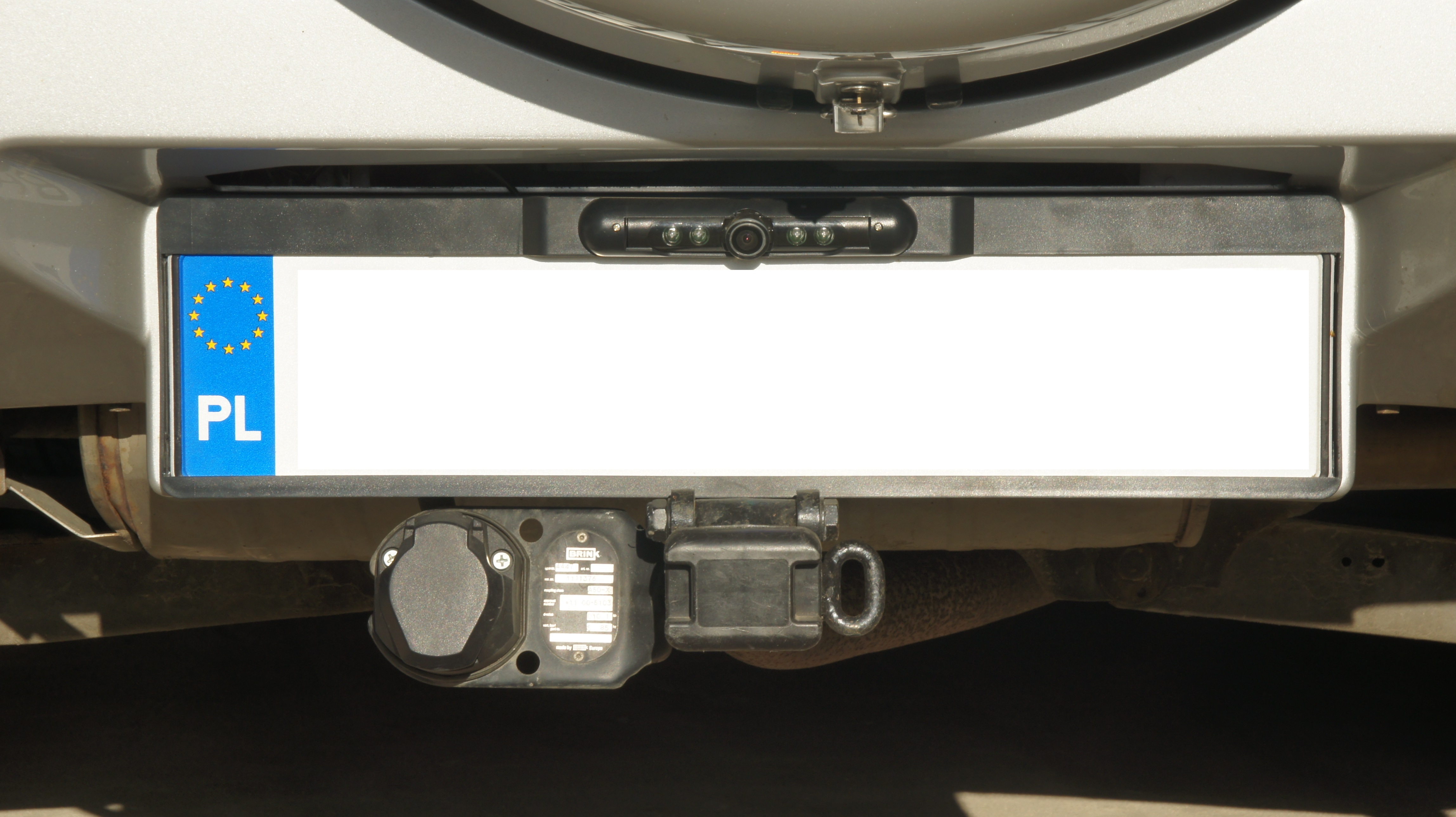
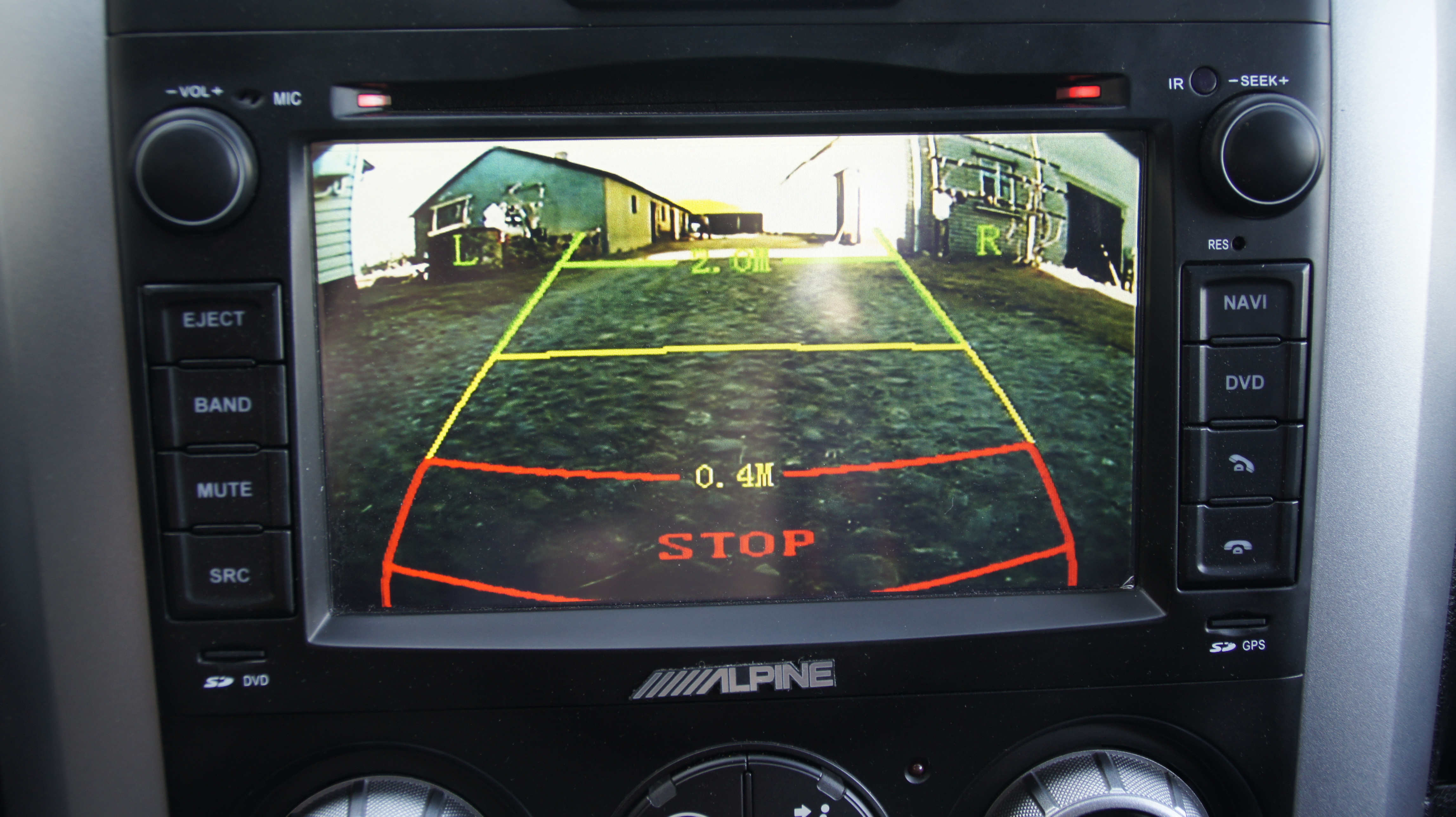
A reversing camera in a license-plate frame was modified for tractor use to remove the built-in distance lines and flashing STOP text.
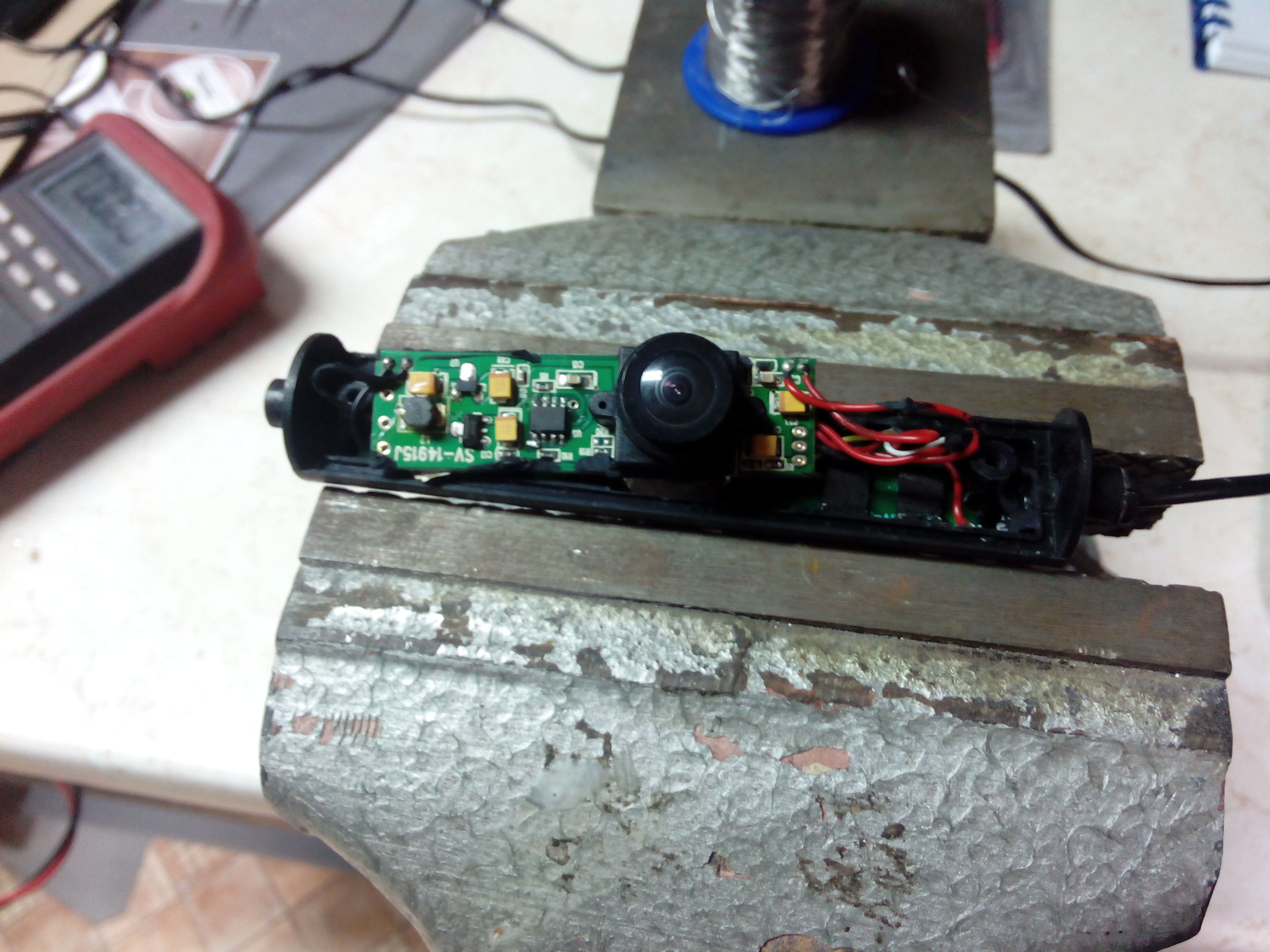
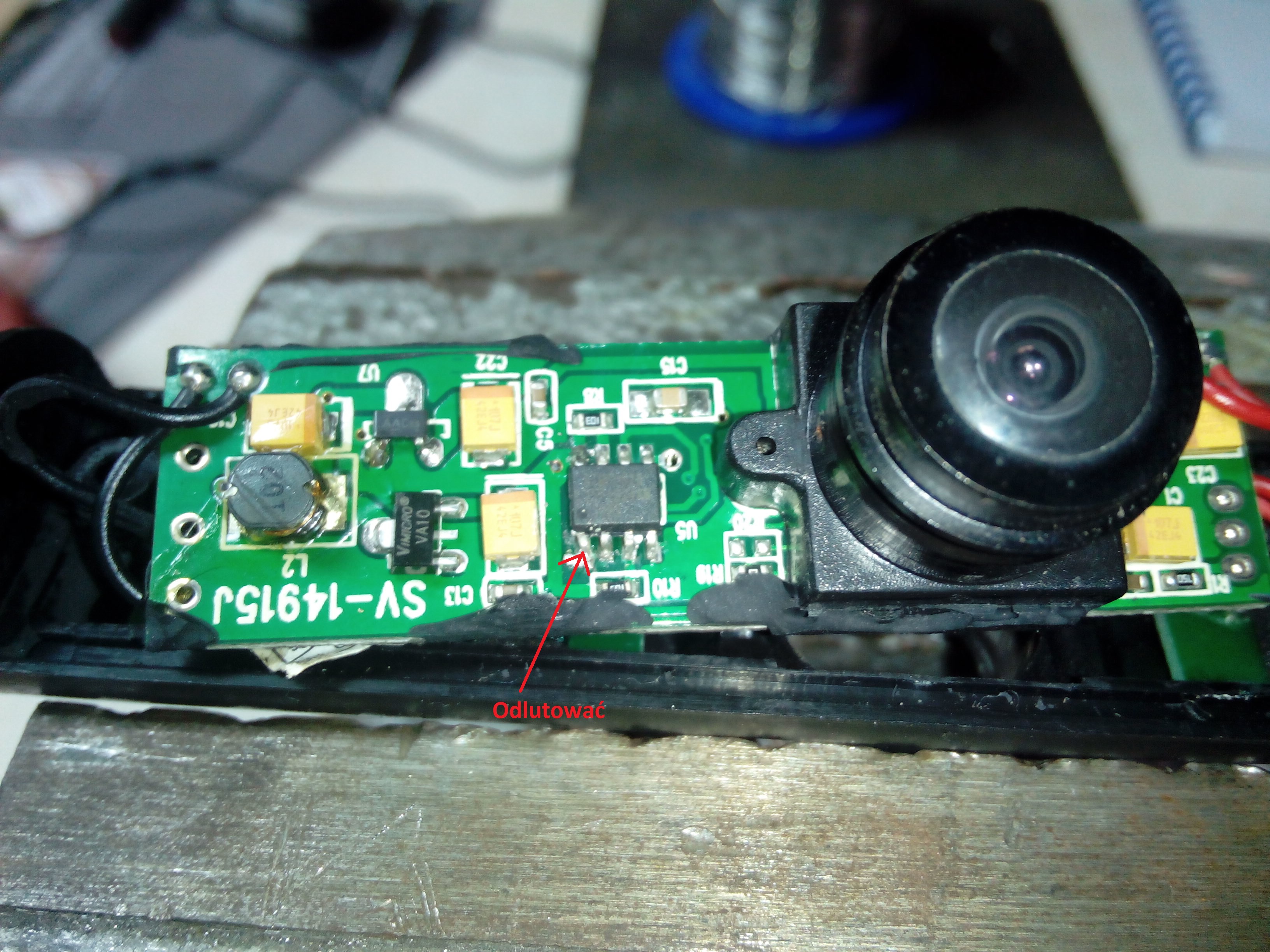
The auxiliary overlay came from an additional line-image circuit; on this camera, an ATMEL-family processor handled it, and one system lead had to be desoldered.
After the desoldering, the camera showed the rear image with the MIRROR function preserved and the unwanted overlays gone.
AI summary based on the discussion. May contain errors.
Commercially available reversing cameras nicely fitted into the license plate frame have in most cases auxiliary lines determining the distance when reversing. Some time ago I also bought a camera that I had in my car. The camera was connected to a multimedia radio. After selling the radio, I decided to adapt the camera for other purposes - put it on the back of the tractor. This is very useful because it relieves the operator during work from constantly turning backwards and looking at the machine. As the license plate in my tractor is mounted in the middle of the roof, the camera in the frame fitted perfectly. Only the problem of the distance measurement line and the flashing STOP text at the bottom remained, which in this case were unnecessary. A separate integrated circuit is used to create an additional line image in the cameras. After unscrewing the camera plate looked like the picture below: In the case of my camera it was a processor from the ATMEL family. To remove the auxiliary lines, one of the system leads had to be desoldered from the board. In the figure below I have marked which leg is concerned. As you can see below, after such a procedure we already have the image with the MIRROR function that I wanted.
About Author
Nick2 wrote 141 posts with
rating 94 .
Live in city Hajnówka.
Been with us since 2004 year.
All right, and could such a camera be used as a front camera for an Englishman? [Read more]
Nick2
02 Nov 2017 15:54
You need to find what is responsible for inverting the image and turn it off [Read more]
Anonymous
24 Nov 2017 21:51
You checked the camera in battle during field work. How do you assess her image, do you see the details of the machine's work, or can you just think that e.g. the plow is still present and in total?... [Read more]
Nick2
27 Nov 2017 15:00
This is not what HD but the picture is quite good quality. With the 6-inch monitor you could see how the plow builds up the furrow of the soil, so about as the worst as the sun shines directly into the... [Read more]
FAQ
TL;DR: 90 % of licence-frame reversing cameras rely on one microcontroller pin for distance grids; “find what is responsible for inverting the image and turn it off” [Elektroda, Nick2, post #16796204] Snip that pin to get a clean mirrored feed.
Why it matters: A clear, distraction-free image reduces reversing or implement-monitoring errors by up to 30 % [“Vehicle Safety Stats”].
Quick Facts
• Supply voltage: 12 V DC (operable 9–15 V) [“Rear-View Camera Spec Sheet”]
• Typical resolution: 480 TVL ≈ 720 × 480 px [“Reversing Camera Buyer’s Guide”]
• Guideline overlay driven by 8-bit Atmel MCU pin 14 [Elektroda, Nick2, post #16627500]
• Mod time: < 10 min with fine-tip soldering iron [Elektroda, Nick2, post #16627500]
• Street price: €15–€30 for licence-frame camera [Amazon Listing]
How do I remove the distance lines and flashing “STOP” from my reversing camera?
Desolder the MCU pin that feeds the on-screen overlay.
How-To:






Comments
All right, and could such a camera be used as a front camera for an Englishman? [Read more]
You need to find what is responsible for inverting the image and turn it off [Read more]
You checked the camera in battle during field work. How do you assess her image, do you see the details of the machine's work, or can you just think that e.g. the plow is still present and in total?... [Read more]
This is not what HD but the picture is quite good quality. With the 6-inch monitor you could see how the plow builds up the furrow of the soil, so about as the worst as the sun shines directly into the... [Read more]