logo elektroda
logo elektroda
X
logo elektroda

Emergency power supply for router or modem

andreyatakum  26 4686 Cool? (+14)
📢 Listen (AI):

TL;DR

  • A compact UPS for a router or modem keeps internet running during frequent power cuts by combining a Li-Ion battery pack with a 12V DC output.
  • The charger uses TP4056 with FS3401 transistors and DW01A/FS8205A protection, and the DC-DC stage uses an MT3608B boost converter.
  • It can run from a USB charger supplying at least 1A or from 18650 cells connected in parallel when mains power is absent.
  • The PCB is designed for two or three cells; if you use only two, part of the board can be cut off, and the SMD parts are hand-solderable.
Generated by the language model.
On my estate, the biggest problem is the frequent lack of electricity. The situation repeats itself almost every week and this occurs for several hours. I don't know the reasons - there is construction going on around here and maybe there is an interruption when connecting new buildings. Fortunately, the laptop battery, despite its age, still provides support, so I could work in peace, but I don't have internet at the time, as the modem is powered from the mains.

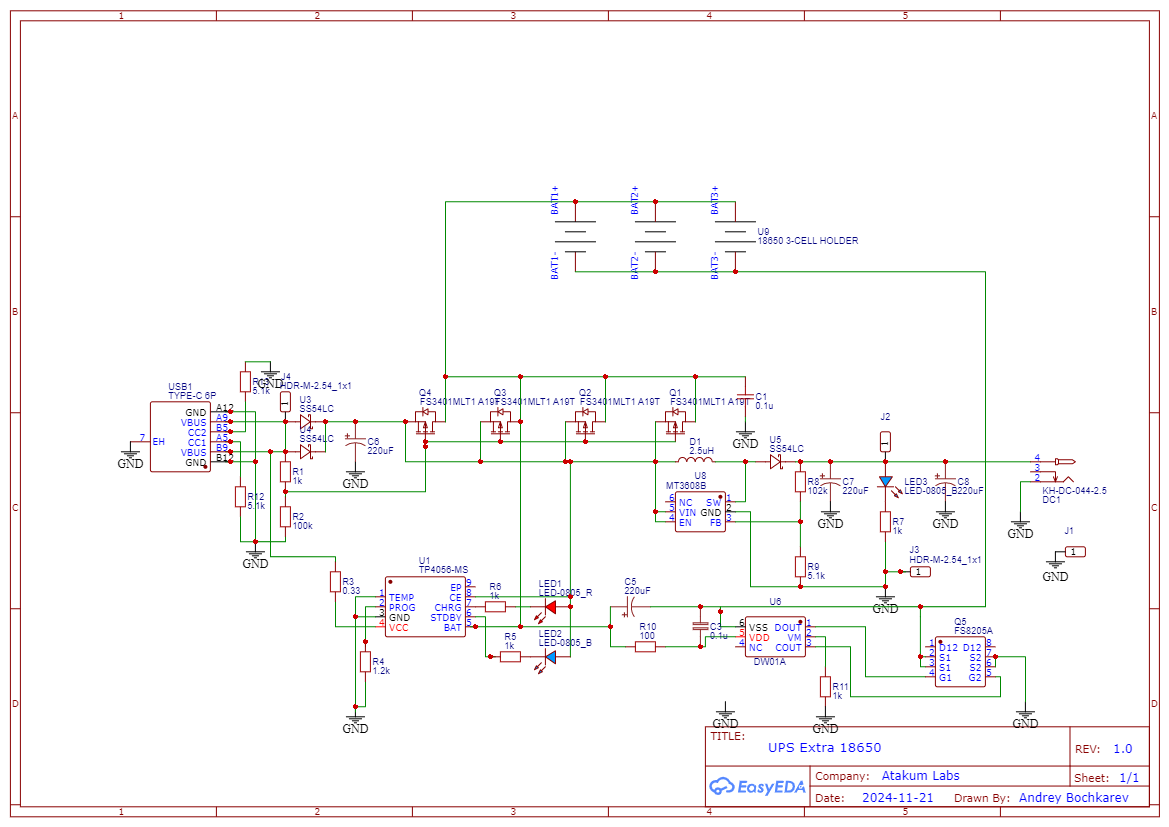
Circuit diagram of a backup power supply (UPS) for modems and routers.
.
Emergency power supply diagram


Design of emergency power supply for router or modem .
On behalf of a client, I developed an uninterruptible power supply (UPS) for an alarm system installed in a garage where power interruptions are constant. This UPS contains a charging circuit for two or three Li-Ion cells, a DC-DC converter from 3.7 to 12V. And it can be used as an emergency power source for a modem or router. For this reason, I have decided to share this project.

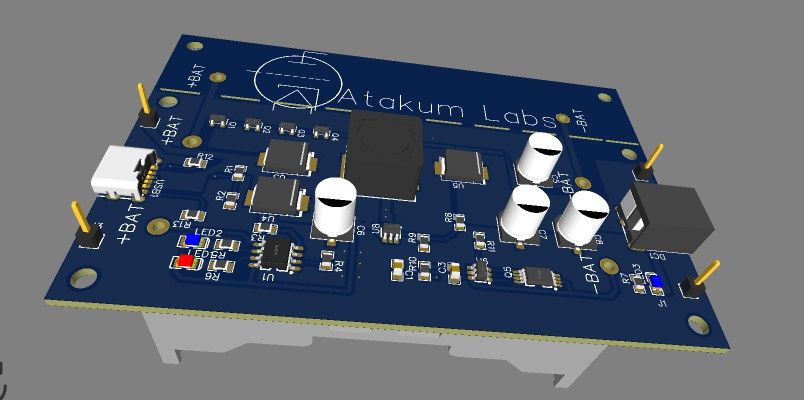
Atakum Labs backup power supply circuit board.
.
View of plate from top


This first one is made on a TP4056 IC and FS3401 field effect transistors. The cell temperature sensor is not used in this case. The LEDs LED1-2 show the status: red - charging, green - its end. The specialised DW01A circuit, which controls a pair of FS8205A field-effect transistors, is responsible for overcharging protection. These are connected between the minus of the battery and the ground of the device.

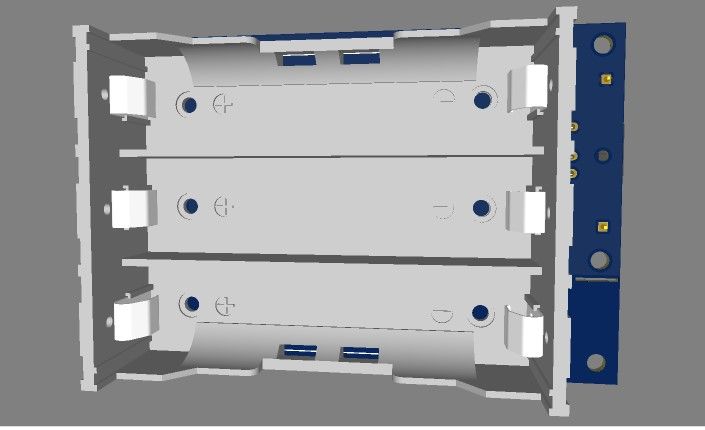
Top view of a housing for two or three cells.
.
View from below


The DC-DC converter from 3.7-5 to 12V is made on the MT3608B chip. It is powered from a USB port from a regular charger, providing a current of no less than 1A, or from 18650 batteries connected in parallel when there is no voltage from the charger. The output voltage can be adjusted by changing the value of resistors R8-R9.

I had to create this schematic from photos of a ready-made Chinese instrument as part of Reverse Engineering. The circuit board, on the other hand, I developed myself. It is dedicated for a socket for 2 or 3 cells. If a socket for 2 is used, part of the board can easily be cut off. Surface mount, but due to the larger size SMD components used, they can be soldered by hand. Circuits (wires), transmitting high current, should be strengthened with a thick layer of solder.
The board can be made yourself or ordered from Chinese factories using the files I have attached below.
Attachments:
  • Gerber_UPS-TP4056_PCB_UPS-TP4056_2_2025-02-10.zip (75.59 KB) You must be logged in to download this attachment.

About Author
andreyatakum
andreyatakum wrote 704 posts with rating 1019 . Live in city Antalya. Been with us since 2021 year.

Comments

Camis 10 Feb 2025 17:33

I am looking for such a module, but I only see on Aliexpress modules up to 15-20W. And I would need one that would give 2.5A on 12V that is 22-26W. I have to power a Router, OLT, and a small PC that does... [Read more]

krzbor 10 Feb 2025 21:29

. Did you mean something like this: Link or this: Link ? [Read more]

szymon122 10 Feb 2025 23:17

In my opinion, the easiest way to do this is to buy a PD 65W powerbank, plug in a constant charge from the socket, connect a step-up converter to the output for 12V, or simply connect an 'initiator' that... [Read more]

krzbor 10 Feb 2025 23:34

Here 2 more modules without a case: 4A - Link or 3A - Link . However, please note that these are "Chinese amps". Therefore, if you want to get 3A it is better to buy for 4A or more. [Read more]

chemik_16 11 Feb 2025 08:49

is it not the same ? https://pl.aliexpress.com/item/1005006860598580.html :) . [Read more]

sq3evp 11 Feb 2025 09:55

. Looks like a solution to the problem - would need to verify that it works as the author assumes. [Read more]

andreyatakum 11 Feb 2025 10:07

. Well, yes! I was drawing from a similar one. [Read more]

Karol966 12 Feb 2025 10:53

I have, tested, for the router perfect, purchase cost under 10zł with shipping to PL. There is no option to make it worthwhile to do it yourself. PS. I came across a circuit for 2 cells, where the cell... [Read more]

Dawid90u 12 Feb 2025 11:25

For a terminal drawing a maximum of 8W, will this also be suitable? I am currently using a classic UPS. And I wonder whether such an uninterruptible power supply wouldn't be better in terms of the energy... [Read more]

chemik_16 12 Feb 2025 11:56

. These from aliexpress can be connected in parallel. The voltage can be raised on the inverter, someone even described here, probably up to 20-odd volts. Only still the whole thing is powered from 5V,... [Read more]

MiroLord 13 Feb 2025 09:32

At my place, I used a Techtron ZA-TECH 500 uninterruptible power supply unit with a 65 Ah battery purchased a few years ago. It is used to maintain power supply to the central heating pumps and in addition... [Read more]

darek_71 15 Feb 2025 19:49

Ready https://www.eaton.com/pl/pl-pl/catalog/backup-power-ups-surge-it-power-distribution/eaton-3s-mini-ups---emea.html [Read more]

nasu 18 Feb 2025 13:23

I have such a ready-made DC1036P MINI DC36W 2A 5V/9V/12V but it heats up a lot https://obrazki.elektroda.pl/5016544900_1739881546_thumb.jpg [Read more]

VPSA132 18 Feb 2025 14:24

The nice thing about this project would be that it would be possible to set the charging voltage of the cells. I would prefer that the cells are not sustained at 4.2V all the time. This will be detrimental... [Read more]

lukiiiii 21 Feb 2025 09:38

And is it a coincidence that buffer operation for lithium cells is already disadvantageous? [Read more]

VPSA132 21 Feb 2025 09:50

It's not as you have a reduced stand-by voltage. It's just keeping the voltage high on the cells that will whip them. It's as if you store the cells at 4.2V all the time for years. When the voltage drops... [Read more]

stellardrone90 21 Feb 2025 10:05

I bought a UPS from greencell a couple of years ago and I can safely recommend it.So far it hasn't let me down [Read more]

chemik_16 21 Feb 2025 11:41

. somewhere here was a description of this power supply what I attached, but I can't find anything on the electrode, although I participated in that thread :D as I have now checked, it bravely holds... [Read more]

VPSA132 21 Feb 2025 11:55

. What did you check the capacity on? What model of cells? Are you able to give an IR before and after one year in the device? [Read more]

FAQ

TL;DR: For homes with weekly outages lasting several hours, a 12V router UPS built from 1S Li-ion cells can keep internet alive; as one user put it, "for the router perfect." This FAQ helps router, modem, OLT, mini-PC, and boiler users choose between DIY boards, cheap DC modules, USB-C PD power banks, and ready-made UPS units. [#21436090]

Why it matters: A small DC backup can use less idle power than a classic 230V UPS, but wrong cell charging, polarity mistakes, or undersized converters can burn traces, overheat modules, or shorten battery life.

Option Typical use from thread Stated limit or concern Thread signal
DIY 1S Li-ion + MT3608B Router or modem at 12V Good for lighter loads Shared as a custom PCB design
Cheap AliExpress DC UPS Router, terminal Often sold as 2A, 3A, 4A; can run hot Very cheap, under 10 zł reported
65W USB-C PD power bank + trigger Router mini UPS Needs 12V trigger and diode OR-ing Suggested as the easiest small build
Classic 230V UPS Router, CCTV, boiler, pump Bigger, higher idle draw Broadest compatibility
Techtron ZA-TECH 500 + battery Boiler, pumps, router Higher upfront price Reported to work for 48 h with 65 Ah battery

Key insight: Above roughly 20W, the thread strongly favors moving away from a 1S boost design. Higher-power loads such as an OLT plus router and mini PC need more current headroom, better thermal behavior, and often a different battery topology. [#21445050]

Quick Facts

  • The shared DIY board charges 2 or 3 Li-ion cells, uses TP4056 + DW01A + FS8205A, and boosts about 3.7-5V to 12V with MT3608B. [#21433292]
  • One user wanted 12V at 2.5A, or about 22-26W, for a router, OLT, and small Proxmox/NAS PC, with only 3-5 minutes of backup for safe shutdown. [#21433711]
  • A tested cheap router UPS module was reported to cost under 10 zł delivered to Poland, and the user said there was "no option to make it worthwhile to do it yourself" for that use case. [#21436090]
  • Ready-made mini UPS examples in the thread include the DC1036P MINI DC36W 2A 5V/9V/12V, which a user said "heats up a lot" in normal use. [#21444954]
  • For longer backup, one setup used a Techtron ZA-TECH 500 with a 65 Ah battery and reportedly kept a router and lights going through a power cut of nearly 48 hours. [#21437494]

How can I build an emergency power supply for a router or modem using TP4056, DW01A, FS8205A and an MT3608B step-up converter?

Build it as a 1S Li-ion buffer supply with charging, protection, and 12V boost stages. 1. Use TP4056 for charging and DW01A with FS8205A for cell overcharge and discharge protection. 2. Feed an MT3608B boost converter from USB power or parallel 18650 cells. 3. Set the output to 12V by changing resistors R8 and R9, then reinforce high-current PCB traces with extra solder. The shared PCB was designed for 2 or 3 cells, and one section can be cut off for a 2-cell holder. [#21433292]

What is buffer operation for lithium-ion cells, and why do some users say it shortens battery life in standby UPS applications?

Buffer operation is standby charging that keeps cells near full voltage all the time. Users object because holding Li-ion near 4.2V continuously can age the cells faster, especially when the charger immediately tops them back up after tiny drops to about 4.1V. One participant explicitly said a reduced standby voltage such as about 3.9V would be less harmful, even though it lowers usable capacity. [#21449485]

What is Proxmox/NAS in the context of a small backup-powered home server, and how does that affect UPS sizing?

"Proxmox/NAS" is a small home server stack that runs virtual machines or containers and stores files, adding shutdown-critical computing load beyond simple networking gear. In the thread, that server sat beside a router and OLT, and the user wanted only 3-5 minutes of backup, enough to shut down cleanly and avoid file-system corruption. That means UPS sizing must cover the combined 12V load, not just internet equipment. [#21433711]

Why is a 1SxP lithium pack with a boost converter considered a poor choice above about 20W, and when is a 4S1P pack with a step-down converter better?

A 1SxP pack with boost conversion is considered weak above about 20W because current rises sharply on the low-voltage side. The thread states that at 20W and above, the cells can draw 5.5A or more, causing voltage drop and inverter losses. A 4S1P pack with a step-down converter is better when you need higher output power, lower current stress, and less loss in the conversion stage. [#21445050]

Which changes are needed to scale a router UPS design from about 1A output to 3A at 12V for a router, OLT and mini PC?

You need a stronger converter path, more current margin, and a different battery approach. The thread suggests that modules sold as 3A should be treated cautiously, and buying a 4A-or-higher unit is safer because the stated ratings can be optimistic. For a 12V system serving a router, OLT, and mini PC, the load reaches roughly 22-26W, which already pushes a small 1S boost design toward its thermal and current limits. [#21434307]

What is an OLT, and how much backup power should I plan for when powering an OLT together with a router and other network gear?

"OLT" is network access equipment that terminates optical lines and feeds subscriber connections, making it a core always-on device in a fiber-based home or small-site setup. In the thread, an OLT plus router and small PC were expected to need about 12V at 2.5A, or roughly 22-26W. Plan backup around the total load and the real objective: 3-5 minutes for safe shutdown is very different from several hours of internet-only runtime. [#21433711]

What are the differences between Techtron ZA-TECH 500 and VOLT SINUSPRO-800E for use with a gas boiler, circulation pump, router and CCTV setup?

The thread gives an anecdotal quality difference, not a spec-by-spec comparison. One user said the ZA-TECH 500 SF cost 590 zł, while the VOLT SINUSPRO-800E was less than half that price, but another user reported the Techtron was much better made and that their Volt unit failed. The same Techtron user also reported 7 years of flawless operation with a 65 Ah battery. [#21803367]

How do I use a 65W USB-C PD power bank with a 12V trigger or 'initiator' board and Schottky diode as a mini UPS for a router?

Use the power bank as the backup 12V source and OR it with the normal 12V adapter. 1. Connect a 65W USB-C PD power bank to a trigger board that negotiates 12V output. 2. Feed that 12V through a Schottky diode and combine it with the regular router supply. 3. Let the main adapter carry the load until mains fails; when it drops below about 11.8V, the power bank takes over. The thread says this can fit on a small board with 12V input and output. [#21434294]

Why do some ready-made mini UPS modules from AliExpress or the DC1036P MINI DC36W heat up so much during normal operation?

They heat up because small DC UPS modules combine charging and DC-DC conversion on a compact board, often near their current limit. The thread reports that the DC1036P MINI DC36W 2A 5V/9V/12V "heats up a lot," and another participant also said their similar board ran hotter than desired. That is a warning sign when using always-on standby operation in a sealed enclosure. [#21444954]

What should I check before connecting 18650 cells in parallel in a cheap router UPS module to avoid reversed-polarity damage and burnt PCB traces?

Check holder orientation against the PCB markings before inserting any cell. One user found a 2-cell board where one holder was mounted opposite to the other; following the holder shape instead of the printed polarity caused smoke, fire, and a burnt trace between the cells. They were lucky because the damage isolated one cell path, and the board still worked afterward on one cell only. [#21436090]

How can I lower the charge voltage in a TP4056-based lithium backup module from 4.2V to around 3.9V to improve cell lifespan?

The thread does not show a clean TP4056 modification to set 3.9V directly. The practical idea raised there was to reduce the effective charge voltage externally, for example by adding voltage drop after the charging circuit, but that also risks keeping the charger from switching off correctly. The main takeaway is strategic: if long standby life matters, choose or redesign the charging stage for a lower standby voltage instead of relying on a stock 4.2V buffer charger. [#21453822]

When is it more practical to buy a ready-made device like the Eaton 3S Mini UPS or a Greencell UPS instead of building a custom router UPS?

Buy a ready-made unit when you want immediate deployment, proven compatibility, and no PCB or cell-work risk. The thread points to the Eaton 3S Mini UPS as a ready option, and another user said they could safely recommend a Greencell UPS because it had not failed them over a couple of years. For a simple router backup, one tester also said cheap ready-made DC modules were so inexpensive that DIY was not worthwhile. [#21440995]

What output current margin should I leave when buying Chinese DC UPS modules advertised as 3A or 4A for 12V networking equipment?

Leave at least one rating step of margin. The clearest advice in the thread is that if you need 3A, buy a module advertised for 4A or more, because these are "Chinese amps" and real output may fall short of the label. That margin matters for 12V networking gear that runs continuously and can overheat a converter near its claimed limit. [#21434307]

How do I estimate backup time for a router, terminal, PoE switch, DVR and small PC based on their wattage and the battery pack capacity?

Estimate it by matching total load to the battery-supported system already described in the thread. A terminal drawing a maximum of 8W was treated as a light load, while a router plus OLT plus small server was estimated at 22-26W and only needed 3-5 minutes for controlled shutdown. At the large end, a 65 Ah battery on a Techtron ZA-TECH 500 reportedly sustained pumps, a router, and some LED lights through nearly 48 hours. [#21437494]

What is reverse engineering in the context of recreating a Chinese UPS module from photos, and what files do I need to order or make the PCB myself?

"Reverse engineering" is the process of reconstructing a device from observation so you can reproduce its circuit, PCB, or function without the original design files. Here, the author recreated the UPS schematic from photos of a ready-made Chinese unit, then designed a new PCB for 2 or 3 cells. To fabricate it yourself or order it from a board house, you need the attached PCB manufacturing files and layout data prepared by the designer. [#21433292]
Generated by the language model.
%}