logo elektroda
logo elektroda
X
logo elektroda
Dostępna jest polska wersja

Czy wolisz polską wersję strony elektroda?

Nie, dziękuję Przekieruj mnie tam

Bosch Condenser Tumble Dryer: Comparing WTW85460PL Heat Pump Model and Conventional Options

axpl 470463 1248
Best answers

Should I buy the Bosch WTW85460PL heat-pump dryer or a conventional condenser dryer, considering drying quality and durability?

The thread leans toward a conventional condenser if your main priority is simplicity, lower repair risk, and long-term durability, but the Bosch WTW85460PL heat-pump model also has positive user reports. A Bosch service technician strongly advised against heat-pump dryers because they have more parts that can fail and repairs are expensive, mentioning a new pump at about PLN 1000 and recommending a regular condenser instead [#14176503] On the other hand, one WTW85460 owner said the dryer was very satisfying, worked 4–6 days a week, raised the electricity bill by only about PLN 25–30, and did not noticeably heat the room [#14276718] The same model was later reported as still working flawlessly after 4 years [#17585771] However, other users reported heat-pump dryers losing efficiency as exchangers clog and described expensive failures after a few years, so the lower energy use does not always translate into trouble-free ownership [#15135750][#15325669]
ADVERTISEMENT
Treść została przetłumaczona polish » english Zobacz oryginalną wersję tematu
  • #1231 21836439
    Borutka
    Level 29  
    In #1123 I uploaded two photos. The lint drawer (or sediment trap or second filter) is a lockable container lying in the water under the exchanger. The bottom is at a slant, also the deeper it is the more water stands. The pump's nipple enters from the top just behind the lint drawer and this is more or less in the middle of this whole space. The pump looks like it connects with a hose directly to the teat. Access to the pump is from the rear under the inspection flap, also any cleaning or replacement is 2 snaps and 2 screws. But this is probably a common solution.

    mrice wrote:
    I wonder what the differences are. I have collected a lot of them in my life and have not found any differences in construction....

    Compared to the infamous 6-series self cleaner variant....
  • ADVERTISEMENT
  • #1232 21842710
    Borutka
    Level 29  
    Attached is one of the exchanger flushing cycles. In my opinion it works effectively


  • #1233 21842742
    piokrza
    Level 27  
    It is a pity that Bosch has withdrawn these dryers with AutoClean and no other manufacturer has come up with something similar, as it seems a sensible solution to the ills of SelfClean type systems.
  • #1234 21842749
    puniek71
    Level 10  
    >>21842742 Which Bosch models have this system?
  • ADVERTISEMENT
  • #1235 21842756
    Borutka
    Level 29  
    piokrza wrote:
    It is a shame that Bosch has withdrawn these dryers

    Presumably the new models (8 series) work similarly, as can be seen by the use of a filter in the condensate tank. The care programme in principle also works in the same way. However, it appears that for the user to clean there is only a small classic filter under the door, which basically forces emptying after each drying. For more access is not visible, unless access is from the back.
    In my opinion, the biggest advantage of this type of system is that the circulation of lint is through a layer of water and generally there is no contact between the dry lint and the exchanger so no cobweb forms. Also, in the new models I don't expect any regression.
  • #1237 21843087
    stasiekb100
    Level 30  
    Borutka wrote:
    the course of the canine is through a layer of water

    How do you figure it
  • #1238 21843102
    Borutka
    Level 29  
    stasiekb100 wrote:
    Borutka wrote:
    the course of the canine is through a layer of water

    How do you imagine it

    No imagination needed. Lint enters the filter through a section submerged in water. I have described above.
  • ADVERTISEMENT
  • #1239 21843142
    mrice
    Moderator of Home appliances
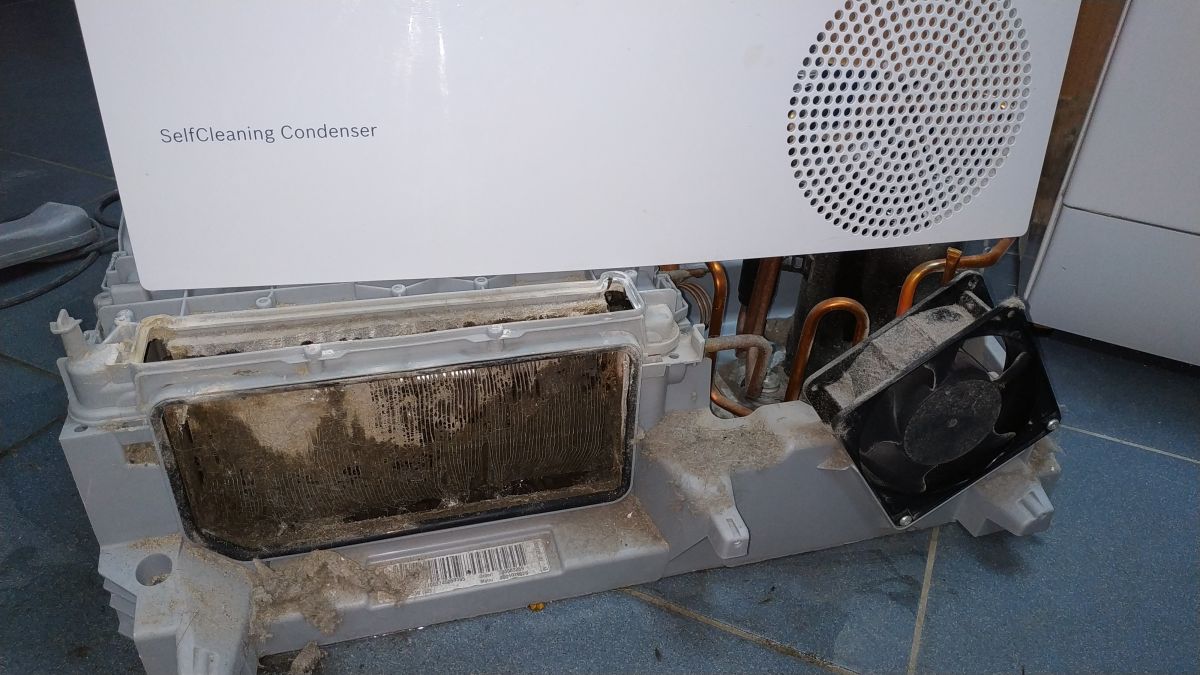
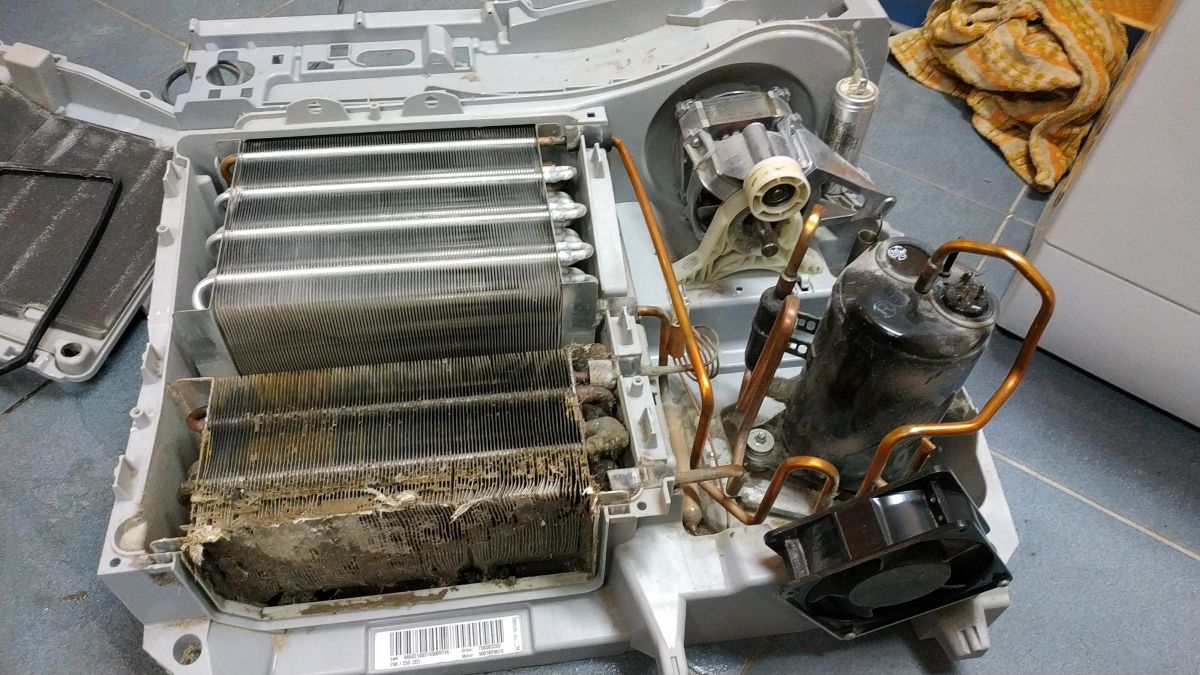
    Here is an example of the effectiveness of the exchanger flush. one of the many dryers with auto cloas or self clean systems after a certain period of operation.


    Dirty dryer heat exchanger and fan; “SelfCleaning Condenser” text on the panel

    Disassembled dryer unit with dirty heat exchanger, copper pipes, compressor, and fan inside a plastic housing
  • #1240 21843161
    Borutka
    Level 29  
    >>21843142
    One of many... let's not do beauty contests. I presented a specific solution which I happen to have and which I think works, and which a colleague obviously does not have to like.
  • #1241 21843481
    stasiekb100
    Level 30  
    @mrice I cleaned a colleague's once by taking it apart like this, the second time went with a pressure washer and it was done
  • #1242 21843704
    pacpaw
    Level 12  
    >>21843142

    What you are showing is not AutoClean.
  • ADVERTISEMENT
  • #1243 21846829
    mrice
    Moderator of Home appliances
    stasiekb100 wrote:
    the second taz went the pressure washer and the case was over


    This is not the way to go, once with a pressure washer you will not clean the other part of the exchanger or the drain channel properly.
    This technique is, unfortunately, patting the syph with powder.

    Borutka wrote:
    One of many.... let's not do beauty contests.

    It's not about competitions, it's about facts, how dryers with exchanger flush systems look like.
    I will not convince a colleague by force if he does not believe the photos.

    pacpaw wrote:
    What you show is not AutoClean.

    So outline the differences in construction and principle of self and auto.
  • #1244 21853824
    piokrza
    Level 27  
    Borutka wrote:
    piokrza wrote:
    It is a shame that Bosch has discontinued these dryers

    Presumably the new models (8 series) work similarly, as can be seen by the use of a filter in the condensate tank. The care programme in principle also works in the same way. However, it appears that for the user to clean there is only a small classic filter under the door, which basically forces emptying after each drying. For more access is not visible, unless access is from the back.
    In my opinion, the biggest advantage of this type of system is that the circulation of lint is through a layer of water and generally there is no contact between the dry lint and the exchanger so no cobweb forms. Also in the new models I don't expect a regression.


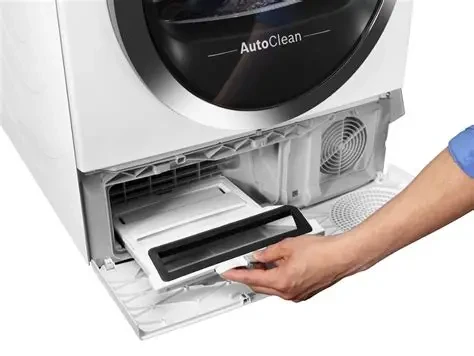
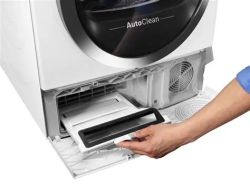
    I was referring to a system where there was no filter under the door, but it was in front of the exchanger. It was flushed with water and the lint went into a drawer under the exchanger. For some reason, this system was abandoned and we returned to the infamous previous solution, where the exchanger is flushed and not the filter in front of it. There is also a filter under the door.

    Listen, what dryer would you recommend today where the exchanger doesn't rust and doesn't get clogged with dust? I've seen videos on YouTube where dryers have been taken apart for cleaning and in the Samsung for example, the exchanger was rusty after a few years. I have a LG slim washer dryer for 6 years and it's lame because the heater system is useless. It shrinks and destroys clothes. LG dryers, on the other hand, are one of the more expensive ones as far as I can see and there is no access to the exchanger at all, not even through the flap. The whole front is built in, no door. There is only a self-cleaning system, questionable as in all such systems anyway.

    Added after 9 [minutes]:

    mrice wrote:
    pacpaw wrote:
    What you are showing is not AutoClean.

    So show the differences in the construction and principle of self and auto.


    You have shown a dryer with SelfClean, this is an older system, in fact Bosch still uses it.

    I think the AutoClean system was in one generation, which they quickly phased out. Supposedly due to a change in EU requirements for energy labels (although I don't know what the fart has to do with the windmill). Below is a photo.


    Bosch Condenser Tumble Dryer: Comparing WTW85460PL Heat Pump Model and Conventional Options
  • #1245 21854009
    puniek71
    Level 10  
    They withdrew because it worked and probably reduced sales of dryers
  • #1247 21872683
    yanes
    Level 33  
    From the instruction manual for the one in the first link , quotes "Connecting the hose that discharges air from the dryer
    The dryer allows three ways of draining the air: from the back, from the right and from the left. At the time of
    delivery, the opening at the rear is open and the connection fitting (1) is mounted on it.
    The side openings are covered with two
    plugs. The machine is supplied
    with air exhaust hose
    (3) and two clamps (2)
  • #1248 21872709
    piokrza
    Level 27  
    The EU has probably only allowed this to be marketed by 'Professional', after all the pump lobby wouldn't allow it.
  • #1249 21872728
    mrice
    Moderator of Home appliances
    The former is an extractor, the latter a condenser.
    I would no less dismiss ASKO. One, most service technicians when they hear the name will not even want to talk about coming here, two, today it is basically the same as HiSense, only many times more expensive.

Topic summary

✨ The discussion centers on choosing between Bosch condenser tumble dryers with and without heat pump technology, focusing on the Bosch WTW85460PL heat pump model and conventional condenser models like the WTB86201PL and WTG86400PL. Heat pump dryers offer lower energy consumption (approximately half) and gentler drying at lower temperatures (~55°C vs. 80°C), which reduces fabric damage. However, they have longer drying times, higher purchase and repair costs (notably expensive heat pump replacements), and require regular cleaning of densely finned heat exchangers that are difficult to access. Conventional condenser dryers are simpler, more reliable, easier and cheaper to maintain, and dry faster but consume more energy and generate more ambient heat, which can be beneficial in colder months. Energy consumption measurements show heat pump dryers use less electricity per drying cycle but the payback period depends on usage frequency and electricity costs. Users report mixed experiences with heat pump dryers regarding durability and maintenance complexity. The discussion also covers practical aspects such as placing dryers on washing machines using Bosch connectors, cleaning procedures for heat exchangers, and the impact of spin speed on drying efficiency. Other brands like Electrolux, AEG, Whirlpool, Hotpoint-Ariston, Candy, Gorenje, and Miele are mentioned, with some users sharing negative experiences with Electrolux heat pump models due to early failures. Overall, the consensus leans toward conventional Bosch condenser dryers for reliability and ease of maintenance, while heat pump models are favored for energy savings and fabric care if budget and maintenance are manageable.

FAQ

TL;DR: Heat-pump dryers use up to 54 % less electricity per cycle, yet “he strongly advised me against the heat pump dryer” due to repair costs [Elektroda, iwaszkop, post #14176503] Average 3 kWh saved yearly, but pumps may fail after 3 years (₱1850 repair). Why it matters: picking the right type balances energy bills against reliability.

Quick Facts

• Energy per cycle: 1.9–4.6 kWh (heat-pump vs heater) [Elektroda, flash12, post #14466912] • Repair bill for failed pump + compressor: ≈ PLN 1850 (+ service) [Elektroda, Czokid, post #15135750] • Typical runtime: 60 – 226 min depending on programme [Elektroda, flash12, post #14466912] • Filter cleaning: after every cycle; exchanger rinse monthly [Elektroda, baconp, post #17006377] • Safe stack load: ≈ 100 kg (washer + dryer) when connector kit fitted [Bosch Manual]

Which Bosch condenser model is most popular for stacking with a washer?

Owners of the 8 kg Bosch WTG86400 PL highlight simple lint access, 60 × 60 cm footprint and ≤ 1.2 kWh per mixed load when spun at 1000 rpm [Elektroda, baconp, post #17037823]

Do heat-pump dryers really pay back the higher purchase price?

At 2.12 kWh vs 4.61 kWh per cotton load, power savings are ≈ 54 % [Elektroda, flash12, post #14466912] With 260 cycles / year and PLN 0.55 kWh, payback on a PLN 650 price gap arrives after ≈ 4 years. A pump failure before then wipes out the gain.

Can I run washer and dryer on one 16 A circuit?

Yes if the dryer draws ≤ 3 kW and the washer heater is off. Users stagger start times or wash cold; combined load stays < 3.7 kW (socket limit) [Elektroda, my41s, post #17373776]

Is a 2 × 2 m bathroom big enough for a heater dryer?

No. Owners report sauna-like heat in 3 × 3 m rooms [Elektroda, baconp, post #17006377] In small, closed spaces choose a heat-pump model or add forced ventilation.

How do I deep-clean a Bosch ‘SelfCleaning’ condenser?

  1. Open front grille; cut the marked service hatch. 2. Tilt machine 10 ° left; insert garden hose behind pump. 3. Flush until clear water exits [Elektroda, yanes, post #16850165] Perform yearly or if cycles lengthen.

Will a dryer shrink printed T-shirts?

High-heat cotton cycles can shrink up to one size. Run ‘Synthetics/Gentle’ ≤ 55 °C or air-fluff; no reported damage to House/Cropp tees when settings followed [Elektroda, SolariS099, post #17204684]

What statistic shows real-world energy use?

February meter log: 14.7 kWh for 10 h runtime (≈ PLN 10) on a B-class heater dryer serving three people [Elektroda, baconp, post #17068373]

Edge-case: how quickly can a pump dryer die?

Two Electrolux EDH97981W units failed in < 3 years; each needed PLN 1850 compressors and were scrapped [Elektroda, Czokid, #15135750; MG MARCIN, #15157976].

How do I set Whirlpool conductivity levels?

Press and hold ‘Programming’ until the settings icon blinks, turn knob to 1–5 (1 = damp, 5 = very dry), press knob to save [Whirlpool Manual; Elektrolux, SolariS099, #17207496].

Are exhaust-air dryers still sold?

Indesit IDV 75 EU remains the only widely stocked vented model; users vent it to a 10-storey block shaft without moisture issues [Elektroda, marecki_78, post #16821967]
ADVERTISEMENT