


From the electronics archive - how the analog system for imaging the Earth's surface from orbit worked,
and how were data packets switched without internet?
Photographs of the Earth from orbit in 1959.
Nowadays, everyone can view satellite images of the Earth using a computer connected to the Internet and a web browser.
In 1959. on-demand satellite imagery was reserved for military use. The American Corona satellite program allowed for taking pictures of the Earth from orbit around the Earth in the years 1959-1972.
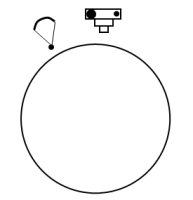
Corona spy satellites had analogue cameras installed on board, as well as a film advance and winding system. Trials were performed with black and white, color and infrared sensitive plates. One, two or even three camera lenses were installed on board, it was possible to obtain stereoscopic photos. The mechanism allowed for taking photos and rolling the film in the tray. The tray was thrown back and fell to the surface of the Earth. The trays automatically opened the parachute, the falling capsules could be intercepted in flight by the passing plane. Capsules could drift on the sea surface, but if not retrieved within two days, the salt plug dissolved, allowing the capsule to sink.
Depending on the lens, you could get surprisingly good 1.8-7.5m detail or wide-angle pictures with a "resolution" of 140m.
Interestingly, in the Corona project satellites, there was a problem with electrostatic charges, which in the form of corona discharges exposed the film, worsening the quality of the photos.
An alternative idea to the Corona program was SAMOS (1960), the project assumed the execution, development, scanning of photos inside the satellite, and then sending the scan via radio to Earth.
The Soviet counterpart were satellites Zenith (1961).
The Zenit satellites, similarly to the Corona, ejected containers with a film and a camera (here the difference compared to Corona), which fell on a parachute. The containers were equipped with a radio transmitter that facilitated finding the load. The Zenit satellites were supplemented by the Soviet Yantar spy satellites, which could stay in orbit much longer.
There were times when analog technology competed with digital technology in the field of photography. In the following years, CCDs with good quality lenses (often mirror lenses) and radio transmission of the photos taken were used.
Orbital switch with encryption.
Strzała is the name of a system of Soviet telecommunications satellites (1970) operating in store and forward mode.
The Strzała series satellites received messages from various sources (intelligence agents, military units) at the time of their flight over the sender. The received message was saved in the satellite's memory. When the satellite was flying over Moscow, for example, it sent saved messages.
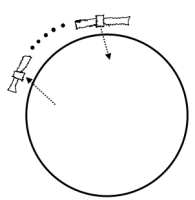
SeriesArrow satellites usually operated at low frequencies (150-400MHz) and low orbits (LEO). Later versions had the ability to encrypt the transmission, the on-board memory capacity (12Mbit) increased over time, the required transmission speeds were not high (e.g. 2.4-64kb / s), power supplied from solar panels depending on the version 8-150W + storage batteries energy.
In 2009, one of the satellites of the Arrow constellation collided with the Iridium 33 telecommunications satellite, which is part of a system providing satellite telephone services with global coverage.
Technologies that were once reserved for military applications can now be used on a daily basis, for example using Google Earth maps or sending encrypted e-mails from continent to continent ...
Sources:
http://en.wikipedia.org/wiki/Corona_(satellite)
http://www.kosmonauta.net/2012/09/corona-program/
http://pl.wikipedia.org/wiki/Strzała_(satelita)
http://en.wikipedia.org/wiki/Samos_(satellite)
http://en.wikipedia.org/wiki/Zenit_(satellite)
http://en.wikipedia.org/wiki/Yantar_(satellite)
http://pl.wikipedia.org/wiki/Strzała_(satelita)
http://en.wikipedia.org/wiki/Strela_(satellite)
and how were data packets switched without internet?
Photographs of the Earth from orbit in 1959.
Nowadays, everyone can view satellite images of the Earth using a computer connected to the Internet and a web browser.
In 1959. on-demand satellite imagery was reserved for military use. The American Corona satellite program allowed for taking pictures of the Earth from orbit around the Earth in the years 1959-1972.
Corona spy satellites had analogue cameras installed on board, as well as a film advance and winding system. Trials were performed with black and white, color and infrared sensitive plates. One, two or even three camera lenses were installed on board, it was possible to obtain stereoscopic photos. The mechanism allowed for taking photos and rolling the film in the tray. The tray was thrown back and fell to the surface of the Earth. The trays automatically opened the parachute, the falling capsules could be intercepted in flight by the passing plane. Capsules could drift on the sea surface, but if not retrieved within two days, the salt plug dissolved, allowing the capsule to sink.
Depending on the lens, you could get surprisingly good 1.8-7.5m detail or wide-angle pictures with a "resolution" of 140m.
Interestingly, in the Corona project satellites, there was a problem with electrostatic charges, which in the form of corona discharges exposed the film, worsening the quality of the photos.
An alternative idea to the Corona program was SAMOS (1960), the project assumed the execution, development, scanning of photos inside the satellite, and then sending the scan via radio to Earth.
The Soviet counterpart were satellites Zenith (1961).
The Zenit satellites, similarly to the Corona, ejected containers with a film and a camera (here the difference compared to Corona), which fell on a parachute. The containers were equipped with a radio transmitter that facilitated finding the load. The Zenit satellites were supplemented by the Soviet Yantar spy satellites, which could stay in orbit much longer.
There were times when analog technology competed with digital technology in the field of photography. In the following years, CCDs with good quality lenses (often mirror lenses) and radio transmission of the photos taken were used.
Orbital switch with encryption.
Strzała is the name of a system of Soviet telecommunications satellites (1970) operating in store and forward mode.
The Strzała series satellites received messages from various sources (intelligence agents, military units) at the time of their flight over the sender. The received message was saved in the satellite's memory. When the satellite was flying over Moscow, for example, it sent saved messages.
SeriesArrow satellites usually operated at low frequencies (150-400MHz) and low orbits (LEO). Later versions had the ability to encrypt the transmission, the on-board memory capacity (12Mbit) increased over time, the required transmission speeds were not high (e.g. 2.4-64kb / s), power supplied from solar panels depending on the version 8-150W + storage batteries energy.
In 2009, one of the satellites of the Arrow constellation collided with the Iridium 33 telecommunications satellite, which is part of a system providing satellite telephone services with global coverage.
Technologies that were once reserved for military applications can now be used on a daily basis, for example using Google Earth maps or sending encrypted e-mails from continent to continent ...
Sources:
http://en.wikipedia.org/wiki/Corona_(satellite)
http://www.kosmonauta.net/2012/09/corona-program/
http://pl.wikipedia.org/wiki/Strzała_(satelita)
http://en.wikipedia.org/wiki/Samos_(satellite)
http://en.wikipedia.org/wiki/Zenit_(satellite)
http://en.wikipedia.org/wiki/Yantar_(satellite)
http://pl.wikipedia.org/wiki/Strzała_(satelita)
http://en.wikipedia.org/wiki/Strela_(satellite)
Cool? Ranking DIY