logo elektroda
logo elektroda
X
logo elektroda

Micro limit switch motor compatibility.

jammmo 4017 17
ADVERTISEMENT
Treść została przetłumaczona polish » english Zobacz oryginalną wersję tematu
  • #1 15792112
    jammmo
    Level 15  
    hello, I have a dilemma with the selection of a limit switch to work with a 12V/DC motor , but powered by about 24V/DC and the current consumption of the motor is about 4-6A.

    These switches will be plugged in series under the motor cables and will operate on the principle of constant current flow through them (contacts ).I have found such small ones with a current rating of 10A at 250V/AC.
    https://www.conrad.pl/Mikro-prze%C5%82%C4%85c...lowy-1-szt..htm?websale8=conrad&pi=704778
    As I am not an electronics engineer, I would like to ask whether, by applying 24V/DC to these switches, they can withstand a constant current flow during motor operation (max. 60s during 1 cycle) of 6A.
  • ADVERTISEMENT
  • #2 15792174
    kindlar
    Level 42  
    Would it not be better to connect the limiters in series and power the motor from a relay controlled by the limiters' circuit?
  • #3 15792245
    jammmo
    Level 15  
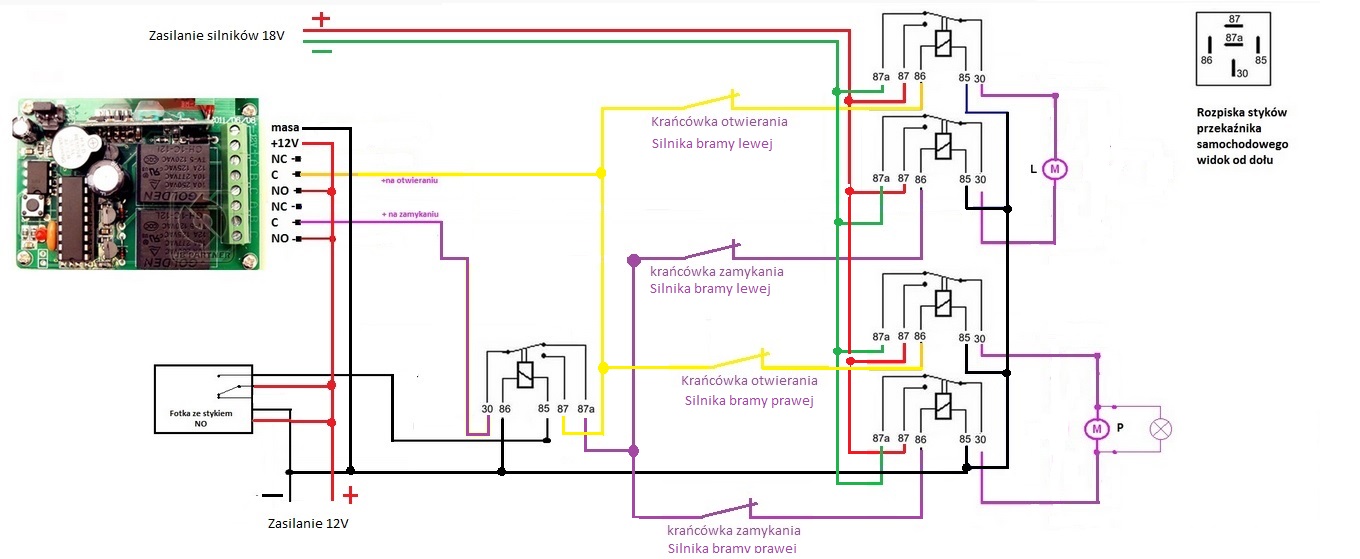
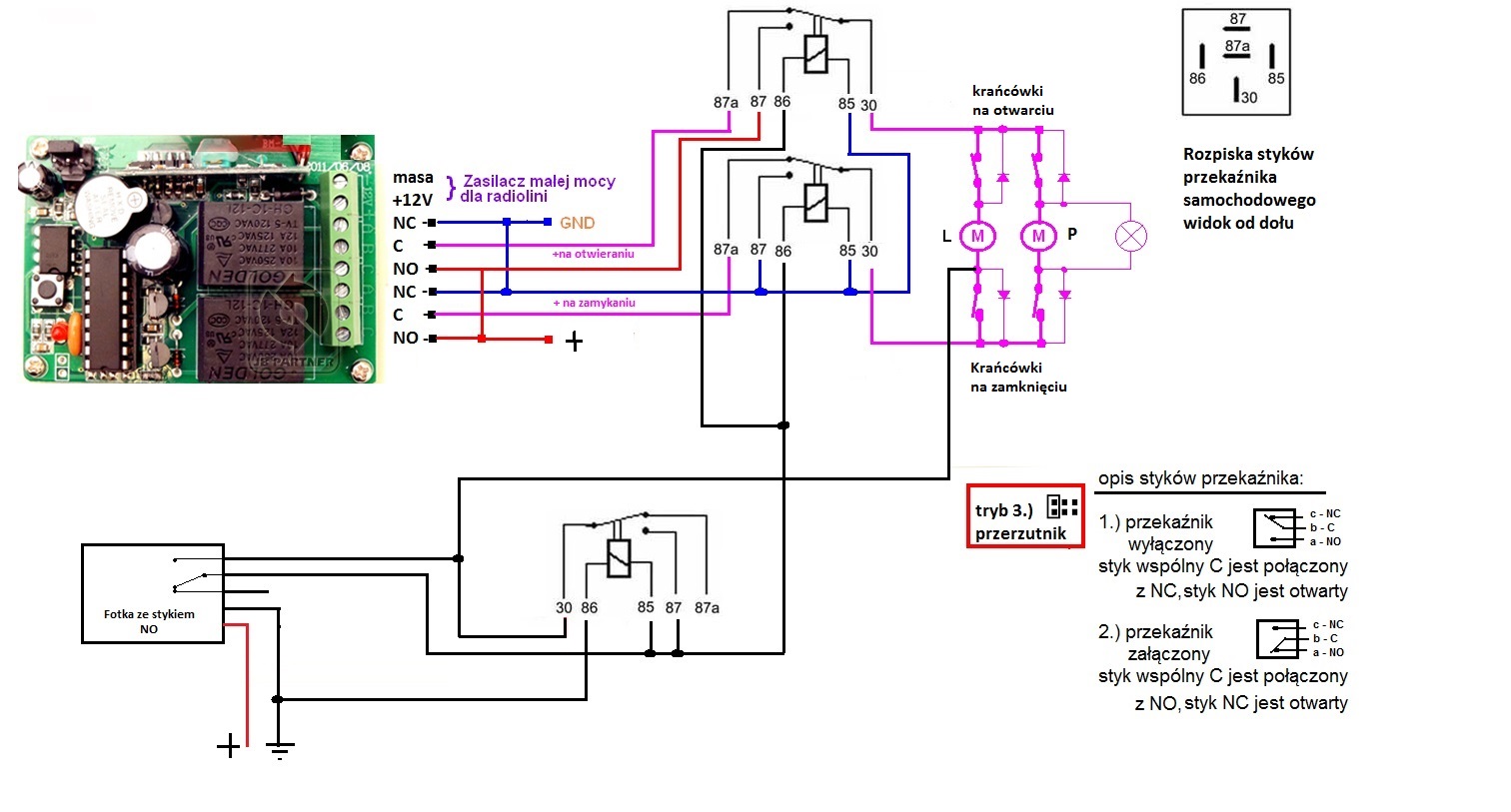
    I don't know much about it kindlar,. I have a diagram, made by a colleague from the forum, of a control system for a double-leaf gate, where relays and a two-channel radio system are used (I could not use the original control panel, although I have bought one, due to quite high current consumption by the motors and their frequent switching off due to overload). The motors will be connected to the relays via limit switches, and here my colleague pointed out to me that they must be of good quality, because they will not operate on the signal principle, but the same current will be flowing through them as through the motor, i.e. about 4-6A.
    Previously, I had prepared limiters, which were connected to the control panel, so there was no such current on them, whereas here there is a different solution and I do not really know how these currents of 10A, as specified in the description, relate to the application of direct current on limiters, in the description AC current of 250V/AC is specified in the parameters
    I am thinking of installing them in an actuator and that is why I am looking for ones with IP at least 40, only whether applying direct current to them does not reduce their amperage output.
  • #4 15792480
    hasfar_antabolis
    Level 12  
    And as kindlar wrote to you - put the limiters in series in the power supply circuit of the relay coils.
    If the limit switch cuts off the power supply to the relay, the motor won't get any current either, and the currents in the relay coil circuit are much smaller.
  • #5 15793115
    jammmo
    Level 15  
    And maybe one of my colleagues can take a look at this diagram and try to draw me how it should be with these limiters , because unfortunately I can't change it myself as I'm not an electronics engineer. Micro limit switch motor compatibility.
  • ADVERTISEMENT
  • #6 15793469
    mawerix123
    Level 39  
    This is a schematic of the circuit you are about to use :?:

    jammmo wrote:
    it is to work with a 12V/DC motor , but powered by about 24V/DC


    You want to supply the 12V motor with 24V :?: o_O
  • #7 15793846
    jammmo
    Level 15  
    Yes, such a diagram was drawn for me by a fellow forum member, and I am thinking of creating one in real life.y . As for the voltage it is as you write. The actuators are made on 12v motors from the windshield wipers of an opel corsa B car. Unfortunately given a 12V supply the gate opens almost 45s. I have the trafo unwound to 21V/AC and the voltage measured in the control panel at the output to the actuators during operation is 18-19V/DC and the gate opens 19-20s.
    Unfortunately the motors draw quite a large current from 4-6A , therefore the overload thresholds in the control panel have to be set to max. Despite these settings the gate after starting quite often stops and returns to its original position and therefore the current drawn by the motor makes it impossible for these actuators to work with the original control panel .
    I will use the original control unit for the second gate, for which I am making actuators with 18V motors from a screwdriver with a gearbox. However , for the control of the gate on these actuators , I asked colleagues on the forum to create a simple scheme from radio and relays . The only problem I have is that I do not know what limit switches to use so that they are relatively small and can withstand a current flow of about 6A, so please help, greetings.
  • #8 15795021
    mawerix123
    Level 39  
    Something like this:

    Micro limit switch motor compatibility.
  • ADVERTISEMENT
  • #9 15795097
    pafciowaw
    Automation specialist
    It can't be done that way - the "M" (motors) must have separate stops - after all, they are independent (in time) of opening or closing.
  • #10 15795175
    mawerix123
    Level 39  
    pafciowaw wrote:
    This is not possible - the "M" (motors) must have separable ends - after all, they are independent (in time) of opening or closing.


    U lala alle gafa ;) right observation.... There was also an error in the photocell control.... when opening, tripping the photocell caused automatic closing.
    I have corrected the whole thing.
  • #11 15795371
    jammmo
    Level 15  
    Thanks a lot for the diagram mate mawerix123 . Although I'm not an electronics technician , the diagram is so clear that I can easily put it together . I understand, of course, that this schematic, which is posted above, is already after corrections yes?
    I also have a question about the relays.
    1 - Doesn't this 18V current fed to the relays according to the diagram have to be DC, I have a toroidal transformer, and from the toroidal transformer comes AC current and I would have to use some kind of rectifying circuit, unless I am mistaken.
    2 - These 4 pieces of relays that go to the motor must be with a 24V coil , because they will be powered by 18-24V/DC and with a current of 10A .
    3 - Is the relay at the bottom for the photocell hold also to be on 24V ?
    And what amperage should I buy it for, as I suspect it doesn't need as many amps as the ones for the motors?
    4 - Now, as far as these limit switches are concerned, they don't have to be resistant to such high currents? with what contact load can I buy them now , is 3 amps enough?
  • #12 15795490
    mawerix123
    Level 39  
    jammmo wrote:
    scheme what is posted above , is already after corrections yes ?


    Yes.

    jammmo wrote:
    1 - Doesn't this 18V current fed to the relays according to the schematic have to be DC already


    As in the attached schematic the power supply has a + and - a which means DC power supply ;)

    jammmo wrote:
    There is AC current coming out of the toroidal transformer and you would probably need some sort of rectifier circuit , unless I am mistaken.


    You are not wrong.

    jammmo wrote:
    These 4 pcs of relays that go to the motor must be with a 24V coil , because they will be powered by 18-24V/DC and with a current of 10A .


    They do not need to be 24V. The coils of these four relays can be 12 or 24V, they do not need to be powered from a high power supply designed to power the drive motors. In the image provided, the control circuits are 12V DC.

    jammmo wrote:
    3 - Is that relay at the bottom for the photocell hold down also supposed to be 24V?


    NO, in the bottom left hand corner of the picture you have posted you have a description of the 12V supply needed to power the coils of all the relays, the photocell and the radio controller if you apply increased voltage to this circuit you may damage any of the components.

    jammmo wrote:
    And what amperage to buy it for, as I suspect it doesn't need as many amps as those for the motors?


    Any current flowing through it will be small.

    jammmo wrote:
    4 - As for these limiters , now they do not have to be resistant to such high currents? with what contact rating can I now buy them , is 3 A sufficient


    Similarly to the photocell relay, the limit switches will only be loaded by the coil current of the relay, even a 1A contact is sufficient, the more important determinant will probably be weather resistance if it is a gate on the property border.
  • ADVERTISEMENT
  • #13 15795654
    jammmo
    Level 15  
    Yes , it's a gateway in from the property , but I try to make the whole actuators and box hermetically sealed.As for the choice of limiters , the ones I have shown are IP 67 rated .
    I have seen that for the power supply of the photocell and radio you have a 12V/DC given in the diagram . As for your question about these relays , I only now read from the schematic , that this 18V supply is only given to the motors .
    I am also considering another option .
    As I have a fairly powerful 21V/AC 420VA transformer, I thought I could power everything from it, i.e. the motors, photocells and radio beacons.
    These radio links from the post come in two versions, namely 12V as well as a 24V version.
    As I already have a 21V/AC trafo, I was thinking of buying a 24V radio link and then I would also buy all the relays for 24V. As for the photocells , I have two sets which can be powered by 12-24V AC/DC, so universal. All I need is some kind of rectifier circuit for the traf and I wouldn't need to buy a separate power supply for 12V .
    How do you see it.
    Mawerix123 , don't you have some schematic for this circuit to rectify the current, I would be grateful if you could advise me to draw something, regards.
  • #14 15795675
    mawerix123
    Level 39  
    It starts to get confusing 12 -18 -24 volts if you have the option then by all means use all the components for 24 volts the fewer different voltages the better.

    jammmo wrote:
    Mawerix123 , don't you have some schematic for this circuit for current rectification, I would be grateful if you could advise me to draw something,


    I have a bunch : https://www.google.pl/search?q=uk%C5%82ad+gra...b&gfe_rd=cr&ei=-QiAV-i2BMmv8wezvYC4CA
  • #15 15795686
    jammmo
    Level 15  
    Ha, ha, sorry don't be angry, but to me you have to speak peasant's language.
    I know that there are such simple schematics, but you need to know what kind of diodes to use and what power, moreover, I don't distinguish all the symbols on the schematics, and sometimes I don't know whether there should be, for example, a diode or a resistor in the schematic, and so on. For an electronics technician this is, as they say, a piece of cake, but for a layman like me it is sometimes black magic :)
  • #16 15796256
    jammmo
    Level 15  
    Mawerix123, I showed this diagram you drew here to a colleague and he said that it is well drawn, only there is a small drawback:
    - the photocells do not have a hold - i.e. if you cover the photocell when closing the leaves - the gate will start to open , but if you uncover it again - it will immediately start to close again - and that's a bit off.
    Normally, the door should either stand still or start to open - until the limiters are tripped or the next command from the remote control.
    How does this diagram actually work?
  • #17 15796281
    mawerix123
    Level 39  
    jammmo wrote:
    - the snapshots have no hold - i.e. if you cover the snapshots on closing - the gate will start to open but if you uncover them - it will start to close again immediately - and that's a bit off.
    Normally the gate should either stand still or start to open - until the next command from the remote control.
    How does this actually work?


    Unfortunately the circuit is on relays and your radio controller doesn't have a limit option which would make things very simple, I made a diagram from what you yourself suggested.

    I have made a schematic of what you suggested. I used to install a gate controller in a bus which was supposed to open the doors

    You could use one like this, get rid of one relay and the photocell problem.

    https://www.google.pl/search?q=eLB7H&ie=u...b&gfe_rd=cr&ei=WryAV8LILMmv8wezvYC4CA
  • #18 15796317
    jammmo
    Level 15  
    Thanks for the information, and as for the radio link for which you drew the diagram, I do not have it yet. All the accessories, i.e. radio link, relays, limit switches needed to make this circuit according to the diagram, I will only buy. For now, I want to get the best and reasonably inexpensive schematic that would provide adequate control and most functions.
    This example controller was used because of its price. As far as I know, the purchase of such a controller from Eldrim is associated with a rather high price, because for it you need to buy separately remote controls at about 45PLN each. In such cases, it would sometimes be more cost-effective for me to replace the motors with ones with lower power consumption, e.g. from screwdrivers, and use the original control panel for double-leaf gates which I currently own. I paid 300 PLN for such a control panel RSB-2S with remote controls and I suspect that the controller from the link + remote controls will not come out much cheaper.
ADVERTISEMENT